
3D Printers Market Overview
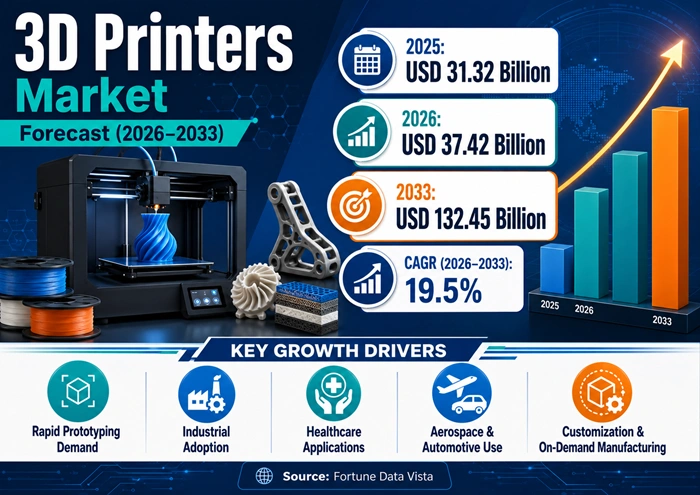
The global 3D printers market size is valued at USD 31.32 billion in 2025 and is predicted to increase from USD 37.42 billion in 2026 to approximately USD 132.45 billion by 2033, growing at a CAGR of 19.5% from 2026 to 2033.
Additive manufacturing — commonly known as 3D printing — has moved well beyond prototyping labs and design studios to become a genuine production technology reshaping how industries from aerospace and automotive to healthcare and construction design, make, and deliver products. The 3D printers market is expanding at an exceptional pace as falling hardware costs, broader material availability, and workflow software improvements make industrial and desktop 3D printing accessible to a dramatically wider range of organizations globally. With governments, large manufacturers, hospitals, and educational institutions all increasing their additive manufacturing investments, the market is entering a period of accelerating growth that is expected to sustain high double-digit expansion through 2033.
AI Impact on the 3D Printers Industry
Artificial Intelligence Is Revolutionizing Every Dimension of Additive Manufacturing — from Design Optimization and Print Parameter Control to Quality Assurance and Autonomous Process Management
Artificial intelligence is having a transformative effect on the 3D printers industry, enabling a new generation of intelligent additive manufacturing systems that can self-optimize, self-monitor, and self-correct throughout the printing process. AI-powered generative design tools — integrated with CAD platforms from Autodesk, PTC, and Siemens — allow engineers to specify functional requirements and constraints and receive optimized part geometries in minutes that would take months to develop through conventional design iteration. These AI-generated geometries are typically impossible to manufacture using traditional subtractive methods but are ideally suited for additive manufacturing, creating a powerful and growing synergy between AI-driven design and 3D printing production that is accelerating adoption across aerospace, automotive, and medical device engineering teams globally.
On the manufacturing floor, AI and machine learning are enabling closed-loop process control in industrial 3D printers that dramatically improves part quality consistency and reduces scrap rates in critical manufacturing applications. Computer vision systems integrated with metal powder bed fusion and polymer FDM printers monitor layer-by-layer deposition in real time, detecting porosity, delamination, warping, and other defects as they form and triggering immediate process parameter adjustments before defects propagate through the part. This capability is particularly valuable in aerospace and medical device manufacturing, where material certification requirements demand documented, repeatable part quality that manual process management cannot reliably guarantee. The integration of AI-driven process intelligence into industrial 3D printing hardware is becoming a key product differentiation factor in the 3D printers market, driving premium pricing and competitive separation for vendors like EOS, 3D Systems, and Stratasys who invest in intelligent manufacturing software as a platform capability.
Growth Factors
Accelerating Adoption of Additive Manufacturing in Serial Production, Rapid Healthcare and Bioprinting Expansion, and the Growing Accessibility of Industrial 3D Printing Technology Are Driving Exceptional Market Growth
The transition of 3D printing from a prototyping tool to a genuine serial production technology is the most significant structural growth driver in the 3D printers market today. For decades, additive manufacturing's role was largely confined to design validation models and one-off custom parts — applications where its speed and design freedom advantages clearly justified its cost premium over injection molding or CNC machining. That calculus has changed dramatically as hardware speeds increase, material portfolios expand, and per-part economics improve to the point where additive manufacturing is genuinely cost-competitive with traditional methods for small-to-medium production runs of complex, high-value components. Aerospace companies including Boeing, Airbus, and Safran are now 3D printing certified flight-critical metal components in series production. Automotive manufacturers including BMW, Ford, and Volkswagen are producing end-use plastic and metal parts in series volumes. This shift from prototyping to production is expanding the total addressable market for industrial 3D printing by an order of magnitude.
The healthcare sector's adoption of additive manufacturing is growing exceptionally fast, driven by the unique value proposition that 3D printing offers for patient-specific customization that is impossible to deliver through any other manufacturing method at comparable cost and speed. Custom surgical implants, patient-matched orthotic and prosthetic devices, dental crowns and bridges, surgical planning models, and drug delivery devices are all being manufactured using 3D printing at rapidly growing volumes. Bioprinting — the 3D printing of living tissues using bio-ink materials containing living cells — is advancing from university laboratories toward clinical application, with companies including Organovo, CELLINK (BICO Group), and Allevi developing bioprinting platforms for tissue engineering, drug testing, and ultimately transplantable organ fabrication. This convergence of additive manufacturing technology with life sciences is creating a new and extraordinarily high-value application vertical that is progressively expanding the 3D printers market's total commercial opportunity.
Market Outlook
The 3D Printers Market Is Entering Its Highest-Growth Decade — Driven by Production-Scale Adoption, Industry 4.0 Integration, and the Emergence of Transformative New Applications in Healthcare, Construction, and Defense
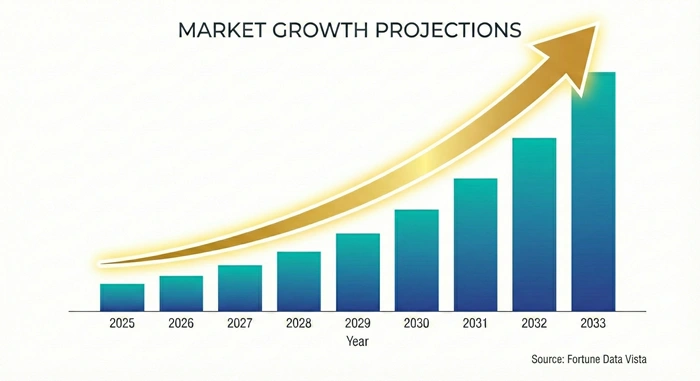
The medium-to-long-term market outlook for the 3D printers industry is exceptionally strong, supported by a convergence of technology maturation, cost trajectory improvements, regulatory acceptance of additive manufactured parts, and genuine production-scale adoption across multiple large industrial sectors. The global industrial base is entering a period of accelerated digitalization and manufacturing flexibility investment — trends that directly favor additive manufacturing over conventional fixed-tooling production methods that lack the geometric complexity capability, customization potential, and supply chain independence advantages that modern 3D printing platforms offer. As the performance gap between additive and subtractive manufacturing continues to close for a growing range of materials and part geometries, the economics argument for 3D printing in serial production will strengthen progressively through 2033.
Looking toward 2033, the most transformative developments in the 3D printers market will include the mainstream commercialization of large-format metal additive manufacturing for aerospace and defense structural components, the clinical deployment of bioprinted tissues and organs in healthcare settings, and the construction sector's adoption of concrete 3D printing for low-cost housing and complex architectural fabrication. Each of these emerging applications represents a potential multi-billion-dollar market segment that barely existed five years ago, and their successful commercialization is not speculative — it is actively occurring, with companies including ICON (construction printing), Relativity Space (rocket manufacturing), and BICO Group (bioprinting) already generating commercial revenue from platforms that demonstrate the breadth of the 3D printing revolution well beyond conventional manufacturing applications.
Expert Speaks
-
"3D Systems is at the center of what I believe is a fundamental manufacturing paradigm shift — from mass production of standard parts to mass customization of optimal parts. The combination of our hardware platforms, materials science capabilities, and application-specific software is enabling our customers across healthcare, aerospace, and automotive to produce parts that are lighter, stronger, and more customized than anything achievable through conventional manufacturing — and the pace of customer adoption continues to accelerate as our technology matures." — Jeffrey Graves, President & CEO, 3D Systems Corporation
-
"At Boeing, additive manufacturing has moved from a promising experiment to an essential production technology. We are 3D printing hundreds of distinct part numbers across our commercial and defense aircraft programs, and the productivity, weight, and supply chain resilience benefits we are realizing are significant. Our investment in qualifying new additive manufacturing processes and materials is growing every year because the strategic value of printing parts on demand, close to where they are needed, is clear." — Kelly Ortberg, President & CEO, Boeing Company
-
"Stratasys has always believed that 3D printing would eventually transform manufacturing — and we are living through that transformation right now. The shift from prototyping to production is real, it is accelerating, and the customers driving it are the world's most sophisticated manufacturers across automotive, aerospace, and healthcare. Our investments in multi-material printing, production-grade polymer systems, and the integration of AI-driven process control into our platforms are positioning Stratasys to capture the full value of this manufacturing revolution." — Yoav Zeif, CEO, Stratasys Ltd.
Key Report Takeaways
-
North America dominates the global 3D printers market, holding the largest regional revenue share of approximately 35% in 2025, underpinned by the United States' world-leading additive manufacturing R&D ecosystem, the highest concentration of industrial 3D printing adopters in aerospace, defense, and medical device manufacturing, strong government investment in advanced manufacturing programs, and the dominant commercial presence of 3D Systems, Stratasys, Desktop Metal, and Markforged.
-
Asia Pacific is the fastest growing regional market, with China, Japan, South Korea, India, and Australia collectively driving exceptional double-digit demand growth through large-scale manufacturing automation investment, government-backed additive manufacturing development programs, rapidly expanding electronics and automotive sector adoption, and the progressive build-out of Asia Pacific's domestic 3D printer hardware manufacturing ecosystem to reduce dependence on imported Western and Japanese systems.
-
The aerospace and defense sector is the highest-value end-user segment in the 3D printers market, contributing over 24% of total industrial 3D printer revenue in 2025 as the sector's combination of high part complexity, low production volumes, extreme performance requirements, and premium part pricing creates the most favorable economic environment for additive manufacturing adoption among all major industry verticals.
-
Industrial 3D printers represent the dominant product category, accounting for approximately 72% of total market revenue in 2025 as large manufacturing organizations invest in production-grade metal and polymer additive manufacturing platforms — including powder bed fusion, binder jetting, and multi-jet fusion systems — that are capable of producing certified end-use parts at the quality and throughput levels required by aerospace, automotive, and medical device manufacturing programs.
-
Fused deposition modeling (FDM) remains the most widely deployed 3D printing technology by installed unit count, driven by its combination of low hardware cost, broad material compatibility, and proven performance across prototyping, tooling, and functional part applications — making it the dominant technology choice for desktop and entry-level industrial printer deployments across education, manufacturing, and product development environments worldwide.
-
Metal 3D printing is the fastest growing material segment, projected to achieve a market share exceeding 28% by 2033 and grow at a CAGR of approximately 23.4%, driven by the qualification and serial production deployment of metal additive manufactured parts in aircraft engines, satellite structures, surgical implants, and defense systems — applications where the combination of weight reduction, geometric freedom, and supply chain independence that metal 3D printing enables directly translates into measurable mission-critical performance and cost advantages.
Market Scope
| Parameter | Details |
|---|---|
| Market Size by 2033 | USD 132.45 Billion | Market Size by 2026 | USD 37.42 Billion | Market Size by 2025 | USD 31.32 Billion | Market Growth Rate from 2026 to 2033 | CAGR of 19.5% | Dominating Region | North America | Fastest Growing Region | Asia Pacific | Segments Covered | Technology, Component, Printer Type, Material, Application, End User | Regions Covered | North America, Europe, Asia Pacific, Latin America, Middle East & Africa |
Market Dynamics
Drivers Impact Analysis
The Convergence of Falling Hardware Costs, Expanding Material Portfolios, and Large-Scale Industrial Production Adoption Is Creating an Exceptionally Powerful and Broad-Based Growth Environment for the 3D Printers Market
| Driver | ≈ % Impact on CAGR Forecast | Geographic Relevance | Impact Timeline |
|---|---|---|---|
| Transition from prototyping to serial production in aerospace and automotive | ~34% | North America, Europe, Asia Pacific | Short to Long Term |
| Healthcare and medical device additive manufacturing adoption | ~28% | Global — especially North America, Europe | Short to Long Term |
| Declining 3D printer hardware costs and expanding material availability | ~22% | Global — especially emerging markets | Short to Medium Term |
| Government investment in advanced manufacturing and Industry 4.0 programs | ~16% | North America, Europe, Asia Pacific | Medium to Long Term |
The economic argument for investing in additive manufacturing for serial production has strengthened dramatically over the past five years as industrial 3D printing hardware prices have fallen, machine build rates have improved, and the qualification and certification of additive manufactured parts in aerospace, medical device, and automotive manufacturing has become more streamlined and well-understood. The unit economics of complex, low-volume production runs now favor 3D printing over conventional tooling-based manufacturing in a rapidly growing range of part geometries and material combinations, creating a genuine production cost case that is driving procurement decisions at tier-1 aerospace suppliers, automotive OEM manufacturing engineering teams, and medical device companies at an accelerating pace.
Government investment in additive manufacturing research, qualification, and industrial deployment is amplifying private sector adoption by reducing the technology risk and regulatory uncertainty that have historically slowed manufacturing certification of 3D printed parts. The U.S. Department of Defense's America Makes program, the EU's Digital Manufacturing initiative under Horizon Europe, and China's national advanced manufacturing policy programs are collectively mobilizing billions of dollars in additive manufacturing research, infrastructure, and supply chain development investment that directly accelerates the maturation and commercial availability of 3D printing technologies across their most strategically important manufacturing sectors.
Restraints Impact Analysis
High Capital Investment Requirements, Material Certification Complexity, and Skilled Workforce Shortages Are the Primary Factors Limiting Even Faster Adoption Across the 3D Printers Market
| Restraint | ≈ % Impact on CAGR Forecast | Geographic Relevance | Impact Timeline |
|---|---|---|---|
| High upfront capital cost of industrial 3D printer systems | ~36% | SMEs and organizations in emerging markets | Short to Medium Term |
| Complexity and time requirements for material and process certification | ~34% | Aerospace, defense, medical device sectors globally | Medium Term |
| Skilled additive manufacturing workforce shortage | ~30% | All regions — especially developing markets | Short to Medium Term |
Industrial-grade metal and polymer 3D printing systems command price points ranging from hundreds of thousands to millions of dollars per machine, creating a significant capital expenditure barrier that limits adoption among small and medium-sized manufacturers who cannot justify the investment without a clear, quantified production application that delivers sufficient ROI to support the business case. This capital intensity is compounded by the need for post-processing equipment — including depowdering stations, sintering furnaces, heat treatment systems, and CNC finishing machines — that adds further infrastructure cost to metal additive manufacturing deployments. While desktop and entry-level industrial 3D printer prices have fallen dramatically, the production-grade systems that deliver the part quality and throughput required for genuine serial manufacturing applications remain expensive enough to constitute a real barrier for broader SME adoption across the 3D printers market.
The certification and qualification of 3D printed materials and processes for safety-critical applications in aerospace, defense, and medical device manufacturing represents a time-consuming and resource-intensive regulatory pathway that acts as a meaningful restraint on the rate at which additive manufacturing displaces conventional manufacturing across these high-value sectors. Aviation regulatory bodies including the FAA and EASA, and medical device regulators including the FDA, require extensive material characterization, process validation, and quality management system documentation for additive manufactured parts used in safety-critical applications — processes that can take two to five years to complete for new material-machine-process combinations. This certification cycle length limits the pace at which new 3D printing technologies and materials can be deployed in regulated manufacturing environments, regardless of their demonstrated technical performance advantages over incumbent manufacturing methods.
Opportunities Impact Analysis
Bioprinting and Organ Manufacturing Commercialization, Large-Format Construction 3D Printing, and On-Demand Distributed Manufacturing Are the Three Most Transformative Commercial Opportunities in the 3D Printers Market
| Opportunity | ≈ % Impact on CAGR Forecast | Geographic Relevance | Impact Timeline |
|---|---|---|---|
| Bioprinting for tissue engineering and medical device manufacturing | ~38% | North America, Europe, Asia Pacific | Medium to Long Term |
| Construction and housing 3D printing technology adoption | ~34% | United States, Europe, China, Emerging Markets | Medium to Long Term |
| Distributed on-demand parts manufacturing and digital inventory | ~28% | Global — especially defense, aerospace, oil and gas | Short to Long Term |
Bioprinting represents perhaps the most profound long-term commercial opportunity in the entire 3D printing ecosystem, with the potential to eventually deliver clinically transplantable human tissues and organs that address the global shortage of donor organs that claims tens of thousands of lives annually. While fully vascularized, transplantable organ bioprinting remains a medium-to-long-term development objective, the near-term commercial bioprinting opportunity in engineered tissue models for drug testing, custom-fit surgical guides, patient-specific bone and cartilage implants, and personalized drug delivery scaffolds is growing rapidly and generating meaningful revenue for companies including BICO Group (CELLINK), Organovo, and Allevi. The convergence of bioprinting, stem cell biology, and regenerative medicine represents a multi-hundred-billion-dollar long-term market opportunity that the 3D printers market is uniquely positioned to enable.
The concept of distributed, on-demand parts manufacturing — where digital designs are transmitted to 3D printers located close to the point of need, eliminating physical inventory and logistics costs — is beginning to transition from a theoretical supply chain model to a commercial reality in industries including defense, aerospace maintenance and repair, oil and gas, and maritime shipping. The U.S. Navy's ongoing deployment of 3D printers on naval vessels for on-demand spare parts manufacturing, the development of forward-deployed additive manufacturing units by the U.S. Army and Marine Corps, and commercial programs by companies including Spare Parts 3D and Stratasys for digital inventory management in industrial maintenance operations are all demonstrating that distributed additive manufacturing can meaningfully reduce spare parts inventory costs, lead times, and supply chain vulnerability — creating a compelling new commercial model that is expected to generate substantial incremental revenue in the 3D printers market through 2033.
Segment Analysis
By Technology
FDM Leads the 3D Printers Market by Installed Base While Metal Powder Bed Fusion Technologies Are Driving the Most Significant Revenue Growth Through Serial Production Adoption
Fused Deposition Modeling (FDM) is the dominant 3D printing technology by installed unit count, commanding approximately 38% of total market revenue in 2025 across desktop and industrial system categories, and growing at a CAGR of approximately 17.2% through 2033. FDM's dominance reflects its proven versatility across thermoplastic materials ranging from commodity PLA and ABS to high-performance PEEK, Ultem, and carbon fiber composites, and its cost-effectiveness at both the desktop and industrial scale that makes it the natural entry point for organizations beginning their additive manufacturing journey. North America leads FDM adoption for industrial applications, where companies including Stratasys (the FDM technology originator), Markforged, and Ultimaker have extensive installed bases across automotive, aerospace MRO, and industrial tooling applications at major manufacturing companies. Stratasys's Fortus and F-series industrial FDM platforms and Markforged's composite reinforced printing systems are particularly well-positioned to benefit from the growing deployment of FDM technology in production tooling, jigs, fixtures, and end-use plastic component manufacturing within the broader 3D printers market.
Selective Laser Sintering (SLS), Direct Metal Laser Sintering (DMLS), and Multi Jet Fusion (MJF) collectively represent the highest-value technology segment in the 3D printers market, accounting for approximately 35% of total revenue in 2025 but growing at the fastest technology-category CAGR of approximately 22.1% through 2033 as metal additive manufacturing transitions from prototyping to certified serial production. These powder bed fusion technologies deliver the combination of material performance, geometric complexity, and surface finish quality required for demanding aerospace, medical device, and high-performance automotive applications — and their adoption in series production by Boeing, Airbus, GE Aviation, Stryker, and premium automotive brands is the primary revenue driver for industrial 3D printer manufacturers in this technology category. Europe leads powder bed fusion technology adoption for production applications, where EOS GmbH (Germany), SLM Solutions (now Trumpf), and Renishaw (U.K.) are the incumbent technology leaders competing with U.S. challengers including 3D Systems (DMP series) and newer entrants including Velo3D for high-value aerospace and medical device production contracts.
By End User
Aerospace and Defense Is the Highest-Value End-User Segment While Healthcare Is the Fastest Growing Vertical in the 3D Printers Market
Aerospace and defense is the largest and most financially significant end-user sector in the 3D printers market, contributing approximately 24% of total revenue in 2025 and growing at a CAGR of approximately 20.8% through 2033. The sector's leadership reflects the unique alignment between additive manufacturing's core capabilities — extreme geometric complexity, weight optimization, material consolidation, and tooling-free production — and aerospace engineering's fundamental performance objectives of maximum performance at minimum weight with zero tolerance for quality deviation. Aerospace OEMs and Tier 1 suppliers have made multi-billion-dollar commitments to qualifying and deploying additive manufacturing across their production programs, and the number of flight-certified additive manufactured part numbers is growing every year at Boeing, Airbus, Pratt & Whitney, GE Aviation, and SpaceX. North America leads aerospace additive manufacturing adoption by a substantial margin, with U.S. defense contractors including Lockheed Martin, Raytheon Technologies, and Northrop Grumman also driving growing demand for 3D printed structural and functional components across advanced weapons systems and military aircraft programs. EOS, 3D Systems, Stratasys, and Trumpf are the key technology suppliers competing for aerospace and defense 3D printer procurement contracts in this high-value segment.
Healthcare represents approximately 18% of total 3D printers market revenue in 2025 and is growing at the fastest end-user sector CAGR of approximately 23.7% through 2033, driven by the convergence of patient-specific customization demand, regulatory acceptance of additive manufactured medical devices, and the emergence of bioprinting as a clinical-stage technology. Custom orthopedic implants, dental restorations, surgical guides, and hearing aid shells are the highest-volume production applications today, with hospitals and device companies increasingly deploying in-house 3D printing capabilities for on-demand custom device production. Asia Pacific is the fastest growing region for healthcare 3D printing adoption, with China, Japan, and South Korea making major investments in additive manufacturing capabilities for medical device manufacturing, driven by aging populations that are increasing demand for custom orthopedic and dental solutions, and government policies supporting the development of domestic additive manufacturing capabilities for strategic healthcare supply chain independence. Key companies including Materialise (Belgium), Stratasys (U.S.), EOS (Germany), and Carbon 3D (U.S.) are the leading 3D printer and software suppliers serving the global healthcare additive manufacturing market.
Regional Insights
North America
North America Leads the Global 3D Printers Market with the World's Deepest Additive Manufacturing Ecosystem — Encompassing Technology Pioneers, Aerospace and Defense Adopters, Medical Device Leaders, and the Largest Concentration of Industrial 3D Printing Installations Globally
The United States Is Home to the Majority of the World's Most Commercially Advanced 3D Printing Companies and Represents the World's Single Largest Country Market for Industrial Additive Manufacturing Investment
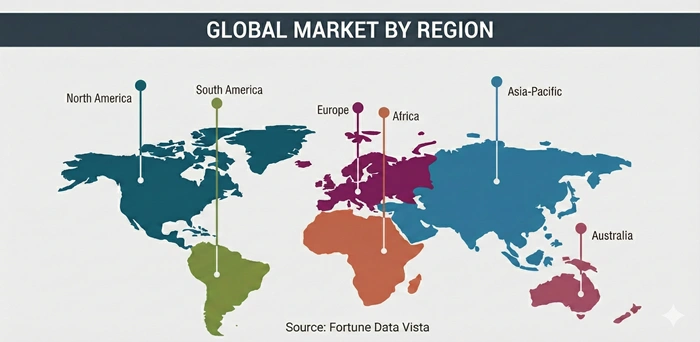
North America commands the largest regional share of the global 3D printers market at approximately 35% of total revenue in 2025, a position of leadership built on decades of additive manufacturing technology development, venture capital investment in 3D printing companies, and early large-scale industrial adoption by U.S. aerospace, defense, and medical device manufacturers. The United States is uniquely positioned as the commercial and technological epicenter of the global 3D printing industry, housing the corporate headquarters and primary R&D operations of 3D Systems, Stratasys, Desktop Metal, Markforged, Carbon 3D, and Nikon SLM Solutions Americas — companies whose combined intellectual property, customer bases, and growth trajectories define the competitive frontier of the global additive manufacturing industry. North America is projected to grow at a regional CAGR of approximately 18.5% from 2026 to 2033, reflecting continued strong investment by aerospace primes, defense programs, healthcare systems, and automotive OEMs that are progressively scaling their additive manufacturing production deployments. The U.S. government's additive manufacturing investment programs — including America Makes, the Manufacturing USA network, and DoD procurement programs — provide structural policy support that reinforces private sector adoption momentum.
Canada contributes meaningful secondary demand from its aerospace, energy, and healthcare sectors, with Canadian aerospace suppliers increasingly qualifying additive manufactured parts for Bombardier, Pratt & Whitney Canada, and Bell Helicopter platforms. The Canadian government's Strategic Innovation Fund has supported several additive manufacturing capability investments at domestic aerospace suppliers, creating a growing cluster of industrially deployed 3D printing capacity in the Montreal and Toronto aerospace corridors. Mexico's additive manufacturing adoption is growing rapidly, driven by the country's expanding automotive and aerospace manufacturing sector — particularly in the Monterrey, Chihuahua, and Querétaro industrial corridors — where nearshoring trends are driving investments in more sophisticated manufacturing capabilities including 3D printing for tooling, fixtures, and selected end-use parts.
Asia Pacific
Asia Pacific Is the Fastest Growing Regional Market for 3D Printers, Driven by China's Massive Investment in Additive Manufacturing Industry Development, Japan's Precision Manufacturing Innovation, and India's Rapidly Expanding Industrial 3D Printing Sector
China's National Additive Manufacturing Development Policy and Its World-Leading Manufacturing Scale Are Making Asia Pacific the Most Consequential Growth Region for 3D Printers Over the Forecast Period
Asia Pacific is the fastest growing regional market in the 3D printers industry, with a projected CAGR of approximately 22.3% from 2026 to 2033, substantially outpacing North America and Europe. The region currently holds approximately 27% of global 3D printers market revenue in 2025, a share that is growing rapidly as China, Japan, South Korea, and India simultaneously scale their industrial 3D printing adoption and invest in domestic additive manufacturing hardware and software development capabilities. China is the most significant growth driver within the region — the Chinese government's national additive manufacturing development plan, advanced manufacturing policy programs, and "dual circulation" economic strategy have mobilized enormous state and private investment in domestic 3D printer manufacturers including Bambu Lab (consumer), Creality (desktop), BLT (Bright Laser Technologies, industrial metal), and Farsoon Technologies (polymer and metal powder bed fusion), creating a rapidly maturing domestic industry that is beginning to compete with Western incumbents in global markets. Major international 3D printing companies including 3D Systems, Stratasys, and EOS are simultaneously expanding their China sales and service operations to capture the country's rapidly growing industrial additive manufacturing procurement budget.
Japan brings high technical sophistication and precision manufacturing culture to the Asia Pacific 3D printers market, with leading Japanese manufacturers including Ricoh, Roland DGA, and Canon increasingly offering additive manufacturing capabilities alongside their established precision manufacturing product lines, while companies like Mitsubishi Electric and Sodick develop directed energy deposition metal 3D printing platforms for precision tooling and industrial part repair applications. South Korea's electronics and automotive sectors are driving growing demand for high-precision polymer and metal 3D printing systems for tooling, consumer electronics component production, and EV battery system hardware prototyping and production applications. India represents the most dynamic emerging growth market in the region, with startups, manufacturing SMEs, education institutions, and defense research organizations all increasing their 3D printing investments under the government's "Make in India" and "Atmanirbhar Bharat" programs that prioritize the development of domestic advanced manufacturing capabilities including additive manufacturing.
Report Customization Available by Region and Country
Access Precisely Targeted 3D Printers Market Intelligence for Any Region or Country — Customized Reports Designed to Align with Your Geographic Priorities, Industry Focus, and Strategic Business Objectives
This report is available for complete customization across all major global regions and individual countries, enabling 3D printer manufacturers, material suppliers, software developers, industrial end users, investors, and government policy analysts to access geography-specific market intelligence tailored precisely to their needs. A customized report delivers country-level market sizing, technology adoption analysis, application-specific demand data, competitive landscape mapping, regulatory environment assessment, and strategic entry opportunity identification specific to the 3D printers market in the selected geography. Whether your objective is expanding into new markets, qualifying regional distribution partners, planning manufacturing investment, or evaluating acquisition targets, our customization service ensures your intelligence is directly actionable.
Customized 3D printers market reports are available for all of the following regions and countries, offering detailed market insights, competitive intelligence, technology adoption trends, and growth opportunities tailored to each specific geography:
North America
-
U.S. — World's leading additive manufacturing ecosystem analysis, aerospace and defense 3D printing adoption, government program investment mapping, and competitive benchmarking of 3D Systems, Stratasys, Desktop Metal, and Markforged
-
Canada — Aerospace corridor additive manufacturing demand, government strategic innovation fund program impact, and medical device 3D printing sector analysis
-
Mexico — Automotive nearshoring-driven 3D printing demand, industrial corridor adoption analysis, and domestic vs. imported 3D printer hardware preferences
Europe
-
U.K. — Aerospace and healthcare 3D printing leadership, Renishaw and Rolls-Royce additive manufacturing program analysis, and post-Brexit advanced manufacturing investment trends
-
Germany — Europe's largest industrial 3D printing market, EOS and Trumpf competitive positioning, automotive sector adoption, and Industry 4.0 additive manufacturing integration
-
France — Aerospace (Safran, Airbus) additive manufacturing program demand, healthcare 3D printing adoption, and government advanced manufacturing investment
-
Italy — Fashion, automotive, and industrial design sector 3D printing adoption, domestic 3D printer manufacturer competitive landscape, and additive manufacturing SME adoption trends
-
Rest of Europe — Scandinavian healthcare 3D printing leadership, Eastern Europe manufacturing sector adoption, and EU additive manufacturing regulatory framework impact
Asia Pacific
-
China — Government additive manufacturing policy impact, domestic vs. international supplier competitive dynamics, BLT and Farsoon competitive profiles, and EV and aerospace sector adoption
-
India — Make in India program additive manufacturing development, defense sector 3D printing demand, education sector growth, and domestic startup ecosystem analysis
-
Japan — Precision manufacturing sector 3D printing adoption, Ricoh and Canon competitive positioning, and automotive and electronics sector demand
-
South Korea — Electronics and automotive sector 3D printing requirements, government advanced manufacturing support, and domestic capability development
-
Australia — Healthcare and mining sector 3D printing adoption, CSIRO research program impact, and defense sector additive manufacturing demand
-
Rest of Asia Pacific — Southeast Asia manufacturing growth 3D printing demand, Vietnam and Thailand electronics sector adoption, and additive manufacturing market entry opportunity assessment
Latin America
-
Brazil — Largest Latin American 3D printer market, automotive and healthcare sector adoption, domestic manufacturing development, and government innovation program impact
-
Argentina — Aerospace and defense sector 3D printing adoption, economic environment impact on hardware procurement, and education sector additive manufacturing growth
-
Rest of Latin America — Colombia, Chile, Peru manufacturing and healthcare sector 3D printing market opportunity analysis
Middle East & Africa (MEA)
-
UAE — Dubai smart manufacturing initiative 3D printing adoption, healthcare and construction sector demand, and government advanced manufacturing hub development
-
Saudi Arabia — Vision 2030 manufacturing diversification 3D printing investment, defense sector additive manufacturing demand, and NEOM smart city construction printing applications
-
Rest of MEA — South Africa aerospace and automotive sector 3D printing adoption, East Africa healthcare 3D printing development, and Egypt industrial manufacturing sector analysis
Top Key Players
-
3D Systems Corporation (United States)
-
Stratasys Ltd. (United States / Israel)
-
EOS GmbH Electro Optical Systems (Germany)
-
Trumpf Group (SLM Solutions) (Germany)
-
Desktop Metal, Inc. (United States)
-
Materialise NV (Belgium)
-
Carbon, Inc. (Carbon 3D) (United States)
-
Markforged, Inc. (United States)
-
Farsoon Technologies Co., Ltd. (China)
-
Renishaw plc (United Kingdom)
-
Bambu Lab (China)
-
BICO Group AB (CELLINK) (Sweden)
Recent Developments
-
In 2025, 3D Systems Corporation announced the commercial launch of its Figure 4 Modular Production platform enhanced with integrated AI-driven closed-loop process control, enabling pharmaceutical and medical device customers to achieve fully automated, validated production of custom drug delivery devices and surgical guides at speeds and quality consistency levels previously unachievable on any competitive polymer additive manufacturing platform.
-
In 2024, Stratasys Ltd. completed a significant strategic partnership with Siemens Digital Industries Software to deeply integrate Stratasys's Fortus and F-series industrial FDM platforms with Siemens' Teamcenter PLM and NX CAD software ecosystems — enabling seamless design-to-print workflow automation for manufacturing engineering teams and positioning both companies to jointly capture growing demand for integrated digital manufacturing solutions across automotive and aerospace customers.
-
In 2025, EOS GmbH launched its EOS M 300-4 Flex metal powder bed fusion system featuring a new modular automation architecture and integrated AI-powered layer monitoring system that reduces quality inspection labor by over 70% compared to manual inspection processes — addressing one of the most significant cost and scalability challenges in high-volume metal additive manufacturing production deployments for aerospace and medical device customers.
-
In 2024, Desktop Metal, Inc. successfully completed the sale of its ExOne binder jetting division assets and refocused its commercial strategy on its Shop System and Production System metal binder jetting platforms, completing an operational restructuring that improved unit economics and customer support focus — while simultaneously closing a major production supply agreement with a leading European automotive manufacturer for binder jetted metal powertrain components.
-
In 2025, Carbon, Inc. secured a major multi-year supply agreement with a leading global sportswear company to manufacture custom-fit lattice midsole components for a premium performance running shoe line using Carbon's DLS (Digital Light Synthesis) resin printing platform, representing one of the largest single commercial 3D printing production contracts for mass-customized consumer product manufacturing and demonstrating the expanding commercial viability of additive manufacturing in consumer goods production.
Market Trends
The Industrialization of Additive Manufacturing and the Rise of Distributed, On-Demand Digital Production Are the Two Most Consequential Trends Transforming the Global 3D Printers Market Through 2033
As 3D Printing Moves from Prototype to Production Across Aerospace, Healthcare, and Defense, the Market Is Transitioning from a Technology-Driven Niche to a Mainstream Manufacturing Platform with Trillion-Dollar Long-Term Commercial Potential
The industrialization of additive manufacturing — the transition of 3D printing from a rapid prototyping tool to a certified, production-scale manufacturing technology — is the dominant trend reshaping the 3D printers market's competitive and commercial landscape. This transition is visible in the growing number of flight-certified additive manufactured parts on commercial and military aircraft, the expanding deployment of 3D printed surgical implants approved by the FDA and CE Mark authorities, and the increasing installation of production-grade polymer and metal 3D printing systems on automotive manufacturing lines. The hardware, software, and materials technology improvements driving this transition — including higher machine throughput, improved surface finish, expanded certified material portfolios, and AI-driven quality assurance — are collectively reducing the performance gap between additive and conventional manufacturing to the point where the unique geometric and customization advantages of 3D printing are progressively accessible in production contexts that would have been uneconomical five years ago.
The emergence of distributed, on-demand digital manufacturing as a supply chain model represents the second transformative trend in the 3D printers market. Rather than maintaining physical inventories of spare parts that may sit unused for years, organizations are progressively transitioning to digital inventory strategies where part designs are stored as certified digital files and printed on demand at locations closest to the point of need. The U.S. military's deployment of shipboard and expeditionary 3D printing programs, Airbus's "Spare Parts Online" digital catalog for 3D printed cabin components, and Shell's deployment of distributed 3D printing at offshore oil platforms are all early demonstrations of a supply chain model that simultaneously reduces inventory costs, eliminates long-lead-time parts delays, and improves operational resilience in ways that have compelling value propositions for organizations across defense, aerospace MRO, maritime, and energy sectors worldwide.
Segments Covered in the Report
-
By Technology
-
Fused Deposition Modeling (FDM)
-
Stereolithography (SLA)
-
Selective Laser Sintering (SLS)
-
Direct Metal Laser Sintering (DMLS) / Laser Powder Bed Fusion (LPBF)
-
Multi Jet Fusion (MJF)
-
PolyJet / Material Jetting (MJP)
-
Electron Beam Melting (EBM)
-
Binder Jetting
-
Direct Energy Deposition (DED)
-
Others (DLP, CLIP, Bioprinting)
-
-
By Component
-
Hardware (Printers and Related Equipment)
-
Software (CAD, Slicing, Process Simulation, Quality Management)
-
Services (Design, Printing, Post-Processing, Maintenance, Consulting)
-
-
By Printer Type
-
Desktop 3D Printers
-
Industrial 3D Printers (Mid-Range and Production-Grade)
-
-
By Material
-
Plastics and Polymers (PLA, ABS, PEEK, Nylon, Resin)
-
Metals (Titanium, Steel, Aluminum, Nickel Superalloys, Cobalt-Chrome)
-
Ceramics
-
Biomaterials (Bio-Inks, Hydrogels, Living Cell Materials)
-
Others (Composites, Sand, Concrete)
-
-
By Application
-
Rapid Prototyping
-
Tooling, Jigs, and Fixtures
-
Functional End-Use Parts Manufacturing
-
Bioprinting and Medical Implants
-
Others (Education, Art and Design, Food Printing)
-
-
By End User
-
Aerospace and Defense
-
Automotive
-
Healthcare and Medical Devices
-
Consumer Electronics
-
Education and Research
-
Construction and Architecture
-
Others (Energy, Jewelry, Food and Beverage)
-
-
By Region
-
North America (U.S., Canada, Mexico)
-
Europe (U.K., Germany, France, Italy, Rest of Europe)
-
Asia Pacific (China, India, Japan, South Korea, Australia, Rest of Asia Pacific)
-
Latin America (Brazil, Argentina, Rest of Latin America)
-
Middle East & Africa (UAE, Saudi Arabia, Rest of MEA)
-
❝ Built for Every Level — From Startups to Industry Giants ❞
Here Is Exactly How This Report Works for You
-
For Tier 1 industrial 3D printer manufacturers, aerospace and defense primes, Fortune 500 manufacturers, and institutional investors, this report delivers a comprehensive competitor revenue analysis — including technology platform revenue contribution breakdowns, material and service attachment rate data, and a detailed assessment of how geopolitical developments including U.S.-China technology competition, export controls on advanced manufacturing equipment, and government-mandated domestic supply chain requirements are reshaping capital allocation, technology licensing, and international expansion strategies across the global 3D printers market through 2033.
-
For Tier 2 and Tier 3 3D printer resellers, regional application service bureaus, material suppliers, and software developers, the supply-demand dynamics section maps technology adoption cycle timing, application qualification progression, and geographic market development opportunities where industrial production adoption of 3D printing is creating concentrated new procurement demand — giving your commercial teams the intelligence to identify and secure the highest-value customer relationships ahead of intensifying competition from global hardware vendors expanding their direct sales and service presence.
-
For additive manufacturing startups, cleantech innovators developing bioprinting or construction printing platforms, and PE investors evaluating 3D printing M&A opportunities, this report provides a detailed technology adoption curve analysis, patent landscape assessment, and regulatory pathway mapping alongside an identification of the most commercially attractive application segments and geographic markets where the 3D printers market's exceptional growth trajectory is creating the most actionable investment, partnership, and go-to-market opportunities through 2033.
Frequently Asked Questions:
Answer: The global 3D printers market was valued at USD 31.32 billion in 2025 and is projected to reach USD 132.45 billion by 2033. It is expected to grow at a CAGR of 19.5% from 2026 to 2033, driven by the transition from prototyping to serial production, rapid healthcare adoption, and the emergence of transformative new applications in construction and bioprinting.
Answer: The aerospace and defense sector is the largest revenue-contributing end user in the 3D printers market, driven by the qualification and serial production deployment of certified additive manufactured components in aircraft engines, satellite structures, and defense systems. Healthcare is the fastest growing sector, where custom surgical implants, dental restorations, and the emerging field of bioprinting are creating exceptional new demand for specialized 3D printing platforms.
Answer: Desktop 3D printers are entry-level systems designed for prototyping, education, and small-scale production — offering lower cost but limited material capability, build volume, and part quality compared to industrial systems. Industrial 3D printers are production-grade machines engineered for manufacturing environments, delivering higher throughput, broader certified material portfolios, tighter dimensional tolerances, and the process documentation capabilities required for aerospace, medical device, and automotive manufacturing quality systems — making them the dominant revenue segment in the 3D printers market.
Answer: The 3D printers market has actually benefited from global supply chain disruptions in recent years, as manufacturers experiencing parts shortages and long lead times from traditional supply chains accelerated their investment in on-demand additive manufacturing capabilities to reduce dependence on single-source suppliers and long-distance logistics networks. The ability to print replacement parts on demand, close to the point of use, using a digital design file rather than a physical inventory is one of the most compelling supply chain resilience arguments driving industrial 3D printing adoption.
Answer: Thermoplastic polymers — including PLA, ABS, nylon, PEEK, and carbon fiber composites — are the most widely used 3D printing materials by volume, primarily deployed in FDM and SLS desktop and industrial printers for prototyping, tooling, and functional end-use plastic parts across automotive, aerospace, and consumer goods applications. Metal powders — including titanium alloys, stainless steel, aluminum alloys, and nickel superalloys — are the highest-value material category in the 3D printers market and are growing rapidly as DMLS, LPBF, and binder jetting systems for serial production of certified metal components in aerospace, medical device, and industrial manufacturing are increasingly deployed at scale.