
Additive Manufacturing Market Overview
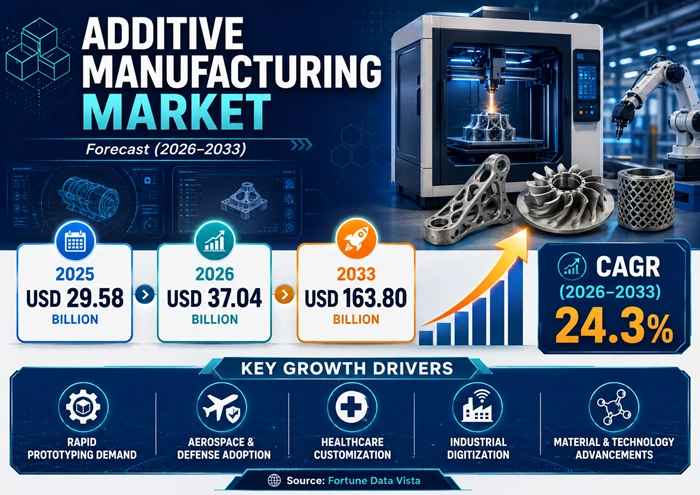
The global additive manufacturing market size is valued at USD 29.58 billion in 2025 and is predicted to increase from USD 37.04 billion in 2026 to approximately USD 163.80 billion by 2033, growing at a CAGR of 24.3% from 2026 to 2033. This remarkable growth is powered by expanding industrial adoption of 3D printing technologies, rising demand for customized production, and accelerating digital transformation across aerospace, healthcare, automotive, and defense sectors worldwide.
AI Impact on the Additive Manufacturing Industry
Artificial Intelligence Is Fundamentally Reshaping How Products Are Designed, Tested, and Manufactured at Scale Across Every Key Vertical*
Artificial intelligence is transforming the additive manufacturing landscape from design conception to final production output. AI-powered generative design tools are enabling engineers to create highly optimized geometries that were previously impossible to produce using traditional manufacturing methods. These tools analyze thousands of design iterations in seconds, selecting the configurations that offer the best strength-to-weight ratios while minimizing material consumption. As a result, industries such as aerospace and healthcare are producing components that perform better and cost less to manufacture. The integration of AI with additive manufacturing is also reducing design cycle times dramatically and lowering the frequency of costly prototyping errors.
Smart manufacturing ecosystems are increasingly embedding AI-driven quality control systems directly into industrial 3D printing workflows. IoT-enabled printers connected to cloud-based manufacturing platforms now allow operators to monitor every layer of a build in real time, catching defects before they propagate through an entire part. Predictive maintenance algorithms use machine performance data to schedule downtime proactively, reducing production interruptions. Digital twin technology, paired with AI simulation, gives manufacturers a virtual replica of their printing processes — enabling continuous optimization without physical trial and error. These advancements are turning the additive manufacturing market into a smarter, leaner, and far more responsive production ecosystem.
Growth Factors
Expanding Industrial Demand, Material Innovation, and Digital Manufacturing Integration Are the Three Pillars Powering the Market's Exceptional Trajectory*
A rapidly growing number of industries are moving beyond using 3D printing only for prototypes and are now applying it to full-scale production of functional, end-use components. This shift is a critical growth driver for the additive manufacturing sector. Aerospace companies are printing lightweight turbine blades and structural brackets. Medical device manufacturers are producing patient-specific implants and surgical guides. Automotive OEMs are using additive processes to reduce vehicle weight and shorten tooling cycles. The ability to deliver complex geometries, mass customization, and on-demand production — without the need for expensive dies or molds — gives additive manufacturing a significant competitive edge over conventional methods. Combined with continuous reductions in equipment costs and improvements in print speeds, this positions the market for sustained, double-digit growth through 2033.
Material innovation is playing an equally important role in expanding the scope of additive manufacturing applications. The growing availability of engineering-grade polymers, advanced metal alloys, ceramics, and composite materials is unlocking new use cases that were previously constrained by material limitations. Metal additive manufacturing, in particular, has seen surging adoption in high-stakes industries, with titanium, stainless steel, and nickel-based superalloys now routinely processed using powder bed fusion and directed energy deposition technologies. Simultaneously, the development of bio-compatible and high-temperature-resistant materials is broadening additive manufacturing's footprint in healthcare and energy applications. The convergence of superior materials, smarter software, and more capable hardware is accelerating market penetration across both established and emerging verticals.
Market Outlook
Long-Term Market Expansion Will Be Driven by Decentralized Production Models, Industry 4.0 Adoption, and a Global Push Toward Sustainable Manufacturing Practices*
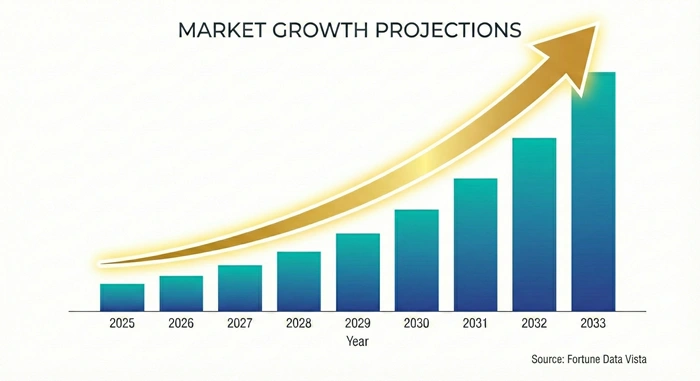
The long-term outlook for the additive manufacturing industry remains exceptionally strong. Enterprises across sectors are realizing that additive processes offer a strategic pathway to decentralized manufacturing — the ability to produce parts closer to the point of use, eliminating long supply chains and reducing logistics costs. This model gained significant traction during supply chain disruptions over recent years, and the momentum has continued well into 2026. Governments in North America, Europe, and Asia Pacific are actively funding advanced manufacturing programs that include 3D printing as a core pillar, further accelerating adoption timelines. By 2033, additive manufacturing is expected to be a mainstream production technology across virtually every major industrial sector.
Sustainability is emerging as a powerful secondary driver reshaping the additive manufacturing market's trajectory. Unlike subtractive manufacturing methods that generate significant material waste, additive processes build parts layer by layer, consuming only the material needed. This approach is deeply aligned with global corporate sustainability commitments, circular economy principles, and increasingly stringent environmental regulations. Energy efficiency improvements in modern 3D printing systems, combined with the rise of recyclable polymer and metal powders, are making additive manufacturing one of the most environmentally responsible production technologies available. As ESG considerations move to the center of capital allocation decisions, the additive manufacturing market is positioned to capture growing investment from sustainability-focused enterprises.
Expert Speaks
-
"Additive manufacturing is no longer a prototyping technology — it is a full production platform, and we are investing accordingly to make it central to our industrial strategy." — Jeff Immelt, Former CEO, General Electric
-
"The convergence of AI, advanced materials, and 3D printing is creating a new paradigm for manufacturing. Companies that embrace this shift will hold a decisive competitive advantage in the decade ahead." — Dion Weisler, Former CEO, HP Inc.
-
"Stratasys is at the forefront of enabling manufacturers globally to transition from prototype-centric workflows to production-grade additive capabilities across aerospace, healthcare, and industrial sectors." — Yoav Zeif, CEO, Stratasys
Key Report Takeaways
-
North America dominates the additive manufacturing market, accounting for more than 32.8% of global revenue in 2025, driven by strong R&D infrastructure, established aerospace and defense sectors, and early adoption of Industry 4.0 technologies
-
Asia Pacific is the fastest-growing region, expected to register the highest CAGR through 2033, propelled by expanding smart manufacturing ecosystems in China, Japan, India, and South Korea, along with strong government-led industrial digitalization initiatives
-
Industrial users in aerospace, automotive, and healthcare are the heaviest adopters of additive manufacturing technologies, with aerospace and defense leveraging it for lightweight, high-strength, and complex components, and healthcare applying it for patient-specific implants and bio-printed structures
-
The prototyping segment contributes the most by application, holding the largest share in 2025 due to widespread demand for rapid prototyping, iterative design validation, and accelerated product development cycles across automotive, aerospace, and electronics industries
-
Powder bed fusion (including SLS and DMLS) is the most widely adopted additive manufacturing technology for high-precision industrial applications, particularly for metal components in aerospace, defense, and medical implant manufacturing
-
The software segment is projected to grow at the fastest CAGR among all components, driven by AI-powered generative design tools, digital twins, and cloud-based manufacturing platforms — the software segment is forecast to capture a growing market share, expanding at a double-digit CAGR through 2033 as manufacturers prioritize end-to-end digital workflow optimization
Market Scope
| Parameter | Details |
|---|---|
| Market Size by 2033 | USD 163.80 Billion | Market Size by 2026 | USD 37.04 Billion | Market Size by 2025 | USD 29.58 Billion | Market Growth Rate from 2026 to 2033 | CAGR of 24.3% | Dominating Region | North America | Fastest Growing Region | Asia Pacific | Segments Covered | Component, Printer Type, Technology, Software, Application, Vertical, Material, Region | Regions Covered | North America, Europe, Asia Pacific, Latin America, Middle East & Africa |
Market Dynamics
Drivers Impact Analysis
Accelerating Industrial Adoption, Technological Convergence, and Demand for Customized Production Are the Primary Forces Expanding the Additive Manufacturing Market*
| Driver | ≈ % Impact on CAGR Forecast | Geographic Relevance | Impact Timeline |
|---|---|---|---|
| Rising demand for rapid prototyping and on-demand manufacturing | ~28% | Global | Near-term (2026–2028) |
| Growth in metal additive manufacturing for aerospace and defense | ~24% | North America, Europe | Medium-term (2026–2030) |
| Integration of AI and Industry 4.0 in manufacturing workflows | ~22% | North America, Asia Pacific | Long-term (2028–2033) |
| Expanding healthcare applications (implants, bioprinting) | ~15% | North America, Europe | Medium to Long-term |
| Government investments in advanced manufacturing | ~11% | Asia Pacific, North America | Near to Medium-term |
The growing industrial demand for rapid prototyping and on-demand production is one of the most immediate and impactful drivers of the additive manufacturing market. Companies across automotive, aerospace, and consumer electronics are restructuring their product development pipelines to leverage 3D printing for faster iteration cycles and reduced time-to-market. The ability to create complex, high-performance parts without expensive tooling is particularly attractive in defense and aerospace, where low-volume, high-precision components are standard requirements. This driver is simultaneously relevant across all major geographies, making it the most consistent source of growth momentum through the forecast period.
Metal additive manufacturing is emerging as a particularly powerful market driver, enabling production of critical components from titanium, aluminum, and nickel superalloys in sectors where conventional machining falls short. As powder bed fusion, directed energy deposition, and binder jetting technologies mature, their operational costs are declining while their throughput and reliability improve. Government-backed programs in the U.S., Germany, and China are specifically funding metal AM research and industrial deployment, reinforcing its long-term strategic importance. These combined effects are expected to sustain elevated growth rates well into the latter half of the forecast period.
Restraints Impact Analysis
High Capital Requirements and Material Standardization Gaps Remain the Most Significant Barriers Limiting Broader Adoption Across Tier 2 and Tier 3 Manufacturers*
| Restraint | ≈ % Impact on CAGR Forecast | Geographic Relevance | Impact Timeline |
|---|---|---|---|
| High initial investment for equipment and infrastructure | ~−5.2% | Global (especially SMEs) | Near to Medium-term |
| Material quality inconsistency and lack of standardization | ~−3.8% | Global | Near-term (2026–2028) |
| Skilled workforce shortage for AM system operation | ~−3.1% | Developing Economies | Medium-term |
| Regulatory and certification complexity in aerospace/healthcare | ~−2.5% | North America, Europe | Ongoing |
The high cost of industrial-grade 3D printing equipment, proprietary software, and specialized raw materials remains a primary restraint within the additive manufacturing sector. For small and medium-sized businesses and early-stage startups, the upfront capital required to establish a competitive additive manufacturing facility often outweighs near-term returns, delaying adoption timelines significantly. While equipment costs have been declining gradually, enterprise-class metal printing systems still command price points that place them out of reach for a large segment of potential adopters. This financial barrier disproportionately affects manufacturers in price-sensitive markets across Southeast Asia, Latin America, and parts of Eastern Europe.
Material standardization challenges present another structural restraint. The variety of material formulations, supplier inconsistencies, and the absence of globally harmonized testing and certification protocols make it difficult for manufacturers — particularly in aerospace and healthcare — to achieve the regulatory approvals required for end-use part production. Without standardized specifications, quality assurance processes become time-consuming and costly, slowing adoption in industries where component reliability is non-negotiable. Ongoing efforts by standards bodies such as ASTM International and ISO are gradually addressing these gaps, but significant inconsistencies remain across material types and geographic markets.
Opportunities Impact Analysis
Expansion Into Healthcare Bioprinting, Sustainability-Driven Manufacturing, and Emerging Market Industrialization Represent the Most Transformative Growth Opportunities*
| Opportunity | ≈ % Impact on CAGR Forecast | Geographic Relevance | Impact Timeline |
|---|---|---|---|
| Healthcare bioprinting and personalized medicine | ~+4.8% | North America, Europe | Medium to Long-term |
| Sustainable and circular manufacturing adoption | ~+4.2% | Europe, North America | Medium-term (2026–2030) |
| Rising industrial digitalization in Asia Pacific | ~+5.5% | China, India, Southeast Asia | Near to Long-term |
| Defense sector modernization and spare parts on-demand | ~+3.6% | North America, Middle East | Medium-term |
| Growth of desktop 3D printing in SMEs and education | ~+2.9% | Global | Near-term |
The healthcare sector presents one of the most significant and fastest-growing opportunity spaces for additive manufacturing. Personalized medicine, bio-compatible implants, surgical guide printing, and emerging tissue bioprinting applications are each expanding the commercial footprint of 3D printing in clinical environments. As reimbursement frameworks for 3D-printed medical devices evolve and bioprinting technologies mature, the healthcare additive manufacturing segment is poised for exceptional growth through 2033. North America and Europe lead current adoption, but emerging healthcare infrastructure investments in Asia Pacific and the Middle East are creating substantial new demand pools.
Asia Pacific's rapid industrial digitalization represents arguably the most expansive long-term opportunity for market participants. China's government-led advanced manufacturing initiatives, India's growing manufacturing base, and Southeast Asia's expanding electronics production ecosystem are collectively creating enormous demand for flexible, cost-efficient additive manufacturing solutions. Countries in this region are increasingly investing in localized 3D printing capabilities to reduce import dependency and accelerate domestic production of high-value components. International additive manufacturing companies that establish partnerships, joint ventures, or localized production facilities in this region stand to gain a disproportionate share of its high-growth market potential.
Segment Analysis
By Component — Hardware
Hardware Remains the Revenue Backbone of the Industry, Anchored by Accelerating Deployment of Industrial-Grade Metal and Multi-Material Printing Systems*
The hardware segment is the largest and most foundational component of the additive manufacturing market, commanding more than 62.6% of global revenue share in 2025. This dominance reflects the broad-based deployment of industrial 3D printing systems across core manufacturing verticals. The segment encompasses a wide range of equipment — from high-speed polymer printing systems used in consumer goods and electronics to precision metal printers deployed in aerospace and defense production lines. Hardware revenues are growing at a strong CAGR driven by increasing capital expenditure in smart factory builds, the automation of additive manufacturing cells, and the integration of hybrid manufacturing platforms that combine additive and subtractive processes in a single workflow. North America and Europe are the primary revenue contributors within this segment, where established aerospace primes and tier-1 automotive suppliers are actively expanding their industrial 3D printing fleets. Leading companies including GE Additive, EOS GmbH, 3D Systems Corporation, and Stratasys Ltd. are continuously introducing next-generation systems with higher build volumes, improved speed, and multi-material capability.
In the Asia Pacific region, hardware adoption is accelerating particularly in China and Japan, where government-backed manufacturing modernization programs are funding large-scale procurement of industrial additive manufacturing equipment. China's domestic AM hardware manufacturers are also gaining market presence, partially displacing international suppliers in lower-margin segments. Japan's automotive and electronics sectors are systematically integrating additive manufacturing hardware into lean manufacturing environments, driving incremental growth. With hardware prices gradually declining due to increased competition and economies of scale in component production, the segment is expected to maintain its market leadership while simultaneously broadening its accessible market across mid-tier manufacturers and SMEs through 2033.
By Technology — Stereolithography (SLA) and Metal-Based Technologies
Technology Leadership Is Shifting Toward High-Speed, High-Precision Platforms as Industrial Demand for End-Use Part Production Intensifies*
Stereolithography (SLA) held the leading technology position in the additive manufacturing market in 2025, driven by its proven precision, superior surface quality, and established track record in dental manufacturing, medical device prototyping, and high-accuracy engineering applications. SLA systems are widely adopted in North America and Europe, where dental labs, biomedical companies, and electronics manufacturers rely on their ability to produce dimensionally accurate parts from a growing library of photopolymer resins. The segment benefits from continuous resin innovation — with new engineering-grade, biocompatible, and high-temperature formulations regularly expanding the technology's application envelope. Companies such as 3D Systems and Formlabs dominate the SLA space and continue to release faster, more scalable systems suited to production environments.
Metal-based additive manufacturing technologies — particularly Selective Laser Sintering (SLS), Direct Metal Laser Sintering (DMLS), and Electron Beam Melting (EBM) — are growing at the fastest CAGR within the technology segment, fueled by surging demand in aerospace and defense for complex, lightweight, mission-critical components. The metal technology sub-segment held approximately 50.3% of the material-based market share in 2025, reflecting its dominant position in high-value industrial applications. Asia Pacific, particularly China and Japan, is emerging as a rapidly growing geography for metal AM technologies, as government programs and aerospace expansion drive local investment. EOS GmbH, GE Additive, and Renishaw are the leading players advancing metal AM capabilities, continuously pushing boundaries in build speed, multi-alloy capability, and automated post-processing workflows.
Regional Insights
North America — The Global Leader in Additive Manufacturing Adoption
Unmatched R&D Infrastructure, a Mature Aerospace-Defense Industrial Base, and Early-Mover Advantage in Industry 4.0 Integration Cement North America's Market Leadership*
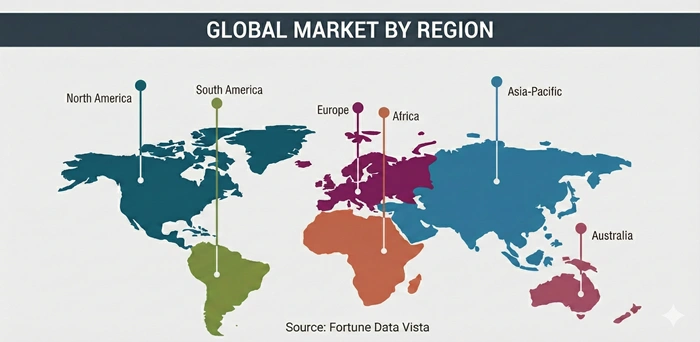
North America is the dominant region in the global additive manufacturing market, accounting for more than 32.8% of global revenue in 2025. The United States alone is responsible for the vast majority of this share, underpinned by a concentrated ecosystem of leading AM companies, world-class research universities, and heavy investment from aerospace and defense primes. The U.S. Department of Defense has been a consistent early adopter of 3D printing for spare parts on-demand, rapid tooling, and forward-deployed manufacturing applications — creating a high-volume, high-reliability demand pool that sustains the most advanced end of the market. Companies like 3D Systems, Stratasys, ExOne, and GE Additive have their headquarters and primary innovation centers in the U.S., ensuring that the region remains at the cutting edge of hardware, software, and materials development. Canada and Mexico are also registering consistent growth as automotive supply chains in the region integrate additive manufacturing into production workflows.
North America is expected to maintain a healthy CAGR of approximately 22–23% through 2033, supported by continued federal investments in advanced manufacturing hubs and the growing presence of additive manufacturing in healthcare, where patient-specific implants and surgical guide production are expanding rapidly across major hospital networks. The region's strong intellectual property frameworks, regulatory clarity from agencies such as the FDA for medical AM applications, and access to venture capital for AM startups collectively sustain an innovation-friendly environment. Geographically, the U.S. Northeast and Southeast corridors, along with Texas and California, are emerging as the highest-density hubs for industrial additive manufacturing adoption.
Asia Pacific — The World's Fastest-Growing Additive Manufacturing Region
Government-Led Industrial Digitalization, Rapid Expansion of Electronics and Automotive Manufacturing, and Large-Scale R&D Investment Are Making Asia Pacific the Market's Growth Epicenter*
Asia Pacific is projected to record the highest CAGR among all regions through the 2026–2033 forecast period, driven by a sweeping wave of industrial modernization across China, Japan, India, and South Korea. China currently holds the largest share within the region — accounting for more than 50.4% of Asia Pacific's regional market — powered by state-backed programs promoting advanced manufacturing, domestic 3D printing hardware production, and integration of additive processes into aerospace, automotive, and consumer electronics supply chains. The Chinese government has identified additive manufacturing as a strategic technology priority under its "Made in China 2035" industrial policy, committing significant funding to research institutions and industrial parks focused on AM innovation. Companies such as BLT (Bright Laser Technologies) and Farsoon Technologies are emerging as strong domestic competitors to international players.
India is the second-largest growth contributor within Asia Pacific, holding more than 30.1% of the regional market share during the forecast period, as its expanding aerospace, defense, and pharmaceutical manufacturing sectors increasingly adopt 3D printing for prototyping and functional part production. Japan, with its renowned precision manufacturing culture and strong automotive-electronics industrial base, is investing heavily in metal additive manufacturing systems from both domestic developers and international leaders like EOS and Renishaw. South Korea and Singapore are emerging as sophisticated AM hubs with strong government-backed incubation programs and mature electronics manufacturing ecosystems. The entire Asia Pacific additive manufacturing market is expected to outperform all other regions in terms of growth velocity, creating compelling opportunities for both global AM leaders and regional innovators through 2033.
Top Key Players
-
3D Systems, Inc. (United States)
-
Stratasys Ltd. (United States / Israel)
-
EOS GmbH (Germany)
-
GE Additive (Colibrium Additive) (United States)
-
HP Inc. (United States)
-
Materialise NV (Belgium)
-
Renishaw PLC (United Kingdom)
-
SLM Solutions Group AG (Germany)
-
EnvisionTEC GmbH (Germany)
-
Autodesk, Inc. (United States)
-
Dassault Systèmes (France)
-
ExOne (United States)
-
Farsoon Technologies (China)
-
Bright Laser Technologies (BLT) (China)
Recent Developments
-
In May 2026, Stratasys Ltd. announced an agreement to acquire Markforged, Inc. in an all-cash deal valued at approximately USD 42.5 million, significantly strengthening its capabilities in aerospace, defense, and industrial production-grade 3D printing.
-
In April 2026, EOS GmbH acquired Metalpine GmbH, a specialist in high-quality metal powders for additive manufacturing, enhancing EOS' titanium powder production capabilities and supporting broader adoption of industrial metal 3D printing.
-
In April 2026, Inspira Technologies acquired Nano Dimension's Additive Manufacturing Electronics (AME) platform, including intellectual property, manufacturing assets, software, and customer operations, to accelerate advanced 3D electronics printing.
-
In March 2026, AFM Capital acquired a majority stake in Incodema3D Holdings, Inc., one of North America's leading metal additive manufacturing service providers serving aerospace, defense, energy, and industrial customers.
-
In January 2026, EOS committed a USD 3 million investment to expand its manufacturing and logistics facilities in Texas, boosting production capacity and accelerating industrial additive manufacturing adoption across the United States.
Market Trends
The Additive Manufacturing Market Is Being Reshaped by a Dual Wave of Sustainability Imperatives and Production-Scale Technology Maturation*
The most prominent trend reshaping the additive manufacturing landscape in 2026 is the decisive shift from prototyping-only workflows toward full-scale production deployment. Manufacturers across industries are no longer evaluating 3D printing as an experimental technology — they are embedding it into their core production lines. Hybrid manufacturing platforms, which combine additive and subtractive processes within a single machining center, are gaining rapid adoption in aerospace and automotive environments where dimensional tolerances are non-negotiable. Multi-material and multi-color printing systems are expanding design possibilities in consumer goods and electronics. Simultaneously, cloud-connected additive manufacturing platforms are enabling distributed production networks, where digital files can be sent to any node in a global network and printed locally — fundamentally disrupting traditional centralized manufacturing models.
Sustainability is the second defining trend driving market evolution. The additive manufacturing market is increasingly viewed not just as a production efficiency tool, but as a strategic sustainability enabler. Layer-by-layer production generates significantly less waste than conventional subtractive methods, and the growing availability of recycled metal powders and bio-based polymer filaments is amplifying this environmental advantage. Manufacturers in Europe, in particular, are responding to strict regulatory sustainability mandates by transitioning components to additive processes wherever feasible. The circular economy concept — where end-of-life parts are ground into powder and reprinted — is moving from concept to commercial reality, supported by material recovery programs from leading powder suppliers. These sustainability dynamics are actively reshaping procurement, investment, and technology selection decisions across the global additive manufacturing ecosystem.
Segments Covered in the Report
-
By Component
-
Hardware
-
Software
-
Services
-
-
By Printer Type
-
Desktop 3D Printer
-
Industrial 3D Printer
-
-
By Technology
-
Stereolithography (SLA)
-
Fused Deposition Modeling (FDM)
-
Selective Laser Sintering (SLS)
-
Direct Metal Laser Sintering (DMLS)
-
Polyjet Printing
-
Inkjet Printing
-
Electron Beam Melting (EBM)
-
Laser Metal Deposition (LMD)
-
Digital Light Processing (DLP)
-
Laminated Object Manufacturing (LOM)
-
Others
-
-
By Software
-
Design Software
-
Inspection Software
-
Printer Software
-
Scanning Software
-
-
By Application
-
Prototyping
-
Tooling
-
Functional Parts
-
-
By Vertical
-
Industrial Additive Manufacturing
-
Automotive
-
Aerospace & Defense
-
Healthcare
-
Consumer Electronics
-
Power & Energy
-
Others
-
-
Desktop Additive Manufacturing
-
Educational Purpose
-
Fashion & Jewelry
-
Dental
-
Food
-
Others
-
-
-
By Material
-
Polymer
-
Metal
-
Ceramic
-
Composites
-
Others
-
-
By Region
-
North America (U.S., Canada, Mexico)
-
Europe (Germany, UK, France, Italy, Spain)
-
Asia Pacific (China, Japan, India, South Korea, Singapore, Australia)
-
Latin America (Brazil)
-
Middle East & Africa (KSA, UAE, South Africa)
-
❝ Built for Every Level — From Startups to Industry Giants ❞
Here Is Exactly How This Report Works for You
-
For Tier 1 and Tier 2 manufacturers, large investors, and Fortune 500 industrial companies, this report delivers granular competitor revenue analysis, revenue source breakdowns, and geopolitical impact assessments — equipping decision-makers to navigate supply disruptions, tariff environments, and market entry barriers with confidence, because every strategic expansion or consolidation decision requires clarity that only deep market intelligence can provide.
-
For Tier 3 manufacturers, mid-level companies, and startups, this report translates complex supply-demand dynamics into actionable intelligence, identifying whitespace opportunities by technology, geography, and application — helping emerging players find the right market entry point before the window closes in this hyper-growth industry.
-
For investors at all levels, the detailed segment-level CAGR projections, company share analyses, and forward-looking trend assessments contained in this report remove guesswork from portfolio decisions — giving you the analytical foundation to back the right technologies, companies, and geographies in the global additive manufacturing market before the next wave of consolidation reshapes the competitive landscape.
Frequently Asked Questions:
Answer: The global additive manufacturing market is valued at USD 29.58 billion in 2025 and is projected to reach USD 163.80 billion by 2033. The market is growing at a CAGR of 24.3% from 2026 to 2033, driven by expanding industrial applications and technological advancements.
Answer: North America currently leads the additive manufacturing market with over 32.8% of global revenue share in 2025, supported by a mature aerospace, defense, and healthcare manufacturing base. Asia Pacific is the fastest-growing region, driven by China, India, and Japan's aggressive industrial digitalization programs.
Answer: The primary drivers include rising demand for rapid prototyping, growing adoption of metal additive manufacturing in aerospace and defense, and integration of AI and Industry 4.0 into production workflows. Expanding healthcare applications such as patient-specific implants and bioprinting are also significantly contributing to the additive manufacturing market's growth.
Answer: High initial investment costs for industrial-grade equipment and infrastructure remain the most significant barrier, especially for SMEs and startups in emerging markets. Additionally, material standardization gaps and complex regulatory certification requirements in aerospace and healthcare sectors slow the pace of broader additive manufacturing adoption.
Answer: Digital Light Processing (DLP) and metal-based technologies such as DMLS and EBM are among the fastest-growing technology segments within the additive manufacturing market. These technologies offer superior speed, precision, and material performance, making them ideal for high-value production applications in aerospace, healthcare, and defense.