
Aerospace Artificial Intelligence Market Overview
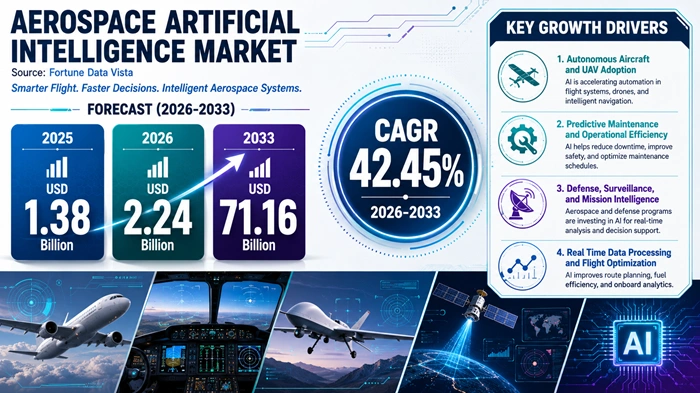
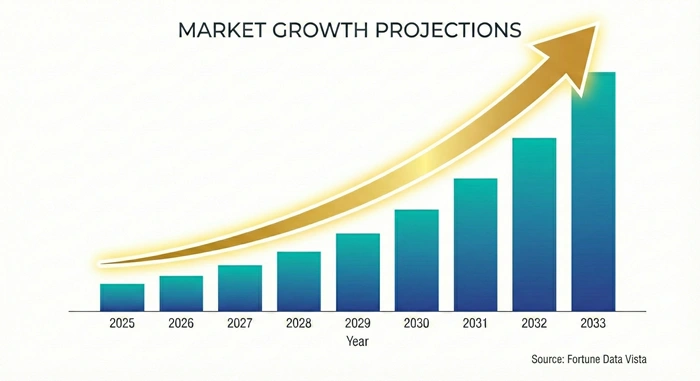
The global Aerospace Artificial Intelligence market size is valued at USD 1.38 billion in 2025 and is predicted to increase from USD 2.24 billion in 2026 to approximately USD 71.16 billion by 2033, growing at a CAGR of 42.45% from 2026 to 2033. This extraordinary growth trajectory reflects the aviation and defense sector's accelerating transition toward AI-driven operations — spanning autonomous systems, predictive maintenance, air traffic management, mission planning, and intelligent cockpit technologies. As governments and commercial aviation players alike deepen their AI investment commitments, this market is positioned among the fastest-expanding segments within the global technology landscape.
AI Impact on the Aerospace Artificial Intelligence Industry
Artificial Intelligence Is No Longer Supplementing Aerospace Operations — It Is Becoming the Core Operational Architecture of How Aircraft Are Designed, Maintained, Flown, and Defended*
The integration of AI into aerospace operations represents one of the most transformative technological shifts in the industry's history. Machine learning platforms are being applied across every stage of the aircraft lifecycle — from design simulation and materials optimization during engineering, to real-time fault detection and predictive component replacement during service. Major defense contractors are deploying deep learning models that can analyze thousands of sensor data streams simultaneously, enabling ground teams to identify developing mechanical issues before they manifest as operational failures, dramatically improving mission readiness rates and reducing unplanned maintenance events.
In commercial aviation, AI systems are fundamentally reshaping how airlines manage operations, dispatch crews, optimize fuel consumption, and communicate with passengers. Natural language processing platforms handle millions of customer service interactions daily without human intervention, while AI-driven flight management systems continuously recalculate optimal routing in response to evolving weather patterns, airspace congestion, and fuel efficiency targets. The aerospace artificial intelligence market is seeing particular investment in AI-powered cockpit assistance tools — systems that serve as an intelligent co-pilot, monitoring pilot decision-making patterns, flagging cognitive load risks, and providing contextual situational awareness support during complex flight phases.
Growth Factors
Surging Defense Modernization Budgets, the Global Rise of Autonomous Aerial Vehicles, and an Industry-Wide Commitment to Predictive Operations Are Together Driving Explosive Market Expansion*
Defense sector modernization is the single most powerful accelerant of growth across the aerospace artificial intelligence market. Governments across the United States, China, the European Union, and India are committing unprecedented levels of defense funding toward AI-enabled capabilities — including autonomous combat drones, intelligent surveillance systems, AI-driven logistics coordination, and next-generation missile guidance technologies. The U.S. Department of Defense alone has publicly committed to integrating AI across its core operational domains, creating a massive and sustained government procurement market for AI systems specifically designed to meet the rigorous performance, reliability, and cybersecurity demands of aerospace and defense applications.
Commercial aviation's recovery from the disruptions of the early 2020s has also created a powerful additional growth driver. Airlines, aircraft manufacturers, and maintenance providers are investing heavily in AI tools that can help them do more with constrained workforces, reduce turnaround times, and improve on-time performance in an environment of soaring passenger demand. The proliferation of electric vertical take-off and landing (eVTOL) aircraft and urban air mobility platforms is further expanding the addressable market for aerospace AI, as these next-generation vehicle categories require highly sophisticated autonomous navigation, collision avoidance, and air traffic deconfliction systems that simply cannot function without advanced AI at their core.
Market Outlook
With Defense Budgets at Historic Highs, Commercial Aviation Volumes Reaching New Records, and Autonomous Systems Graduating from Prototype to Production Scale, the Market Is Entering Its Most Dynamic Growth Phase*
The long-term outlook for aerospace artificial intelligence is defined by a convergence of technology readiness, regulatory maturation, and investment momentum that is unlike anything the industry has previously experienced. Regulatory agencies including the FAA, EASA, and China's CAAC are in the process of establishing certification frameworks for AI-enabled aviation systems — a development that, once finalized, will unlock the large-scale commercial deployment of AI in areas such as autonomous cargo aircraft, AI-assisted air traffic management, and partially automated commercial flight operations. These regulatory frameworks are expected to be substantially more defined by 2028, catalyzing a second wave of adoption that compounds the market's already exceptional growth rate.
From a competitive standpoint, the aerospace artificial intelligence market is attracting investment from an increasingly diverse ecosystem — including defense primes, commercial aerospace OEMs, pure-play AI companies, semiconductor giants, and venture-backed startups. This competitive intensity is accelerating innovation cycles, driving down the cost of AI system development, and producing increasingly capable solutions at progressively accessible price points. The result is a market that is widening its addressable base far beyond the major defense contractors and tier-one airlines of the early 2020s, pulling in mid-sized regional carriers, smaller defense agencies, and aerospace manufacturing suppliers who are now beginning to deploy AI for the first time.
Expert Speaks
-
"At Boeing, we see artificial intelligence as perhaps the most consequential technology development in aerospace's history — not because of what it can do today, but because of the compounding capability gains it will deliver every year for the next decade. Our investments in AI-driven design, maintenance intelligence, and autonomous systems are already proving their value, and we are only at the beginning of this journey." — Kelly Ortberg, President & CEO, Boeing Company
-
"Honeywell's aerospace customers are telling us clearly that AI is now a strategic imperative, not a nice-to-have. From predictive engine maintenance to intelligent cockpit systems and autonomous ground handling, the demand we are seeing for AI-integrated aerospace solutions is accelerating faster than any other technology category in our portfolio." — Vimal Kapur, CEO, Honeywell International Inc.
-
"The convergence of AI, advanced sensors, and connected aircraft systems is enabling Raytheon to deliver defense and commercial aerospace solutions that were simply not achievable five years ago. We are committed to leading this transition, and the market response to our AI-enabled product roadmap has exceeded our expectations." — Christopher Calio, President & CEO, RTX Corporation (Raytheon Technologies)
Key Report Takeaways
-
North America dominates the global aerospace artificial intelligence market, holding approximately 42% of global revenue in 2024, underpinned by massive U.S. defense AI investment programs, the presence of the world's most advanced aerospace OEMs, and a well-developed commercial aviation AI vendor ecosystem spanning companies like Lockheed Martin, Northrop Grumman, and Palantir Technologies.
-
Asia Pacific is the fastest-growing regional market, driven by China's aggressive AI-in-defense programs, India's expanding aerospace manufacturing sector, and significant commercial aviation fleet growth across Southeast Asia that is creating new demand for AI-enabled fleet management, maintenance, and operations solutions.
-
Defense and security applications are the leading end-user segment, accounting for approximately 47% of total market revenue in 2024, as government defense agencies represent the highest-value, highest-commitment buyers of AI systems designed for surveillance, autonomous systems, mission planning, and intelligent threat response.
-
Machine learning is the dominant AI technology type deployed across the aerospace industry, with the highest revenue share among all AI technology segments in 2024, owing to its broad applicability in predictive maintenance, flight optimization, anomaly detection, and autonomous navigation.
-
Predictive maintenance and monitoring is the most widely adopted application within the aerospace artificial intelligence market, capturing over 29% of application-level revenue, as airlines and defense operators prioritize AI tools that reduce costly unplanned downtime and extend the operational life of high-value aircraft assets.
-
Autonomous and unmanned systems is the fastest-growing application segment, projected to expand at a CAGR exceeding 45% through 2033, with a rising share driven by accelerating defense investment in unmanned aerial vehicles, the commercial eVTOL sector's rapid maturation, and the growing use of autonomous drones for logistics and infrastructure inspection.
Market Scope
| Parameter | Details |
|---|---|
| Market Size by 2033 | USD 71.16 Billion | Market Size by 2026 | USD 2.24 Billion | Market Size by 2025 | USD 1.38 Billion | Market Growth Rate from 2026 to 2033 | CAGR of 42.45% | Dominating Region | North America | Fastest Growing Region | Asia Pacific | Segments Covered | By Technology, By Application, By Platform, By End-User, By Component, By Region | Regions Covered | North America, Europe, Asia Pacific, Latin America, Middle East & Africa |
Market Dynamics
Drivers Impact Analysis
Unprecedented Defense AI Investment, the Scaling of Unmanned Aerial Systems, and the Industry's Urgent Need to Address Maintenance Cost Inefficiencies Are Together Creating the Strongest Growth Foundation This Market Has Ever Seen*
| Driver | ≈ % Impact on CAGR Forecast | Geographic Relevance | Impact Timeline |
|---|---|---|---|
| Massive government defense AI modernization programs | ~14.2% | North America, Europe, Asia Pacific | 2026–2033 (Ongoing) |
| Growth of unmanned aerial vehicles and autonomous systems | ~12.1% | Global | 2026–2033 (Accelerating) |
| AI adoption for predictive maintenance and fleet efficiency | ~8.7% | North America, Europe, Asia Pacific | 2026–2030 (Near-term) |
| Expanding commercial air traffic and airline operational AI needs | ~6.4% | Global | 2026–2033 (Sustained) |
Defense AI investment is the foundational driver that separates the aerospace artificial intelligence sector from most other AI application markets in terms of both scale and durability. Unlike enterprise AI adoption — which is often driven by discretionary technology budgets — defense AI investment is tied to national security imperatives and multi-year government procurement contracts that provide predictable, large-scale, long-term revenue for AI system vendors. The U.S. Department of Defense's Joint Artificial Intelligence Center (JAIC) and similar agencies in China, the UK, and France are channeling billions of dollars annually into AI programs spanning autonomous weapons, intelligent logistics, real-time battlefield awareness, and secure AI-enabled communications — all of which draw directly on capabilities developed within the aerospace artificial intelligence market.
The exponential growth of unmanned aerial systems — from military reconnaissance drones to commercial delivery UAVs and urban air mobility vehicles — adds another massive and accelerating demand channel. Every autonomous aerial vehicle requires sophisticated AI for navigation, collision avoidance, mission planning, and real-time situational awareness. As the global UAV fleet scales from thousands to millions of units over the coming decade, the cumulative demand for embedded aerospace AI software, AI-enabled sensors, and supporting data infrastructure will compound at rates that few other technology markets can rival. This structural alignment between hardware proliferation and AI software demand is a core reason why the aerospace AI market is projected to grow at rates far exceeding the broader AI sector average through 2033.
Restraints Impact Analysis
High System Certification Complexity, Data Security Vulnerabilities in Connected Aerospace AI Platforms, and the Specialized Talent Shortage Are Creating Real Friction in the Market's Growth Path*
| Restraint | ≈ % Impact on CAGR Forecast | Geographic Relevance | Impact Timeline |
|---|---|---|---|
| Complex and lengthy AI system certification and regulatory approval processes | ~−4.8% | North America, Europe | 2026–2030 (Persistent) |
| Cybersecurity and data integrity risks in connected aerospace AI systems | ~−3.2% | Global | 2026–2033 |
| Shortage of specialized aerospace AI engineering talent | ~−2.6% | Global | 2026–2033 |
| High R&D and integration costs for AI deployment in safety-critical environments | ~−1.9% | Global | 2026–2029 |
The most significant restraint on the aerospace artificial intelligence market is the extraordinary complexity and duration of the certification process required to deploy AI in safety-critical aviation environments. Unlike commercial software applications where rapid iteration is the norm, AI systems embedded in aircraft, air traffic management infrastructure, or defense systems must pass rigorous airworthiness certification processes that can take years and consume substantial engineering resources. Regulatory bodies like the FAA and EASA are still developing frameworks specifically designed for AI systems — creating a period of regulatory uncertainty that slows deployment timelines, raises compliance costs, and increases the risk premium associated with aerospace AI investment.
Cybersecurity vulnerabilities represent a closely related and equally serious concern. AI-enabled aerospace systems are inherently data-intensive and often network-connected — characteristics that expand the attack surface for cyber threats significantly compared to traditional avionics. A successful cyberattack on an AI-driven flight management system, autonomous drone fleet, or military AI planning platform could have catastrophic consequences, creating intense pressure on system developers to invest in extremely robust security architectures. This requirement adds considerable cost and development time, and the high-profile nature of aerospace cyber risk means that even relatively minor security incidents can trigger widespread regulatory scrutiny and contract delays that ripple across the entire industry.
Opportunities Impact Analysis
Urban Air Mobility, AI-Driven Space Systems, and the Digital Transformation of MRO Operations Present Transformative and Largely Untapped Growth Opportunities for the Global Aerospace AI Market*
| Opportunity | ≈ % Impact on CAGR Forecast | Geographic Relevance | Impact Timeline |
|---|---|---|---|
| Commercialization of urban air mobility and eVTOL platforms | ~+15.3% | North America, Europe, Asia Pacific | 2027–2033 |
| AI integration in space exploration and satellite constellation management | ~+10.6% | North America, Asia Pacific | 2027–2033 |
| Digital transformation of MRO (Maintenance, Repair, Overhaul) operations | ~+8.4% | Global | 2026–2033 |
| AI adoption in smaller defense agencies and mid-tier aerospace manufacturers | ~+5.7% | Global | 2026–2030 |
The urban air mobility sector stands out as perhaps the single most transformative near-term opportunity within the aerospace artificial intelligence landscape. Companies like Joby Aviation, Archer Aviation, Wisk Aero, and Lilium are developing electric vertical take-off and landing vehicles that are fundamentally AI-dependent — requiring onboard machine learning platforms to manage flight stability, autonomous navigation, real-time traffic separation, and passenger safety simultaneously. As these platforms advance toward commercial certification and initial service launch, they will create an entirely new AI application market that sits at the intersection of aviation, autonomous vehicles, and smart city infrastructure, with demand scaling rapidly through the late 2020s and early 2030s.
Space represents another enormous emerging opportunity. The proliferation of commercial satellite constellations — including Starlink, OneWeb, and Amazon's Kuiper — combined with ambitious national and commercial deep space exploration programs, is generating unprecedented demand for AI systems capable of managing satellite operations, autonomous orbital maneuvering, space situational awareness, and deep space communication optimization. Ground-based AI platforms that can manage thousands of satellites simultaneously — predicting orbital decay, scheduling software updates, and autonomously resolving technical faults — are already a commercial reality and represent a rapidly scaling revenue opportunity for the most technically capable players in the aerospace artificial intelligence market.
Segment Analysis
By Technology
Machine Learning and Deep Learning Are Serving as the Foundational Technological Pillars of the Aerospace Artificial Intelligence Market, Enabling Breakthroughs Across Every Application Domain*
Machine learning holds the dominant technology position within the aerospace artificial intelligence market, commanding approximately 38% of total technology segment revenue in 2024 and growing at a CAGR of around 41.5% through 2033. Its dominance reflects the fact that ML is the underlying methodology powering the industry's most valuable AI applications — including predictive maintenance algorithms that analyze engine sensor data, computer vision systems that automate visual inspection, and reinforcement learning platforms that continuously improve autonomous navigation performance. North America is the strongest ML adoption region, driven by the concentrated presence of defense prime contractors and commercial aerospace technology companies — including Lockheed Martin, Northrop Grumman, and Palantir Technologies — that are deploying large-scale machine learning programs across their product portfolios and internal operations. European aerospace leaders like Airbus and Thales Group are similarly making major ML investments, particularly in AI-assisted cockpit systems and intelligent air traffic management platforms.
Computer vision is the fastest-growing individual technology sub-segment within the broader aerospace AI landscape, poised to deliver exceptional growth rates through 2033 due to its critical role in enabling autonomous flight, automated quality inspection in manufacturing, and real-time aerial surveillance analytics. Asia Pacific is witnessing the highest rate of computer vision adoption in aerospace contexts, particularly in China where both military drone programs and commercial aviation MRO automation are deploying computer vision at large scale. Companies such as Baidu, Huawei, and DJI are actively contributing AI technology capabilities — including advanced computer vision — to China's aerospace sector, while Japanese and South Korean aerospace manufacturers are integrating computer vision into automated production line inspection and quality assurance systems. This technology segment is expected to post a CAGR approaching 46% through 2033 as autonomous aerial systems proliferate globally and manufacturing automation investment intensifies.
By Application
Predictive Maintenance and Autonomous Systems Are the Two Defining Application Categories That Will Determine Market Leadership and Revenue Concentration Through the 2033 Forecast Period*
The predictive maintenance and monitoring application represents the largest existing revenue segment within the aerospace AI market, accounting for approximately 29.4% of application-level revenue in 2024 and expected to grow at a CAGR of around 40.2% through 2033. Airlines and defense operators are strongly motivated to invest in AI-driven maintenance solutions because the financial and operational cost of unexpected aircraft downtime is immense — grounded aircraft cost airlines hundreds of thousands of dollars per day, while unplanned defense asset downtime directly compromises mission readiness. Companies like General Electric, Rolls-Royce, and Honeywell are leading this segment by embedding AI health monitoring systems directly into their engine and avionics products, creating subscription-based data analytics revenue streams that complement their hardware businesses. North America and Europe dominate this application segment, where mature aircraft fleets and well-funded maintenance operations provide the ideal environment for deploying and monetizing predictive AI capabilities at scale.
The autonomous and unmanned systems application is not only the fastest-growing segment in the aerospace artificial intelligence market but arguably the one with the most profound long-term implications for how aerospace operations are conducted globally. This segment encompasses AI for military UAVs and unmanned combat aerial vehicles, eVTOL platforms, autonomous cargo aircraft, and AI-driven air traffic deconfliction systems — all of which are in various stages of development, certification, and initial deployment. North America leads in this segment currently, but Asia Pacific is closing the gap with extraordinary speed, driven primarily by China's extensive national investment in military and commercial drone AI capabilities. The segment is projected to grow at a CAGR exceeding 45% through 2033, capturing an increasing share of overall aerospace AI spending as autonomous platforms proliferate and the supporting regulatory infrastructure matures.
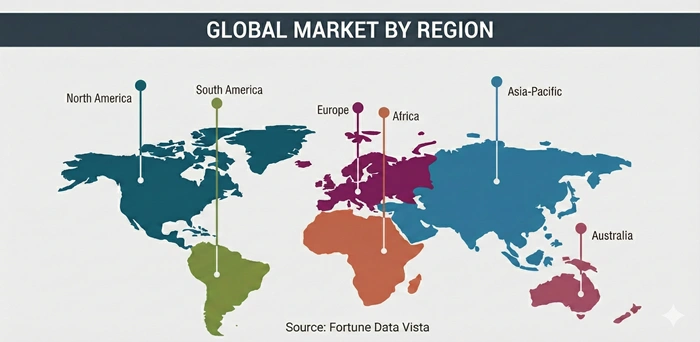
Regional Insights
North America
North America's Commanding Lead in the Aerospace Artificial Intelligence Market Is Built on Unmatched Defense Budgets, World-Leading AI Research Institutions, and a Deep Commercial Aviation Innovation Ecosystem*
North America holds approximately 42.3% of global aerospace artificial intelligence market revenue in 2024, making it the undisputed regional leader, with a projected CAGR of approximately 41.8% through 2033. The United States is the primary driver, powered by the world's largest defense budget, a deeply developed aerospace manufacturing sector, and an unparalleled concentration of AI research universities and technology companies. Major players including Lockheed Martin, Northrop Grumman, Boeing, Palantir Technologies, and IBM maintain strong positions in the region, each investing billions annually in AI-enabled aerospace and defense system development. The U.S. Air Force's AI-enabled combat systems programs, the Navy's autonomous underwater and surface vehicle initiatives, and NASA's AI-driven space exploration platforms collectively represent the most advanced and well-funded aerospace AI deployment programs on the planet.
Canada contributes meaningfully to the regional market, particularly through its aerospace manufacturing hubs in Quebec and Ontario, where companies like CAE Inc. and Bombardier are integrating AI into flight simulation, training systems, and business jet avionics. The regulatory environment in North America — while complex — is among the most advanced globally in terms of AI governance frameworks for aviation, with the FAA having published initial guidance on AI certification pathways that is expected to accelerate commercial aerospace AI deployment timelines through the mid-2020s. This regulatory clarity, combined with the region's deep investment capital availability and talent base, ensures that North America will retain its leadership position within the aerospace artificial intelligence market throughout the forecast period.
Asia Pacific
Asia Pacific Is Emerging as the Most Strategically Significant Growth Market for Aerospace Artificial Intelligence, Powered by China's Defense AI Ambitions and the Region's Explosive Commercial Aviation Expansion*
Asia Pacific is the fastest-growing region within the aerospace artificial intelligence market, projected to expand at a CAGR of approximately 44.6% through 2033 — marginally above the global market average — from a 2024 revenue share of approximately 27.8%. China is unquestionably the engine of this growth, with the Chinese government having designated AI-in-aerospace as a strategic national priority within its 14th and 15th Five-Year Plans. Chinese aerospace and defense companies — including COMAC, AVIC (Aviation Industry Corporation of China), and a growing ecosystem of AI startups backed by Baidu, Alibaba, and Tencent — are investing aggressively in AI-enabled aircraft design, autonomous drone development, and AI-driven air traffic management infrastructure. India is the second most important growth market in the region, where rising defense modernization spending, a rapidly growing commercial aviation sector, and government programs supporting indigenous aerospace AI development are creating strong and accelerating demand.
Japan and South Korea round out the region's sophisticated aerospace AI landscape, with their advanced manufacturing technology sectors contributing significantly to AI integration in precision aerospace component production and inspection systems. Companies such as Mitsubishi Heavy Industries and Korea Aerospace Industries are actively developing AI-enhanced aerospace platforms, while technology players from both countries are supplying AI semiconductors, sensors, and software components that serve the global aerospace AI supply chain. Southeast Asia's booming commercial aviation sector — with rapidly growing fleets in Indonesia, Vietnam, Thailand, and the Philippines — is also beginning to adopt AI-driven fleet management, predictive maintenance, and customer experience tools at scale, expanding the region's addressable market for aerospace AI beyond its current concentration in China and North Asia.
Top Key Players
-
Lockheed Martin Corporation (United States)
-
The Boeing Company (United States)
-
Northrop Grumman Corporation (United States)
-
Raytheon Technologies Corporation (RTX) (United States)
-
General Electric Company (United States)
-
Airbus SE (Netherlands / France)
-
Thales Group (France)
-
Honeywell International Inc. (United States)
-
IBM Corporation (United States)
-
Palantir Technologies Inc. (United States)
-
Intel Corporation (United States)
-
Microsoft Corporation (United States)
-
NVIDIA Corporation (United States)
-
Rolls-Royce Holdings plc (United Kingdom)
-
BAE Systems plc (United Kingdom)
-
Safran SA (France)
Recent Developments
-
In 2025, Lockheed Martin announced a major expansion of its AI-enabled mission systems portfolio, including the successful demonstration of an AI-driven collaborative combat aircraft (CCA) prototype that autonomously coordinated with manned fighter aircraft during live flight testing, marking a significant milestone in the company's autonomous systems development program.
-
In 2024, Palantir Technologies secured a landmark multi-year contract with the U.S. Department of Defense to deploy its AI Operations Platform (AIP) across multiple branches of the armed forces, significantly expanding the company's presence in defense AI applications including logistics optimization, predictive maintenance, and battlefield intelligence systems.
-
In 2025, Airbus launched its "ATTOL" (Autonomous Taxi, Take-Off and Landing) program's second phase, deploying advanced machine learning models for fully autonomous ground maneuvering at congested European airports, as part of the company's broader roadmap to integrate certified AI into commercial aircraft operations by the early 2030s.
-
In 2024, General Electric (GE Aerospace) completed a significant investment in its AI-based fleet health monitoring platform "FlightPulse," rolling out enhanced predictive maintenance capabilities to over 100 airline customers globally and reporting documented fuel savings and maintenance cost reductions as a direct result of AI-driven insights.
-
In 2025, Microsoft announced a strategic partnership with Raytheon Technologies (RTX) to co-develop secure AI and cloud computing solutions specifically architected for aerospace and defense applications, combining Microsoft's Azure Government cloud infrastructure with RTX's deep aerospace engineering expertise to serve U.S. and allied defense customers.
Market Trends
The Emergence of Autonomous Combat Systems, AI-Native Aircraft Design Platforms, and the Democratization of Aerospace AI Through Cloud-Based Tools Are Defining the Next Competitive Era*
One of the most impactful trends currently shaping the aerospace artificial intelligence market is the transition of major aerospace OEMs from treating AI as an add-on feature to embedding it as a foundational design principle from the earliest stages of aircraft and system development. This shift — visible in Boeing's digital engineering initiatives, Airbus's AI-first concept aircraft programs, and Lockheed Martin's AI-integrated production systems — is producing aircraft and defense systems with AI capabilities that are architecturally integrated rather than retrofitted, enabling far more sophisticated autonomous behaviors, predictive capabilities, and operational flexibility than previous-generation platforms could achieve.
In parallel, the democratization of aerospace AI through cloud-based platforms and as-a-service delivery models is expanding the market's customer base considerably. Smaller regional airlines, mid-tier defense contractors, and aerospace component manufacturers that previously lacked the resources to build or buy bespoke AI systems are now accessing powerful AI analytics, predictive maintenance, and operational optimization capabilities through subscription-based cloud platforms offered by companies like IBM, Microsoft, and specialized aerospace AI startups. This accessibility shift is broadening the total addressable market significantly, bringing AI adoption to segments of the industry that have historically been underserved by large-system aerospace AI vendors and are now ready to invest.
Segments Covered in the Report
-
By Technology
-
Machine Learning
-
Deep Learning
-
Natural Language Processing (NLP)
-
Computer Vision
-
Context-Aware Computing
-
Others
-
-
By Application
-
Predictive Maintenance and Monitoring
-
Autonomous and Unmanned Systems
-
Flight Operations and Management
-
Air Traffic Management (ATM)
-
Threat Detection and Cybersecurity
-
Manufacturing and Quality Control
-
Passenger Experience Optimization
-
Others
-
-
By Platform
-
Commercial Aircraft
-
Military Aircraft
-
Unmanned Aerial Vehicles (UAVs)
-
Spacecraft
-
Ground Systems and Infrastructure
-
-
By End-User
-
Commercial Aviation
-
Defense and Security
-
Space Exploration
-
MRO (Maintenance, Repair, and Overhaul)
-
-
By Component
-
Hardware (Processors, Sensors, Memory)
-
Software (AI Platforms, Analytics Tools)
-
Services (Consulting, Integration, Managed AI Services)
-
-
By Region
-
North America (U.S., Canada, Mexico)
-
Europe (Germany, France, UK, Italy, Rest of Europe)
-
Asia Pacific (China, India, Japan, South Korea, Rest of Asia Pacific)
-
Latin America (Brazil, Rest of Latin America)
-
Middle East & Africa (GCC Countries, Rest of MEA)
-
❝ Built for Every Level — From Startups to Industry Giants ❞
Here Is Exactly How This Report Works for You
-
Whether you are a startup building a niche aerospace AI application or a Tier 1 defense contractor evaluating billion-dollar AI integration investments, this report delivers precise segment revenue forecasts, competitive positioning intelligence, and geopolitical risk analysis that equip your leadership team to make confident market entry, product development, and capital allocation decisions across the explosive 2026–2033 growth window.
-
For investors, mid-level aerospace technology companies, and diversified industrial conglomerates, the report's detailed supply-demand analysis and competitor revenue breakdown reveal how shifting defense procurement policies, trade restrictions on AI semiconductor exports, and evolving aviation certification timelines are affecting market access and margin dynamics — giving you the strategic context to make risk-adjusted investment decisions in a highly dynamic geopolitical environment.
-
The competitive intelligence section provides granular analysis of revenue sources, contract win history, technology partnership strategies, and M&A activity for the top 16 players in the global aerospace artificial intelligence industry — equipping procurement teams, corporate strategy executives, and M&A advisory professionals with the actionable data they need to identify acquisition targets, benchmark their AI capabilities, and navigate the consolidating competitive landscape with confidence.
Frequently Asked Questions:
Answer: The global aerospace artificial intelligence market is valued at USD 1.38 billion in 2025 and is projected to reach USD 71.16 billion by 2033. This reflects a remarkable CAGR of 42.45% from 2026 to 2033, driven by surging defense AI investment and the proliferation of autonomous aerial systems worldwide.
Answer: The key growth drivers include massive government defense AI modernization programs, the scaling of autonomous and unmanned aerial vehicles, and the widespread adoption of AI for predictive maintenance in commercial and military aviation. The emergence of urban air mobility and space AI applications is adding further momentum to this already fast-growing market.
Answer: North America holds the dominant position in the aerospace artificial intelligence market with approximately 42% of global revenue, driven by U.S. defense AI programs and leading aerospace OEMs. Asia Pacific is the fastest-growing region, expanding above the global CAGR average, led primarily by China's defense AI ambitions and India's aerospace manufacturing growth.
Answer: The primary challenges include the complex and lengthy AI system certification processes required by aviation regulators such as the FAA and EASA, which significantly extend deployment timelines. Cybersecurity risks and the shortage of specialized aerospace AI engineering talent further constrain the pace at which companies can scale their AI capabilities across this highly regulated sector.
Answer: Autonomous and unmanned systems represent the highest-growth application segment within the aerospace artificial intelligence market, projected to expand at a CAGR exceeding 45% through 2033. This growth is driven by accelerating defense investment in UAVs, the commercialization of eVTOL platforms, and the growing role of AI in managing increasingly complex autonomous aerospace operations globally.