
Agricultural Lubricant Market Overview
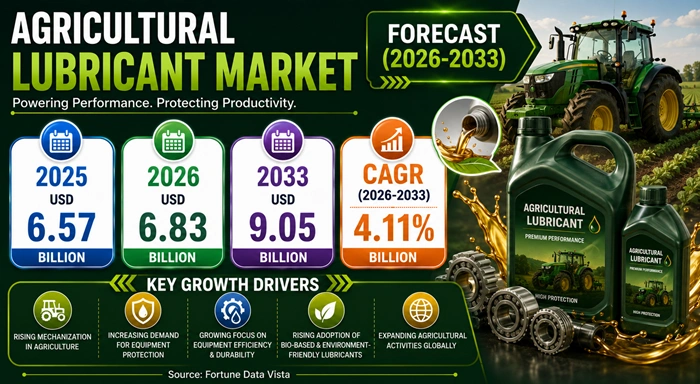
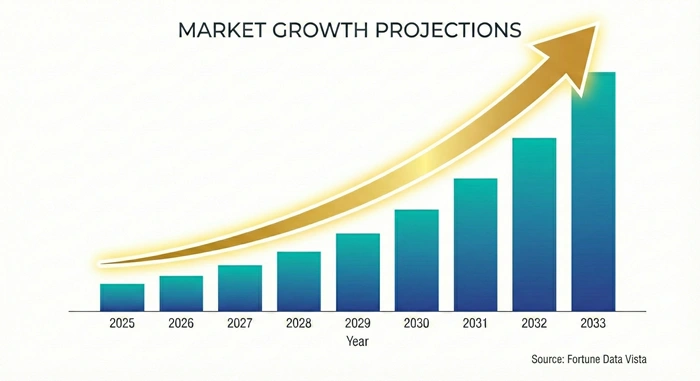
The global agricultural lubricant market size is valued at USD 6.57 billion in 2025 and is predicted to increase from USD 6.83 billion in 2026 to approximately USD 9.05 billion by 2033, growing at a CAGR of 4.11% from 2026 to 2033.
This steady growth reflects the ongoing mechanization of farming operations worldwide, where tractors, harvesters, and other heavy equipment depend on high-performance lubricants to maintain engine efficiency and reduce costly downtime. As farms scale up and machinery becomes more technologically advanced, demand for specialized agricultural lubricant formulations continues climbing across both developed and emerging farming economies.
AI Impact on the Agricultural Lubricant Industry
Artificial Intelligence Is Enabling Predictive Maintenance Scheduling, Optimizing Lubricant Formulation Testing, and Strengthening Equipment Failure Prevention Across the Agricultural Lubricant Landscape — Fundamentally Changing How Farm Operators Manage Machinery Uptime
Artificial intelligence has become an increasingly valuable tool for large-scale farm operators managing extensive equipment fleets, with predictive maintenance platforms now capable of analyzing sensor data from tractors and harvesters to flag exactly when lubricant degradation is approaching a level that could risk engine wear or component failure. This capability allows farm managers to schedule oil changes and lubricant replenishment based on actual equipment condition rather than relying solely on fixed maintenance intervals, helping avoid both premature servicing and costly unexpected breakdowns during critical planting or harvest windows. Equipment manufacturers integrating these AI-driven monitoring systems directly into modern machinery are increasingly setting a new standard for how farms approach preventive maintenance planning.
Beyond predictive maintenance, AI is also playing a growing role in how lubricant manufacturers develop and test new formulations, using machine learning models to simulate how different additive combinations will perform under the wide range of temperature and load conditions typical of agricultural equipment operation. This modeling capability allows chemists to narrow down promising formulations before committing to expensive physical testing, accelerating development timelines for bio-based and synthetic lubricant alternatives. As these AI-driven maintenance and formulation tools continue advancing, they are becoming an increasingly important competitive advantage for suppliers within the broader agricultural lubricant market.
Growth Factors
Rising Farm Mechanization and Growing Demand for Extended Equipment Life Continue Driving Sustained Demand
The most significant growth factor supporting the agricultural lubricant market is the continued global expansion of farm mechanization, as more farming operations across both developed and emerging economies invest in tractors, combines, and other powered equipment to boost productivity and address rising food demand. As mechanized equipment fleets expand, the corresponding need for engine oils, hydraulic fluids, and greases naturally grows alongside them, creating a durable base of consistent lubricant consumption tied directly to equipment operating hours.
A second important growth factor is the increasing emphasis farm operators place on extending machinery lifespan and minimizing unplanned downtime, particularly during time-sensitive planting and harvest seasons when equipment failure can carry significant financial consequences. This has pushed many operators toward higher-performance synthetic and semi-synthetic lubricant formulations that offer superior thermal stability and wear protection compared to conventional mineral-based products. This combination of expanding mechanized farmland and growing emphasis on equipment reliability continues to broaden demand across the agricultural lubricant market.
Market Outlook
Bio-Based Formulation Advancement and Precision Farming Integration Point Toward Sustained Growth Through 2033
Looking ahead through the forecast period, the agricultural lubricant industry is expected to benefit substantially from continued development of bio-based and biodegradable lubricant formulations, as environmental regulations and grower sustainability commitments push the industry away from traditional mineral oil products toward more eco-friendly alternatives. This shift is likely to become an increasingly important purchasing consideration for larger farming operations facing growing scrutiny around agricultural runoff and soil contamination risks associated with conventional lubricants.
At the same time, deeper integration between lubricant suppliers and precision farming technology providers is expected to create new demand for lubricants specifically engineered to support the sensors, hydraulic systems, and automated components found in modern precision agricultural equipment. Companies that can deliver both traditional high-performance formulations and newer bio-based alternatives while supporting the technical requirements of precision machinery are increasingly well positioned to capture this growth. Suppliers combining strong chemical research capabilities with close OEM equipment partnerships are likely to lead growth within the broader agricultural lubricant market through 2033.
Expert Speaks
-
"Our customers rely on us to deliver lubricants that keep their equipment running reliably through the most demanding planting and harvest conditions, and we continue investing in formulations that extend machinery life." — CEO, Chevron Corporation
-
"As farming operations grow larger and machinery becomes more sophisticated, the demand for advanced, purpose-built lubricants continues rising, and our portfolio keeps evolving to meet that need." — CEO, Shell plc
-
"Sustainability is becoming a defining priority across agriculture, and our bio-based lubricant offerings reflect our commitment to supporting environmentally responsible farming practices." — CEO, TotalEnergies SE
Key Report Takeaways
-
Asia Pacific leads the global agricultural lubricant market, holding approximately 40% market share in 2025, supported by rapid farm mechanization across China and India backed by strong government support
-
North America is the fastest-growing region, projected to expand at a CAGR near 4.7% through 2033, driven by large-scale precision farming adoption and advanced machinery upgrades
-
Large commercial farms represent the dominant end-user segment, accounting for roughly 55% share, given their extensive equipment fleets requiring consistent lubricant supply
-
Engine oil applications contribute the most to overall demand, reflecting the essential role lubricants play in maintaining tractor and harvester engine performance
-
Mineral oil-based lubricants remain the most widely adopted base type, valued for their cost-effectiveness and broad availability across developing farming regions
-
Bio-based lubricants will grow the fastest among product segments, holding close to 22% market share with a CAGR near 8% through the forecast period, driven by rising environmental regulation and grower sustainability commitments
Market Scope
| Parameter | Details |
|---|---|
| Market Size by 2033 | USD 9.05 Billion | Market Size by 2026 | USD 6.83 Billion | Market Size by 2025 | USD 6.57 Billion | Market Growth Rate from 2026 to 2033 | CAGR of 4.11% | Dominating Region | Asia Pacific | Fastest Growing Region | North America | Segments Covered | Product Type, Base Oil, Equipment Type, Sales Channel, Region | Regions Covered | North America, Europe, Asia Pacific, Latin America, Middle East & Africa |
Market Dynamics
Drivers Impact Analysis
Rising Farm Mechanization and Growing Equipment Reliability Needs Remain the Two Strongest Forces Behind Market Momentum
| Driver | (≈) % Impact on CAGR Forecast | Geographic Relevance | Impact Timeline |
|---|---|---|---|
| Rapid expansion of farm mechanization across emerging economies | ~34% | Asia Pacific, Latin America | Short to long-term |
| Growing emphasis on extending machinery lifespan and reducing downtime | ~29% | Global | Medium to long-term |
| Rising adoption of high-performance synthetic lubricant formulations | ~23% | North America, Europe | Medium-term |
| Expanding aftermarket demand for scheduled lubricant replenishment | ~14% | Global | Short to medium-term |
Rapid expansion of farm mechanization across emerging economies continues to serve as the primary engine behind sustained growth in the agricultural lubricant market, as more farming operations invest in tractors and other powered equipment to meet rising food production demands. This growing equipment base has translated directly into higher lubricant consumption among farms scaling up their mechanized operations.
Growing emphasis on extending machinery lifespan represents the second major driver, as farm operators increasingly recognize that consistent, high-quality lubrication directly protects their equipment investment and minimizes the risk of costly breakdowns during time-sensitive seasons. This focus on reliability, combined with rising adoption of high-performance synthetic formulations, continues reinforcing steady demand growth across the broader agricultural lubricant market.
Restraints Impact Analysis
Volatile Base Oil Pricing and Limited Farmer Awareness Continue to Moderate Broader Adoption
| Restraint | (≈) % Impact on CAGR Forecast | Geographic Relevance | Impact Timeline |
|---|---|---|---|
| Volatility in crude oil and base oil pricing affecting production costs | ~35% | Global | Short to medium-term |
| Limited awareness among smallholder farmers regarding lubricant benefits | ~29% | Emerging markets, rural areas | Medium-term |
| Higher cost of premium synthetic and bio-based lubricant formulations | ~22% | Emerging markets, price-sensitive segments | Short to medium-term |
| Growing regulatory scrutiny over conventional mineral oil environmental impact | ~14% | Europe, North America | Medium to long-term |
The most persistent restraint facing the agricultural lubricant market is the ongoing volatility in crude oil and base oil pricing, which directly affects production costs and can create pricing uncertainty for both manufacturers and farm operators planning annual maintenance budgets. This cost sensitivity is particularly pronounced among smaller farming operations that operate on tighter margins.
Limited awareness among smallholder farmers regarding proper lubricant selection and maintenance practices represents a second significant restraint, since many smaller operations continue relying on lower-cost, lower-performance lubricants without fully understanding the long-term equipment benefits of investing in higher-quality products. Combined with the higher upfront cost of premium synthetic and bio-based formulations, these restraints continue moderating how quickly broader adoption of advanced lubricants spreads across the global agricultural lubricant market.
Opportunities Impact Analysis
Bio-Based Formulation Innovation and Precision Farming Integration Represent the Clearest Paths to Growth
| Opportunity | (≈) % Impact on CAGR Forecast | Geographic Relevance | Impact Timeline |
|---|---|---|---|
| Advancing bio-based and biodegradable lubricant formulation technology | ~37% | Europe, North America, growing globally | Short to medium-term |
| Expanding precision farming equipment adoption requiring specialized lubricants | ~33% | North America, Europe | Medium to long-term |
| Growing mechanized farmland expansion across emerging Asia Pacific economies | ~30% | Asia Pacific | Medium to long-term |
Advancing bio-based and biodegradable lubricant formulation technology represents one of the most substantial opportunities within the agricultural lubricant market, as suppliers developing these environmentally responsible alternatives stand to capture significant share from growers facing increasing regulatory pressure and sustainability expectations. This formulation innovation is expected to meaningfully reshape competitive positioning among leading lubricant manufacturers over the coming years.
Expanding precision farming equipment adoption presents a second substantial opportunity, as increasingly automated and sensor-equipped machinery requires specialized lubricants engineered to support hydraulic systems and precision components reliably. Growing mechanized farmland expansion across emerging Asia Pacific economies further broadens the opportunity landscape, particularly as countries continue investing in agricultural modernization programs. Companies pursuing these parallel opportunities are well positioned to capture meaningful growth within the broader agricultural lubricant market through the forecast period.
Segment Analysis
By Product Type: Engine Oil
Engine Oil Continues to Anchor the Product Landscape, Reflecting Its Essential Role in Farm Equipment Performance
Engine oil holds the largest share within the product type segment of the agricultural lubricant market, accounting for approximately 43% of total segment revenue in 2025. This dominance reflects the essential and continuous role engine oil plays in protecting tractor and harvester engines from wear during extended operating hours, particularly during intensive planting and harvest periods when equipment runs at maximum capacity. In markets like the United States and India, farm operators increasingly favor advanced synthetic blend engine oils that offer superior thermal stability and fuel efficiency compared to conventional mineral-based products. Leading suppliers such as Shell, Chevron, and ExxonMobil continue to dominate this segment through continuous formulation innovation and expanded distribution networks.
Growth within this segment remains particularly strong in Asia Pacific, where rapidly expanding tractor and combine adoption across China and India continues driving demand for reliable, cost-effective engine oil products suited to intensive mechanized farming. The region's combination of large farming populations and growing government support for agricultural modernization has helped engine oil maintain its leading position despite growing interest in specialized hydraulic and gear lubricant alternatives. As mechanized farming equipment fleets continue expanding globally, engine oil is expected to remain the dominant product type within the broader agricultural lubricant market throughout the forecast period.
By Equipment Type: Tractors
Tractors Remain the Leading Equipment Category, Reflecting Their Central Role in Modern Farming Operations
Tractors account for approximately 56% of equipment-based revenue within the agricultural lubricant market, reflecting their essential role across nearly every stage of modern farming, from plowing and planting to hauling and general utility work throughout the growing season. Farm operators increasingly rely on specialized lubricants engineered to withstand the heavy loads and variable environmental conditions tractors regularly encounter, making consistent lubrication a critical component of maintaining long-term equipment reliability. This steady, high-volume demand has made tractors the anchor equipment category for lubricant suppliers targeting agricultural machinery customers.
Growth in this equipment segment remains especially strong in North America, where large-scale commercial farms continue upgrading to advanced, technologically sophisticated tractors requiring higher-performance lubricant formulations. Companies like John Deere and AGCO have worked closely with lubricant suppliers to optimize product recommendations for their equipment lines, often bundling maintenance guidance with new machinery purchases. As tractor adoption continues expanding across both developed and emerging farming regions, this equipment segment is expected to remain the primary demand driver within the broader agricultural lubricant market.
Regional Insights
Asia Pacific
Rapid Farm Mechanization and Strong Government Support Keep Asia Pacific Firmly in the Lead
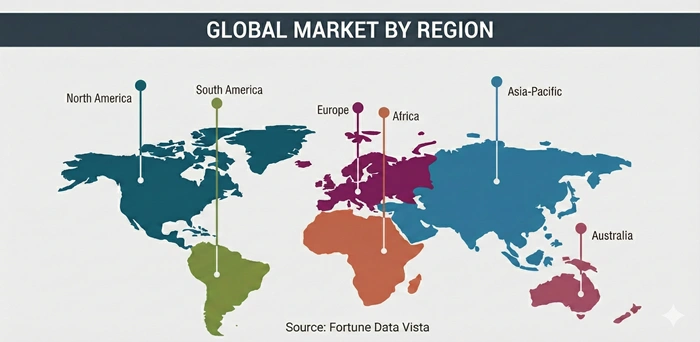
Asia Pacific commands the leading position in the global agricultural lubricant market, holding approximately 40% share in 2025, supported by rapid farm mechanization across China and India, backed by substantial government initiatives aimed at boosting agricultural productivity and modernizing rural farming infrastructure. China drives a significant portion of regional demand, backed by large-scale tractor and combine adoption alongside expanding domestic lubricant production capacity from major regional suppliers. Companies with strong regional presence include Sinopec, Indian Oil Corporation, and Shell, each maintaining deep relationships with regional equipment manufacturers and distributors.
India also contributes substantially to regional demand, supported by government subsidies for tractor purchases and growing farmer awareness of proper equipment maintenance practices. The region's combination of massive farming populations, expanding mechanized equipment fleets, and continuous government modernization support ensures Asia Pacific's leadership position within the agricultural lubricant market remains firmly intact through the remainder of the forecast period.
North America
Advanced Precision Farming Adoption and Environmental Regulation Position North America as the Fastest-Growing Region
North America is projected to register the fastest CAGR within the global agricultural lubricant market through 2033, expanding at a rate near 4.7% as advanced precision farming adoption and environmental regulations promoting eco-friendly lubricant formulations continue driving regional growth. The United States leads much of this regional growth, supported by large commercial farms investing in technologically sophisticated machinery that requires specialized, high-performance lubricant products. Companies with strong regional presence include Chevron, ExxonMobil, and Valvoline, each expanding their research investment into bio-based and synthetic formulations suited to modern precision equipment.
Canada also contributes meaningfully to regional growth, supported by expanding large-scale farming operations and growing adoption of sustainable agricultural practices that favor biodegradable lubricant alternatives. Government initiatives promoting fuel-efficient, environmentally responsible machinery continue accelerating lubricant innovation among regional suppliers serving increasingly sophisticated farm operators. This combination of advanced equipment adoption, strong regulatory support, and growing sustainability focus positions North America as the clear growth leader within the broader agricultural lubricant market through the forecast period.
Customization Available for This Report
Region-Specific and Country-Specific Versions of This Report Are Available to Deliver a Sharper, More Localized View of Market Dynamics
This report can be tailored on a region-by-region and country-by-country basis, providing localized market sizing, competitive mapping, and farm mechanization trend analysis that a global overview alone cannot fully capture.
Clients seeking a more focused breakdown can request a customized version covering any of the following regions and countries, complete with demand forecasting, competitor landscape review, and adoption trend analysis tied specifically to the agricultural lubricant keyword focus:
North America
-
U.S. — Detailed review of precision farming adoption and bio-based lubricant regulation trends
-
Canada — Coverage of large-scale farming investment and sustainability adoption patterns
-
Mexico — Analysis of emerging farm mechanization modernization trends
Europe
-
U.K. — Review of agricultural equipment regulation and lubricant adoption trends
-
Germany — Coverage of farm machinery investment among leading agricultural equipment manufacturers
-
France — Insights into sustainable lubricant modernization and adoption patterns
-
Italy — Analysis of regional agricultural equipment investment trends
-
Rest of Europe — Country-level view of emerging demand across Eastern Europe and the Nordics
Asia Pacific
-
China — Coverage of expanding tractor adoption and domestic lubricant production investment
-
India — Analysis of growing farm mechanization and government subsidy programs
-
Japan — Review of established agricultural equipment market and adoption trends
-
South Korea — Assessment of farm equipment investment and lubricant adoption
-
Australia — Insights into large-scale farming and lubricant adoption trends
-
Rest of Asia Pacific — Country-level breakdown covering Thailand, Vietnam, Indonesia, and Malaysia
Latin America
-
Brazil — Coverage of expanding commercial farming investment and lubricant adoption
-
Argentina — Analysis of early-stage farm mechanization modernization trends
-
Rest of Latin America — Country-level sizing across Colombia, Peru, and Chile
Middle East & Africa
-
UAE — Review of agricultural equipment investment and lubricant adoption trends
-
Saudi Arabia — Coverage of expanding farm mechanization modernization initiatives
-
Rest of MEA — Country-level view of Sub-Saharan Africa agricultural equipment expansion
Top Key Players
-
Shell plc (United Kingdom)
-
Chevron Corporation (United States)
-
Exxon Mobil Corporation (United States)
-
TotalEnergies SE (France)
-
BP plc, Castrol (United Kingdom)
-
Valvoline Inc (United States)
-
FUCHS Petrolub SE (Germany)
-
Phillips 66 (United States)
-
PETRONAS Lubricants International (Malaysia)
-
Sinopec Lubricant Company (China)
-
Indian Oil Corporation Ltd (India)
-
Schaeffer Manufacturing Co (United States)
Recent Developments
-
In 2025, Shell expanded its agricultural lubricant portfolio with enhanced synthetic engine oil formulations designed to improve fuel efficiency across modern tractor engines
-
In 2025, Chevron strengthened its bio-based lubricant research investment to support growing grower demand for environmentally responsible farming products
-
In 2026, TotalEnergies deepened its investment in biodegradable hydraulic fluid technology to support precision farming equipment adoption across European markets
-
In 2025, FUCHS Petrolub advanced its specialty greases lineup with new formulations engineered for heavy-duty farm equipment operating in extreme conditions
-
In 2025, PETRONAS Lubricants International expanded its manufacturing capacity across Asia Pacific to support rising demand from rapidly mechanizing farming economies
Market Trends
Bio-Based Formulation Growth and Precision Equipment Integration Are Reshaping Industry Standards
One of the clearest trends shaping the agricultural lubricant market is the accelerating development of bio-based and biodegradable formulations, as environmental regulations and grower sustainability commitments push suppliers to reduce reliance on conventional mineral oil products. Manufacturers are investing heavily in additive research, recognizing that environmental credentials are becoming an increasingly important competitive differentiator as farming operations face growing scrutiny around soil and water contamination risks.
A second significant trend is the growing integration between lubricant suppliers and precision farming equipment manufacturers, as increasingly automated and sensor-equipped machinery requires specialized formulations engineered to support hydraulic systems and precision components reliably. This trend toward closer OEM collaboration is particularly meaningful for suppliers targeting large commercial farms upgrading to technologically advanced equipment, continuing to support steady expansion across the broader agricultural lubricant market as machinery sophistication increases.
Segments Covered in the Report
By Product Type
-
Engine Oil
-
Hydraulic Fluid
-
Gear Oil
-
Grease
-
Coolants
By Base Oil
-
Mineral Oil
-
Synthetic Oil
-
Bio-Based Oil
By Equipment Type
-
Tractors
-
Combines and Harvesters
-
Irrigation Equipment
-
Other Farm Machinery
By Sales Channel
-
OEM
-
Aftermarket
By Region
-
North America (U.S., Canada, Mexico)
-
Europe (U.K., Germany, France, Italy, Rest of Europe)
-
Asia Pacific (China, India, Japan, South Korea, Australia, Rest of Asia Pacific)
-
Latin America (Brazil, Argentina, Rest of Latin America)
-
Middle East & Africa (UAE, Saudi Arabia, Rest of MEA)
❝ Built for Every Level — From Startups to Industry Giants ❞
Here Is Exactly How This Report Works for You
-
For tier 1 companies, investors, and established market leaders, this report delivers detailed competitor revenue analysis, bio-based formulation trend mapping, and geopolitical risk context that support confident decisions around product expansion, pricing strategy, and long-term positioning within the agricultural lubricant space
-
For tier 2 and tier 3 companies, startups, and mid-sized suppliers, this report highlights the most commercially promising equipment categories and underserved regional opportunities, giving you a practical framework to compete against larger established players without overextending limited resources
-
For every decision maker across the value chain, this report explains exactly how mechanization trends, regulatory developments, and competitor formulation innovations are shaping market direction through 2033, equipping you to plan investment and go-to-market decisions with genuine confidence
Frequently Asked Questions:
Answer: The global agricultural lubricant market was valued at USD 6.57 billion in 2025 and is projected to reach USD 9.05 billion by 2033. This growth is driven largely by rising farm mechanization and growing emphasis on equipment reliability.
Answer: Growth in the agricultural lubricant market is being driven by rapid farm mechanization across emerging economies and rising adoption of high-performance synthetic formulations. Growing emphasis on reducing equipment downtime is further reinforcing this expansion.
Answer: Asia Pacific currently leads the agricultural lubricant market with roughly 40% share, supported by rapid farm mechanization across China and India. North America is growing the fastest, driven by precision farming adoption.
Answer: Engine oil generates the largest share of revenue in the agricultural lubricant market, reflecting its essential role in protecting farm equipment engines. Tractors also remain the dominant equipment category driving demand.
Answer: Leading companies in the agricultural lubricant market include Shell, Chevron, ExxonMobil, TotalEnergies, and FUCHS Petrolub. These companies compete through continuous innovation in bio-based and synthetic lubricant formulations.