
AI Inference-as-a-Service Market Overview
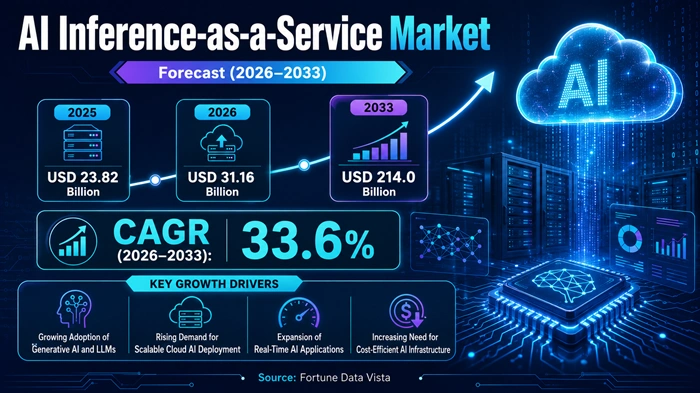
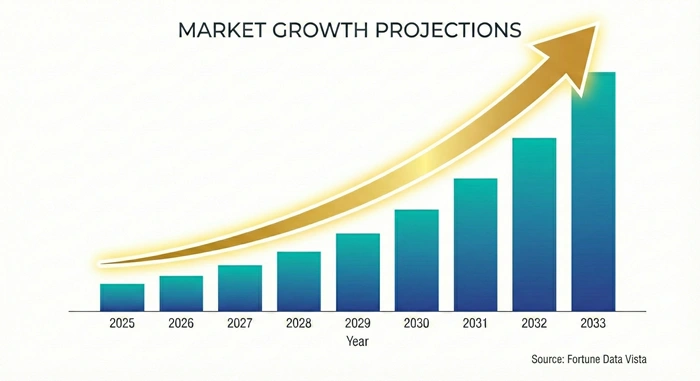
The global AI inference-as-a-service market size is valued at USD 23.82 billion in 2025 and is predicted to increase from USD 31.16 billion in 2026 to approximately USD 214.0 billion by 2033, growing at a CAGR of 33.6% from 2026 to 2033.
As enterprises globally accelerate their adoption of artificial intelligence — particularly large language models, computer vision systems, and generative AI applications — the demand for scalable, low-latency, and cost-efficient cloud-based AI inference services is growing at an extraordinary pace. AI inference-as-a-service platforms allow organizations to deploy pre-trained and custom AI models through cloud APIs without managing the complex and expensive GPU infrastructure that inference workloads demand. The convergence of generative AI commercialization, enterprise digital transformation, and the prohibitive cost of on-premises inference hardware is making cloud-delivered inference services the default AI deployment model for the majority of businesses across industries globally.
AI Impact on the AI Inference-as-a-Service Industry
Artificial Intelligence Advances in Model Efficiency, Quantization, and Specialized Inference Hardware Are Simultaneously Expanding the Capability and Reducing the Cost of Cloud AI Inference Services — Creating a Self-Reinforcing Growth Dynamic That Is Dramatically Broadening the Addressable Market for AI Inference-as-a-Service Platforms
It may seem circular to discuss AI's impact on the AI inference-as-a-service market, but the reality is that advances in AI model architecture and optimization are among the most powerful commercial forces reshaping the competitive landscape and cost economics of inference-as-a-service platforms. Breakthroughs in model quantization — which compress full-precision neural network weights to lower-bit representations without significant performance degradation — are dramatically reducing the GPU memory and compute requirements for inference workloads, enabling cloud providers to serve more inference requests per GPU unit and pass meaningful cost savings through to enterprise customers. Similarly, advances in model distillation that produce smaller, faster, and equally capable "student" models from larger "teacher" models are enabling inference service providers to deliver lower-latency, higher-throughput AI outputs at costs that make previously impractical AI application use cases commercially viable.
The development of purpose-built AI inference accelerator chips — including NVIDIA's H200 and Blackwell GPUs, Google's Tensor Processing Units (TPUs), Amazon's Trainium and Inferentia chips, and Microsoft's Maia silicon — is creating a hardware specialization layer that is simultaneously improving inference performance-per-watt and reducing per-token inference costs at rates that no general-purpose computing hardware can match. These inference-optimized silicon platforms are available exclusively through the major cloud hyperscalers' inference-as-a-service platforms — creating a powerful and durable hardware moat around cloud AI inference that makes on-premises inference economically unjustifiable for the vast majority of enterprise use cases. As next-generation inference hardware generations continue to multiply performance while reducing cost, the economic case for cloud-delivered AI inference-as-a-service over alternative deployment models strengthens with every hardware cycle.
Growth Factors
The Explosive Commercialization of Generative AI and Large Language Models, the Enterprise Shift to Cloud-Native AI Architecture, and the Prohibitive Cost of On-Premises AI Inference Infrastructure Are the Primary Forces Fueling the Extraordinary Growth of the AI Inference-as-a-Service Market
The generative AI commercialization wave is the single most powerful near-term growth driver in the AI inference-as-a-service market, as every enterprise application of large language models — from customer service chatbots and document analysis tools to code generation systems and multimodal content platforms — requires scalable inference infrastructure that cloud-delivered inference services are uniquely positioned to provide cost-effectively. The deployment of LLMs in production enterprise environments generates unpredictable, bursty inference workloads that are poorly suited to fixed on-premises GPU infrastructure — which either sits idle during low-demand periods or fails to meet peak demand during high-traffic events. Cloud inference-as-a-service platforms solve this mismatch elegantly through elastic scaling that automatically provisions additional inference capacity in seconds, allowing enterprises to optimize both cost and performance without managing infrastructure complexity. This fundamental operational advantage of cloud inference over on-premises deployment is driving an accelerating enterprise migration to inference-as-a-service models that is expected to sustain extraordinary market growth across the forecast period.
The enterprise digital transformation megatrend is the second major growth driver, operating through the progressive embedding of AI inference capability into the operational workflows, products, and customer experiences of businesses across every major industry. Healthcare organizations deploying AI diagnostic imaging analysis, BFSI companies integrating real-time fraud detection and credit scoring models, retailers embedding personalized recommendation engines, and manufacturers deploying predictive quality and maintenance systems all require reliable, scalable inference capacity that is most efficiently and cost-effectively accessed through cloud inference-as-a-service platforms. As AI moves from discrete pilot projects to pervasive operational integration — where AI inference becomes embedded in hundreds of business processes simultaneously — the inference volume generated by enterprise digital transformation grows exponentially rather than linearly, creating a compounding demand growth dynamic for AI inference-as-a-service platforms.
Market Outlook
The AI Inference-as-a-Service Market Is Positioned for One of the Fastest Growth Trajectories in the Global Technology Industry Through 2033, Powered by the Generative AI Deployment Wave, the Growing Enterprise AI Maturity, and the Relentless Innovation in Inference Hardware and Model Efficiency That Is Expanding Both Supply Capability and Demand Addressability
The long-term growth outlook for the AI inference-as-a-service market is among the most compelling in the global technology sector, supported by demand drivers that are simultaneously structural — rooted in the fundamental economics of cloud versus on-premises AI infrastructure — and dynamic, driven by the continuous expansion of AI application categories that create new inference workload demand. The generative AI deployment wave currently dominating technology spending discussions is only the leading edge of a broader AI inference demand wave that will eventually encompass virtually every software application category as AI capability becomes embedded into productivity tools, customer experience platforms, enterprise resource systems, and industrial automation solutions. As the total volume of enterprise AI inference requests grows from billions to trillions per day over the forecast period, the scale of revenue opportunity for inference-as-a-service providers expands proportionally.
The competitive landscape of the AI inference-as-a-service market is also evolving in ways that are expanding the total market opportunity — with specialized inference platform providers, open-source model hosts, and regional cloud operators increasingly participating alongside the dominant hyperscaler platforms (AWS, Google Cloud, Microsoft Azure) to serve a more diverse range of enterprise inference requirements across latency, cost, data privacy, and model specialization dimensions. This expansion of inference service supply — through more diverse provider types, more inference-optimized deployment architectures, and more geographically distributed inference infrastructure — is progressively making AI inference-as-a-service accessible and cost-effective for organizations that the hyperscaler platforms alone do not optimally serve, broadening the total addressable market and sustaining the extraordinary growth rates that characterize this market's early commercialization phase.
Expert Speaks
-
"Microsoft's Azure AI infrastructure is at the center of one of the most significant technology transitions we have witnessed — the shift from discrete AI model training to continuous, large-scale AI inference that is now embedded into the daily workflows of hundreds of millions of enterprise users globally. Our investment in AI inference-optimized data centers, custom silicon, and the Azure AI Foundry inference platform is directly responding to this extraordinary demand, and we see the AI inference-as-a-service market continuing to grow at exceptional rates as enterprise AI deployment matures and inference workloads scale." — Satya Nadella, CEO, Microsoft Corporation
-
"Amazon Web Services is seeing unprecedented demand across our AI inference services — from our Bedrock foundation model platform and our SageMaker real-time inference endpoints to our purpose-built Inferentia and Trainium chips that deliver the best inference price-performance in the cloud. The AI inference market is fundamentally reshaping cloud computing economics, and AWS is committed to continuous innovation in inference hardware, software, and pricing models that make AI inference-as-a-service accessible and cost-effective for customers of every size and technical sophistication." — Andy Jassy, CEO, Amazon
-
"Google Cloud's investment in AI inference infrastructure — anchored by our Tensor Processing Units, our Vertex AI prediction platform, and our leadership in transformer model architecture research — positions us at the forefront of the global AI inference-as-a-service market. We see this market growing at extraordinary rates through the decade as generative AI moves from experimental deployment to pervasive enterprise integration, and Google Cloud's combination of proprietary inference silicon, open-source model ecosystem leadership, and enterprise AI platform capabilities gives us a uniquely strong competitive position to serve this demand." — Sundar Pichai, CEO, Alphabet / Google
Key Report Takeaways
-
North America dominates the global AI inference-as-a-service market, accounting for approximately 42% of total global revenue in 2026, anchored by the United States' position as the world's leading AI technology development and enterprise AI adoption market — home to the world's dominant inference-as-a-service providers including Amazon Web Services, Microsoft Azure, and Google Cloud, which collectively serve the vast majority of global enterprise AI inference workloads through their hyperscaler cloud platforms.
-
Asia Pacific is the fastest-growing regional market, expanding at a CAGR of approximately 37% from 2026 to 2033, driven by China's massive domestic AI industry and government-backed AI infrastructure investment programs, Japan's advanced enterprise technology adoption, South Korea's technology sector depth, and India's rapidly expanding AI startup and enterprise technology ecosystem that is generating growing demand for scalable inference-as-a-service platforms.
-
Large enterprises are the dominant end-user segment, contributing approximately 65% of total end-user revenue in 2026, reflecting their earlier and more comprehensive AI adoption maturity, larger AI application deployment budgets, and more complex inference workload requirements that drive disproportionately high per-customer inference service consumption relative to SME customers.
-
Large language models are the dominant model type segment, accounting for approximately 48% of total model-type revenue in 2026, as the explosive enterprise adoption of generative AI applications — customer service automation, document intelligence, code generation, content creation, and multimodal analysis — creates enormous and rapidly scaling LLM inference demand that is the primary revenue growth engine for leading cloud AI inference-as-a-service platforms globally.
-
Public cloud is the dominant deployment mode, holding approximately 62% of total deployment mode revenue in 2026, as the elastic scalability, pay-per-use pricing, and access to the latest inference-optimized hardware that public cloud inference platforms provide make them the default deployment model for the majority of enterprise AI inference workloads.
-
Healthcare is the fastest-growing end-use industry segment, projected to reach approximately 18% of total end-use industry revenue by 2033 at a CAGR of approximately 38% from 2026 to 2033, driven by the rapid deployment of AI diagnostic imaging, clinical documentation, drug discovery, and patient engagement applications that require scalable, HIPAA-compliant inference-as-a-service platforms with healthcare-specific data security and regulatory compliance capabilities.
Market Scope
| Parameter | Details |
|---|---|
| Market Size by 2033 | USD 214.0 Billion | Market Size by 2026 | USD 31.16 Billion | Market Size by 2025 | USD 23.82 Billion | Market Growth Rate from 2026 to 2033 | CAGR of 33.6% | Dominating Region | North America | Fastest Growing Region | Asia Pacific | Segments Covered | Component, Deployment Mode, Model Type, Enterprise Size, End Use Industry | Regions Covered | North America, Europe, Asia Pacific, Latin America, Middle East and Africa |
Market Dynamics
Drivers Impact Analysis
The Generative AI Enterprise Adoption Surge, the Prohibitive Economics of On-Premises AI Inference Infrastructure, and the Rapid Enterprise Digital Transformation Embedding AI Inference Into Core Business Processes Are the Three Most Powerful Drivers Accelerating Growth in the AI Inference-as-a-Service Market
| Driver | ≈ % Impact on CAGR Forecast | Geographic Relevance | Impact Timeline |
|---|---|---|---|
| Generative AI and LLM enterprise commercialization | ~32% | North America, Europe, Asia Pacific | Short to Long-Term |
| Prohibitive cost and complexity of on-premises AI inference infrastructure | ~26% | Global | Short to Long-Term |
| Enterprise digital transformation embedding AI in core workflows | ~20% | North America, Europe, Asia Pacific | Medium to Long-Term |
| Growing availability of open-source foundation models driving inference demand | ~10% | Global | Short to Medium-Term |
| Inference-optimized cloud silicon reducing per-token costs and expanding use cases | ~8% | North America, Asia Pacific | Short to Medium-Term |
| Real-time AI application demand requiring low-latency cloud inference | ~4% | Global | Medium-Term |
The generative AI commercialization driver is both the most immediately powerful and the most visible force in the AI inference-as-a-service market today. Enterprise adoption of LLM-powered applications — which began accelerating rapidly following the public launch of ChatGPT in late 2022 and has continued to intensify as enterprise AI tools from Microsoft, Google, Salesforce, ServiceNow, and hundreds of AI-native startups have reached mainstream commercial deployment — generates inference workloads at a scale that virtually no enterprise could cost-effectively support through on-premises GPU infrastructure. A single large language model inference API call can require dozens of GPU operations across a parameter space of tens or hundreds of billions of weights — and enterprises running customer-facing AI applications may require millions of such inference calls per day, creating a scale of GPU compute demand that is practical to serve only through the massive, purpose-built inference infrastructure of hyperscaler cloud platforms.
The digital transformation driver operates through a broader and longer-lasting mechanism, as AI inference-as-a-service becomes progressively embedded not just in AI-specific applications but in the operational fabric of enterprise software systems. As AI inference APIs become standard components of enterprise ERP, CRM, supply chain, and HR platforms — integrated by enterprise software vendors including SAP, Salesforce, Oracle, and Workday — the inference-as-a-service consumption generated by enterprise digital transformation compounds with every additional software integration. This systemic integration of AI inference into enterprise software infrastructure creates a type of demand that is highly durable and grows with enterprise software usage rather than with discrete AI project starts — providing the AI inference-as-a-service market with a long-term structural demand base that will sustain growth well beyond the current generative AI deployment cycle.
Restraints Impact Analysis
Data Privacy and Security Concerns Around Cloud-Based AI Inference, the Emerging Competitive Threat From On-Device and Edge Inference Deployments, and the High Concentration Risk of Hyperscaler Vendor Dependency Are the Primary Factors Limiting Adoption Speed in the AI Inference-as-a-Service Market
| Restraint | ≈ % Impact on CAGR Forecast | Geographic Relevance | Impact Timeline |
|---|---|---|---|
| Data privacy, security, and regulatory compliance concerns | ~-30% | Europe, Healthcare, BFSI sectors globally | Short to Long-Term |
| Competition from on-device and edge AI inference deployments | ~-25% | Consumer electronics, industrial IoT | Medium to Long-Term |
| Hyperscaler vendor lock-in and pricing dependency concerns | ~-20% | Enterprise customers globally | Medium-Term |
| Network latency limitations for real-time inference applications | ~-14% | Industrial, automotive, real-time applications | Short to Medium-Term |
| High inference cost for large-scale LLM deployment | ~-11% | SMEs, cost-sensitive enterprise customers | Short to Medium-Term |
Data privacy and regulatory compliance is the most significant restraint in the AI inference-as-a-service market, particularly in regulated industries including healthcare, financial services, and government — where the transmission of sensitive data to cloud inference platforms raises concerns about data sovereignty, GDPR and HIPAA compliance, and the potential for sensitive information exposure through model inference processes. European organizations face particularly acute regulatory constraints on cloud AI inference of personal data under the GDPR framework — with data protection authorities in several EU member states having issued guidance on permissible AI inference practices that effectively limits the scope of cloud inference service adoption for certain data types and use cases. These regulatory constraints are moderating the pace of AI inference-as-a-service adoption in regulated industry sectors and in the European market specifically — creating demand for private cloud and hybrid deployment models that provide greater data control, but adding deployment complexity and cost relative to public cloud inference.
The emergence of on-device and edge AI inference as a credible alternative for certain applications — particularly latency-sensitive real-time applications and privacy-critical use cases where data cannot leave the device or premises — creates a competitive ceiling on the addressable market for cloud AI inference-as-a-service in some application categories. Apple's Neural Engine and on-device AI inference capabilities in iPhone and Mac silicon, Qualcomm's AI-optimized mobile processors, and the growing capability of industrial edge computing platforms are enabling a growing range of AI inference workloads to run locally without cloud connectivity — reducing per-inference cloud service consumption for mobile and edge-deployed applications. While on-device inference will not displace cloud inference-as-a-service for the vast majority of enterprise AI applications, its growing capability creates a structural substitution boundary that limits the total addressable market for cloud-delivered inference in consumer and real-time industrial contexts.
Opportunities Impact Analysis
The Growing Demand for Industry-Specific Inference Platforms, the Commercial Expansion of Multimodal AI Applications Requiring Advanced Inference Capabilities, and the Emergence of New Geographic Cloud AI Markets in Asia and the Middle East Are Creating Significant Revenue Growth Opportunities in the AI Inference-as-a-Service Market
| Opportunity | ≈ % Impact on CAGR Forecast | Geographic Relevance | Impact Timeline |
|---|---|---|---|
| Industry-specific AI inference platforms with compliance and data control | ~28% | Healthcare, BFSI, Government globally | Short to Long-Term |
| Multimodal AI application growth requiring advanced inference services | ~24% | North America, Europe, Asia Pacific | Short to Medium-Term |
| New geographic cloud AI infrastructure markets in Asia and Middle East | ~20% | Asia Pacific, Middle East | Medium to Long-Term |
| SME AI adoption driving high-volume, low-cost inference service demand | ~16% | Global | Medium-Term |
| Real-time inference for autonomous systems, robotics, and industrial AI | ~12% | Asia Pacific, North America, Europe | Long-Term |
The development of industry-specific AI inference platforms — which combine cloud inference scalability with the data security, regulatory compliance documentation, and domain-specific model optimization that healthcare, financial services, and government enterprise customers require — represents one of the most commercially valuable opportunity areas in the AI inference-as-a-service market. Healthcare-specific inference platforms that offer HIPAA-compliant data processing, PHI isolation, audit logging, and clinically validated AI model deployment support can capture the significant healthcare AI inference demand that is currently constrained by generic cloud platform privacy limitations. Microsoft Azure Health Data Services, AWS HealthLake inference capabilities, and Google Cloud Healthcare API are all investing in precisely this direction — building regulatory-compliant healthcare inference platforms that overcome the data privacy barrier and unlock the substantial healthcare AI inference market that current generic cloud platforms cannot fully serve.
The growth of multimodal AI applications — which process and generate combinations of text, image, audio, and video data — is creating an entirely new category of high-value, high-compute AI inference demand that is particularly well-suited to cloud inference-as-a-service delivery. Multimodal inference workloads require significantly more GPU memory and compute than single-modality text inference, making on-premises deployment even more economically challenging and cloud inference delivery even more compelling from a cost and scalability perspective. As enterprise applications for multimodal AI expand — from medical imaging analysis to video surveillance intelligence, from product design visualization to autonomous quality inspection — the inference workload complexity and volume generated will drive disproportionate revenue growth in the premium tier of AI inference-as-a-service platforms that can deliver multimodal inference at the performance and cost levels enterprise applications require.
Segment Analysis
By Model Type: Large Language Models
Large Language Models Generate the Largest Share of Revenue in the AI Inference-as-a-Service Market, Driven by the Explosive Enterprise Adoption of Generative AI Applications That Create Continuous, High-Volume LLM Inference Demand Across Every Major Industry Sector
Large language models hold the dominant position in the AI inference-as-a-service market by model type, accounting for approximately 48% of total model-type revenue in 2026. The enterprise adoption of LLM-powered applications — customer service automation, document intelligence, code generation, content creation, legal document analysis, and conversational AI products — is generating inference demand at a scale that makes LLM inference the most commercially significant workload category on every major cloud inference platform globally. The LLM segment within the AI inference-as-a-service market is projected to grow at a CAGR of approximately 35% from 2026 to 2033, driven by both the increasing volume of enterprise LLM deployments and the growing average size and complexity of production LLMs that generate higher per-request inference compute demand and higher per-request revenue for inference service providers. North America is the dominant regional market for LLM inference-as-a-service, with Microsoft Azure (USA), Amazon Web Services (USA), and Google Cloud (USA) collectively serving the vast majority of global enterprise LLM inference volume through their OpenAI, Bedrock, and Vertex AI inference platforms respectively.
Asia Pacific is the fastest-growing regional market for LLM inference services, driven by the rapid development of Chinese domestic LLM platforms — including Baidu's ERNIE models, Alibaba's Qwen series, and ByteDance's Doubao — that are generating enormous domestic inference demand within the Chinese market, and by the progressive adoption of LLM-powered enterprise applications across Japan, South Korea, India, and Southeast Asia's rapidly expanding technology company ecosystem. In India, the combination of a large and rapidly growing software technology industry, a major English-language AI application development community, and strong government AI investment programs is creating a particularly dynamic LLM inference-as-a-service demand environment — with both domestic technology companies and the Indian operations of multinational enterprises driving growing API-based LLM inference consumption through platforms including Microsoft Azure OpenAI Service, AWS Bedrock, and regional Indian cloud providers.
By Deployment Mode: Public Cloud
Public Cloud Inference-as-a-Service Dominates the Market as the Most Scalable, Cost-Efficient, and Innovation-Rich Deployment Model for Enterprise AI Inference Workloads, Offering Elastic Capacity, Pay-Per-Use Pricing, and Access to the Latest Inference-Optimized Hardware
Public cloud deployment is the dominant mode in the AI inference-as-a-service market, accounting for approximately 62% of total deployment mode revenue in 2026. The public cloud model's combination of elastic scalability — enabling instantaneous capacity expansion for inference workload peaks — pay-per-token or pay-per-inference-second pricing that aligns costs with actual consumption, and continuous access to the most advanced inference-optimized GPU hardware makes it the overwhelming deployment preference for enterprise AI applications where inference workload volumes are variable, growing, or difficult to predict. The public cloud deployment segment within the AI inference-as-a-service market is expected to grow at a CAGR of approximately 34% from 2026 to 2033, sustained by the accelerating enterprise shift to cloud-native AI architectures and the continuous competitive innovation among major cloud providers that makes public cloud inference platforms progressively better, faster, and cheaper relative to on-premises alternatives. Leading public cloud AI inference platforms in North America include Amazon Web Services with its Bedrock and SageMaker inference services, Microsoft Azure with its OpenAI Service and Azure AI Foundry platform, and Google Cloud with its Vertex AI and Gemini API inference services — all of which are investing massively in inference capacity expansion to meet the extraordinary growth of enterprise AI workloads.
Asia Pacific is the fastest-growing regional market for public cloud AI inference, driven by the rapid expansion of cloud infrastructure investment in China — where Alibaba Cloud, Tencent Cloud, and Huawei Cloud are all building massive AI inference-optimized data center capacity — and by the growing enterprise cloud AI adoption across Japan, South Korea, India, and Southeast Asia. Alibaba Cloud (China), Tencent Cloud (China), and Baidu AI Cloud (China) serve the dominant share of domestic Chinese AI inference demand through their domestic cloud platforms, while international hyperscalers serve the growing cross-border and multinational enterprise AI inference market across the broader Asia Pacific region. The public cloud deployment model's economics become increasingly compelling as inference workloads scale — making it particularly well-aligned with the rapidly growing AI application deployment environments across the Asia Pacific technology sector.
Regional Insights
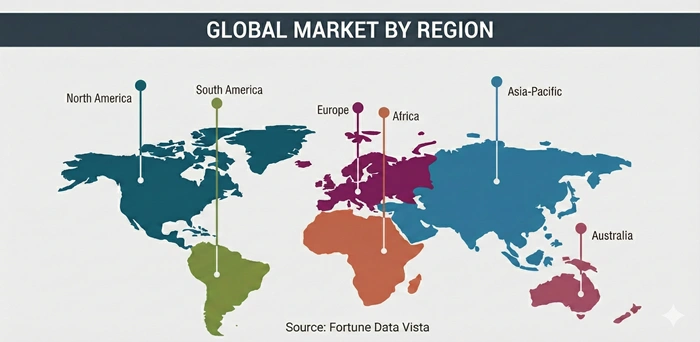
North America: The Dominating Region
North America Leads the Global AI Inference-as-a-Service Market Through the United States' Unrivaled Concentration of AI Technology Innovation, the World's Dominant Hyperscaler Cloud Platforms, and the Most Advanced Enterprise AI Adoption Ecosystem That Generates the Largest AI Inference Workload Volume Globally
North America holds the largest share of the global AI inference-as-a-service market, accounting for approximately 42% of total global revenue in 2026, with a regional CAGR of approximately 31% from 2026 to 2033. The United States is the dominant national market by a substantial margin, anchored by the world's three leading cloud AI inference platforms — Amazon Web Services (USA), Microsoft Azure (USA), and Google Cloud (USA) — which collectively serve the majority of global enterprise AI inference demand and generate the vast majority of North American inference-as-a-service revenue. The U.S. enterprise AI adoption market is the world's most mature and deepest, with large enterprises across every major industry sector deploying AI inference-intensive applications at a scale and sophistication that no other national market currently approaches — generating per-organization AI inference consumption volumes that drive market revenue concentration in North America well above the region's share of global enterprise count.
Canada contributes meaningfully to the regional market through its strong AI research ecosystem — particularly the Vector Institute for Artificial Intelligence in Toronto and Mila in Montreal — and through its growing enterprise AI adoption across financial services, healthcare, and technology sectors. The North American AI inference-as-a-service market also benefits from the region's deep venture capital investment in AI-native startups that build inference-intensive products as their core value propositions — with companies including OpenAI, Anthropic, Cohere, and Mistral all generating substantial inference API consumption through their own products and through enterprise licensing partnerships that collectively contribute significant inference-as-a-service market revenue.
Asia Pacific: The Fastest Growing Region
Asia Pacific Is the Fastest Growing Region in the AI Inference-as-a-Service Market, Powered by China's Massive Domestic AI Industry, Japan's and South Korea's Advanced Technology Sectors, and India's Rapidly Expanding AI Startup and Enterprise Technology Ecosystem
Asia Pacific is the fastest-growing regional segment in the AI inference-as-a-service market, projected to expand at a CAGR of approximately 37% from 2026 to 2033 — the highest regional growth rate globally. China is the dominant national market within the region and one of the most significant globally, with a large and rapidly growing domestic AI inference demand base generated by major technology companies including Baidu (China), Alibaba Group (China), ByteDance (China), and Tencent (China) — all of which have developed large-scale LLM and AI model portfolios that generate enormous domestic inference-as-a-service consumption through their consumer and enterprise AI product platforms. China's government-backed AI infrastructure investment programs — including massive national AI computing cluster development initiatives — are further expanding the domestic inference capacity available to support the extraordinary growth of Chinese AI application deployment.
Japan and South Korea are the most technically sophisticated AI inference markets within Asia Pacific outside of China, with Japan's advanced manufacturing, robotics, and enterprise software sectors generating growing AI inference demand across computer vision, predictive analytics, and language understanding applications — served by both international hyperscalers including Microsoft Azure Japan and AWS Asia Pacific and domestic technology companies including Fujitsu (Japan) and NEC Corporation (Japan). India is emerging as one of the most commercially exciting AI inference-as-a-service growth markets globally, with its massive software technology industry, strong English-language AI development community, government AI mission programs, and the large Indian operations of multinational technology companies collectively creating a dynamic and rapidly growing inference-as-a-service demand environment. The Asia Pacific AI inference-as-a-service market's growth is further strengthened by the region's rapidly expanding internet user base, growing smartphone AI capability adoption, and the progressive deployment of enterprise AI applications across the region's large manufacturing, retail, and financial services sectors.
Report Customization by Region and Country
This AI Inference-as-a-Service Market Report Offers Full Region-Wise and Country-Wise Customization — Delivering Precise, Geography-Specific Market Sizing, Cloud Infrastructure Landscape Analysis, Competitive Intelligence, Regulatory Insights, and Strategic Growth Opportunities Tailored to Every Region and Country You Need to Analyze
This AI Inference-as-a-Service Market report is available with full customization by region and country, enabling organizations to access precise, geography-specific insights tailored to their strategic focus. The report can be configured to deliver the exact regional depth and market intelligence your business requires — covering market sizing, CAGR forecasts, segment breakdowns, cloud infrastructure landscape analysis, regulatory environment, key player profiles, and actionable strategic opportunities specific to each selected geography.
North America
-
U.S. — Hyperscaler AI inference platform competitive landscape, enterprise LLM adoption trends, generative AI spending analysis, and leading company profiles including AWS, Microsoft Azure, and Google Cloud
-
Canada — AI research ecosystem-driven inference demand, enterprise AI adoption by sector, and regional market sizing and growth forecast through 2033
-
Mexico — Enterprise cloud AI adoption growth, nearshoring digital services demand, and AI inference-as-a-service market development opportunity analysis
Europe
-
U.K. — Enterprise AI adoption maturity, GDPR compliance impact on inference deployment, domestic AI company landscape, and regional market sizing
-
Germany — Industrial AI inference applications in manufacturing and automotive sectors, data sovereignty requirements, and leading enterprise AI service provider profiles
-
France — Government AI investment programs, enterprise AI adoption by sector, domestic AI inference market sizing, and competitive landscape analysis
-
Italy — Enterprise digital transformation AI adoption, manufacturing sector AI inference demand, and regional market outlook through 2033
-
Rest of Europe — Scandinavian AI innovation ecosystem, Eastern European AI talent and development market, and region-wide inference-as-a-service demand growth outlook
Asia Pacific
-
China — Domestic AI inference platform landscape (Baidu, Alibaba, ByteDance), government AI infrastructure programs, regulatory environment, and market sizing
-
India — AI startup ecosystem growth, enterprise AI adoption trends, government AI mission programs, and market sizing and forecast
-
Japan — Enterprise AI adoption in manufacturing, financial services, and healthcare, leading domestic technology company AI inference investments, and market outlook
-
South Korea — Samsung, LG, and SK technology sector AI inference adoption, semiconductor AI hardware advantage, and regional market analysis
-
Australia — Enterprise cloud AI adoption, government AI initiative investments, and AI inference-as-a-service market sizing and growth forecast
-
Rest of Asia Pacific — Southeast Asian AI startup growth, enterprise digital transformation AI demand, and inference-as-a-service market opportunities across Vietnam, Indonesia, Thailand, and the Philippines
Latin America
-
Brazil — Enterprise AI adoption across financial services and retail, domestic cloud AI infrastructure growth, and AI inference-as-a-service market sizing
-
Argentina — AI technology startup ecosystem, software development talent base, and regional inference market development outlook
-
Rest of Latin America — Regional digital transformation AI demand, cloud adoption growth, and inference-as-a-service market opportunities across Colombia and Chile
Middle East and Africa (MEA)
-
UAE — Smart city and government AI investment programs, enterprise AI adoption in financial services and logistics, and inference-as-a-service market opportunity sizing
-
Saudi Arabia — Vision 2030 AI and digital economy programs, cloud infrastructure investment, and AI inference market growth forecast through 2033
-
Rest of MEA — African technology sector AI adoption growth, mobile-first AI application demand, and long-term inference-as-a-service market development opportunity
Each customized AI Inference-as-a-Service Market report delivers targeted intelligence — including country-specific cloud AI infrastructure landscape analysis, enterprise AI adoption trend mapping, regulatory compliance environment assessment, and market entry and investment strategy guidance — providing decision-makers with everything they need to build competitive advantages and capture growth in their chosen geographies.
Top Key Players
-
Amazon Web Services Inc. (United States)
-
Microsoft Corporation (United States)
-
Google LLC (United States)
-
NVIDIA Corporation (United States)
-
IBM Corporation (United States)
-
Oracle Corporation (United States)
-
Alibaba Cloud (China)
-
Baidu Inc. (China)
-
Hugging Face Inc. (United States)
-
CoreWeave Inc. (United States)
-
Together AI (United States)
-
Mistral AI (France)
Recent Developments
-
In 2025, Microsoft Azure launched the Azure AI Foundry inference platform — a comprehensive enterprise AI model deployment and management service that provides customers with access to over 1800 AI models from OpenAI, Meta, Mistral, and other leading model providers through a unified inference API with enterprise-grade security, compliance, and real-time token usage monitoring capabilities that make large-scale AI inference deployment dramatically simpler for enterprise customers.
-
In 2025, NVIDIA Corporation launched its Blackwell Ultra GPU architecture — delivering up to four times the inference throughput of the previous Hopper generation for transformer-based language model inference workloads — with immediate deployment by all major cloud hyperscaler AI inference platforms that are integrating Blackwell Ultra GPU clusters into their inference infrastructure to meet the extraordinary growth of enterprise generative AI inference demand globally.
-
In 2026, Amazon Web Services expanded its Amazon Bedrock inference platform with new cross-region inference routing capabilities — enabling enterprise customers to automatically direct inference workloads to the lowest-latency, most cost-efficient AWS data center region based on real-time demand — while simultaneously adding support for additional foundation model providers and introducing Bedrock Intelligent Prompt Routing that optimizes model selection for each inference request based on cost, latency, and quality requirements.
-
In 2025, CoreWeave Inc. raised USD 1.5 billion in a landmark funding round that valued the AI inference cloud provider at approximately USD 19 billion — reflecting the extraordinary investor interest in purpose-built AI inference infrastructure companies that compete with hyperscaler inference platforms by offering dedicated NVIDIA GPU clusters with superior performance, more transparent pricing, and greater customer control than multi-tenant hyperscaler inference services provide.
-
In 2026, Google Cloud announced the general availability of its Ironwood Tensor Processing Unit — the company's seventh-generation AI inference chip — offering 10 times the inference throughput of its predecessor and making it available to enterprise customers through the Vertex AI inference platform as both a managed inference service and as a bare-metal AI inference infrastructure option — reinforcing Google Cloud's commitment to proprietary AI silicon as a long-term competitive differentiator in the AI inference-as-a-service market.
Market Trends
The Emergence of Model-as-a-Service Inference Platforms and the Growing Adoption of Multi-Model and Agentic AI Architectures Are the Two Most Commercially Transformative Trends Reshaping the AI Inference-as-a-Service Market Through 2033
The evolution of AI inference-as-a-service from simple API access to individual AI models toward comprehensive model-as-a-service platforms — which manage model selection, prompt optimization, quality routing, caching, and cost management across libraries of hundreds of available models — represents a fundamental commercial shift in how enterprises consume and pay for AI inference. Platforms including Amazon Bedrock, Azure AI Foundry, and Google Vertex AI are progressively abstracting the complexity of multi-model AI architectures from enterprise customers — providing intelligent inference orchestration layers that automatically select the optimal model for each request based on cost, latency, and quality requirements. This platform-layer abstraction creates stronger customer lock-in, higher average inference service consumption per customer, and more predictable revenue streams for inference platform operators — while simultaneously making enterprise AI application development faster and less dependent on specialized AI infrastructure expertise.
The rise of agentic AI architectures — where AI systems execute complex multi-step tasks autonomously by chaining multiple inference calls, using tools, browsing the web, writing and executing code, and managing long-context reasoning workflows — is creating a new category of AI inference demand that is dramatically more compute-intensive per end-user task than simple question-answering or text generation use cases. Agentic AI applications running autonomous research, code development, data analysis, or business process automation tasks may generate hundreds or thousands of inference API calls to complete a single end-user-initiated workflow — multiplying inference consumption per user session and per business process execution relative to earlier-generation AI application architectures. As agentic AI deployment scales from early enterprise pilots to production deployment across millions of enterprise workflows over the forecast period, the inference workload generated per enterprise customer will grow substantially — creating a powerful and sustained revenue growth driver for AI inference-as-a-service platforms throughout the 2026 to 2033 period.
Segments Covered in the Report
By Component:
-
Platform
-
Services
By Deployment Mode:
-
Public Cloud
-
Private Cloud
-
Hybrid Cloud
By Model Type:
-
Large Language Models
-
Computer Vision Models
-
Speech Recognition Models
-
Recommendation Models
-
Others
By Enterprise Size:
-
Large Enterprises
-
Small and Medium Enterprises
By End Use Industry:
-
Healthcare
-
BFSI
-
Retail and E-Commerce
-
IT and Telecommunications
-
Manufacturing
-
Media and Entertainment
-
Others
By Region:
-
North America (U.S., Canada, Mexico)
-
Europe (U.K., Germany, France, Italy, Rest of Europe)
-
Asia Pacific (China, India, Japan, South Korea, Australia, Rest of Asia Pacific)
-
Latin America (Brazil, Argentina, Rest of Latin America)
-
Middle East and Africa (UAE, Saudi Arabia, Rest of MEA)
❝ Built for Every Level — From Startups to Industry Giants ❞
Here Is Exactly How This Report Works for You
-
Whether you are a cloud hyperscaler evaluating AI inference platform competitive positioning and capacity investment priorities, an AI-native startup assessing go-to-market strategy for inference-as-a-service products, or an institutional investor analyzing the long-term revenue growth, margin profile, and competitive dynamics of the AI inference-as-a-service market, this report delivers granular revenue forecasts by component, deployment mode, model type, enterprise size, end-use industry, and region — combined with detailed competitor revenue analysis, platform capability benchmarking, enterprise AI adoption trend analysis, and regulatory landscape intelligence that enables confident strategic and capital allocation decisions.
-
This report comprehensively maps the supply-demand dynamics of the AI inference-as-a-service ecosystem — including enterprise AI application deployment scaling by industry and region, inference hardware cost curve projections, model architecture evolution impact on inference economics, and how geopolitical factors including U.S.-China AI technology competition, the EU AI Act regulatory framework, and data sovereignty legislation across key markets are reshaping global cloud AI inference deployment patterns in ways that create both material risks and significant competitive opportunities for platform providers, enterprise adopters, and investors.
-
The full version provides detailed competitor revenue breakdowns by model type and industry vertical, AI inference platform feature and pricing benchmarking, enterprise AI budget allocation tracking by sector and region, agentic AI workload growth projections, and a forward-looking assessment of multimodal inference, real-time industrial AI, and healthcare compliance inference platform opportunities — providing the strategic intelligence needed to capture the extraordinary growth opportunity of one of the global technology industry's fastest-growing and most strategically consequential market categories.
Frequently Asked Questions:
Answer: The AI inference-as-a-service market is valued at USD 23.82 billion in 2025 and is projected to reach USD 214.0 billion by 2033. It is expected to grow at a CAGR of 33.6% from 2026 to 2033, driven by the explosive enterprise adoption of generative AI applications, the growing complexity of LLM inference workloads, and the continuous expansion of cloud AI infrastructure investment by major hyperscaler providers.
Answer: North America leads the AI inference-as-a-service market, accounting for approximately 42% of total global revenue in 2026, anchored by the United States' concentration of world-leading hyperscaler inference platforms including Amazon Web Services, Microsoft Azure, and Google Cloud. The region's combination of AI technology innovation leadership, the world's deepest enterprise AI adoption market, and the headquarters of the dominant global inference-as-a-service providers makes North America the most commercially significant geography in the global market.
Answer: The primary growth drivers in the AI inference-as-a-service market include the explosive enterprise adoption of generative AI and LLM-powered applications, the prohibitive cost and operational complexity of on-premises AI inference infrastructure, and the progressive embedding of AI inference into core enterprise digital workflows across every major industry sector. The continuous improvement of inference-optimized cloud hardware and the falling per-token cost of cloud AI inference are simultaneously expanding the addressable application market by making AI inference economically viable for an ever-broader range of use cases and company sizes.
Answer: The AI inference-as-a-service model allows enterprises to access AI model inference capabilities through cloud APIs — consuming inference compute on a pay-per-use basis from hyperscaler providers who manage all underlying GPU infrastructure, model optimization, and scaling operations — whereas on-premises inference requires enterprises to purchase, operate, and maintain their own GPU server infrastructure. For most enterprise AI applications, inference-as-a-service delivers better economics, faster access to the latest model and hardware generations, and elastic scalability that on-premises infrastructure cannot match without massive capital investment.
Answer: BFSI, healthcare, retail and e-commerce, and IT and telecommunications are currently the most active enterprise adopters of AI inference-as-a-service platforms — driven by high-value AI application use cases including fraud detection, clinical documentation AI, personalized recommendation engines, and customer service automation that generate consistent high-volume inference API consumption. Healthcare is the fastest-growing end-use industry segment, projected to expand at approximately 38% CAGR from 2026 to 2033, as healthcare organizations deploy AI diagnostic imaging, clinical decision support, and patient engagement applications through HIPAA-compliant inference-as-a-service platforms.