
AI PC Market Overview
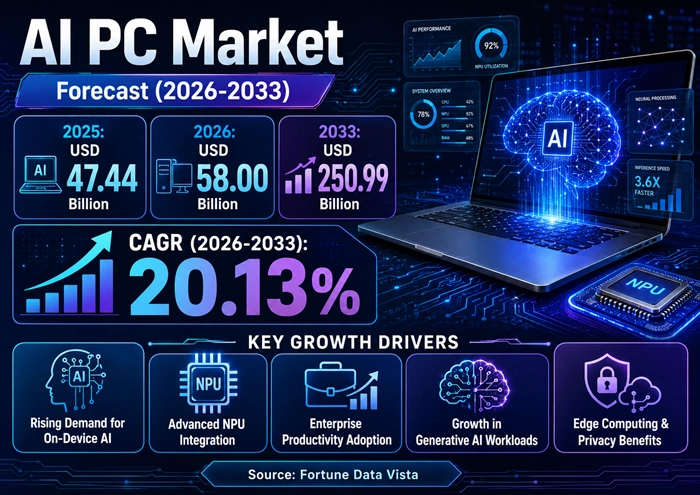
The global AI PC market size is valued at USD 47.44 billion in 2025 and is predicted to increase from USD 58.00 billion in 2026 to approximately USD 250.99 billion by 2033, growing at a CAGR of 20.13% from 2026 to 2033.
AI PCs are personal computers built with dedicated neural processing units alongside traditional CPUs and GPUs, allowing devices to run artificial intelligence tasks like image generation, voice recognition, and real-time language translation directly on the machine instead of relying entirely on cloud servers. This on-device processing approach offers meaningful advantages in speed, privacy, and offline functionality, which is why major chipmakers and computer manufacturers have moved quickly to bring these devices to both consumer and enterprise markets. Rising demand for on-device artificial intelligence, growing enterprise refresh cycles, and expanding software support for AI-optimized applications are together driving explosive, sustained growth for this emerging computing category.
AI Impact on the AI PC Industry
How On-Device Artificial Intelligence Is Transforming Everyday Computing Experiences Across Consumer and Enterprise Devices
Artificial intelligence is not just a feature being added to personal computers, it is fundamentally reshaping how these devices are designed, marketed, and used across both consumer and enterprise segments. The integration of dedicated neural processing units allows AI PCs to run generative AI applications, real-time video enhancement, and advanced voice assistants locally, dramatically reducing the latency and privacy concerns associated with sending sensitive data to cloud-based AI services. This shift is particularly meaningful for enterprise customers handling confidential business information, who increasingly prefer on-device processing over cloud dependency for security-sensitive AI workloads.
Beyond raw processing capability, artificial intelligence is also transforming how operating systems and software applications are designed, with major platform providers increasingly building AI-first features directly into their operating systems to take advantage of dedicated on-device processing hardware. This has created a reinforcing cycle where hardware manufacturers continue improving neural processing performance while software developers build increasingly sophisticated AI features that require this specialized hardware to run efficiently. As this hardware and software ecosystem continues maturing together, companies operating in the AI PC market are racing to establish strong early positions before the technology becomes a standard expectation across the broader personal computing industry.
Growth Factors
Rising Demand for On-Device AI Processing, Growing Enterprise Refresh Cycles, and Expanding AI Software Ecosystem Are the Three Most Influential Growth Drivers
Rising consumer and enterprise demand for on-device artificial intelligence processing remains one of the most powerful growth factors sustaining momentum in the AI PC market, as users increasingly value the speed, privacy, and offline functionality that local AI processing offers compared to cloud-dependent alternatives. As awareness of these benefits continues spreading across both consumer and business markets, demand for devices equipped with dedicated neural processing hardware continues accelerating correspondingly.
Growing enterprise device refresh cycles represent a second significant driver, as businesses replacing aging computer fleets increasingly prioritize AI-capable devices to future-proof their technology investments and support emerging productivity applications built around on-device artificial intelligence. The rapidly expanding software ecosystem designed specifically to take advantage of neural processing hardware is also gaining strong traction, as more applications from major software providers begin offering meaningfully enhanced features exclusively for AI-equipped devices. Combined with major chipmakers and manufacturers aggressively marketing next-generation processors with dramatically improved AI performance, these factors continue reinforcing rapid, sustained growth across the global AI PC market.
Market Outlook
The AI PC Market Is Positioned for Explosive Growth Through 2033 as On-Device AI Becomes a Standard Computing Expectation
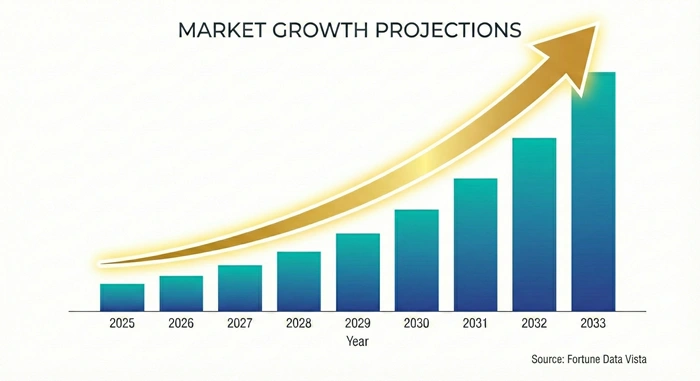
The long-term outlook for AI PCs remains exceptionally strong, reflecting the technology's rapid transition from a niche premium feature to an expected standard across nearly all new personal computer purchases. As neural processing unit performance continues improving with each new generation of chips, industry analysts widely expect AI-capable devices to eventually represent the overwhelming majority of new PC shipments within just a few years, fundamentally reshaping the competitive dynamics of the broader personal computing industry. This transition is likely to accelerate further as software developers increasingly build applications that require on-device AI hardware to function at all, rather than treating these capabilities as optional enhancements.
Looking further ahead, continued advancement in generative AI applications and increasingly sophisticated on-device large language models are expected to create entirely new categories of productivity and creative software that depend on local AI processing capability. Growing enterprise investment in AI-driven productivity tools, combined with consumer enthusiasm for AI-enhanced creative and entertainment applications, is also expected to sustain strong demand growth across multiple customer segments. These dynamics point toward an AI PC market positioned for sustained, rapid expansion through 2033 as on-device artificial intelligence becomes deeply embedded in everyday computing experiences.
Expert Speaks
-
"AI PCs represent the most significant platform shift in personal computing in decades, and we are seeing unprecedented customer enthusiasm for devices with dedicated neural processing capability." — CEO, Intel Corporation.
-
"Our continued investment in AI-optimized processor architecture reflects the reality that on-device artificial intelligence is quickly becoming a baseline expectation rather than a premium feature." — CEO, Advanced Micro Devices Inc.
-
"As enterprises accelerate their device refresh cycles, we see strong and sustained demand for AI-capable laptops that offer meaningful productivity advantages for our business customers." — CEO, Dell Technologies.
Key Report Takeaways
-
North America leads the AI PC market with an estimated 33% revenue share in 2025, supported by strong enterprise technology investment and early adoption of AI-capable devices across major corporations.
-
Asia Pacific is the fastest-growing region, projected to expand at a CAGR near 23% through 2033, driven by massive PC manufacturing capacity and rapidly growing consumer demand across China, Japan, and South Korea.
-
Enterprise customers represent the largest customer base, relying on AI PCs to future-proof technology investments and support emerging AI-driven productivity applications.
-
Laptop devices contribute the most to overall demand, given strong consumer and business preference for portable AI-capable computing devices.
-
NPU-based compute architecture remains the most widely adopted processing approach, valued for its energy efficiency and dedicated AI performance advantages.
-
The commercial end user segment is projected to grow fastest going forward, expected to hold a growing share of total demand by 2033 while expanding at a CAGR near 24.5% during the forecast period.
Market Scope
| Parameter | Details |
|---|---|
| Market Size by 2033 | USD 250.99 Billion | Market Size by 2026 | USD 58.00 Billion | Market Size by 2025 | USD 47.44 Billion | Market Growth Rate from 2026 to 2033 | CAGR of 20.13% | Dominating Region | North America | Fastest Growing Region | Asia Pacific | Segments Covered | By Device Type, By Compute Type, By Operating System, By End User, By Region | Regions Covered | North America, Europe, Asia Pacific, Latin America, Middle East & Africa |
Market Dynamics
Drivers Impact Analysis
Rising On-Device AI Demand and Enterprise Refresh Cycles Are the Most Commercially Significant Drivers of Market Growth
| Driver | (≈) % Impact on CAGR Forecast | Geographic Relevance | Impact Timeline |
|---|---|---|---|
| Rising consumer and enterprise demand for on-device AI processing | ~37% | Global, led by North America and Asia Pacific | Short to long-term |
| Growing enterprise device refresh cycles favoring AI-capable hardware | ~28% | North America, Europe | Short to medium-term |
| Expanding software ecosystem optimized for neural processing hardware | ~21% | Global | Medium-term |
| Aggressive chipmaker marketing and next-generation processor launches | ~14% | Global | Ongoing |
Rising consumer and enterprise demand for on-device artificial intelligence processing remains the most powerful driver sustaining momentum across the AI PC market, as users increasingly value the speed, privacy, and offline reliability that local processing offers over cloud-dependent alternatives. This fundamental shift in user preference is ensuring rapid, durable demand growth as awareness of these benefits continues spreading.
Growing enterprise device refresh cycles represent a second significant driver, as businesses replacing aging computer fleets increasingly prioritize AI-capable devices to future-proof their technology investments. Combined with an expanding software ecosystem optimized for neural processing hardware and aggressive chipmaker marketing of next-generation processors, these drivers together sustain explosive, multi-year demand growth across the global AI PC landscape.
Restraints Impact Analysis
Premium Pricing and Limited Compelling Software Use Cases Are the Two Primary Constraints Limiting Faster Market Growth
| Restraint | (≈) % Impact on CAGR Forecast | Geographic Relevance | Impact Timeline |
|---|---|---|---|
| Premium pricing of AI-capable devices compared to standard PCs | ~35% | Global | Short to medium-term |
| Limited availability of compelling, must-have AI software applications | ~30% | Global | Short-term |
| Slower enterprise procurement cycles in cost-sensitive markets | ~22% | Latin America, parts of Asia Pacific | Medium-term |
| Consumer uncertainty around practical everyday AI PC benefits | ~13% | Global | Short-term |
The premium pricing associated with AI-capable devices compared to standard personal computers remains a meaningful barrier, particularly for cost-sensitive consumer segments and smaller businesses that may not see immediate practical benefits justifying the additional expense. This pricing gap has slowed adoption in certain market segments despite strong overall industry enthusiasm for the technology.
The limited availability of compelling, must-have software applications that genuinely require on-device AI processing also constrains faster adoption, as many consumers and businesses remain uncertain about the practical everyday benefits these devices offer beyond marketing claims. Slower enterprise procurement cycles in more cost-sensitive regional markets further moderate the pace of adoption outside leading economies. These restraints do not reverse the underlying growth trend but do introduce meaningful friction that tempers the pace of expansion within the AI PC market, particularly among price-sensitive customer segments.
Opportunities Impact Analysis
Generative AI Application Expansion and Enterprise Productivity Software Integration Represent the Most Significant Untapped Growth Opportunities
| Opportunity | (≈) % Impact on CAGR Forecast | Geographic Relevance | Impact Timeline |
|---|---|---|---|
| Expansion of generative AI applications requiring on-device processing | ~38% | Global | Medium to long-term |
| Growing integration of AI features into enterprise productivity software | ~33% | North America, Europe | Medium-term |
| Rising AI PC adoption in emerging markets as prices decline | ~29% | Asia Pacific, Latin America | Medium to long-term |
The expanding availability of generative AI applications that specifically require on-device processing capability presents a significant opportunity for hardware manufacturers, as this creates genuine, compelling reasons for consumers and businesses to upgrade beyond simple marketing claims. Companies that can successfully partner with software developers to create must-have AI-native applications are well positioned to accelerate broader market adoption.
Growing integration of artificial intelligence features into mainstream enterprise productivity software represents a second major opportunity, as this trend gives businesses concrete, measurable justification for accelerating their device refresh cycles toward AI-capable hardware. Rising AI PC adoption in emerging markets as device prices gradually decline also creates significant expansion opportunities, positioning manufacturers with strong emerging market distribution networks to capture growing demand within the broader AI PC market.
Segment Analysis
By Device Type
Laptops Anchor the Largest Share Within AI PC Market Demand
Laptops hold the largest share of the AI PC market, accounting for roughly 62% of total device revenue with a CAGR near 20% through 2033. Consumers and business users overwhelmingly prefer portable AI-capable devices that combine mobility with on-device artificial intelligence performance, making laptops the primary battleground for AI PC adoption across nearly every customer segment. North America leads this segment given strong enterprise technology investment and early corporate adoption of AI-capable business laptops, and leading companies operating here include Dell Technologies and HP Inc., each maintaining substantial market share through comprehensive AI-enabled laptop portfolios.
Desktop AI PCs represent a smaller but steadily growing segment, expanding as creative professionals and enterprise workstation users increasingly demand powerful on-device AI processing for demanding applications like video editing and content creation. This segment is showing meaningful growth momentum across Asia Pacific, where expanding creative industries and gaming markets in China, Japan, and South Korea continue driving demand for high-performance AI-capable desktop systems. Companies such as Lenovo and ASUS have built strong positions supplying AI-enabled desktop systems to regional creative and enterprise customers, reinforcing steady demand growth across both leading device categories within the global AI PC market.
By Compute Type
NPU-Based Architecture Anchors the Fastest Adoption Path Within AI PC Market Demand
NPU-based compute architecture accounts for a rapidly growing and increasingly dominant share of AI PC market revenue, supported by strong CAGR growth as dedicated neural processing units offer superior energy efficiency and performance for AI-specific workloads compared to relying solely on CPUs or GPUs. This architecture has quickly become the industry standard reference point for what defines a true AI PC, with major chipmakers competing aggressively on neural processing performance metrics. Companies such as Intel and Qualcomm have established strong positions in this compute category through continuous generational improvements in neural processing unit performance.
GPU-based compute continues playing an important complementary role, particularly for more demanding AI workloads like generative image and video creation that benefit from the parallel processing capabilities GPUs offer alongside dedicated NPUs. Europe maintains meaningful demand for GPU-heavy configurations given its strong creative and design industry presence, with companies including AMD and NVIDIA maintaining strong positions serving this performance-focused customer segment. Growing consumer and enterprise preference for devices combining both NPU and GPU capabilities continues reinforcing demand across both compute categories within the broader AI PC market.
Regional Insights
North America
Strong Enterprise Technology Investment Keeps North America at the Top of the AI PC Market
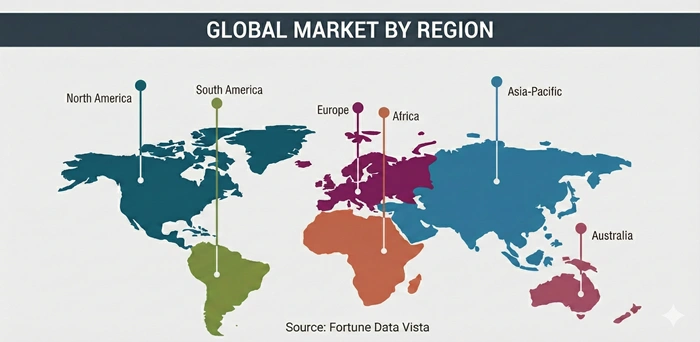
North America commands the largest share of the global AI PC market, holding close to 33% of total revenue in 2025 with a regional CAGR near 19% through 2033. Strong enterprise technology investment, early corporate adoption of AI-capable devices, and substantial consumer purchasing power keep demand consistently strong throughout the region. Leading companies such as Dell Technologies and HP Inc., both headquartered in the United States, dominate AI PC sales contracts across major enterprise and consumer customers.
The region's mature technology procurement ecosystem, combined with aggressive marketing from leading chipmakers and computer manufacturers, further reinforces this leadership position within the broader personal computing landscape. Large enterprises across the United States and Canada are increasingly standardizing on AI-capable devices as part of routine technology refresh cycles. This combination of purchasing power, technology adoption culture, and strong manufacturer presence ensures North America remains the anchor region for AI PC market revenue generation over the coming years.
Asia Pacific
Massive PC Manufacturing Capacity and Growing Consumer Demand Make Asia Pacific the Fastest-Growing Region
Asia Pacific is the fastest-growing region in the AI PC market, projected to expand at a CAGR near 23% through 2033 while currently holding a substantial and rapidly growing share of global revenue. Massive PC manufacturing capacity, rapidly growing consumer demand, and expanding domestic technology investment across China, Japan, and South Korea are together driving this accelerated regional growth. Companies such as Lenovo in China are scaling AI-capable device production rapidly to meet surging demand from both domestic and international customers.
Growing government support for domestic semiconductor and AI hardware manufacturing, combined with the region's massive consumer electronics market, continues to widen Asia Pacific's addressable opportunity for AI PC manufacturers. Japan and South Korea are also contributing meaningfully through advanced component manufacturing capabilities and strong consumer technology adoption culture. As regional manufacturing capacity and consumer awareness continue expanding, Asia Pacific is expected to narrow its overall revenue gap with North America over the coming several years within the broader AI PC market.
Customization Available for This Report
Region-wise and country-wise customized reports are available for organizations seeking deeper geographic insight into the AI PC market. Our research team can tailor market analysis, competitive intelligence, trends, and growth opportunities specifically for any of the regions and countries listed below, offering detailed information aligned to your selected market and keyword combination.
North America
-
U.S., Canada, Mexico — detailed enterprise technology investment trends and competitive positioning
Europe
-
U.K., Germany, France, Italy, Rest of Europe — creative industry adoption trends and key player analysis
Asia Pacific
-
China, India, Japan, South Korea, Australia, Rest of Asia Pacific — manufacturing capacity, consumer demand trends, and local vendor analysis
Latin America
-
Brazil, Argentina, Rest of Latin America — emerging consumer adoption and market entry opportunities
Middle East & Africa
-
UAE, Saudi Arabia, Rest of MEA — enterprise technology investment and regional partnership opportunities
Top Key Players
-
Intel Corporation (United States)
-
Advanced Micro Devices Inc. (United States)
-
Qualcomm Incorporated (United States)
-
NVIDIA Corporation (United States)
-
Dell Technologies Inc. (United States)
-
HP Inc. (United States)
-
Lenovo Group Limited (China)
-
ASUS Computer International (Taiwan)
-
Acer Inc. (Taiwan)
-
Apple Inc. (United States)
-
Samsung Electronics Co. Ltd. (South Korea)
-
Microsoft Corporation (United States)
Recent Developments
-
In 2025, Intel expanded its Core Ultra processor lineup with enhanced neural processing capabilities designed to accelerate generative AI application performance.
-
In 2025, AMD launched next-generation Ryzen AI processors featuring significantly improved on-device AI processing performance for laptops and desktops.
-
In 2025, Qualcomm strengthened its Snapdragon X series partnerships with major PC manufacturers to expand its presence in the enterprise AI PC segment.
-
In 2026, Dell Technologies deepened its enterprise AI PC offerings through expanded partnerships focused on business productivity software integration.
-
In 2026, Lenovo advanced its AI PC manufacturing capacity in Asia Pacific to meet growing regional and international demand for AI-capable devices.
Market Trends
Neural Processing Performance Competition and Software Ecosystem Development Are Reshaping the AI PC Landscape
One of the clearest trends shaping the industry is the intensifying competition among chipmakers to deliver ever-higher neural processing performance, measured in tera operations per second, as this metric has become a key marketing differentiator across the AI PC category. This is encouraging rapid generational improvement cycles as companies race to offer devices capable of running increasingly sophisticated AI applications directly on the hardware.
A second notable trend is the growing collaboration between hardware manufacturers and software developers to build applications specifically designed to take advantage of on-device neural processing capability, moving beyond simple marketing claims toward genuinely differentiated user experiences. As this hardware and software ecosystem continues maturing together, this trend is reinforcing sustained, rapid demand growth across the global AI PC market.
Segments Covered in the Report
By Device Type
-
Laptops
-
Desktops
-
Tablets
-
Workstations
By Compute Type
-
CPU-Based
-
GPU-Based
-
NPU-Based
By Operating System
-
Windows
-
macOS
-
ChromeOS
-
Others
By End User
-
Consumer
-
Commercial
-
Enterprise
By Region
-
North America (U.S., Canada, Mexico)
-
Europe (U.K., Germany, France, Italy, Rest of Europe)
-
Asia Pacific (China, India, Japan, South Korea, Australia, Rest of Asia Pacific)
-
Latin America (Brazil, Argentina, Rest of Latin America)
-
Middle East and Africa (UAE, Saudi Arabia, Rest of MEA)
❝ Built for Every Level — From Startups to Industry Giants ❞
Here Is Exactly How This Report Works for You
-
For tier 1 chipmakers, computer manufacturers, and institutional investors, this report delivers granular competitor revenue analysis across Intel, AMD, and Qualcomm, alongside geopolitical semiconductor supply chain risk assessment supporting confident investment and product roadmap decisions.
-
For tier 2, tier 3 companies, hardware startups, and mid-level manufacturers, this report identifies the highest-growth device and compute segments and most commercially accessible regional markets, offering an evidence-based roadmap for entering or expanding within the AI PC market.
-
For all decision-makers across the personal computing value chain, this report translates complex supply-demand shifts and evolving competitive dynamics into clear, actionable strategic intelligence supporting stronger product development and go-to-market decisions through 2033.
Frequently Asked Questions:
Answer: The AI PC market was valued at USD 47.44 billion in 2025. It is projected to reach approximately USD 250.99 billion by 2033 at a CAGR of 20.13%.
Answer: North America leads the AI PC market with roughly 33% revenue share. Strong enterprise technology investment supports this position.
Answer: Asia Pacific is the fastest-growing region in the AI PC market. Massive PC manufacturing capacity and growing consumer demand are driving this growth.
Answer: Intel, AMD, and Qualcomm are top companies in the AI PC market. They lead through continuous improvements in neural processing performance.
Answer: Laptops generate the largest share of demand in the AI PC market. Desktop AI PCs form a steadily growing complementary segment.