
Air Traffic Control Equipment Market Overview
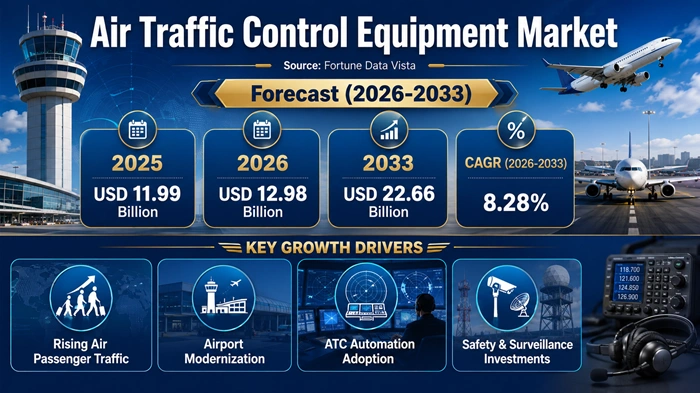
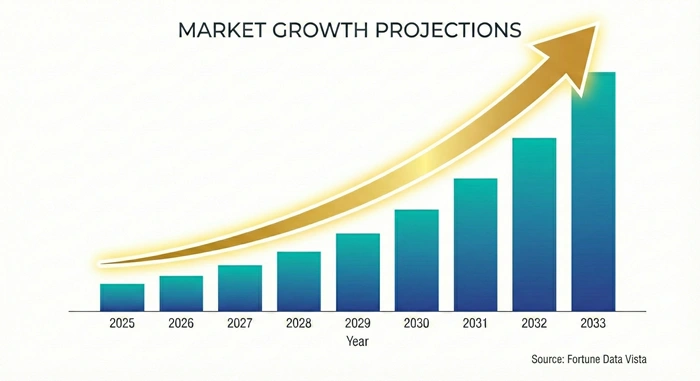
The global air traffic control equipment market size is valued at USD 11.99 billion in 2025 and is predicted to increase from USD 12.98 billion in 2026 to approximately USD 22.66 billion by 2033, growing at a CAGR of 8.28% from 2026 to 2033.
This robust growth reflects rising global air passenger traffic, ongoing airport modernization programs, and expanding government investment in next-generation surveillance and navigation systems that keep skies safe as flight volumes climb. As aviation authorities worldwide replace legacy radar and communication infrastructure with digital tower technology and satellite-based surveillance, demand for advanced air traffic control equipment continues expanding across commercial, military, and general aviation sectors alike.
AI Impact on the Air Traffic Control Equipment Industry
Artificial Intelligence Is Enhancing Conflict Detection, Improving Predictive Maintenance Scheduling, and Strengthening Automated Traffic Flow Management Across the Air Traffic Control Equipment Landscape — Fundamentally Changing How Controllers Manage Increasingly Congested Airspace
Artificial intelligence has become an increasingly valuable tool for improving conflict detection accuracy, with machine learning algorithms now capable of analyzing real-time radar and ADS-B surveillance data to identify potential aircraft separation issues well before human controllers would typically notice developing conflicts. This predictive capability matters considerably as global airspace grows more congested, since earlier conflict identification gives controllers more time to issue corrective instructions and maintain safe separation standards. Companies building AI-driven decision support directly into their air traffic control equipment are increasingly differentiating themselves through measurably reduced controller workload during peak traffic periods.
Beyond conflict detection, AI is also improving predictive maintenance scheduling for radar, navigation, and communication infrastructure, with sensor-based analytics now able to flag early signs of equipment degradation before failures disrupt operations at busy airports. This capability has proven valuable for air navigation service providers managing aging infrastructure, since predictive maintenance reduces costly unplanned outages that can ground flights across entire regions. As these AI-driven monitoring and traffic flow optimization tools continue maturing, they are becoming an increasingly important factor shaping operational reliability across the broader air traffic control equipment market.
Growth Factors
Rising Global Air Passenger Traffic and Expanding Airport Modernization Programs Continue Driving Sustained Demand
The most significant growth factor supporting the air traffic control equipment market is the steadily rising volume of global air passenger traffic, as growing disposable incomes and expanding air connectivity across emerging economies push airports toward capacity limits that require upgraded surveillance, navigation, and communication infrastructure to manage safely. With international passenger numbers continuing to climb well beyond pre-pandemic levels, this traffic-driven demand has become an increasingly important revenue driver for equipment manufacturers serving both new and existing airport facilities.
A second important growth factor is the continued expansion of airport modernization programs across both developed and emerging aviation markets, as governments invest heavily in replacing aging analog radar systems with digital tower technology, satellite-based surveillance, and automated air traffic management platforms. This growing infrastructure investment, combined with rising defense-related procurement of military air traffic control systems amid heightened geopolitical tensions, has broadened the addressable market for advanced control equipment considerably. This combination of rising passenger traffic and expanding modernization investment continues to strengthen demand across the air traffic control equipment market.
Market Outlook
Digital Tower Adoption and Expanding Satellite-Based Surveillance Point Toward Sustained Growth Through 2033
Looking ahead through the forecast period, the air traffic control equipment industry is expected to benefit substantially from continued adoption of remote and digital tower technology, as airport operators recognize the operational flexibility and cost savings of managing multiple smaller airports from centralized control facilities rather than maintaining separate towers at every location. This digital tower shift is likely to reshape airport infrastructure investment considerably as more regional airports pursue remote operation models.
At the same time, expanding deployment of satellite-based surveillance technologies including ADS-B and multilateration is expected to create substantial new demand, as aviation authorities seek more precise aircraft tracking capability across oceanic and remote airspace that traditional ground-based radar cannot adequately cover. Companies that can deliver both proven surveillance accuracy and cybersecurity-hardened systems are increasingly well positioned to capture this growth. Manufacturers combining strong systems integration capability with global service networks are likely to lead growth within the broader air traffic control equipment market through 2033.
Expert Speaks
-
"Our continued investment in digital air traffic management technology reflects our commitment to helping aviation authorities safely manage growing global airspace complexity." — CEO, Thales Group
-
"As air traffic volumes continue rising worldwide, our surveillance and navigation systems remain focused on delivering the reliability that airports and passengers depend on." — CEO, RTX Corporation (Raytheon Technologies)
-
"We remain dedicated to advancing next-generation communication and surveillance solutions that support both commercial aviation growth and national airspace security." — CEO, L3Harris Technologies Inc
Key Report Takeaways
-
North America leads the global air traffic control equipment market, holding approximately 32% market share in 2025, supported by extensive legacy infrastructure modernization and dense commercial air traffic volume
-
Asia Pacific is the fastest-growing region, projected to expand at a CAGR near 10.4% through 2033, driven by rapid airport construction and rising passenger traffic across China and India
-
Commercial airport operators represent the dominant end-user segment, accounting for roughly 58% share, given the concentrated infrastructure investment required to manage rising passenger volumes safely
-
Surveillance systems contribute the most to overall demand, reflecting sustained investment in radar and ADS-B technology needed to track growing aircraft numbers
-
Digital tower technology remains the fastest-adopted equipment category, valued for its ability to manage multiple airports remotely from centralized facilities
-
Automation and air traffic management software segments will grow the fastest among offering categories, holding close to 24% market share with a CAGR near 11.2% through the forecast period, driven by rising demand for intelligent traffic flow optimization
Market Scope
| Parameter | Details |
|---|---|
| Market Size by 2033 | USD 22.66 Billion | Market Size by 2026 | USD 12.98 Billion | Market Size by 2025 | USD 11.99 Billion | Market Growth Rate from 2026 to 2033 | CAGR of 8.28% | Dominating Region | North America | Fastest Growing Region | Asia Pacific | Segments Covered | Offering, Application, Airport Size, Sector, Region | Regions Covered | North America, Europe, Asia Pacific, Latin America, Middle East & Africa |
Market Dynamics
Drivers Impact Analysis
Rising Air Passenger Traffic and Expanding Airport Modernization Investment Remain the Two Strongest Forces Behind Market Momentum
| Driver | (≈) % Impact on CAGR Forecast | Geographic Relevance | Impact Timeline |
|---|---|---|---|
| Steadily rising global air passenger traffic volumes | ~34% | Global | Short to long-term |
| Expanding airport infrastructure modernization programs | ~29% | North America, Asia Pacific | Medium to long-term |
| Growing defense procurement of military air traffic control systems | ~23% | Global | Medium-term |
| Increasing airport construction across emerging aviation markets | ~14% | Asia Pacific, Middle East | Short to medium-term |
Steadily rising global air passenger traffic continues to serve as the primary engine behind sustained growth in the air traffic control equipment market, as airports worldwide approach capacity limits requiring upgraded surveillance and navigation infrastructure to manage safely growing aircraft movements. This traffic-driven demand has translated directly into rising procurement activity among air navigation service providers across nearly every major aviation market.
Expanding airport infrastructure modernization programs represent the second major driver, as governments replace aging analog radar and communication systems with digital tower technology and satellite-based surveillance capable of handling denser, more complex airspace. This modernization-driven demand, combined with rising defense-related procurement amid heightened geopolitical tensions, continues reinforcing steady momentum across the broader air traffic control equipment market.
Restraints Impact Analysis
High System Costs and Cybersecurity Vulnerabilities Continue to Moderate Broader Adoption
| Restraint | (≈) % Impact on CAGR Forecast | Geographic Relevance | Impact Timeline |
|---|---|---|---|
| High upfront cost of advanced radar and surveillance system installation | ~35% | Global, particularly emerging markets | Short to medium-term |
| Growing cybersecurity vulnerabilities within digitized air traffic systems | ~28% | Global | Medium to long-term |
| Lengthy certification and regulatory approval processes for new equipment | ~23% | North America, Europe | Medium-term |
| Budget constraints limiting modernization at smaller regional airports | ~14% | Emerging markets | Short to medium-term |
The most persistent restraint facing the air traffic control equipment market is the substantial upfront cost associated with installing advanced radar, surveillance, and communication systems, which can create significant financial barriers for smaller airports and developing aviation markets despite the long-term safety benefits. This cost sensitivity remains particularly pronounced in regions where government aviation budgets face competing infrastructure priorities.
Growing cybersecurity vulnerabilities within increasingly digitized air traffic systems represent a second significant restraint, since interconnected surveillance and communication networks create expanded attack surfaces that require costly, continuously updated protection measures. Combined with lengthy certification and regulatory approval timelines for new equipment, these restraints continue moderating how quickly modernization spreads across the global air traffic control equipment market.
Opportunities Impact Analysis
Satellite-Based Surveillance Expansion and Remote Tower Adoption Represent the Clearest Paths to Growth
| Opportunity | (≈) % Impact on CAGR Forecast | Geographic Relevance | Impact Timeline |
|---|---|---|---|
| Expanding deployment of satellite-based surveillance technologies like ADS-B | ~38% | Global | Medium to long-term |
| Growing adoption of remote and digital tower operations at regional airports | ~33% | Europe, Asia Pacific | Short to medium-term |
| Rising investment in AI-enabled traffic flow management platforms | ~29% | Global | Medium-term |
Expanding deployment of satellite-based surveillance technologies represents one of the most substantial opportunities within the air traffic control equipment market, as aviation authorities seeking precise aircraft tracking across oceanic and remote airspace increasingly turn to ADS-B and multilateration systems that ground-based radar cannot adequately provide. This surveillance expansion is expected to meaningfully reshape competitive positioning among leading equipment manufacturers over the coming years.
Growing adoption of remote and digital tower operations presents a second substantial opportunity, as regional airports across Europe and Asia Pacific pursue cost-effective centralized management models that reduce the need for dedicated on-site control towers. Rising investment in AI-enabled traffic flow management platforms further broadens the opportunity landscape, particularly for suppliers able to bundle intelligent software with hardware infrastructure upgrades. Companies pursuing these parallel opportunities are well positioned to capture meaningful growth within the broader air traffic control equipment market through the forecast period.
Segment Analysis
By Application: Surveillance Systems
Surveillance Systems Continue to Anchor the Application Landscape, Reflecting Sustained Investment in Radar and Tracking Infrastructure
Surveillance systems hold the largest share within the application segment of the air traffic control equipment market, accounting for approximately 36% of total segment revenue in 2025. This dominance reflects the continuous investment required in radar, ADS-B, and multilateration technology to track growing aircraft volumes accurately across increasingly congested airspace worldwide. In markets like the United States and Germany, air navigation service providers increasingly favor combined primary and secondary surveillance radar upgrades bundled with satellite-based tracking to close coverage gaps in remote areas. Leading suppliers such as Thales, RTX Corporation, and L3Harris continue to dominate this segment through expanded product portfolios and continuous surveillance accuracy improvements.
Growth within this segment remains particularly strong in North America, where extensive legacy radar infrastructure requiring replacement and dense commercial air traffic volume continue generating sustained demand for upgraded surveillance technology across hundreds of airports. The region's combination of aging infrastructure and high traffic density has helped surveillance systems maintain their leading position despite growing interest in automation software alternatives. As satellite-based tracking technology continues maturing, surveillance systems are expected to remain the dominant category within the broader air traffic control equipment market throughout the forecast period.
By Offering: Automation and Air Traffic Management Software
Automation Software Represents the Fastest-Growing Offering Segment, Reflecting Rising Demand for Intelligent Traffic Flow Optimization
Automation and air traffic management software represents the fastest-growing offering segment within the air traffic control equipment market, holding close to 24% share in 2025 with a projected CAGR near 11.2% through the forecast period as airports increasingly seek intelligent systems capable of optimizing traffic flow beyond what manual controller decision-making alone can achieve. Unlike traditional hardware-centric radar and communication upgrades, automation software actively processes surveillance data to recommend optimal routing, sequencing, and separation decisions that reduce controller workload during peak congestion periods. This intelligence-driven approach has generated substantial interest among air navigation service providers managing increasingly dense airspace, particularly across hub airports handling significant daily traffic volumes.
Growth in this segment remains especially strong in Asia Pacific, where rapid airport construction and rising passenger traffic across China and India continue driving demand for modern automation platforms capable of scaling alongside expanding aviation infrastructure. Companies like Thales and Indra Sistemas have expanded their automation software portfolios significantly to serve this growing regional demand, often partnering directly with national civil aviation authorities on system integration projects. As airspace congestion continues intensifying globally, this offering segment is expected to remain the fastest-growing category within the broader air traffic control equipment market.
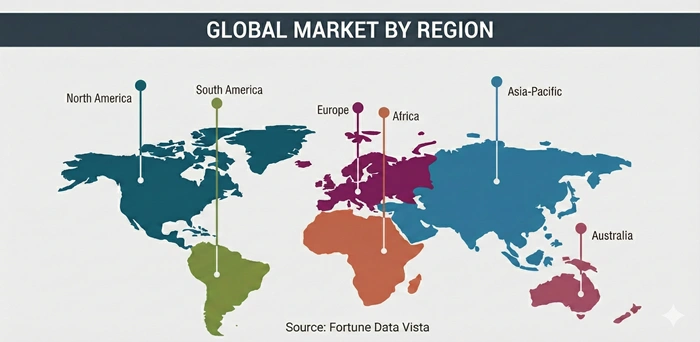
Regional Insights
North America
Extensive Legacy Infrastructure Modernization and Dense Commercial Traffic Keep North America Firmly in the Lead
North America commands the leading position in the global air traffic control equipment market, holding approximately 32% share in 2025, supported by extensive legacy radar infrastructure requiring modernization, dense commercial air traffic volume, and a strong concentration of leading equipment manufacturers. The United States drives the overwhelming majority of regional demand, backed by ongoing Federal Aviation Administration modernization initiatives and hundreds of commercial airports requiring continuous surveillance and communication system upgrades. Companies with strong regional presence include RTX Corporation, L3Harris Technologies, Honeywell, and Northrop Grumman, each maintaining deep relationships with federal aviation authorities across the country.
Canada also contributes meaningfully to regional demand, supported by continued investment in remote tower technology to serve its vast, sparsely populated airspace more cost-effectively than traditional staffed towers. The region's combination of established regulatory infrastructure, deep systems integration expertise, and continuous technology innovation ensures North America's leadership position within the air traffic control equipment market remains firmly intact through the remainder of the forecast period.
Asia Pacific
Rapid Airport Construction and Rising Passenger Traffic Position Asia Pacific as the Fastest-Growing Region
Asia Pacific is projected to register the fastest CAGR within the global air traffic control equipment market through 2033, expanding at a rate near 10.4% as rapid airport construction and rising passenger traffic across China and India create substantial new demand throughout the region. China leads much of this regional growth, supported by an aggressive airport expansion program and growing domestic air travel that require extensive new surveillance and navigation infrastructure at newly built facilities. Regional and international equipment manufacturers alike have expanded their presence to serve this growing demand, often establishing local partnerships to navigate national procurement requirements.
India and Japan contribute further depth to regional growth, both bringing expanding airport infrastructure investment and growing government focus on airspace modernization to accommodate rising passenger volumes across increasingly crowded domestic routes. Growing government investment in indigenous manufacturing capabilities across several Asia Pacific markets continues to accelerate technology adoption among expanding national aviation authorities alike. This combination of rapid airport construction, rising passenger traffic, and growing modernization investment positions Asia Pacific as the clear growth leader within the broader air traffic control equipment market through the forecast period.
Customization Available for This Report
Region-Specific and Country-Specific Versions of This Report Are Available to Deliver a Sharper, More Localized View of Market Dynamics
This report can be tailored on a region-by-region and country-by-country basis, providing localized market sizing, competitive mapping, and infrastructure investment trend analysis that a global overview alone cannot fully capture.
Clients seeking a more focused breakdown can request a customized version covering any of the following regions and countries, complete with demand forecasting, competitor landscape review, and adoption trend analysis tied specifically to the air traffic control equipment keyword focus:
North America
-
U.S. — Detailed review of FAA modernization programs and surveillance infrastructure trends
-
Canada — Coverage of remote tower technology adoption across sparsely populated airspace
-
Mexico — Analysis of emerging airport modernization investment trends
Europe
-
U.K. — Review of digital tower regulation and airspace management trends
-
Germany — Coverage of surveillance system investment among leading manufacturers
-
France — Insights into air navigation infrastructure modernization patterns
-
Italy — Analysis of regional airport equipment investment trends
-
Rest of Europe — Country-level view of emerging demand across Eastern Europe and the Nordics
Asia Pacific
-
China — Coverage of rapid airport construction and surveillance system deployment
-
India — Analysis of growing airport infrastructure and modernization demand
-
Japan — Review of established aviation infrastructure and automation adoption
-
South Korea — Assessment of air traffic control equipment investment and adoption
-
Australia — Insights into remote surveillance and navigation adoption trends
-
Rest of Asia Pacific — Country-level breakdown covering Indonesia, Vietnam, and Malaysia
Latin America
-
Brazil — Coverage of expanding airport surveillance access and adoption
-
Argentina — Analysis of early-stage airspace modernization investment trends
-
Rest of Latin America — Country-level sizing across Colombia, Peru, and Chile
Middle East & Africa
-
UAE — Review of airport infrastructure investment and surveillance adoption trends
-
Saudi Arabia — Coverage of expanding aviation modernization initiatives
-
Rest of MEA — Country-level view of African airspace infrastructure expansion
Top Key Players
-
Thales Group (France)
-
RTX Corporation - Raytheon Technologies (United States)
-
L3Harris Technologies Inc (United States)
-
Indra Sistemas SA (Spain)
-
Leonardo SpA (Italy)
-
Honeywell International Inc (United States)
-
Northrop Grumman Corporation (United States)
-
Frequentis AG (Austria)
-
Saab AB (Sweden)
-
BAE Systems plc (United Kingdom)
-
Adacel Technologies Limited (Australia)
-
SITA (Switzerland)
Recent Developments
-
In 2025, Thales expanded its digital tower product portfolio to support broader remote airport operation adoption across European regional airports
-
In 2025, RTX Corporation strengthened its surveillance radar offerings through continued investment in next-generation ADS-B and multilateration technology
-
In 2026, L3Harris advanced its air traffic management software capabilities targeting improved automation for congested hub airport operations
-
In 2025, Indra Sistemas deepened its systems integration partnerships to support expanding air traffic modernization projects across Asia Pacific
-
In 2025, Frequentis broadened its communication and surveillance system portfolio with cybersecurity-enhanced solutions for national aviation authorities
Market Trends
Digital Tower Expansion and Satellite-Based Surveillance Adoption Are Reshaping Infrastructure Priorities
One of the clearest trends shaping the air traffic control equipment market is the accelerating adoption of remote and digital tower technology, as airport operators recognize the cost efficiency of managing multiple smaller facilities from centralized locations rather than staffing individual control towers at every regional airport. Companies are investing heavily in digital tower research, recognizing that centralized remote operation has become an increasingly important competitive differentiator as aviation authorities seek to stretch limited controller staffing across growing airport networks.
A second significant trend is the growing deployment of satellite-based surveillance technologies including ADS-B and multilateration systems, as aviation authorities seek more precise aircraft tracking across oceanic and remote airspace that traditional ground-based radar coverage simply cannot reach. This trend toward space-based tracking is particularly meaningful for regions managing vast, sparsely monitored airspace, continuing to support steady expansion across the broader air traffic control equipment market as satellite technology adoption deepens.
Segments Covered in the Report
By Offering
-
Hardware
-
Software
-
Services
By Application
-
Communication Systems
-
Navigation Systems
-
Surveillance Systems
-
Automation Systems
By Airport Size
-
Large Airports
-
Medium Airports
-
Small Airports
By Sector
-
Commercial Aviation
-
Military and Defense Aviation
By Region
-
North America (U.S., Canada, Mexico)
-
Europe (U.K., Germany, France, Italy, Rest of Europe)
-
Asia Pacific (China, India, Japan, South Korea, Australia, Rest of Asia Pacific)
-
Latin America (Brazil, Argentina, Rest of Latin America)
-
Middle East & Africa (UAE, Saudi Arabia, Rest of MEA)
❝ Built for Every Level — From Startups to Industry Giants ❞
Here Is Exactly How This Report Works for You
-
For tier 1 companies, investors, and established market leaders, this report delivers detailed competitor revenue analysis, infrastructure investment trend mapping, and geopolitical risk context that support confident decisions around product expansion, pricing strategy, and long-term positioning within the air traffic control equipment space
-
For tier 2 and tier 3 companies, startups, and mid-sized suppliers, this report highlights the most commercially promising offering categories and underserved regional opportunities, giving you a practical framework to compete against larger established players without overextending limited resources
-
For every decision maker across the value chain, this report explains exactly how airport modernization funding, cybersecurity regulation, and competitor contract wins are shaping market direction through 2033, equipping you to plan investment and go-to-market decisions with genuine confidence
Frequently Asked Questions:
Answer: The global air traffic control equipment market was valued at USD 11.99 billion in 2025 and is projected to reach USD 22.66 billion by 2033. This growth is driven largely by rising air passenger traffic and expanding airport modernization investment.
Answer: Growth in the air traffic control equipment market is being driven by rising global passenger traffic and expanding airport infrastructure modernization programs. Growing defense procurement of military systems is further reinforcing this expansion.
Answer: North America currently leads the air traffic control equipment market with roughly 32% share, supported by extensive legacy infrastructure modernization. Asia Pacific is growing the fastest, driven by rapid airport construction and rising passenger traffic.
Answer: Surveillance systems generate the largest share of revenue in the air traffic control equipment market, reflecting sustained investment in radar and tracking infrastructure. Automation and air traffic management software remain the fastest-growing offering segment.
Answer: Leading companies in the air traffic control equipment market include Thales, RTX Corporation, L3Harris, Indra Sistemas, and Leonardo. These companies compete through continuous innovation in digital towers and satellite-based surveillance technology.