
Automated Mining Equipment Market Overview
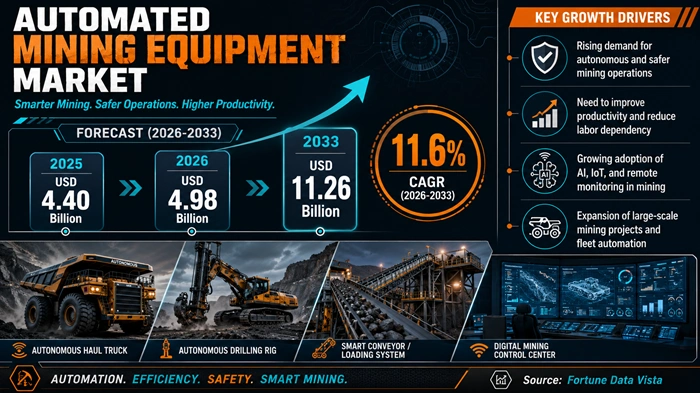
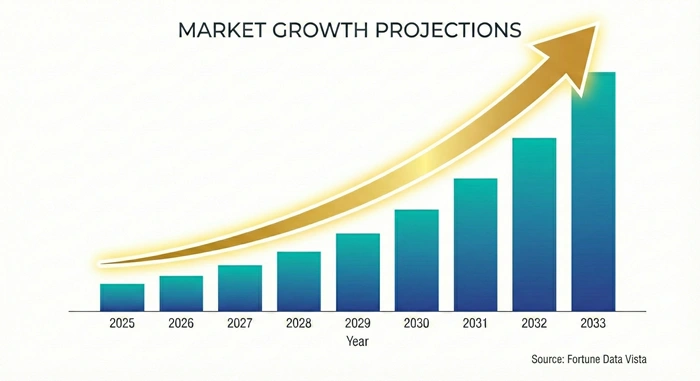
The global Automated Mining Equipment market size is valued at USD 4.40 billion in 2025 and is predicted to increase from USD 4.98 billion in 2026 to approximately USD 11.26 billion by 2033, growing at a CAGR of 11.6% from 2026 to 2033. This strong expansion reflects the mining industry's accelerating shift toward autonomous and remotely operated equipment to improve operational safety, productivity, and cost efficiency across surface and underground mining environments. As labor shortages intensify, ore grades decline, and global mineral demand surges — particularly for battery metals essential to the clean energy transition — mining companies are investing heavily in automation to extract more value from every operational hour.
AI Impact on the Automated Mining Equipment Industry
Artificial Intelligence Is Fundamentally Transforming How Mining Equipment Operates, Thinks, and Interacts with Its Environment — Enabling a New Era of Truly Intelligent, Self-Optimizing Mining Operations*
AI is reshaping the automated mining equipment market at every level of the operational technology stack. Machine learning algorithms embedded in autonomous haulage systems now process real-time data from LiDAR, radar, GPS, and cameras to navigate complex mine site environments with a precision and consistency that human operators cannot replicate over extended shifts. These AI-driven navigation and path-planning systems continuously learn from each operating cycle, improving their obstacle avoidance, route optimization, and load cycle efficiency over time — delivering cumulative performance gains that compound meaningfully as system operating hours accumulate. Industry leaders including Caterpillar and Komatsu are deploying AI-powered fleet management platforms that coordinate the movement of dozens of autonomous haul trucks simultaneously, optimizing the entire material movement cycle with a level of systemic efficiency that would be impossible through conventional manual operations.
Beyond vehicle autonomy, AI is enabling predictive maintenance capabilities that are fundamentally changing the economics of heavy mining equipment operation. Sensor arrays embedded throughout equipment drivetrains, hydraulic systems, structural components, and tires continuously feed performance data to AI models that can detect the early signatures of impending mechanical failure — often days or weeks before a fault becomes observable to a human technician. By scheduling maintenance interventions precisely when they are needed rather than at fixed calendar intervals, AI-driven predictive maintenance systems are dramatically reducing unplanned downtime, extending equipment service life, and lowering total maintenance cost per operating hour. This capability is one of the most commercially compelling value propositions of advanced automation in mining, and its growing adoption is a significant factor driving investment in the broader automated mining equipment ecosystem.
Growth Factors
Escalating Global Mineral Demand for Clean Energy Technologies, Critical Labor Shortages in Mining, and the Relentless Pressure to Improve Safety and Productivity Are Together Powering Extraordinary Growth in This Market*
The energy transition is one of the most powerful demand drivers the automated mining equipment market has ever encountered. The exponential growth of electric vehicle production, renewable energy infrastructure, and grid-scale battery storage is creating an unprecedented surge in demand for copper, lithium, cobalt, nickel, and rare earth elements — minerals that must be extracted from increasingly deep, complex, and geographically remote ore deposits. Mining companies pursuing these resources are under intense commercial pressure to maximize extraction efficiency while controlling operating costs in difficult geological and environmental conditions, making the productivity and safety advantages of automated equipment not just attractive but operationally necessary for competitive mine development.
Labor availability is an equally compelling structural driver. The mining industry globally is contending with a worsening shortage of skilled equipment operators — a challenge that is particularly acute in the remote, harsh-environment locations where many major mineral deposits are situated. Recruiting, training, retaining, and maintaining the safety of a large human workforce in deep underground mines or remote surface operations is extraordinarily expensive and carries significant operational risk. Autonomous and semi-autonomous mining equipment addresses this challenge directly by enabling 24-hour per day operations with fewer human operators working in hazardous environments — simultaneously improving productivity, reducing labor costs, and dramatically improving worker safety metrics. This combination of productivity and safety benefits is creating compelling economic justification for automation investment across mine types, commodity segments, and geographic markets.
Market Outlook
With Battery Metals Demand Accelerating, Mine Automation Technology Maturing Rapidly, and Regulatory Pressure on Mining Safety Intensifying, the Automated Mining Equipment Market Is Entering Its Most Dynamic and Commercially Exciting Growth Phase*
The medium-to-long-term outlook for the automated mining equipment market is defined by the convergence of several structural trends that reinforce one another. The clean energy transition is creating a multi-decade supercycle of demand for critical minerals that mining companies must meet by developing new deposits in increasingly challenging geological environments — a reality that makes the productivity and cost advantages of automation not optional enhancements but operational requirements for competitive mine development. As automation technology matures and the cost of autonomous system deployment declines, the economic case for automating progressively more of the mining operation — from drilling and blasting to loading, haulage, and processing — becomes compelling across a wider range of mine types, scales, and commodity categories.
The integration of autonomous equipment with real-time mine planning and execution systems represents the next major frontier of value creation in the mining automation space. Companies are now developing end-to-end digital mine platforms that connect autonomous fleet management, drill plan optimization, blast design, ore tracking, and processing control in a single, integrated data environment — enabling dynamic mine planning decisions to be executed automatically in real time as geological and operational conditions evolve. This vision of the fully integrated autonomous mine is already being realized at scale in Australia's Pilbara iron ore region, and its commercial success is compelling mining companies globally to accelerate their own automation investment programs. The deepening integration of automation across the full mine value chain will continue to expand the addressable market for automated mining equipment and supporting technology platforms through 2033 and beyond.
Expert Speaks
-
"At Caterpillar, we have been at the forefront of mining automation for over two decades, and I can say with confidence that we are now entering a genuinely transformative phase. The integration of AI, autonomous systems, and real-time data analytics into our equipment portfolio is enabling our mining customers to achieve levels of productivity, safety, and cost efficiency that were simply not achievable with conventional equipment — and we are only scratching the surface of what is possible." — Jim Umpleby, Chairman & CEO, Caterpillar Inc.
-
"Komatsu has a deep commitment to the concept of 'Creating value together for people, society, and the earth through manufacturing and technology innovation,' and nowhere is that commitment more visible than in our mining automation portfolio. Our Autonomous Haulage System has already moved billions of tons of material across some of the world's largest mines — and as we expand these capabilities with new AI and connectivity technologies, we are helping our customers build fundamentally safer and more productive mining operations." — Hiroyuki Ogawa, President & CEO, Komatsu Ltd.
-
"The mining industry is at an inflection point where automation is no longer a competitive differentiator — it is a competitive necessity. At Sandvik, our investment in autonomous drilling systems, intelligent rock tools, and digital mine integration platforms reflects our conviction that the mines of the future will be defined by their ability to operate autonomously, continuously, and with exceptional precision — and we are building the technology portfolio that will make that vision a commercial reality for our customers." — Stefan Widing, President & CEO, Sandvik AB
Key Report Takeaways
-
North America leads the global automated mining equipment market with the highest regional revenue share in 2025, driven by the concentration of advanced precision mining operations across the United States and Canada, strong regulatory emphasis on mine worker safety that incentivizes automation investment, and the presence of major autonomous mining technology vendors headquartered in the region.
-
Asia Pacific is the fastest-growing regional market for automated mining equipment, expanding significantly above the global CAGR through 2033, driven by Australia's world-leading iron ore and gold mine automation programs, China's massive investment in mining modernization, and India's growing coal and mineral extraction sector that is increasingly adopting automation for safety and productivity improvement.
-
The surface mining segment is the dominant equipment deployment category, commanding the largest application revenue share owing to the suitability of open-pit environments for large-scale autonomous haulage and drilling system deployment, with the open mine geometry and established communication infrastructure making surface operations easier to automate at commercial scale compared to underground environments.
-
Autonomous haulage systems (AHS) are the most widely adopted automated equipment type, representing the leading product segment by revenue as the commercial case for replacing manually operated haul trucks with autonomous equivalents has been demonstrated most conclusively — delivering 15–30% productivity improvements and significant safety benefits across multiple major mine sites globally.
-
Autonomous drilling systems represent the fastest-growing individual equipment segment, projected to expand at a CAGR above the overall market average through 2033, driven by the compounding productivity and precision advantages of automated drilling in both surface blast-hole and underground development drilling applications, and the growing number of OEM-approved autonomous drill models available across multiple platform types.
-
The underground mining automation segment is the highest-growth application category over the forecast period, holding approximately 32.4% share and growing at a CAGR of approximately 13.2% through 2033, as the safety imperative in deep underground environments creates the strongest economic and regulatory justification for removing human operators from hazardous working environments through automation technology.
Market Scope
| Parameter | Details |
|---|---|
| Market Size by 2033 | USD 11.26 Billion | Market Size by 2026 | USD 4.98 Billion | Market Size by 2025 | USD 4.40 Billion | Market Growth Rate from 2026 to 2033 | CAGR of 11.6% | Dominating Region | North America | Fastest Growing Region | Asia Pacific | Segments Covered | By Equipment Type, By Mining Type, By Level of Automation, By Application, By Technology, By Region | Regions Covered | North America, Europe, Asia Pacific, Latin America, Middle East & Africa |
Market Dynamics
Drivers Impact Analysis
Surging Global Demand for Critical and Battery Minerals, the Worsening Mining Labor Shortage, and Regulatory Pressure to Eliminate Worker Fatalities Are Providing Exceptional and Durable Growth Momentum for the Automated Mining Equipment Market*
| Driver | ≈ % Impact on CAGR Forecast | Geographic Relevance | Impact Timeline |
|---|---|---|---|
| Rising global demand for critical minerals (copper, lithium, cobalt, nickel) driving mine productivity pressure | ~3.8% | Global (Australia, Latin America, Africa) | 2026–2033 (Ongoing) |
| Critical labor shortage in remote mining environments driving automation adoption | ~2.9% | Australia, North America, Latin America | 2026–2033 (Sustained) |
| Strict safety regulations mandating reduced human exposure in hazardous mine environments | ~2.4% | Global (especially Australia, Europe, Canada) | 2026–2033 |
| Declining ore grades requiring productivity improvements to sustain economics | ~1.7% | Global | 2026–2030 |
The global energy transition's demand for battery and critical minerals is creating an extraordinary productivity imperative for the automated mining equipment market. Battery electric vehicle penetration is scaling exponentially globally — with EV sales in major markets already representing 20–30% of new vehicle sales — and grid-scale energy storage deployment is accelerating in parallel. This is translating into a structural, multi-decade increase in demand for copper (used extensively in EV motors, charging infrastructure, and power grids), lithium (essential for battery cathode chemistry), cobalt, and nickel that mining companies must meet by operating their mines more intensively and efficiently than ever before. Automation is the primary lever available to mining operators for achieving the step-change productivity improvements needed to meet this demand while managing escalating operational costs.
The safety argument for automation has never been stronger or more commercially compelling. Mine fatality rates remain unacceptably high globally, and regulatory authorities in major mining jurisdictions — including Australia, Canada, the United States, and Chile — are tightening enforcement of worker safety standards and actively encouraging the adoption of technologies that remove human workers from hazardous environments. For underground mine operators particularly, the replacement of manually operated load-haul-dump machines, drill rigs, and support vehicles with autonomous or remote-controlled equivalents represents the most direct and reliable pathway to achieving the fatality reduction targets that regulators and mining company boards are demanding. This safety-driven investment rationale is creating a powerful policy and governance tailwind that reinforces the commercial productivity and cost efficiency arguments for automation investment in the automated mining equipment market.
Restraints Impact Analysis
The Exceptionally High Capital Investment Required, Connectivity Challenges in Underground Environments, and the Complexity of Integrating Legacy Mining Systems With Modern Automation Platforms Are Meaningfully Constraining Market Growth Potential*
| Restraint | ≈ % Impact on CAGR Forecast | Geographic Relevance | Impact Timeline |
|---|---|---|---|
| Very high upfront capital cost of autonomous equipment systems | ~−2.6% | Global (especially emerging mining markets) | 2026–2030 |
| Reliable wireless connectivity challenges in deep underground mine environments | ~−1.8% | Global | 2026–2033 |
| Complexity of integrating autonomous systems with existing legacy mining fleet | ~−1.4% | Global | 2026–2030 |
| Workforce transition resistance and labor union opposition to automation | ~−0.9% | North America, Australia, South Africa | 2026–2030 |
The most significant commercial barrier to broader adoption of automated mining equipment is the substantial upfront capital requirement. A single autonomous haul truck system — including the vehicle hardware, onboard autonomy system, site communications infrastructure, and fleet management software — can cost two to three times the price of an equivalent manually operated machine. For mid-tier and junior mining companies with constrained balance sheets, this capital intensity makes large-scale automation deployment financially challenging without project financing structures, OEM leasing programs, or demonstrated short-term payback evidence from comparable operations. This affordability barrier is particularly acute in developing mining economies in Africa and Southeast Asia, where the combination of lower labor costs and limited access to equipment financing makes the economic case for automation less compelling than in high-wage, high-productivity mining jurisdictions.
Underground mine automation faces additional technical challenges that surface mining does not. The reliable, high-bandwidth wireless communication networks that autonomous equipment requires for safe, coordinated operation are extremely difficult and expensive to deploy and maintain throughout the complex, dynamically changing tunnel networks of an active underground mine. As mining progresses and new development headings are opened, existing communication infrastructure must be continuously extended — creating ongoing capital and maintenance costs that add to the total cost of underground automation implementation. Industry leaders including Epiroc and Sandvik are investing in developing more robust underground communication solutions based on leaky feeder systems, mesh Wi-Fi networks, and ultra-wideband positioning technology, but underground connectivity remains a meaningful constraint on the pace of underground mine automation adoption in the near term.
Opportunities Impact Analysis
The Electrification of Mining Equipment, Digital Twin Integration, and the Expansion of Automation Into Mid-Tier and Junior Mining Companies Present Major Untapped Growth Opportunities for the Automated Mining Equipment Market*
| Opportunity | ≈ % Impact on CAGR Forecast | Geographic Relevance | Impact Timeline |
|---|---|---|---|
| Convergence of electric vehicle technology with mine automation enabling battery-electric autonomous equipment | ~+3.1% | Australia, Europe, North America | 2027–2033 |
| Digital twin and simulation platforms enabling mine automation planning and optimization | ~+2.4% | Global | 2026–2033 |
| Expansion of automation financing models enabling mid-tier mining company access | ~+1.8% | Latin America, Africa, Asia Pacific | 2027–2033 |
| Growing aftermarket services and retrofit automation kit market for existing equipment fleets | ~+1.4% | Global | 2026–2030 |
The convergence of battery-electric mine equipment and autonomous operation technology is creating one of the most exciting new product development frontiers in the automated mining equipment market. Battery-electric underground vehicles eliminate diesel exhaust emissions — a major occupational health hazard and ventilation cost driver in underground mines — while their precise electric drivetrains are more compatible with autonomous control systems than conventional hydraulic-mechanical drivetrains. Companies including Epiroc, Sandvik, and Normet are now commercializing battery-electric autonomous loaders, drill rigs, and support vehicles that deliver both emissions reduction and automation capability simultaneously — a combination that is compelling from both an ESG compliance and operational productivity perspective. As battery energy density improves and electric drivetrain costs decline, battery-electric autonomous equipment is expected to capture rapidly growing market share within the broader automated mining sector through the forecast period.
The retrofit automation market — focused on equipping existing manually operated mining equipment with autonomous or semi-autonomous control systems — represents a significant and underserved commercial opportunity. Most mining companies operate mixed fleets of equipment at different ages and automation readiness levels, and the ability to add automation capability to existing machines through a retrofit kit rather than requiring whole-fleet replacement dramatically lowers the cost and complexity of automation adoption. Companies including Autonomous Solutions Inc. (ASI Mining) and Hexagon AB are developing standardized retrofit automation systems designed to work with multiple makes and models of common mining equipment, targeting the large installed base of non-automated machinery operating globally as a commercially accessible and less capital-intensive entry point into the automated mining equipment market.
Segment Analysis
By Equipment Type
Autonomous Haulage Systems Lead the Automated Mining Equipment Market by Revenue, While Autonomous Drilling Systems Are Rapidly Gaining Ground as the Next Major Technology Adoption Wave*
Autonomous haulage systems (AHS) are the largest and most commercially established equipment type within the automated mining equipment market, accounting for approximately 41.3% of equipment-type segment revenue in 2025 and growing at a CAGR of around 11.0% through 2033. The commercial proof of concept for autonomous haul trucks was established at scale in Australia's Pilbara iron ore mines — where Fortescue Metals Group, Rio Tinto, and BHP collectively operate hundreds of Komatsu and Caterpillar autonomous trucks — and the overwhelming productivity and safety data generated by these operations has created an irresistible commercial argument for adoption at major mine sites globally. Komatsu and Caterpillar are the dominant AHS suppliers globally, with their FrontRunner and Cat Command for hauling systems respectively having accumulated billions of operating hours across multiple mine sites in Australia, North America, Chile, and Canada. Australia is the leading regional market for AHS deployment, where a combination of mine scale, labor cost, and regulatory environment has created the world's most mature and extensive autonomous haulage ecosystem.
Autonomous drilling systems represent the fastest-growing individual equipment segment within the automated mining sector, projected to grow at a CAGR of approximately 13.4% through 2033 as the precision, repeatability, and continuous operation advantages of automated drilling gain commercial recognition across blast-hole, grade control, and underground development applications. Automated drill rigs can maintain consistent drilling angles, depths, and patterns with greater accuracy than human operators — directly improving blast fragmentation quality in surface operations and development advance rates in underground mining. Epiroc's AutoMine drilling platform and Sandvik's AutoMine for surface drills are the leading commercial products in this growing segment, with both companies experiencing strong order growth from global mining majors seeking to extend their automation programs beyond haulage into drilling operations. Latin America is an important emerging growth region for automated drilling adoption, as the large copper and lithium mining operations in Chile, Peru, and Argentina offer ideal deployment conditions for high-capacity autonomous drill systems.
By Mining Type
Surface Mining Dominates Automated Mining Equipment Market Revenue, While Underground Mining Automation Is Growing at the Fastest Rate Driven by Safety Imperatives and Technological Advancement*
Surface mining holds the dominant revenue position within the automated mining equipment market, representing approximately 62.4% of mining-type segment revenue in 2025 and growing at a CAGR of around 10.8% through 2033. The open geometry of surface mine operations — with wide haulage roads, established communication infrastructure, and well-defined operational zones — provides an ideal deployment environment for large-scale autonomous fleet operations. Australia's massive open-pit iron ore, coal, and gold mines are the world's most advanced surface mining automation deployments, with companies including BHP, Rio Tinto, Fortescue Metals Group, and Anglo American collectively operating some of the world's largest autonomous mining fleets. North America is the second most mature surface mining automation market, with autonomous haulage deployments at copper mines in Arizona and Nevada, oil sands operations in Alberta, and coal mines across Wyoming contributing to the region's strong equipment revenue base. The segment's revenue leadership will be sustained through 2033 by continued fleet expansion at existing automated mines and new greenfield automation deployments across multiple global mining regions.
Underground mining automation is the highest-growth application segment within the automated mining equipment market, expected to grow at a CAGR of approximately 13.2% through 2033, from a revenue share of approximately 32.4% in 2025. The safety imperative in deep underground mining environments — where workers face exposure to rock falls, seismic events, dust, fumes, and heat stress — creates the most compelling regulatory and humanitarian argument for automation of any mining context, and this is increasingly being recognized by both mine operators and regulatory authorities. Sandvik and Epiroc are the global leaders in underground mining automation technology, offering integrated suites of autonomous loaders, drill rigs, and autonomous transport vehicles that are being deployed in gold, copper, platinum, and nickel mines across Scandinavia, Australia, Canada, and South Africa. The development of 5G private wireless networks in underground mines is beginning to address the connectivity challenges that have historically slowed underground automation adoption, and as this infrastructure matures and costs decline, the pace of underground automation deployment is expected to accelerate significantly through the forecast period.
Regional Insights
North America
North America Leads the Global Automated Mining Equipment Market Through Its Advanced Mine Technology Ecosystem, Major Commodity Production Base, and Strong Regulatory Safety Framework*
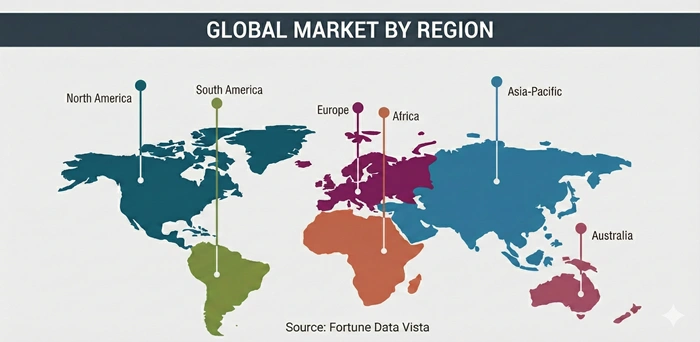
North America holds the dominant position in the global automated mining equipment market, accounting for approximately 34.8% of total revenue in 2025 and growing at a CAGR of approximately 11.2% through 2033. The United States and Canada together host some of the world's largest and most technologically advanced metal and coal mining operations, where the combination of high labor costs, stringent safety regulations, and access to advanced automation technology has created a highly favorable environment for autonomous equipment adoption. Major mining companies operating in the region — including Freeport-McMoRan, Barrick Gold, Teck Resources, and Agnico Eagle Mines — are actively expanding their automation programs across both surface and underground operations. Leading automation technology suppliers with major North American market positions include Caterpillar, Hexagon AB, Trimble Inc., and Autonomous Solutions Inc. (ASI Mining), all of which have established customer relationships with the region's major mining companies and active research and development programs tailored to North American mine operating conditions.
Canada's oil sands sector in Alberta and major metal mining operations in Ontario, Quebec, and British Columbia are among the world's most active adopters of autonomous mining equipment, driven by extreme weather conditions, remote location challenges, and a strong regulatory push from provincial mine safety authorities to reduce worker exposure to hazardous conditions. The U.S. copper mining sector — centered in Arizona, Nevada, and New Mexico — is a growing hub for autonomous haul truck deployment, as operators seek to sustain productivity and safety performance in maturing, deep open-pit operations where manual operations become increasingly challenging. North America's role as a primary hub for mining technology innovation and R&D ensures that the region will maintain its market leadership and remain a critical first-mover market for new autonomous mining equipment technologies throughout the forecast period.
Asia Pacific
Asia Pacific Is the Fastest-Growing Region for Automated Mining Equipment, Powered by Australia's World-Leading Mine Automation Programs and China and India's Large-Scale Mining Modernization Investments*
Asia Pacific is the fastest-growing regional market for automated mining equipment, projected to expand at a CAGR of approximately 12.8% through 2033, from a 2025 revenue share of approximately 28.7%. Australia is the undisputed global leader in large-scale open-pit mining automation, with its Pilbara iron ore operations representing the world's most extensive deployment of autonomous haul trucks, autonomous drills, and remotely operated infrastructure in a live mining environment. BHP, Rio Tinto, and Fortescue Metals Group have collectively invested billions of dollars in autonomous mining technology over the past decade, and their operations serve as the global reference benchmark for what full-scale mine automation can achieve in terms of productivity, safety, and cost performance. Komatsu and Caterpillar are the primary autonomous haulage system suppliers in Australia's Pilbara region, while Epiroc and Sandvik supply autonomous underground equipment to Australian gold and copper mines across Queensland, New South Wales, and Western Australia.
China's massive mining sector — encompassing coal, iron ore, copper, rare earths, and gold production across geographically diverse and often challenging operating environments — represents the single largest growth opportunity for automated mining equipment within the Asia Pacific region through 2033. Chinese government policy is actively promoting mining technology modernization, with state-owned mining companies including China Shenhua Energy and Zijin Mining Group investing in autonomous equipment programs to improve productivity, safety, and environmental compliance across their vast operations. India's growing coal and mineral extraction sector is also beginning to adopt automation technologies as mine safety regulation tightens and the government pursues domestic mining capacity expansion to support its industrial development ambitions. The combined scale of China's and India's mineral production programs, combined with Australia's world-leading automation maturity, makes Asia Pacific the most compelling growth region for automated mining equipment investment globally through the forecast period.
Top Key Players
-
Caterpillar Inc. (United States)
-
Komatsu Ltd. (Japan)
-
Sandvik AB (Sweden)
-
Epiroc AB (Sweden)
-
ABB Ltd. (Switzerland)
-
Rockwell Automation, Inc. (United States)
-
Hexagon AB (Sweden)
-
Trimble Inc. (United States)
-
Autonomous Solutions Inc. (ASI Mining) (United States)
-
Hitachi Construction Machinery Co., Ltd. (Japan)
-
Liebherr Group (Switzerland / Germany)
-
Atlas Copco AB (Sweden)
-
Volvo Group (Sweden)
-
Normet Group Oy (Finland)
-
MacLean Engineering & Marketing Co. Ltd. (Canada)
Recent Developments
-
In 2025, Caterpillar announced the expansion of its Cat Command autonomous mining platform to include a new generation of 793 and 797 autonomous haul truck configurations, featuring enhanced AI-based obstacle detection and multi-fleet coordination capabilities, and signed major fleet supply agreements with copper mining operations in Chile and the United States.
-
In 2024, Komatsu deployed its 1000th autonomous haulage system truck globally, marking a major commercial milestone for the company's FrontRunner AHS technology and announcing partnerships with several new mining operators in Africa and Latin America to expand autonomous haulage deployment beyond the Australian iron ore market where the technology was first commercialized.
-
In 2025, Epiroc AB launched the Minetruck MT65 battery electric autonomous underground haul truck — one of the most capable battery-electric autonomous underground vehicles ever commercialized — targeting deep underground metal mines seeking to combine zero-emission electric operation with continuous autonomous productivity for ore extraction and development activities.
-
In 2024, Hexagon AB completed the acquisition of Alastri, an Australian mining optimization software company, strengthening its capability to deliver integrated autonomous fleet management, mine planning, and real-time execution optimization services to large-scale open-pit mining operations globally.
-
In 2025, Sandvik expanded its AutoMine autonomous mining system to include a new generation of multi-machine autonomous development drilling capability for underground hard rock mines, enabling coordinated autonomous drilling, charging, and mucking cycles that deliver significant development advance rate improvements in deep underground gold and copper mining applications.
Market Trends
The Convergence of Battery-Electric Drivetrains With Autonomous Control Systems and the Rise of the Fully Integrated Digital Mine Are the Two Defining Technology Trends Reshaping the Automated Mining Equipment Market Through 2033*
The most commercially significant technology trend currently reshaping the automated mining equipment market is the accelerating convergence of battery-electric powertrain technology with autonomous control systems in underground mining equipment. Underground mines have historically been constrained in their automation ambitions by the heat, fumes, and infrastructure requirements of diesel-powered equipment — limitations that battery-electric machines eliminate entirely. Battery-electric autonomous underground equipment not only removes the health and safety risks associated with diesel exhaust exposure but also enables more efficient autonomous control by providing the precise, responsive electric drivetrains that autonomous control systems can manage with greater accuracy and predictability than conventional mechanical-hydraulic machines. As battery energy density continues to improve and OEM product portfolios of battery-electric autonomous underground equipment expand, this convergence is expected to fundamentally transform the economics and operational model of deep underground mining over the coming decade.
The development of fully integrated digital mine platforms — connecting autonomous equipment fleets, real-time geological data, mine planning systems, and processing plant controls in a single, unified operational environment — is rapidly moving from a long-term vision to a commercially available reality. Companies including Hexagon, Trimble, and Wenco International Mining Systems are developing mine operating system platforms that provide mine operators with a single pane of glass from which to monitor, manage, and optimize the entire mine operation — from drill plan design to haul truck dispatch to processing plant feed rate. As these integrated platforms mature and their ability to improve mine-wide operational efficiency is demonstrated at scale, they are expected to become the organizational infrastructure around which next-generation automated mines are built and operated, driving sustained demand for the automated equipment and connectivity systems that these platforms coordinate.
Segments Covered in the Report
-
By Equipment Type
-
Autonomous Haulage Systems (AHS / Autonomous Haul Trucks)
-
Autonomous Drilling Systems (Blast-Hole Drill Rigs, Underground Drill Rigs)
-
Autonomous Load-Haul-Dump (LHD) Loaders
-
Automated Tunnel Boring and Development Equipment
-
Automated Blasting Systems
-
Smart Ventilation and Support Systems
-
Others
-
-
By Mining Type
-
Surface Mining
-
Underground Mining
-
-
By Level of Automation
-
Fully Autonomous
-
Semi-Autonomous (Operator-Assisted)
-
Remote-Controlled
-
-
By Application
-
Mine Development
-
Mine Production
-
Maintenance and Support Operations
-
-
By Technology
-
Autonomous Haulage Technology
-
Collision Avoidance Systems
-
Fleet Management Systems
-
Real-Time Location and Positioning Systems
-
Remote Monitoring and Control Platforms
-
Predictive Maintenance Analytics
-
-
By Region
-
North America (U.S., Canada, Mexico)
-
Europe (Sweden, Finland, Germany, Rest of Europe)
-
Asia Pacific (Australia, China, India, Japan, Rest of Asia Pacific)
-
Latin America (Chile, Peru, Brazil, Rest of Latin America)
-
Middle East & Africa (South Africa, Rest of MEA)
-
❝ Built for Every Level — From Startups to Industry Giants ❞
Here Is Exactly How This Report Works for You
-
From early-stage autonomous mining technology startups to Tier 1 global OEMs managing billion-dollar equipment portfolios, this report delivers granular segment revenue forecasts, technology adoption benchmarks, and competitive positioning intelligence that directly shape your product development roadmap, OEM partnership strategy, and regional market entry decisions — giving you the data-driven clarity needed to compete in the USD 11.26 billion opportunity projected by 2033.
-
For mining company executives, equipment finance investors, and industrial technology private equity teams, the report's comprehensive supply-demand analysis reveals precisely how critical mineral demand cycles, mine operator capital allocation patterns, and evolving safety regulations across Australia, North America, and Latin America are driving equipment procurement decisions — enabling confident investment thesis development, operational planning, and portfolio company growth strategy in this rapidly expanding market.
-
The competitor revenue analysis section provides a detailed breakdown of product portfolio positioning, OEM approval status, regional market share, contract win activity, M&A history, and digital platform strategy for the top 15 players in the global automated mining equipment industry — equipping your business development leadership with the actionable competitive intelligence needed to identify white-space opportunities, build winning OEM relationships, and outmaneuver competitors in the mine automation market's fastest-growing application and regional segments.
Frequently Asked Questions:
Answer: The global automated mining equipment market is valued at USD 4.40 billion in 2025 and is projected to reach approximately USD 11.26 billion by 2033. This represents a CAGR of 11.6% from 2026 to 2033, fueled by surging critical mineral demand, mining labor shortages, and regulatory pressure to improve mine worker safety through automation.
Answer: The automated mining equipment market encompasses a broad range of autonomous and semi-autonomous technologies, including autonomous haul trucks, automated drilling rigs, autonomous load-haul-dump loaders, tunnel boring systems, remote-controlled blasting platforms, and supporting fleet management and predictive maintenance systems. The market spans both surface and underground mining environments and covers the full range of automation levels from remote-controlled to fully autonomous operation.
Answer: North America is the leading region in the automated mining equipment market, holding approximately 35% of global revenue in 2025, driven by advanced mining operations in the U.S. and Canada and strong safety regulation supporting automation investment. Asia Pacific is the fastest-growing region, expanding at a CAGR above 12% through 2033, led by Australia's world-leading mine automation programs, China's large-scale mining modernization, and growing automation adoption in India.
Answer: Battery-electric mining vehicles are transforming the automated mining equipment market by combining zero-emission underground operation with autonomous control capability — eliminating the diesel exhaust exposure and ventilation costs that have historically constrained underground automation adoption. As battery-electric autonomous underground loaders, haul vehicles, and drill rigs from suppliers like Epiroc and Sandvik become more commercially available and cost-competitive, this technology convergence is expected to accelerate underground mine automation adoption significantly through 2033.
Answer: The automated mining equipment market is led by global OEMs including Caterpillar (U.S.), Komatsu (Japan), Sandvik (Sweden), and Epiroc (Sweden) for autonomous equipment hardware, alongside technology platform companies including Hexagon, Trimble, ABB, and Rockwell Automation that provide the fleet management, connectivity, and control software that autonomous equipment systems require. These companies compete and collaborate across different elements of the mine automation value chain, with OEM-technology provider partnerships increasingly defining the commercial landscape of the market.