
Automated Truck Loading System Market Overview
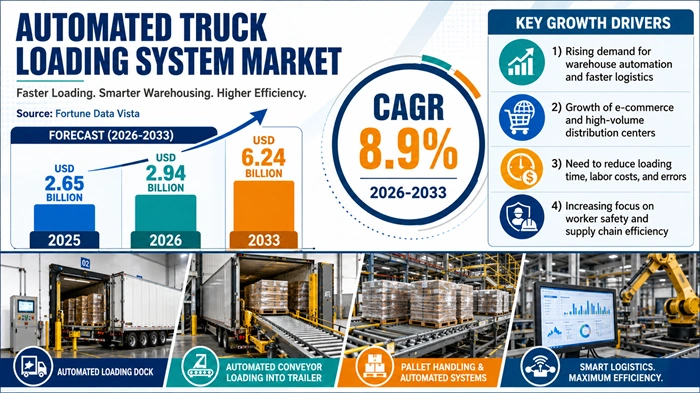
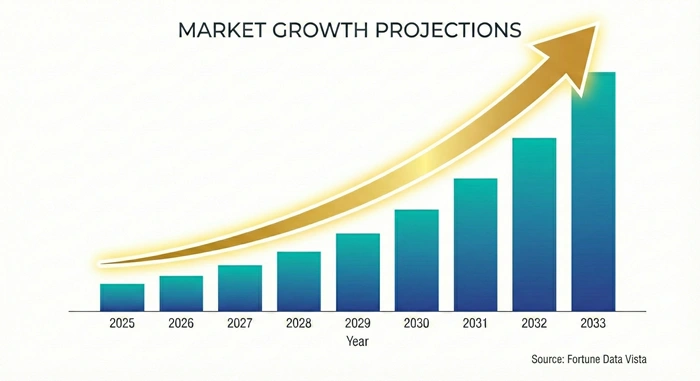
The global Automated Truck Loading System market size is valued at USD 2.65 billion in 2025 and is predicted to increase from USD 2.94 billion in 2026 to approximately USD 6.24 billion by 2033, growing at a CAGR of 8.9% from 2026 to 2033. This remarkable trajectory reflects the accelerating adoption of automation technologies across logistics, warehousing, e-commerce fulfillment, and manufacturing sectors worldwide. Businesses are increasingly turning to automated loading solutions to address persistent labor shortages, reduce operational costs, and meet the demands of high-volume, time-sensitive freight movement.
AI Impact on the Automated Truck Loading System Industry
Artificial Intelligence Is Fundamentally Transforming How Warehouses and Distribution Centers Plan, Execute, and Optimize Every Stage of the Truck Loading Process*
AI is reshaping the automated truck loading system landscape in ways that go well beyond basic mechanical automation. Machine learning algorithms are now being deployed to optimize load sequencing in real time — analyzing cargo weight distribution, delivery route priorities, and vehicle capacity constraints simultaneously to ensure each truck is loaded with maximum efficiency. Computer vision systems powered by AI can detect irregularly shaped pallets, identify damaged goods, and dynamically adjust robotic handling parameters without human intervention, reducing both cycle times and error rates across large-scale distribution operations.
Beyond operational optimization, AI is enabling predictive maintenance capabilities that are significantly reducing unplanned downtime for automated loading equipment. IoT-connected sensors embedded in loading dock machinery continuously feed data to AI platforms that can identify wear patterns, flag potential failures before they occur, and automatically schedule maintenance windows during low-activity periods. Companies like BEUMER Group and Joloda Hydraroll are actively integrating AI-driven analytics into their system platforms, giving logistics operators real-time visibility into dock performance metrics and enabling smarter workforce deployment alongside automated systems.
Growth Factors
The Explosive Growth of E-Commerce, Persistent Labor Shortages, and a Global Commitment to Supply Chain Modernization Are Creating Ideal Conditions for Sustained Market Expansion*
The single most powerful growth driver for this market is the unprecedented surge in e-commerce order volumes, which has placed immense pressure on distribution centers to process and dispatch freight faster than ever before. Retailers and third-party logistics providers operating at massive scale — including Amazon, Walmart, and global FMCG companies — are investing heavily in automated loading technologies that can match the throughput demands of peak shopping seasons without proportional increases in labor costs. As consumer expectations for same-day and next-day delivery become the norm rather than the exception, automated truck loading systems are transitioning from a competitive advantage into an operational necessity.
Simultaneously, the global logistics sector is grappling with a structural labor shortage that shows no signs of easing. Loading dock work is physically demanding, injury-prone, and increasingly difficult to staff reliably — particularly in developed economies where workforce participation in manual logistics roles is declining. Automated loading systems directly address this challenge by replacing or augmenting human labor at the dock face, enabling facilities to maintain consistent throughput regardless of labor market conditions. This dynamic is particularly pronounced in North America and Europe, where industrial automation investment has surged as companies seek to insulate their supply chains from workforce volatility and rising wage inflation.
Market Outlook
With Infrastructure Modernization Programs, Smart Logistics Investments, and Post-Pandemic Supply Chain Resilience Mandates Gaining Momentum, the Market Is Set for a Decade of Robust and Diversified Growth*
The outlook for automated truck loading technology through 2033 is exceptionally strong, underpinned by a convergence of structural trends that show little sign of reversing. Governments across North America, Europe, and Asia Pacific are channeling significant public investment into smart infrastructure and intelligent logistics networks — initiatives that are directly accelerating the adoption of automated dock solutions in ports, distribution hubs, rail-to-road transfer facilities, and urban freight consolidation centers. The U.S. Department of Transportation's infrastructure modernization programs and the European Union's logistics digitalization directives are both actively catalyzing demand for next-generation loading automation technologies.
From a technology standpoint, the coming years will see the automated truck loading system market benefit enormously from advances in robotics, 5G connectivity, and digital twin simulation — all of which are making automated loading systems faster, more flexible, and capable of handling a wider variety of cargo types than previous generations. The integration of Automated Guided Vehicles (AGVs) and collaborative robots within loading dock environments is opening entirely new market segments, particularly in pharmaceutical logistics, food and beverage distribution, and high-value electronics freight, where precise handling and traceability are mission-critical requirements.
Expert Speaks
-
"Automation in logistics is no longer optional — it is a strategic imperative. At FedEx, we are committed to deploying advanced loading and unloading automation across our global hub network to drive throughput gains, reduce injury rates, and build a more resilient freight operation that can scale with our customers' demands." — Raj Subramaniam, President & CEO, FedEx Corporation
-
"The transformation of the loading dock from a manual bottleneck into an intelligent, automated interface is one of the most impactful changes happening in supply chain management today. At UPS, our investments in automated truck loading and dock management technology are already delivering measurable efficiency improvements across our U.S. and European networks." — Carol Tomé, CEO, United Parcel Service (UPS)
-
"Automation across our distribution infrastructure — including truck loading and dock management systems — is central to our strategy for serving customers faster and more efficiently. We are seeing compelling returns on automated loading investments, and we plan to continue scaling these capabilities across our global fulfillment network." — Doug McMillon, President & CEO, Walmart Inc.
Key Report Takeaways
-
North America holds the dominant position in the global automated truck loading system market, capturing over 38% of total revenue in 2024, driven by large-scale e-commerce fulfillment operations, strong industry adoption of warehouse automation, and well-developed logistics infrastructure supported by major players such as BEUMER Group and Joloda Hydraroll.
-
Asia Pacific is the fastest-growing regional market, expected to expand at a CAGR above the global average through 2033, powered by China's booming smart logistics ecosystem, India's rapid manufacturing and retail growth, and substantial government investment in industrial automation and port modernization across Southeast Asia.
-
Large-scale e-commerce and third-party logistics (3PL) operators are the heaviest users of automated loading technology, particularly those managing high-velocity distribution centers where consistent throughput, reduced dock turnaround time, and lower labor dependency are critical operational priorities.
-
The automotive and transportation industry is the leading end-user segment, accounting for approximately 34% of global market revenue, owing to just-in-time manufacturing requirements, high freight volumes, and the need for damage-free, precisely sequenced component delivery across complex supply chains.
-
Conveyor-based systems — including roller track and belt conveyors — represent the most widely adopted system type, owing to their reliability, adaptability to diverse cargo formats, and relatively straightforward integration with existing warehouse management systems and dock infrastructure.
-
Automated Guided Vehicles (AGVs) are the fastest-growing system type, projected to expand at a CAGR of approximately 11.2% through 2033, with a rising share driven by their flexibility to handle varied load configurations and their compatibility with fully autonomous warehouse operations across food, pharma, and retail distribution.
Market Scope
| Parameter | Details |
|---|---|
| Market Size by 2033 | USD 6.24 Billion | Market Size by 2026 | USD 2.94 Billion | Market Size by 2025 | USD 2.65 Billion | Market Growth Rate from 2026 to 2033 | CAGR of 8.9% | Dominating Region | Europe | Fastest Growing Region | Asia Pacific | Segments Covered | By System Type, By Loading Dock Type, By Truck Type, By Industry, By Automation Level, By Region | Regions Covered | North America, Europe, Asia Pacific, Latin America, Middle East & Africa |
Market Dynamics
Drivers Impact Analysis
Surging E-Commerce Volumes, Labor Market Constraints, and the Urgent Need for Supply Chain Resilience Are Collectively Powering Structural Demand for Automated Loading Technologies Globally*
| Driver | ≈ % Impact on CAGR Forecast | Geographic Relevance | Impact Timeline |
|---|---|---|---|
| E-commerce order volume growth requiring faster, high-throughput loading | ~3.1% | Global (North America, Asia Pacific, Europe) | 2026–2033 (Ongoing) |
| Structural labor shortages in warehouse and logistics operations | ~2.3% | North America, Europe | 2026–2030 (Near-term, sustained) |
| Government investment in smart infrastructure and intelligent logistics hubs | ~1.7% | Asia Pacific, North America, Europe | 2027–2033 (Accelerating) |
| Rising demand for dock efficiency and reduced truck turnaround times | ~1.4% | Global | 2026–2033 (Sustained) |
The relentless expansion of global e-commerce is placing unprecedented strain on distribution centers and logistics hubs worldwide, making the automated truck loading system market one of the most strategically important segments within industrial automation. The sheer volume of freight that modern fulfillment operations must process — particularly during peak periods — requires dock automation solutions capable of operating continuously with consistent precision. As consumer demand for rapid delivery intensifies across North America, Europe, and Asia Pacific, investment in automated loading technology is scaling proportionally, driving durable revenue growth across all major system types and industry verticals.
Labor market dynamics are compounding this urgency in meaningful ways. The growing unwillingness of workers in developed economies to accept physically demanding dock labor roles — combined with rising minimum wage legislation and escalating workers' compensation costs linked to loading-related injuries — is creating a powerful economic case for automation investment. Companies that deploy automated truck loading solutions are not only reducing recurring labor costs but also cutting injury-related insurance premiums and improving dock safety compliance, delivering multi-dimensional financial returns that significantly accelerate the return on capital investment timelines.
Restraints Impact Analysis
High Capital Investment Requirements and the Complexity of Integrating Automated Loading Systems into Legacy Warehouse Infrastructure Remain Meaningful Barriers to Wider Adoption*
| Restraint | ≈ % Impact on CAGR Forecast | Geographic Relevance | Impact Timeline |
|---|---|---|---|
| High upfront capital expenditure for system procurement and installation | ~−1.9% | Global (especially SMEs in developing markets) | 2026–2030 |
| Integration complexity with existing WMS, ERP, and dock infrastructure | ~−1.3% | Global | 2026–2033 (Persistent) |
| Limited awareness and technical expertise in emerging economies | ~−0.8% | Latin America, MEA, Southeast Asia | 2026–2029 |
| Operational disruption risk during system installation and commissioning | ~−0.6% | Global | 2026–2028 |
The primary restraint facing the automated truck loading system market is the substantial capital outlay required to design, procure, install, and commission a fully automated loading solution. For mid-sized manufacturers and regional logistics operators, the total cost of ownership — including system hardware, integration software, dock structural modifications, and staff retraining — can represent a significant financial hurdle, particularly in environments where management teams are under pressure to minimize capital expenditure. This challenge is most pronounced in Latin America, the Middle East, and Southeast Asia, where financing options for industrial automation remain limited compared to North America and Europe.
Integration complexity represents a closely related and equally persistent challenge. Many warehouses and distribution centers operate with legacy warehouse management systems (WMS), aging dock infrastructure, and diverse truck fleet configurations that were not designed with automated loading compatibility in mind. Retrofitting automated systems into these environments requires significant engineering customization, extended commissioning timelines, and careful operational transition planning to avoid disruption to live freight flows. Until system vendors develop more plug-and-play, fleet-agnostic automated loading solutions, integration complexity will continue to moderate the pace of adoption among operators with heterogeneous existing infrastructure.
Opportunities Impact Analysis
Pharmaceutical Cold-Chain Logistics, Smart Port Automation, and the Rise of Autonomous Freight Networks Present Compelling Untapped Growth Opportunities for the Automated Truck Loading System Market*
| Opportunity | ≈ % Impact on CAGR Forecast | Geographic Relevance | Impact Timeline |
|---|---|---|---|
| Growth in pharmaceutical and cold-chain logistics requiring precision automated handling | ~+2.2% | North America, Europe, Asia Pacific | 2027–2033 |
| Smart port and intermodal freight hub automation programs | ~+1.8% | Asia Pacific, Middle East, Europe | 2026–2033 |
| Integration with autonomous trucking and self-docking vehicle platforms | ~+1.5% | North America, Europe | 2028–2033 |
| Expansion of 3PL and contract logistics sectors in emerging economies | ~+1.0% | Asia Pacific, Latin America | 2026–2033 |
The pharmaceutical and cold-chain logistics sector represents one of the most promising growth frontiers for the automated truck loading system market. Temperature-sensitive pharmaceutical products, vaccines, and perishable food items require precise, gentle handling during loading and unloading — conditions that automated systems with integrated temperature monitoring and controlled-environment dock solutions can deliver far more consistently than manual operations. As global pharmaceutical supply chain volumes grow — driven by expanding biologics production, vaccine distribution programs, and specialty drug delivery networks — the demand for automated loading solutions in this high-value vertical is set to accelerate meaningfully.
The convergence of automated truck loading technology with the emerging autonomous trucking ecosystem presents another transformative long-term opportunity. As self-driving freight vehicles — developed by companies like Waymo Via, Plus.ai, and Aurora — begin operating at scale on highway routes, the integration of fully automated loading dock systems becomes not just a productivity enhancement but a technical necessity. Autonomous trucks arriving at a distribution center cannot participate in a partially manual loading process. This paradigm creates an enormous addressable market for end-to-end dock automation solutions, positioning the most innovative players in the automated loading sector to capture disproportionate value as freight autonomy scales through the 2030s.
Segment Analysis
By System Type
Automated Guided Vehicles and Conveyor-Based Loading Systems Are Together Reshaping the Economics and Operational Architecture of Modern Distribution Dock Management*
The conveyor system segment — encompassing roller track, belt, and slat conveyor configurations — currently holds the largest share within the automated truck loading system market, accounting for approximately 42% of global system revenue in 2024. Conveyor-based systems dominate because of their proven reliability in high-throughput environments, their ability to handle standardized pallet and unit load formats efficiently, and their relative ease of integration with existing dock leveler and warehouse handling infrastructure. North America is the strongest regional market for conveyor-based automated loading systems, where large-scale food and beverage, FMCG, and retail distribution centers have been deploying these technologies for over a decade. Key players including Joloda Hydraroll, Ancra Systems, and Cargo Floor have built strong market positions in North America by offering highly customized conveyor system configurations tailored to specific dock layouts and cargo profiles. The segment is expected to grow at a steady CAGR of approximately 8.4% through 2033, driven by ongoing capacity expansion investments among tier-one retail and distribution operators.
Automated Guided Vehicles represent the most dynamic and fastest-growing technology within the broader automated truck loading system market, projected to post a CAGR of approximately 11.2% through 2033. AGVs offer a level of operational flexibility that fixed conveyor systems cannot match — they can navigate dynamic dock environments, handle varied cargo configurations, and be rapidly redeployed across different loading zones based on real-time operational requirements. Asia Pacific is the fastest-growing region for AGV-based loading systems, where China's smart logistics parks and India's emerging automated warehousing sector are generating substantial new demand for flexible automated material handling solutions. Companies such as BEUMER Group and GHARD Fördertechnik are actively expanding their AGV-integrated loading system offerings in the Asia Pacific region to capture this growing opportunity. The shift toward fully autonomous freight operations is further strengthening the long-term case for AGV adoption across global distribution infrastructure.
By Industry
The Automotive Sector Remains the Cornerstone End-User of Automated Loading Technology, While FMCG and E-Commerce Are Rapidly Closing the Gap as Volume and Complexity Demands Intensify*
The automotive and transportation industry maintains its position as the leading end-user segment in the automated truck loading system market, representing approximately 34% of global industry revenue in 2024 and growing at a CAGR of around 9.0% through 2033. Automotive manufacturers and their Tier 1 and Tier 2 component suppliers operate under just-in-time (JIT) manufacturing disciplines that leave almost zero tolerance for dock delay or loading errors. Automated loading systems are essential in this environment — ensuring that the right components are loaded onto the right vehicles in the precise sequence needed by assembly line operations downstream. Europe is the dominant region for automotive-sector automated loading adoption, with Germany, France, and Italy hosting the highest concentration of automotive OEM and Tier 1 supplier facilities that have invested extensively in automated dock systems. BEUMER Group and Euroimpianti S.p.A. are among the leading system vendors serving European automotive manufacturers, offering bespoke loading solutions that integrate seamlessly with factory logistics management systems.
The FMCG and food and beverage sector is emerging as the second most significant growth driver within the broader market landscape. This industry's unique combination of high order volumes, strict delivery window requirements, and perishable product sensitivity makes automated loading technology particularly compelling. FMCG companies operating in North America and Asia Pacific are accelerating their investments in automated loading solutions to improve dock throughput, reduce cold-chain exposure time, and cut labor-intensive palletizing and loading activities. Hygienic design standards in food distribution facilities are also pushing demand toward automated systems that minimize human contact with product during the loading process — a trend that was significantly accelerated by post-pandemic biosafety protocols and has since become a durable industry standard. This segment is projected to grow at a CAGR of approximately 10.1% through 2033, outpacing the overall market average.
Regional Insights
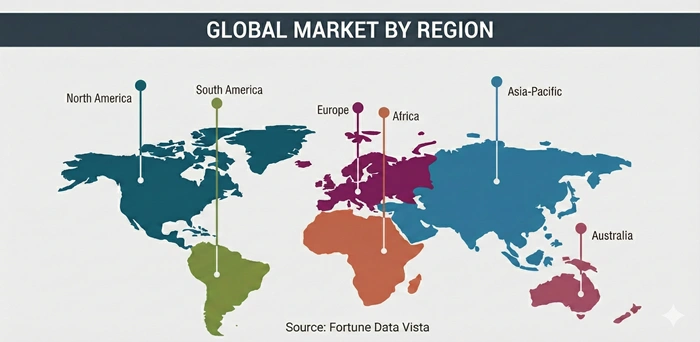
North America
North America's Leadership in the Automated Truck Loading System Market Reflects Its Advanced Logistics Infrastructure, High E-Commerce Penetration, and Sustained Enterprise Investment in Supply Chain Automation*
North America commands the largest share of the global automated truck loading system market, accounting for approximately 38.4% of total revenue in 2024 and expected to grow at a CAGR of around 8.7% through 2033. The United States is the engine of regional demand, driven by a massive e-commerce ecosystem, a well-funded contract logistics industry, and the presence of globally leading system integrators and technology providers. Companies including Joloda Hydraroll, Ancra Systems, and BEUMER Group's North American operations have strong commercial footholds in the U.S. market, supplying automated loading solutions to major retail, automotive, and food distribution operators. The region's advanced warehouse management technology adoption rate and its extensive base of large-format distribution centers create ideal conditions for continued investment in dock automation through the forecast period.
The U.S. regulatory environment — particularly OSHA's push for enhanced warehouse safety standards — is also contributing to accelerating adoption of automated loading systems by reducing the incidence of musculoskeletal injuries associated with manual dock operations. Canada is contributing meaningfully to regional growth, particularly in the food and beverage and pharmaceutical distribution sectors, where precision loading and cold-chain integrity requirements are driving interest in automated solutions. The combination of strong economic fundamentals, ongoing investment in logistics infrastructure, and a large addressable base of partially automated warehouses in need of upgrades positions North America as a sustained growth market for automated truck loading technology well into the 2030s.
Asia Pacific
Asia Pacific Is the Fastest-Growing Region in the Automated Truck Loading System Market, Energized by China's Smart Logistics Revolution, India's Manufacturing Boom, and Southeast Asia's Rising Automation Ambitions*
Asia Pacific is projected to achieve the highest regional growth rate in the automated truck loading system market, expanding at a CAGR of approximately 10.8% through 2033, significantly outpacing North America and Europe. China represents the largest individual country opportunity within the region, where government-backed investments in intelligent logistics parks, e-commerce fulfillment infrastructure, and Industry 4.0 manufacturing are generating enormous and growing demand for automated loading dock solutions. Domestic and international players including BEUMER Group and Dematic Corporation are actively establishing and expanding their Asia Pacific operations to serve this demand. China's dominant e-commerce platforms — driving daily freight volumes that dwarf those of U.S. counterparts on peak shopping events like Singles' Day — are creating continuous pressure on logistics operators to adopt automated loading technology at scale.
India is emerging as the most exciting secondary growth market in the region, with rapid expansion of its organized retail, pharmaceutical manufacturing, and automotive component export sectors driving strong new demand for dock automation. Government initiatives promoting smart manufacturing and Make in India are encouraging large industrial operators to invest in automated logistics infrastructure, including truck loading systems. Japan and South Korea further strengthen the region's profile through their advanced robotics industries and high-precision manufacturing ecosystems, which both generate demand for and contribute expertise to the development of automated loading solutions. The Asia Pacific market for automated truck loading systems is expected to grow from a revenue share of approximately 29.6% in 2024 to a meaningfully larger proportion of the global total by 2033.
Top Key Players
-
Joloda Hydraroll Limited (United Kingdom)
-
BEUMER Group GmbH & Co. KG (Germany)
-
Ancra Systems B.V. (Netherlands)
-
Cargo Floor B.V. (Netherlands)
-
HAVER & BOECKER OHG (Germany)
-
ACTIW Ltd. (Finland)
-
Euroimpianti S.p.A. (Italy)
-
Secon Components S.L. (Spain)
-
Dematic Corporation (United States)
-
GHARD Fördertechnik GmbH (Germany)
-
Asbreuk Service B.V. (Netherlands)
-
Terberg DTS B.V. (Netherlands)
-
Caljan A/S (Denmark)
-
Landoll Corporation (United States)
-
FMH Conveyors (United States)
Recent Developments
-
In 2024, Dematic Corporation unveiled a new generation of automated truck-loading systems featuring robotic arm integration and AI-driven load optimization algorithms, claiming improvements in loading efficiency and reductions in labor costs of up to 25%, targeting large-scale retail and FMCG distribution operators.
-
In 2024, BEUMER Group announced a strategic partnership with a leading European automotive manufacturer to deploy fully integrated automated loading and unloading systems across three major assembly plant logistics hubs in Germany, marking one of the company's largest automotive sector installations to date.
-
In 2025, Joloda Hydraroll Limited expanded its product portfolio with the launch of a new modular, fleet-agnostic loading system designed for non-modified trailer compatibility — directly addressing one of the most commonly cited barriers to adoption among mid-market logistics operators.
-
In 2024, Ancra Systems B.V. completed a significant commercial contract win with a multinational FMCG company to supply automated loading systems across its European distribution network, expanding the company's installed base in the food and beverage sector considerably.
-
In 2025, ACTIW Ltd. introduced its next-generation LoadPlate system with enhanced IoT connectivity and real-time load monitoring capabilities, enabling fleet operators to track dock performance data centrally and integrate loading cycle metrics with transportation management systems.
Market Trends
The Convergence of Autonomous Freight, Collaborative Robotics, and Real-Time Dock Intelligence Is Reshaping the Competitive Landscape of the Automated Truck Loading System Market*
One of the most consequential trends currently shaping the automated truck loading system market is the accelerating integration of collaborative robots — or cobots — within dock loading environments. Unlike traditional fixed industrial robots, cobots are designed to operate safely alongside human workers, handling repetitive and physically demanding loading tasks while leaving judgment-intensive activities to human operators. This hybrid automation model is proving particularly attractive for mid-scale distribution operators that cannot justify or afford fully automated dock systems but are eager to reduce labor dependency and improve throughput consistency. Leading vendors are now offering cobot-enabled loading solutions as a lower-capital entry point to dock automation, significantly expanding the addressable market beyond the tier-one logistics operators that have historically been the primary buyers.
In parallel, the integration of real-time dock intelligence platforms — combining IoT sensor data, AI analytics, and cloud-based performance dashboards — is transforming how logistics managers measure, optimize, and plan loading operations. Rather than treating each dock event as an isolated activity, modern automated loading systems are now capable of feeding continuous performance data into warehouse management and transportation management platforms, enabling dynamic scheduling, predictive throughput modeling, and automatic cross-facility benchmarking. This shift toward data-driven dock management is creating strong lock-in dynamics for leading vendors who can offer end-to-end software-hardware loading ecosystem integration, and it is raising the competitive bar for new entrants seeking to challenge established players on the basis of system intelligence and connectivity rather than hardware performance alone.
Segments Covered in the Report
-
By System Type
-
Chain Conveyor System
-
Slat Conveyor System
-
Belt Conveyor System
-
Skate Conveyor System
-
Roller Track System
-
Automated Guided Vehicle (AGV)
-
Loading Plate System
-
-
By Loading Dock Type
-
Flush Dock
-
Enclosed Dock
-
Sawtooth Dock
-
Climate Controlled Dock
-
Others
-
-
By Truck Type
-
Non-Modified Truck
-
Modified Truck
-
-
By Industry
-
Automotive and Transportation
-
Aviation
-
Construction and Manufacturing
-
FMCG
-
Food and Beverage
-
Healthcare and Pharmaceutical
-
Others
-
-
By Automation Level
-
Semi-Automated Systems
-
Fully Automated Systems
-
-
By Region
-
North America (U.S., Canada, Mexico)
-
Europe (Germany, France, UK, Italy, Netherlands, Rest of Europe)
-
Asia Pacific (China, India, Japan, South Korea, Rest of Asia Pacific)
-
Latin America (Brazil, Rest of Latin America)
-
Middle East & Africa (GCC Countries, Rest of MEA)
-
❝ Built for Every Level — From Startups to Industry Giants ❞
Here Is Exactly How This Report Works for You
-
Whether you are a startup entering the dock automation space or a Tier 1 logistics conglomerate managing a global network, this report delivers segment-level revenue forecasts, competitive benchmarking, and supply-demand dynamics that directly inform your product strategy, market entry timing, and capital allocation decisions — giving every level of organization the intelligence needed to compete and grow in an increasingly automated freight landscape.
-
For investors, mid-level companies, and high-growth enterprises, the report's geopolitical risk analysis maps how trade tensions, port infrastructure policies, and cross-border logistics regulation changes are affecting demand patterns across North America, Europe, and Asia Pacific — equipping your leadership team with the context needed to make confident, risk-adjusted investment and expansion decisions.
-
The competitor revenue analysis section provides a detailed breakdown of revenue sources, commercial strategy, recent contract wins, and market share positioning for the top 15 players in the automated truck loading system industry — giving procurement executives, M&A teams, and business development leaders the actionable competitive intelligence they need to identify partnership opportunities, benchmark their pricing, and outmaneuver rivals in key regional markets.
Frequently Asked Questions:
Answer: The global automated truck loading system market is valued at USD 2.65 billion in 2025 and is projected to reach approximately USD 6.24 billion by 2033. This represents a CAGR of 8.9% from 2026 to 2033, underpinned by rising logistics automation investment globally.
Answer: The key drivers include surging e-commerce freight volumes requiring faster dock throughput, persistent labor shortages in warehouse operations, and growing government investment in smart logistics infrastructure. These factors are collectively accelerating the adoption of automated loading solutions across automotive, FMCG, and pharmaceutical distribution sectors.
Answer: North America currently leads the automated truck loading system market with approximately 38% revenue share, supported by its mature logistics infrastructure and high e-commerce penetration. Asia Pacific is the fastest-growing region, expanding at a CAGR above 10% through 2033, driven by China's smart logistics programs and India's industrial automation investments.
Answer: Automated Guided Vehicles (AGVs) are the fastest-growing system type within the automated truck loading system market, projected to expand at around 11.2% CAGR through 2033. Their operational flexibility, compatibility with autonomous freight ecosystems, and adaptability to varied cargo types are making them the preferred choice for next-generation distribution facilities.
Answer: The emergence of autonomous trucking platforms is creating a strong long-term tailwind for the automated truck loading system market, as self-driving freight vehicles cannot participate in partially manual dock operations. This convergence is driving significant R&D investment in fully automated, self-docking loading systems that can interface directly with autonomous truck fleets.