
Automotive Coolant Market Overview
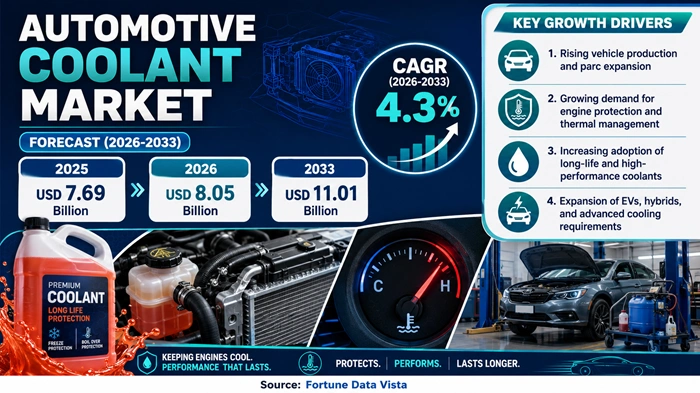
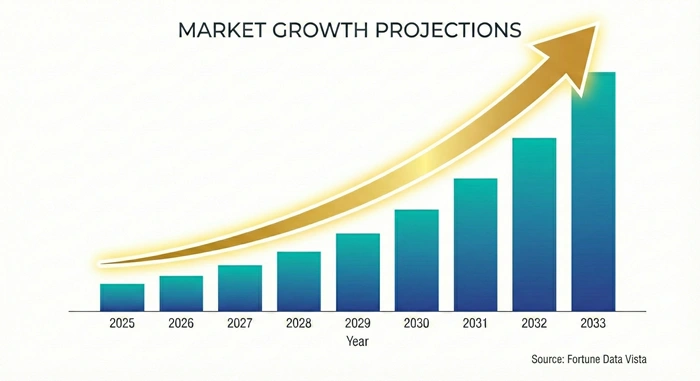
The global Automotive Coolant market size is valued at USD 7.69 billion in 2025 and is predicted to increase from USD 8.05 billion in 2026 to approximately USD 11.01 billion by 2033, growing at a CAGR of 4.3% from 2026 to 2033. This steady growth trajectory reflects the continued global expansion of the automotive industry, the rising global vehicle parc, and growing awareness among vehicle owners and fleet operators of the critical role that engine coolants and antifreeze fluids play in maintaining optimal engine performance, preventing corrosion, and extending vehicle lifespan. As vehicle technology evolves and EV thermal management requirements create new demand vectors, the coolant industry is navigating a period of important structural transformation.
AI Impact on the Automotive Coolant Industry
Artificial Intelligence Is Reshaping Coolant Formulation Science, Predictive Maintenance Protocols, and Supply Chain Management — Enabling Manufacturers to Deliver Smarter, More Targeted Products for an Evolving Automotive Landscape*
AI is beginning to exert a meaningful influence on how automotive coolants are formulated, tested, and brought to market. Machine learning platforms are being deployed by leading chemical companies to analyze vast datasets of engine test results, material compatibility studies, and field performance records — dramatically accelerating the identification of optimal inhibitor combinations, glycol ratios, and additive packages for specific engine architectures and operating conditions. What previously required months of laboratory iteration can now be modeled computationally in days, enabling manufacturers to bring new coolant formulations to market faster while achieving higher levels of performance specificity than ever before.
On the application side, AI-driven predictive maintenance systems embedded in connected vehicles are beginning to monitor coolant condition in real time — tracking pH levels, inhibitor depletion, and contamination markers through onboard sensor networks. When an AI-powered vehicle health monitoring platform detects that coolant performance is degrading before the scheduled maintenance interval, it can alert the vehicle owner or fleet manager proactively, preventing costly engine damage and enabling more efficient, condition-based maintenance scheduling. This shift from time-based to condition-based coolant maintenance is reshaping service interval norms across the automotive aftermarket and creating new commercial opportunities for coolant manufacturers who can develop products with sensor-compatible performance monitoring features.
Growth Factors
Rising Global Vehicle Production, a Massive Expanding Vehicle Aftermarket, and the Emergence of Electric Vehicle Thermal Management as a New Demand Category Are Collectively Sustaining Market Growth*
The most fundamental growth driver for the automotive coolant market is the continued expansion of the global vehicle fleet. As vehicle ownership rates rise across Asia Pacific, Latin America, the Middle East, and Africa — driven by economic development, urbanization, and increasing household disposable income — the number of vehicles requiring regular coolant maintenance and replacement is growing year after year. The global vehicle parc is currently estimated at well over 1.4 billion units, each requiring periodic coolant servicing, and this enormous installed base creates a massive, recurring aftermarket demand that provides a resilient revenue foundation for coolant manufacturers even during periods of slower new vehicle production.
The accelerating adoption of electric vehicles is introducing a new and important demand dimension to the automotive coolant market. While battery electric vehicles do not require traditional engine coolants for combustion-related temperature management, they rely significantly on liquid coolant systems to regulate battery pack temperature, power electronics thermal management, and cabin climate control through heat pump systems. This requirement for specialized EV thermal management fluids — which differ from conventional ethylene glycol antifreeze in their electrical resistivity, compatibility with battery materials, and thermal conductivity properties — is opening entirely new product development and commercialization opportunities for leading coolant manufacturers that are investing proactively in next-generation EV-specific fluid formulations.
Market Outlook
With the Global Fleet Growing, EV Thermal Fluid Innovation Accelerating, and Emerging Markets Deepening Their Automotive Infrastructure, the Automotive Coolant Market Is Set for Steady and Diversified Growth Through 2033*
The medium-to-long-term outlook for the automotive coolant industry is shaped by the interplay of two major forces: the sustained growth of the conventional ICE vehicle aftermarket and the gradual but accelerating transition toward electric vehicle platforms with distinct thermal management fluid requirements. In the near to mid-term, the ICE vehicle base will continue to generate enormous recurring demand for conventional and extended-life coolants, particularly in markets where EVs represent a small fraction of the total vehicle fleet. This creates a long-tailed demand runway for established coolant products and formulations that will support market revenue well into the 2030s across most global regions.
Looking further ahead, the competitive dynamics of the automotive coolant market will increasingly be defined by which manufacturers succeed in developing and commercializing EV thermal management fluid portfolios that meet the demanding performance, compatibility, and longevity requirements of next-generation electric vehicle platforms. OEMs are working closely with chemical companies to co-develop proprietary thermal management fluids for their specific battery architectures — creating opportunities for long-term supply partnerships and branded OEM-specification products that command premium pricing and generate durable revenue streams. The companies that invest early in EV fluid R&D and secure OEM approvals are likely to establish significant competitive advantages that will shape market leadership through the forecast period and beyond.
Expert Speaks
-
"The automotive fluids and coolant category is at a fascinating inflection point — serving a massive and still-growing conventional vehicle base while simultaneously developing the next generation of EV thermal management solutions. At ExxonMobil, our investment in both segments reflects our confidence that coolant technology will remain mission-critical to automotive performance across every powertrain configuration for decades to come." — Darren Woods, Chairman & CEO, ExxonMobil Corporation
-
"As the global vehicle fleet continues to grow and the shift toward electrification accelerates, the demands on automotive coolant and thermal management fluids are becoming more sophisticated and more varied than ever before. At Shell, we are committed to developing science-led fluid solutions that address the full spectrum of vehicle thermal management needs — from today's high-performance ICE engines to tomorrow's complex battery electric architectures." — Wael Sawan, CEO, Shell plc
-
"Automotive coolants are a foundational element of vehicle performance and reliability, and as vehicle technology evolves, so does the complexity of the thermal management challenge. Valvoline's deep expertise in automotive fluid science positions us well to serve both the traditional coolant market and the emerging EV thermal fluid opportunity, which we view as one of the most exciting growth areas in the automotive aftermarket." — Lori Flees, President & CEO, Valvoline Inc.
Key Report Takeaways
-
Asia Pacific leads the global automotive coolant market with the highest revenue share in 2024, driven by the world's largest concentration of vehicle manufacturing hubs in China, India, Japan, and South Korea, as well as rapidly growing vehicle ownership rates across Southeast Asian markets that generate robust aftermarket coolant demand.
-
Asia Pacific is also the fastest-growing regional market, with a CAGR above the global average through 2033, fueled by accelerating vehicle production growth in India, infrastructure development driving commercial vehicle demand, and strong government support for domestic automotive industry expansion across the region.
-
The passenger car segment is the largest end-user category, commanding over 60% of total market revenue, owing to the dominance of passenger vehicles in the global fleet and the high frequency of coolant maintenance services required across both personal and shared mobility use cases.
-
Ethylene glycol-based coolants remain the most widely used product type, holding the largest market share among all coolant base fluid categories owing to their excellent thermal performance, cost-effectiveness, wide availability, and proven compatibility with a broad range of engine materials across both passenger and commercial vehicles.
-
Organic Acid Technology (OAT) formulations represent the most rapidly growing coolant technology segment, as these extended-life, corrosion-inhibiting coolants are increasingly specified by OEMs for their superior protection of aluminum engine components and their ability to deliver service intervals of up to 5 years or 150000 miles compared to conventional IAT products.
-
Electric vehicle thermal management fluids are the fastest-growing new product category within the broader coolant landscape, projected to grow at a CAGR significantly above the overall market average through 2033, as EV penetration rates rise and OEMs increasingly specify proprietary dielectric thermal management fluids for battery and power electronics cooling applications.
Market Scope
| Parameter | Details |
|---|---|
| Market Size by 2033 | USD 11.01 Billion | Market Size by 2026 | USD 8.05 Billion | Market Size by 2025 | USD 7.69 Billion | Market Growth Rate from 2026 to 2033 | CAGR of 4.3% | Dominating Region | Asia Pacific | Fastest Growing Region | North America | Segments Covered | By Product Type, By Technology, By Vehicle Type, By Application, By Distribution Channel, By Region | Regions Covered | North America, Europe, Asia Pacific, Latin America, Middle East & Africa |
Market Dynamics
Drivers Impact Analysis
Expanding Global Vehicle Parc, Rising Demand for Extended-Life and EV-Compatible Coolant Formulations, and Growth in Automotive Aftermarket Services Are Collectively Powering Sustained Demand Across the Automotive Coolant Market*
| Driver | ≈ % Impact on CAGR Forecast | Geographic Relevance | Impact Timeline |
|---|---|---|---|
| Continuous growth of global vehicle fleet and aftermarket coolant replacement demand | ~1.8% | Global (Asia Pacific, North America, Europe) | 2026–2033 (Ongoing) |
| Rising adoption of OAT and extended-life coolant formulations by OEMs | ~1.2% | North America, Europe, Asia Pacific | 2026–2033 (Sustained) |
| Emerging demand for EV-specific thermal management fluids | ~0.9% | North America, Europe, Asia Pacific | 2027–2033 (Accelerating) |
| Growth of commercial vehicle fleets in emerging economies | ~0.7% | Asia Pacific, Latin America, MEA | 2026–2030 |
The sheer scale of the global vehicle parc — encompassing well over a billion passenger cars and commercial vehicles requiring periodic thermal fluid maintenance — provides the automotive coolant market with a resilient and growing demand foundation that is largely insulated from short-term economic volatility. Coolant replacement is a non-discretionary vehicle maintenance activity governed by manufacturer service specifications, meaning that demand is driven more by fleet size and vehicle usage patterns than by consumer sentiment or economic conditions. As emerging market vehicle ownership rates rise and the average age of vehicles in service increases in developed markets, the aftermarket volume of coolant serviced globally is increasing year after year, providing a durable underlying growth momentum that supports consistent revenue expansion for coolant manufacturers across all major product categories.
The transition of major OEMs toward extended-life coolant specifications is reshaping product mix within the automotive coolant market in commercially important ways. As OEMs increasingly specify Organic Acid Technology (OAT) and hybrid OAT (HOAT) coolants as factory-fill products for new vehicles — reflecting these formulations' superior protection of modern aluminum-intensive engines and extended service life capabilities — the aftermarket is following suit, with consumers and fleet operators transitioning away from conventional Inorganic Additive Technology (IAT) coolants toward premium long-life alternatives. This premiumization of the product mix is supporting average selling price increases across the market, helping manufacturers improve revenue per liter sold even as total volume growth remains moderate.
Restraints Impact Analysis
The Accelerating Transition to Battery Electric Vehicles and Raw Material Price Volatility Present Genuine Structural Challenges to Long-Term Growth Within the Automotive Coolant Market*
| Restraint | ≈ % Impact on CAGR Forecast | Geographic Relevance | Impact Timeline |
|---|---|---|---|
| Declining conventional engine coolant demand as EV adoption accelerates | ~−1.4% | Europe, North America | 2028–2033 |
| Volatility in ethylene glycol and propylene glycol raw material prices | ~−0.9% | Global | 2026–2030 |
| Environmental and toxicity concerns related to ethylene glycol-based formulations | ~−0.6% | Europe, North America | 2026–2033 |
| Competitive pressure from low-cost private label coolant manufacturers in Asia | ~−0.5% | Asia Pacific, Latin America | 2026–2030 |
The most significant long-term structural restraint on the conventional automotive coolant market is the accelerating adoption of battery electric vehicles in key markets — particularly Europe, China, and North America. As EVs represent a growing proportion of new vehicle sales, the addressable market for traditional engine coolants — which are specifically formulated for internal combustion engine temperature management — will gradually contract in these markets over the forecast period. While this transition is gradual rather than sudden, and the total ICE vehicle fleet will continue to grow globally in absolute terms for many years, the directional trend represents a meaningful headwind for manufacturers heavily concentrated in conventional coolant product lines who are slow to build EV thermal fluid capabilities.
Raw material cost volatility is an additional operational challenge that weighs on profitability within the automotive coolant industry. Ethylene glycol — the dominant base fluid in most automotive coolants — is a derivative of ethylene oxide, itself linked to crude oil and natural gas prices that can fluctuate dramatically in response to energy market dynamics, geopolitical events, and supply chain disruptions. When raw material costs spike, coolant manufacturers face difficult decisions around margin absorption versus price increase implementation, particularly in highly competitive aftermarket channels where consumers and fleet buyers demonstrate meaningful price sensitivity. Environmental concerns around ethylene glycol toxicity — both to wildlife and in accidental spill scenarios — are also driving gradual regulatory pressure toward less toxic alternatives such as propylene glycol and bio-based glycol formulations, adding product reformulation costs for manufacturers operating in regulated markets.
Opportunities Impact Analysis
EV Thermal Management Fluid Innovation, Bio-Based and Low-Toxicity Coolant Development, and Expanding Automotive Aftermarket Networks in Emerging Economies Are Creating Compelling Growth Frontiers*
| Opportunity | ≈ % Impact on CAGR Forecast | Geographic Relevance | Impact Timeline |
|---|---|---|---|
| Development and commercialization of EV-specific dielectric thermal management fluids | ~+1.6% | North America, Europe, Asia Pacific | 2027–2033 |
| Growth of organized automotive aftermarket in Asia Pacific and Latin America | ~+1.1% | Asia Pacific, Latin America | 2026–2033 |
| Bio-based and propylene glycol coolant formulations driven by environmental regulation | ~+0.8% | Europe, North America | 2026–2033 |
| OEM co-development partnerships for next-generation extended-life coolant systems | ~+0.6% | Global | 2026–2030 |
The emergence of battery electric vehicles as a mainstream vehicle category is simultaneously a threat to conventional coolant demand and a significant commercial opportunity for manufacturers able to develop and qualify next-generation EV thermal management fluids. Battery electric vehicles require specialized dielectric coolant fluids with precisely controlled electrical resistivity, superior heat transfer properties, and long-term compatibility with lithium-ion battery cell chemistry, power electronics materials, and electric motor components. These technical requirements create barriers to entry that favor established chemical companies with deep formulation expertise and OEM qualification capabilities — companies that invest early in this transition stand to capture premium-priced, OEM-approved EV thermal fluid positions that can sustain revenue growth even as conventional engine coolant volumes mature.
The organic expansion of automotive aftermarket infrastructure across rapidly developing economies in Asia Pacific, Latin America, and the Middle East represents another attractive long-term opportunity. As vehicle ownership rates rise and the formal service sector develops — displacing informal, unbranded coolant sales in these markets — branded coolant manufacturers have an expanding commercial opportunity to capture market share through organized retail channels, quick-lube service networks, and franchise vehicle service centers. The growing penetration of branded, quality-certified coolant products into previously underserved markets in India, Indonesia, Brazil, Saudi Arabia, and sub-Saharan Africa is expected to contribute meaningfully to global market volume growth through the 2026–2033 forecast period.
Segment Analysis
By Product Type
Ethylene Glycol Continues to Dominate Automotive Coolant Formulations Globally, While Propylene Glycol Is Gaining Commercially Important Ground as Environmental Awareness and Regulatory Pressure Intensify*
Ethylene glycol-based coolants maintain the dominant position in the automotive coolant market, accounting for approximately 63.8% of global product revenue in 2024 and growing at a CAGR of around 4.0% through 2033. Ethylene glycol's dominance is built on decades of automotive industry reliance — it delivers excellent thermal performance, freeze protection across a wide temperature range, effective boiling point elevation, and broad compatibility with engine sealing materials, all at a highly competitive price point relative to alternative base fluids. Asia Pacific is the strongest regional market for ethylene glycol-based coolants, where China, India, and Japan collectively account for the largest share of global coolant consumption by volume. Leading global coolant manufacturers including ExxonMobil (Mobil Antifreeze), Shell (Shell Antifreeze), and TotalEnergies (Total Coolelf) dominate the ethylene glycol segment in Asia Pacific, competing alongside strong regional players such as Sinopec Lubricant and Petronas that serve high-volume OEM and aftermarket channels. The segment is expected to maintain its revenue leadership position throughout the forecast period, supported by the continued dominance of ICE vehicles in global markets outside Europe and North America.
Propylene glycol-based coolants represent the fastest-growing product segment within the automotive coolant market, projected to expand at a CAGR of approximately 6.1% through 2033 — notably above the overall market average. Propylene glycol is significantly less toxic than ethylene glycol, making it the preferred choice for applications where environmental safety is a priority and in markets where stricter regulations on toxic automotive fluids are being enacted or anticipated. Europe is the fastest-growing region for propylene glycol coolant adoption, driven by the EU's increasingly stringent chemicals and automotive fluids regulation, strong consumer preference for environmentally responsible automotive products, and OEM procurement programs that are beginning to specify low-toxicity coolants for models sold in European markets. Major suppliers including BASF's Glysantin product line and Clariant's Antifrogen brand are investing in expanding their propylene glycol-compatible coolant portfolios to serve this growing demand, positioning themselves to capture a disproportionate share of the premium, eco-oriented coolant segment through 2033.
By Vehicle Type
Passenger Cars Drive the Majority of Automotive Coolant Market Revenue, While Commercial Vehicles Present a High-Value, High-Volume Growth Opportunity Across Emerging Economies*
The passenger car segment remains the largest and most commercially significant vehicle category within the automotive coolant market, representing approximately 61.2% of total vehicle-type segment revenue in 2024 and growing at a CAGR of around 4.2% through 2033. This dominance reflects the sheer scale of the global passenger vehicle fleet — billions of units in active service across every geographic region — combined with the relatively frequent service intervals that coolant maintenance programs require. North America and Europe are the highest-value regional markets for passenger car coolants on a per-vehicle basis, where premium extended-life OAT and HOAT formulations command higher average selling prices and are increasingly specified as the standard by leading OEMs including Ford, General Motors, BMW, and Volkswagen. Valvoline, Castrol (BP), and Prestone are leading aftermarket suppliers serving the North American and European passenger car coolant segments, competing through brand recognition, product performance differentiation, and extensive retail distribution networks. The segment's sustained growth is anchored by rising vehicle ownership in Asia Pacific and the ongoing replacement cycle of the large existing passenger vehicle fleet in developed markets.
Commercial vehicles — encompassing heavy-duty trucks, buses, construction equipment, and agricultural machinery — constitute the second largest and one of the most strategically important segments for automotive coolant manufacturers, accounting for approximately 28.6% of market revenue in 2024 and projected to grow at a CAGR of around 4.8% through 2033. Commercial vehicles typically operate under more demanding thermal conditions than passenger cars — running at higher loads, for longer duty cycles, and often in challenging environmental conditions — making high-performance coolant formulations that deliver extended engine protection and longer drain intervals particularly valuable in this segment. Asia Pacific is the fastest-growing region for commercial vehicle coolant demand, driven by India's massive and rapidly expanding commercial vehicle industry, China's dominant position in truck manufacturing and sales, and Southeast Asia's growing construction and logistics sectors that are adding commercial vehicles to service at a rapid pace. Companies including Shell Rimula, ExxonMobil Diesel Coolant, and PETRONAS Paraflu are leading suppliers to the commercial vehicle coolant segment in the region, offering heavy-duty extended-life formulations approved by major truck and engine OEMs.
Regional Insights
Asia Pacific
Asia Pacific Leads the Global Automotive Coolant Market Through Its Unrivaled Vehicle Production Scale, Rapidly Expanding Aftermarket, and Largest Concentration of Automotive OEM Manufacturing Facilities*
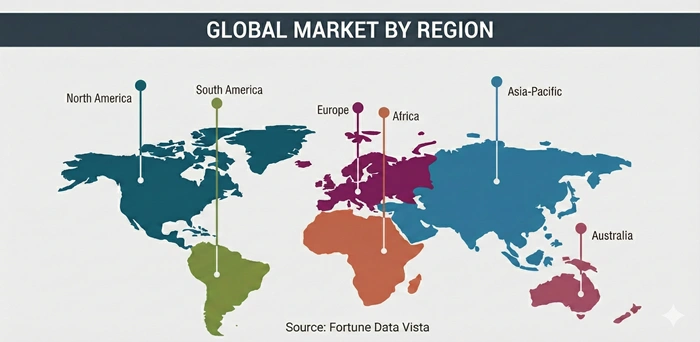
Asia Pacific holds the dominant position in the global automotive coolant market, commanding approximately 41.7% of total revenue in 2024 and growing at a CAGR of approximately 4.8% through 2033 — the highest regional growth rate globally. China is the single largest country market within the region, operating as the world's largest vehicle producer and consumer, with a massive OEM manufacturing ecosystem and a rapidly developing automotive aftermarket infrastructure that collectively generate immense and growing demand for both factory-fill and service-fill coolant products. Japan and South Korea maintain sophisticated automotive sectors with high per-vehicle coolant quality standards, while India is emerging as one of the most dynamic growth markets globally, driven by rapidly expanding vehicle production, rising vehicle ownership rates, and a fast-growing organized aftermarket network. Major suppliers operating in the Asia Pacific coolant market include Sinopec Lubricant, Petronas, Shell, TotalEnergies, ExxonMobil, and Castrol — all of which maintain significant regional manufacturing and distribution footprints to serve the diverse needs of this vast and complex market.
Southeast Asia is contributing increasingly meaningful incremental demand as vehicle ownership rates rise in Indonesia, Thailand, Vietnam, and the Philippines — markets where growing middle-class populations are purchasing vehicles in rapidly rising numbers. The region's accessibility of low-cost manufacturing, combined with government programs promoting domestic vehicle production and automotive supply chain development, is encouraging both international and regional coolant manufacturers to expand their Asia Pacific production capacity and distribution networks. The depth and breadth of growth drivers across Asia Pacific — from China's dominant OEM base to India's commercial vehicle boom to Southeast Asia's consumer vehicle expansion — ensures that the region will maintain its market leadership position throughout the 2026–2033 forecast window.
North America
North America's Mature but High-Value Automotive Coolant Market Benefits from Premium Product Preferences, a Large Legacy Vehicle Fleet, and Growing Investment in EV Thermal Fluid Development*
North America is the second largest regional market for automotive coolant, holding approximately 24.3% of global revenue in 2024 and expected to grow at a CAGR of around 3.8% through 2033. The United States is the dominant country market within the region, characterized by a large passenger and commercial vehicle fleet, a highly developed and organized automotive aftermarket, and strong consumer preference for premium branded extended-life coolant formulations. Leading coolant suppliers with major North American market positions include Valvoline, Prestone (owned by Recochem), Castrol, ExxonMobil Mobil Antifreeze, and Shell Antifreeze — all of which compete through strong brand equity, OEM approvals, and extensive retail distribution in auto parts chains, big-box retailers, and franchise quick-lube networks. The North American market is characterized by a higher proportion of OAT and HOAT formulations compared to the global average, reflecting the region's large base of modern vehicles with aluminum engine components requiring advanced corrosion inhibition. Canada contributes meaningful additional demand, particularly for coolants with strong low-temperature freeze protection performance given the country's harsh winter climate conditions across the majority of its geographic territory.
Top Key Players
-
ExxonMobil Corporation (United States)
-
Chevron Corporation (United States)
-
Shell plc (United Kingdom / Netherlands)
-
TotalEnergies SE (France)
-
Valvoline Inc. (United States)
-
Castrol Limited (BP plc) (United Kingdom)
-
BASF SE (Germany)
-
Prestone Products Corporation (Recochem Inc.) (United States / Canada)
-
Sinopec Lubricant Company (China)
-
PETRONAS Lubricants International (Malaysia)
-
Motul SA (France)
-
Clariant AG (Switzerland)
-
Ashland Inc. (United States)
-
Lukoil (Russia)
-
Gulf Oil International (United Kingdom)
Recent Developments
-
In 2025, BASF SE launched an expanded range of Glysantin EV-specific thermal management fluids, including dielectric cooling fluids engineered for immersion-cooled battery systems in next-generation electric vehicles, targeting OEM co-development programs with major European and Asian electric vehicle manufacturers.
-
In 2024, Valvoline Inc. accelerated its expansion of Express Care service center locations across North America, adding over 200 new locations to its franchise network and significantly increasing the channel availability of its premium automotive coolant and fluid exchange service programs across the U.S. and Canada.
-
In 2025, TotalEnergies SE announced a significant investment in its Coolelf and Glacelf automotive coolant product lines, introducing new extended-life OAT formulations meeting the latest European OEM specifications, and launching a bio-based propylene glycol coolant variant targeting European markets under increasing environmental regulatory pressure.
-
In 2024, ExxonMobil strengthened its automotive fluids business by expanding its Mobil Antifreeze product line with new heavy-duty extended-life formulations specifically approved for the latest generation of diesel truck engines, targeting the rapidly growing commercial vehicle coolant aftermarket in North America and Asia Pacific.
-
In 2025, Sinopec Lubricant Company expanded its automotive coolant production capacity at its Changling refinery in China, adding dedicated manufacturing lines for premium OAT-based coolants to serve both domestic OEM supply contracts and the growing Chinese automotive aftermarket demand for long-life, high-performance coolant products.
Market Trends
The Dual Transition to Extended-Life OAT Formulations and EV Thermal Management Fluids Is Fundamentally Reshaping Product Development Priorities and Competitive Positioning Across the Automotive Coolant Market*
The most significant ongoing trend reshaping the automotive coolant market is the industry-wide migration from conventional short-life Inorganic Additive Technology (IAT) coolants toward Organic Acid Technology (OAT) and Hybrid Organic Acid Technology (HOAT) extended-life formulations. Modern vehicle engines — particularly those featuring aluminum cylinder blocks, aluminum cylinder heads, and aluminum radiators — require the superior corrosion protection that OAT-based inhibitor systems deliver, combined with service intervals of 5 years or 150000 miles that dramatically reduce the frequency of coolant maintenance events. As the global vehicle fleet continues to modernize and OEM factory-fill specifications evolve toward universal extended-life coolant requirements, the OAT and HOAT segments are growing their share of total coolant market revenue at the expense of conventional IAT products — a shift that is simultaneously improving product margins and changing the aftermarket purchasing cycle.
In parallel, the development of specialized thermal management fluids for electric vehicles is emerging as the most commercially exciting product innovation area in the automotive fluid industry in a generation. EV battery thermal management systems require coolants with fundamentally different performance profiles compared to conventional engine coolants — including precise control of electrical conductivity (to prevent battery short-circuits), enhanced thermal conductivity for efficient heat extraction from dense battery cell arrays, and long-term compatibility with the polymers, metals, and adhesives used in battery module construction. Leading chemical companies including BASF, Shell, and ExxonMobil are investing heavily in developing and qualifying EV-specific thermal fluid product lines, recognizing that securing early OEM approval positions in this segment will be critical to capturing a growing share of the market's future premium-segment revenue.
Segments Covered in the Report
-
By Product Type
-
Ethylene Glycol
-
Propylene Glycol
-
Glycerine-Based
-
Bio-Based Coolants
-
Others
-
-
By Technology
-
Inorganic Additive Technology (IAT)
-
Organic Acid Technology (OAT)
-
Hybrid Organic Acid Technology (HOAT)
-
Others
-
-
By Vehicle Type
-
Passenger Cars
-
Light Commercial Vehicles (LCVs)
-
Heavy Commercial Vehicles (HCVs)
-
Electric Vehicles (EVs)
-
Others
-
-
By Application
-
Engine Cooling
-
HVAC and Cabin Climate Cooling
-
Battery Thermal Management (EV)
-
Power Electronics Cooling (EV)
-
Others
-
-
By Distribution Channel
-
OEM (Factory Fill)
-
Aftermarket (Retail Stores, Auto Parts Chains, Quick-Lube Centers, Online)
-
-
By Region
-
North America (U.S., Canada, Mexico)
-
Europe (Germany, France, UK, Italy, Rest of Europe)
-
Asia Pacific (China, India, Japan, South Korea, Rest of Asia Pacific)
-
Latin America (Brazil, Rest of Latin America)
-
Middle East & Africa (Saudi Arabia, UAE, Rest of MEA)
-
❝ Built for Every Level — From Startups to Industry Giants ❞
Here Is Exactly How This Report Works for You
-
Whether you are a startup entering the automotive fluid market or a Tier 1 global chemical company managing a multi-billion-dollar coolant portfolio, this report provides granular segment revenue forecasts, product technology trend analysis, and competitive benchmarking data that directly support your product development strategy, regional market entry decisions, and OEM relationship investments — giving your leadership team a clear, evidence-based picture of where the automotive coolant market is heading and how to win in it.
-
For investors, mid-market fluid manufacturers, and fleet management companies, the report's detailed supply-demand analysis maps how ethylene glycol raw material cost trends, EV adoption rates, and automotive production patterns across Asia Pacific, North America, and Europe are influencing demand composition and pricing dynamics — giving you the commercial intelligence needed to make confident procurement, investment, and portfolio allocation decisions.
-
The competitor revenue analysis section provides a comprehensive breakdown of revenue sources, OEM approval portfolios, product mix strategies, regional market share positions, and M&A activity for the top 15 companies in the global automotive coolant industry — equipping your business development team and corporate strategy function with the actionable competitive intelligence needed to identify growth opportunities, evaluate strategic partnerships, and benchmark your positioning against market leaders.
Frequently Asked Questions:
Answer: The global automotive coolant market is valued at USD 7.69 billion in 2025 and is projected to reach approximately USD 11.01 billion by 2033. This growth reflects a CAGR of 4.3% from 2026 to 2033, supported by expanding global vehicle production, rising aftermarket demand, and growing EV thermal management fluid requirements.
Answer: The primary drivers include the continuous expansion of the global vehicle fleet generating recurring aftermarket coolant demand, the premiumization of coolant technology toward extended-life OAT formulations, and the emerging demand for specialized EV battery thermal management fluids. Rising vehicle ownership in developing economies and growth in commercial vehicle fleets across Asia Pacific and Latin America are further amplifying market volume growth.
Answer: Asia Pacific dominates the automotive coolant market with approximately 42% revenue share, driven by the world's largest vehicle production base in China, India, Japan, and South Korea. The region is also the fastest-growing market globally, expanding at a CAGR above the global average through 2033, fueled by rising vehicle ownership and rapid automotive aftermarket development.
Answer: The EV transition is creating a dual impact on the automotive coolant market — gradually reducing demand for conventional ICE engine coolants in markets with high EV adoption while simultaneously generating new demand for specialized EV battery and power electronics thermal management fluids. Companies investing early in EV-specific thermal fluid formulations and OEM approvals are positioned to capture premium-priced opportunities that partially offset the long-term volume headwind from declining ICE vehicle populations.
Answer: IAT (Inorganic Additive Technology) coolants use inorganic corrosion inhibitors and typically require replacement every 2 years or 30000 miles, making them suited for older vehicles. OAT (Organic Acid Technology) coolants use organic corrosion inhibitors offering up to 5-year or 150000-mile service intervals and are the preferred specification for modern aluminum-intensive engines, while HOAT combines both technologies to serve vehicles requiring intermediate performance characteristics within the automotive coolant market.