
Automotive Seat Belts Market Overview
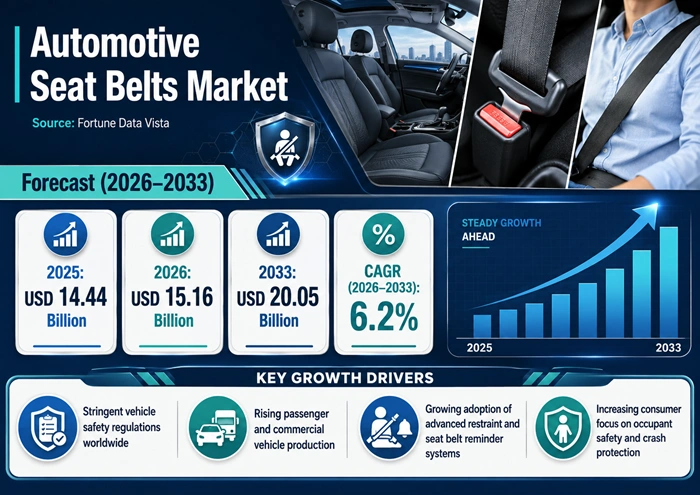
The global automotive seat belts market size is valued at USD 14.44 billion in 2025 and is predicted to increase from USD 15.16 billion in 2026 to approximately USD 20.05 billion by 2033, growing at a CAGR of 6.2% from 2026 to 2033. This steady growth reflects the rising global vehicle production, stricter crash safety regulations across major economies, growing consumer awareness about occupant protection, and the rapid adoption of advanced restraint technologies — including pretensioners, inflatable seat belts, and integrated reminder systems — across both passenger and commercial vehicles.
AI Impact on the Automotive Seat Belts Industry
Artificial Intelligence Is Transforming How Seat Belt Systems Are Designed, Tested, and Integrated Into Next-Generation Vehicle Safety Architectures*
Artificial intelligence is playing an increasingly significant role in the evolution of the automotive seat belts industry. AI-powered crash simulation software now allows safety engineers to test thousands of virtual occupant scenarios — varying body types, crash angles, and restraint configurations — before a single physical prototype is built. This dramatically reduces development time and cost while improving the accuracy of seat belt force modeling, particularly for edge-case collisions that are difficult and expensive to replicate in traditional sled tests. Machine learning algorithms are also being applied to occupant classification systems, enabling smart seat belt pretensioners to adjust their deployment force in real time based on detected passenger weight, seating posture, and crash severity.
Beyond design and testing, AI is being integrated into seat belt monitoring and compliance systems. Advanced occupant detection modules now use camera-based vision and sensor fusion to identify whether each seating position is occupied and whether the seat belt is correctly buckled — alerting drivers and fleet operators instantly when a passenger is unrestrained. In commercial fleets and ride-hailing vehicles, these AI-driven monitoring systems are being mandated by insurance providers and regulators in multiple markets. As autonomous vehicle platforms develop, AI will also define how seat belt systems adapt to non-traditional seating configurations such as rotating and reclining seats, making AI integration essential to the long-term design roadmap of the automotive seat belts industry.
Growth Factors
Rising Road Fatalities, Increasing Vehicle Sales, Stricter Safety Mandates, and Growing Demand for Smart Restraint Systems Are the Core Engines Driving Automotive Seat Belts Market Expansion Through 2033*
The most fundamental driver of the automotive seat belts market is the persistent and growing burden of road traffic fatalities worldwide. Road accidents kill approximately 1.35 million people every year, according to global health data, and another 50 million suffer non-fatal injuries. This public safety crisis compels governments across the globe to strengthen vehicle safety regulations, mandate the fitment of advanced restraint systems, and enforce seat belt usage laws. Every new crash safety standard upgrade — from NHTSA updates in the US to Bharat NCAP requirements in India and Euro NCAP's latest five-star criteria in Europe — directly drives demand for more capable and compliant seat belt systems at both the OEM and aftermarket level.
Simultaneous growth in global vehicle production is amplifying these demand signals. New passenger car sales continue to recover and expand across Asia-Pacific, particularly in China, India, Southeast Asia, and South Korea, where rising disposable incomes and expanding middle-class populations are driving first-time vehicle ownership. The commercial vehicle segment is also a significant contributor, as logistics expansion, e-commerce growth, and last-mile delivery services increase the global fleet of trucks, vans, and buses — all of which require compliant multi-point seat belt installations under commercial safety mandates. The adoption of inflatable seat belts and pretensioner-equipped systems in mid-range and economy vehicles — not just luxury tiers — is also broadening the total addressable market for premium restraint system suppliers, giving the seat belt industry multiple parallel growth vectors through 2033.
Market Outlook
The Automotive Seat Belts Market Is Entering a New Growth Phase Shaped by Intelligent Restraint Integration, EV-Specific Design Requirements, and Expanding Regulatory Mandates in Emerging Economies*
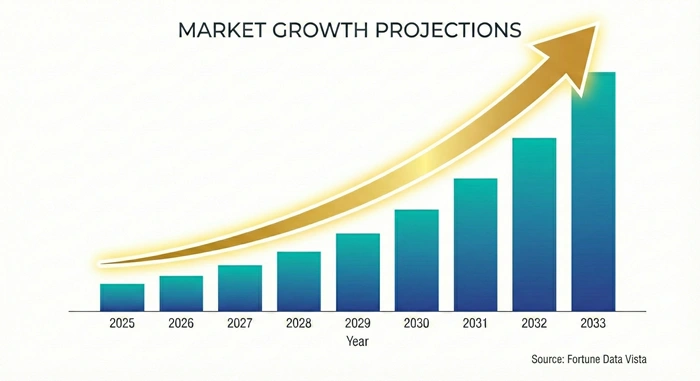
The automotive seat belts market is expected to reach USD 20.05 billion by 2033, reflecting sustained growth anchored by both structural regulatory demand and ongoing technological innovation. The integration of seat belt systems with Advanced Driver Assistance Systems (ADAS) is becoming a defining feature of next-generation passenger vehicles. Pretensioners are increasingly being triggered by forward collision warning sensors, pre-emptively tightening the belt before impact based on radar and camera data — a shift from reactive to predictive occupant protection that is becoming a standard feature in mid-range vehicles across North America and Europe. As ADAS adoption spreads across emerging markets, this integration capability is expected to drive premium belt system uptake globally.
Electric vehicles are also reshaping seat belt design requirements in important ways. The absence of engine vibration and the quieter cabin environment in EVs make seat belt reminders and pretensioner engagement more acoustically and tactilely perceptible to occupants, prompting manufacturers to redesign haptic and audio feedback systems. More critically, EV platforms have different structural crash zones compared to conventional vehicles, requiring revalidation of seat belt anchor locations and load limiter calibration for each new platform. ZF Friedrichshafen's Heat Belt — which embeds heating conductors within the belt webbing to warm occupants and reduce cabin HVAC energy consumption in EVs — is an example of how EV-specific innovation is creating new product categories within the restraint market. These converging trends position the automotive seat belts market for healthy sustained growth through the forecast period.
Expert Speaks
-
"Road safety remains a non-negotiable priority, and the seat belt remains the most cost-effective occupant protection technology ever developed. Our focus is on integrating smart pretensioner systems with ADAS platforms so that seat belts no longer respond only to collisions — they anticipate them. This shift from reactive to predictive restraint is the most important safety innovation of the current decade and is directly tied to the long-term growth of the vehicle safety components market." — CEO, Autoliv Inc.
-
"We are seeing significant OEM demand for lightweight, high-strength webbing materials that meet the safety performance benchmarks of traditional nylon belts while reducing overall vehicle weight for fuel efficiency and emissions compliance. Every gram saved in restraint hardware compounds across fleet-scale production. The intersection of material science and passive safety is where the next wave of seat belt market innovation will be driven." — CEO, ZF Friedrichshafen AG
-
"The commercial vehicle sector is one of the most important growth frontiers for the restraint systems industry. Logistics fleets operating at scale are now subject to increasingly strict driver and occupant safety compliance requirements in every major market. Companies that can offer integrated seat belt monitoring, pretensioner systems, and telematics-compatible restraint diagnostics will capture significant share as commercial vehicle fleets modernize globally over the next five to seven years." — CEO, Joyson Safety Systems
Key Report Takeaways
-
Asia-Pacific dominates the global automotive seat belts market, holding approximately 38.82% of global revenue share in 2025, driven by the world's largest vehicle production volumes in China, Japan, South Korea, and India, alongside increasingly stringent national vehicle safety assessment programs.
-
North America is the fastest-growing region, projected to expand at a CAGR of approximately 7.1% through 2033, supported by active NHTSA regulatory enforcement, rising demand for ADAS-integrated restraint systems, and growing electric vehicle adoption that demands EV-platform-specific seat belt redesigns.
-
Passenger car customers represent the largest end-user category, contributing the greatest revenue share due to high production volumes, escalating consumer safety expectations, and stricter crash test requirements that compel OEMs to standardize advanced seat belt technologies across vehicle tiers.
-
The OEM distribution channel contributes the most to overall seat belt revenue, as automakers source certified restraint systems from tier-1 suppliers who meet OEM-specific engineering and regulatory compliance standards, with aftermarket channels serving as a secondary segment primarily for fleet replacement and older vehicle retrofits.
-
Three-point seat belts represent the most widely deployed configuration, holding approximately 72% of market share across all vehicle categories and regions due to their standard fitment status in virtually all passenger and commercial vehicles worldwide as mandated by road safety legislation.
-
The inflatable seat belts segment is the fastest-growing future technology, forecast to expand at a CAGR of approximately 8.4% through 2033, capturing increasing share in premium and luxury vehicle segments as they offer superior rear-occupant head and chest protection; this segment is also expanding rapidly in Asia-Pacific markets where rear-seat occupant safety mandates are strengthening.
Market Scope
| Parameter | Details |
|---|---|
| Market Size by 2033 | USD 20.05 Billion | Market Size by 2026 | USD 15.16 Billion | Market Size by 2025 | USD 14.44 Billion | Market Growth Rate from 2026 to 2033 | CAGR of 6.2% | Dominating Region | Asia-Pacific | Fastest Growing Region | North America | Segments Covered | By Seat Belt Type, By Technology, By Vehicle Type, By Sales Channel, By Region | Regions Covered | Asia-Pacific, North America, Europe, Latin America, Middle East & Africa |
Market Dynamics
Drivers Impact Analysis
Surging Road Accident Rates and Increasingly Stringent National Safety Regulations Are the Two Most Powerful and Durable Demand Drivers in the Automotive Seat Belts Market*
| Driver | ≈ % Impact on CAGR Forecast | Geographic Relevance | Impact Timeline |
|---|---|---|---|
| Rising global road accident rates and fatality burden | ~+36% | Global — acute in Asia-Pacific and Latin America | Ongoing, long-term |
| Stricter vehicle safety regulations and crash rating mandates | ~+28% | Global — particularly NHTSA (US), Euro NCAP, BNVSAP (India) | Near to long-term |
| Growing vehicle production and rising passenger car sales | ~+21% | Asia-Pacific, North America | Near to mid-term |
| Increasing adoption of ADAS-integrated restraint systems | ~+15% | North America, Europe, East Asia | Mid to long-term |
The automotive seat belts market draws its most consistent demand from the persistent global burden of road traffic casualties. Governments from every major vehicle market — the United States, China, India, Germany, Brazil, and beyond — have strengthened vehicle occupant protection regulations over the past five years, and this regulatory momentum is unlikely to slow through the forecast period. In many emerging markets, regulatory bodies are now introducing mandatory seat belt reminder systems, airbag thresholds, and five-star crash test performance requirements for vehicles sold in mass-market segments, which historically relied on more basic safety specifications. Each regulatory upgrade cycle directly triggers OEM procurement of upgraded restraint system components, sustaining consistent demand.
Equally important is the combination of growing global vehicle production and rising consumer income levels in emerging economies. As first-time car buyers in India, Vietnam, Indonesia, and across Africa enter the market, the volume of vehicles requiring seat belt systems scales proportionally. At the same time, existing vehicle owners in maturing markets are replacing older vehicles with models equipped with next-generation restraint systems featuring pretensioners, load limiters, and height-adjustable upper anchors. The automotive seat belts market thus benefits simultaneously from first-time fitment demand in growing markets and from technology upgrade demand in established ones — a dual demand dynamic that supports the forecast 6.2% CAGR through 2033.
Restraints Impact Analysis
Seat Belt Injury Risks, Raw Material Price Volatility, and Consumer Compliance Gaps in Developing Markets Are the Primary Factors Moderating Growth in the Automotive Seat Belts Market*
| Restraint | ≈ % Impact on CAGR Forecast | Geographic Relevance | Impact Timeline |
|---|---|---|---|
| Injury risks from seat belt failure or improper use | ~-28% | Global — amplified in markets with low compliance rates | Ongoing |
| Fluctuations in raw material prices (nylon, webbing, metals) | ~-24% | Global — acute for non-vertically integrated suppliers | Near to mid-term |
| Low seat belt usage compliance in developing markets | ~-20% | South Asia, Sub-Saharan Africa, Southeast Asia | Mid to long-term |
| High cost of inflatable and smart seat belt technologies | ~-18% | Cost-sensitive emerging markets | Mid-term |
| Availability of counterfeit aftermarket seat belt products | ~-10% | Asia-Pacific, Latin America | Near to mid-term |
Faulty or improperly worn seat belts can cause injuries ranging from soft tissue bruising to severe spinal and abdominal trauma, and these injury risks — when publicized through litigation or safety recalls — can create negative consumer sentiment toward specific product lines and suppliers. Product liability exposure and warranty costs related to seat belt failure are a significant operational risk for manufacturers, particularly those supplying high-volume OEMs. Additionally, the cost of raw materials used in seat belt webbing — primarily high-tenacity nylon yarn — is subject to petrochemical price volatility, which compresses margins for belt manufacturers who cannot immediately pass cost increases through to automotive OEM customers under multi-year fixed-price contracts.
Consumer seat belt usage compliance remains a structural restraint in many high-growth markets. Despite the existence of seat belt laws in most countries, actual usage rates in the rear seats of vehicles remain alarmingly low across much of South Asia, Africa, and Southeast Asia. When rear passengers are not buckling up, the effective safety benefit of advanced seat belt technologies is lost — and the regulatory push for mandating rear-seat reminders and occupant detection takes time to propagate through vehicle model refresh cycles. This compliance gap slows the commercial justification for premiumizing seat belt systems in economy vehicle segments that serve these markets, moderating growth in the lower end of the automotive seat belts market.
Opportunities Impact Analysis
ADAS Integration, Electric Vehicle Platform Redesigns, and Emerging Market Safety Upgrades Are the Three Highest-Value Growth Opportunities in the Automotive Seat Belts Market*
| Opportunity | ≈ % Impact on CAGR Forecast | Geographic Relevance | Impact Timeline |
|---|---|---|---|
| Integration with ADAS and pre-collision sensing systems | ~+38% of opportunity pool | North America, Europe, East Asia | Near to mid-term |
| EV-specific seat belt design and heated belt innovation | ~+30% of opportunity pool | Global — led by North America, China, Europe EV markets | Near to mid-term |
| Mandatory safety upgrades in emerging economy vehicles | ~+20% of opportunity pool | India, ASEAN, Latin America, Africa | Mid to long-term |
| Growth in commercial fleet safety compliance programs | ~+12% of opportunity pool | Global — North America, Europe, Asia-Pacific logistics | Mid-term |
The most commercially significant near-term opportunity in the automotive seat belts market is the deepening integration of belt systems with ADAS platforms. As vehicles increasingly rely on forward collision warning, emergency braking, and lane departure systems, seat belt pretensioners are being connected to these same sensor arrays to provide pre-emptive occupant restraint before impact. This ADAS coupling elevates the seat belt from a passive safety device to an active element of the vehicle's overall safety architecture, which increases average selling prices, opens door to software-driven OEM service contracts, and creates stickier supplier-OEM relationships for the companies best positioned to offer fully integrated restraint and sensing modules.
Electric vehicle growth presents a parallel set of product development and commercial opportunities. EV-specific structural designs require revalidated belt anchor geometries, and the elimination of engine warmth means occupant comfort features like ZF's Heat Belt become commercially attractive differentiators. Across emerging markets, India's Bharat NCAP program, Southeast Asia's expanding safety assessment frameworks, and increasingly active road safety legislation in Latin America are all creating mandatory upgrade paths that will expand seat belt content per vehicle substantially over the next five to seven years. Commercial fleet operators — accelerated by last-mile logistics expansion — are also investing in seat belt monitoring and telematics systems to manage driver compliance and reduce insurance exposure, adding another revenue stream to the automotive seat belts market.
Segment Analysis
By Seat Belt Type: Three-Point Seat Belts
Three-Point Seat Belts Remain the Undisputed Revenue Leader in the Automotive Seat Belts Market — Universally Mandated, Technologically Evolving, and Deeply Embedded in OEM Procurement Across Every Vehicle Category*
The three-point seat belt segment holds the largest share of the automotive seat belts market, accounting for approximately 72% of total revenue in 2025, and is projected to expand at a CAGR of approximately 5.8% through 2033. This dominance reflects the segment's universal regulatory mandation — virtually every country with mandatory seat belt legislation requires three-point belts for all front and rear seating positions in passenger vehicles. The design's ability to distribute crash forces across the pelvis, chest, and shoulder simultaneously makes it far more effective than two-point lap-only alternatives, and its established supply chain maturity enables high-volume, cost-optimized production at every vehicle price tier. Three-point belts are evolving rapidly with the addition of pretensioners that retract webbing slack in milliseconds before impact, load limiters that manage the deceleration force on the chest, and motorized height-adjustable upper anchors that ensure a precise shoulder fit for occupants of varying sizes. Asia-Pacific dominates production and consumption of three-point systems, driven by China's massive passenger car output and India's rapidly expanding vehicle manufacturing base, with key suppliers Autoliv Inc. (Sweden/USA) and Joyson Safety Systems (China/Germany) holding leading positions in the region.
On the technology evolution front, three-point belts are increasingly being paired with integrated seat belt reminder systems and occupant detection sensors to meet tightening regulatory requirements for rear-passenger monitoring. The European Union's General Safety Regulation, which phased in requirements for seat belt reminders across all seating positions from 2022 onward, has driven significant OEM procurement of enhanced three-point belt assemblies equipped with buckle sensors and acoustic or visual alert systems. North America is seeing similar upgrades as NHTSA raises the bar for rear-seat occupant protection. Tokai Rika Co. Ltd. (Japan) and Ashimori Industry Co. Ltd. (Japan) are among the major suppliers delivering these upgraded assemblies into high-volume Japanese and Korean OEM platforms. As this regulatory upgrading trend spreads to emerging markets in Southeast Asia and Latin America, the three-point segment will continue to represent the majority of revenue growth in the overall automotive seat belts market through 2033.
By Technology: Pretensioner Seat Belts
Pretensioner Seat Belt Technology Is Redefining Passive Safety Performance Standards — and Its Adoption Is Rapidly Expanding From Premium to Mass-Market Vehicles Across the Automotive Seat Belts Market
The pretensioner seat belt technology segment holds approximately 34% of the technology-based market share in 2025 and is growing at a CAGR of approximately 7.4% through 2033 — among the fastest growth rates of any technology sub-segment in the automotive seat belts market. Pretensioners deploy through pyrotechnic or electric actuation, eliminating seat belt slack within milliseconds of a collision trigger, pulling the occupant firmly against the seat back before secondary impact forces act. This fraction-of-a-second intervention meaningfully reduces chest and head forward displacement, lowering the severity of thoracic and cranial injuries. As crash safety rating organizations such as Euro NCAP and NHTSA have progressively elevated scoring criteria, pretensioner fitment has migrated from a luxury-vehicle exclusive feature to a standard specification in mid-range and increasingly in economy-grade passenger cars. North America and Europe are the most mature markets for pretensioner adoption, but Asia-Pacific is the fastest-growing region, with China and India implementing vehicle safety mandates that are steadily making pretensioner technology a compulsory fitment for new model approvals. Leading suppliers including ZF Friedrichshafen AG (Germany), Autoliv Inc. (Sweden/USA), and Joyson Safety Systems (China/Germany) are investing in next-generation electric pretensioner designs that offer programmable retraction force profiles and compatibility with ADAS pre-crash sensing architectures.
The ADAS integration dimension of pretensioner technology is the segment's most exciting long-term growth catalyst. Forward collision warning systems now communicate directly with pretensioner controllers, enabling pre-tensioning to begin up to 300 milliseconds before impact when a collision is assessed as unavoidable — a capability branded as "reversible pretensioner" by several OEMs as the retractor can reset if the predicted collision does not materialize. This feature is standard in multiple premium vehicle lines and is migrating into volume segments with each new model generation. As EV platforms proliferate — with their structurally different crash zones and heavier vehicle masses — pretensioner load management profiles must be revalidated for each platform, creating engineering service contracts and high-value product differentiation opportunities for suppliers. Hyundai Mobis (South Korea) and Lear Corporation (USA) are expanding their pretensioner portfolios specifically for EV OEM platforms across both domestic and export markets, reinforcing the segment's growth leadership within the broader automotive seat belts market.
Regional Insights
Asia-Pacific
Asia-Pacific Leads the Global Automotive Seat Belts Market With the Largest Revenue Share — Underpinned by Massive Vehicle Production, Rising Safety Standards, and World-Class Restraint System Manufacturing
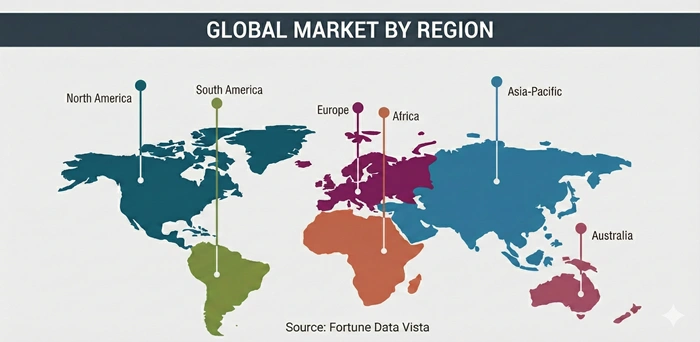
Asia-Pacific accounts for approximately 38.82% of global automotive seat belts market revenue in 2025, with a steady CAGR of approximately 5.9% through 2033, making it the world's single most important region for seat belt manufacturing and consumption. China is the dominant market within the region, driven by annual new vehicle sales exceeding 25 million units and a government that has progressively tightened vehicle safety regulations through the C-NCAP upgrade cycle and mandatory seat belt reminder legislation. Japan and South Korea contribute as both major vehicle production hubs and technology exporters, with companies like Tokai Rika, Ashimori Industry, and Hyundai Mobis supplying OEM programs globally. India is the region's fastest-growing individual country market, propelled by Bharat NCAP implementation, rising passenger car sales, and an automotive sector expanding to serve both domestic demand and export programs.
The region's dominance extends to the supply chain level, as Asia-Pacific hosts the majority of high-volume seat belt webbing production, buckle stamping facilities, and pretensioner assembly plants that serve global OEM programs. Autoliv's manufacturing network in China and Joyson Safety Systems' vertically integrated operations across multiple Asian countries give these tier-1 suppliers unmatched cost and proximity advantages for Asian OEM procurement. Southeast Asian markets — including Thailand, Vietnam, and Indonesia — are emerging as secondary production bases and growth consumption markets as vehicle ownership rates rise and national safety regulations strengthen. Together, these dynamics ensure that Asia-Pacific retains its leadership position in the automotive seat belts market throughout the 2026–2033 forecast period.North America
North America
North America Is the Fastest-Growing Region in the Automotive Seat Belts Market — Driven by ADAS Integration Mandates, Electric Vehicle Adoption, and an Active Regulatory Environment That Continuously Raises the Safety Performance Bar
North America is projected to grow at approximately 7.1% CAGR through 2033, making it the fastest-growing regional market in the automotive seat belts industry. The United States accounts for the majority of regional revenue, supported by NHTSA's ongoing enhancement of Federal Motor Vehicle Safety Standards, robust OEM procurement programs at Ford, General Motors, and Stellantis, and strong consumer demand for vehicles with five-star crash ratings. The US is also one of the world's most active EV adoption markets, with the rapid rollout of new EV platforms from Tesla, Rivian, and legacy OEMs creating substantial demand for revalidated and platform-specific seat belt systems. Canada contributes meaningfully to regional growth through its deep integration with US automotive production networks and its own strengthening safety enforcement environment.
Key players heavily active in the North American automotive seat belts market include Autoliv Inc. (Sweden/USA), ZF Friedrichshafen AG (Germany), Joyson Safety Systems (China/Germany), and Lear Corporation (USA). The region is increasingly seeing demand for integrated pretensioner-ADAS modules and occupant detection seat belt systems, as consumer rating organizations like IIHS continue to expand their rear-occupant protection criteria. The commercial vehicle segment in North America — encompassing long-haul trucking, school buses, and last-mile delivery vans — is another important growth vector as the Federal Motor Carrier Safety Administration strengthens restraint requirements for commercial drivers and fleet operators implement active compliance monitoring programs. These combined forces underpin North America's position as the growth leader in the global automotive seat belts market through 2033.
Top Key Players
-
Autoliv Inc. (Sweden / United States)
-
ZF Friedrichshafen AG (Germany)
-
Joyson Safety Systems (China / Germany)
-
Tokai Rika Co., Ltd. (Japan)
-
Ashimori Industry Co., Ltd. (Japan)
-
Toyoda Gosei Co., Ltd. (Japan)
-
Hyundai Mobis Co., Ltd. (South Korea)
-
Lear Corporation (United States)
-
Forvia Faurecia SE (France)
-
Holmbergs Safety System Holding AB (Sweden)
-
GWR Safety Systems (United Kingdom)
-
Schroth Safety Products GmbH (Germany)
-
Sabelt S.p.A. (Italy)
-
APV Corporation (United States)
-
Simpson Performance Products (United States)
Recent Developments
-
In January 2023, ZF Friedrichshafen AG launched the Heat Belt, an innovative heated seat belt designed specifically for electric vehicles — integrating heating conductors directly into the webbing structure to provide close-to-body warmth and reduce cabin heating energy consumption by up to 15%, extending EV driving range in cold climates.
-
In September 2023, Autoliv Inc. entered a strategic partnership with Great Wall Motor to co-develop next-generation occupant protection systems including overhead airbags, integrated zero-gravity seat safety systems, and sustainable interior materials, combining Autoliv's restraint system expertise with Great Wall Motor's vehicle platform design capabilities.
-
In July 2024, Joyson Safety Systems expanded its production footprint in India with an advanced manufacturing facility in Pune designed to serve growing domestic OEM demand, positioning the company to capitalize on India's Bharat NCAP-driven requirement for enhanced seat belt and airbag systems in mass-market vehicles.
-
In March 2024, Hyundai Mobis announced an expanded seat belt pretensioner supply agreement with a major European OEM for their next-generation EV platform lineup, covering multiple vehicle architectures and geographies — a contract reflecting the growing importance of EV-specific restraint system validation across global OEM programs.
-
In February 2025, Tokai Rika Co., Ltd. unveiled a new advanced electric pretensioner design compatible with next-generation ADAS collision avoidance systems, featuring programmable retraction force curves and a compact architecture designed for integration into the narrow pillar structures of new battery electric vehicle body-in-white platforms.
Market Trends
Two Defining Technology Trends Are Reshaping the Automotive Seat Belts Market: The Rise of Pre-Emptive ADAS-Triggered Restraints and the Integration of Smart Occupant Monitoring Directly Into Belt Systems*
The most consequential trend reshaping the automotive seat belts market is the coupling of pretensioner systems with forward collision sensing from ADAS hardware. In newer vehicle models from BMW, Mercedes-Benz, and Toyota, radar-based pre-crash detection now activates seat belt retraction before impact, reducing occupant forward displacement by a meaningful margin. This shift transforms the seat belt from a collision-response device to a collision-anticipation device, fundamentally improving injury outcomes in the most common crash scenarios. Automotive safety engineers describe this as the most significant advancement in restraint performance in two decades, and OEMs across every vehicle segment are incorporating some form of ADAS-belt integration into their next model generation safety specifications. The commercial implications are substantial: pretensioner units with ADAS communication capability command higher ASPs and create tighter OEM supplier relationships.
The second major trend is the rapid sophistication of in-belt occupant monitoring technology. Buckle hall-effect sensors that detect whether a belt is engaged have been standard for years, but the latest generation of restraint systems now incorporates webbing-tension sensors that detect incorrect routing of the seat belt across the abdomen rather than the pelvis — a common misuse pattern that significantly increases abdominal injury risk in crashes. Camera and infrared sensor arrays integrated with seat belt systems can identify not just whether the belt is buckled, but whether it is correctly positioned. These smart monitoring capabilities are gaining traction as automakers prepare for progressively stricter rear-seat occupant protection scoring criteria from IIHS, Euro NCAP, and equivalent bodies in China and India. Together, these trends are elevating the technical complexity, average selling price, and strategic importance of the restraint system as a competitive differentiator in the global automotive seat belts market.
Segments Covered in the Report
-
By Seat Belt Type
-
Three-Point Seat Belts (Standard, ALR, ELR, Adjustable)
-
Five-Point Seat Belts (Harness Systems, Adjustable, Fixed, Racing Harnesses)
-
-
By Technology
-
Pretensioner Seat Belts
-
Retractor Seat Belts
-
Active Seat Belts
-
Inflatable Seat Belts
-
Load Limiter Seat Belts
-
Reminder / Warning System Seat Belts
-
-
By Vehicle Type
-
Passenger Cars
-
Light Commercial Vehicles
-
Buses
-
Trucks
-
-
By Sales Channel
-
Original Equipment Manufacturer (OEM)
-
Aftermarket
-
-
By Region
-
Asia-Pacific (China, Japan, India, South Korea, Australia, ASEAN, Rest of Asia-Pacific)
-
North America (US, Canada, Mexico)
-
Europe (Germany, UK, France, Italy, Spain, Russia, Rest of Europe)
-
Latin America (Brazil, Argentina, Rest of Latin America)
-
Middle East & Africa (GCC Countries, South Africa, Rest of MEA)
-
"Built for Every Level — From Startups to Industry Giants"
Here Is Exactly How This Report Works for You
-
This report equips every category of business participant — from startups developing next-generation restraint sensor technology to tier-1 suppliers, OEM procurement teams, private equity investors, and global fleet operators — with the precise market intelligence needed to understand supply-demand imbalances in key seat belt component categories, benchmark competitor revenue streams and product portfolios, and assess how geopolitical factors such as US-China trade tensions, India's evolving safety mandates, and EU regulatory timelines directly impact sourcing strategy, pricing power, and market access decisions in the automotive seat belts industry.
-
Tier 2 and tier 3 component suppliers — including webbing manufacturers, buckle stampers, and pretensioner subassembly producers — will find the full report's customer segment breakdown, regional procurement volume data, and OEM alignment mapping essential for identifying which vehicle platform programs represent the strongest near-term growth opportunities and how to position their production capabilities to secure preferred supplier status with leading tier-1 integrators.
-
Investors and high-level executives evaluating M&A activity, new facility investments, or technology licensing opportunities in the automotive seat belts sector will gain direct value from the report's competitive positioning matrix, geopolitical risk scenario modeling, and long-term forecast scenarios that quantify the revenue impact of ADAS integration mandates, EV platform proliferation, and emerging market safety regulation cycles — delivering the evidence base needed to make high-confidence, multi-year capital decisions.
Frequently Asked Questions:
Answer: The global automotive seat belts market is valued at USD 14.44 billion in 2025 and is expected to grow to USD 15.16 billion in 2026. By 2033, the market is projected to reach approximately USD 20.05 billion, expanding at a CAGR of 6.2% over the 2026–2033 forecast period.
Answer: The automotive seat belts market is primarily driven by rising global road fatality rates that compel governments to tighten vehicle safety regulations and mandate more advanced restraint technologies. Increasing vehicle production volumes, growing consumer safety awareness, and the rapid adoption of ADAS-integrated pretensioner systems are reinforcing this demand across both passenger and commercial vehicle segments.
Answer: Asia-Pacific is the dominant region in the automotive seat belts market with approximately 38.82% revenue share in 2025, anchored by massive vehicle production in China, Japan, South Korea, and India. North America is the fastest-growing region, projected at approximately 7.1% CAGR through 2033, driven by ADAS mandates, EV adoption, and rising rear-occupant protection requirements.
Answer: Three-point seat belts dominate the automotive seat belts market with approximately 72% share due to their universal regulatory mandate and cost-effective fitment across all vehicle categories. Inflatable seat belts, while holding a smaller share, are the fastest-growing technology at approximately 8.4% CAGR, gaining ground in premium segments and rear-seat applications as their superior head and chest protection performance is recognized by global crash rating organizations.
Answer: The global automotive seat belts market is led by major safety system suppliers including Autoliv Inc., ZF Friedrichshafen AG, Joyson Safety Systems, Tokai Rika Co. Ltd., and Hyundai Mobis, which collectively hold a significant combined market share. These companies compete on the basis of pretensioner technology advancement, ADAS integration capability, EV-platform compatibility, and regional manufacturing proximity to major OEM assembly hubs.