
Automotive Shock Absorber Market Overview
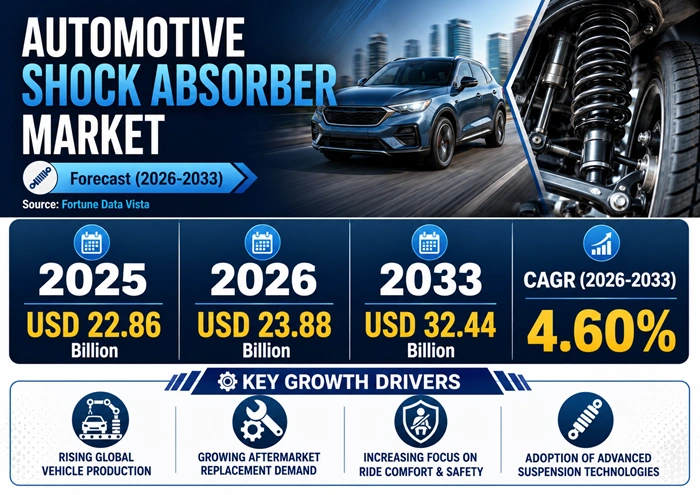
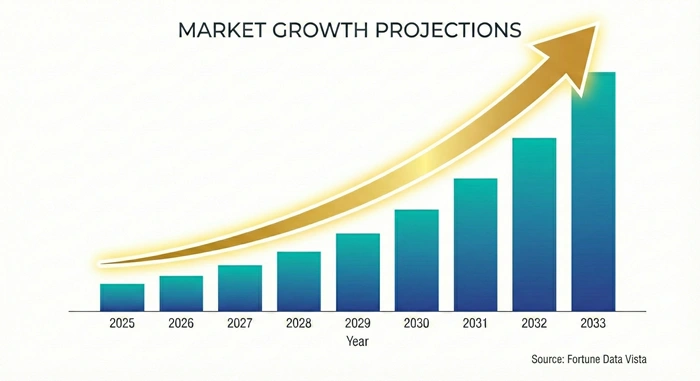
The global automotive shock absorber market size is valued at USD 22.86 billion in 2025 and is predicted to increase from USD 23.88 billion in 2026 to approximately USD 32.44 billion by 2033, growing at a CAGR of 4.60% from 2026 to 2033.
This steady expansion reflects the continued importance of ride comfort, vehicle stability, and safety in both passenger and commercial vehicle segments worldwide. Rising vehicle production, growing demand for advanced suspension technology, and expanding aftermarket replacement needs are together supporting demand for shock absorbers across developed and emerging automotive markets.
AI Impact on the Automotive Shock Absorber Industry
Artificial Intelligence Is Quietly Transforming How Suspension Systems Are Designed, Tested, and Tuned
Artificial intelligence is beginning to play a meaningful role in reshaping how shock absorbers are engineered and validated before reaching production vehicles. Machine learning tools embedded in simulation software are helping engineers predict damping performance under thousands of road and load conditions without needing extensive physical prototyping, which shortens development cycles and reduces testing costs significantly. AI-driven predictive maintenance systems are also being integrated into modern vehicles, allowing onboard sensors to detect early signs of suspension wear and alert drivers before a shock absorber failure affects ride safety.
Beyond design and diagnostics, AI is enabling smarter adaptive damping systems that adjust suspension stiffness in real time based on road conditions, driving style, and cargo load. Automakers are increasingly using data collected from connected vehicles to refine future shock absorber designs, creating a continuous feedback loop between real-world usage and engineering improvement. The broader integration of AI into manufacturing quality control is also helping suppliers catch defects earlier in production, which strengthens overall reliability across the automotive shock absorber market and reduces costly warranty claims for manufacturers.
Growth Factors
Rising Vehicle Production, Aftermarket Demand, and Suspension Innovation Are Converging to Sustain Market Growth
The primary engine driving the automotive shock absorber market forward is the steady global growth in passenger and commercial vehicle production, particularly across emerging economies where rising incomes are fueling car ownership. As more vehicles roll off assembly lines each year, original equipment manufacturers require a consistent and growing supply of shock absorbers designed to match increasingly sophisticated vehicle platforms. This demand is further reinforced by rising consumer expectations around ride comfort and handling, which push automakers to invest in higher-quality suspension components even in mid-range vehicle segments.
At the same time, the expanding automotive aftermarket sector is becoming an equally important growth driver. Shock absorbers wear out over time and require periodic replacement, and as the global vehicle parc continues to age in many mature markets, demand for replacement parts remains strong and steady. The development of gas-filled and adaptive damping technologies, along with growing consumer interest in performance upgrades for SUVs and off-road vehicles, is further expanding the range of products available to both OEM and aftermarket customers, strengthening overall demand across the automotive shock absorber market.
Market Outlook
Electrification, Emerging Market Expansion, and Technology Upgrades Are Setting the Stage for Long-Term Stability
The automotive shock absorber industry is positioned for steady, resilient growth driven by the ongoing shift toward electric vehicles, which require specially tuned suspension components to manage different weight distribution and ride characteristics compared to conventional vehicles. As electric vehicle adoption accelerates across North America, Europe, and Asia Pacific, suppliers are adapting their product lines to serve this growing segment, creating a durable new source of demand that will support the market well beyond 2033. This shift toward electrified drivetrains represents an important structural opportunity for shock absorber manufacturers willing to invest in specialized engineering capabilities.
Emerging markets will be a key area of focus for growth through the forecast period. Countries across Asia Pacific and Latin America are seeing rising vehicle ownership rates alongside expanding domestic manufacturing capacity, which is increasing demand for both OEM-fitted and aftermarket shock absorbers. Government infrastructure investment and improving road networks in these regions are also encouraging consumers to prioritize vehicle comfort and safety features. Companies that invest early in cost-efficient, durable shock absorber technology suited to these growing markets are likely to capture a meaningful share of this expanding demand within the automotive shock absorber market.
Expert Speaks
-
"Suspension technology continues to evolve rapidly as vehicles become smarter and more connected, and our investment in adaptive damping systems reflects exactly where the industry is heading. Customers today expect ride comfort that adjusts intelligently to changing road conditions, not fixed performance." — CEO, ZF Friedrichshafen
-
"The shift toward electric vehicles is reshaping how we approach shock absorber design, since weight distribution and ride dynamics are fundamentally different from traditional combustion vehicles. We are seeing growing demand from automakers who need suspension partners capable of engineering for these new platforms." — CEO, Tenneco Inc.
-
"Aftermarket demand remains a steady and reliable growth pillar for our business, even as OEM production cycles fluctuate with broader economic conditions. Consumers are increasingly willing to invest in quality replacement parts once they understand how much ride comfort and safety depend on well-maintained suspension." — CEO, KYB Corporation
Key Report Takeaways
-
Asia Pacific leads the global automotive shock absorber market, holding approximately 38% market share in 2025, supported by massive vehicle production volumes across China, India, and Japan alongside a rapidly expanding component manufacturing base
-
North America is a key growth region, driven by strong aftermarket replacement demand and rising adoption of adaptive suspension technology in premium and electric vehicle segments
-
Original equipment manufacturers represent the dominant customer base, relying heavily on shock absorber suppliers to meet strict quality and durability standards during new vehicle production
-
Passenger vehicle applications contribute the most to overall demand, reflecting continued global growth in car ownership and rising consumer expectations around ride comfort
-
Twin-tube shock absorbers remain the most widely used product type, prized for their cost efficiency, durability, and suitability across a broad range of vehicle categories
-
Gas-filled and adaptive damping shock absorbers will grow the fastest among product segments, holding close to 27% market share with a CAGR near 6.5% through the forecast period, driven by rising demand for advanced ride comfort in premium and electric vehicles
Market Scope
| Parameter | Details |
|---|---|
| Market Size by 2033 | USD 32.44 Billion | Market Size by 2026 | USD 23.88 Billion | Market Size by 2025 | USD 22.86 Billion | Market Growth Rate from 2026 to 2033 | CAGR of 4.60% | Dominating Region | Asia Pacific | Fastest Growing Region | North America | Segments Covered | Type, Product Type, Technology, Vehicle Type, Sales Channel, Region | Regions Covered | North America, Europe, Asia Pacific, Latin America, Middle East & Africa |
Market Dynamics
Drivers Impact Analysis
Rising Vehicle Production and Growing Aftermarket Replacement Demand Are Emerging as the Two Most Powerful Forces Propelling This Market Forward
| Driver | (≈) % Impact on CAGR Forecast | Geographic Relevance | Impact Timeline |
|---|---|---|---|
| Rising global passenger and commercial vehicle production | ~35% | Asia Pacific, North America | Short to long-term |
| Growing aftermarket replacement demand from aging vehicle parc | ~28% | Global, strongest in North America, Europe | Medium to long-term |
| Increasing adoption of adaptive and gas-filled damping technology | ~20% | Global, led by premium vehicle segments | Short to medium-term |
| Expansion of electric vehicle production requiring specialized suspension | ~17% | Global | Medium to long-term |
The steady rise in global vehicle production is without question the single most powerful demand driver in the automotive shock absorber market. As automakers ramp up output across both passenger and commercial vehicle categories, the requirement for reliable, cost-effective suspension components grows in direct proportion. This is particularly visible in Asia Pacific, where growing middle-class populations and expanding manufacturing capacity are pushing vehicle production to record levels, creating sustained order volumes for shock absorber suppliers.
Growing aftermarket replacement demand is the second critical driver shaping the automotive shock absorber market. Since shock absorbers naturally degrade with use and require periodic replacement, the aging vehicle fleet in mature markets like North America and Europe continues to generate steady, recurring revenue for component manufacturers. This matters commercially because aftermarket sales tend to be less cyclical than OEM production, providing suppliers with a stable revenue base even during periods of slower new vehicle sales. As consumers increasingly prioritize ride comfort and safety, demand for quality replacement parts continues to climb steadily.
Restraints Impact Analysis
Raw Material Price Volatility and Intense Price Competition Continue to Present Real-World Barriers to Margin Growth
| Restraint | (≈) % Impact on CAGR Forecast | Geographic Relevance | Impact Timeline |
|---|---|---|---|
| Volatility in steel and raw material prices | ~38% | Global | Short to medium-term |
| Intense price competition among aftermarket suppliers | ~30% | Global, strongest in Asia Pacific, Latin America | Short to long-term |
| High cost of advanced adaptive damping systems | ~20% | Global, notable in price-sensitive markets | Medium-term |
| Slower vehicle production growth in certain mature markets | ~12% | Europe, parts of North America | Ongoing |
The most significant structural restraint in the automotive shock absorber market is the persistent volatility in raw material prices, particularly steel and specialty alloys used in manufacturing. Fluctuating input costs make it difficult for suppliers to maintain stable pricing with OEM customers who typically negotiate long-term supply contracts, squeezing profit margins during periods of rising commodity prices. This cost pressure is especially challenging for smaller manufacturers that lack the scale to absorb short-term price swings.
Intense price competition among aftermarket suppliers, particularly in price-sensitive markets across Asia Pacific and Latin America, remains a persistent commercial challenge. Numerous regional and local manufacturers compete aggressively on price, which can erode margins for established brands trying to maintain quality standards while remaining competitive. While premium adaptive damping technology offers a path toward differentiation, the higher production cost of these advanced systems limits their adoption among cost-conscious consumers and fleet operators, keeping much of the broader automotive shock absorber market anchored to conventional, lower-margin products.
Opportunities Impact Analysis
Electric Vehicle Suspension Demand and Adaptive Damping Adoption Represent the Most Commercially Significant Growth Opportunities
| Opportunity | (≈) % Impact on CAGR Forecast | Geographic Relevance | Impact Timeline |
|---|---|---|---|
| Growing demand for specialized electric vehicle suspension systems | ~40% | Global, led by North America, Europe, China | Medium to long-term |
| Expansion of adaptive and semi-active damping technology | ~35% | Global, strongest in premium vehicle segments | Short to medium-term |
| Growth of e-commerce driven aftermarket parts distribution | ~25% | Global | Long-term |
The growing demand for specialized suspension systems tailored to electric vehicles represents one of the most commercially attractive opportunities in the automotive shock absorber market. Electric vehicles carry heavier battery packs and have different weight distribution compared to traditional combustion vehicles, requiring shock absorbers engineered specifically to handle these unique dynamics. Suppliers that invest early in electric vehicle-specific suspension technology stand to capture a growing share of this rapidly expanding customer base as automakers continue scaling up electric vehicle production globally.
The expansion of adaptive and semi-active damping technology into mid-range vehicle segments is opening entirely new commercial opportunities beyond the traditional premium and luxury vehicle categories. As production costs for these advanced systems gradually decline, automakers are increasingly offering adaptive suspension as a standard or optional feature across a broader range of price points. Companies that can deliver affordable, reliable adaptive damping solutions will find significant commercial opportunity as consumer expectations around ride comfort continue rising across nearly every vehicle segment.
Segment Analysis
By Type: Twin-Tube Shock Absorbers
Twin-Tube Shock Absorbers Lead the Type Segment, Driven by Cost Efficiency and Broad Vehicle Compatibility
Twin-tube shock absorbers hold the dominant position in the automotive shock absorber market, accounting for approximately 58% of the total type segment in 2025. This dominance is deeply rooted in the cost efficiency and manufacturing simplicity of twin-tube designs, which make them the preferred choice for mainstream passenger vehicles and commercial trucks across most price segments. In high-volume markets like China, India, and the United States, manufacturers have standardized production around twin-tube platforms because they balance durability with affordability effectively. Leading companies such as Tenneco, KYB Corporation, and Mando Corporation continue to dominate procurement in these markets through well-established manufacturing networks and long-standing OEM supply agreements.
Asia Pacific is emerging as the fastest-growing region for twin-tube shock absorber demand, expanding steadily as vehicle production volumes in China and India continue climbing year after year. The region's enormous manufacturing base, combined with growing domestic vehicle ownership and government support for automotive industry expansion, is generating significant institutional demand for cost-effective suspension components. Gabriel India and KYB have strengthened their regional presence through local production facilities and long-term supply partnerships with domestic automakers. The broader shift toward slightly upgraded twin-tube designs with improved sealing and damping consistency is also being led by this segment, with manufacturers gradually incorporating incremental technology improvements to remain competitive.
By Vehicle Type: Passenger Vehicles
Passenger Vehicles Dominate the Vehicle Type Segment, Reflecting Strong Global Demand for Ride Comfort and Safety
Passenger vehicles account for approximately 64% of the total vehicle type segment in 2025, reflecting the sheer scale of global passenger car production and the growing consumer focus on ride comfort and handling. With hundreds of millions of passenger vehicles produced and sold worldwide each year, this segment represents the foundational demand driver across virtually every regional automotive shock absorber market. Automakers maintain long-term procurement relationships with suspension suppliers to ensure consistent quality across new vehicle platforms, and this segment operates at a CAGR broadly in line with the overall market average, supported by continued growth in global vehicle ownership rates.
North America stands out as a strong growth region for passenger vehicle shock absorber demand, supported by steady vehicle replacement cycles and rising consumer interest in comfort-oriented suspension upgrades. Growing popularity of SUVs and crossover vehicles in the region has pushed suppliers to develop shock absorbers specifically tuned for heavier vehicle platforms with different ride height requirements. Companies like Monroe, a Tenneco brand, and Bilstein have deepened their presence in the region through dealer partnerships and strong aftermarket distribution networks. Commercial vehicle applications, while smaller in volume, remain an important segment due to the durability requirements of trucks and buses operating under heavier loads.
Regional Insights
Asia Pacific
Asia Pacific's Massive Vehicle Production Base and Expanding Component Manufacturing Ecosystem Make It the Global Market Leader
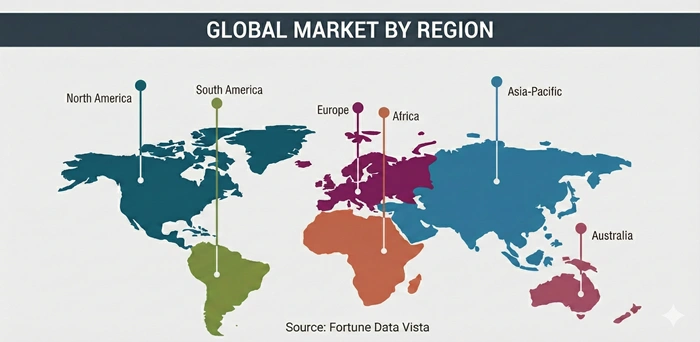
Asia Pacific holds the dominant position in the global automotive shock absorber market with approximately 38% market share in 2025 and continues to expand steadily through 2033. China and India drive the majority of regional demand, supported by enormous vehicle production volumes, a deep component manufacturing base, and rising domestic vehicle ownership rates among growing middle-class populations. Key companies with strong Asia Pacific market presence include KYB Corporation, Gabriel India, and Mando Corporation, all of which maintain extensive local production facilities and long-standing OEM supply relationships across the region.
Japan and South Korea also contribute meaningfully to regional demand, both bringing decades of precision manufacturing expertise that supports premium and export-oriented shock absorber production. Automakers across the region continue to invest in domestic component supply chains to reduce costs and improve production efficiency, reinforcing the strength of local suspension manufacturers. The combination of massive production scale, cost-competitive manufacturing, and growing consumer demand for vehicle comfort ensures Asia Pacific's leadership position in the automotive shock absorber market remains firmly intact through 2033.
North America
North America's Strong Aftermarket Base and Rising Adaptive Suspension Adoption Drive Steady Market Growth
North America represents a key growth region in the global automotive shock absorber market, supported by a mature vehicle parc that generates consistent aftermarket replacement demand alongside growing adoption of advanced adaptive damping technology in premium and electric vehicle segments. The United States drives the majority of regional demand, backed by strong consumer spending on vehicle maintenance and a well-established network of automotive parts retailers and service centers. Companies like Tenneco, Monroe, and Bilstein maintain strong North American operations, offering both OEM and aftermarket suspension products tailored to a wide range of vehicle types.
The United States and Canada represent the two markets most closely watched within the region, given the scale of vehicle ownership and the steady pace of suspension component replacement across aging vehicle fleets. The U.S. has seen growing interest in performance and off-road suspension upgrades, particularly among SUV and pickup truck owners seeking enhanced ride quality. Canada's market, while smaller, benefits from similar consumer trends and continues to support steady demand growth across the broader North American automotive shock absorber market.
Customization Available for This Report
Region-Wise and Country-Wise Customization Ensures Every Client Gets Insights Tailored to Their Exact Market Focus
This report offers comprehensive region-wise and country-wise customization, providing tailored market insights, trends, competitive analysis, and opportunity assessments specific to your geography of interest.
Our team can deliver a fully customized version of this report for any of the following regions and countries, providing deep-dive market analysis, demand forecasting, regulatory landscape review, and competitive intelligence specific to the selected market and automotive shock absorber keyword combination:
North America
-
U.S. — Detailed analysis of aftermarket replacement trends, adaptive suspension adoption, and dealer distribution networks
-
Canada — Insights into vehicle fleet aging patterns and suspension component demand
-
Mexico — Manufacturing hub integration and shock absorber component export growth
Europe
-
U.K. — Aftermarket parts distribution trends and premium suspension technology adoption
-
Germany — Advanced adaptive damping manufacturing landscape and strong OEM supply chain presence
-
France — Passenger vehicle production trends and suspension component demand
-
Italy — Growing performance vehicle suspension demand and design-driven engineering requirements
-
Rest of Europe — Emerging suspension component markets across Eastern Europe and the Baltics
Asia Pacific
-
China — Vehicle production scale, domestic component manufacturing growth, and export competitiveness
-
India — Growing passenger vehicle production and affordable suspension component demand
-
Japan — Advanced precision manufacturing ecosystem supporting premium suspension exports
-
South Korea — Automotive component integration and institutional OEM procurement
-
Australia — Off-road and performance suspension demand in regional vehicle segments
-
Rest of Asia Pacific — Country-level analysis covering Thailand, Vietnam, Indonesia, and Malaysia
Latin America
-
Brazil — Growing vehicle production base and expanding aftermarket suspension demand
-
Argentina — Early-stage suspension component market development
-
Rest of Latin America — Colombia, Mexico, Peru, and Chile country-level automotive shock absorber market sizing
Middle East & Africa
-
UAE — Growing vehicle fleet and imported suspension component demand
-
Saudi Arabia — Industrial modernization and automotive parts procurement growth
-
Rest of MEA — Sub-Saharan Africa automotive component access expansion and distribution channel growth
Top Key Players
-
Tenneco Inc (United States)
-
ZF Friedrichshafen AG (Germany)
-
KYB Corporation (Japan)
-
Mando Corporation (South Korea)
-
Bilstein Group (Germany)
-
Gabriel India Limited (India)
-
Hitachi Astemo Ltd (Japan)
-
Magneti Marelli SpA (Italy)
-
Showa Corporation (Japan)
-
Hendrickson USA LLC (United States)
-
Rheinmetall AG (Germany)
-
Sogefi SpA (Italy)
Recent Developments
-
In 2025, Tenneco expanded its Monroe brand product line with new adaptive damping technology aimed at improving ride comfort for electric vehicle platforms
-
In 2026, ZF Friedrichshafen announced enhancements to its Sachs suspension portfolio, targeting faster integration with software-defined vehicle architectures
-
In 2025, KYB Corporation strengthened its manufacturing presence in India through capacity expansion aimed at meeting rising domestic passenger vehicle demand
-
In 2026, Mando Corporation introduced new semi-active damping systems designed for mid-range vehicle segments, expanding beyond its traditional premium vehicle focus
-
In 2025, Bilstein Group deepened its partnerships with performance vehicle manufacturers to expand its motorsport-derived suspension technology into mainstream SUV applications
Market Trends
The Automotive Shock Absorber Market Is Rapidly Shifting Toward Adaptive Damping Systems and Electric Vehicle-Specific Suspension Engineering
Two of the most consequential trends reshaping the automotive shock absorber landscape are the growing adoption of adaptive damping systems and the rise of suspension components engineered specifically for electric vehicles. Adaptive dampers that adjust stiffness in real time based on road conditions and driving behavior are increasingly appearing in mid-range vehicles, not just luxury models, as production costs gradually decline. This trend is improving ride comfort expectations across a much broader consumer base and is pushing suppliers to invest more heavily in electronic control integration within their suspension products.
The second major trend is the growing specialization of shock absorber design for electric vehicles, which carry heavier battery packs and different center-of-gravity characteristics compared to conventional combustion vehicles. Suspension suppliers are working closely with electric vehicle manufacturers to develop components that handle these unique dynamics effectively while maintaining efficient energy use. At the same time, the expansion of e-commerce distribution channels for aftermarket suspension parts is creating a new layer of revenue opportunity for suppliers that can reach individual consumers directly rather than relying solely on traditional dealer networks.
Segments Covered in the Report
By Type
-
Single-Tube Shock Absorbers
-
Twin-Tube Shock Absorbers
By Product Type
-
Hydraulic Type
-
Gas-Filled Type
By Technology
-
Conventional Damping Systems
-
Adaptive and Semi-Active Damping Systems
-
Electronically Controlled Suspension Systems
By Vehicle Type
-
Passenger Vehicles
-
Commercial Vehicles
By Sales Channel
-
OEM
-
Aftermarket
By Region
-
North America (U.S., Canada, Mexico)
-
Europe (U.K., Germany, France, Italy, Rest of Europe)
-
Asia Pacific (China, India, Japan, South Korea, Australia, Rest of Asia Pacific)
-
Latin America (Brazil, Argentina, Rest of Latin America)
-
Middle East & Africa (UAE, Saudi Arabia, Rest of MEA)
❝ Built for Every Level — From Startups to Industry Giants ❞
Here Is Exactly How This Report Works for You
-
For tier 1 enterprises, investors, and high-level decision-makers, this report delivers competitor revenue analysis, detailed revenue source breakdowns, geopolitical risk assessments, and supply-demand dynamics that enable confident capital allocation, M&A targeting, and strategic market entry or expansion decisions in the automotive shock absorber space
-
For tier 2 and tier 3 companies, mid-level businesses, and startups, this report provides a practical roadmap of the most commercially viable segments, regional opportunities, and technology investment priorities, helping you compete effectively against established players and identify white spaces before they become crowded
-
For all decision-makers across the value chain, this report explains exactly how raw material cost shifts, electric vehicle adoption trends, trade policy changes, and competitor positioning are converging to shape market direction through 2033, giving you the intelligence framework to make proactive, evidence-based decisions rather than reactive ones
Frequently Asked Questions:
Answer: The global automotive shock absorber market was valued at USD 22.86 billion in 2025 and is projected to reach USD 32.44 billion by 2033. This growth is driven by rising vehicle production and steady aftermarket replacement demand worldwide.
Answer: The primary drivers of the automotive shock absorber market include growing global vehicle production and rising demand for adaptive damping technology. Expanding electric vehicle adoption is further accelerating demand for specialized suspension components.
Answer: Asia Pacific currently dominates the automotive shock absorber market with approximately 38% market share, supported by massive vehicle production volumes. North America remains a key growth region, driven by strong aftermarket replacement demand.
Answer: Twin-tube shock absorbers account for approximately 58% of the type segment, reflecting their cost efficiency and durability. Passenger vehicles also dominate the vehicle type segment due to strong global demand for ride comfort.
Answer: Leading players in the automotive shock absorber market include Tenneco, ZF Friedrichshafen, KYB Corporation, Mando Corporation, and Bilstein Group. These companies compete through strong OEM relationships, broad aftermarket networks, and continuous investment in adaptive damping technology.