
Automotive Simulation Software Market Overview
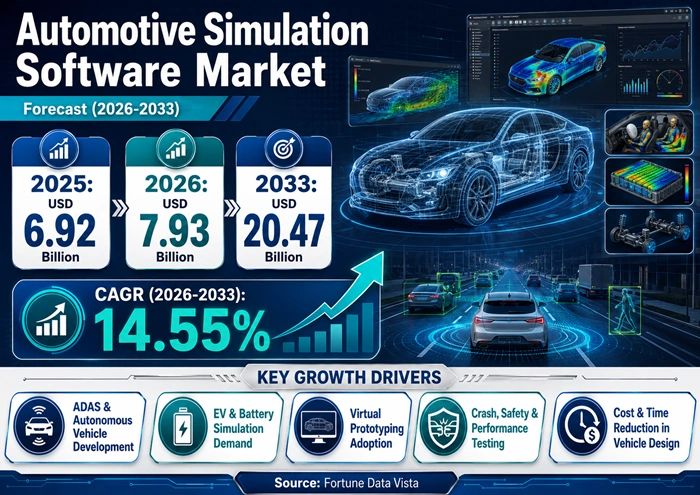
The global automotive simulation software market size is valued at USD 6.92 billion in 2025 and is predicted to increase from USD 7.93 billion in 2026 to approximately USD 20.47 billion by 2033, growing at a CAGR of 14.55% from 2026 to 2033.
Automotive simulation software allows engineers to model, test, and validate vehicle performance virtually, covering everything from crash safety and vehicle dynamics to thermal management and electromagnetic compatibility, without the need to build costly physical prototypes for every design iteration. This technology has become especially critical as automakers race to develop autonomous driving systems and electric vehicle platforms, since virtual testing allows engineers to evaluate thousands of driving scenarios far faster and more affordably than physical road testing ever could. Rising investment in autonomous vehicle development, growing electric vehicle production, and increasing pressure to shorten product development cycles are together fueling strong, sustained demand for this essential engineering technology.
AI Impact on the Automotive Simulation Software Industry
How Artificial Intelligence Is Accelerating Scenario Generation and Predictive Modeling Across Automotive Simulation Platforms
Artificial intelligence is fundamentally reshaping how automotive engineers use simulation software to validate vehicle designs and autonomous driving systems. AI-powered scenario generation tools can now automatically create thousands of realistic driving conditions, including rare edge cases involving unusual weather, pedestrian behavior, or sensor failures, that would be extremely difficult and dangerous to test in the physical world. This capability has become essential for autonomous vehicle developers who need to validate their systems against an enormous range of possible real-world situations before deployment, making AI-enhanced simulation a critical component of safety certification processes.
Beyond scenario generation, machine learning algorithms are increasingly being integrated directly into simulation platforms to predict vehicle behavior more accurately based on historical testing data, reducing the computational time required for complex physics-based simulations. This is particularly valuable for battery thermal management simulation in electric vehicles, where AI models can quickly predict performance across different temperature and usage conditions without running full computational fluid dynamics simulations every time. As AI-driven predictive modeling becomes more sophisticated, companies operating in the automotive simulation software market are increasingly building these capabilities directly into their platforms to help automakers accelerate development timelines while improving overall vehicle safety and reliability.
Growth Factors
Rising Autonomous Vehicle Development, Growing Electric Vehicle Production, and Shortening Product Development Cycles Are the Three Most Influential Growth Drivers
The rapid global expansion of autonomous vehicle development programs remains one of the most powerful growth factors sustaining demand for automotive simulation software, since virtual testing is the only practical way to validate self-driving systems against the millions of miles of diverse driving scenarios required for safety certification. As automakers and technology companies continue investing heavily in autonomous driving capabilities, demand for sophisticated simulation platforms capable of modeling complex sensor behavior and traffic interactions continues growing correspondingly.
Growing electric vehicle production represents a second significant driver, as automakers increasingly rely on simulation software to optimize battery performance, thermal management, and powertrain efficiency before committing to expensive physical prototype testing. The broader industry pressure to shorten product development cycles and reduce engineering costs is also gaining strong traction, as automakers face intensifying competition and need to bring new vehicle models to market faster than traditional development processes allowed. Combined with growing regulatory requirements for extensive safety validation, these factors continue reinforcing durable, multi-year demand growth across the global automotive simulation software market.
Market Outlook
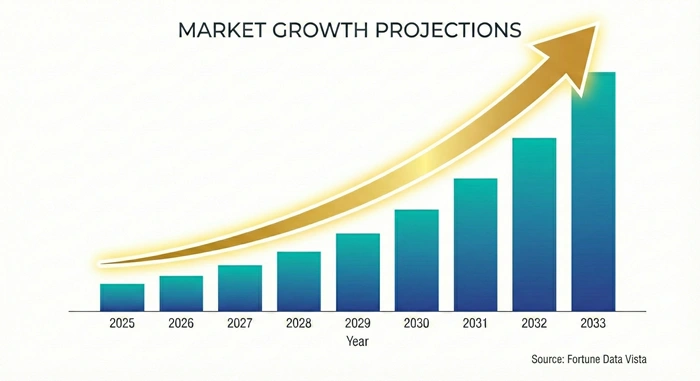
The Automotive Simulation Software Market Is Positioned for Rapid Expansion Through 2033 as Virtual Testing Becomes Standard Practice
The long-term outlook for automotive simulation software remains extremely strong as virtual testing continues shifting from a supplementary engineering tool to a foundational component of vehicle development processes across the industry. As cloud computing capabilities continue expanding, more automakers and suppliers are expected to adopt cloud-based simulation platforms that offer greater computational power and collaborative capabilities compared to traditional on-premises solutions, creating new revenue opportunities for software providers offering flexible deployment models. This shift toward cloud-based simulation is likely to reshape the competitive landscape, favoring companies that can deliver scalable, subscription-based platforms alongside their traditional enterprise software offerings.
Looking further ahead, continued advancement in digital twin technology is expected to enable even more comprehensive virtual vehicle representations that combine simulation with real-world sensor data throughout a vehicle's entire lifecycle. Growing regulatory emphasis on autonomous vehicle safety validation across major automotive markets is also expected to accelerate simulation software adoption as a required component of certification processes. These dynamics point toward an automotive simulation software market that will remain one of the fastest-growing segments within the broader automotive technology industry through 2033.
Expert Speaks
-
"Virtual testing has become absolutely essential to how we develop and validate next-generation vehicles, and our continued investment in advanced simulation technology reflects its growing strategic importance." — CEO, Siemens AG.
-
"As autonomous driving programs scale globally, we see accelerating demand for simulation platforms capable of testing millions of driving scenarios that would be impossible to replicate physically." — CEO, Ansys Inc.
-
"Digital twin and simulation technology are reshaping how automakers approach product development, and this shift is creating significant long-term growth opportunities across our automotive software portfolio." — CEO, Dassault Systèmes.
Key Report Takeaways
-
North America leads the automotive simulation software market with an estimated 34% revenue share in 2025, supported by strong autonomous vehicle development activity and advanced automotive engineering infrastructure.
-
Asia Pacific is the fastest-growing region, projected to expand at a CAGR near 16.5% through 2033, driven by rapidly expanding electric vehicle production and growing automotive software adoption across China, Japan, and South Korea.
-
Automotive manufacturers represent the largest customer base, relying on simulation software to accelerate vehicle design validation and reduce physical prototyping costs.
-
Vehicle dynamics simulation applications contribute significantly to overall demand, given their critical role in validating handling, safety, and performance characteristics.
-
On-premises deployment remains the most widely used model among large automotive manufacturers, valued for its data security and integration with existing engineering systems.
-
The cloud-based deployment segment is projected to grow fastest going forward, expected to hold a growing share of total demand by 2033 while expanding at a CAGR near 18.2% during the forecast period.
Market Scope
| Parameter | Details |
|---|---|
| Market Size by 2033 | USD 20.47 Billion | Market Size by 2026 | USD 7.93 Billion | Market Size by 2025 | USD 6.92 Billion | Market Growth Rate from 2026 to 2033 | CAGR of 14.55% | Dominating Region | North America | Fastest Growing Region | Asia Pacific | Segments Covered | By Application, By Deployment Model, By End User, By Region | Regions Covered | North America, Europe, Asia Pacific, Latin America, Middle East & Africa |
Market Dynamics
Drivers Impact Analysis
Rising Autonomous Vehicle Development and Growing Electric Vehicle Production Are the Most Commercially Significant Drivers of Market Growth
| Driver | (≈) % Impact on CAGR Forecast | Geographic Relevance | Impact Timeline |
|---|---|---|---|
| Rapid expansion of autonomous vehicle development programs | ~36% | Global, led by North America and Asia Pacific | Short to long-term |
| Growing electric vehicle production requiring battery and powertrain simulation | ~28% | Asia Pacific, Europe | Medium-term |
| Rising pressure to shorten vehicle product development cycles | ~22% | Global | Short to medium-term |
| Increasing regulatory requirements for safety validation testing | ~14% | North America, Europe | Medium to long-term |
The rapid expansion of autonomous vehicle development programs remains the most powerful driver sustaining demand across the automotive simulation software market, as virtual testing offers the only practical and scalable way to validate self-driving systems against the enormous range of driving scenarios required for safety certification. This fundamental testing requirement ensures durable, long-term demand growth as autonomous vehicle programs continue advancing globally.
Growing electric vehicle production is a second significant driver, as automakers increasingly rely on simulation software to optimize battery thermal management and powertrain efficiency before committing to costly physical prototype testing. Combined with rising pressure to shorten product development cycles and increasing regulatory requirements for extensive safety validation, these drivers together sustain strong, multi-year demand growth across the global automotive simulation software landscape.
Restraints Impact Analysis
High Software Licensing Costs and Integration Complexity Are the Two Primary Constraints Limiting Faster Market Growth
| Restraint | (≈) % Impact on CAGR Forecast | Geographic Relevance | Impact Timeline |
|---|---|---|---|
| High licensing and implementation costs of advanced simulation platforms | ~34% | Global | Short to medium-term |
| Complex integration requirements with existing engineering workflows | ~30% | North America, Europe | Medium-term |
| Shortage of skilled simulation engineers in emerging markets | ~22% | Asia Pacific, Latin America | Medium-term |
| Data security concerns with cloud-based simulation platforms | ~14% | Global | Short-term |
The high licensing and implementation costs associated with advanced simulation platforms remain a meaningful barrier, particularly for smaller automotive suppliers and startups that lack the substantial capital budget required to deploy comprehensive enterprise-grade simulation tools. This cost sensitivity often limits smaller companies to more basic simulation capabilities compared to larger, well-resourced automotive manufacturers.
Complex integration requirements between new simulation platforms and existing engineering workflows also slow adoption, particularly for established automakers with deeply embedded legacy design and testing processes. A persistent shortage of skilled simulation engineers in several emerging markets further constrains the pace at which regional automotive companies can fully leverage these advanced tools. These restraints do not reverse the underlying growth trend but do introduce meaningful friction that moderates the pace of expansion within the automotive simulation software market, particularly among smaller and resource-constrained organizations.
Opportunities Impact Analysis
Cloud-Based Platform Expansion and Digital Twin Technology Advancement Represent the Most Significant Untapped Growth Opportunities
| Opportunity | (≈) % Impact on CAGR Forecast | Geographic Relevance | Impact Timeline |
|---|---|---|---|
| Expansion of cloud-based, subscription-model simulation platforms | ~37% | Global | Medium-term |
| Advancing digital twin technology for full vehicle lifecycle simulation | ~34% | North America, Europe | Medium to long-term |
| Growing electric vehicle and autonomous technology adoption in emerging markets | ~29% | Asia Pacific, Latin America | Medium to long-term |
The expansion of cloud-based, subscription-model simulation platforms presents a significant opportunity for software providers, as this deployment approach lowers the barrier to entry for smaller automotive companies while offering greater scalability and computational power for even the largest enterprise customers. Companies that can deliver flexible, cloud-native simulation solutions are well positioned to capture a broader customer base across the entire automotive value chain.
Advancing digital twin technology, which combines simulation with real-world vehicle sensor data throughout the product lifecycle, represents a second major opportunity for companies willing to invest in this increasingly sophisticated integrated approach. Growing electric vehicle and autonomous technology adoption across emerging markets in Asia Pacific and Latin America also creates significant expansion opportunities as regional automotive industries modernize their engineering capabilities, positioning early-moving companies to capture a growing share of the global automotive simulation software market.
Segment Analysis
By Application
Vehicle Dynamics Simulation Anchors the Largest Share Within Automotive Simulation Software Market Demand
Vehicle dynamics simulation holds the largest share of the automotive simulation software market, accounting for roughly 32% of total application revenue with a CAGR near 14% through 2033. Engineers rely heavily on vehicle dynamics simulation to validate handling, stability, and ride comfort characteristics before committing to expensive physical prototype testing, making this application segment fundamentally tied to core vehicle development processes across nearly every automotive manufacturer. North America leads this segment given its strong automotive engineering infrastructure and advanced testing capabilities, and leading companies operating here include Ansys and MSC Software, each maintaining substantial market share through established engineering simulation portfolios.
Crash simulation represents a fast-growing and critical application segment, expanding steadily as automakers face increasingly stringent global safety regulations requiring extensive virtual crash testing before physical validation. This segment is showing particularly strong growth momentum across Asia Pacific, where rapidly expanding automotive manufacturing capacity in China and India continues driving demand for comprehensive safety simulation tools. Companies such as Altair Engineering and ESI Group have built strong positions supplying crash simulation software to regional automotive manufacturers, reinforcing steady demand growth across both leading application segments within the global automotive simulation software market.
By Deployment Model
On-Premises Deployment Dominates While Cloud-Based Platforms Expand Rapidly Across the Industry
On-premises deployment accounts for a substantial share of the automotive simulation software market, supported by steady demand from large automotive manufacturers that prioritize data security and deep integration with existing proprietary engineering systems. This deployment model remains particularly popular among established automakers with significant existing infrastructure investment and stringent intellectual property protection requirements. Companies such as Siemens and Dassault Systèmes have established leading positions in this deployment category through comprehensive enterprise software suites tailored to large-scale automotive engineering operations.
Cloud-based deployment represents the fastest-growing segment, expected to expand at a CAGR near 18.2% through 2033 as automotive companies increasingly favor the scalability, lower upfront costs, and collaborative capabilities that cloud platforms offer. Europe is showing particularly strong growth in cloud adoption, driven by growing acceptance of software-as-a-service models among mid-sized automotive suppliers seeking cost-effective simulation capabilities. Companies including Autodesk and PTC maintain strong positions serving this rapidly expanding cloud-based segment, reinforcing steady growth across both leading deployment categories within the broader automotive simulation software market.
Regional Insights
North America
Strong Autonomous Vehicle Development and Advanced Engineering Infrastructure Keep North America at the Top of the Automotive Simulation Software Market
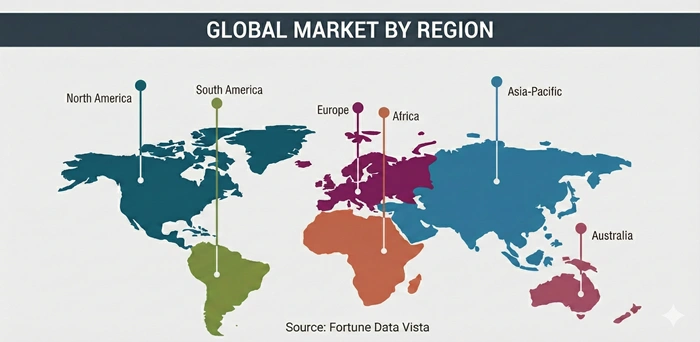
North America commands the largest share of the global automotive simulation software market, holding close to 34% of total revenue in 2025 with a regional CAGR near 13.5% through 2033. Strong autonomous vehicle development activity, advanced automotive engineering infrastructure, and substantial technology investment keep demand consistently strong throughout the region. Leading companies such as Ansys and PTC, both headquartered in the United States, dominate simulation software contracts across major automotive manufacturers and autonomous vehicle developers.
The region's mature automotive research and development ecosystem, combined with significant venture capital investment in autonomous driving technology companies, further reinforces this leadership position within the broader automotive technology landscape. Large automotive manufacturers and technology companies routinely integrate advanced simulation capabilities into their core vehicle development and validation workflows. This combination of technology leadership, engineering talent, and sustained investment ensures North America remains the anchor region for automotive simulation software market revenue generation over the coming years.
Asia Pacific
Rapidly Expanding Electric Vehicle Production Makes Asia Pacific the Fastest-Growing Region
Asia Pacific is the fastest-growing region in the automotive simulation software market, projected to expand at a CAGR near 16.5% through 2033 while currently holding a substantial and rapidly growing share of global revenue. Rapidly expanding electric vehicle production, growing automotive software adoption, and significant government investment in autonomous vehicle infrastructure across China, Japan, and South Korea are together driving this accelerated regional growth. Companies such as Hexagon AB's regional operations and various local automotive software providers are scaling operations rapidly to meet surging demand from expanding regional automotive manufacturing hubs.
Growing government support for electric vehicle and autonomous technology development, combined with the region's massive automotive manufacturing base, continues to widen Asia Pacific's addressable opportunity for simulation software providers. Japan and South Korea are also contributing meaningfully through advanced automotive engineering capabilities and strong domestic technology company investment. As regional automotive manufacturers continue adopting more sophisticated simulation tools, Asia Pacific is expected to narrow its overall revenue gap with North America over the coming several years within the broader automotive simulation software market.
Customization Available for This Report
Region-wise and country-wise customized reports are available for organizations seeking deeper geographic insight into the automotive simulation software market. Our research team can tailor market analysis, competitive intelligence, trends, and growth opportunities specifically for any of the regions and countries listed below, offering detailed information aligned to your selected market and keyword combination.
North America
-
U.S., Canada, Mexico — detailed autonomous vehicle development trends, engineering infrastructure analysis, and competitive positioning
Europe
-
U.K., Germany, France, Italy, Rest of Europe — cloud adoption trends and key player analysis
Asia Pacific
-
China, India, Japan, South Korea, Australia, Rest of Asia Pacific — electric vehicle production growth, government policy support, and local vendor analysis
Latin America
-
Brazil, Argentina, Rest of Latin America — emerging automotive manufacturing and market entry opportunities
Middle East & Africa
-
UAE, Saudi Arabia, Rest of MEA — automotive technology investment trends and regional partnership opportunities
Top Key Players
-
Ansys Inc. (United States)
-
Siemens AG (Germany)
-
Dassault Systèmes SE (France)
-
Autodesk Inc. (United States)
-
PTC Inc. (United States)
-
Altair Engineering Inc. (United States)
-
ESI Group (France)
-
MSC Software Corporation (United States)
-
Hexagon AB (Sweden)
-
MathWorks Inc. (United States)
-
Cadence Design Systems Inc. (United States)
-
Synopsys Inc. (United States)
-
rFpro Ltd. (United Kingdom)
Recent Developments
-
In 2025, Ansys expanded its autonomous vehicle simulation platform with enhanced sensor modeling capabilities designed for Level 4 and Level 5 driving validation.
-
In 2025, Siemens strengthened its digital twin simulation portfolio through integration with real-time vehicle sensor data for full lifecycle performance modeling.
-
In 2025, Dassault Systèmes introduced upgraded battery simulation tools tailored specifically for electric vehicle thermal management validation.
-
In 2026, Altair Engineering deepened investment in cloud-based crash simulation capabilities aimed at expanding accessibility for mid-sized automotive suppliers.
-
In 2026, MathWorks advanced its autonomous driving scenario generation tools, improving coverage of complex edge-case testing scenarios.
Market Trends
Cloud Migration and Digital Twin Integration Are Reshaping the Automotive Simulation Software Landscape
One of the clearest trends shaping the industry is the accelerating shift toward cloud-based simulation platforms, as automotive companies increasingly recognize the scalability and cost advantages these solutions offer compared to traditional on-premises infrastructure. This is particularly benefiting smaller and mid-sized automotive suppliers who previously lacked the capital resources to invest in comprehensive enterprise-grade simulation tools, expanding the overall addressable customer base for software providers.
A second notable trend is the growing integration of digital twin technology with traditional simulation software, allowing engineers to combine predictive virtual modeling with real-world vehicle performance data throughout the entire product lifecycle. As autonomous vehicle development and electric vehicle production continue accelerating globally, this trend is reinforcing sustained long-term demand growth across the automotive simulation software market.
Segments Covered in the Report
By Application
-
Crash Simulation
-
Vehicle Dynamics
-
Electromagnetic Compatibility
-
Thermal Management
-
Fluid Dynamics
By Deployment Model
-
On-Premises
-
Cloud-Based
By End User
-
Automotive Manufacturers
-
Suppliers
-
Research Institutions
-
Government Agencies
By Region
-
North America (U.S., Canada, Mexico)
-
Europe (U.K., Germany, France, Italy, Rest of Europe)
-
Asia Pacific (China, India, Japan, South Korea, Australia, Rest of Asia Pacific)
-
Latin America (Brazil, Argentina, Rest of Latin America)
-
Middle East and Africa (UAE, Saudi Arabia, Rest of MEA)
❝ Built for Every Level — From Startups to Industry Giants ❞
Here Is Exactly How This Report Works for You
-
For tier 1 automotive software companies and institutional investors, this report delivers granular competitor revenue analysis across Ansys, Siemens, and Dassault Systèmes, alongside geopolitical and supply chain risk assessment supporting confident investment and acquisition decisions.
-
For tier 2, tier 3 companies, automotive technology startups, and mid-level suppliers, this report identifies the highest-growth application and deployment segments and most commercially accessible regional markets, offering an evidence-based roadmap for entering or expanding within the automotive simulation software market.
-
For all decision-makers across the automotive engineering software value chain, this report translates complex supply-demand shifts and evolving competitive dynamics into clear, actionable strategic intelligence supporting stronger product development and commercialization decisions through 2033.
Frequently Asked Questions:
Answer: The automotive simulation software market was valued at USD 6.92 billion in 2025. It is projected to reach approximately USD 20.47 billion by 2033 at a CAGR of 14.55%.
Answer: North America leads the automotive simulation software market with roughly 34% revenue share. Strong autonomous vehicle development activity supports this position.
Answer: Asia Pacific is the fastest-growing region in the automotive simulation software market. Rapidly expanding electric vehicle production is driving this growth.
Answer: Ansys, Siemens, and Dassault Systèmes are top companies in the automotive simulation software market. They lead through advanced engineering simulation portfolios.
Answer: Vehicle dynamics simulation generates the largest share of demand in the automotive simulation software market. Crash simulation forms a fast-growing, critical segment.