
BOPP Capacitor Film Market Overview
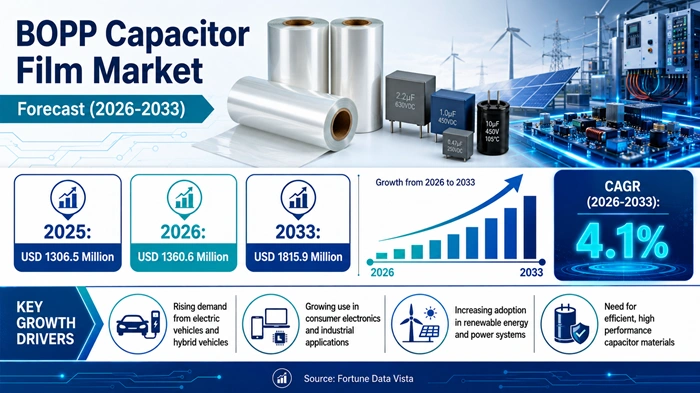
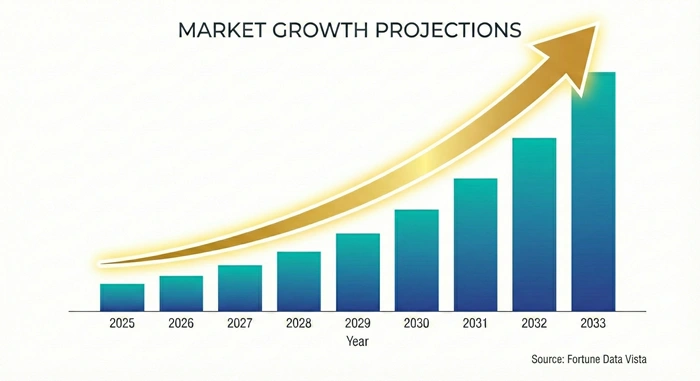
The global BOPP capacitor film market size is valued at USD 1306.5 million in 2025 and is predicted to increase from USD 1360.6 million in 2026 to approximately USD 1815.9 million by 2033, growing at a CAGR of 4.1% from 2026 to 2033.
This consistent growth reflects the critical role that biaxially oriented polypropylene (BOPP) capacitor film plays as the dielectric material of choice in film capacitors used across power electronics, energy storage systems, electric vehicles, renewable energy infrastructure, and consumer electronics. BOPP capacitor film's unique combination of high dielectric strength, low dissipation factor, excellent voltage endurance, wide operating temperature range, and self-healing capability — where the film repairs localized insulation breakdowns automatically — makes it irreplaceable in the capacitor manufacturing industry, and the accelerating electrification of the global economy is generating durable, growing demand for these high-performance polypropylene dielectric films across every major end-use sector.
AI Impact on the BOPP Capacitor Film Industry
Artificial Intelligence Is Enabling Precision Thickness Control, Predictive Manufacturing Quality Management, Advanced Material Performance Simulation, and Supply Chain Optimization Across the Global BOPP Capacitor Film Market*
Artificial intelligence is beginning to transform BOPP capacitor film manufacturing by enabling unprecedented precision in film extrusion and biaxial orientation processes. In modern tenter frame BOPP film production lines operated by manufacturers including Treofan, Toray Plastics, and Cosmo Films, AI-powered process control systems are monitoring hundreds of sensor inputs — including melt temperature, die pressure, stretching ratios, thickness profile, and surface roughness — simultaneously and in real time, making microsecond adjustments to ensure that capacitor-grade BOPP films meet the extremely tight thickness tolerances and surface uniformity specifications demanded by high-performance capacitor manufacturers. These AI-controlled production systems can reliably produce capacitor-grade BOPP films with thickness tolerances of ±0.1 microns or tighter — a level of consistency that manual process control fundamentally cannot match and that directly determines the voltage performance and reliability of the finished film capacitors in their end-use applications.
At the materials research level, AI-driven molecular simulation and polymer property prediction platforms are accelerating the development of next-generation BOPP capacitor film formulations with enhanced dielectric properties. Machine learning models trained on experimental datasets of polypropylene formulation variables and their dielectric output characteristics are enabling researchers at companies including Borealis AG, SABIC, and Mitsui Chemicals to identify optimal propylene copolymer blend compositions, nucleating agent concentrations, and biaxial orientation process parameters that maximize dielectric constant stability across temperature ranges — a critical performance requirement for EV powertrain capacitors and grid-scale energy storage capacitors that operate in thermally demanding environments. AI is also being deployed in BOPP capacitor film quality inspection — with high-resolution machine vision systems analyzing film surface imagery at production speeds of 400 meters per minute to detect pinholes, contamination, and surface defects that would cause dielectric failure in finished capacitors.
Growth Factors
EV and Hybrid Vehicle Powertrain Expansion, Renewable Energy System Deployment, Power Grid Modernization Investment, and Industrial Automation Growth Are the Four Primary Structural Forces Driving Demand for the BOPP Capacitor Film Market*
The most powerful demand driver in the BOPP capacitor film market is the global electrification of transportation — particularly the explosive growth of electric vehicles (EVs) and hybrid electric vehicles (HEVs) — which are intensive users of film capacitors containing BOPP dielectric material. Each battery electric vehicle contains film capacitors in its DC-link inverter, onboard charger, active front end converter, DC-DC converter, and motor drive unit — collectively requiring BOPP capacitor film in quantities several times greater than conventional internal combustion engine vehicles that use film capacitors primarily in radio frequency interference suppression and HVAC applications. The International Energy Agency projects that global EV sales will continue growing strongly through the 2030s, with EV fleets in China, Europe, and North America expanding to hundreds of millions of vehicles — generating a structurally growing demand for film capacitors and the BOPP dielectric film that is their primary insulating material.
The global expansion of renewable energy infrastructure — particularly solar photovoltaic (PV) and wind power generation — is the second major structural driver of BOPP capacitor film market demand. Solar PV inverters, wind turbine converters, grid-scale energy storage battery management systems, and static VAR compensators are all significant film capacitor consumers, and the global renewable energy installation pipeline is adding hundreds of gigawatts of new capacity annually — each megawatt of renewable generation requiring film capacitors with BOPP dielectric film as the primary insulating medium. Power grid modernization programs in North America, Europe, and Asia — including smart grid upgrades, HVDC transmission systems, and flexible AC transmission (FACTS) equipment — are also consuming large volumes of power capacitors using BOPP capacitor film, as utilities invest in grid stability and power quality infrastructure that supports the integration of variable renewable energy sources into national transmission networks.
Market Outlook
China's Dominant BOPP Film Manufacturing Position, Europe's EV and Energy Transition Driving Premium Film Demand, and North America's Power Electronics and Grid Modernization Investment Are Shaping the Long-Term BOPP Capacitor Film Market Trajectory Through 2033*
The long-term outlook for the BOPP capacitor film market is positive and structurally supported by the irreversible global trends of energy transition, electrification of transportation, and digitalization of industrial and consumer systems — all of which depend on electronics and power conversion systems that require film capacitors with BOPP dielectric material. Asia Pacific currently leads the global market, accounting for approximately 56.4% of global production and consumption, anchored by China's position as the world's largest BOPP film manufacturing nation and the largest consumer of film capacitors — driven by the country's massive electronics manufacturing sector, world-leading EV production volumes, and enormous renewable energy installation program. Japan, South Korea, and India are also significant contributors to Asia Pacific market growth, each hosting major capacitor manufacturers and electronics OEMs that consume substantial volumes of capacitor-grade BOPP film from domestic and regional suppliers.
Europe represents the most technically demanding and highest-value regional segment in the BOPP capacitor film market — where German, Italian, and French capacitor manufacturers including WIMA, Vishay (European operations), Epcos (TDK), and Eichhoff Kondensatoren produce premium power film capacitors for industrial drives, railway traction, and EV powertrain applications that require the most precise and highest-performing BOPP dielectric films available. The European automotive sector's accelerating EV production programs — with Volkswagen, Stellantis, BMW, Mercedes-Benz, and Renault all scaling EV manufacturing rapidly — are generating growing procurement of capacitor-grade BOPP film for EV powertrain capacitor manufacturing, creating a sustained high-value demand growth trajectory in the European market through 2033 and beyond.
Expert Speaks
-
"Toray Group is committed to developing and expanding its supply of capacitor-grade BOPP and next-generation polypropylene dielectric films for the global electrification market — recognizing that the transition to electric vehicles, renewable energy, and smart power electronics is creating sustained, growing demand for high-performance dielectric films that meet the most exacting electrical and thermal performance requirements. The BOPP capacitor film market is entering a structurally elevated growth phase, and Toray is investing in both production capacity expansion and material innovation to serve our global capacitor and power electronics customers with the most technically advanced dielectric film solutions available." — Akihiro Nikkaku, Chairman, Toray Industries Inc.
-
"Borealis sees the polypropylene capacitor film segment as one of the most strategically important and fastest-growing application markets for advanced PP homopolymer and copolymer resins. The growth of electric vehicles and renewable energy infrastructure is creating structural demand growth for capacitor film PP grades with the highest dielectric purity, thermal stability, and processability — and Borealis is investing in next-generation resin development specifically engineered for the most demanding capacitor film applications. Our collaboration with leading BOPP film producers globally ensures that our advanced PP capacitor film grades are aligned with the performance requirements that tomorrow's EV and energy transition applications demand." — Thomas Gangl, CEO, Borealis AG
-
"TDK's strategy in the film capacitor business is focused on delivering the highest performance BOPP and polypropylene dielectric film capacitor solutions for our automotive, industrial, and energy customers globally — and the BOPP capacitor film market's growth is a direct reflection of the essential role that film capacitors play in enabling efficient power conversion, energy storage, and motor drive systems across the electrified economy. We are continuously investing in new film winding technology, advanced dielectric film procurement, and application-specific capacitor engineering to ensure that TDK remains the supplier of choice for customers who demand the absolute highest level of capacitor performance and reliability in the most demanding electrical environments." — Noboru Saito, President & CEO, TDK Corporation
Key Report Takeaways
-
Asia Pacific leads the global BOPP capacitor film market with approximately 56.4% of global revenue in 2025, driven by China's dominant position as both the world's largest BOPP film manufacturing nation and the world's largest consumer of film capacitors — supported by a massive domestic electronics manufacturing sector, world-leading EV production volumes, and the largest annual renewable energy installation program globally that collectively generate consistent high-volume demand for capacitor-grade polypropylene dielectric films.
-
Europe is the fastest-growing premium market segment within the BOPP capacitor film market, projected to expand at a CAGR of approximately 4.8% from 2026 to 2033, driven by the continent's accelerating EV manufacturing transition, ambitious renewable energy capacity expansion targets under the European Green Deal, railway electrification programs, and industrial automation investment — all of which drive demand for the highest-specification capacitor-grade BOPP dielectric films that command the highest average selling prices in the global market.
-
Power capacitor applications dominate the BOPP capacitor film market, accounting for approximately 52.3% of global application revenue in 2025, as industrial drives, reactive power compensation systems, AC motor start capacitors, HVDC converter stations, and power factor correction equipment consume the largest volumes of high-dielectric-strength BOPP film across all industrial economies globally — a demand base that is expanding as power infrastructure investment grows.
-
Metalized BOPP capacitor film is the dominant film type, holding approximately 63.8% of global film type revenue in 2025, because the metallization of BOPP film enables the production of self-healing film capacitors — where dielectric breakdown events cause the metal electrode to evaporate locally, isolating the fault and preserving capacitor function — making metalized BOPP capacitor film the standard dielectric material for virtually all commercial film capacitor designs across power electronics, consumer electronics, and energy applications.
-
Automotive and EV is the fastest-growing application segment, expected to grow at a CAGR of approximately 6.2% from 2026 to 2033, driven by the rapid global expansion of EV production that requires intensive film capacitor usage in inverters, onboard chargers, and DC-DC converters — making the automotive and EV segment the most important incremental demand growth source in the BOPP capacitor film market over the entire forecast period.
-
3–6 micron thickness films are the largest and growing thickness segment, accounting for approximately 45.2% of global thickness segment revenue in 2025, as this thickness range represents the optimal balance of dielectric strength, energy density, film processability, and manufacturing yield for the majority of AC and DC power capacitor and consumer electronics capacitor applications — the two largest volume consumption categories in the market.
Market Scope
| Parameter | Details |
|---|---|
| Market Size by 2033 | USD 1815.9 Million | Market Size by 2026 | USD 1360.6 Million | Market Size by 2025 | USD 1306.5 Million | Market Growth Rate from 2026 to 2033 | CAGR of 4.1% | Dominating Region | Asia Pacific | Fastest Growing Region | North America | Segments Covered | By Film Type, By Thickness, By Application, By End User | Regions Covered | North America, Europe, Asia Pacific, Latin America, Middle East & Africa |
Market Dynamics
Drivers Impact Analysis
Global EV Adoption, Renewable Energy Infrastructure Expansion, Power Grid Modernization, Industrial Automation Growth, and Consumer Electronics Demand Are the Five Core Demand Pillars Sustaining Growth in the BOPP Capacitor Film Market*
| Driver | ≈ % Impact on CAGR Forecast | Geographic Relevance | Impact Timeline |
|---|---|---|---|
| EV and hybrid vehicle powertrain capacitor demand growth | ~32% | China, Europe, North America | Short to Long Term |
| Renewable energy (solar, wind) infrastructure expansion | ~26% | Global — especially Asia Pacific, Europe | Short to Long Term |
| Power grid modernization and reactive power compensation investment | ~22% | North America, Europe, Asia Pacific | Short to Long Term |
| Industrial automation and variable frequency drive adoption | ~14% | Asia Pacific, Europe, North America | Short to Long Term |
| Consumer electronics and HVAC market growth | ~6% | Asia Pacific, North America | Short to Medium Term |
The EV-driven demand surge for film capacitors is the most commercially transformative force reshaping the BOPP capacitor film market today. A single battery electric vehicle contains between 200 and 400 film capacitors, depending on the powertrain architecture — in applications including the main inverter DC-link capacitor, onboard AC charger, bidirectional DC-DC converter, and multiple auxiliary power modules. With global EV production growing to tens of millions of vehicles annually through the 2020s, the total volume of BOPP dielectric film required for EV capacitor applications is growing from a minor specialty application into one of the largest single demand categories in the polypropylene film market globally. Chinese EV manufacturers including BYD, CATL's supply chain customers, NIO, and Xpeng, combined with European manufacturers including BMW, Volkswagen, and Stellantis and North American producers including Tesla and General Motors, collectively represent a growing and increasingly critical customer base for BOPP capacitor film suppliers.
The global renewable energy buildout is generating an equally important and structurally permanent demand driver for BOPP capacitor film. Each megawatt of solar PV capacity deployed requires string inverters, central inverters, or microinverters — all of which contain film capacitors as critical components of their power conversion electronics. Wind turbines similarly use film capacitors extensively in their pitch control systems, generator converters, and grid interface inverters. The International Renewable Energy Agency (IRENA) estimates that global renewable energy capacity must triple by 2030 to meet climate targets — implying an enormous acceleration in solar and wind system deployments that will generate sustained growth in film capacitor consumption and BOPP capacitor film demand through the entire 2026–2033 forecast period and beyond.
Restraints Impact Analysis
Raw Material Price Volatility, Competition From Alternative Dielectric Films, Technical Barriers in Ultra-Thin Film Production, and the High Capital Intensity of Tenter Frame BOPP Production Lines Are the Primary Challenges Constraining the BOPP Capacitor Film Market*
| Restraint | ≈ % Impact on CAGR Forecast | Geographic Relevance | Impact Timeline |
|---|---|---|---|
| Polypropylene resin price volatility affecting film manufacturing margins | ~38% | Global — especially Asia Pacific | Short to Long Term |
| Competition from ceramic and electrolytic capacitors in some applications | ~28% | Global | Short to Medium Term |
| Technical challenges in producing sub-2-micron ultra-thin BOPP capacitor films | ~22% | Europe, North America, Japan | Short to Long Term |
| High capital cost of BOPP tenter frame production equipment | ~12% | Emerging markets | Short to Medium Term |
Polypropylene resin price volatility is the most operationally significant restraint in the BOPP capacitor film market, as PP resin typically represents 50–65% of the total manufacturing cost of BOPP capacitor film. Propylene monomer prices are tightly linked to crude oil and naphtha price cycles — creating significant and unpredictable input cost fluctuations that compress film manufacturer margins during periods of resin price escalation and create pricing instability for capacitor manufacturers who are procuring BOPP dielectric film on annual or multi-year supply contracts. The 2021–2022 period of extreme polymer price inflation demonstrated how sharply PP cost surges can impact BOPP capacitor film manufacturer profitability — a risk that smaller and less vertically integrated film producers are particularly exposed to in comparison with larger players who have hedging capabilities or upstream PP resin production.
Competition from multilayer ceramic capacitors (MLCCs) in certain high-frequency and miniaturization-sensitive applications represents a technical restraint on BOPP capacitor film market growth in the consumer electronics segment. MLCCs offer superior volumetric efficiency and can achieve capacitance values and voltage ratings in smaller packages than film capacitors — making them the preferred technology for smartphone, tablet, and wearable electronics design. However, BOPP capacitor film maintains decisive technical advantages in high-power, high-voltage, and high-temperature applications including EV powertrains, renewable energy inverters, and industrial drives — where MLCCs cannot match film capacitors' voltage handling, energy density at high voltages, and self-healing capability — meaning that competition from ceramic capacitors primarily constrains the BOPP capacitor film market in lower-power consumer electronics rather than in the high-growth industrial and EV application segments.
Opportunities Impact Analysis
Ultra-Thin BOPP Capacitor Film Development for EV Powertrains, Emerging Market Capacitor Manufacturing Expansion, and Next-Generation Energy Storage Applications Are Creating High-Value Growth Opportunities*
| Opportunity | ≈ % Impact on CAGR Forecast | Geographic Relevance | Impact Timeline |
|---|---|---|---|
| Ultra-thin high-energy-density BOPP film for EV and energy storage | ~36% | Europe, Japan, North America | Short to Long Term |
| Emerging market capacitor manufacturing expansion in India and Southeast Asia | ~28% | India, Vietnam, Malaysia | Short to Long Term |
| Railway electrification and EV charging infrastructure capacitor demand | ~22% | Global | Short to Long Term |
| Recycled and bio-based polypropylene film development for sustainability | ~14% | Europe, North America | Medium to Long Term |
The development of ultra-thin BOPP capacitor films — with thicknesses below 2 microns and superior dielectric properties — represents the highest-value technical innovation opportunity in the BOPP capacitor film market for the 2026–2033 period. EV powertrain designers and renewable energy inverter engineers are continuously seeking to reduce the size, weight, and cost of film capacitor assemblies while maintaining or improving energy density and electrical performance — a challenge that requires BOPP dielectric films with the lowest possible thickness combined with the highest possible dielectric strength. Japanese manufacturers including Toray and Oji F-Tex and German companies including Treofan have been pioneering sub-2-micron capacitor-grade BOPP film production — and the commercialization of these ultra-thin high-performance films at competitive cost points represents an enormous market opportunity in the EV and renewable energy inverter segments that are the BOPP capacitor film market's highest-growth demand drivers.
India's emergence as a significant capacitor and electronics manufacturing location presents a substantial mid-term market development opportunity for BOPP capacitor film suppliers seeking to diversify their customer base beyond the Chinese-dominated Asian market. Indian government initiatives including the Production Linked Incentive (PLI) scheme for electronics manufacturing, the National Electronics Policy, and Make in India manufacturing promotion programs are attracting domestic and foreign investment in electronics component manufacturing — including film capacitor production — that will generate growing domestic demand for capacitor-grade BOPP film. Southeast Asian countries including Vietnam, Malaysia, and Thailand are similarly emerging as alternative electronics manufacturing locations as global OEMs diversify their supply chains beyond China — creating new regional demand nodes for BOPP capacitor film that will become increasingly commercially significant through the 2026–2033 forecast period.
Segment Analysis
By Film Type: Metalized BOPP Capacitor Film
Metalized BOPP Capacitor Film Commands the Dominant Market Position Due to Its Self-Healing Capability, Superior Energy Density, and Universal Adoption Across Power Electronics, EV, and Renewable Energy Capacitor Designs*
Metalized BOPP capacitor film holds the dominant position in the BOPP capacitor film market by film type, accounting for approximately 63.8% of global film type revenue in 2025 and growing at a CAGR of approximately 4.3% from 2026 to 2033. The fundamental commercial advantage of metalized BOPP film over non-metalized alternatives is the self-healing capability it enables in finished film capacitors — a property that arises because the aluminum or zinc metallization layer on the BOPP film surface is extremely thin (typically 20–40 nanometers), allowing localized dielectric breakdown events to vaporize the metal electrode at the fault site, preventing the fault from propagating and preserving overall capacitor function. This self-healing mechanism dramatically improves the reliability and operational lifetime of film capacitors used in power electronics applications where voltage spikes, switching transients, and partial discharge events are routine occurrences. Asia Pacific leads the metalized BOPP capacitor film segment, driven by China's dominant capacitor manufacturing industry that produces the majority of the world's self-healing film capacitors for AC motor run, PFC, and general-purpose power electronics applications — with leading Chinese manufacturers including Anhui Tongfeng Electronics, Nantong Jianghai Capacitor, and Guilin Power Capacitor consuming the largest volumes of metalized BOPP dielectric film.
Europe is the highest-value regional market for premium metalized BOPP capacitor film — where German, Italian, and French film capacitor manufacturers including WIMA GmbH, Eichhoff Kondensatoren, and Icar SpA produce the most demanding and highest-specification metalized film capacitor designs for automotive, railway, and industrial power electronics applications that require the most stringent dielectric film performance characteristics. Japanese manufacturers including Nichicon, Panasonic, and Murata Manufacturing produce premium metalized film capacitors for automotive and consumer electronics applications using ultra-thin metalized BOPP dielectric films that represent the highest-performance and highest-cost tier of the market. The metalized BOPP capacitor film segment benefits from continuous innovation in metallization density profile engineering — where varying the metal electrode thickness across the film surface (using "heavy edge" or "fishbone" metallization patterns) optimizes self-healing performance and allows manufacturers to fine-tune the current handling capacity and energy density of finished capacitors for specific application requirements.
By Application: Power Capacitors
Power Capacitors Are the Dominant Application Consuming the Largest Volume of BOPP Capacitor Film Globally, Driven by Industrial Motor Drives, Power Factor Correction, HVDC Transmission Systems, and Grid Infrastructure Investment*
Power capacitors hold the dominant position in the BOPP capacitor film market by application, accounting for approximately 52.3% of global application revenue in 2025 and growing at a CAGR of approximately 3.9% from 2026 to 2033. Power film capacitors — including AC power capacitors for power factor correction, DC link capacitors for industrial drives and converters, and high-voltage capacitors for HVDC and reactive power compensation equipment — represent the single largest volume consumption category for capacitor-grade BOPP dielectric film globally. The industrial power electronics sector is a continuous, high-volume consumer of film capacitors as variable frequency drives (VFDs) for industrial motor control, welding power supplies, induction heating systems, UPS systems, and switchgear operate continuously and replace film capacitors on maintenance cycles — generating a steady aftermarket demand flow that supplements the larger new-equipment installation demand. Asia Pacific dominates the power capacitor application segment, accounting for approximately 58.2% of global segment revenue in 2025, driven by China's enormous manufacturing industrial base with its vast installed base of AC motor-driven equipment consuming power factor correction capacitors, combined with China's world-leading HVDC transmission infrastructure buildout.
North America is an important and stable market for power capacitors using BOPP capacitor film, where utility-scale reactive power compensation, power factor correction in commercial buildings and industrial facilities, and the growing adoption of VFDs for industrial energy efficiency are steady demand contributors. European demand for power capacitors is being incrementally augmented by the region's ambitious offshore wind energy buildout — with massive HVDC interconnection cables and offshore wind substation reactive power equipment representing a high-value, high-voltage power capacitor demand segment that uses the most advanced BOPP dielectric film grades available. Leading power capacitor manufacturers including ABB (now Hitachi Energy), Vishay Intertechnology, Eaton, and Electronicon Kondensatoren are the primary end customers for capacitor-grade BOPP film in the power application segment — purchasing from BOPP film suppliers including Treofan, Toray, and Cosmo Films on long-term supply agreements that provide stable demand visibility for film producers.
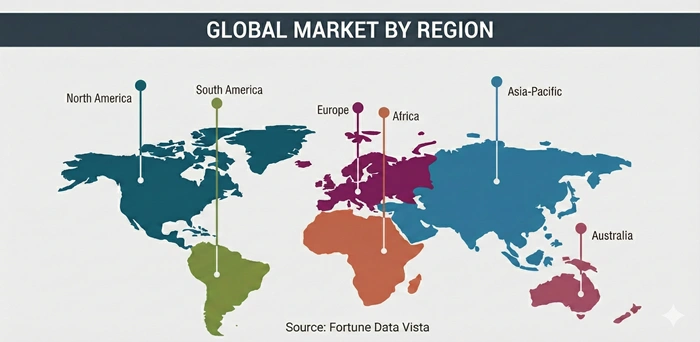
Regional Insights
Asia Pacific: The Global Leader in the BOPP Capacitor Film Market
Asia Pacific Dominates the Global BOPP Capacitor Film Market Through China's World-Leading Film Manufacturing Infrastructure, the Largest Capacitor Manufacturing Industry Globally, and the World's Fastest-Growing EV and Renewable Energy Markets*
Asia Pacific holds the dominant position in the global BOPP capacitor film market, accounting for approximately 56.4% of global revenue in 2025 and expected to maintain a CAGR of approximately 4.2% through 2033. China is the undisputed core of the Asia Pacific market — operating as both the world's largest manufacturer of BOPP capacitor film and the world's largest consumer, with domestic BOPP film producers including Ningbo Exciton Technology, Anhui Tongfeng, and Cosmo Specialty Chemicals serving a domestic capacitor manufacturing industry that produces tens of billions of film capacitors annually. Japan and South Korea are the region's highest-technology market participants — with Japanese companies including Toray, Oji F-Tex, and Panasonic manufacturing the world's most advanced ultra-thin BOPP dielectric films for automotive and premium electronics capacitor applications, and South Korean chaebols including Samsung Electro-Mechanics and LG Innotek consuming film capacitor components for their massive consumer electronics and automotive electronics production programs.
India is the most strategically important emerging growth market in Asia Pacific for BOPP capacitor film, as the country's expanding electronics manufacturing sector, growing EV production industry, and ambitious solar PV installation programs are collectively generating accelerating demand for film capacitors and the BOPP dielectric material from which they are produced. The government of India's PLI scheme for electronics components manufacturing is creating incentives for both domestic and international film capacitor manufacturers to establish or expand Indian production facilities — investments that will require local BOPP capacitor film sourcing and will drive either domestic film production expansion or import demand growth from established Asian producers. Southeast Asian markets including Vietnam, Malaysia, and Thailand are also growing meaningful capacitor manufacturing bases as electronics OEMs diversify manufacturing away from exclusive China dependence — representing new demand nodes in the Asia Pacific BOPP capacitor film market that will grow in commercial significance through 2033.
Europe: The Fastest-Growing Premium Market for BOPP Capacitor Film
Europe Is the Fastest-Growing Regional Market for Premium BOPP Capacitor Film, Powered by Accelerating EV Manufacturing Transition, Ambitious Renewable Energy Buildout, and the World's Most Technically Demanding Capacitor Manufacturers*
Europe is the fastest-growing regional market in the global BOPP capacitor film market in terms of value growth, projected to expand at a CAGR of approximately 4.8% from 2026 to 2033, the highest CAGR of any major global region. Europe accounts for approximately 21.6% of global BOPP capacitor film market revenue in 2025 — and this share is expected to grow as the region's energy transition accelerates procurement of high-performance film capacitors for EV powertrains, offshore and onshore wind power systems, solar inverters, and smart grid infrastructure. Germany leads European market demand, as the country's world-leading automotive industry — including BMW, Mercedes-Benz, Volkswagen, and Bosch Automotive — transitions to EV production at scale and as Germany's domestic capacitor manufacturers including WIMA and Epcos (TDK) produce the most sophisticated power film capacitors globally for industrial and automotive applications that demand the highest-specification BOPP dielectric films.
Italy, France, and Sweden are also significant European consumers of capacitor-grade BOPP film — with Italian manufacturers including Icar SpA and Ducati Energia, French manufacturers, and Swedish Epcos operations producing power capacitors for railway traction, industrial drives, and wind power applications across the European market. Treofan Germany — one of Europe's leading BOPP capacitor film producers — supplies the European capacitor manufacturing industry with premium domestic film, while also competing against imports from Japanese and Chinese manufacturers in the price-sensitive standard film grade segments. The European BOPP capacitor film market is characterized by the highest average selling prices globally — because European capacitor manufacturers require the most demanding technical specifications including the tightest thickness tolerances, the highest dielectric breakdown voltage ratings, and the most rigorous quality certification standards of any regional market. This premium quality requirement profile supports European film producers in maintaining price leadership and differentiating against lower-cost Asian competition in the most technically demanding product segments.
Top Key Players
-
Toray Plastics (America) Inc. (United States / Japan)
-
Treofan GmbH & Co. KG (Germany)
-
Cosmo Films Ltd. (India)
-
Bolloré Group (Bolloré Thin Papers) (France)
-
Oji F-Tex Co. Ltd. (Japan)
-
Anhui Tongfeng Electronics Co. Ltd. (China)
-
Ningbo Exciton Technology Co. Ltd. (China)
-
Jindal Poly Films Ltd. (India)
-
Brückner Group GmbH (Germany)
-
Gettel Group (China)
-
Braskem S.A. (Brazil)
-
Borealis AG (Austria)
Recent Developments
-
In March 2026, Toray Industries announced a JPY 18 billion investment in expanding its capacitor-grade BOPP and biaxially oriented polypropylene dielectric film production capacity at its Mishima manufacturing complex in Japan — increasing annual output of ultra-thin BOPP capacitor films by 25% to meet surging demand from EV powertrain capacitor manufacturers in Japan and Europe who are scaling up production for the next generation of electric vehicle inverter capacitor assemblies.
-
In January 2026, Cosmo Films Ltd. completed the commissioning of a new tenter frame BOPP production line in Waluj, India, capable of producing capacitor-grade BOPP film at specifications meeting IEC standard requirements for power film capacitors — expanding Cosmo Films' entry into the technically demanding BOPP capacitor film market segment and positioning the company to serve growing domestic Indian demand from electronics and renewable energy capacitor manufacturers.
-
In November 2025, Treofan GmbH secured a five-year supply agreement with a major European automotive tier-1 supplier for the provision of ultra-thin BOPP dielectric film for EV powertrain film capacitor applications — with the supply agreement covering Treofan's proprietary high-dielectric-strength capacitor film grade engineered specifically for the thermal and electrical performance requirements of silicon carbide (SiC)-based EV inverter capacitor designs.
-
In September 2025, Anhui Tongfeng Electronics — China's largest film capacitor manufacturer — announced a vertical integration investment to establish an in-house BOPP capacitor film production facility, reducing the company's dependency on external BOPP film suppliers and securing dielectric film supply chain resilience for its growing EV capacitor business serving Chinese and international automotive customers.
-
In February 2026, Ningbo Exciton Technology established a technical collaboration with a leading European polypropylene resin producer to co-develop a new generation of ultra-high-purity PP resin grade specifically optimized for sub-2-micron BOPP capacitor film production — targeting the EV inverter and high-frequency power electronics capacitor market segments where ultra-thin dielectric film with the lowest possible impurity levels is critical for maximizing dielectric breakdown strength and long-term capacitor operational reliability.
Market Trends
The Shift Toward Ultra-Thin High-Energy-Density BOPP Capacitor Film and the Growing Adoption of Silicon Carbide Power Semiconductors Creating New Dielectric Performance Requirements Are the Two Dominant Trends Reshaping the Market*
The most important technical and commercial trend reshaping the BOPP capacitor film market is the accelerating demand for ultra-thin dielectric film grades — with film thicknesses below 2 microns and ultimately approaching 1 micron — driven by EV powertrain engineers and renewable energy inverter designers who require film capacitor assemblies with maximized energy density in minimized volume and weight envelopes. Standard BOPP capacitor films used in conventional power electronics applications are typically 3–6 microns thick — but the thermal and volumetric constraints of EV inverter packaging are driving capacitor manufacturers to demand dielectric films at 1.5–2.0 micron thicknesses with maintained or improved dielectric breakdown voltage performance. This ultra-thin film development trend is creating a technical differentiation opportunity for advanced BOPP film producers including Toray, Treofan, and Oji F-Tex who can manufacture at sub-2-micron thicknesses with the process control required to maintain dielectric quality — while creating a barrier to participation for manufacturers whose tenter frame equipment and process control capabilities are optimized for standard capacitor film thickness ranges.
The rapid adoption of silicon carbide (SiC) power MOSFETs in EV inverters and renewable energy converters is the second major technology trend driving technical evolution in the BOPP capacitor film market. SiC-based power electronics switch at much higher frequencies (50–200 kHz) and operating temperatures (up to 175°C junction temperature) than silicon IGBT-based systems — creating significantly more demanding electrical stress environments for DC-link film capacitors that require BOPP dielectric films with lower dissipation factor at high frequencies, better capacitance stability over temperature, and higher partial discharge inception voltage than standard capacitor film grades. These elevated performance requirements from SiC-based power electronics are driving capacitor film manufacturers and their resin suppliers to develop new BOPP film grades with improved high-frequency dielectric characteristics — representing both a technology development investment requirement and a significant market differentiation opportunity for producers who can deliver SiC-compatible dielectric film performance to the growing EV and renewable energy power electronics market.
Segments Covered in the Report
-
By Film Type:
-
Rough Surface BOPP Capacitor Film
-
Smooth Surface BOPP Capacitor Film
-
Metalized BOPP Capacitor Film
-
Non-Metalized BOPP Capacitor Film
-
-
By Thickness:
-
Below 3 Microns
-
3–6 Microns
-
6–9 Microns
-
Above 9 Microns
-
-
By Application:
-
Power Capacitors
-
AC Power Capacitors
-
DC Power Capacitors
-
Pulse Capacitors
-
-
Electronics Capacitors
-
Consumer Electronics Capacitors
-
Industrial Electronics Capacitors
-
-
Energy Storage Systems
-
Grid-Scale Energy Storage
-
Renewable Energy Systems
-
-
Automotive & Electric Vehicles
-
EV Powertrain Capacitors
-
ADAS Capacitors
-
-
Railway Traction Capacitors
-
HVAC Systems
-
Other Applications
-
-
By End User:
-
Electrical & Electronics Manufacturers
-
Automotive OEMs & EV Manufacturers
-
Renewable Energy System Manufacturers
-
Industrial Machinery Manufacturers
-
Aerospace & Defense
-
Railway & Transportation Manufacturers
-
-
By Region:
-
North America (U.S., Canada, Mexico)
-
Europe (Germany, France, Italy, UK, Rest of Europe)
-
Asia Pacific (China, India, Japan, South Korea, Rest of Asia Pacific)
-
Latin America (Brazil, Argentina, Rest of Latin America)
-
Middle East & Africa (UAE, Saudi Arabia, Rest of MEA)
-
"Built for Every Level — From Startups to Industry Giants"
Here Is Exactly How This Report Works for You
-
For Tier 1 global BOPP film producers, polypropylene resin manufacturers, major capacitor manufacturers, Fortune 500 electronics OEMs, automotive tier-1 suppliers, and institutional investors, this report delivers comprehensive competitor revenue analysis by segment and geography, detailed assessment of how geopolitical factors — including China's dominant position in BOPP film manufacturing and capacitor production, U.S.-China trade policy implications for BOPP film supply chains, EU carbon border adjustment mechanism impacts on European film manufacturing cost structures, and Indo-Pacific supply chain diversification strategies — are reshaping competitive positioning and capital allocation in the BOPP capacitor film market, equipping executives with the intelligence needed to make informed decisions on capacity investment, geographic expansion, M&A strategy, and technology development priorities.
-
For Tier 2 and Tier 3 BOPP film convertors, specialty film distributors, film capacitor contract manufacturers, regional electronics distributors, and mid-market industrial supply chain companies, this report provides detailed supply-demand balance forecasts by film type and thickness, end-user procurement volume trends by application and geography, and pricing dynamic analysis across standard and premium film grade segments — revealing precisely where the most commercially accessible market entry opportunities exist in the global BOPP capacitor film market for companies looking to expand their product portfolios, geographic reach, or customer industry diversification.
-
For startups developing novel dielectric film materials, bio-based polymer film ventures, AI-driven film manufacturing technology companies, clean energy transition investors, and new entrants to the BOPP capacitor film value chain, this report delivers actionable intelligence on the technology development roadmap driving dielectric film innovation for EV and energy transition applications, competitive white space analysis identifying underserved film specification categories and emerging geographic markets, and detailed profiling of the revenue models, competitive strengths, and investment strategies of the leading BOPP capacitor film producers globally — providing the market intelligence foundation needed to build differentiated strategies in one of specialty films' most dynamically growing application segments.
Frequently Asked Questions:
Answer: The global BOPP capacitor film market is valued at USD 1306.5 million in 2025 and is projected to reach USD 1815.9 million by 2033. The market is growing at a CAGR of 4.1% from 2026 to 2033, driven by rising demand for film capacitors in EV powertrains, renewable energy inverters, and industrial power electronics applications.
Answer: The BOPP capacitor film market is primarily driven by the global electrification of transportation — with EV powertrain capacitors creating surging demand — and the rapid expansion of renewable energy infrastructure, where solar and wind inverters require large volumes of film capacitors. Power grid modernization, industrial automation adoption of variable frequency drives, and growing consumer electronics production are additional structural growth contributors.
Answer: Asia Pacific dominates the BOPP capacitor film market with approximately 56.4% of global revenue in 2025, anchored by China's position as both the world's largest BOPP film producer and the world's largest capacitor manufacturer. Japan and South Korea contribute premium technical capabilities, while India is emerging as the fastest-growing individual country market within the region.
Answer: The primary applications for BOPP capacitor film include power capacitors (power factor correction, AC motor run, HVDC), automotive and EV powertrain capacitors, electronics capacitors for consumer and industrial devices, railway traction capacitors, and energy storage system capacitors for renewable energy applications. Power capacitors represent the largest volume segment, while automotive and EV is the fastest-growing application.
Answer: The main types of BOPP capacitor film include metalized and non-metalized variants, as well as rough-surface and smooth-surface films differentiated by their surface topography for winding process compatibility. Metalized BOPP capacitor film is the most widely used type — commanding approximately 63.8% of global film type revenue in 2025 — because its thin metal electrode layer enables the self-healing capability that makes it the standard choice for virtually all commercial film capacitor designs.