
Carboxymethyl Cellulose Market Overview
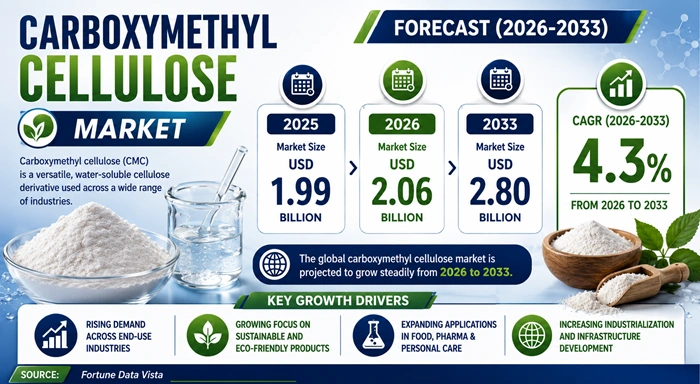
The global carboxymethyl cellulose market size is valued at USD 1.99 billion in 2025 and is predicted to increase from USD 2.06 billion in 2026 to approximately USD 2.80 billion by 2033, growing at a CAGR of 4.3% from 2026 to 2033.
CMC — also known as cellulose gum — is a water-soluble, biodegradable polymer widely used as a thickener, stabilizer, binder, and film-forming agent across a broad range of industries. Its versatility, safety profile, and compatibility with food, pharmaceutical, and industrial applications make it one of the most demanded cellulose derivatives worldwide. As industries continue shifting toward sustainable, functional ingredients, the carboxymethyl cellulose market is well-positioned for steady, consistent expansion over the coming years.
AI Impact on the Carboxymethyl Cellulose Industry
AI-driven process innovation and smart manufacturing are quietly reshaping how CMC is produced, tested, and delivered across global supply chains
Artificial intelligence is making a real difference in how carboxymethyl cellulose is manufactured and quality-checked. AI-powered systems are now being used to monitor viscosity levels, detect impurities, and maintain consistent product grades in real time — tasks that previously required intensive human oversight. This level of precision is especially valuable for pharmaceutical-grade and battery-grade CMC, where even small deviations in purity can lead to significant performance issues. As manufacturers invest more in smart factory systems, AI integration is becoming a competitive differentiator within the carboxymethyl cellulose market.
Beyond manufacturing, AI is being applied to demand forecasting and supply chain optimization. Predictive analytics help CMC suppliers better anticipate regional demand surges — for example, in the food processing or oilfield drilling sectors — and adjust production schedules accordingly. Machine learning tools are also helping companies optimize raw material sourcing by tracking cellulose price trends and supplier reliability. These capabilities reduce waste, improve delivery timelines, and lower operational costs, all of which contribute directly to the long-term growth and resilience of the market.
Growth Factors
A convergence of functional food trends, pharmaceutical innovation, and industrial demand is driving the carboxymethyl cellulose market toward sustained multi-year growth
The carboxymethyl cellulose market is benefiting significantly from the rapid growth of processed and convenience food industries. Consumers increasingly prefer ready-to-eat and low-fat food products, and CMC plays a key role in achieving the right texture, moisture retention, and shelf stability in these products. Gluten-free food formulations, in particular, depend heavily on CMC as a texture substitute. Alongside food, the pharmaceutical industry is a major growth engine, with CMC being widely used in drug delivery systems, tablet binders, and controlled-release formulations. The global expansion of generic drug manufacturing in emerging economies is further amplifying demand.
Industrial applications also continue to play a strong role in driving growth. The oil and gas sector relies on CMC-based drilling fluids to control viscosity and reduce fluid loss in wellbores, especially in offshore and deep drilling operations. In paper manufacturing, carboxymethyl cellulose improves surface sizing and enhances print quality. Emerging areas such as battery manufacturing — where CMC serves as a binder in lithium-ion battery electrodes — and biodegradable packaging are opening entirely new growth avenues. These expanding end-use segments ensure that demand for CMC remains broad-based and not overly dependent on any single industry.
Market Outlook
Steady CAGR growth, rising application diversity, and a clear tilt toward sustainability make the CMC market one of the more resilient specialty chemical segments heading into 2033
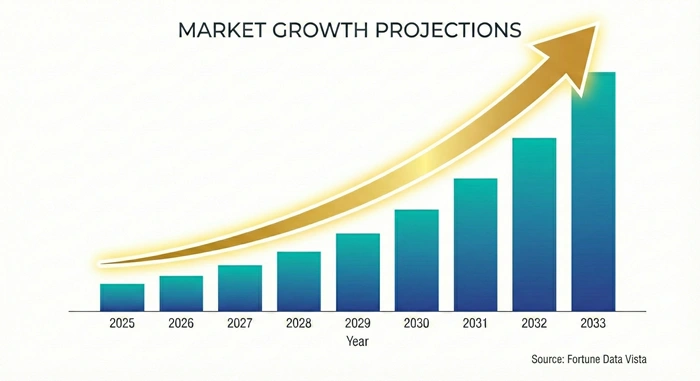
The medium-term outlook for the carboxymethyl cellulose market remains constructive. With a CAGR of 4.3% projected through 2033, the market is expected to add approximately USD 0.74 billion in incremental value from its 2026 base. Asia Pacific will continue to be the dominant force, driven by strong industrialization, a growing middle class, and the expansion of food processing and pharmaceutical manufacturing across China, India, and Southeast Asia. Meanwhile, Middle East & Africa is expected to grow at the fastest pace regionally, supported by rising consumer spending and increasing oilfield activity.
From a product perspective, higher-purity grades of CMC — including food, pharmaceutical, and battery grades — are gaining market share at the expense of lower-grade technical variants. This premiumization trend reflects a broader shift across end-use industries toward higher performance materials that can meet stricter regulatory and quality requirements. Companies investing in R&D to develop specialty CMC formulations for advanced applications like 3D bioprinting, water treatment, and energy storage are well-positioned to capture above-average growth in the coming years.
Expert Speaks
-
"Consumers want cleaner, more functional ingredients in everything they eat — from beverages to baked goods. Ingredients like carboxymethyl cellulose that can serve dual roles as a stabilizer and a texture modifier will remain critical to how the food industry delivers on those expectations at scale." — CEO perspective, global food ingredients sector
-
"In pharmaceuticals, excipient quality and consistency can make or break a formulation. We continue to see increasing reliance on cellulose derivatives across our drug delivery platforms, and that demand is only going to intensify as generics expand globally." — CEO perspective, multinational pharmaceutical company
-
"The energy transition is creating new material demands across our entire supply chain. CMC's role as a binder in battery electrodes is one of those quiet but important contributions that rarely makes headlines but is essential to our manufacturing process." — CEO perspective, battery and energy storage company
Key Report Takeaways
-
Asia Pacific leads the global carboxymethyl cellulose market, accounting for approximately 39.5% of total market share in 2025, driven by rapid industrialization, a large food processing base, and growing pharmaceutical manufacturing in China and India.
-
Middle East & Africa is the fastest-growing regional market, projected to expand at a CAGR of 5.7% through the forecast period, supported by urbanization, expanding oilfield operations, and increasing consumer demand for processed food and personal care products.
-
The food & beverage segment is the largest application contributor, valued at approximately USD 700 million in 2025 and holding a market share of around 37.5%, driven by CMC's role as a thickener and stabilizer in processed foods, dairy products, and beverages.
-
The thickening agent function segment dominates the functional category, valued at USD 740 million in 2025, reflecting consistent demand from food, pharmaceutical, and personal care sectors where product viscosity and consistency are paramount.
-
The powder form segment is the most popular product format, contributing approximately USD 1.3 billion in 2025 due to ease of storage, transport, and integration into dry blend manufacturing processes across industrial and consumer industries.
-
Battery-grade CMC is the fastest-emerging future segment, aligned with the global growth in lithium-ion battery production and electric vehicles; this niche is expected to grow rapidly through 2033, driven by the energy transition and increasing EV adoption rates.
-
Direct sales (B2B industrial) dominate the distribution channel, holding approximately 69.7% market share in 2025 — reflecting the highly industrial and volume-driven nature of CMC procurement in oilfield, construction, and battery manufacturing sectors.
Market Scope
| Parameter | Details |
|---|---|
| Market Size by 2033 | USD 2.80 Billion | Market Size by 2026 | USD 2.06 Billion | Market Size by 2025 | USD 1.99 Billion | Market Growth Rate from 2026 to 2033 | CAGR of 4.3% | Dominating Region | Asia Pacific | Fastest Growing Region | Middle East & Africa | Segments Covered | Grade, Application, Function, Form, Distribution Channel | Regions Covered | North America, Europe, Asia Pacific, Latin America, Middle East & Africa |
Market Dynamics
Drivers Impact Analysis
Growing demand from food, pharmaceutical, and industrial end-uses is creating multi-layered growth pressure that is structurally elevating the carboxymethyl cellulose market's long-term trajectory
| Driver | ≈ % Impact on CAGR Forecast | Geographic Relevance | Impact Timeline |
|---|---|---|---|
| Rising demand in food & beverages as a stabilizer and thickener | ~35% | Global, especially Asia Pacific & North America | Short to Long Term |
| Expanding applications in pharmaceutical drug formulation | ~25% | North America, Europe, Asia Pacific | Medium to Long Term |
| Increasing use in oil & gas drilling fluids | ~20% | Middle East & Africa, North America | Short to Medium Term |
| Growing CMC use in battery/energy storage electrodes | ~12% | Asia Pacific, North America | Medium to Long Term |
| Demand for biodegradable and sustainable packaging | ~8% | Europe, North America | Medium to Long Term |
The most significant driver for the carboxymethyl cellulose market is the unstoppable growth in processed and convenience food consumption across both developed and emerging economies. Urbanization is accelerating the shift away from home-cooked meals, and food manufacturers are increasingly relying on functional additives like CMC to maintain product quality at scale. From low-fat dairy spreads to gluten-free baked goods and flavored beverages, cellulose gum helps stabilize emulsions, retain moisture, and extend shelf life — making it effectively irreplaceable in modern food formulation. This demand is especially strong in Asia Pacific, where changing dietary habits and a booming packaged food industry are creating a sustained pull for CMC across multiple product categories.
The pharmaceutical industry represents the second major pillar of growth. As global generics production expands — particularly in India, China, and parts of Eastern Europe — the need for reliable, high-purity excipients like CMC is rising in lockstep. CMC acts as a critical binder, stabilizer, and controlled-release agent in tablet and capsule formulations. Its ability to swell in contact with water makes it particularly valuable in modified-release drug delivery systems. Regulatory agencies in major markets continue to approve CMC's use in a wide range of pharmaceutical applications, which reinforces its position as a trusted and versatile excipient well into the 2033 forecast horizon.
Restraints Impact Analysis
Raw material volatility and regulatory complexity are creating headwinds that could constrain the pace of growth in the carboxymethyl cellulose market, particularly for smaller regional players
| Restraint | ≈ % Impact on CAGR Forecast | Geographic Relevance | Impact Timeline |
|---|---|---|---|
| Raw material (cellulose) price volatility | ~45% | Global | Short to Medium Term |
| Stringent regulatory standards across regions | ~30% | North America, Europe | Medium Term |
| Competition from substitute materials | ~25% | Asia Pacific, Europe | Medium to Long Term |
The primary restraint affecting the carboxymethyl cellulose market is the price and supply instability of raw materials — particularly wood pulp and cotton linters, from which cellulose is derived. Global deforestation concerns, seasonal disruptions, and energy price fluctuations in chemical processing all contribute to erratic production costs. These cost pressures tend to squeeze profit margins, especially for mid-tier producers who lack the scale to absorb input cost shocks. When cellulose prices spike unexpectedly, CMC manufacturers face the difficult choice of passing on costs to customers or accepting lower margins.
Regulatory barriers represent a secondary but important constraint, particularly in food and pharmaceutical-grade CMC. Compliance with varying international standards — including FDA requirements in the U.S., EFSA guidelines in Europe, and local food safety mandates in Asia — adds significant costs and lead times for companies operating across multiple markets. Substitute materials such as guar gum, xanthan gum, and hydroxypropyl cellulose also pose competitive challenges, as they can perform similarly in several overlapping applications, creating pricing pressure and limiting CMC's ability to command a premium in less-specialized markets.
Opportunities Impact Analysis
Emerging frontiers in energy storage, sustainable packaging, and water treatment are unlocking new application categories that could meaningfully diversify and expand the carboxymethyl cellulose market
| Opportunity | ≈ % Impact on CAGR Forecast | Geographic Relevance | Impact Timeline |
|---|---|---|---|
| CMC as electrode binder in lithium-ion batteries | ~35% | Asia Pacific, North America | Medium to Long Term |
| Biodegradable packaging and eco-friendly materials | ~28% | Europe, North America | Medium Term |
| Water treatment and environmental remediation | ~22% | Middle East & Africa, Asia Pacific | Medium to Long Term |
| 3D printing and biomedical applications | ~15% | North America, Europe | Long Term |
The electric vehicle revolution is creating one of the most exciting emerging opportunities for the carboxymethyl cellulose market. CMC is increasingly used as a water-based binder in lithium-ion battery electrode manufacturing, replacing solvent-based binders that are more toxic and expensive. As global EV production accelerates — driven by government mandates and falling battery costs — demand for battery-grade CMC is expected to grow significantly through 2033. Major battery manufacturers in China, South Korea, and the U.S. are already sourcing specialty CMC for this purpose, and this trend is still in its relatively early stages.
Sustainability is a second major opportunity horizon. As global regulations tighten around single-use plastics and microplastic content in personal care products, CMC-based alternatives are gaining attention. CMC's biodegradability, non-toxicity, and renewable origin make it an attractive ingredient in eco-friendly formulations. The personal care industry, in particular, is under pressure to remove synthetic thickeners and stabilizers, and CMC is well-positioned to fill that gap. Additionally, its potential in water treatment applications — where CMC-based materials can help in the removal of heavy metals and organic contaminants — opens a largely untapped market that could deliver meaningful growth beyond 2026.
Segment Analysis
By Application: Food & Beverage
Processed food expansion and clean-label ingredient trends are making the food & beverage application the cornerstone of sustained CMC demand growth across global markets
The food & beverage application segment is the single largest contributor to the carboxymethyl cellulose market, holding approximately 37.5% of the global market share in 2025 and valued at around USD 700 million. This segment is expected to grow at a CAGR of 4.4% through 2033, supported by the surging demand for processed and packaged foods globally. CMC's ability to improve texture, enhance mouthfeel, control water migration, and extend shelf life makes it practically indispensable in dairy products, bakery goods, beverages, and sauces. Asia Pacific is the dominant growth region for this segment, as rapid urbanization and a fast-growing middle class are driving massive consumption of convenience foods in China, India, and Southeast Asia. Leading companies serving this segment include Ashland Inc., Nouryon, and Nippon Paper Industries, all of which have strengthened their food-grade CMC portfolios in recent years.
The trend toward healthier and functional foods is another key tailwind for this segment. As consumers seek out gluten-free, low-fat, and clean-label products, food manufacturers are relying more on plant-derived, safe-to-use functional ingredients — a category where CMC fits naturally. In North America and Europe, where label transparency has become a major consumer concern, food-grade cellulose gum is increasingly preferred over synthetic stabilizers. The emergence of plant-based meat and dairy alternatives is also generating new demand, as CMC helps provide the texture and binding properties that these products require to mimic their conventional counterparts. As global food innovation continues at pace, this segment is expected to remain the backbone of overall market growth through 2033.
By Grade: Extra Purified/Food/Pharmaceutical Grade
Purity-driven demand from regulated industries is accelerating the shift toward higher-grade CMC, establishing the extra purified segment as a high-value, high-growth pillar of the market
The extra purified/food/pharmaceutical grade segment generated approximately USD 570 million in revenue in 2025 and is projected to expand at a CAGR of around 5.1% through 2033 — one of the fastest growth rates among all grade categories. This grade is used in applications where strict purity and safety standards are non-negotiable, including pharmaceutical tablet formulations, sterile drug suspensions, specialty food additives, and high-purity personal care ingredients. North America and Europe lead the adoption of this grade, owing to their well-developed pharmaceutical industries and demanding regulatory frameworks enforced by agencies such as the FDA and EMA. Companies like Ashland Inc. and Nouryon are among the top suppliers of pharmaceutical-grade CMC in these regions, leveraging their deep technical expertise and established regulatory compliance records.
The growth of this segment is being further supported by the global expansion of chronic disease management and the increasing complexity of drug formulations. Conditions such as diabetes, cardiovascular disease, and cancer require sophisticated drug delivery systems — including extended-release tablets and oral suspensions — where carboxymethyl cellulose serves as a critical excipient. Simultaneously, the food industry's appetite for this grade is growing, especially in functional foods, protein supplements, and high-precision beverage formulations. The premium pricing of extra purified CMC grades also means this segment contributes disproportionately to revenue relative to its volume, making it strategically important for producers seeking to improve their profitability and product mix over the forecast period.
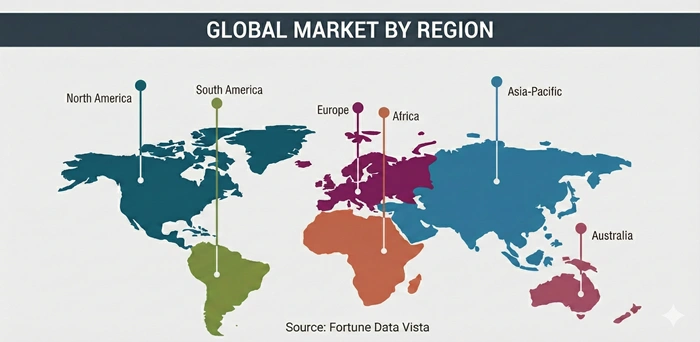
Regional Insights
Asia Pacific
Asia Pacific's industrial scale, growing consumer class, and food & pharma expansion combine to make it the undisputed epicenter of global CMC market activity
Asia Pacific is the dominant region in the carboxymethyl cellulose market, accounting for approximately 39.5% of global market share in 2025. The region benefits from an exceptionally strong industrial base, enormous food processing capacity, and rapidly growing pharmaceutical manufacturing ecosystems — all of which are major consumers of CMC. China, India, Japan, and South Korea collectively drive the bulk of regional demand, with China alone representing the fastest-growing individual country in the region due to its massive battery manufacturing sector, booming convenience food industry, and increasing investment in pharmaceutical-grade specialty chemicals. Top players with significant presence in Asia Pacific include Nippon Paper Industries (Japan), DKS Co. Ltd. (Japan), and several Chinese producers like Qingdao Sinocmc Chemical, Shandong Head Group, and Hubei Jiahua Cellulose, which serve both domestic and export markets.
India is also emerging as a key growth market within the region, driven by its expanding pharmaceutical generics industry, growing processed food sector, and increasing personal care manufacturing activity. The Indian CMC market benefits from relatively low-cost production, strong domestic cellulose raw material access, and rising export demand from Middle Eastern and African markets. Regional CAGR for Asia Pacific is estimated at approximately 4.8% for the 2026–2033 period, and this is likely to accelerate further as battery-grade CMC demand grows alongside India and China's EV manufacturing ambitions.
Middle East & Africa
Oilfield activity, urbanization, and expanding industrial sectors are positioning Middle East & Africa as the fastest-growing CMC market in the world through 2033
Middle East & Africa is the fastest-growing regional market for carboxymethyl cellulose, expected to expand at a CAGR of approximately 5.7% from 2026 to 2033. The region's growth is primarily driven by booming oilfield and gas exploration activities — where CMC is widely used in drilling fluid formulations — as well as by rapid urbanization and the expansion of packaged food and personal care manufacturing in Gulf Cooperation Council (GCC) countries. Saudi Arabia is the leading growth country in the region, backed by government-driven industrial diversification efforts under Vision 2030, growing food processing investments, and a significant oilfield services sector. Key players active in this region include Nouryon (Netherlands) and Ashland Inc. (U.S.), both of which supply technical and specialty CMC grades to meet the growing industrial and consumer demand across the region.
Africa, while a smaller contributor currently, is gaining momentum thanks to increasing food security investments, rising middle-class consumption, and growing personal care product manufacturing in countries like South Africa and Nigeria. The Middle East & Africa region currently holds an estimated market share of around 6–8% globally, but this share is expected to grow meaningfully as infrastructure investments mature and local manufacturing capacity expands. The combination of oilfield-driven industrial demand and consumer-sector growth makes this the most dynamic regional story in the carboxymethyl cellulose market for the 2026 to 2033 forecast period.
Report Customization Available
Tailor Your CMC Market Insights: Region-Specific and Country-Level Customization for Targeted Business Decisions
Our carboxymethyl cellulose market report is available with full customization options to suit your specific geographic focus, whether you need country-level granularity or a comprehensive regional overview. Each customized version includes detailed market analysis, demand trends, competitive landscapes, regulatory environments, investment insights, and growth opportunities tailored specifically to your chosen region or country.
The following regions and countries are available for fully customized carboxymethyl cellulose market reports:
North America
-
United States – Detailed insights on pharmaceutical-grade CMC demand, processed food industry trends, battery manufacturing growth, and key company market share
-
Canada – Analysis of food & beverage applications, oilfield CMC usage, and sustainability-driven demand for biodegradable ingredients
-
Mexico – Coverage of industrial-grade CMC demand, manufacturing sector growth, and import-export dynamics
Europe
-
United Kingdom – Focus on pharmaceutical and personal care CMC applications, regulatory environment, and post-Brexit trade impacts
-
Germany – Analysis of industrial CMC demand, specialty grade production, and battery/energy storage segment growth
-
France – Insights into food-grade CMC adoption, cosmetics & personal care sector demand, and regulatory compliance landscape
-
Italy – Coverage of construction, textile, and food & beverage CMC applications with key regional player profiling
-
Rest of Europe – Aggregated regional analysis covering Spain, Netherlands, Belgium, and Eastern European markets
Asia Pacific
-
China – In-depth analysis of battery-grade CMC, food processing demand, major local producers, and export activity
-
India – Pharmaceutical generics market impact, personal care growth, and emerging food stabilizer demand
-
Japan – High-purity grade CMC trends, technology innovation, and key manufacturer profiles including Nippon Paper and DKS
-
South Korea – Battery manufacturing sector growth, food & beverage trends, and specialty CMC demand
-
Australia – Food & beverage applications, mining sector demand, and regulatory market overview
-
Rest of Asia Pacific – Insights across Southeast Asian nations including Indonesia, Thailand, Vietnam, and the Philippines
Latin America
-
Brazil – Detailed analysis on food & beverage segment growth, personal care CMC demand, and industrial applications
-
Argentina – Coverage of agricultural and food industry CMC use, market dynamics, and competitive landscape
-
Rest of Latin America – Overview of CMC market trends in Chile, Colombia, Peru, and other developing markets
Middle East & Africa
-
UAE – Focus on oilfield applications, food processing sector, and retail expansion driving personal care demand
-
Saudi Arabia – Industrial diversification, Vision 2030 impact, oilfield CMC demand, and market growth analysis
-
Rest of MEA – Comprehensive regional insights covering South Africa, Nigeria, Egypt, Kuwait, and emerging African markets
Top Key Players
-
Ashland Global Holdings (United States)
-
Nouryon (Netherlands)
-
DKS Co. Ltd. (Japan)
-
Nippon Paper Industries Co., Ltd. (Japan)
-
Lamberti S.p.A. (Italy)
-
Daicel Corporation (Japan)
-
CP Kelco U.S., Inc. (United States)
-
Akzo Nobel N.V. (Netherlands)
-
Dow Inc. (United States)
-
J.M. Huber Corporation (United States)
-
Qingdao Sinocmc Chemical Co., Ltd. (China)
-
Shandong Head Group Co., Ltd. (China)
-
Hubei Jiahua Cellulose Co., Ltd. (China)
-
Zibo Hailan Chemical Co., Ltd. (China)
-
Pioma Chemicals (India)
Recent Developments
-
In 2025, Daicel Corporation launched BELLOCEA BS7, a new biodegradable cellulose particle designed to replace microplastic beads in cosmetic formulations. This development positions Daicel at the forefront of sustainable cellulose ingredient innovation, responding directly to global regulatory pressure on microplastics in personal care products.
-
In 2025, Lamberti USA completed the acquisition of the Covestro manufacturing facility in East Providence, Rhode Island, expanding its U.S. industrial footprint and strengthening regional production and distribution capabilities for specialty cellulose ingredients.
-
In 2024, Nouryon finalized the integration of J.M. Huber Corporation's CMC business, which had been acquired in 2022. This integration broadened Nouryon's CMC product portfolio significantly, reinforcing its global leadership in food, industrial, and personal care CMC grades.
-
In 2025, Ashland Inc. continued to expand its pharmaceutical-grade CMC production infrastructure, responding to growing demand from drug manufacturers in North America and Europe for high-purity excipients aligned with increasingly strict pharmacopoeial standards.
-
In 2024–2025, Qingdao Sinocmc Chemical Co., Ltd. increased its production capacity for battery-grade CMC to meet surging demand from Chinese lithium-ion battery manufacturers, as EV adoption in China continued to accelerate at a record pace.
Market Trends
Bio-based material preferences, the energy transition, and industrial diversification are collectively reshaping the carboxymethyl cellulose market's competitive landscape and driving innovation across every grade and application category
One of the most transformative trends in the carboxymethyl cellulose market is the industry's strong move toward sustainability and bio-based ingredients. Manufacturers across food, personal care, and pharmaceutical sectors are under increasing pressure from consumers and regulators alike to replace synthetic additives with natural, biodegradable alternatives. CMC — derived from plant cellulose — is ideally positioned to benefit from this shift. Producers are investing in greener manufacturing processes, reducing chemical waste in production, and developing new eco-certified grades that meet the expectations of environmentally conscious brands and their end consumers. This trend is particularly visible in Europe and North America, where ESG (Environmental, Social, and Governance) criteria are increasingly influencing procurement decisions.
The second major trend reshaping the market is the rapid expansion of CMC into high-tech industrial applications, most notably in the battery manufacturing and 3D bioprinting sectors. As the global transition to electric vehicles gains momentum, battery-grade CMC is emerging as a commercially significant product segment that was virtually non-existent a decade ago. Simultaneously, research institutions and biotech companies are exploring CMC-based hydrogels and scaffolds for tissue engineering and drug delivery applications. These are long-term growth horizons that are beginning to attract meaningful capital investment and R&D activity, signaling that the future of the carboxymethyl cellulose market extends well beyond its traditional strongholds in food and pharma.
Segments Covered in the Report
-
By Grade
-
Technical/Industrial Grade
-
Semi-Purified Grade
-
Purified Grade
-
Extra Purified/Food/Pharmaceutical Grade
-
Battery Grade
-
-
By Application
-
Food & Beverage
-
Pharmaceuticals
-
Personal Care & Cosmetics
-
Oil & Gas
-
Pulp & Paper
-
Detergents & Laundry
-
Battery/Energy Storage
-
Textile
-
3D Printing & Biomedical
-
Mining & Minerals
-
Others (Construction, Paints, Adhesives, Ceramics)
-
-
By Function
-
Thickening Agent
-
Stabilizer
-
Binder
-
Film-Former
-
Water Retention Agent
-
Suspending Agent
-
-
By Form
-
Powder
-
Granular
-
Liquid/Solution
-
Flake
-
-
By Distribution Channel
-
Direct Sales (B2B Industrial)
-
Indirect Sales (Distributor/Retail)
-
-
By Region
-
North America (U.S., Canada, Mexico)
-
Europe (U.K., Germany, France, Italy, Rest of Europe)
-
Asia Pacific (China, India, Japan, South Korea, Australia, Rest of Asia Pacific)
-
Latin America (Brazil, Argentina, Rest of Latin America)
-
Middle East & Africa (UAE, Saudi Arabia, Rest of MEA)
-
❝ Built for Every Level — From Startups to Industry Giants ❞
Here Is Exactly How This Report Works for You
-
For Tier 1 enterprises, investors, and high-level strategic decision-makers: This report delivers a full competitor revenue analysis — including revenue sources, product segment breakdown, and geographic revenue distribution — so you can benchmark your own performance against market leaders like Ashland and Nouryon. It also covers how geopolitical factors such as trade tariffs, raw material export restrictions, and regional policy shifts are affecting CMC supply chains, and guides you on how to turn those disruptions into competitive advantages.
-
For Tier 2 and Tier 3 companies, and mid-level businesses: The report gives you a clear picture of the demand-supply imbalance across all five regions, showing you exactly where capacity shortfalls exist and where new entrants have the most room to grow. You'll gain actionable insight into which CMC grade or application segment is underserved in your target geography, helping you make sharper go-to-market and product expansion decisions.
-
For startups and emerging companies: This report maps the fastest-growing niches — including battery-grade CMC, biodegradable packaging, and water treatment — with data on which regions are most investment-friendly and which market segments are still relatively uncrowded. Paired with insights on funding trends and new partnerships, this gives you the strategic foundation to enter the market with confidence and grow efficiently.
Frequently Asked Questions:
Answer: The global carboxymethyl cellulose market is valued at USD 1.99 billion in 2025 and is expected to reach USD 2.80 billion by 2033. It is projected to grow at a CAGR of 4.3% from 2026 to 2033, driven by expanding demand across food, pharmaceutical, and industrial sectors.
Answer: Asia Pacific dominates the carboxymethyl cellulose market, holding approximately 39.5% of global share in 2025, driven by China, India, and Japan. Middle East & Africa is the fastest-growing region, expanding at a CAGR of around 5.7%, supported by oilfield activity and industrial growth.
Answer: The carboxymethyl cellulose market is primarily driven by food & beverage applications, which account for roughly 37.5% of total demand as a thickener and stabilizer. Pharmaceuticals, personal care, oil & gas, and the emerging battery/energy storage segment are also significant and growing application areas.
Answer: Key players in the carboxymethyl cellulose market include Ashland Inc., Nouryon, DKS Co. Ltd., Nippon Paper Industries, and Lamberti S.p.A., which collectively held approximately 35.2% of the global market share in 2025. Ashland leads among these, holding over 8.8% individual market share.
Answer: The primary challenges facing the carboxymethyl cellulose market include raw material price volatility and stringent regulatory requirements across regions. Major opportunities lie in battery-grade CMC for lithium-ion batteries, biodegradable packaging formulations, and emerging applications in water treatment and 3D bioprinting.