
Cerebral Angiography Market Overview
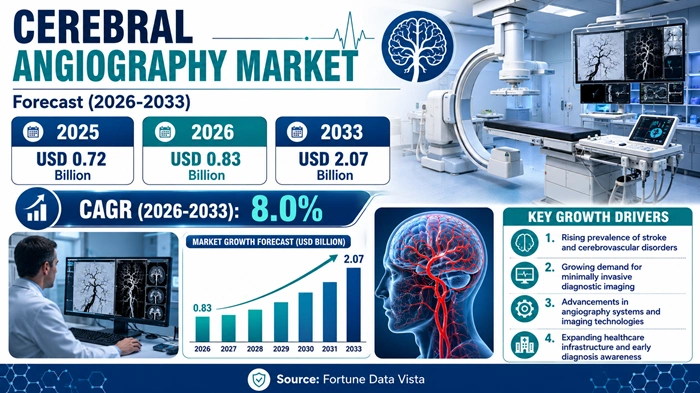
The global cerebral angiography market size is valued at USD 0.72 billion in 2025 and is predicted to increase from USD 0.83 billion in 2026 to approximately USD 2.07 billion by 2033, growing at a CAGR of 8.0% from 2026 to 2033.
This steady growth is driven by the rising global incidence of cerebrovascular diseases including stroke, brain aneurysms, and arteriovenous malformations (AVMs), combined with rapid technological advances in digital subtraction angiography (DSA) systems, growing adoption of non-invasive cerebral vascular imaging modalities like CT angiography and MR angiography, and expanding healthcare infrastructure in emerging markets. Cerebral angiography remains the clinical gold standard for detailed visualization of intracranial blood vessels, and its role in guiding endovascular interventions is becoming increasingly central as minimally invasive neurovascular treatment options expand.
AI Impact on the Cerebral Angiography Industry
Artificial Intelligence Is Transforming Cerebrovascular Image Analysis, Lesion Detection Accuracy, and Interventional Planning Workflows Across the Entire Cerebral Angiography Market*
Artificial intelligence is becoming one of the most transformative forces in the cerebral angiography market, fundamentally improving how cerebrovascular images are acquired, analyzed, and translated into clinical decisions. AI-powered image reconstruction algorithms are now deployed in leading DSA, CTA, and MRA platforms to reduce radiation dose, suppress image noise, and enhance vessel wall visualization — enabling diagnostic-quality cerebral angiograms at significantly lower contrast media doses and X-ray exposure levels. Deep learning models trained on large cerebrovascular imaging datasets are achieving near-radiologist accuracy in detecting intracranial aneurysms, vessel stenosis, and AVM nidus boundaries — lesions that can be subtle and easily overlooked during manual review, particularly in high-volume imaging centers where time pressure and reader fatigue are real clinical challenges.
Beyond diagnostic image analysis, AI is reshaping procedural planning and intraoperative guidance in endovascular cerebral interventions. Pre-procedural AI-assisted 3D vessel modeling from CTA or DSA datasets allows neurointerventionalists to simulate catheter navigation paths, predict flow dynamics within aneurysm domes, and optimize coil packing strategies or stent placement sequences — reducing procedural time, contrast usage, and complication risk. Real-time AI guidance during DSA-guided endovascular procedures is an active development frontier, where augmented fluoroscopy platforms overlay AI-generated anatomical annotations directly onto live imaging feeds, improving procedural confidence for both experienced and developing operators. These capabilities are progressively distinguishing AI-enabled cerebral angiography systems from conventional platforms and are becoming important procurement criteria for advanced neurovascular intervention programs.
Growth Factors
Rising Stroke and Cerebrovascular Disease Burden, Growing Endovascular Neurovascular Intervention Volumes, and Continuous Advances in Digital Subtraction Angiography Technology Are the Core Structural Drivers of Growth in the Cerebral Angiography Market*
The most powerful growth driver in the cerebral angiography market is the alarming and sustained rise in global cerebrovascular disease burden. Stroke is the second leading cause of death and the third leading cause of disability worldwide, with approximately 15 million new stroke cases reported annually. Brain aneurysms — estimated to affect 3–5% of the global population — and arteriovenous malformations represent additional high-priority diagnostic categories where accurate cerebrovascular imaging is essential for clinical management decisions. As hypertension, diabetes, obesity, and aging population demographics — all established risk factors for cerebrovascular disease — continue to increase globally, the clinical need for detailed, actionable intracranial vascular imaging is growing consistently across all major healthcare markets. The World Stroke Organization projects that the lifetime stroke risk for individuals over 25 years of age now exceeds 25%, creating a massive and durable demand base for advanced cerebral vascular imaging services.
The rapid expansion of minimally invasive endovascular neurovascular treatment — including mechanical thrombectomy for acute ischemic stroke, flow diverter and coil embolization for cerebral aneurysms, and radiosurgery planning for AVMs — is the second major structural growth driver. Each of these interventional procedures requires high-quality DSA imaging for both procedural guidance and outcome assessment, directly driving demand for advanced flat-panel detector angiography systems equipped with high-frame-rate fluoroscopy, 3D rotational angiography, and cone-beam CT capabilities. The growing acceptance of mechanical thrombectomy as the standard of care for large vessel occlusion stroke — supported by multiple landmark trials including MR CLEAN, SWIFT PRIME, and DAWN — has created a step-change increase in DSA suite utilization at comprehensive stroke centers globally, directly driving capital equipment demand for the cerebral angiography market.
Market Outlook
Integration of Non-Invasive Modalities, Expansion of Comprehensive Stroke Centers, and Healthcare Infrastructure Growth in Asia Pacific and MEA Are Positioning the Cerebral Angiography Market for Consistent Long-Term Growth Through 2033*
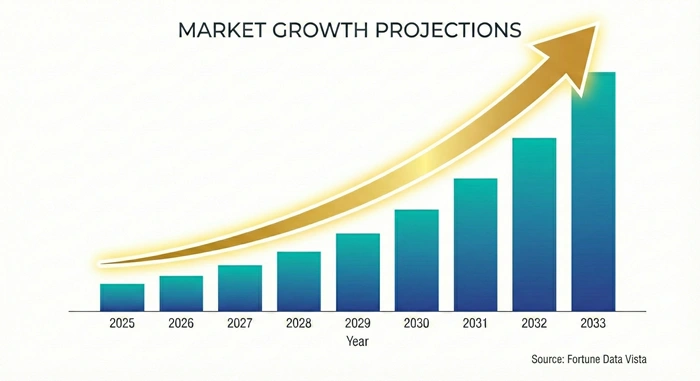
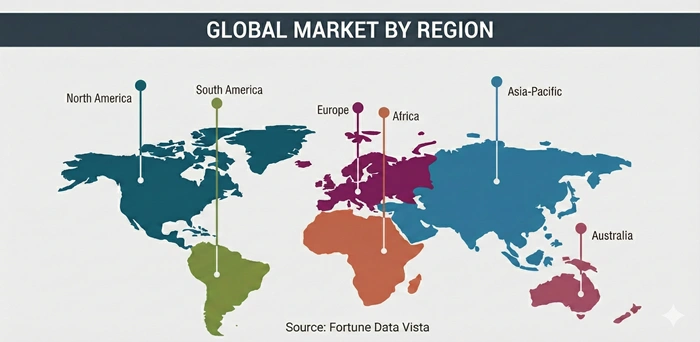
The long-term outlook for the cerebral angiography market is consistently positive, anchored by durable clinical need, ongoing procedural expansion, and meaningful technological differentiation among leading system manufacturers. North America currently leads the global market, supported by a dense network of comprehensive stroke centers, Joint Commission-certified Primary and Comprehensive Stroke Centers, and high procedure volumes driven by both diagnostic workup and endovascular intervention. Europe is the second-largest market, where regulatory frameworks mandating structured stroke systems of care and national stroke action plans are driving investment in advanced angiography infrastructure. Asia Pacific is the fastest-growing region, where a combination of rapidly aging populations, escalating cardiovascular and cerebrovascular disease burden, and significant government investment in hospital infrastructure is creating expanding demand for cerebral vascular imaging capabilities.
The progressive shift toward non-invasive cerebrovascular imaging — particularly CTA and MRA — is reshaping the product mix within the cerebral angiography market, as these modalities increasingly replace conventional catheter-based diagnostic angiography in lower-risk patients while driving demand for advanced imaging workstations with AI-assisted vessel analysis tools. However, invasive DSA retains a non-negotiable role in interventional procedures and in cases where definitive anatomical detail is required — ensuring that the angiography systems segment remains a high-value component of the market through 2033. Manufacturers who invest in hybrid DSA-CBCT platforms, AI-integrated image analysis, radiation dose management technology, and clinical decision support tools will be best positioned to capture premium market opportunities and long-term institutional procurement relationships.
Expert Speaks
-
"Siemens Healthineers is committed to advancing the science of cerebrovascular imaging to support better outcomes for stroke and brain vascular disease patients worldwide. Our Artis portfolio of angiography systems — combining advanced flat-panel detector technology, cone-beam CT, and AI-powered image analysis — reflects our deep investment in providing neurointerventionalists with the tools they need to perform complex endovascular procedures with maximum precision, speed, and safety." — Bernd Montag, CEO, Siemens Healthineers AG
-
"At Philips, we recognize that cerebral angiography is at the intersection of diagnostic imaging and life-saving intervention — and that the quality of the imaging directly determines the quality of the clinical outcome. Our Azurion platform and AI-powered vessel analysis tools are designed to give neurointerventionalists the clearest possible picture of the cerebral vasculature in the fastest possible time, and we are continuously investing in innovation to maintain our leadership in this critical clinical domain." — Roy Jakobs, CEO, Koninklijke Philips N.V.
-
"GE HealthCare's strategic focus on advanced imaging technologies includes a strong commitment to the cerebral and neurovascular imaging segment, where clinical complexity and the stakes of accurate diagnosis are among the highest in medicine. We are investing in next-generation flat-panel angiography platforms, AI-assisted cerebrovascular analysis, and hybrid imaging systems that enable our clinical partners to deliver the highest standard of care for stroke, aneurysm, and AVM patients across all types of healthcare settings." — Peter Arduini, President & CEO, GE HealthCare
Key Report Takeaways
-
North America leads the global cerebral angiography market with approximately 40.2% of global revenue share in 2026, supported by the world's most extensive network of certified comprehensive stroke centers, high per-capita endovascular neurovascular intervention volumes, favorable reimbursement policies for advanced cerebrovascular imaging, and the commercial headquarters of leading system manufacturers including GE HealthCare, Medtronic, and Siemens Healthineers' North American operations.
-
Asia Pacific is the fastest-growing regional market, projected to expand at a CAGR of approximately 10.2% from 2026 to 2033, driven by rapidly aging populations with rising cerebrovascular disease prevalence in China, India, Japan, and South Korea, significant government investment in tertiary hospital neurology infrastructure, and growing adoption of endovascular stroke treatment protocols in regional comprehensive stroke centers.
-
Hospitals and neurology centers are the dominant end-user segment, accounting for approximately 58.3% of global cerebral angiography market revenue in 2025, reflecting the concentration of both diagnostic and interventional cerebral angiography procedures in acute care hospital settings equipped with dedicated neuroangiography suites and neurovascular intervention teams.
-
Digital Subtraction Angiography (DSA) remains the dominant type segment, holding approximately 43.8% of global market share in 2025, as it continues to serve as the definitive gold standard for intracranial vessel imaging and the essential guidance modality for all endovascular cerebrovascular interventions including thrombectomy, coil embolization, flow diversion, and stent-assisted angioplasty.
-
CT Angiography (CTA) is the fastest-growing type segment, projected to expand at a CAGR of approximately 9.6% from 2026 to 2033, driven by its widespread availability in emergency settings, rapid acquisition speed critical in acute stroke triage, improving spatial resolution, and its role as the primary first-line imaging tool for cerebrovascular disease diagnosis and treatment planning in both inpatient and outpatient settings globally.
-
The Stroke and TIA Diagnosis application segment holds the largest revenue share, contributing approximately 46.7% of global application revenue in 2025, reflecting the high clinical urgency and procedural volume associated with acute ischemic and hemorrhagic stroke diagnosis and the essential role of cerebral angiography in guiding time-critical endovascular treatment decisions.
-
Non-Invasive Cerebral Angiography is the fastest-growing modality segment, expected to grow at a CAGR of approximately 10.1% from 2026 to 2033, driven by increasing clinical preference for radiation-free MRA and faster-access CTA over conventional catheter angiography for diagnostic workup — while invasive DSA maintains its essential role in all procedural and interventional contexts.
Market Scope
| Parameter | Details |
|---|---|
| Market Size by 2033 | USD 2.07 Billion | Market Size by 2026 | USD 0.83 Billion | Market Size by 2025 | USD 0.72 Billion | Market Growth Rate from 2026 to 2033 | CAGR of 8.0% | Dominating Region | North America | Fastest Growing Region | Asia Pacific | Segments Covered | By Type, By Product, By Application, By End User, By Modality | Regions Covered | North America, Europe, Asia Pacific, Latin America, Middle East & Africa |
Market Dynamics
Drivers Impact Analysis
Global Cerebrovascular Disease Burden, Endovascular Intervention Adoption, and Comprehensive Stroke Center Expansion Are the Three Structural Forces Sustaining Demand Growth in the Cerebral Angiography Market*
| Driver | ≈ % Impact on CAGR Forecast | Geographic Relevance | Impact Timeline |
|---|---|---|---|
| Rising global stroke and cerebrovascular disease incidence | ~34% | Global — especially Asia Pacific, North America | Short to Long Term |
| Growth of endovascular neurovascular intervention volumes | ~28% | North America, Europe, Asia Pacific | Short to Long Term |
| Comprehensive stroke center infrastructure expansion | ~20% | Global | Short to Medium Term |
| CTA and MRA technology improvements driving non-invasive adoption | ~12% | Global | Short to Medium Term |
| AI and image analysis integration into angiography platforms | ~6% | North America, Europe, Asia Pacific | Medium to Long Term |
The most foundational driver sustaining growth in the cerebral angiography market is the global escalation of cerebrovascular disease incidence. The convergence of aging demographics, sedentary lifestyles, high hypertension prevalence, and rising rates of diabetes and atrial fibrillation is creating an expanding global population at elevated risk for stroke, intracranial aneurysm rupture, and other cerebrovascular events. Each acute cerebrovascular episode requiring emergency or elective neurological assessment creates a direct demand for cerebral vascular imaging — whether through acute CTA perfusion studies, diagnostic DSA, or follow-up MRA. This underlying disease burden creates a durable and growing imaging volume base that is fundamentally insulated from economic cyclicality and discretionary healthcare spending fluctuations, making the cerebral angiography market one of the more structurally resilient segments within medical imaging.
The progressive establishment of comprehensive stroke systems of care globally — anchored by certified comprehensive stroke centers equipped with 24/7 neuroangiography suites — is translating the rising cerebrovascular disease burden into increased DSA and interventional imaging procedure volumes. Mechanical thrombectomy for large vessel occlusion stroke has been adopted as standard of care across North America, Europe, and increasingly Asia Pacific, requiring high-quality DSA imaging with real-time fluoroscopic guidance. The growing clinical evidence base supporting flow diverter and intrasaccular device treatment for complex and wide-neck cerebral aneurysms is also driving DSA procedure volumes, as these techniques require precise angiographic visualization and post-procedural imaging assessment that CTA alone cannot reliably provide.
Restraints Impact Analysis
High Equipment Procurement Costs, Radiation and Contrast Media Risk Concerns, Shortage of Trained Neurointerventionalists, and Limited Infrastructure in Low-Income Markets Are the Key Constraints on Faster Market Expansion*
| Restraint | ≈ % Impact on CAGR Forecast | Geographic Relevance | Impact Timeline |
|---|---|---|---|
| High capital cost of advanced DSA angiography systems | ~38% | Emerging markets, smaller hospitals | Short to Long Term |
| Radiation exposure and contrast media safety concerns | ~28% | Global | Short to Medium Term |
| Shortage of trained neurointerventionalists | ~20% | Emerging markets, rural settings | Short to Long Term |
| Reimbursement variability across healthcare systems | ~14% | Latin America, MEA, parts of Asia Pacific | Short to Medium Term |
The high capital investment required for advanced flat-panel digital subtraction angiography systems — the core equipment of any neuroangiography suite — represents the most significant barrier limiting market penetration, particularly in middle- and low-income countries and among smaller regional hospitals. State-of-the-art biplane DSA systems equipped with cone-beam CT, 3D rotational angiography, and AI-integrated analysis software from manufacturers such as Siemens Healthineers, Philips, and GE HealthCare typically carry price tags in the range of USD 1.5 million to USD 3.5 million per installed system, exclusive of suite construction, radiation protection infrastructure, and ancillary equipment costs. This cost level effectively limits neuroangiography infrastructure investment to well-resourced tertiary and academic medical centers, creating significant geographic disparities in access to cerebral angiography services.
Radiation exposure and contrast media toxicity concerns represent a second meaningful restraint, particularly in the context of diagnostic imaging pathways where non-invasive alternatives are increasingly available. Patient awareness of radiation risks and the growing availability of high-quality CTA and MRA alternatives for diagnostic assessment of stable cerebrovascular conditions is diverting some procedure volume away from conventional catheter angiography. Iodinated contrast nephrotoxicity remains a clinical concern in patients with pre-existing renal impairment — a common comorbidity in the aging stroke-risk population — requiring careful patient selection and protocol management. These concerns are gradually shifting the diagnostic mix within the cerebral angiography market toward lower-risk non-invasive modalities for elective applications, while preserving invasive DSA's essential role in interventional and emergency settings.
Opportunities Impact Analysis
Emerging Market Healthcare Infrastructure Investment, Hybrid Angiography Suite Adoption, Non-Invasive Modality Growth, and AI-Powered Cerebrovascular Analysis Are Creating High-Value Long-Term Growth Opportunities*
| Opportunity | ≈ % Impact on CAGR Forecast | Geographic Relevance | Impact Timeline |
|---|---|---|---|
| Emerging market neuroangiography infrastructure investment | ~36% | Asia Pacific, Latin America, MEA | Short to Long Term |
| Hybrid DSA-CT/MRI suite development for comprehensive neurovascular care | ~27% | North America, Europe | Medium to Long Term |
| AI-powered cerebrovascular image analysis and decision support | ~22% | Global | Short to Long Term |
| Expansion of endovascular aneurysm and AVM treatment programs | ~15% | Global | Short to Medium Term |
The most immediately significant growth opportunity in the cerebral angiography market lies in the rapid expansion of neurovascular care infrastructure in emerging healthcare markets — particularly China, India, Brazil, Saudi Arabia, and Southeast Asian nations. Government-funded hospital construction programs, universal health coverage initiatives, and growing middle-class expectations for tertiary medical care are creating a fast-growing installed base of hospitals seeking to establish or upgrade neurological imaging and intervention capabilities. China's "Healthy China 2030" initiative, India's Ayushman Bharat health insurance expansion, and Gulf Cooperation Council countries' Vision 2030 healthcare modernization programs are all generating substantial capital allocation for advanced diagnostic imaging infrastructure — directly creating demand for DSA systems, CT angiography platforms, and supporting clinical consumables in the cerebral angiography market.
Hybrid neuroangiography suite designs — combining flat-panel DSA capabilities with integrated CT or MRI imaging in a single procedure room — represent a transformative technological opportunity for comprehensive stroke and neurovascular intervention programs. These hybrid systems eliminate the need to transport critically ill stroke patients between imaging suites during complex endovascular procedures, enabling seamless integration of pre-procedural vessel mapping, intraoperative fluoroscopic guidance, and immediate post-procedural perfusion assessment in a single setting. While currently installed only at elite academic medical centers due to their extraordinary capital cost, declining hardware costs and growing clinical validation of hybrid suite workflows are expected to drive meaningful adoption growth in high-volume stroke intervention programs throughout the forecast period.
Segment Analysis
By Type: Digital Subtraction Angiography (DSA)
DSA Remains the Unchallenged Gold Standard and Largest Revenue Segment in the Cerebral Angiography Market, Serving as the Essential Imaging Platform for All Endovascular Cerebrovascular Interventions Globally*
Digital Subtraction Angiography (DSA) holds the dominant position in the cerebral angiography market by type, accounting for approximately 43.8% of global revenue in 2025 and maintaining its leadership position throughout the forecast period. DSA's dominance is grounded in its clinical irreplaceability — it provides spatial resolution and temporal imaging capabilities that no non-invasive modality can currently match for intracranial vessel assessment during active procedures. It remains the mandatory imaging platform for mechanical thrombectomy guidance, cerebral aneurysm coil embolization, flow diverter deployment, carotid artery stenting, and AVM embolization — a constellation of high-growth endovascular procedures that collectively generate a growing and stable demand base for DSA suite utilization. North America holds the largest DSA segment revenue share, approximately 41.5% of global DSA market revenue, driven by the density of Joint Commission-certified comprehensive stroke centers and the high volume of complex neuroendovascular procedures performed at academic and tertiary medical centers. Leading DSA system manufacturers active in North America include Siemens Healthineers (Artis series), Koninklijke Philips (Azurion platform), GE HealthCare (Innova series), and Shimadzu Corporation.
Europe represents the second-largest DSA market, where advanced neurovascular intervention programs at academic hospitals in Germany, France, the UK, Netherlands, and Switzerland drive consistent capital equipment demand and high system utilization rates. Asia Pacific is the fastest-growing DSA market, expanding at a CAGR of approximately 10.6% from 2026 to 2033, as comprehensive stroke center designations multiply across China and India and as regional healthcare authorities invest in upgrading legacy fluoroscopy systems with modern flat-panel DSA platforms. The DSA segment is projected to grow at a CAGR of 7.8% from 2026 to 2033 globally, with the transition from single-plane to biplane configurations — enabling simultaneous bi-orthogonal vessel visualization for complex intracranial navigation — and the integration of cone-beam CT capability driving both new installations and installed base upgrade cycles throughout the forecast period.
By Application: Stroke and TIA Diagnosis
Stroke and TIA Diagnosis Is the Largest and Most Urgently Growing Application Driving the Cerebral Angiography Market, Reflecting the Global Stroke Epidemic and the Time-Critical Nature of Cerebrovascular Emergency Imaging*
The stroke and transient ischemic attack (TIA) diagnosis application segment holds the commanding lead in the cerebral angiography market, contributing approximately 46.7% of global application revenue in 2025. This dominance is driven by the extraordinary clinical urgency of acute stroke diagnosis — the "time is brain" paradigm, in which every minute of treatment delay costs approximately 1.9 million neurons — which mandates immediate, high-quality cerebrovascular imaging for every suspected stroke patient. CTA with perfusion mapping is the cornerstone of acute stroke imaging protocols at comprehensive stroke centers, identifying the extent of salvageable penumbral tissue and determining eligibility for endovascular thrombectomy. DSA then serves as the definitive procedural guide for thrombectomy execution and post-treatment vessel patency assessment. The segment is growing at a CAGR of approximately 8.4% from 2026 to 2033, with growth driven by increasing endovascular stroke treatment volumes, expanding window criteria for thrombectomy based on tissue-based selection, and growing stroke center designation activity globally. Leading companies serving this application segment include Siemens Healthineers, Philips, GE HealthCare, Canon Medical Systems, and Medtronic — whose neurovascular devices are used in conjunction with DSA guidance.
Asia Pacific is the fastest-growing regional market for stroke-related cerebral angiography, expanding at a CAGR of approximately 11.3% from 2026 to 2033, driven by the catastrophic stroke burden in China — which accounts for approximately 40% of global stroke mortality — and India, where stroke incidence among working-age adults is disproportionately high compared to global averages. China's national stroke initiative — including the National Stroke Prevention and Control Program and the Chinese Stroke Center Alliance — is systematically driving adoption of evidence-based stroke imaging protocols including CTA perfusion and interventional DSA across a rapidly expanding network of designated stroke centers. Japan and South Korea maintain the most sophisticated stroke imaging ecosystems in Asia Pacific, with advanced CBCT-integrated DSA systems deployed at major academic stroke centers and well-established thrombectomy programs driving consistent premium system utilization.
Regional Insights
North America: The Global Leader in Cerebral Angiography
North America Commands the Largest Revenue Share in the Cerebral Angiography Market, Supported by a Dense Stroke Center Infrastructure, High Endovascular Procedure Volumes, and Premium Imaging Technology Adoption*
North America holds the dominant position in the global cerebral angiography market, commanding approximately 40.2% of global revenue in 2026 and expected to maintain a CAGR of 7.3% through 2033. The United States accounts for the vast majority of North American market activity, where the American Heart Association/American Stroke Association's comprehensive stroke center certification program has driven systematic investment in advanced neuroangiography infrastructure at hundreds of hospitals nationwide. Key commercial leaders active in the North American cerebral angiography market include Siemens Healthineers, Koninklijke Philips, GE HealthCare, Canon Medical Systems Corporation, Medtronic, and Stryker Neurovascular — collectively offering the full spectrum of DSA systems, CTA platforms, neurovascular intervention devices, and AI-powered image analysis software used in comprehensive stroke and neurovascular intervention programs across the region. The United States' favorable reimbursement environment for advanced stroke imaging and endovascular treatment procedures provides a powerful financial incentive for hospital investment in premium cerebral angiography capabilities.
Canada contributes meaningfully to North American market growth, with a well-developed stroke system of care in Ontario, British Columbia, and Quebec driving consistent DSA and CTA procedure volumes. The region's leadership in clinical adoption of AI-enhanced angiography platforms — including automated aneurysm detection, AI-guided vessel analysis, and intelligent dose management — is further reinforcing North America's premium positioning within the global cerebral angiography market. As comprehensive stroke thrombectomy volumes continue to grow — supported by evolving clinical guidelines expanding the eligible patient population — North America's demand for both capital equipment and high-volume catheter, guidewire, and contrast media consumables is expected to sustain consistent above-average growth throughout the forecast period.
Asia Pacific: The Fastest-Growing Region in Cerebral Angiography
Asia Pacific Is Rapidly Emerging as the Most Dynamic Growth Market for Cerebral Angiography, Driven by an Extraordinary Cerebrovascular Disease Burden in China and India, Rapid Healthcare Infrastructure Investment, and Expanding Endovascular Treatment Programs*
Asia Pacific is the fastest-growing regional market in the global cerebral angiography market, projected to expand at a CAGR of approximately 10.2% from 2026 to 2033, dramatically outpacing all other regions. The region accounts for approximately 24.8% of global market revenue in 2026 and is expected to significantly increase its market share over the forecast period as healthcare infrastructure investment accelerates and stroke system development advances. China is the undisputed engine of regional growth — it carries the world's highest absolute stroke burden, with approximately 3.9 million new stroke cases annually — and government investment in the National Cerebrovascular Disease Prevention and Treatment Alliance is systematically expanding the country's DSA-equipped stroke center network. Key international manufacturers including Siemens Healthineers, GE HealthCare, Philips, and Canon Medical Systems (formerly Toshiba Medical) have established strong commercial operations in China, competing alongside domestic suppliers such as Wandong Medical and United Imaging Healthcare for the rapidly growing installed base opportunity.
India represents Asia Pacific's fastest-growing national market within the cerebral angiography segment, driven by the dual dynamics of escalating stroke incidence among the country's aging and hypertension-burdened population, and substantial government and private hospital investment in neurology and neurovascular intervention capabilities. Japan and South Korea — while more mature and slower-growing — maintain some of the world's highest-quality neuroangiography infrastructure, where premium biplane DSA systems with CBCT and AI integration are the standard at leading academic stroke and neurovascular centers. Australia and Singapore serve as key technology adoption reference markets for the broader region, where early uptake of next-generation imaging platforms and clinical trial participation in cerebrovascular research help validate new products and protocols for the broader Asia Pacific cerebral angiography market adoption cycle.
Top Key Players
-
Siemens Healthineers AG (Germany)
-
Koninklijke Philips N.V. (Netherlands)
-
GE HealthCare Technologies Inc. (United States)
-
Canon Medical Systems Corporation (Japan)
-
Shimadzu Corporation (Japan)
-
Medtronic plc (Ireland)
-
Stryker Corporation (Neurovascular Division) (United States)
-
Boston Scientific Corporation (United States)
-
Abbott Laboratories (United States)
-
Penumbra, Inc. (United States)
-
AngioDynamics, Inc. (United States)
-
B. Braun Melsungen AG (Germany)
-
Terumo Corporation (Japan)
-
Cardinal Health, Inc. (United States)
Recent Developments
-
In April 2026, Siemens Healthineers received FDA 510(k) clearance for its next-generation Artis icono biplane DSA system featuring integrated AI-Rad Companion for automated cerebral vessel analysis and aneurysm detection — a major product advancement that positions the platform as the most AI-capable cerebral angiography system in the company's commercial portfolio and directly addresses growing clinical demand for intelligent imaging decision support.
-
In January 2026, Philips Healthcare announced a global expansion of its Azurion FlexArm neurovascular angiography platform, incorporating a new Deep Learning Image Enhancement module that reduces DSA image noise by up to 40% compared to conventional reconstruction — enabling clearer visualization of small perforator vessels and distal intracranial arterial segments critical for complex thrombectomy and aneurysm embolization procedures.
-
In September 2025, Medtronic completed the commercial launch of its Pipeline Vantage flow diverter system in all major international markets — a next-generation endovascular aneurysm treatment device that requires DSA-guided deployment and expands the patient population eligible for flow diversion treatment, directly driving incremental neuroangiography procedure volume at cerebrovascular intervention programs globally.
-
In June 2025, Penumbra, Inc. reported strong commercial traction for its Lightning Flash mechanical thrombectomy system, with neurointerventionalists at over 180 comprehensive stroke centers in North America and Europe adopting the platform — creating incremental DSA procedure volume at each adopting center and reinforcing the critical role of high-quality DSA imaging in enabling next-generation stroke intervention technologies.
-
In March 2025, Canon Medical Systems introduced its upgraded Alphenix Hyper 3D rotational angiography platform with expanded field-of-view cone-beam CT capability for cerebral applications, providing neurovascular teams with significantly improved 3D intracranial vessel reconstruction and surgical planning information within the DSA procedural workflow — strengthening Canon's competitive position against Siemens and Philips in the premium neuroangiography system segment.
Market Trends
AI-Integrated Cerebrovascular Image Analysis and the Adoption of Hybrid Angiography Suites Are the Two Defining Technology Trends Reshaping the Cerebral Angiography Market Through 2033*
The integration of artificial intelligence into cerebrovascular angiography platforms is transitioning from a competitive differentiator to a clinical expectation across leading institutions. AI-powered automated vessel segmentation, real-time aneurysm detection alerts, flow quantification algorithms, and intelligent dose modulation systems are now embedded or actively under development across the product roadmaps of every major DSA manufacturer. The growing availability of large, well-annotated cerebrovascular imaging datasets — accumulated through national stroke registries and academic imaging consortia — is enabling increasingly sophisticated AI model training, driving annual improvements in detection sensitivity and specificity for critical cerebrovascular lesions. For the cerebral angiography market, this AI integration trend is both improving clinical outcomes and creating meaningful equipment differentiation that is shifting procurement decisions toward premium AI-capable platforms.
The second defining trend is the growing clinical and commercial momentum behind hybrid neuroangiography suite design — dedicated procedure rooms combining biplane flat-panel DSA capabilities with integrated CT or MRI imaging. These hybrid environments eliminate the dangerous transport of unstable stroke or subarachnoid hemorrhage patients between separate imaging and procedural suites, enabling seamless intra-procedural CBCT confirmation, immediate post-thrombectomy perfusion assessment, and real-time treatment response evaluation within a single controlled clinical environment. Institutions that have installed hybrid neurovascular suites consistently report improved procedural outcomes, shorter door-to-reperfusion times, and enhanced operator confidence in complex neuroendovascular cases. As hybrid suite technology costs decline and clinical evidence accumulates, this design philosophy is expected to become the reference standard for next-generation comprehensive stroke center infrastructure across North America, Europe, and leading Asia Pacific neurovascular programs through 2033.
Segments Covered in the Report
-
By Type:
-
Digital Subtraction Angiography (DSA)
-
Magnetic Resonance Angiography (MRA)
-
Computed Tomography Angiography (CTA)
-
Ultrasound Angiography
-
X-Ray / Conventional Angiography
-
-
By Product:
-
Angiography Systems & Equipment
-
Contrast Media / Dyes
-
Catheters & Guidewires
-
Sheaths & Introducers
-
Software & Workstations
-
Others
-
-
By Application:
-
Stroke & TIA Diagnosis
-
Brain Tumor Detection
-
Arteriovenous Malformation (AVM)
-
Cerebral Aneurysm Assessment
-
Atherosclerosis Evaluation
-
Pre-Surgical Planning
-
Others
-
-
By End User:
-
Hospitals & Neurology Centers
-
Diagnostic Imaging Centers
-
Specialty Clinics & Catheterization Labs
-
Academic & Research Institutes
-
-
By Modality:
-
Invasive Cerebral Angiography
-
Non-Invasive Cerebral Angiography
-
-
By Region:
-
North America (U.S., Canada, Mexico)
-
Europe (Germany, UK, France, Italy, Netherlands, Spain, Rest of Europe)
-
Asia Pacific (China, India, Japan, South Korea, Australia, Rest of Asia Pacific)
-
Latin America (Brazil, Argentina, Rest of Latin America)
-
Middle East & Africa (GCC Countries, South Africa, Rest of MEA)
-
"Built for Every Level — From Startups to Industry Giants"
Here Is Exactly How This Report Works for You
-
For Tier 1 medical imaging companies, neurovascular device manufacturers, institutional investors, and senior healthcare executives, this report delivers comprehensive competitor revenue analysis, system-level market share benchmarking by geography and product type, and a rigorous assessment of how geopolitical factors — including U.S.-China medical technology trade tensions, EU MDR compliance requirements for angiography systems, and healthcare budget allocation patterns in major markets — are shaping competitive strategy and capital investment decisions in the cerebral angiography market, providing your leadership with the verified intelligence required to make confident business decisions.
-
For Tier 2 and Tier 3 medical device manufacturers, regional imaging distributors, hospital procurement teams, and mid-market healthcare companies, this report provides granular segment-level demand forecasts, technology adoption timelines, and supply-demand analysis that reveal exactly where the highest-margin and fastest-growing opportunities exist within the cerebral angiography market — enabling you to strategically align product development investments, distribution partnerships, and clinical education programs with the most commercially valuable market segments.
-
For startups developing next-generation cerebrovascular imaging technologies, neurotech venture-backed companies, new market entrants, and academic institutions commercializing imaging innovations, this report delivers actionable regulatory landscape intelligence, a detailed competitive positioning map of existing players across product categories and geographies, and identification of underserved clinical applications and geographic markets where the cerebral angiography market's current infrastructure gaps create genuine commercial opportunities for differentiated new entrants.
Frequently Asked Questions:
Answer: The global cerebral angiography market is valued at USD 0.72 billion in 2025 and is projected to reach USD 2.07 billion by 2033. It is expected to grow at a CAGR of 8.0% from 2026 to 2033, driven by rising cerebrovascular disease burden and expanding endovascular neurovascular intervention volumes.
Answer: The primary drivers include the global escalation of stroke and cerebrovascular disease incidence, the rapid expansion of endovascular thrombectomy and aneurysm treatment programs, and the ongoing advancement of DSA, CTA, and MRA technology platforms. Growing comprehensive stroke center networks and government healthcare infrastructure investment in Asia Pacific are also contributing meaningfully to market expansion.
Answer: Digital Subtraction Angiography (DSA) dominates with approximately 43.8% of global cerebral angiography market revenue in 2025, as it remains the gold standard for intracranial vessel imaging and the essential guidance platform for all endovascular cerebrovascular interventions. CT Angiography (CTA) is the fastest-growing type segment at approximately 9.6% CAGR, driven by its speed and accessibility in emergency stroke diagnosis settings.
Answer: North America leads the cerebral angiography market with approximately 40.2% revenue share in 2026, supported by a dense network of stroke centers and high endovascular procedure volumes. Asia Pacific is the fastest-growing region at a projected CAGR of 10.2% from 2026 to 2033, powered by China's massive stroke burden, India's rapidly expanding neurology infrastructure, and rising healthcare investment across the region.
Answer: Key players include Siemens Healthineers, Koninklijke Philips, GE HealthCare, Canon Medical Systems, Shimadzu Corporation, Medtronic, Stryker Neurovascular, Boston Scientific, Penumbra Inc., and Abbott Laboratories. These companies compete on DSA system technology, AI-integrated imaging capabilities, endovascular device portfolios, geographic distribution strength, and clinical service and education support programs.