
Cheese Market Overview
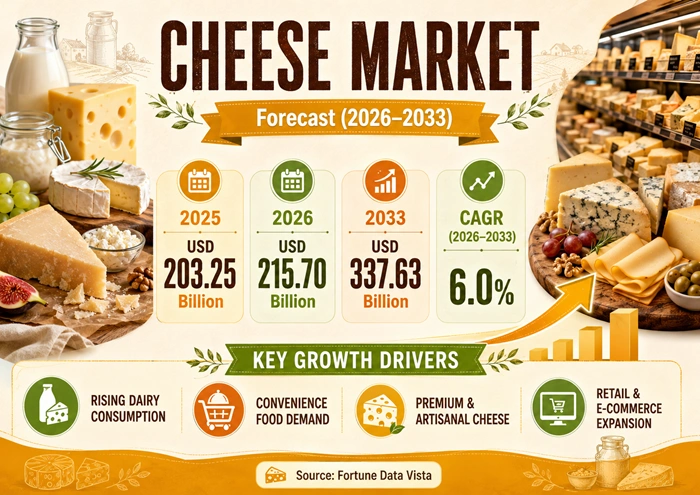
The global cheese market size is valued at USD 203.25 billion in 2025 and is predicted to increase from USD 215.70 billion in 2026 to approximately USD 337.63 billion by 2033, growing at a CAGR of 6.0% from 2026 to 2033.
The cheese market continues to grow steadily as global consumers increasingly incorporate cheese into their daily diets — across home cooking, foodservice, snacking, and processed food applications. Rising disposable incomes in emerging markets, the global spread of Western eating habits, and a consistent wave of product innovation in specialty, organic, and plant-based varieties are collectively supporting long-term demand. With Europe maintaining its dominance as the world's leading producer and consumer, and Asia Pacific emerging as the fastest growing regional market, the global cheese industry is entering an era of both geographic expansion and premiumization.
AI Impact on the Cheese Industry
Artificial Intelligence Is Modernizing Cheese Production, Supply Chain Management, and Consumer Marketing — Creating a Smarter and More Efficient Dairy Industry
Artificial intelligence is beginning to leave a meaningful footprint across the cheese market, particularly in production quality control, demand forecasting, and consumer personalization. Dairy processors are deploying computer vision systems powered by AI to detect defects in cheese texture, color, and aging consistency at production speeds that are impossible to match with manual inspection. These systems not only reduce waste and improve product uniformity but also allow manufacturers to maintain exacting quality standards across large-scale batch processing — a critical requirement for premium and export-grade cheese categories.
On the commercial side, AI-driven data analytics are helping retailers and distributors predict regional demand patterns with greater accuracy, enabling more precise inventory management and reducing spoilage across cold-chain networks. Personalization engines on e-commerce and specialty food platforms are using machine learning to recommend cheese varieties to consumers based on flavor preferences, dietary requirements, and past purchasing behavior. This convergence of AI with the cheese industry is strengthening profitability at both the production and distribution level, and it is expected to play an increasingly central role as the market scales toward its 2033 projection.
Growth Factors
Growing Global Appetite for Dairy, Rising Demand for Convenience Foods, and Product Innovation Are Fueling Sustained Growth in the Cheese Market
The increasing global appetite for protein-rich, nutrient-dense foods is one of the most powerful structural drivers of growth in the cheese market. As health-conscious consumers seek satisfying, high-protein snacking alternatives to ultra-processed foods, cheese — particularly natural and artisanal varieties — is gaining ground as a preferred option. The foodservice industry's growing reliance on cheese as a core ingredient across quick-service restaurants, pizza chains, sandwich outlets, and gourmet dining further amplifies consistent volume demand across all major geographies.
Product innovation is adding a second, equally important growth vector. Manufacturers are launching an expanding range of flavored, organic, reduced-fat, and plant-based cheese alternatives that cater to diverse and evolving consumer preferences. The growth of lactose-free and vegan cheese products is bringing previously excluded consumer groups into the market, while the premiumization trend is driving consumers in developed markets to trade up from commodity cheddar and processed slices toward artisanal, imported, and specialty varieties. Together, these forces are broadening the addressable market and keeping the global cheese industry on a healthy growth trajectory through 2033.
Market Outlook
The Cheese Market Is Positioned for Consistent Long-Term Expansion — Supported by Emerging Market Demand, Specialty Product Growth, and Foodservice Recovery
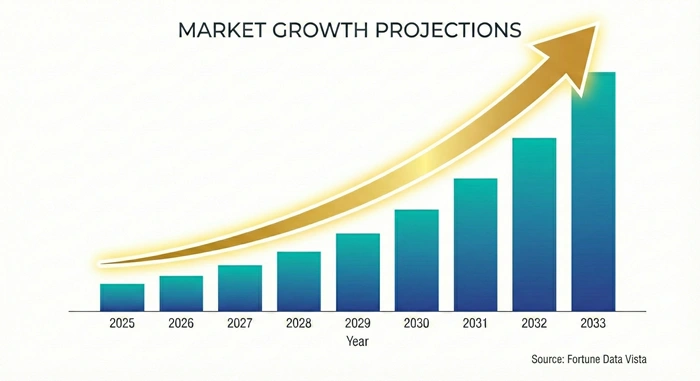
The medium-to-long-term outlook for the cheese market is encouraging and well-supported by both demand-side and supply-side fundamentals. On the demand side, the continued rise of the middle class in Asia Pacific, Latin America, and the Middle East is introducing millions of new consumers to cheese-based diets for the first time, particularly through Western-style fast food chains and packaged food brands that use cheese as a central flavor component. This geographic diversification of consumption is expected to generate meaningful incremental revenue for the global cheese industry through 2033.
From a supply perspective, advances in dairy farming efficiency, cold-chain logistics, and cheese aging technology are making it increasingly viable to serve distant markets with high-quality products. The growing network of international trade agreements in dairy is also enabling leading cheese-producing nations — including the United States, France, Germany, Australia, and the Netherlands — to expand their export footprint into high-growth markets with minimal trade friction. As the industry scales and consumer sophistication deepens, the cheese market is well-positioned to deliver its projected valuation of USD 337.63 billion by 2033.
Expert Speaks
-
"At Lactalis, we are seeing remarkable demand for premium and specialty cheese across all our international markets. Consumers are moving beyond traditional commodity varieties and embracing regional European cheeses, organic options, and innovative flavors — a trend that is creating significant revenue opportunities for producers who invest in quality and provenance storytelling." — Emmanuel Besnier, CEO, Groupe Lactalis
-
"Kraft Heinz's cheese portfolio remains one of our most strategically important business units. We are focused on innovation that bridges convenience and quality — because today's consumers want great-tasting cheese that fits their busy lives, and that means new formats, new flavors, and new distribution channels including direct-to-consumer and e-commerce." — Carlos Abrams-Rivera, CEO, The Kraft Heinz Company
-
"The growing global demand for cheese is creating both exciting opportunities and real responsibilities for the dairy industry. At Fonterra, we are committed to sustainable dairy sourcing and to bringing high-quality New Zealand cheese to consumers across Asia Pacific and the Middle East — markets where growth is accelerating faster than almost anywhere else in the world." — Miles Hurrell, CEO, Fonterra Co-operative Group
Key Report Takeaways
-
Europe dominates the global cheese market, holding the largest regional share of approximately 41% in 2025, driven by a centuries-old tradition of cheese production and consumption, a highly sophisticated dairy processing industry, and the global prestige of European cheese varieties such as Parmesan, Brie, Gouda, Gruyère, and Feta across both domestic and export markets.
-
Asia Pacific is the fastest growing regional market, with China, India, South Korea, and Japan collectively driving demand through rising Western food adoption, rapid expansion of quick-service restaurant chains, and growing consumer exposure to imported and specialty cheese varieties through modern retail and e-commerce channels.
-
The foodservice sector is the dominant application segment, contributing over 45% of global cheese market revenue in 2025 as commercial food operators — including pizza chains, burger restaurants, sandwich outlets, and hotel kitchens — represent the highest-volume, most consistent consumers of cheese across all product categories.
-
Natural cheese holds the largest product type share, accounting for approximately 62% of total cheese market revenue in 2025, reflecting strong consumer preference for minimally processed, authentic cheese varieties that offer superior flavor complexity and align with clean-label and ingredient-transparency trends.
-
Mozzarella is the most widely consumed individual cheese variety globally, commanding the highest product-level market share due to its universal application across pizza, pasta, salads, sandwiches, and snacking — making it the single most important SKU for both foodservice operators and retail cheese buyers worldwide.
-
Plant-based and specialty cheese is the fastest growing future segment, projected to achieve a market share of over 8% by 2033 and grow at a CAGR of approximately 11.5% through the forecast period, driven by the rapid expansion of the vegan and flexitarian consumer base, ongoing improvement in plant-based cheese texture and taste, and growing retail shelf space dedicated to dairy-free alternatives.
Market Scope
| Parameter | Details |
|---|---|
| Market Size by 2033 | USD 337.63 Billion | Market Size by 2026 | USD 215.70 Billion | Market Size by 2025 | USD 203.25 Billion | Market Growth Rate from 2026 to 2033 | CAGR of 6.0% | Dominating Region | Europe | Fastest Growing Region | Asia Pacific | Segments Covered | Type, Product, Source, Form, Application, Distribution Channel | Regions Covered | North America, Europe, Asia Pacific, Latin America, Middle East & Africa |
Market Dynamics
Drivers Impact Analysis
Rising Global Dairy Consumption, Expanding Foodservice Industry, and Premiumization Trends Are the Key Forces Driving Sustained Cheese Market Growth
| Driver | ≈ % Impact on CAGR Forecast | Geographic Relevance | Impact Timeline |
|---|---|---|---|
| Rising global protein and dairy consumption | ~30% | Asia Pacific, Latin America, MEA | Short to Long Term |
| Expansion of foodservice and QSR chains | ~28% | Global — especially Emerging Markets | Short to Medium Term |
| Premiumization and specialty cheese demand | ~24% | North America, Europe, Urban Asia Pacific | Medium to Long Term |
| Growth of plant-based and functional cheese | ~18% | North America, Europe | Medium to Long Term |
The steady rise in global dairy consumption — particularly in markets that are transitioning from traditional staple-based diets toward higher-protein, diversified food cultures — is providing a durable foundation for growth in the cheese market. Countries across Southeast Asia, South Asia, and the Middle East are experiencing rapid dietary transition as rising incomes, urbanization, and exposure to Western food culture introduce cheese into daily meal occasions for the first time. This trend is particularly visible in the foodservice channel, where international QSR chains are a primary gateway through which consumers in developing economies first encounter cheese as a regular ingredient.
In more mature markets across North America and Europe, the primary growth driver is premiumization — the consistent consumer preference for trading up from commodity cheese products toward premium, artisanal, and specialty varieties. This shift is reflected in the strong growth of specialty cheese counters in supermarkets, the expansion of online specialty cheese retailers, and the rising number of dedicated cheese subscription services. Manufacturers are investing in provenance-driven branding, protected designation of origin (PDO) products, and aging and curing innovation to meet this demand and capture higher margins in the global cheese industry.
Restraints Impact Analysis
Volatile Milk Prices, Rising Production Costs, and Lactose Intolerance Awareness Are Creating Headwinds for the Cheese Market
| Restraint | ≈ % Impact on CAGR Forecast | Geographic Relevance | Impact Timeline |
|---|---|---|---|
| Volatile raw milk prices and input cost inflation | ~38% | All regions — especially smaller producers | Short to Medium Term |
| Rising awareness of lactose intolerance and dairy allergies | ~32% | North America, Europe, Asia Pacific | Short to Long Term |
| Stringent food safety and dairy import regulations | ~30% | MEA, Asia Pacific, Latin America | Medium Term |
Fluctuating raw milk prices represent one of the most persistent operational risks for cheese producers worldwide. The cost of milk — which accounts for the majority of total cheese production costs — is highly sensitive to feed prices, weather patterns, livestock disease outbreaks, and broader agricultural commodity cycles. When milk prices spike unexpectedly, smaller and mid-sized cheese manufacturers face significant margin compression that can limit their ability to invest in product development or competitive pricing, potentially ceding market share to larger, vertically integrated dairy groups with greater purchasing power and hedging capabilities.
Consumer awareness of lactose intolerance, dairy allergies, and the perceived environmental impact of animal-based dairy is also acting as a mild but growing restraint on the cheese market's expansion in certain consumer segments. While the overall market continues to grow, manufacturers are under increasing pressure to develop lactose-free, reduced-dairy, and entirely plant-based cheese alternatives to retain consumers who are reducing their conventional dairy intake. Failure to address this trend risks long-term brand and volume erosion, particularly among younger demographic groups in North America and Western Europe who are most engaged with health and sustainability messaging.
Opportunities Impact Analysis
Plant-Based Cheese Innovation, E-Commerce Expansion, and Untapped Emerging Market Demand Represent the Most Compelling Growth Opportunities for the Cheese Industry
| Opportunity | ≈ % Impact on CAGR Forecast | Geographic Relevance | Impact Timeline |
|---|---|---|---|
| Plant-based and vegan cheese product development | ~36% | North America, Europe, Urban Asia Pacific | Medium to Long Term |
| E-commerce and direct-to-consumer cheese sales | ~34% | Global — especially North America and Europe | Short to Long Term |
| Market penetration in underdeveloped emerging markets | ~30% | India, Southeast Asia, MEA, Latin America | Medium to Long Term |
The rapid growth of the plant-based food movement is creating a substantial product development and market expansion opportunity for dairy companies willing to invest in alternative cheese formulations. Cashew-based, almond-based, soy-based, and oat-based cheese products are improving dramatically in taste and texture, and consumer acceptance is rising steadily. Companies that develop credible, great-tasting plant-based cheese products with strong brand positioning stand to capture a growing segment of the dairy-free consumer market that is currently estimated to be worth several billion dollars globally and expanding at double-digit annual rates.
E-commerce and direct-to-consumer sales channels are unlocking new revenue streams for both large dairy multinationals and small artisanal cheese producers who have historically lacked the distribution reach to access national or international consumer markets. Subscription cheese boxes, online specialty cheese platforms, and click-and-collect models are enabling producers to bypass traditional grocery retail entirely and build direct, high-margin customer relationships. This trend is particularly powerful for regional and artisanal producers whose products would rarely appear on supermarket shelves, giving the global cheese market a new long tail of premium, niche products that collectively represent a meaningful revenue opportunity.
Segment Analysis
By Type
Natural Cheese Leads the Global Cheese Market While Processed Cheese Retains Strong Relevance Across Foodservice and Packaged Food Applications
Natural cheese holds the dominant position in the cheese market, accounting for approximately 62% of total market share in 2025 and projected to grow at a CAGR of approximately 6.2% through 2033. The segment's strength is rooted in the universal consumer appreciation for authentic, minimally processed dairy products that offer rich and complex flavor profiles developed through traditional aging and curing processes. Europe is the leading region for natural cheese consumption and production, driven by a deep-rooted cultural tradition of cheese-making and the global demand for protected origin varieties including Parmigiano-Reggiano, Gruyère, Manchego, and Roquefort. Major players driving natural cheese sales in Europe include Lactalis, Arla Foods, and Savencia Fromage & Dairy, all of which maintain extensive portfolios of regionally distinct natural cheese varieties that command strong retail and foodservice pricing.
Processed cheese, while occupying a smaller share of approximately 38% of the market, maintains robust and consistent demand across foodservice, packaged food manufacturing, and mass retail channels — particularly in North America and Asia Pacific. Its advantages in meltability, extended shelf life, uniformity, and affordability make it the preferred cheese format for fast-food operators, ready-meal manufacturers, and snack food companies that require consistent performance at scale. The Kraft Heinz Company and Bel Group are among the global leaders in processed cheese, leveraging strong brand equity, widespread retail distribution, and foodservice partnerships to sustain high-volume sales across multiple geographies. In Asia Pacific, processed cheese slices and spreadable formats are often the consumer's first point of entry into cheese consumption, making this segment a critical gateway for long-term category development in high-growth emerging markets.
By Application
Foodservice Remains the Dominant Application for Cheese Consumption Globally, While the Retail Segment Drives Premiumization and Category Expansion
The foodservice application segment is the largest revenue contributor in the cheese market, accounting for approximately 45% of total market revenue in 2025 and projected to maintain a CAGR of around 6.4% through 2033. The global expansion of pizza chains, burger restaurants, Mexican-inspired quick-service concepts, and international hotel and catering operations is driving consistent, high-volume cheese procurement from commercial food operators at every price point. North America leads the foodservice cheese segment, with the United States alone representing the world's largest single-country market for foodservice cheese procurement, anchored by the country's massive pizza delivery, fast casual, and stadium food industries. Companies including Leprino Foods — the world's largest mozzarella producer — and Tillamook Creamery are among the top suppliers serving U.S. foodservice operators with reliable, high-volume, specification-grade cheese products.
The retail application segment, while contributing a smaller share of approximately 37% of total revenue, is the primary engine of premiumization and category innovation within the global cheese industry. Retail consumers are increasingly purchasing a wider variety of cheese types — moving beyond basics like cheddar and mozzarella into brie, camembert, blue cheese, fresh ricotta, and imported specialty varieties — as food culture becomes more globally diverse and culinary curiosity deepens across all income brackets. Europe is the leading retail cheese market, with French, German, and Italian consumers exhibiting among the highest per-capita cheese expenditures in the world. Premium retailer formats, farmers' market cheese counters, and online specialty food platforms are all expanding the retail addressable market, supporting above-average revenue growth within this application segment through 2033.
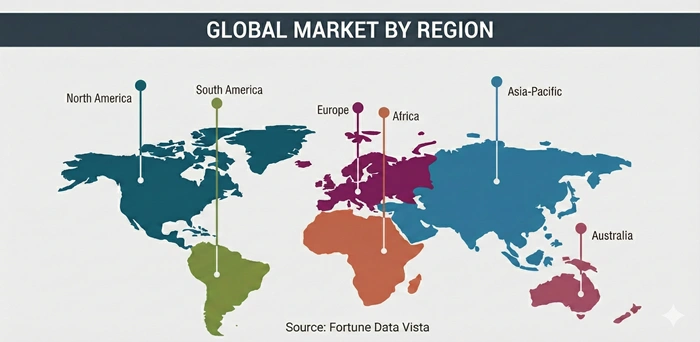
Regional Insights
Europe
Europe Commands the Largest Share of the Global Cheese Market, Underpinned by Centuries of Tradition, World-Renowned Cheese Varieties, and a Highly Mature Dairy Industry
France, Germany, and the Netherlands Lead European Cheese Production and Consumption, While the Region's Protected Designation System Reinforces Premium Market Positioning Globally
Europe accounts for approximately 41% of global cheese market revenue in 2025, making it the world's dominant cheese-producing and consuming region by a substantial margin. The continent's leadership is built on a combination of centuries-old production expertise, an exceptionally diverse portfolio of regionally distinct varieties, and the global prestige of European protected designation of origin (PDO) cheeses that command premium pricing in export markets worldwide. France, Germany, the Netherlands, Italy, and the United Kingdom are the five largest cheese markets within the region, collectively accounting for over 70% of European cheese industry revenue. Europe's regional CAGR is projected at approximately 5.5% from 2026 to 2033, reflecting a mature but stable demand environment supported by consistent domestic consumption and growing export demand. Key players including Lactalis (France), Arla Foods (Denmark/Sweden), Friesland Campina (Netherlands), and Savencia Fromage & Dairy (France) dominate the European landscape.
European cheese exports are a critical pillar of the global industry, with the European Union collectively representing the world's largest cheese-exporting bloc. As global foodservice chains and retail grocery networks across Asia, the Middle East, and North America expand their specialty and imported cheese assortments, European producers are benefiting from strong and growing export demand that supplements already robust domestic consumption. The growing global reputation of European cheese-making — supported by the EU's geographical indication system — is enabling producers to command significant price premiums in international markets, reinforcing Europe's role as the standard-bearer of quality in the global cheese market for the foreseeable future.
Asia Pacific
Asia Pacific Is the Fastest Growing Regional Market for Cheese, with China, India, and South Korea Driving Accelerating Demand Through Westernization, Urbanization, and QSR Expansion
Rising Middle-Class Income Growth and the Rapid Proliferation of Western-Style Food Culture Are Transforming Asia Pacific into a High-Priority Growth Market for Global Cheese Producers
Asia Pacific is the fastest growing regional market in the global cheese industry, with a projected CAGR of approximately 8.2% from 2026 to 2033, significantly outpacing all other regions. The region currently holds approximately 14% of global market share in 2025 — a figure that is expected to rise materially over the forecast period as dietary habits evolve and per-capita cheese consumption deepens across high-population markets. China is the primary driver of regional growth, where the rapid expansion of Western-style pizza and burger chains, growing household income, and increasing retail availability of imported cheese varieties are collectively driving category development at an impressive rate. Fonterra (New Zealand), Lactalis (France), and Arla Foods are among the international companies most aggressively expanding their presence in China and broader Asia Pacific through local partnerships, cold-chain investments, and brand-building initiatives.
India, South Korea, and Japan are contributing meaningfully to the region's growth trajectory, each with distinct demand dynamics that are expanding the total addressable market for the cheese market across Asia. South Korea's sophisticated urban consumer base has developed a strong appreciation for premium imported European cheeses, while Japan's established Western food culture continues to drive consistent retail and foodservice cheese procurement. India represents the most exciting long-term growth story, where a young, rapidly urbanizing population is being introduced to cheese through the explosive growth of pizza delivery chains, cafés, and packaged snack formats. As cold-chain logistics infrastructure improves and local dairy processing capabilities expand in these countries, Asia Pacific is expected to become an increasingly important revenue contributor to the global cheese industry through 2033.
Report Customization Available by Region and Country
Access Deeper, Geography-Specific Intelligence with Our Fully Customized Region-Wise and Country-Wise Cheese Market Reports — Built to Match Your Exact Market and Strategic Focus
This report can be fully customized to deliver highly targeted, geography-specific insights for any region or country listed below. A customized version of this report goes beyond the global overview to provide in-depth market sizing, segment-level demand analysis, competitive landscape mapping, regulatory environment assessment, consumer behavior profiling, and opportunity identification specific to the chosen geography and the cheese market dynamics relevant to that location. Whether you are assessing market entry potential, benchmarking regional competitors, or building a country-level investment thesis, our customization service ensures you receive analysis that is directly actionable for your geographic area of focus.
Customized cheese market reports are available for all of the following regions and countries, with detailed insights, trends, opportunities, and competitive intelligence tailored to each specific market:
North America
-
U.S. — Largest single-country cheese market analysis, foodservice vs. retail split, top brand competitive benchmarking, and regional consumption patterns by state
-
Canada — Cheese import and domestic production dynamics, retail premiumization trends, and regulatory environment for dairy trade
-
Mexico — Rapid Western food adoption, QSR-driven cheese demand, and growth potential for imported varieties across urban consumer markets
Europe
-
U.K. — Post-Brexit dairy trade implications, cheddar and specialty cheese market segmentation, and leading retailer and foodservice buyer strategies
-
Germany — Europe's largest cheese consumer market analysis, domestic vs. imported variety preference split, and sustainability sourcing trends
-
France — PDO cheese category deep-dive, export strategy analysis, retail and foodservice channel dynamics, and artisanal sector profiling
-
Italy — Parmesan and mozzarella production leadership, domestic market maturity, and export performance across global markets
-
Rest of Europe — Scandinavia, Eastern Europe, and Iberian Peninsula cheese market growth opportunities and competitive dynamics
Asia Pacific
-
China — Western food-driven cheese demand, QSR chain expansion impact, cold-chain infrastructure gaps, and key international player strategies
-
India — Nascent market opportunity mapping, local dairy processing capabilities, urban vs. rural demand segmentation, and foodservice penetration analysis
-
Japan — Mature Western food culture, imported vs. domestic cheese preferences, and premium retail segment profiling
-
South Korea — Premium imported cheese demand, leading retail and foodservice buyers, and consumer trend analysis by demographic
-
Australia — Domestic cheese production strength, export market development, and consumer premiumization trends
-
Rest of Asia Pacific — Southeast Asia market entry analysis, Indonesia, Thailand, and Vietnam cheese demand outlook
Latin America
-
Brazil — Largest Latin American cheese market, domestic production dynamics, local variety preferences, and international import trends
-
Argentina — Established dairy culture, cheese production and export capability analysis, and consumer market segmentation
-
Rest of Latin America — Chile, Colombia, Peru cheese market opportunity assessment and regional competitive landscape
Middle East & Africa (MEA)
-
UAE — Premium imported cheese demand, hospitality sector procurement, expat consumer base analysis, and cold-chain infrastructure
-
Saudi Arabia — Vision 2030 food diversification impact, halal cheese certification requirements, and growing retail and QSR cheese demand
-
Rest of MEA — South Africa, Egypt, and Nigeria cheese market development potential and distribution channel analysis
Top Key Players
-
Lactalis Group (France)
-
Arla Foods amba (Denmark / Sweden)
-
The Kraft Heinz Company (United States)
-
Fonterra Co-operative Group (New Zealand)
-
Friesland Campina (Netherlands)
-
Savencia Fromage & Dairy (France)
-
Leprino Foods Company (United States)
-
Bel Group (France)
-
Saputo Inc. (Canada)
-
Tillamook County Creamery Association (United States)
-
Hochland SE (Germany)
-
Sargento Foods Inc. (United States)
Recent Developments
-
In 2025, Lactalis Group completed the acquisition of Kraft Heinz's natural cheese business in the United States, significantly expanding Lactalis's North American retail presence and adding well-known American cheese brands to its global portfolio of over 200 cheese varieties.
-
In 2024, Arla Foods announced a EUR 500 million investment program to upgrade its European cheese production facilities with advanced automation and AI-driven quality control systems, targeting a 20% improvement in production efficiency and a reduction in product waste across its cheddar and gouda manufacturing lines.
-
In 2025, Saputo Inc. finalized the acquisition of a leading Australian specialty cheese producer, strengthening its Asia Pacific distribution footprint and adding a premium artisanal cheese range to its portfolio that positions the company for growth in high-value export markets across China and Southeast Asia.
-
In 2024, Fonterra Co-operative Group launched a new premium cheese brand targeting the fast-growing urban consumer segment in China, backed by a dedicated retail and foodservice distribution agreement with a major Chinese grocery retail chain covering over 1500 stores nationwide.
-
In 2025, Bel Group expanded its plant-based cheese product range with the launch of three new dairy-free varieties under its Nurishh brand — including a vegan mozzarella and a dairy-free cream cheese spread — targeting the rapidly growing flexitarian and vegan consumer segment across European and North American retail markets.
Market Trends
Premiumization, Plant-Based Innovation, and the Rise of Specialty Cheese E-Commerce Are the Three Most Consequential Trends Reshaping the Global Cheese Market
Consumer Appetite for Artisanal, Authentic, and Alternative Cheese Products Is Creating New Growth Lanes That Are Fundamentally Broadening the Cheese Market's Revenue Potential
The premiumization of cheese consumption is arguably the most significant trend reshaping the global cheese market in developed economies. Consumers in North America and Western Europe are progressively trading up from commodity cheese products toward artisanal, aged, and geographically distinctive varieties that offer richer flavor profiles and a stronger sense of food story and provenance. This shift is being reinforced by growing consumer interest in food craftsmanship, culinary exploration, and the cultural authenticity of European cheesemaking traditions. Retailers are responding by dedicating significantly more shelf and counter space to specialty cheese assortments, and online platforms dedicated exclusively to premium and imported cheese are recording strong double-digit subscriber growth as consumers seek curated, expert-guided cheese discovery experiences.
The rise of plant-based and functional cheese alternatives is introducing a parallel growth dynamic that is attracting investment from both established dairy companies and food technology startups. Companies are investing heavily in improving the taste, texture, and nutritional profile of cashew, almond, oat, and soy-based cheese products, with some of the most recent formulations approaching parity with dairy cheese on key sensory attributes. Precision fermentation technology — which uses microorganisms to produce dairy proteins without animals — is emerging as a potentially transformative force in cheese production, enabling manufacturers to create products that are functionally identical to conventional cheese while carrying significant sustainability and allergen-free credentials. These innovations are attracting a growing cohort of younger, health-conscious, and environmentally motivated consumers to the broader cheese category.
Segments Covered in the Report
-
By Type
-
Natural Cheese
-
Processed Cheese
-
-
By Product
-
Mozzarella
-
Cheddar
-
Feta
-
Parmesan
-
Gouda
-
Others (Brie, Camembert, Blue Cheese, Ricotta, Emmental)
-
-
By Source
-
Cow
-
Goat
-
Sheep
-
Others (Buffalo, Mixed)
-
-
By Form
-
Slices
-
Blocks
-
Shreds
-
Spreads
-
Others (Crumbles, Cubes, Powder)
-
-
By Application
-
Foodservice
-
Food Processing
-
Retail
-
-
By Distribution Channel
-
Supermarkets / Hypermarkets
-
Convenience Stores
-
Online Retail
-
Specialty Stores
-
Others
-
-
By Region
-
North America (U.S., Canada, Mexico)
-
Europe (U.K., Germany, France, Italy, Rest of Europe)
-
Asia Pacific (China, India, Japan, South Korea, Australia, Rest of Asia Pacific)
-
Latin America (Brazil, Argentina, Rest of Latin America)
-
Middle East & Africa (UAE, Saudi Arabia, Rest of MEA)
-
❝ Built for Every Level — From Startups to Industry Giants ❞
Here Is Exactly How This Report Works for You
-
For Tier 1 dairy conglomerates, major foodservice chains, and institutional investors, this report delivers a comprehensive competitor revenue analysis — including revenue source breakdowns, export market dependency ratios, and a detailed assessment of how geopolitical factors such as dairy trade tariffs, feed price inflation, and import regulations are impacting profitability and investment decisions across the global cheese market — providing the strategic intelligence needed to protect margins and identify acquisition targets.
-
For Tier 2 and Tier 3 cheese producers, specialty dairy companies, and regional distributors, the supply-demand dynamics section of this report maps raw milk supply trends, cold-chain bottlenecks, and regional demand-supply imbalances that are directly influencing procurement costs, production planning decisions, and channel partner selection — giving your commercial and operations teams a measurable advantage in a competitive and cost-pressured market environment.
-
For startups, plant-based food innovators, and new market entrants, this report identifies high-growth white-space opportunities in the specialty, plant-based, and functional cheese segments — along with M&A and partnership activity trends, consumer preference shifts by demographic and geography, and the competitive gaps left by incumbent players — providing the roadmap and investor-ready evidence base needed to build a compelling market entry strategy in the rapidly evolving cheese industry.
Frequently Asked Questions:
Answer: The global cheese market was valued at USD 203.25 billion in 2025 and is expected to reach USD 337.63 billion by 2033. It is projected to grow at a CAGR of 6.0% from 2026 to 2033.
Answer: The cheese market is primarily driven by rising global dairy consumption, the expansion of the foodservice industry, and growing consumer demand for premium and specialty cheese varieties. Product innovation in plant-based, organic, and functional cheese formats is also opening new consumer segments and broadening the market's total addressable audience.
Answer: Europe is the dominant region in the global cheese market, accounting for approximately 41% of total revenue in 2025. The region's leadership is supported by centuries of cheesemaking heritage, world-renowned PDO varieties, and a sophisticated domestic consumer base with high per-capita cheese consumption.
Answer: Plant-based and specialty cheese is the fastest growing product category within the cheese market, projected to grow at a CAGR of approximately 11.5% through 2033. Improving product quality, rising vegan and flexitarian consumer numbers, and expanding retail shelf space are the primary drivers of this segment's rapid expansion.
Answer: The global cheese market is led by major players including Lactalis Group, Arla Foods, The Kraft Heinz Company, Fonterra, Friesland Campina, and Saputo Inc. These companies compete on the basis of product quality, brand portfolio breadth, geographic distribution reach, and continuous investment in innovation across natural, processed, and alternative cheese categories.