
Chemical API CDMO Market Overview
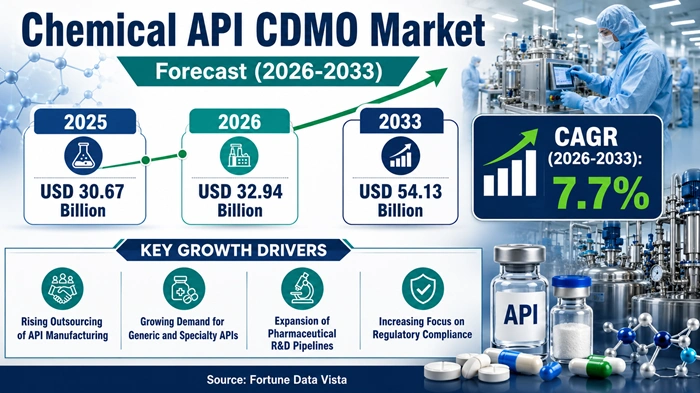
The global chemical API CDMO market size is valued at USD 30.67 billion in 2025 and is predicted to increase from USD 32.94 billion in 2026 to approximately USD 54.13 billion by 2033, growing at a CAGR of 7.7% from 2026 to 2033.
Chemical active pharmaceutical ingredient contract development and manufacturing organizations — companies that provide outsourced chemical synthesis, process development, scale-up, and commercial manufacturing services for active pharmaceutical ingredients on behalf of pharmaceutical and biotechnology clients — have become indispensable partners in the global pharmaceutical supply chain. Rising drug pipeline complexity, the pharmaceutical industry's deepening commitment to outsourcing as a strategic operating model, accelerating generic drug demand across aging global populations, and the growing pharmaceutical manufacturing capacity in Asia Pacific are sustaining robust and broad-based growth across the chemical API CDMO industry through the full forecast period.
AI Impact on the Chemical API CDMO Industry
Artificial Intelligence Is Revolutionizing Chemical API Contract Development and Manufacturing by Accelerating Process Chemistry Design, Enabling Predictive Quality Management, and Delivering Data-Driven Manufacturing Optimization That Sharply Reduces Development Timelines and Batch Failure Rates
Artificial intelligence is creating tangible and growing commercial impact across the chemical API CDMO industry, most practically in the domains of retrosynthetic route planning, process optimization, and predictive quality control. AI-powered retrosynthesis tools that analyze millions of documented chemical reactions can now identify feasible and optimized synthetic routes for complex API molecules in a fraction of the time required by traditional computational and empirical chemistry methods — allowing CDMO process chemistry teams to evaluate a broader range of synthetic options faster, identify patent-free synthetic routes, and develop more cost-efficient and scalable processes earlier in the development timeline. This acceleration in process development has direct commercial value for pharmaceutical clients managing competitive drug development timelines, making AI-enhanced process chemistry capability an increasingly important selection criterion when pharmaceutical companies evaluate CDMO partners for new API programs.
Machine learning platforms trained on historical manufacturing batch data and real-time process sensor readings are simultaneously transforming quality management in commercial API manufacturing operations. Predictive quality models can now identify critical process parameter deviations and predict their likely impact on API purity, yield, and physical form — enabling process engineers to take corrective action before batch specification failures occur rather than discovering issues after batch completion during release testing. Chemical API CDMO operators including Lonza Group, WuXi AppTec, and Divi's Laboratories are actively integrating these AI-driven quality prediction capabilities into their GMP manufacturing workflows — reducing out-of-specification batch rates, improving manufacturing yield consistency, and generating the robust process understanding documentation that modern FDA and EMA chemistry, manufacturing and controls regulatory submissions require.
Growth Factors
The Global Pharmaceutical Industry's Strategic Outsourcing of API Manufacturing, the Growing Complexity of Small Molecule Drug Candidates, and the Rising Generic Drug Demand Across Emerging and Aging Population Markets Are the Core Forces Sustaining the Growth Momentum of the Chemical API CDMO Market
The pharmaceutical industry's structural and progressive shift from in-house API manufacturing toward specialized CDMO outsourcing remains the most powerful and durable demand driver in the chemical API CDMO market. Over the past fifteen years, major pharmaceutical companies have systematically divested internal API manufacturing facilities and redirected capital toward R&D, business development, and commercial operations — concentrating manufacturing execution in CDMO partners that offer superior chemistry expertise, greater process development agility, and more cost-competitive manufacturing economics than pharmaceutical companies can sustain in-house. This outsourcing model shift is not cyclical but structural, and pharmaceutical companies' continued rationalization of internal manufacturing footprints is expected to progressively increase the proportion of API requirements fulfilled through CDMO partnerships across both innovative and generic drug segments throughout the forecast period.
The growing technical complexity of pharmaceutical drug pipelines is the second critical driver, adding a qualitative dimension to demand growth that is specifically positive for chemical API CDMOs with specialized synthesis capabilities. The emergence of highly potent API drug candidates in oncology — including kinase inhibitors, antibody-drug conjugate linker-payloads, and targeted protein degraders — and the growth of complex natural product-derived APIs in infectious disease and CNS therapeutic areas are creating demand for CDMO partners with containment-rated high-potency manufacturing facilities, asymmetric synthesis capabilities, and multi-step complex synthesis expertise that relatively few operators globally possess at commercial scale. This complexity-driven premium demand is expanding the revenue and margin opportunity at the most capable end of the chemical API CDMO market, creating a quality differentiation dynamic that rewards investment in specialized chemistry infrastructure and expertise.
Market Outlook
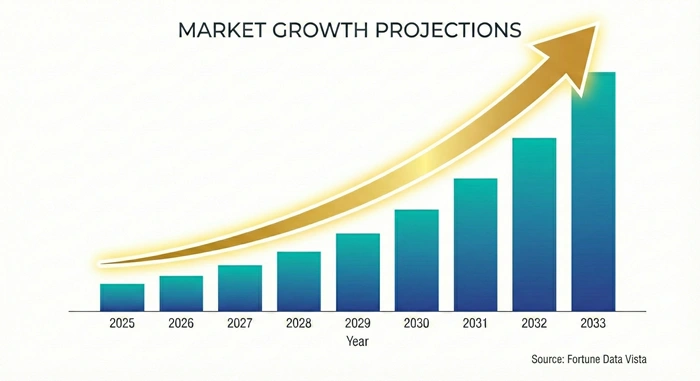
The Chemical API CDMO Market Is on a Sustained Growth Path Through 2033, Driven by the Continued Expansion of Pharmaceutical Outsourcing, the Growing Value of Asia Pacific API Manufacturing, and the Strategic Imperative for Supply Chain Resilience That Is Reshaping Global API Sourcing Decisions
The long-term market outlook for chemical API CDMO services is consistently positive, supported by the convergence of multiple demand-side growth factors that operate with different geographic intensities and timelines but collectively sustain broad-based revenue growth across all major market segments and regions. In North America and Europe — the most mature and highest-value markets — the primary growth mechanism is the ongoing upgrade of pharmaceutical company outsourcing programs to more complex, higher-margin API types, the adoption of integrated CDMO service models that bundle process development with commercial manufacturing, and the growing regulatory-driven demand for comprehensive API process understanding and characterization documentation that requires sophisticated CDMO analytical capability. These developed market dynamics generate steady, quality-driven revenue growth at premium pricing levels that underpin the profitability of leading chemical API CDMO operators.
In Asia Pacific — particularly India and China — the market outlook is driven by a combination of domestic pharmaceutical demand growth, the progressive qualification of regional CDMO operators for regulated market pharmaceutical outsourcing programs, and massive ongoing investment in pharmaceutical-grade chemical synthesis infrastructure that is expanding both the volume and the complexity range of API manufacturing that Asian CDMOs can competitively perform. India's pharmaceutical manufacturing industry — which already accounts for approximately 20% of global generic medicine volume production — is progressively moving up the API complexity ladder toward specialized synthesis, high-potency manufacturing, and integrated process development services that position Indian CDMOs to capture growing share of the global chemical API CDMO market from multinational pharmaceutical companies seeking both cost advantage and regulatory-compliant supply chain alternatives for their API programs.
Expert Speaks
-
"Lonza's chemical API synthesis business continues to experience strong and diversified demand growth across our development, clinical, and commercial manufacturing programs, driven by the pharmaceutical industry's growing reliance on CDMO partners for the full API development and manufacturing lifecycle. We are investing significantly in both capacity expansion and chemistry capability development — including high-potency API manufacturing, continuous flow synthesis, and digital process analytics — to serve the growing complexity and volume demands of our pharmaceutical company client base in the chemical API CDMO market." — Albert Bollard, CEO, Lonza Group
-
"WuXi AppTec's integrated chemistry services platform — spanning discovery chemistry, process development, and commercial API manufacturing — is experiencing robust demand growth from pharmaceutical and biotechnology clients globally who value our depth of chemistry expertise, our regulatory compliance track record, and our ability to manage programs from early development all the way through commercial supply. The chemical API CDMO market continues to grow at attractive rates, and WuXi is committed to expanding both our service capabilities and our global manufacturing capacity to meet the needs of our customers worldwide." — Dr. Ge Li, CEO, WuXi AppTec
-
"Thermo Fisher's Patheon API manufacturing business is benefiting from the powerful tailwind of pharmaceutical outsourcing growth and the increasing complexity of small molecule drug development programs that require specialized CDMO chemistry partners with the capability, capacity, and compliance infrastructure to deliver high-quality APIs reliably and on schedule. We continue to invest in our chemical API CDMO capabilities through facility expansions, technology upgrades, and talent development programs that ensure Thermo Fisher remains at the forefront of the global API contract manufacturing industry." — Marc Casper, CEO, Thermo Fisher Scientific
Key Report Takeaways
-
North America dominates the global chemical API CDMO market, accounting for approximately 36% of total global revenue in 2026, anchored by the United States' status as the world's largest pharmaceutical R&D and drug development market — generating consistent high-value API development and commercial manufacturing outsourcing demand from major pharmaceutical and biotechnology companies that are served by a dense ecosystem of domestic and international CDMO operators with comprehensive chemistry development and GMP API manufacturing capabilities.
-
Asia Pacific is the fastest-growing regional market, expanding at a CAGR of approximately 9.8% from 2026 to 2033, powered by India's and China's rapidly growing pharmaceutical-grade chemical manufacturing industries, government-backed capacity expansion programs, and the progressive regulatory compliance upgrades that are qualifying an expanding number of Asian CDMO facilities for regulated market pharmaceutical company outsourcing programs in North America and Europe.
-
Pharmaceutical companies are the largest end-user segment, contributing approximately 58% of total end-user revenue in 2026, as both large innovator pharmaceutical companies and mid-size specialty pharma firms rely on chemical API CDMOs for outsourced process development, clinical supply manufacturing, and commercial API production across the full drug development and lifecycle management continuum.
-
Innovative API is the dominant type segment, accounting for approximately 55% of total type-based revenue in 2026, reflecting the high-value, premium-priced nature of originators' API development and manufacturing programs that generate significantly higher per-kilogram revenue for CDMO operators than generic API commodity synthesis — driven by the complexity, regulatory documentation requirements, and IP sensitivity of innovator pharmaceutical programs.
-
Commercial manufacturing is the dominant service type segment, holding approximately 48% of total service-type revenue in 2026, as the recurring, high-volume nature of commercial API supply contracts for marketed pharmaceutical products generates the most predictable and largest aggregate revenue in the chemical API CDMO service portfolio.
-
Analytical and testing services is the fastest-growing service segment, projected to reach approximately 20% of total service-type revenue by 2033 at a CAGR of approximately 10.2% from 2026 to 2033, driven by growing regulatory requirements for comprehensive API characterization, impurity profiling, genotoxic impurity testing, and stability data packages that pharmaceutical clients increasingly commission as integrated components of their CDMO partnerships.
Market Scope
| Parameter | Details |
|---|---|
| Market Size by 2033 | USD 54.13 Billion | Market Size by 2026 | USD 32.94 Billion | Market Size by 2025 | USD 30.67 Billion | Market Growth Rate from 2026 to 2033 | CAGR of 7.7% | Dominating Region | North America | Fastest Growing Region | Asia Pacific | Segments Covered | Type, Synthesis Type, Service Type, End User | Regions Covered | North America, Europe, Asia Pacific, Latin America, Middle East and Africa |
Market Dynamics
Drivers Impact Analysis
The Pharmaceutical Industry's Structural Outsourcing Shift, the Rising Technical Complexity of API Drug Candidates, and the Surging Generic Drug Demand Across Aging Global Populations Are the Three Most Powerful Forces Driving Growth in the Chemical API CDMO Market
| Driver | ≈ % Impact on CAGR Forecast | Geographic Relevance | Impact Timeline |
|---|---|---|---|
| Pharmaceutical industry structural outsourcing model shift | ~30% | Global | Short to Long-Term |
| Rising complexity and high-potency nature of API drug candidates | ~24% | North America, Europe, Asia Pacific | Short to Long-Term |
| Generic drug demand growth in aging and emerging population markets | ~20% | Asia Pacific, Latin America, Europe | Medium to Long-Term |
| Regulatory compliance investment strengthening CDMO qualifications | ~12% | Asia Pacific | Medium-Term |
| Pharmaceutical supply chain resilience and reshoring investment | ~9% | North America, Europe | Short to Medium-Term |
| Expansion of biopharmaceutical pipeline creating semi-synthesis API demand | ~5% | North America, Europe | Long-Term |
The pharmaceutical outsourcing driver is deeply embedded in the strategic operating model of virtually every major pharmaceutical company globally, making it the most structurally reliable demand growth mechanism in the chemical API CDMO market. As pharmaceutical companies face increasing pressure to improve R&D productivity, manage patent cliff revenue exposure, and generate better returns on capital, the case for maintaining large internal API manufacturing footprints becomes progressively less compelling compared to the flexibility, cost efficiency, and specialized expertise that CDMO partnerships provide. The resulting concentration of API manufacturing outsourcing volume in CDMO partners is accelerating, with pharmaceutical companies not only outsourcing new drug candidates to CDMOs from the earliest development stages but also progressively transferring existing commercial API supply programs from internal plants to CDMO partners as internal facility rationalization continues globally.
The generic drug demand driver operates through a complementary and geographically broad mechanism, generating high-volume API manufacturing demand that sustains the utilization of large-scale chemical synthesis capacity across the global CDMO industry. As patent expirations of major pharmaceutical products convert branded drug revenue to generic drug markets across therapeutic areas including cardiovascular, diabetes, oncology, and CNS, the resulting demand for generic API supply creates substantial CDMO manufacturing volume across both large-volume established synthetic routes and more complex synthesis programs for specialty generic APIs. Asia Pacific CDMOs — particularly in India and China — capture the largest share of this generic API manufacturing demand due to their cost-competitive chemical synthesis capabilities and the regulatory compliance track record that major Indian and Chinese API manufacturers have established across international pharmacopoeia standards.
Restraints Impact Analysis
Escalating Regulatory Compliance Requirements, the Intellectual Property Sensitivity of API Process Technology, and the Capital-Intensive Nature of High-Potency and Specialized Chemistry Manufacturing Facilities Are the Primary Factors Constraining Faster Growth in the Chemical API CDMO Market
| Restraint | ≈ % Impact on CAGR Forecast | Geographic Relevance | Impact Timeline |
|---|---|---|---|
| Escalating FDA, EMA, and ICH regulatory compliance requirements | ~-28% | Global | Short to Long-Term |
| IP protection concerns in emerging market CDMO manufacturing | ~-24% | Asia Pacific, Latin America | Medium to Long-Term |
| High capital investment requirements for HPAPI and specialized facilities | ~-20% | Developing economies, smaller CDMOs | Medium-Term |
| Raw material supply chain concentration and geopolitical risk | ~-16% | Global | Short to Medium-Term |
| Workforce shortage in process chemistry and regulatory affairs expertise | ~-12% | Global | Long-Term |
Regulatory compliance complexity is the most persistent and operationally challenging constraint in the chemical API CDMO market, affecting every geographic market and every service tier from early development through commercial manufacturing. The FDA's increasingly rigorous expectations for ICH Q8, Q9, Q10, and Q11 compliance across API development and manufacturing — requiring documented process understanding, risk-based quality management, and robust process validation evidence — create compliance infrastructure demands that are resource-intensive and ongoing, requiring continuous investment in quality systems, analytical capabilities, and regulatory affairs expertise that strains the operational capacity of smaller and mid-size CDMO operators. The risk of regulatory action — including FDA Warning Letters, Import Alerts, or manufacturing suspension orders — represents not only a revenue disruption risk for individual CDMO operators but also a supply continuity risk for their pharmaceutical clients, driving pharmaceutical companies to concentrate outsourcing volume in fewer, larger, and compliance-proven CDMO partners that can credibly manage these regulatory risks.
Intellectual property protection represents a particularly sensitive dimension of the restraint landscape for API CDMO outsourcing, especially in Asia Pacific markets where the combination of attractive cost economics and IP protection framework concerns creates a challenging risk-reward calculation for pharmaceutical companies evaluating manufacturing outsourcing decisions. The proprietary synthetic routes, catalysts, and process technologies that pharmaceutical companies develop for their novel API programs represent significant competitive assets that they must entrust to CDMO operators during technology transfer — creating IP exposure risks that pharmaceutical companies mitigate through contractual protections, confidential disclosure agreements, and geographic outsourcing decisions that weigh IP risk alongside cost and capability factors. This IP sensitivity restrains some pharmaceutical companies from using lower-cost CDMO operators in markets where IP enforcement is perceived as less robust, moderating the pace of outsourcing volume transfer to the most cost-competitive CDMO geographies.
Opportunities Impact Analysis
The Growing Demand for High-Potency API Manufacturing Capacity, the Commercial Opportunity From Continuous Flow Chemistry Technology Adoption, and the Strategic Reshoring of API Supply Chains to North America and Europe Are Creating Significant Revenue Growth Opportunities in the Chemical API CDMO Market
| Opportunity | ≈ % Impact on CAGR Forecast | Geographic Relevance | Impact Timeline |
|---|---|---|---|
| High-potency API manufacturing capacity expansion | ~26% | North America, Europe, India | Short to Long-Term |
| Continuous flow chemistry commercial manufacturing adoption | ~22% | North America, Europe | Short to Medium-Term |
| API supply chain reshoring programs in U.S. and Europe | ~20% | North America, Europe | Short to Medium-Term |
| Indian CDMO quality upgrade programs expanding regulated market access | ~18% | Asia Pacific | Medium to Long-Term |
| Integrated API development and commercial supply CDMO partnerships | ~14% | Global | Long-Term |
High-potency API manufacturing represents one of the most commercially valuable opportunity areas in the chemical API CDMO market, driven by the rapid growth of pharmaceutical pipelines in oncology and other targeted therapy areas that increasingly rely on highly potent chemical entities requiring specialized occupational safety containment infrastructure, validated cleaning procedures, and dedicated manufacturing environments. The global shortage of pharmaceutical-grade HPAPI manufacturing capacity — which requires Band 4 and Band 5 contained manufacturing facilities that cost significantly more to design, build, and validate than standard API manufacturing plants — creates a significant revenue opportunity for CDMO operators that make the capital investment in purpose-built containment-rated facilities. CDMOs including Lonza Group, Almac Group, CordenPharma, and Siegfried Holding AG have all made major HPAPI capacity investments in recent years, recognizing the premium pricing and long-term volume commitments that pharmaceutical clients are willing to make for reliable HPAPI manufacturing partners.
The pharmaceutical API supply chain reshoring trend — driven by U.S. and European government policy initiatives aimed at reducing pharmaceutical supply chain dependency on concentrated Asian manufacturing — is creating a structural opportunity for North American and European chemical API CDMOs to attract new volume that was previously outsourced to India or China based purely on cost economics. Government incentive programs — including the U.S. Domestic Manufacturing Resilience Credit provisions and European strategic medicines initiative funding — are making domestic API manufacturing economically viable for a broader range of products and are actively encouraging pharmaceutical companies to diversify their API sourcing toward domestic and allied-nation CDMO partners. For established North American and European CDMO operators with existing GMP manufacturing infrastructure, this policy-driven volume repatriation creates an opportunity to fill capacity, sign long-term supply agreements, and build stronger pharmaceutical client partnerships that deliver sustainable revenue streams over the forecast period.
Segment Analysis
By Type: Innovative API
Innovative API Leads the Chemical API CDMO Market by Revenue Value, Generating Premium Pricing and Long-Term Commercial Supply Partnerships for CDMOs That Possess the Specialized Chemistry Capability and Regulatory Compliance Infrastructure Required for Originator Pharmaceutical API Programs
Innovative API holds the dominant revenue position in the chemical API CDMO market by type, accounting for approximately 55% of total type-based revenue in 2026. Originator pharmaceutical companies — which require CDMO partners for the full continuum of innovative API development from early-phase process chemistry through clinical manufacturing and commercial supply — generate the highest per-kilogram API manufacturing revenue in the industry due to the technical complexity, IP sensitivity, regulatory documentation requirements, and long-term supply security needs associated with novel pharmaceutical products. The innovative API segment within the chemical API CDMO market is projected to grow at a CAGR of approximately 7.2% from 2026 to 2033, sustained by the continuous flow of new chemical entity drug candidates progressing through pharmaceutical development pipelines globally and by the growing proportion of innovative pipelines composed of technically complex molecules — including PROTACs, macrocyclic peptides, and multi-chiral center small molecules — that require specialized CDMO chemistry expertise. North America is the largest regional market for innovative API CDMO services, with Lonza Group (Switzerland), Cambrex Corporation (USA), and Almac Group (U.K.) serving the most technically demanding and commercially valuable innovative pharmaceutical programs through integrated development-to-commercial manufacturing platforms.
Europe is a mature and commercially significant regional market for innovative API CDMO services, supported by the presence of major originator pharmaceutical companies including Roche, Novartis, AstraZeneca, and Sanofi that generate substantial API outsourcing demand across multiple therapeutic areas. European CDMO operators including Siegfried Holding AG (Switzerland), Aenova Group (Germany), and Recipharm AB (Sweden) serve the European innovative API outsourcing market through extensive pharmaceutical-grade chemical synthesis infrastructure and strong regulatory compliance track records across FDA, EMA, and other international regulatory frameworks. The innovative API segment's combination of high service value, long commercial supply contract tenures, and sticky customer relationships based on validated process technology and regulatory submission history makes it the most strategically valuable and defensible segment in the chemical API CDMO market for established operators.
By Service Type: Commercial Manufacturing
Commercial API Manufacturing Generates the Largest and Most Stable Revenue Stream in the Chemical API CDMO Market, Anchored by Long-Term Supply Contracts for Marketed Pharmaceutical Products That Create Predictable, Recurring Revenue for CDMO Operators Across Multiple Product Generations
Commercial manufacturing is the dominant service type within the chemical API CDMO market, accounting for approximately 48% of total service-type revenue in 2026. The long-term, high-volume nature of commercial API supply agreements — which typically span multiple years and cover the full commercial lifecycle of marketed pharmaceutical products — makes commercial manufacturing the most revenue-stable and operationally significant service category in the chemical API CDMO portfolio. Pharmaceutical companies that have successfully transferred an API commercial manufacturing program to a CDMO partner rarely switch suppliers unless driven by significant cost, quality, or supply reliability issues — creating high customer retention rates and predictable long-term revenue streams for CDMO operators with validated commercial API manufacturing capability. The commercial manufacturing segment is projected to grow at a CAGR of approximately 7.5% from 2026 to 2033, driven by the growth of global pharmaceutical consumption, the continued conversion of branded product volumes to generic drugs following patent expirations, and the increasing volume of innovative pharmaceutical products reaching commercial launch after completing development programs that were managed in partnership with CDMO operators. In Asia Pacific, commercial manufacturing CDMO services are dominated by leading Indian operators including Divi's Laboratories (India), Jubilant Pharmova (India), and Laurus Labs (India) — which have built world-scale commercial API synthesis capacity serving both generic drug manufacturers and multinational originator pharmaceutical companies with high-volume, cost-competitive API supply.
North America remains the most commercially valuable regional market for premium commercial API manufacturing services, with Cambrex Corporation (USA), Albany Molecular Research Inc. — AMRI (USA), and Thermo Fisher Scientific / Patheon (USA) operating extensive GMP commercial synthesis facilities that serve the full range of innovative and specialty API manufacturing needs. The commercial manufacturing segment benefits particularly from the growing pharmaceutical industry trend toward integrated development-to-commercial CDMO partnerships — where a single CDMO manages an API program from early process development through commercial supply — which drives higher commercial manufacturing volume retention among CDMOs that demonstrate strong process development and regulatory support capability throughout the pre-commercial phase of pharmaceutical development programs.
Regional Insights
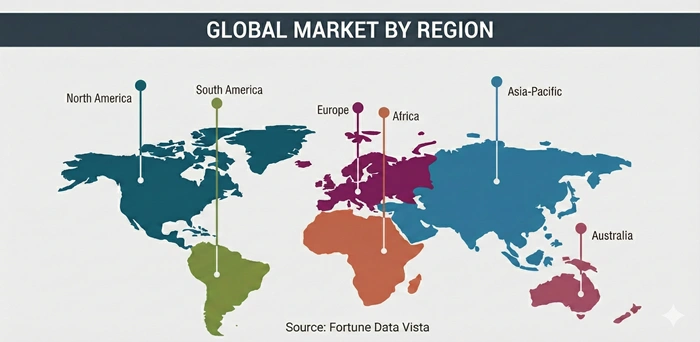
North America: The Dominating Region
North America Leads the Global Chemical API CDMO Market as the World's Largest Pharmaceutical R&D Hub, Generating Consistent High-Value API Development and Commercial Manufacturing Outsourcing Demand From a Dense Ecosystem of Major Pharmaceutical and Biotechnology Companies
North America holds the largest regional share of the global chemical API CDMO market, accounting for approximately 36% of total global revenue in 2026, with a regional CAGR of approximately 7.0% from 2026 to 2033. The United States is the dominant national market, driven by the pharmaceutical and biotechnology industry's enormous and continuously growing R&D investment — which creates a steady pipeline of new API development programs that generate outsourcing demand across process chemistry development, clinical API manufacturing, and commercial supply. Key chemical API CDMO operators serving the North American market include Lonza Group (Switzerland) with multiple U.S. facilities, Cambrex Corporation (USA), Thermo Fisher Scientific / Patheon (USA), and Albany Molecular Research Inc. (USA) — all of which have built deep relationships with major pharmaceutical clients through integrated development-to-commercial API manufacturing service platforms.
The North American chemical API CDMO market is receiving additional structural support from U.S. government API manufacturing reshoring initiatives that are encouraging pharmaceutical companies to diversify their API supply chains toward domestic and allied-nation manufacturing sources. The BIOSECURE Act's provisions restricting pharmaceutical companies from using certain Chinese CDMO operators for U.S. government contract work — and the broader chilling effect on Chinese CDMO usage that pharmaceutical companies are proactively managing to future-proof their supply chains — is creating incremental volume repatriation opportunities for North American and European CDMO operators. Canada contributes to the regional market through its growing biomedical manufacturing sector and university research ecosystem that supports innovative API development outsourcing demand from domestic and international pharmaceutical clients.
Asia Pacific: The Fastest Growing Region
Asia Pacific Is the Fastest Growing Region in the Chemical API CDMO Market, Led by India's World-Dominant Generic API Manufacturing Industry and China's Rapidly Developing Pharmaceutical Chemistry Capabilities That Are Positioning Asian CDMOs as the Global Leaders in Cost-Competitive API Synthesis
Asia Pacific is the fastest-growing regional segment in the chemical API CDMO market, projected to expand at a CAGR of approximately 9.8% from 2026 to 2033 — the highest regional growth rate globally. India is the most commercially significant national growth market, with its pharmaceutical manufacturing industry supplying approximately 20% of global generic medicine volume and operating the world's largest number of U.S. FDA-approved manufacturing facilities outside of the United States. Indian chemical API CDMOs including Divi's Laboratories (India), Jubilant Pharmova (India), Laurus Labs (India), and Piramal Pharma Solutions (India) have built globally competitive commercial API synthesis capacity that serves both generic drug manufacturers and multinational originator pharmaceutical companies — making India the most important single geography for global generic API supply and a progressively important partner for complex and specialty API manufacturing programs from multinational pharmaceutical clients.
China is the second major growth engine in the Asia Pacific chemical API CDMO market, with companies including WuXi AppTec (China) and Zhejiang Jiuzhou Pharmaceutical (China) offering sophisticated chemical synthesis and commercial API manufacturing capabilities across a broad range of molecular complexity levels. The region also benefits from South Korea's expanding pharmaceutical manufacturing sector — with companies including Samsung Biologics (South Korea) broadening their CDMO service portfolios — and Japan's well-established pharmaceutical industry infrastructure that serves both domestic and international pharmaceutical client API outsourcing needs. The Asia Pacific market's combination of cost-competitive manufacturing economics, rapidly improving quality standards, and government investment in pharmaceutical infrastructure creates the most dynamic and high-growth demand environment in the global chemical API CDMO ecosystem.
Report Customization by Region and Country
This Chemical API CDMO Market Report Offers Complete Region-Wise and Country-Wise Customization — Providing Geography-Specific Market Sizing, Regulatory Landscape Analysis, Competitive Intelligence, and Strategic Growth Opportunities Tailored Precisely to Every Region and Country You Need to Analyze
This Chemical API CDMO Market report is available with full customization by region and country, enabling organizations to access precise, geography-specific insights aligned with their strategic focus. The report can be configured to deliver the exact regional depth and market intelligence your business requires — covering market sizing, CAGR forecasts, segment breakdowns, regulatory environment analysis, key player profiles, and actionable strategic opportunities specific to each selected geography.
North America
-
U.S. — Pharmaceutical R&D outsourcing trends, BIOSECURE Act impact on API sourcing, API manufacturing reshoring programs, and leading domestic CDMO competitive landscape
-
Canada — Pharmaceutical manufacturing ecosystem, biomedical research-driven API demand, and market sizing and growth forecast through 2033
-
Mexico — Generic drug manufacturing API demand, nearshoring opportunity assessment, pharmaceutical sector investment trends, and regional CDMO market outlook
Europe
-
U.K. — Post-Brexit pharmaceutical regulatory landscape, MHRA compliance requirements, API CDMO demand from domestic pharmaceutical companies, and leading CDMO operator profiles
-
Germany — Pharmaceutical and specialty chemical manufacturing integration, API CDMO investment activity, domestic pharmaceutical industry outsourcing trends, and competitive landscape analysis
-
France — Pharmaceutical manufacturing regulatory environment, domestic pharmaceutical company API outsourcing demand, and CDMO market sizing and forecast
-
Italy — Generic drug API manufacturing heritage, specialty synthesis capability development, and regional market analysis including CDMO operator profiles
-
Rest of Europe — Scandinavian pharmaceutical innovation, Eastern European API manufacturing growth, and regional competitive dynamics across EU member state markets
Asia Pacific
-
China — API manufacturing scale and capabilities, WuXi AppTec competitive positioning, BIOSECURE Act market impact analysis, regulatory quality upgrade programs, and market outlook
-
India — Generic API manufacturing leadership, Production Linked Incentive scheme impact, FDA-approved facility landscape, and top Indian CDMO operator competitive profiles
-
Japan — Pharmaceutical manufacturing standards, domestic API CDMO market structure, outsourcing trend analysis, and regional market sizing
-
South Korea — Pharmaceutical manufacturing expansion, Samsung Biologics and domestic CDMO landscape, government pharmaceutical investment programs, and market forecast
-
Australia — TGA regulatory environment, pharmaceutical sector API demand, and CDMO market development outlook through 2033
-
Rest of Asia Pacific — Southeast Asian pharmaceutical manufacturing growth, API outsourcing demand expansion, and CDMO market opportunities across Vietnam, Indonesia, and Thailand
Latin America
-
Brazil — ANVISA regulatory framework, generic drug API outsourcing demand, pharmaceutical manufacturing investment, and chemical API CDMO market sizing
-
Argentina — Pharmaceutical manufacturing landscape, API demand trends, and regional CDMO market opportunity analysis
-
Rest of Latin America — Regional pharmaceutical production growth, generic medicine API demand, and CDMO market development across Colombia and Chile
Middle East and Africa (MEA)
-
UAE — Pharmaceutical manufacturing free zone investment, healthcare sector API demand growth, and CDMO market opportunity assessment
-
Saudi Arabia — Vision 2030 pharmaceutical manufacturing localization, API production investment programs, and CDMO market sizing and forecast
-
Rest of MEA — African pharmaceutical manufacturing expansion, generic drug API demand growth, and long-term CDMO market development opportunity across the broader Middle East and Africa region
Each customized Chemical API CDMO Market report delivers targeted intelligence — including country-specific regulatory compliance analysis, pharmaceutical outsourcing program trends, CDMO competitive landscape mapping, and market entry and investment prioritization guidance — providing decision-makers with the precise information they need to build competitive advantages and maximize returns across their chosen geographies.
Top Key Players
-
Lonza Group AG (Switzerland)
-
WuXi AppTec Co. Ltd. (China)
-
Thermo Fisher Scientific Inc. (Patheon) (United States)
-
Divi's Laboratories Ltd. (India)
-
Siegfried Holding AG (Switzerland)
-
Cambrex Corporation (United States)
-
Piramal Pharma Solutions (India)
-
CordenPharma International (Switzerland)
-
Albany Molecular Research Inc. (AMRI) (United States)
-
Jubilant Pharmova Ltd. (India)
-
Laurus Labs Ltd. (India)
-
Recipharm AB (Sweden)
Recent Developments
-
In 2025, Lonza Group announced a CHF 500 million expansion of its chemical API synthesis manufacturing campus at Visp, Switzerland — adding dedicated high-potency API manufacturing capacity and continuous flow chemistry reactor systems that strengthen Lonza's position as the leading global CDMO for complex small molecule API development and commercial manufacturing, responding to strong pharmaceutical client demand for containment-rated API synthesis at commercial scale.
-
In 2025, WuXi AppTec expanded its chemical API manufacturing operations at its Changzhou campus with the addition of over 300 new synthesis reactors and a dedicated high-potency API suite — significantly increasing its commercial API manufacturing capacity to meet growing pharmaceutical client demand while simultaneously navigating the commercial implications of the U.S. BIOSECURE Act by reinforcing its service offerings to non-U.S. government pharmaceutical programs globally.
-
In 2026, Divi's Laboratories commissioned a major new API manufacturing facility at its Kakinada complex in India — equipped with advanced containment reactors, continuous manufacturing capability, and comprehensive environmental control systems — expanding its commercial API synthesis capacity for both generic and specialty API programs and reinforcing its position as India's leading chemical API CDMO operator serving regulated pharmaceutical markets globally.
-
In 2025, Siegfried Holding AG completed a strategic acquisition of a specialized European HPAPI manufacturer — adding dedicated Band 4 and Band 5 containment manufacturing capabilities to Siegfried's European API CDMO service portfolio and positioning the company to capture growing pharmaceutical client demand for reliable, European-based high-potency API manufacturing from oncology drug development programs.
-
In 2026, Piramal Pharma Solutions announced a major capacity expansion of its Riverview, Michigan, USA facility — adding new API synthesis reactors, analytical laboratories, and drug product development infrastructure — reinforcing Piramal's strategic commitment to the North American chemical API CDMO market and supporting pharmaceutical client supply chain reshoring and geographic diversification objectives.
Market Trends
The Accelerating Adoption of Continuous Flow Chemistry and the Growing Pharmaceutical Industry Preference for Integrated Development-to-Commercial API CDMO Partnerships Are the Two Most Commercially Transformative Trends Reshaping the Chemical API CDMO Market Through 2033
Continuous flow chemistry manufacturing is rapidly transitioning from a niche technology explored by a handful of leading CDMO innovators to a mainstream commercial manufacturing approach that major pharmaceutical companies are increasingly mandating or strongly preferring in their CDMO partner evaluations. Flow chemistry offers compelling operational advantages for API synthesis — including superior heat and mass transfer, the ability to safely manage highly exothermic or hazardous reactions that are impractical in batch reactors, reduced equipment footprint, and real-time process analytical data generation — that translate into better API yield, improved purity profiles, and more robust process control documentation for regulatory submissions. The chemical API CDMO operators that have invested early in continuous flow chemistry manufacturing infrastructure — including Lonza, Cambrex, and Siegfried — are positioned to capture growing share of pharmaceutical development programs specifically designed around flow chemistry synthetic routes, creating a competitive advantage that is difficult for less-equipped operators to replicate quickly.
The pharmaceutical industry's growing preference for deeply integrated CDMO partnerships — where a single CDMO manages the chemical API program from early process development through IND-enabling synthesis, clinical manufacturing, and commercial supply — is fundamentally changing how pharmaceutical companies structure their API outsourcing relationships and how leading CDMOs build and market their service platforms. The value of single-vendor accountability, seamless technology transfer from development to commercial scales, and the regulatory submission continuity that integrated partnerships provide is increasingly recognized by pharmaceutical development and supply chain leaders — driving consolidation of outsourcing volume into fewer, fully integrated CDMO partners with demonstrated capability across the complete API development and manufacturing lifecycle. For large chemical API CDMOs with comprehensive integrated service portfolios, this trend creates a powerful and self-reinforcing revenue retention and growth dynamic that compounds over time as integrated programs multiply and deepen.
Segments Covered in the Report
By Type:
-
Innovative API
-
Generic API
By Synthesis Type:
-
Chemical Synthesis
-
Fermentation
-
Semi-Synthesis
By Service Type:
-
Process Development
-
Commercial Manufacturing
-
Analytical and Testing Services
-
Regulatory Support
-
Others
By End User:
-
Pharmaceutical Companies
-
Biotechnology Companies
-
Generic Drug Manufacturers
-
Others
By Region:
-
North America (U.S., Canada, Mexico)
-
Europe (U.K., Germany, France, Italy, Rest of Europe)
-
Asia Pacific (China, India, Japan, South Korea, Australia, Rest of Asia Pacific)
-
Latin America (Brazil, Argentina, Rest of Latin America)
-
Middle East and Africa (UAE, Saudi Arabia, Rest of MEA)
❝ Built for Every Level — From Startups to Industry Giants ❞
Here Is Exactly How This Report Works for You
-
Whether you are a global pharmaceutical or biotechnology company evaluating CDMO partner qualification decisions across North America, Europe, and Asia Pacific; a chemical API CDMO operator benchmarking your competitive positioning, service capabilities, and capacity investment priorities against industry peers; or an institutional investor assessing the long-term commercial growth and margin profile of the chemical API contract development and manufacturing industry, this report delivers granular revenue forecasts by type, synthesis method, service category, end user, and region — combined with detailed competitor revenue analysis, service capability benchmarking, regulatory landscape intelligence, and outsourcing trend analysis that enables confident strategic and capital allocation decisions.
-
This report comprehensively maps the supply-demand dynamics of the chemical API CDMO ecosystem — including pharmaceutical pipeline activity by therapeutic area and molecule complexity, geographic API manufacturing capacity expansion and reshoring trends, regulatory compliance investment and FDA/EMA inspection risk analysis by country, and how geopolitical developments including BIOSECURE Act implementation, U.S.-China trade tensions, and European pharmaceutical supply chain sovereignty initiatives are reshaping global API outsourcing patterns in ways that create both significant risks and major growth opportunities that our analysis equips decision-makers to navigate with clarity and confidence.
-
The full version provides detailed competitor revenue breakdowns by service type and region, CDMO manufacturing capacity utilization and expansion pipeline tracking, pharmaceutical company API outsourcing program monitoring by therapeutic area and molecule class, continuous manufacturing technology adoption forecasting, and a forward-looking assessment of high-potency API, oncology API, and integrated development-to-commercial partnership market opportunities — providing the strategic intelligence needed to capture the full commercial opportunity of one of the pharmaceutical industry's most consistently growing and strategically essential service sectors.
Frequently Asked Questions:
Answer: The chemical API CDMO market is valued at USD 30.67 billion in 2025 and is projected to reach USD 54.13 billion by 2033. It is expected to grow at a CAGR of 7.7% from 2026 to 2033, driven by rising pharmaceutical outsourcing, increasing API complexity, and expanding generic drug manufacturing demand globally.
Answer: North America holds the largest share of the chemical API CDMO market, accounting for approximately 36% of total global revenue in 2026, driven by the United States' position as the world's largest pharmaceutical R&D market and the concentration of leading CDMO operators serving major pharmaceutical and biotechnology company API outsourcing programs. The region's pharmaceutical outsourcing depth, regulatory infrastructure, and API reshoring policy tailwinds are expected to sustain its leadership position through the forecast period.
Answer: The primary growth drivers in the chemical API CDMO market include the pharmaceutical industry's structural shift toward outsourced API manufacturing, the growing complexity of small molecule drug candidates requiring specialized CDMO chemistry expertise, and rising generic drug demand across aging global populations. Government pharmaceutical supply chain reshoring initiatives in North America and Europe, and quality-driven expansion of Asian CDMO capabilities for regulated market outsourcing programs, are additional factors sustaining market momentum through 2033.
Answer: The leading chemical API CDMO market participants include Lonza Group AG, WuXi AppTec, Thermo Fisher Scientific (Patheon), Divi's Laboratories, Siegfried Holding AG, Cambrex Corporation, Piramal Pharma Solutions, CordenPharma, and Jubilant Pharmova — all of which offer comprehensive API process development and commercial manufacturing services. These companies compete on chemistry expertise depth, regulatory compliance track record, manufacturing capacity, geographic reach, and the integration of their development and commercial manufacturing service platforms.
Answer: Continuous flow chemistry is becoming a key differentiator in the chemical API CDMO market, enabling safer handling of hazardous reactions, superior process control, better API purity profiles, and real-time process data generation that strengthens regulatory submissions for FDA and EMA review. CDMO operators including Lonza, Cambrex, and Siegfried are investing heavily in flow chemistry infrastructure to serve growing pharmaceutical client demand for novel API synthetic routes specifically designed around continuous manufacturing processes.