
Chemical Drug CDMO Market Overview
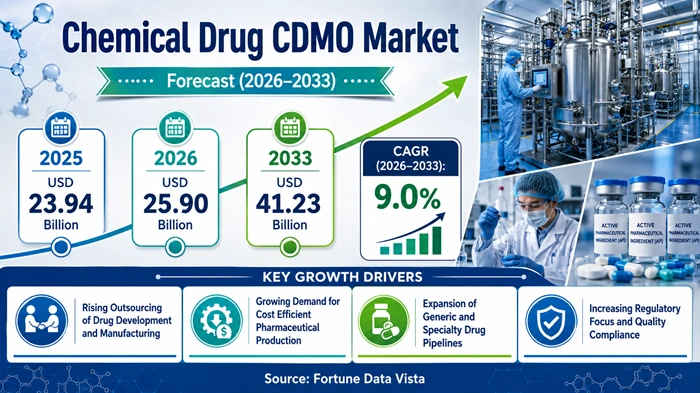
The global chemical drug CDMO market size is valued at USD 23.94 billion in 2025 and is predicted to increase from USD 25.90 billion in 2026 to approximately USD 41.23 billion by 2033, growing at a CAGR of 9.0% from 2026 to 2033.
Chemical drug contract development and manufacturing organizations — which provide pharmaceutical and biotechnology companies with outsourced chemical synthesis, active pharmaceutical ingredient manufacturing, drug product development, and finished dosage form production services — are playing an increasingly central role in the global pharmaceutical supply chain. Rising drug development complexity, growing demand for specialized chemistry and manufacturing expertise, pharmaceutical companies' strategic shift toward asset-light operating models, and the growing importance of cost-competitive API manufacturing in India and China are collectively driving one of the most robust and sustained growth cycles the chemical drug CDMO industry has experienced in recent decades.
AI Impact on the Chemical Drug CDMO Industry
Artificial Intelligence and Advanced Automation Are Transforming Chemical Drug Contract Development and Manufacturing by Enabling Faster Process Development, Predictive Quality Management, and Data-Driven Manufacturing Optimization That Are Redefining Speed, Cost, and Compliance Performance Across the CDMO Industry
Artificial intelligence is beginning to deliver practical and measurable impact across the chemical drug CDMO industry, most meaningfully in the areas of process chemistry development, manufacturing process optimization, and predictive quality management. AI-powered retrosynthesis planning tools — such as those built on large chemical reaction database models — can now identify viable synthetic routes for complex active pharmaceutical ingredients in hours rather than the weeks or months that traditional medicinal chemistry teams require, dramatically compressing the process development timeline and enabling CDMO partners to deliver faster IND-enabling chemistry packages for pharmaceutical company clients. Machine learning models trained on historical manufacturing process data are simultaneously enabling CDMOs to predict critical quality attributes of drug substance batches from real-time process sensor data — identifying potential batch deviations before they result in out-of-specification results and enabling proactive process corrections that reduce batch rejection rates and improve manufacturing yield consistency.
Digital manufacturing platforms that integrate AI-powered process monitoring with automated equipment control, electronic batch record management, and real-time regulatory compliance documentation are progressively transforming the quality and efficiency profile of leading chemical drug CDMO operations. Companies including Lonza Group, Catalent Inc., and Thermo Fisher Scientific (Patheon) are making substantial investments in digital manufacturing infrastructure that connects AI-driven process analytics with GMP-compliant electronic quality management systems — enabling more consistent product quality, faster regulatory submission support, and stronger audit readiness that pharmaceutical company clients increasingly treat as a baseline requirement in CDMO partner selection. As AI manufacturing platforms mature and the competitive advantage they confer becomes more visible, the pace of digital transformation investment across the chemical drug CDMO industry is expected to accelerate significantly over the forecast period.
Growth Factors
The Pharmaceutical Industry's Strategic Shift Toward CDMO Outsourcing, the Growing Complexity of Chemical Drug Development and Synthesis, and the Expanding Pipeline of Small Molecule Drug Candidates Are the Primary Forces Sustaining the Strong Growth Trajectory of the Chemical Drug CDMO Market
The pharmaceutical industry's strategic shift from vertically integrated in-house manufacturing toward selective CDMO outsourcing is the most structurally transformative force driving the chemical drug CDMO market. Large pharmaceutical companies have progressively rationalized their internal manufacturing footprints over the past two decades — divesting older API production facilities, centralizing internal manufacturing on proprietary platforms, and outsourcing commodity chemistry and generic API synthesis to specialized CDMO partners that offer better cost structures, greater flexibility, and access to specialized chemistry capabilities that pharmaceutical companies cannot justify maintaining in-house. This strategic outsourcing trend is not a temporary cost-cutting measure but a fundamental restructuring of the pharmaceutical value chain that creates durable and growing revenue opportunities for CDMO operators with the right chemistry capabilities, regulatory track record, and global manufacturing capacity.
The resurgence of small molecule drug development — driven by new target classes including protein degraders (PROTACs), covalent inhibitors, and RAS pathway inhibitors that have become prominent in oncology drug pipelines — is adding a second powerful demand driver that is specifically positive for chemical drug CDMOs. Small molecule drugs require sophisticated organic chemistry, specialized process development, and complex API synthesis capabilities that CDMO operators are uniquely positioned to provide — and the growing technical complexity of next-generation small molecule drug candidates means that even large pharmaceutical companies with strong internal chemistry capabilities are increasingly partnering with specialized CDMOs that offer expertise in specific synthetic chemistry platforms, such as continuous flow chemistry, asymmetric catalysis, and high-potency API manufacturing. This complexity-driven demand for specialized CDMO chemistry services creates revenue opportunities at premium margins compared to commodity API synthesis — making the chemical drug CDMO industry's growth profile increasingly quality-driven as well as volume-driven.
Market Outlook
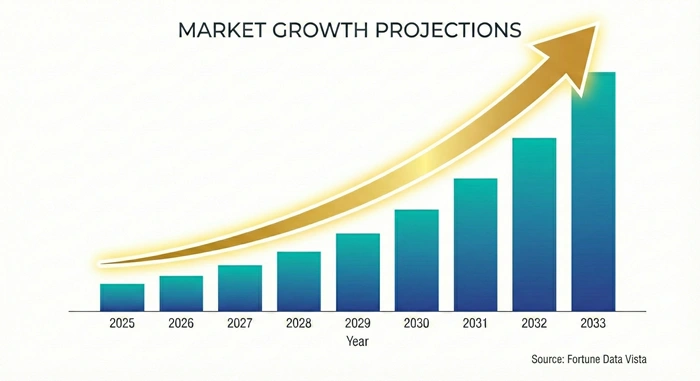
The Chemical Drug CDMO Market Is Set for Consistent Growth Through 2033, Underpinned by the Growing Small Molecule Drug Pipeline, Rising Pharmaceutical Outsourcing, and the Expanding CDMO Manufacturing Capacity Being Built in Asia Pacific That Is Reshaping the Global Pharmaceutical Supply Chain
The long-term growth outlook for the chemical drug CDMO market reflects a remarkably resilient and multi-dimensional demand environment that draws positive momentum from pharmaceutical R&D pipeline activity, generic drug manufacturing economics, specialty chemical synthesis capability development, and the strategic imperatives of major pharmaceutical companies that are fundamentally committed to increasing their reliance on CDMO partners for both development and commercial manufacturing. The growing importance of regulatory compliance as a competitive differentiator — as the FDA, EMA, and other major regulatory agencies increase the scrutiny of API manufacturing practices and supply chain traceability — is further concentrating manufacturing volume in well-resourced, GMP-compliant CDMO operators that have the regulatory infrastructure to support global pharmaceutical clients, creating consolidation dynamics that favor established players and strengthen the long-term market position of leading chemical drug CDMOs.
The Asia Pacific region — particularly India and China — is expected to be the most important driver of capacity expansion in the global chemical drug CDMO market over the forecast period, as both countries continue to invest heavily in pharmaceutical-grade chemical manufacturing infrastructure, chemistry R&D capability, and regulatory quality management systems that progressively qualify their CDMO operators for a broader range of multinational pharmaceutical company outsourcing programs. India's pharmaceutical manufacturing industry — already the world's largest supplier of generic APIs — is moving up the value chain toward specialized small molecule synthesis, high-potency API manufacturing, and integrated drug development services that position Indian CDMOs to capture growing share of the global small molecule outsourcing market from both originators and generic drug manufacturers. This geographic expansion of high-quality chemical drug CDMO capacity is expected to sustain competitive market dynamics and drive continued volume growth across the chemical drug CDMO ecosystem through 2033.
Expert Speaks
-
"Lonza continues to see very strong demand across our chemical synthesis and small molecule CDMO business, driven by the pharmaceutical industry's growing reliance on external partners for both development and commercial manufacturing of complex chemical drug candidates. We are expanding our chemistry and manufacturing capacity to meet this demand, and we see the chemical drug CDMO market as one of the most strategically important growth areas in the pharmaceutical services industry for the foreseeable future." — Albert Bollard, CEO, Lonza Group
-
"Catalent's integrated drug development and manufacturing services business is benefiting from the powerful combination of pharmaceutical outsourcing growth, increasing small molecule drug pipeline complexity, and our customers' need for reliable GMP-compliant manufacturing partners with global reach. We are investing in both capacity expansion and digital manufacturing capabilities to strengthen our position as the preferred CDMO partner for pharmaceutical and biotechnology companies developing chemical drug products." — Alessandro Maselli, CEO, Catalent Inc.
-
"Thermo Fisher's Patheon CDMO business is experiencing robust demand growth driven by the pharmaceutical industry's increasing recognition that specialized CDMO partners deliver faster time-to-clinic, more reliable commercial supply chains, and better cost economics than in-house manufacturing for the majority of chemical drug development and production activities. We see the chemical drug contract development and manufacturing market continuing to grow at attractive rates as pharmaceutical outsourcing penetration deepens across both small and large pharmaceutical company segments." — Marc Casper, CEO, Thermo Fisher Scientific
Key Report Takeaways
-
North America dominates the global chemical drug CDMO market, accounting for approximately 38% of total global revenue in 2026, driven by the United States' position as the world's largest pharmaceutical R&D market, the concentration of major pharmaceutical and biotechnology company headquarters that outsource chemical drug development and manufacturing programs to domestic and international CDMO partners, and the strong commercial presence of leading CDMO operators including Lonza, Catalent, and Thermo Fisher Scientific (Patheon) that serve the U.S. market through integrated drug development and manufacturing service platforms.
-
Asia Pacific is the fastest-growing regional market, expanding at a CAGR of approximately 11.5% from 2026 to 2033, driven by India's and China's rapidly expanding pharmaceutical-grade chemical manufacturing capability, growing regulatory quality compliance investment, and the progressive qualification of Asian CDMO operators for multinational pharmaceutical company outsourcing programs that are relocating both API production and drug product manufacturing to cost-competitive Asian manufacturing partners.
-
Pharmaceutical companies are the dominant end-user segment, contributing approximately 60% of total end-user-based revenue in 2026, as large and mid-size pharmaceutical companies rely on chemical drug CDMOs for both early-stage process development and commercial manufacturing of small molecule drug substances and finished dosage forms, outsourcing the full development-to-commercial manufacturing continuum to CDMO partners as their internal manufacturing footprints continue to rationalize.
-
API manufacturing is the dominant service type segment, accounting for approximately 45% of total service-type-based revenue in 2026, as active pharmaceutical ingredient synthesis represents the highest-value and most technically complex element of chemical drug manufacturing — generating premium service revenue for CDMO operators with specialized chemistry capabilities in continuous flow synthesis, asymmetric catalysis, and high-potency API manufacturing.
-
Small molecule drug substance is the dominant type segment, holding approximately 72% of total type-based revenue in 2026, as small molecule drugs continue to represent the majority of pharmaceutical development pipelines globally and require the organic synthesis, process chemistry, and API manufacturing services that chemical drug CDMOs are specifically organized and equipped to provide.
-
Analytical and testing services is the fastest-growing service type segment, projected to capture approximately 18% of total service-type revenue by 2033 at a CAGR of approximately 12% from 2026 to 2033, driven by growing regulatory requirements for comprehensive analytical characterization and testing documentation across the full drug development and manufacturing lifecycle — creating strong demand for CDMOs that integrate analytical capability with their chemistry and manufacturing service offerings.
Market Scope
| Parameter | Details |
|---|---|
| Market Size by 2033 | USD 41.23 Billion | Market Size by 2026 | USD 25.90 Billion | Market Size by 2025 | USD 23.94 Billion | Market Growth Rate from 2026 to 2033 | CAGR of 9.0% | Dominating Region | North America | Fastest Growing Region | Asia Pacific | Segments Covered | Type, Service Type, End User | Regions Covered | North America, Europe, Asia Pacific, Latin America, Middle East and Africa |
Market Dynamics
Drivers Impact Analysis
Growing Pharmaceutical Outsourcing Penetration, Rising Small Molecule Drug Pipeline Complexity, and the Strategic Investment in High-Potency API and Continuous Flow Chemistry Capabilities by Leading CDMOs Are the Three Most Consequential Forces Driving Growth in the Chemical Drug CDMO Market
| Driver | ≈ % Impact on CAGR Forecast | Geographic Relevance | Impact Timeline |
|---|---|---|---|
| Pharmaceutical company outsourcing model shift toward CDMO partners | ~32% | Global | Short to Long-Term |
| Rising complexity of small molecule drug development pipelines | ~25% | North America, Europe, Asia Pacific | Short to Long-Term |
| Growth of generic drug manufacturing and API outsourcing | ~18% | Asia Pacific, Latin America | Medium to Long-Term |
| Expansion of high-potency API and continuous flow chemistry capabilities | ~12% | North America, Europe | Short to Medium-Term |
| Regulatory quality compliance investment strengthening CDMO qualification | ~8% | Asia Pacific, Latin America | Medium-Term |
| Pharmaceutical supply chain resilience investment post-COVID-19 | ~5% | North America, Europe | Short-Term |
The pharmaceutical outsourcing structural shift is the most foundational driver of growth in the chemical drug CDMO market, operating across all geographies and drug development stages with a consistency and depth that makes it the most reliable and predictable demand driver in the entire CDMO ecosystem. Over the past decade, the average pharmaceutical company's reliance on CDMO partners for API manufacturing has increased from approximately 30% to over 50% of total API requirements — and this outsourcing penetration rate is expected to continue rising as pharmaceutical companies facing pipeline productivity pressure, patent cliff revenue challenges, and investor demands for higher capital efficiency continue to rationalize their internal manufacturing footprints and redirect capital toward R&D, commercial operations, and business development rather than fixed manufacturing assets. For CDMO operators with the right chemistry capabilities and regulatory compliance infrastructure, this structural outsourcing trend creates a self-reinforcing demand growth dynamic that operates largely independently of near-term pharmaceutical market cycles.
The complexity driver operates through a complementary and equally powerful mechanism, creating qualitative as well as quantitative demand growth for chemical drug CDMO services. The emergence of new small molecule drug modalities — including PROTAC protein degraders, macrocyclic peptides, and radioligand therapy components that require multi-step synthetic sequences of significant chemical complexity — is creating demand for CDMO partners with genuinely specialized chemistry expertise that relatively few operators globally can credibly provide. This complexity-driven demand is the most margin-accretive segment of the chemical drug CDMO market, as pharmaceutical companies are willing to pay premium pricing for CDMO partners that reduce development risk, compress timelines, and bring chemistry expertise that is genuinely additive to internal capabilities. The growing proportion of pharmaceutical pipelines composed of complex, molecularly sophisticated small molecule drug candidates is therefore progressively improving the revenue quality of the chemical drug CDMO market even as overall volume grows.
Restraints Impact Analysis
Regulatory Compliance Complexity and Inspection Risk, High Capital Investment Requirements for Specialized Chemistry Manufacturing Capacity, and Supply Chain Dependency Vulnerabilities for Key Chemical Starting Materials Are the Primary Constraints Limiting Faster Growth in the Chemical Drug CDMO Market
| Restraint | ≈ % Impact on CAGR Forecast | Geographic Relevance | Impact Timeline |
|---|---|---|---|
| Regulatory compliance complexity and FDA/EMA inspection risk | ~-28% | Global | Short to Long-Term |
| High capital investment requirements for specialized manufacturing facilities | ~-25% | Developing economies, smaller CDMOs | Medium to Long-Term |
| Raw material and key chemical starting material supply chain vulnerabilities | ~-20% | Global | Short to Medium-Term |
| Intellectual property protection concerns in emerging market CDMO operations | ~-15% | Asia Pacific, Latin America | Medium to Long-Term |
| Talent shortage in specialized process chemistry and regulatory affairs roles | ~-12% | Global | Long-Term |
Regulatory compliance complexity is the most pervasive and structurally significant restraint across the chemical drug CDMO market, creating meaningful barriers to both market entry for newer operators and capacity expansion for established CDMOs. The requirements for GMP-compliant facility design, process validation, analytical method validation, change control documentation, and stability testing across every chemical drug development and manufacturing program create compliance infrastructure costs that are substantial and ongoing — requiring continuous investment in quality management systems, regulatory affairs expertise, and facility maintenance that represents a significant fixed-cost burden that smaller or less well-resourced CDMO operators struggle to sustain while maintaining competitive pricing. The risk of FDA Warning Letters, EMA import alerts, or facility import bans — which have historically disrupted API supply chains and caused significant revenue disruption for affected CDMOs — creates a risk environment that pharmaceutical company clients increasingly mitigate through rigorous CDMO qualification processes and dual-sourcing strategies that concentrate outsourcing volume in fewer, larger, and more compliance-reliable CDMO partners.
The capital intensity of specialized chemical drug manufacturing facilities — particularly those required for high-potency API production, controlled substance synthesis, and continuous flow chemistry operations — creates a meaningful restraint for mid-size and emerging CDMO operators that lack the financial resources to build and qualify the specialized infrastructure these capabilities require. Containment-rated facilities for high-potency API manufacturing can cost tens of millions of dollars to design, construct, equip, and validate to GMP standards before generating their first commercial revenue — creating a capital commitment that requires significant financial strength or long-term pharmaceutical company volume commitments to justify. This capital barrier tends to concentrate high-margin, complex chemistry CDMO work in the largest and best-capitalized CDMO operators, limiting the competitive landscape in the highest-value segments of the chemical drug CDMO market.
Opportunities Impact Analysis
The Growing Demand for Integrated Drug Substance and Drug Product CDMO Services, the Expansion of Continuous Manufacturing Technology Adoption, and the Strategic Reshoring of Pharmaceutical Supply Chains in North America and Europe Are Creating Significant New Revenue Opportunities in the Chemical Drug CDMO Market
| Opportunity | ≈ % Impact on CAGR Forecast | Geographic Relevance | Impact Timeline |
|---|---|---|---|
| Integrated drug substance and drug product one-stop CDMO services | ~26% | North America, Europe, Asia Pacific | Short to Long-Term |
| Continuous manufacturing technology adoption for API production | ~22% | North America, Europe | Short to Medium-Term |
| Pharmaceutical supply chain reshoring programs in U.S. and Europe | ~20% | North America, Europe | Short to Medium-Term |
| High-potency API and oncology drug substance manufacturing expansion | ~18% | Global | Medium to Long-Term |
| Indian and Chinese CDMO quality upgrade programs expanding multinational client base | ~14% | Asia Pacific | Long-Term |
The pharmaceutical industry's growing preference for integrated CDMO partners that can manage the full drug development and manufacturing continuum — from early-stage process chemistry development through clinical manufacturing and commercial API supply — represents one of the most commercially significant revenue opportunities in the chemical drug CDMO market. Pharmaceutical companies managing complex small molecule development programs prefer the operational simplicity, IP security, and accountability clarity of single-CDMO development-to-commercial partnerships over the multi-vendor management complexity of using separate CDMOs for development, clinical, and commercial manufacturing stages. Leading chemical drug CDMOs that have built genuinely integrated service capabilities — combining process chemistry development, API manufacturing, drug product formulation, analytical services, and regulatory submission support under one roof — are capturing disproportionate share of the highest-value pharmaceutical outsourcing programs and commanding the premium pricing that integrated service value justifies.
The reshoring of pharmaceutical API manufacturing to North America and Europe — driven by the COVID-19 pandemic's exposure of supply chain vulnerabilities from concentrated Asian API production, and reinforced by government policy initiatives including the U.S. BIOSECURE Act and European pharmaceutical strategy legislation — creates a major structural opportunity for CDMO operators with existing North American and European manufacturing capacity. Government incentive programs for domestic pharmaceutical manufacturing investment in the United States and European Union are further encouraging capacity expansion by established CDMOs and new entrants who are building pharmaceutical-grade chemical manufacturing facilities in geographies that were previously uncompetitive with Asian API production costs. While the cost gap between North American/European and Indian/Chinese API manufacturing has narrowed, the supply chain security premium that pharmaceutical companies are increasingly willing to pay for regionally sourced APIs makes domestic manufacturing economically viable for an expanding range of chemical drug products.
Segment Analysis
By Type: Small Molecule Drug Substance
Small Molecule Drug Substance Commands the Largest Share of the Chemical Drug CDMO Market, Anchored by the Enduring Dominance of Small Molecule Drugs in Global Pharmaceutical Pipelines and the High-Value Chemistry Development and API Synthesis Services These Drug Candidates Require
Small molecule drug substance is the dominant type segment within the chemical drug CDMO market, accounting for approximately 72% of total type-based revenue in 2026, and it is expected to maintain this dominant position through the forecast period driven by the structural depth and breadth of small molecule drug development activity in both innovator and generic pharmaceutical pipelines globally. Small molecule APIs require organic synthesis processes — including multi-step chemical reactions, chiral resolution, crystallization, and isolation procedures — that demand highly specialized process chemistry expertise, pharmaceutical-grade chemical manufacturing facilities, and rigorous analytical characterization capabilities that purpose-built chemical drug CDMOs are specifically organized to deliver. The chemical drug CDMO market's small molecule segment is projected to grow at a CAGR of approximately 8.5% from 2026 to 2033, sustained by the continuous replenishment of pharmaceutical development pipelines with new small molecule drug candidates targeting oncology, central nervous system, cardiovascular, and infectious disease indications that generate consistent new CDMO development program starts. North America is the largest and most valuable regional market for small molecule CDMO services, with leading operators including Lonza Group (Switzerland), Cambrex Corporation (USA), and Almac Group (U.K.) serving major pharmaceutical clients through integrated synthesis, process development, and GMP manufacturing service platforms.
Asia Pacific is the fastest-growing regional market for small molecule drug substance CDMO services, driven by India's emergence as the world's leading generic API supplier and China's progressive development of both generic and innovator small molecule synthesis capabilities. Indian CDMOs including Divi's Laboratories (India) and Jubilant Pharmova (India) have built globally competitive small molecule API manufacturing operations that serve both generic drug manufacturers and increasingly multinational originator pharmaceutical companies seeking cost-competitive API supply. The Indian government's Production Linked Incentive scheme for pharmaceutical manufacturing is further accelerating capacity expansion and quality capability development among Indian CDMOs — progressively qualifying an expanding number of Indian facilities for US FDA and EU GMP certification that enables access to regulated market pharmaceutical company outsourcing programs.
By Service Type: API Manufacturing
API Manufacturing Generates the Highest Revenue in the Chemical Drug CDMO Market, Reflecting the High Technical Complexity, Premium Pricing, and Consistent Volume Demand for Pharmaceutical-Grade Active Pharmaceutical Ingredient Production Across Both Development and Commercial Stage Programs
API manufacturing is the dominant service type within the chemical drug CDMO market, accounting for approximately 45% of total service-type revenue in 2026. Active pharmaceutical ingredient synthesis is the most technically demanding, capital-intensive, and highest-margin service category in the chemical drug CDMO ecosystem — requiring pharmaceutical-grade synthetic organic chemistry capabilities, extensive analytical characterization infrastructure, validated GMP manufacturing processes, and comprehensive regulatory documentation packages that support pharmaceutical client IND and NDA/MAA filing requirements. The API manufacturing segment within the chemical drug CDMO market is projected to expand at a CAGR of approximately 8.8% from 2026 to 2033, driven by the growing volume and complexity of pharmaceutical development pipelines, increasing generic drug API outsourcing, and the progressive shift of multinational pharmaceutical companies toward single-source CDMO partners that can manage API development and commercial supply as an integrated service. Europe is a major and mature API manufacturing CDMO market, with companies including Siegfried Holding AG (Switzerland), Aenova Group (Germany), and Recipharm AB (Sweden) operating extensive pharmaceutical-grade API synthesis and manufacturing capacity across European facilities that serve both European and global pharmaceutical clients.
Asia Pacific is simultaneously the fastest-growing regional market for API manufacturing CDMO services and the most important from a volume and cost economics perspective. China's pharmaceutical chemical manufacturing industry — historically focused on bulk commodity API production — is progressively upgrading toward more complex synthesis and higher regulatory compliance standards, expanding the range of API types that Chinese CDMOs can produce for multinational pharmaceutical clients. Companies including WuXi AppTec (China) and Porton Fine Chemicals (China) have built globally competitive API manufacturing capabilities across a broad range of synthetic complexity levels, making them some of the most commercially significant CDMO operators in the global chemical drug API manufacturing market. The API manufacturing segment's combination of high service value, consistent repeat volume from commercial supply programs, and growing complexity-driven demand makes it the most strategically important segment in the chemical drug CDMO market for both established operators and investors evaluating the industry's long-term growth profile.
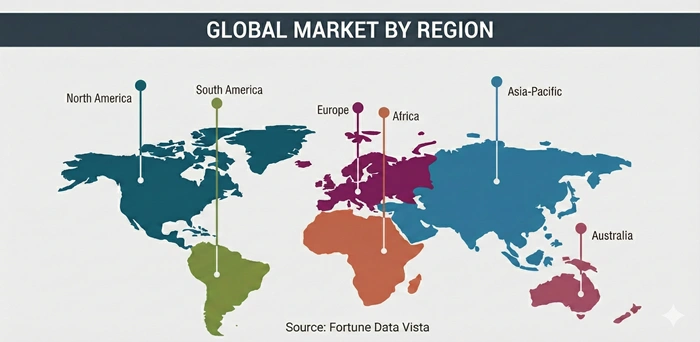
Regional Insights
North America: The Dominating Region
North America Leads the Global Chemical Drug CDMO Market Through the United States' Position as the World's Largest Pharmaceutical R&D Hub, Its Dense Pharmaceutical and Biotechnology Company Ecosystem, and the Concentration of Leading CDMO Operators With Integrated Chemistry Development and GMP Manufacturing Capabilities
North America holds the largest share of the global chemical drug CDMO market, accounting for approximately 38% of total global revenue in 2026, with a regional CAGR of approximately 8.2% from 2026 to 2033. The United States is the dominant national market, anchored by the pharmaceutical and biotechnology industry's enormous R&D investment — which generates a continuous flow of new small molecule drug development programs that create demand for process chemistry development, clinical API manufacturing, and commercial drug substance supply from domestic and international CDMO partners. Leading chemical drug CDMO operators serving the North American market include Catalent Inc. (USA), Thermo Fisher Scientific / Patheon (USA), Cambrex Corporation (USA), and Albany Molecular Research Inc. — AMRI (USA) — all of which have built integrated chemistry development and GMP manufacturing service platforms across multiple U.S. facilities that serve the full range of pharmaceutical and biotechnology company CDMO outsourcing needs.
Canada contributes meaningfully to the regional market through its growing pharmaceutical manufacturing sector and its strong biomedical research ecosystem — particularly in Montreal and Toronto — that generates CDMO demand from both domestic biotech companies and international pharmaceutical clients operating North American development programs. The North American chemical drug CDMO market is further being strengthened by the pharmaceutical supply chain reshoring trend — driven by U.S. government initiatives including the BIOSECURE Act provisions and domestic pharmaceutical manufacturing incentive programs — that is encouraging capacity expansion by existing North American CDMO operators and providing a policy tailwind that is expected to attract new pharmaceutical-grade API manufacturing investment into the region over the forecast period.
Asia Pacific: The Fastest Growing Region
Asia Pacific Is the Fastest Growing Regional Market for Chemical Drug CDMO Services, Powered by India's World-Leading Generic API Manufacturing Industry, China's Expanding Pharmaceutical Chemistry Capabilities, and the Progressive Quality Upgrade of Asian CDMO Operators for Multinational Pharmaceutical Outsourcing Programs
Asia Pacific is the fastest-growing regional segment within the chemical drug CDMO market, projected to expand at a CAGR of approximately 11.5% from 2026 to 2033. India is the single most important national market driving regional growth, as the country's pharmaceutical manufacturing industry — which supplies approximately 20% of global generic medicine volumes and is the world's largest supplier of generic APIs by volume — continues to invest heavily in both manufacturing capacity expansion and quality management system enhancement that progressively qualifies more Indian CDMO facilities for the highest regulatory standards. Indian chemical drug CDMOs including Divi's Laboratories (India), Jubilant Pharmova (India), and Laurus Labs (India) have established internationally competitive API manufacturing operations serving both generic drug manufacturers and innovator pharmaceutical companies globally — making India the most commercially significant emerging market in the global chemical drug CDMO ecosystem.
China represents the second major growth engine within Asia Pacific, with companies including WuXi AppTec (China), Porton Fine Chemicals (China), and Zhejiang Jiuzhou Pharmaceutical (China) developing increasingly sophisticated chemical synthesis and API manufacturing capabilities that position Chinese CDMOs to capture growing share of complex small molecule outsourcing programs from multinational pharmaceutical companies. The chemical drug CDMO market in Asia Pacific also benefits from the region's rapidly expanding pharmaceutical consumption — particularly in China, India, Japan, and South Korea — which is driving growing domestic generic drug production demand that sustains high-volume API manufacturing activity across regional CDMO operators even as they simultaneously develop capabilities to serve international regulated market pharmaceutical clients.
Report Customization by Region and Country
This Chemical Drug CDMO Market Report Offers Full Region-Wise and Country-Wise Customization — Delivering Precise, Geography-Specific Market Sizing, Regulatory Landscapes, Competitive Intelligence, and Strategic Opportunities Tailored to Every Region and Country Covered in This Report
This Chemical Drug CDMO Market report is available with full customization by region and country, enabling organizations to access precise, geography-specific insights tailored to their unique strategic focus. The report can be configured to deliver exactly the regional depth and market intelligence your business requires — covering market sizing, CAGR forecasts, segment breakdowns, regulatory frameworks, key player profiles, recent outsourcing program developments, and actionable strategic opportunities specific to each selected geography.
North America
-
U.S. — Pharmaceutical R&D outsourcing trends, API manufacturing reshoring programs, BIOSECURE Act impact analysis, and leading CDMO competitive landscape
-
Canada — Biomedical research ecosystem CDMO demand, pharmaceutical manufacturing investment trends, and regional market sizing and forecast
-
Mexico — Pharmaceutical manufacturing expansion, generic drug production API demand, and nearshoring opportunity assessment for chemical drug CDMO services
Europe
-
U.K. — Post-Brexit pharmaceutical regulatory landscape, drug substance CDMO demand, MHRA compliance requirements, and key domestic CDMO operator profiles
-
Germany — Pharmaceutical and specialty chemical manufacturing integration, API CDMO investment trends, and leading German CDMO operator competitive landscape
-
France — Pharmaceutical manufacturing regulatory framework, CDMO capacity expansion programs, and domestic pharmaceutical company outsourcing demand analysis
-
Italy — Generic drug API manufacturing heritage, CDMO service expansion into complex synthesis, and regional market sizing and growth forecast
-
Rest of Europe — Scandinavian CDMO innovation, Eastern European pharmaceutical manufacturing growth, and regional competitive dynamics across EU member markets
Asia Pacific
-
China — API manufacturing capacity scale and scope, regulatory quality upgrade programs, domestic pharmaceutical demand growth, and leading CDMO company profiles including WuXi AppTec and Porton
-
India — Generic API manufacturing leadership, regulatory compliance investment trends, Production Linked Incentive scheme impact, and leading CDMO operator competitive landscape
-
Japan — Pharmaceutical manufacturing regulatory standards, domestic CDMO market structure, and outsourcing trend analysis for Japanese pharmaceutical companies
-
South Korea — Pharmaceutical manufacturing expansion, biotech CDMO demand growth, and Korean government pharmaceutical industry investment programs
-
Australia — Pharmaceutical CDMO market sizing, regulatory framework analysis, and domestic and multinational CDMO service demand outlook
-
Rest of Asia Pacific — Southeast Asian pharmaceutical manufacturing growth, API outsourcing demand, and CDMO market development opportunities across Vietnam, Indonesia, and Thailand
Latin America
-
Brazil — ANVISA regulatory framework, generic drug API demand, domestic pharmaceutical manufacturing growth, and CDMO market sizing forecast
-
Argentina — Pharmaceutical manufacturing landscape, API outsourcing demand, and emerging CDMO market opportunities
-
Rest of Latin America — Regional pharmaceutical production growth, generic drug manufacturing API demand, and CDMO market development opportunities across Colombia and Chile
Middle East and Africa (MEA)
-
UAE — Pharmaceutical manufacturing free zone investment, healthcare sector growth driving API demand, and CDMO market opportunity assessment
-
Saudi Arabia — Vision 2030 pharmaceutical manufacturing localization programs, API demand growth, and CDMO investment opportunity landscape
-
Rest of MEA — African pharmaceutical manufacturing expansion, generic medicine API demand growth, and long-term CDMO market development opportunity across the broader Middle East and Africa region
Each customized Chemical Drug CDMO Market report delivers targeted intelligence — including country-specific regulatory and compliance environment analysis, key pharmaceutical outsourcing program trends, CDMO competitive landscape mapping, and market entry and investment prioritization guidance — providing decision-makers with the precise information they need to build competitive advantages and maximize returns in their chosen chemical drug CDMO markets worldwide.
Top Key Players
-
Lonza Group AG (Switzerland)
-
Catalent Inc. (United States)
-
Thermo Fisher Scientific Inc. (Patheon) (United States)
-
WuXi AppTec Co. Ltd. (China)
-
Siegfried Holding AG (Switzerland)
-
Cambrex Corporation (United States)
-
Almac Group (United Kingdom)
-
Recipharm AB (Sweden)
-
Jubilant Pharmova Ltd. (India)
-
Aenova Group GmbH (Germany)
-
Divi's Laboratories Ltd. (India)
-
Porton Fine Chemicals Ltd. (China)
Recent Developments
-
In 2025, Lonza Group announced a major expansion of its Visp, Switzerland synthesis and API manufacturing campus — adding dedicated high-potency API and continuous flow chemistry manufacturing capacity with a capital investment exceeding USD 500 million — reinforcing its position as the world's leading chemical drug CDMO and substantially increasing its ability to serve pharmaceutical company demand for complex small molecule API synthesis and GMP manufacturing.
-
In 2025, Catalent Inc. was acquired by Novo Holdings — the investment arm of the Novo Nordisk Foundation — in a landmark USD 16.5 billion transaction that represents one of the largest CDMO acquisitions in industry history, combining Catalent's integrated drug development and manufacturing platform with Novo Holdings' long-term pharmaceutical industry investment commitment to create a significantly more competitive and strategically positioned chemical drug contract manufacturing organization.
-
In 2026, WuXi AppTec announced a strategic capacity expansion of its API synthesis and chemical manufacturing operations across its Changzhou and Shanghai manufacturing campuses — adding over 200 additional chemical synthesis reactors and expanding analytical laboratory capacity — in response to growing pharmaceutical company demand for WuXi's chemistry development and GMP API manufacturing services across both Western and Asian pharmaceutical client bases.
-
In 2025, Siegfried Holding AG completed the acquisition of a specialized European API manufacturer with established capabilities in controlled substance synthesis and complex multi-step chemical synthesis — expanding Siegfried's chemical drug CDMO service portfolio into new high-value chemistry capability areas and strengthening its competitive position in the European pharmaceutical outsourcing market.
-
In 2026, Thermo Fisher Scientific (Patheon) expanded its integrated chemical drug development and manufacturing service offering through a new Drug Product Design Center in the United States — combining early formulation development, small molecule API characterization, and integrated drug product manufacturing services under one facility to serve pharmaceutical clients seeking comprehensive development-to-commercial CDMO partnerships.
Market Trends
The Growing Adoption of Continuous Flow Chemistry Manufacturing and the Accelerating Demand for Integrated Development-to-Commercial CDMO Partnerships Are the Two Most Commercially Significant Trends Reshaping the Chemical Drug CDMO Market Through 2033
Continuous flow chemistry manufacturing — which processes chemical reactions in a continuous stream through tube or microreactor systems rather than in traditional batch stirred-tank reactors — is rapidly becoming one of the most strategically important technology differentiators in the chemical drug CDMO market. Continuous manufacturing offers compelling advantages over batch synthesis for many pharmaceutical API processes, including faster heat and mass transfer, more precise reaction control, smaller equipment footprint, improved safety for hazardous reactions, and the ability to generate real-time process analytical data that supports FDA and EMA continuous manufacturing regulatory submissions. Leading chemical drug CDMOs including Lonza, Cambrex, and Thermo Fisher Scientific are investing heavily in continuous flow chemistry manufacturing capabilities — both to differentiate their service offerings from less-equipped competitors and to meet the growing demand from pharmaceutical clients whose newer drug development programs are specifically designed around continuous manufacturing process chemistry.
The pharmaceutical industry's preference for deeply integrated, development-to-commercial CDMO partnerships — where a single CDMO partner manages a drug candidate from early-stage process chemistry development through IND-enabling API synthesis, clinical manufacturing, and ultimately commercial drug substance supply — is reshaping the competitive dynamics of the chemical drug CDMO market in ways that strongly favor large, fully integrated operators at the expense of smaller, stage-specialized CDMOs. Pharmaceutical companies increasingly value the risk reduction, IP security, timeline predictability, and technology transfer efficiency that a single-partner development-to-commercial model provides — and they are consolidating their outsourcing portfolios into smaller numbers of preferred CDMO partners with the integrated capabilities to serve the full program lifecycle. For large chemical drug CDMOs with comprehensive service portfolios, this trend creates a powerful mechanism for long-term revenue retention and program volume growth that compounds over time as integrated partnerships deepen and expand across multiple drug development programs.
Segments Covered in the Report
By Type:
-
Small Molecule Drug Substance
-
Large Molecule Drug Substance
By Service Type:
-
API Manufacturing
-
Finished Dosage Form Manufacturing
-
Drug Product Development
-
Analytical and Testing Services
-
Others
By End User:
-
Pharmaceutical Companies
-
Biotechnology Companies
-
Generic Drug Manufacturers
-
Others
By Region:
-
North America (U.S., Canada, Mexico)
-
Europe (U.K., Germany, France, Italy, Rest of Europe)
-
Asia Pacific (China, India, Japan, South Korea, Australia, Rest of Asia Pacific)
-
Latin America (Brazil, Argentina, Rest of Latin America)
-
Middle East and Africa (UAE, Saudi Arabia, Rest of MEA)
❝ Built for Every Level — From Startups to Industry Giants ❞
Here Is Exactly How This Report Works for You
-
Whether you are a global pharmaceutical company evaluating CDMO partner qualification and outsourcing program expansion across North America, Europe, and Asia Pacific; a chemical drug CDMO operator assessing competitive positioning and capacity investment priorities; or an institutional investor analyzing the long-term revenue growth and margin profile of the chemical drug contract development and manufacturing industry, this report delivers granular revenue forecasts by type, service category, end user, and region — combined with detailed competitor revenue analysis, service capability benchmarking, regulatory landscape intelligence, and outsourcing trend analysis that enables confident strategic and capital allocation decisions.
-
This report comprehensively maps the supply-demand dynamics of the chemical drug CDMO ecosystem — including pharmaceutical pipeline activity by disease area and molecule type, geographic API manufacturing capacity expansion trends, regulatory compliance investment and inspection risk analysis by country, and how geopolitical factors including U.S.-China trade tensions, BIOSECURE Act implementation, and European pharmaceutical supply chain sovereignty initiatives are reshaping global CDMO outsourcing patterns in ways that create both risks and growth opportunities that our analysis equips decision-makers to navigate with confidence.
-
The full version provides detailed competitor revenue breakdowns by service type and region, CDMO capacity utilization and expansion pipeline analysis, pharmaceutical company outsourcing program tracking by therapeutic area, continuous manufacturing technology adoption forecasting, and forward-looking assessment of high-potency API, controlled substance synthesis, and integrated development-to-commercial partnership market opportunities — providing decision-makers at pharmaceutical companies, CDMO operators, investors, and specialty chemical manufacturers with the strategic intelligence needed to capture the full commercial opportunity of one of the pharmaceutical industry's most consistently growing and strategically important service market segments.
Frequently Asked Questions:
Answer: The chemical drug CDMO market is valued at USD 23.94 billion in 2025 and is projected to reach USD 41.23 billion by 2033. It is expected to grow at a CAGR of 9.0% from 2026 to 2033, driven by rising pharmaceutical outsourcing, growing small molecule drug pipeline complexity, and expanding CDMO manufacturing capacity in Asia Pacific.
Answer: North America dominates the chemical drug CDMO market with approximately 38% of total global revenue in 2026, driven by the United States' position as the world's largest pharmaceutical R&D market and the concentration of leading CDMO operators including Catalent, Lonza, and Thermo Fisher Scientific. The region's strong regulatory compliance infrastructure and pharmaceutical company outsourcing demand make it the most commercially valuable geography in the global CDMO industry.
Answer: The primary growth drivers in the chemical drug CDMO market include the pharmaceutical industry's strategic outsourcing shift toward CDMO partners for both development and commercial manufacturing, the growing technical complexity of small molecule drug candidates that require specialized chemistry expertise, and the expansion of generic API manufacturing demand in Asia Pacific. Supply chain reshoring initiatives in North America and Europe are adding a further demand layer by encouraging pharmaceutical-grade chemical manufacturing capacity investment in these regions.
Answer: The leading chemical drug CDMO market participants include Lonza Group AG, Catalent Inc., Thermo Fisher Scientific (Patheon), WuXi AppTec, Siegfried Holding AG, Cambrex Corporation, Almac Group, and Recipharm AB — all of which offer integrated chemistry development and GMP API manufacturing services across multiple global facilities. These companies compete on chemistry expertise, regulatory compliance track record, manufacturing capacity, geographic reach, and the breadth of their integrated development-to-commercial service offerings.
Answer: Continuous flow chemistry is becoming one of the most significant technology differentiators in the chemical drug CDMO market, offering pharmaceutical clients faster reaction control, improved process safety, smaller manufacturing footprints, and real-time process analytical data that supports regulatory submissions for next-generation API manufacturing processes. Leading CDMOs including Lonza, Cambrex, and Thermo Fisher Scientific are investing heavily in continuous manufacturing capabilities to serve growing pharmaceutical client demand for CDMO partners with this specialized chemistry capability.