
Chemical Protective Gloves Market Overview
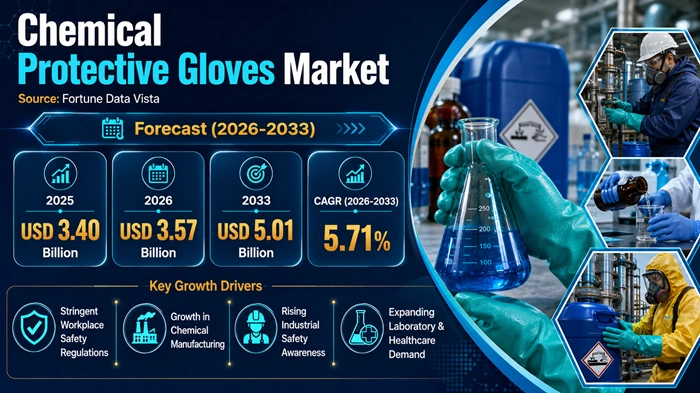
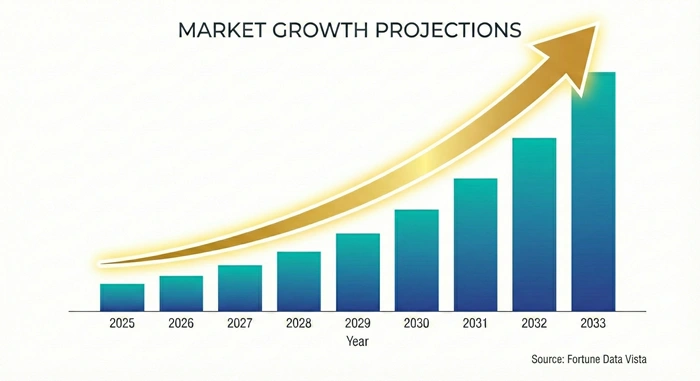
The global chemical protective gloves market size is valued at USD 3.40 billion in 2025 and is predicted to increase from USD 3.57 billion in 2026 to approximately USD 5.01 billion by 2033, growing at a CAGR of 5.71% from 2026 to 2033.
This steady expansion is being shaped by tightening workplace safety regulations, rising chemical handling activity across manufacturing and healthcare, and growing awareness among employers about the long-term cost of workplace injuries. As industries such as oil and gas, pharmaceuticals, and agriculture continue expanding their chemical-intensive operations, demand for reliable hand protection equipment is climbing steadily across both developed and emerging economies.
AI Impact on the Chemical Protective Gloves Industry
Smart Manufacturing and Predictive Quality Control Are Reshaping How Chemical Protective Gloves Are Designed, Tested, and Brought to Market — Fundamentally Changing Production Reliability Across the Industry
Artificial intelligence is beginning to influence how chemical protective glove manufacturers approach product design and quality assurance, particularly through AI-assisted material testing that can predict how different polymer blends will perform against specific chemical exposures long before physical prototypes are built. This capability is helping manufacturers shorten development cycles for new glove formulations while also reducing the number of costly physical trials needed to validate chemical resistance ratings. Companies that have adopted these predictive testing tools are bringing improved products to market faster than competitors relying solely on traditional laboratory testing methods.
On the production side, AI-powered visual inspection systems are increasingly being deployed on glove manufacturing lines to detect microscopic defects such as pinholes or uneven coating thickness that human inspectors might miss, which is particularly important given that even tiny manufacturing flaws can compromise a glove's chemical barrier properties. This shift toward automated quality control is helping manufacturers maintain more consistent safety standards at scale, which matters enormously in a product category where failure can directly expose workers to hazardous chemical injury. As these AI-driven manufacturing improvements become more widespread, they are gradually raising the baseline quality expectations across the broader chemical protective gloves market.
Growth Factors
Stricter Workplace Safety Regulations and Expanding Industrial Chemical Use Continue Driving Steady Demand Across Multiple Sectors
The most influential growth factor behind rising demand in the chemical protective gloves market is the continued tightening of occupational safety regulations across major industrial economies, which increasingly mandate specific hand protection standards for workers handling hazardous substances. Regulatory bodies in North America and Europe have progressively raised compliance expectations for chemical handling industries, pushing employers to replace older protective equipment with gloves that meet updated resistance certifications. This regulatory pressure is proving to be a durable growth driver since compliance requirements rarely loosen once established, creating consistent replacement demand across covered industries.
A second significant growth factor is the expanding scale of chemical-intensive industrial activity in sectors like pharmaceuticals, agriculture, oil and gas, and specialty chemical manufacturing, particularly in developing economies experiencing rapid industrialization. As these industries grow, so does the workforce exposed to hazardous chemicals during production, handling, and maintenance activities, directly expanding the pool of workers who require certified chemical protective gloves. This combination of tightening regulation in mature markets and expanding industrial exposure in emerging markets continues to support broad-based growth across the entire chemical protective gloves market.
Market Outlook
Sustainable Materials and Disposable Glove Innovation Are Expected to Define the Next Phase of Category Growth Through 2033
Looking ahead through the forecast period, the chemical protective gloves industry is expected to see meaningful innovation around sustainable and biodegradable glove materials, as manufacturers respond to growing pressure from both regulators and environmentally conscious industrial buyers to reduce the environmental footprint of disposable protective equipment. Companies that successfully develop chemical-resistant materials with improved biodegradability, without compromising on protective performance, are likely to capture growing interest from large industrial buyers seeking to align procurement decisions with corporate sustainability commitments. This shift represents a meaningful evolution for a product category that has historically prioritized performance almost exclusively over environmental considerations.
At the same time, continued growth in single-use, disposable glove formats is expected to persist, driven by hygiene-conscious sectors such as pharmaceuticals, food processing, and healthcare that require frequent glove changes to prevent cross-contamination. Manufacturers are increasingly focused on improving the comfort and dexterity of disposable chemical protective gloves without sacrificing barrier protection, since worker compliance often depends heavily on how comfortable equipment feels during extended wear. Companies balancing sustainability innovation with continued performance improvement are best positioned to capture growing demand across the broader chemical protective gloves market through 2033.
Expert Speaks
-
"Workplace safety compliance is no longer viewed as a cost center by our industrial customers, it is increasingly seen as core to operational risk management." — CEO, Honeywell International Inc
-
"We continue to invest heavily in material science because chemical resistance performance genuinely differentiates our products in a market where worker safety outcomes matter enormously." — CEO, Ansell Limited
-
"Sustainability and protective performance are no longer competing priorities for us, our customers expect both, and that is shaping our entire product development roadmap." — CEO, 3M Company
Key Report Takeaways
-
North America leads the global chemical protective gloves market, holding approximately 34% market share in 2025, supported by strict occupational safety regulations, strong industrial chemical handling activity, and high compliance enforcement across manufacturing sectors
-
Asia Pacific is the fastest-growing region, projected to expand at a CAGR near 8% through 2033, driven by rapid industrialization, expanding chemical manufacturing capacity, and improving worker safety awareness across developing economies
-
Large industrial manufacturers and chemical processing companies represent the dominant customer base, relying on certified chemical protective gloves to meet regulatory compliance and reduce workplace injury liability
-
Chemical and petrochemical processing applications contribute the most to overall demand, given the high frequency of direct chemical exposure faced by workers in these environments
-
Nitrile-based gloves remain the most widely adopted material type, valued for their strong balance of chemical resistance, dexterity, and cost efficiency across diverse industrial applications
-
Disposable chemical protective gloves will grow the fastest among product type segments, holding close to 28% market share with a CAGR near 7.5% through the forecast period, driven by expanding hygiene-conscious use in pharmaceuticals and healthcare
Market Scope
| Parameter | Details |
|---|---|
| Market Size by 2033 | USD 5.01 Billion | Market Size by 2026 | USD 3.57 Billion | Market Size by 2025 | USD 3.40 Billion | Market Growth Rate from 2026 to 2033 | CAGR of 5.71% | Dominating Region | North America | Fastest Growing Region | Asia Pacific | Segments Covered | Material Type, Product Type, End Use, Region | Regions Covered | North America, Europe, Asia Pacific, Latin America, Middle East & Africa |
Market Dynamics
Drivers Impact Analysis
Regulatory Compliance Pressure and Expanding Industrial Chemical Exposure Remain the Two Strongest Forces Behind Steady Market Momentum
| Driver | (≈) % Impact on CAGR Forecast | Geographic Relevance | Impact Timeline |
|---|---|---|---|
| Tightening occupational safety regulations for chemical handling | ~35% | North America, Europe, growing in Asia Pacific | Short to long-term |
| Expanding chemical and petrochemical manufacturing activity | ~28% | Global, led by Asia Pacific, Middle East | Medium to long-term |
| Rising demand from pharmaceutical and healthcare sectors | ~21% | Global | Short to medium-term |
| Growing awareness of workplace injury liability costs | ~16% | Global | Medium-term |
Tightening occupational safety regulations continue to serve as the primary engine behind demand growth in the chemical protective gloves market, as governments across North America and Europe steadily raise compliance requirements for industries that handle hazardous chemicals on a regular basis. This regulatory momentum creates durable replacement demand, since compliant employers must consistently supply certified protective equipment rather than treating it as a one-time purchase, and non-compliance carries increasingly significant financial and legal consequences.
Expanding chemical and petrochemical manufacturing activity represents the second major driver, particularly as production capacity continues growing across Asia Pacific and the Middle East to meet rising global demand for industrial chemicals, plastics, and specialty compounds. This expansion directly increases the number of workers exposed to hazardous substances during production and handling, translating into higher unit demand for chemical protective gloves across these rapidly industrializing regions. Rising pharmaceutical and healthcare sector demand further reinforces this trend, as strict contamination control protocols require frequent glove changes across laboratory and clinical settings handling reactive or hazardous compounds.
Restraints Impact Analysis
Raw Material Price Volatility and Competition from Low-Cost Substitutes Continue Constraining Margin Growth
| Restraint | (≈) % Impact on CAGR Forecast | Geographic Relevance | Impact Timeline |
|---|---|---|---|
| Volatility in raw material costs, particularly nitrile and rubber latex | ~34% | Global | Short to medium-term |
| Competition from low-cost, lower-quality substitute products | ~29% | Asia Pacific, Latin America, Middle East & Africa | Ongoing |
| Inconsistent safety enforcement in developing regions | ~22% | Africa, parts of Latin America, South Asia | Long-term |
| Rising environmental disposal concerns around single-use gloves | ~15% | North America, Europe | Medium to long-term |
Volatility in raw material costs, particularly for nitrile and rubber latex used extensively in glove manufacturing, represents the most significant restraint facing manufacturers in the chemical protective gloves market. Sudden price swings driven by supply chain disruptions or shifting petrochemical feedstock costs can squeeze manufacturer margins considerably, forcing difficult pricing decisions that risk either eroding profitability or pushing price-sensitive industrial buyers toward cheaper alternatives.
Competition from low-cost, lower-quality substitute products presents a second meaningful restraint, particularly across price-sensitive emerging markets where buyers sometimes prioritize upfront cost savings over long-term chemical resistance performance, occasionally exposing workers to elevated safety risk. Combined with inconsistent regulatory enforcement in several developing regions, where compliance monitoring remains weaker than in North America or Europe, these restraints continue moderating how quickly premium-quality chemical protective gloves can achieve universal adoption across the broader global market.
Opportunities Impact Analysis
Sustainable Material Innovation and Emerging Market Industrialization Present the Clearest Paths to Sustained Growth
| Opportunity | (≈) % Impact on CAGR Forecast | Geographic Relevance | Impact Timeline |
|---|---|---|---|
| Development of sustainable and biodegradable glove materials | ~37% | North America, Europe | Medium to long-term |
| Expanding industrial safety adoption across emerging economies | ~33% | Asia Pacific, Latin America, Middle East & Africa | Short to medium-term |
| Growth in specialized high-performance gloves for niche chemical applications | ~30% | Global | Long-term |
The development of sustainable and biodegradable glove materials represents one of the most promising commercial opportunities within the chemical protective gloves market, as large industrial buyers increasingly factor environmental impact into procurement decisions alongside traditional performance criteria. Manufacturers that successfully balance genuine chemical resistance with improved biodegradability are likely to command premium pricing among environmentally conscious corporate customers, particularly in Europe where sustainability regulations continue tightening.
Expanding industrial safety adoption across emerging economies offers a second substantial opportunity, as rising awareness of workplace injury costs and improving regulatory enforcement across Asia Pacific, Latin America, and the Middle East continue pushing previously underserved industrial workforces toward certified protective equipment. Growth in specialized high-performance gloves designed for niche chemical applications, such as handling highly corrosive or carcinogenic substances, presents an additional higher-margin opportunity for manufacturers willing to invest in advanced material science. Companies that pursue these parallel opportunities are well positioned to capture meaningful growth within the broader chemical protective gloves market through the forecast period.
Segment Analysis
By Material Type: Nitrile Gloves
Nitrile Gloves Continue to Anchor the Material Landscape, Driven by Their Reliable Balance of Chemical Resistance and Dexterity
Nitrile gloves hold the largest share within the material type segment of the chemical protective gloves market, accounting for approximately 38% of total segment revenue in 2025. Their dominance reflects a combination of strong resistance to a wide range of industrial chemicals, good puncture resistance, and enough flexibility to allow workers to perform detailed tasks without sacrificing safety, which has made nitrile the default choice across countless industrial applications. In markets like the United States and Germany, nitrile gloves have become the standard protective option across manufacturing, laboratory, and healthcare settings because they eliminate the latex allergy concerns associated with older rubber-based alternatives. Leading manufacturers such as Ansell, Honeywell, and Kimberly-Clark continue to dominate this segment through continuous formulation improvements and strong distribution relationships with major industrial buyers.
Growth within this segment remains particularly strong in Asia Pacific, where expanding chemical manufacturing and pharmaceutical production continue driving substantial nitrile glove demand across both large industrial facilities and smaller regional manufacturers. China and India in particular have seen meaningful growth in local nitrile glove production capacity, supported by rising domestic industrial safety standards alongside growing export demand from global buyers seeking cost-competitive supply sources. As industries continue prioritizing cost-effective, versatile chemical protection, nitrile gloves are expected to maintain their leading position within the broader chemical protective gloves market throughout the forecast period.
By End Use: Chemical and Petrochemical Processing
Chemical and Petrochemical Processing Remains the Dominant End-Use Segment, Reflecting the High Frequency of Direct Hazardous Exposure in This Industry
Chemical and petrochemical processing accounts for approximately 32% of end-use segment revenue within the chemical protective gloves market in 2025, reflecting the sheer frequency and severity of chemical exposure risk faced by workers in refining, production, and handling operations across this industry. Workers in these facilities routinely handle corrosive acids, solvents, and reactive compounds that require gloves certified to specific chemical resistance standards, making protective equipment purchasing a non-negotiable operational cost rather than a discretionary expense. This consistent, high-stakes demand has made the chemical and petrochemical sector the single largest revenue contributor for most major glove manufacturers.
Growth in this end-use segment remains especially strong in the Middle East and parts of Asia Pacific, where expanding petrochemical production capacity continues driving significant new demand for certified hand protection equipment. Companies like Honeywell and 3M have expanded their regional presence specifically to serve this growing petrochemical customer base, offering specialized glove formulations designed to withstand the specific chemical profiles common in refining and processing operations. As global petrochemical capacity continues expanding to meet rising demand for plastics and industrial chemicals, this end-use segment is expected to remain a cornerstone of overall demand within the broader chemical protective gloves market.
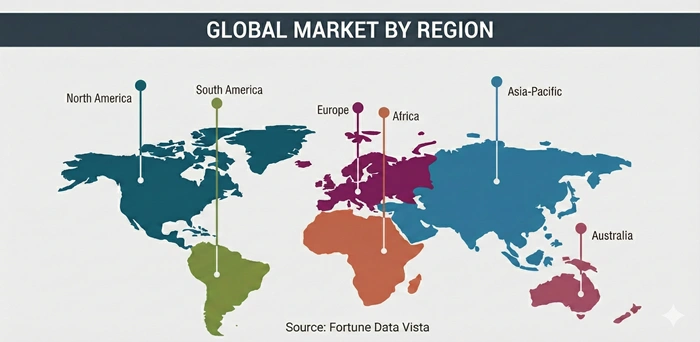
Regional Insights
North America
Strict Regulatory Enforcement and Mature Industrial Safety Culture Keep North America Firmly in the Lead
North America commands the leading position in the global chemical protective gloves market, holding approximately 34% share in 2025, supported by rigorous occupational safety regulations, well-established industrial safety culture, and strong compliance enforcement across chemical handling industries. The United States drives the overwhelming majority of regional demand, backed by strict Occupational Safety and Health Administration standards that require certified protective equipment across manufacturing, healthcare, and laboratory settings. Companies with strong regional presence include Ansell, Honeywell, 3M, and Kimberly-Clark, each maintaining deep distribution relationships with major industrial and healthcare buyers across the country.
Canada also contributes meaningfully to regional demand, supported by similarly stringent workplace safety regulations and a mature industrial base that consistently prioritizes worker protection compliance. The region's combination of strict regulatory enforcement, high safety awareness, and strong vendor presence ensures North America's leadership position within the chemical protective gloves market remains firmly intact through the remainder of the forecast period.
Asia Pacific
Rapid Industrialization and Improving Safety Standards Position Asia Pacific as the Fastest-Growing Region
Asia Pacific is projected to register the fastest CAGR within the global chemical protective gloves market through 2033, expanding at a rate near 8% as rapid industrialization and steadily improving occupational safety standards create substantial new demand across the region. China and India lead this growth, supported by expanding chemical manufacturing capacity and growing government emphasis on workplace safety compliance across industrial sectors that previously operated with minimal protective equipment requirements. Regional and international manufacturers alike have expanded local production capacity to serve this growing demand, often developing cost-competitive product lines suited to price-sensitive industrial buyers.
Japan and South Korea contribute further depth to regional growth, both bringing established industrial safety standards that increasingly favor premium, high-performance chemical protective gloves for specialized manufacturing applications. Rising government investment in occupational safety enforcement across several Asia Pacific countries continues to accelerate adoption among small and mid-sized industrial operations that previously lacked access to certified protective equipment. This combination of industrial expansion, improving regulatory enforcement, and growing safety awareness positions Asia Pacific as the clear growth leader within the broader chemical protective gloves market through the forecast period.
Customization Available for This Report
Region-Specific and Country-Specific Versions of This Report Are Available to Deliver a Sharper, More Localized View of Market Dynamics
This report can be tailored on a region-by-region and country-by-country basis, providing localized market sizing, competitive mapping, and demand analysis that a global overview alone cannot fully capture.
Clients seeking a more focused breakdown can request a customized version covering any of the following regions and countries, complete with demand forecasting, competitor landscape review, and adoption trend analysis tied specifically to the chemical protective gloves keyword focus:
North America
-
U.S. — Detailed review of OSHA compliance trends and industrial safety procurement patterns
-
Canada — Coverage of workplace safety regulation enforcement and distribution networks
-
Mexico — Analysis of expanding manufacturing sector safety equipment adoption
Europe
-
U.K. — Review of workplace safety standards and industrial glove procurement trends
-
Germany — Coverage of chemical manufacturing safety compliance and vendor competition
-
France — Insights into industrial hand protection adoption and regulatory trends
-
Italy — Analysis of regional manufacturing safety equipment demand patterns
-
Rest of Europe — Country-level view of emerging demand across Eastern Europe and the Nordics
Asia Pacific
-
China — Coverage of expanding chemical manufacturing capacity and local production growth
-
India — Analysis of improving workplace safety enforcement and affordable glove demand
-
Japan — Review of premium safety equipment adoption and specialized manufacturing needs
-
South Korea — Assessment of industrial safety standards and regional manufacturing capacity
-
Australia — Insights into occupational safety compliance and distribution trends
-
Rest of Asia Pacific — Country-level breakdown covering Thailand, Vietnam, Indonesia, and Malaysia
Latin America
-
Brazil — Coverage of expanding industrial safety compliance and distribution networks
-
Argentina — Analysis of manufacturing sector safety equipment adoption trends
-
Rest of Latin America — Country-level sizing across Colombia, Peru, and Chile
Middle East & Africa
-
UAE — Review of petrochemical sector safety equipment demand and import trends
-
Saudi Arabia — Coverage of expanding petrochemical production and safety compliance initiatives
-
Rest of MEA — Country-level view of Sub-Saharan Africa industrial safety equipment access expansion
Top Key Players
-
Ansell Limited (Australia)
-
Honeywell International Inc (United States)
-
3M Company (United States)
-
Kimberly-Clark Corporation (United States)
-
SHOWA Group (Japan)
-
MAPA Professional (France)
-
DuPont de Nemours Inc (United States)
-
Top Glove Corporation Bhd (Malaysia)
-
Supermax Corporation Berhad (Malaysia)
-
Mallcom India Limited (India)
-
Superior Glove Works Ltd (Canada)
-
Delta Plus Group (France)
Recent Developments
-
In 2024, Ansell expanded its chemical-resistant glove portfolio with a new nitrile formulation offering improved puncture resistance, targeting petrochemical and industrial cleaning customers seeking longer-lasting protective wear
-
In 2025, Honeywell strengthened its industrial safety product line through a strategic distribution partnership aimed at expanding its footprint across fast-growing Asia Pacific manufacturing hubs
-
In 2024, 3M introduced an enhanced chemical splash protection glove line built specifically for pharmaceutical and laboratory handling environments requiring stricter contamination control
-
In 2025, SHOWA Group increased production capacity at its Southeast Asian manufacturing facility to keep pace with rising regional demand for certified chemical protective gloves across multiple industries
-
In 2024, DuPont expanded its specialty protective glove offerings with a new material formulation designed for highly corrosive chemical handling applications common in oil and gas processing operations
Market Trends
Sustainability Innovation and Regional Manufacturing Expansion Are Reshaping Category Competition
One of the clearest trends shaping the chemical protective gloves market is the growing manufacturer investment in sustainable and biodegradable material formulations, driven by mounting pressure from environmentally conscious industrial buyers and tightening European sustainability regulations. This trend is pushing established players to rethink product development priorities that have historically focused almost entirely on chemical resistance performance, now increasingly balancing that priority against environmental impact considerations that matter more to procurement decision-makers each year.
A second significant trend is the continued expansion of regional manufacturing capacity across Asia Pacific, as global and domestic producers alike build local production facilities to serve growing industrial demand more cost-effectively while reducing exposure to international supply chain disruptions. This regional manufacturing shift is gradually changing the competitive landscape, giving Asia Pacific-based producers a stronger position to compete on both cost and delivery speed against established Western manufacturers within the broader chemical protective gloves market.
Segments Covered in the Report
By Material Type
-
Nitrile
-
Neoprene
-
Latex
-
PVC and Other Polymers
By Product Type
-
Reusable Gloves
-
Disposable Gloves
By End Use
-
Chemical and Petrochemical Processing
-
Pharmaceutical and Healthcare
-
Manufacturing and Industrial
-
Agriculture
By Region
-
North America (U.S., Canada, Mexico)
-
Europe (U.K., Germany, France, Italy, Rest of Europe)
-
Asia Pacific (China, India, Japan, South Korea, Australia, Rest of Asia Pacific)
-
Latin America (Brazil, Argentina, Rest of Latin America)
-
Middle East & Africa (UAE, Saudi Arabia, Rest of MEA)
❝ Built for Every Level — From Startups to Industry Giants ❞
Here Is Exactly How This Report Works for You
-
For tier 1 manufacturers, investors, and established market leaders, this report delivers detailed competitor revenue analysis, regulatory compliance mapping, and geopolitical supply chain risk context that support confident decisions around production expansion, pricing strategy, and long-term positioning within the chemical protective gloves space
-
For tier 2 and tier 3 companies, startups, and mid-sized manufacturers, this report highlights the most commercially promising material innovations and underserved regional opportunities, giving you a practical framework to compete against established players without overextending limited resources
-
For every decision maker across the value chain, this report explains exactly how raw material price trends, regulatory shifts, and competitor product launches are shaping market direction through 2033, equipping you to plan sourcing, pricing, and go-to-market decisions with genuine confidence
Frequently Asked Questions:
Answer: The global chemical protective gloves market was valued at USD 3.40 billion in 2025 and is projected to reach USD 5.01 billion by 2033. This growth is driven primarily by tightening safety regulations and expanding industrial chemical handling activity.
Answer: Demand in the chemical protective gloves market is being driven by stricter occupational safety regulations and expanding chemical and petrochemical manufacturing activity worldwide. Rising pharmaceutical and healthcare sector needs are further reinforcing steady growth.
Answer: North America currently leads the chemical protective gloves market with roughly 34% share, supported by strict regulatory enforcement and mature industrial safety culture. Asia Pacific is growing the fastest, driven by rapid industrialization and improving safety standards.
Answer: Nitrile gloves generate the largest share of revenue in the chemical protective gloves market, valued for their strong chemical resistance and dexterity. Chemical and petrochemical processing also remains the dominant end-use segment due to high exposure risk.
Answer: Leading companies in the chemical protective gloves market include Ansell, Honeywell, 3M, Kimberly-Clark, and SHOWA Group. These companies compete through continuous material innovation, expanding regional production capacity, and growing focus on sustainable glove formulations.