
Commercial Printing Market Overview
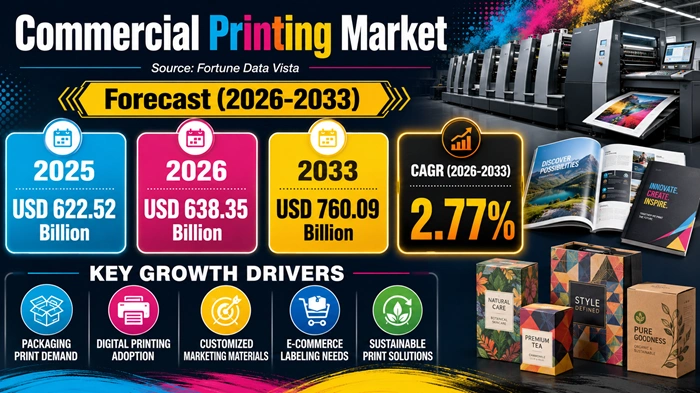
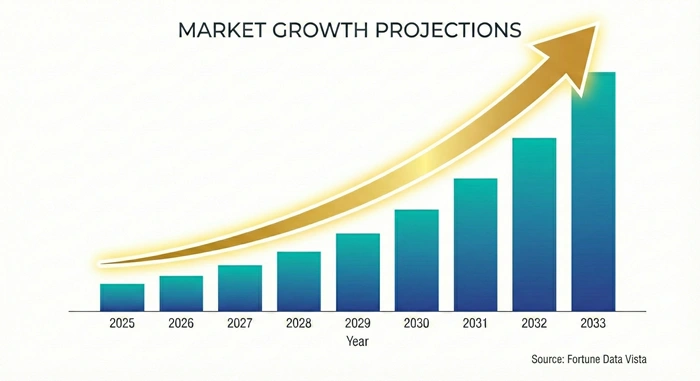
The global commercial printing market size is valued at USD 622.52 billion in 2025 and is predicted to increase from USD 638.35 billion in 2026 to approximately USD 760.09 billion by 2033, growing at a CAGR of 2.77% from 2026 to 2033.
This steady expansion reflects the continued reliance on printed materials for branding, packaging, publishing, and promotional purposes despite the ongoing shift toward digital media. Rising demand for personalized print products, growing e-commerce packaging needs, and advances in digital printing technology are together supporting demand for commercial printing services across both developed and emerging economies.
AI Impact on the Commercial Printing Industry
Artificial Intelligence Is Quietly Transforming How Print Shops Manage Production, Quality, and Customer Personalization
Artificial intelligence is beginning to play a meaningful role in reshaping how commercial printers manage workflows and quality control. Machine learning tools built into modern press systems are improving color matching accuracy and reducing material waste by analyzing print defects in real time rather than relying solely on manual inspection. AI-powered software is also shortening design-to-print turnaround, a significant improvement for printers managing large volumes of personalized orders during peak retail and marketing seasons.
Beyond the press floor, AI is enabling smarter job scheduling by processing data on order volume, material availability, and machine downtime history. Print businesses are leveraging these tools to plan production more efficiently and reduce idle press time. The broader integration of AI into print management software also supports variable data printing at scale, which strengthens the ability of commercial printing companies to deliver individualized marketing materials, an area that has become central to brand engagement strategies in recent years.
Growth Factors
Rising Demand for Personalized Print, Packaging Growth, and Digital Press Innovation Are Converging to Sustain Market Expansion
The primary engine driving the commercial printing market forward is the growing demand for customized and short-run print jobs across retail, advertising, and packaging sectors. Businesses are increasingly seeking personalized brochures, labels, and packaging materials that strengthen brand identity and improve customer engagement, creating steady demand for flexible, high-quality printing solutions. This shift toward customization is especially strong in retail and consumer goods, where brands compete heavily on shelf appeal and packaging design.
At the same time, technological innovation is making commercial printing faster, more efficient, and more sustainable. The widespread adoption of digital and inkjet presses for shorter runs, the development of eco-friendly inks and substrates that meet growing environmental expectations, and the emergence of automated finishing equipment are all supporting continued market relevance. Government and industry initiatives promoting sustainable packaging in regions like Europe and North America are further encouraging print companies to modernize their equipment and materials.
Market Outlook
Steady Institutional Demand, Packaging Growth, and Regional Diversification Are Setting the Stage for Continued Market Stability
The commercial printing industry is positioned for steady, moderate growth driven by a combination of packaging demand and continued reliance on print for branding and compliance documentation. As e-commerce continues to expand globally, demand for printed packaging, shipping labels, and inserts is helping offset some of the decline seen in traditional publishing and newspaper printing. This diversification of end-use demand represents an important stabilizing factor for print companies navigating a changing media landscape.
Emerging markets will be an important source of incremental growth through 2033. Countries across Asia Pacific and Latin America are seeing rising consumer spending and expanding retail sectors, which is increasing demand for packaging and promotional print materials. Regional manufacturing growth in countries like India and Vietnam is also creating demand for labels and industrial print applications. Commercial printing companies that invest early in digital capabilities and sustainable materials suited for these growing markets are likely to capture a meaningful share of this expanding demand.
Expert Speaks
-
"Print remains a trusted and highly credible medium for brand communication, and the growing shift toward digital and personalized printing is opening entirely new revenue streams for our industry. Businesses that adapt quickly to these changing formats are seeing stronger customer loyalty and repeat orders." — CEO, RR Donnelley
-
"Sustainability is no longer optional in commercial printing; customers across every sector now expect eco-friendly materials and processes as a standard offering rather than a premium add-on. Companies that fail to invest in greener production methods risk losing contracts to more environmentally conscious competitors." — CEO, Quad Graphics
-
"The future of commercial printing lies in combining automation with creative flexibility to serve brands that need faster, smarter print solutions at scale. As customer expectations rise, printers that can deliver both speed and personalization will define the next phase of industry growth." — CEO, Cimpress (Vistaprint)
Key Report Takeaways
-
Asia Pacific leads the global commercial printing market, holding approximately 34% market share in 2025, driven by a large manufacturing base, growing packaging demand, and expanding retail sectors across China and India
-
North America is the fastest-growing regional market, expected to expand at a CAGR of around 4.1% through 2033, fueled by demand for sustainable, energy-efficient printing solutions and continued investment in digital press technology
-
Retail and advertising businesses are the dominant end-use customers, relying heavily on commercial printing for packaging, promotional materials, and personalized marketing collateral
-
Packaging applications contribute the most to overall demand, reflecting the ongoing growth of e-commerce and consumer goods that require labels, boxes, and printed inserts
-
Offset lithography remains the most popular printing process, prized for its cost efficiency and consistent quality across large production runs
-
Digital printing is the fastest-growing technology segment, holding close to 26% market share with a CAGR near 6.5% through the forecast period, driven by rising demand for short-run and personalized print jobs
Market Scope
| Parameter | Details |
|---|---|
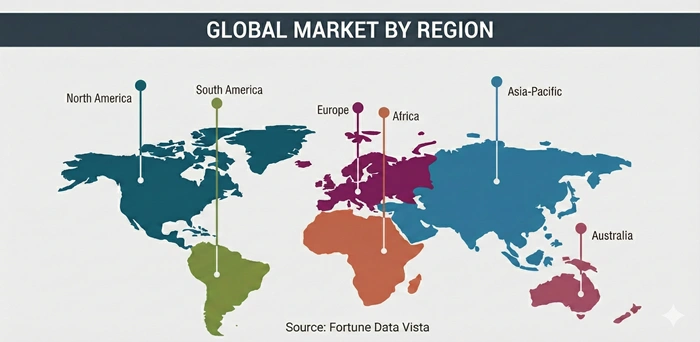
| Market Size by 2033 | USD 760.09 Billion | Market Size by 2026 | USD 638.35 Billion | Market Size by 2025 | USD 622.52 Billion | Market Growth Rate from 2026 to 2033 | CAGR of 2.77% | Dominating Region | Asia Pacific | Fastest Growing Region | North America | Segments Covered | Technology, Application, End User, Substrate, Region | Regions Covered | North America, Europe, Asia Pacific, Latin America, Middle East & Africa |
Market Dynamics
Drivers Impact Analysis
Growing Packaging Demand and Personalized Print Adoption Are Emerging as the Two Most Powerful Forces Propelling This Market Forward
| Driver | (≈) % Impact on CAGR Forecast | Geographic Relevance | Impact Timeline |
|---|---|---|---|
| Rising demand for packaging and labels | ~35% | Global, strongest in Asia Pacific | Short to long-term |
| Growth in personalized and short-run print jobs | ~28% | North America, Europe | Medium-term |
| Expansion of e-commerce driven packaging | ~20% | Asia Pacific, North America | Short to medium-term |
| Adoption of sustainable inks and substrates | ~17% | Europe, North America | Medium to long-term |
The growing global demand for packaging and labeling is without question the single most powerful driver in the commercial printing market. E-commerce growth has created enormous demand for printed boxes, mailers, and shipping labels, and consumer goods companies increasingly rely on packaging as a key branding touchpoint. This packaging-driven demand is helping the commercial printing sector offset declines in traditional print categories like newspapers and magazines, creating a more resilient overall revenue base.
Technological advancement is the second critical driver. The transition from traditional offset printing to flexible digital and inkjet platforms is enabling printers to handle smaller, more customized orders profitably. This matters commercially because brands increasingly want personalized packaging and marketing materials tailored to specific customer segments or regional campaigns. As printing companies upgrade equipment globally, adoption of digital press technology is accelerating, particularly among mid-sized print businesses competing for short-run and variable data jobs.
Restraints Impact Analysis
Digital Media Substitution and Rising Material Costs Continue to Present Real-World Barriers to Full Market Growth
| Restraint | (≈) % Impact on CAGR Forecast | Geographic Relevance | Impact Timeline |
|---|---|---|---|
| Shift toward digital media and advertising | ~38% | Global, strongest in developed markets | Short to long-term |
| Rising paper and ink material costs | ~30% | Global | Short to medium-term |
| Declining demand for traditional publishing print | ~20% | North America, Europe | Ongoing |
| Supply chain disruptions affecting raw materials | ~12% | Global | Short-term |
The most significant structural restraint in the commercial printing market is the continued shift of advertising and communication budgets toward digital channels. Newspapers, magazines, and catalogs have seen declining print volumes as consumers and businesses increasingly favor online content, creating a gap that packaging and specialty print segments must fill to sustain overall market revenue. This structural shift requires commercial printers to diversify their service offerings continuously to remain relevant.
Rising costs for paper, ink, and other consumables remain a persistent operational challenge for printing companies. Supply chain disruptions in recent years have made raw material sourcing less predictable, forcing printers to adjust pricing structures that can strain client relationships. While digital and sustainable alternatives are helping mitigate some cost pressure, the higher price of eco-friendly substrates compared to conventional materials still limits universal adoption among cost-sensitive small print businesses.
Opportunities Impact Analysis
Sustainable Printing Adoption and Packaging Innovation Represent the Most Commercially Significant Growth Opportunities
| Opportunity | (≈) % Impact on CAGR Forecast | Geographic Relevance | Impact Timeline |
|---|---|---|---|
| Growth of sustainable and eco-friendly printing | ~40% | Europe, North America | Medium to long-term |
| Expansion of smart packaging with embedded technology | ~35% | Global, led by Asia Pacific | Short to medium-term |
| Growth of variable data and personalized print services | ~25% | Global | Long-term |
The growing shift toward sustainable inks, recyclable substrates, and energy-efficient printing equipment represents one of the most commercially attractive opportunities in the commercial printing sector. Regulatory pressure and consumer preference for eco-friendly packaging are pushing brands to demand greener print solutions, and companies that can deliver certified sustainable products stand to capture premium contracts. As environmental compliance becomes a purchasing criterion for major retailers, demand for green commercial printing services is expected to rise sharply.
Smart packaging that integrates QR codes, NFC tags, and augmented reality features is opening entirely new revenue streams for printers willing to invest in specialized equipment. Retail brands, pharmaceutical companies, and food producers represent a growing customer base seeking interactive packaging that enhances consumer engagement and product traceability. Companies that can deliver innovative, technology-integrated print solutions will find significant commercial opportunity in the growing demand from brand owners across multiple industries.
Segment Analysis
By Technology
Offset Lithography Leads the Technology Landscape, Driven by Cost Efficiency and Consistent Quality for Large-Volume Runs
Offset lithography holds the dominant position in the commercial printing market, accounting for approximately 40% of the total technology segment in 2026. This dominance is deeply rooted in the cost efficiency of offset presses for high-volume production runs, making it the preferred choice for large print jobs like catalogs, packaging, and promotional materials. In high-income markets like the United States, Germany, and Japan, printing companies have maintained substantial offset capacity alongside newer digital equipment, creating stable, recurring demand for offset consumables and services. Leading companies such as RR Donnelley, Quad Graphics, and Toppan continue to dominate procurement in these markets through well-established production networks and long-standing client relationships.
Asia Pacific is emerging as a strong growth region for offset lithography demand, supported by expanding packaging needs in countries like China and India. The region's enormous consumer goods and retail sector, combined with active investment in modern offset press technology, is generating steady institutional demand for large-scale printing services. Toppan and Dai Nippon Printing have strengthened their regional presence through local production facilities and distribution partnerships. The broader shift toward hybrid production lines that combine offset and digital capabilities is also being led by this segment, with faster changeover technology gaining traction in packaging plants.
By Application
Packaging Applications Are Reshaping Demand Patterns, Commanding Strong Growth Across the Commercial Printing Market
Packaging applications account for approximately 32% of the total application segment in 2026, reflecting the growing reliance on printed packaging for branding and e-commerce fulfillment. With online retail volumes continuing to climb, packaging represents a foundational and expanding demand driver across virtually every developed and emerging print market. Consumer goods companies and e-commerce retailers maintain growing procurement relationships with commercial printers for boxes, labels, and printed inserts. This segment operates at a CAGR of nearly 4.5%, above the overall market average, supported by continued growth in online shopping and brand differentiation strategies.
North America is a standout growth region for packaging print applications, expanding at approximately 4.1% CAGR, with the United States serving as the primary demand anchor due to strong e-commerce penetration. Recurrent growth in direct-to-consumer brands has forced packaging suppliers to scale up printed packaging capacity, and specialty print companies have expanded their capabilities in parallel. Companies like Cimpress and Deluxe Corporation have deepened their presence in the region through digital ordering platforms and fast-turnaround production models. Advertising and promotional print, while growing more slowly, remains an important application segment due to continued brand investment in direct mail and point-of-sale materials.
Regional Insights
North America
North America Is the Fastest-Growing Region for Commercial Printing, Powered by Sustainable Technology Adoption and E-Commerce Packaging Growth
North America is expected to register the fastest CAGR in the global commercial printing market through 2033, with the United States growing at approximately 4.1%, above the global average. The region is experiencing strong demand for energy-efficient and sustainable printing solutions as businesses prioritize cost-effective, eco-friendly technologies that reduce environmental impact while maintaining productivity. Companies like RR Donnelley, Quad Graphics, and Cimpress are expanding their North American production capabilities to capture growing institutional demand for packaging and personalized print services. This growth is fueled by e-commerce expansion, brand differentiation needs, and government incentives supporting sustainable manufacturing practices.
The United States and Canada are the two markets to watch most closely within the region. The U.S. has seen strong growth in direct-to-consumer packaging demand, and ongoing investment in digital press technology is funding further capacity expansion among mid-sized printers. Canada's market, supported by growing retail and packaging needs, is also witnessing rapid adoption of automated finishing and sustainable substrate technology. Regional printers are increasingly participating in the competitive landscape, offering cost-competitive solutions that meet quality benchmarks while addressing sustainability expectations from major retail clients.
Asia Pacific
Asia Pacific's Expanding Manufacturing Base and Rising Packaging Demand Make It the Global Market Leader
Asia Pacific holds the dominant position in the global commercial printing market with approximately 34% market share in 2025 and is growing at a steady pace through 2033. China drives the majority of regional demand, supported by a vast manufacturing and packaging ecosystem, growing consumer goods production, and rapid adoption of digital printing platforms. Key companies with strong Asia Pacific market presence include Toppan, Dai Nippon Printing, and various regional packaging specialists, all of which maintain direct production facilities and distribution agreements across the region. Demand is further reinforced by expanding e-commerce packaging needs and growing awareness of sustainable print practices among Chinese and Indian manufacturers.
China alone accounts for a substantial share of Asia Pacific revenue, with meaningful contributions from India and Japan as well. Printing companies across the region are increasingly adopting flexible, digitally enabled solutions that reduce turnaround time for packaging and promotional orders. India and Australia contribute meaningfully to regional growth, with India investing in domestic packaging capacity and Australia scaling up sustainable print adoption as part of its environmental compliance agenda. The combination of strong manufacturing density, growing retail consumption, and expanding packaging demand ensures Asia Pacific's leadership position remains firmly intact through 2033.
Customization Available for This Report
Region-Wise and Country-Wise Customization Ensures Every Client Gets Insights Tailored to Their Exact Market Focus
This report offers comprehensive region-wise and country-wise customization, providing tailored market insights, trends, competitive analysis, and opportunity assessments specific to your geography of interest.
Our team can deliver a fully customized version of this report for any of the following regions and countries, providing deep-dive market analysis, demand forecasting, regulatory landscape review, and competitive intelligence specific to the selected market and commercial printing keyword combination:
North America
-
U.S. — Detailed analysis of e-commerce packaging trends, digital press adoption, and sustainable print investment
-
Canada — Insights into retail packaging growth, provincial manufacturing spending, and eco-friendly substrate adoption
-
Mexico — Packaging expansion, public sector print demand, and manufacturing hub development
Europe
-
U.K. — Sustainable packaging adoption, personalized print demand, and retail sector procurement patterns
-
Germany — Advanced offset and digital printing manufacturing landscape, regulatory environment, and industrial adoption rates
-
France — Luxury goods packaging demand, promotional print dynamics, and retail sector investment
-
Italy — Growing fashion and packaging print demand, design-driven print requirements
-
Rest of Europe — Emerging print markets across Eastern Europe and the Baltics
Asia Pacific
-
China — Manufacturing and packaging burden, government-funded industrial infrastructure, and domestic printer competitiveness
-
India — Growing packaging network, government-funded manufacturing demand, and affordable print market
-
Japan — Advanced digital printing adoption, regulatory pathway analysis, and premium packaging market
-
South Korea — Packaging export industry and institutional procurement
-
Australia — Sustainable printing investments in retail and packaging sectors
-
Rest of Asia Pacific — Country-level analysis covering Thailand, Vietnam, Philippines, Indonesia, and Malaysia
Latin America
-
Brazil — Growing retail packaging market, federal industrial procurement, and print ecosystem development
-
Argentina — Emerging packaging needs and print market development
-
Rest of Latin America — Colombia, Mexico, Peru, and Chile country-level commercial printing market sizing
Middle East & Africa
-
UAE — Advanced packaging adoption, retail-aligned industrial investments, and imported print technology
-
Saudi Arabia — Industrial modernization, packaging automation, and manufacturing procurement
-
Rest of MEA — Sub-Saharan Africa print access expansion, industrial funded programs, and procurement channels
Top Key Players
-
RR Donnelley & Sons Company (United States)
-
Quad Graphics Inc (United States)
-
Cimpress plc (Netherlands)
-
Toppan Inc (Japan)
-
Dai Nippon Printing Co Ltd (Japan)
-
Transcontinental Inc (Canada)
-
Quebecor Inc (Canada)
-
Deluxe Corporation (United States)
-
Bertelsmann SE and Co KGaA (Germany)
-
Cenveo Worldwide Limited (United States)
-
Ennis Inc (United States)
-
Taylor Communications (United States)
Recent Developments
-
In 2025, Cimpress expanded its digital packaging platform to offer faster turnaround for small business customers ordering personalized print products
-
In 2026, Quad Graphics announced a new sustainable ink initiative aimed at reducing environmental impact across its major production facilities
-
In 2025, Toppan opened a new packaging innovation center focused on smart packaging technology integration for retail and pharmaceutical clients
-
In 2026, RR Donnelley upgraded several regional facilities with digital press equipment to support growing demand for short-run, variable data printing
-
In 2025, Transcontinental partnered with several retail brands to pilot sustainable packaging solutions using recycled substrates across North America
Market Trends
The Commercial Printing Market Is Rapidly Shifting Toward Sustainable Materials and Digitally Enabled Personalization That Match Evolving Brand Expectations
Two of the most consequential trends reshaping the commercial printing landscape are the move toward sustainable materials and the mainstreaming of personalized, data-driven print production. Eco-friendly inks and recyclable substrates are replacing conventional materials in well-equipped print facilities as brands and regulators push for greener packaging and promotional products. This trend is reducing environmental impact per job, improving brand reputation for print buyers, and enabling more precise sustainability reporting during procurement decisions. Companies that offer validated sustainable solutions with strong environmental credentials are gaining market share at the expense of printers relying on conventional, less eco-friendly processes.
The second major trend is the geographic broadening of packaging demand into emerging economies across Asia Pacific and Latin America, which is pushing printing companies in these regions to build capacity they previously considered unnecessary. This is opening entirely new market segments, regional consumer goods producers, e-commerce startups, and boutique packaging brands, that historically relied on basic print services. At the same time, the digitalization of print ordering systems, including automated proofing and reporting platforms that connect print jobs to client dashboards in near real-time, is creating a new layer of service revenue for commercial printers that integrate software and connectivity into their offerings.
Segments Covered in the Report
By Technology
-
Offset Lithography
-
Sheet-Fed Offset Presses
-
Web Offset Presses
-
Digital Printing
-
Inkjet Printing Systems
-
Electrophotographic Printing
-
Flexographic Printing
-
Label Printing Systems
-
Packaging Print Units
-
Screen Printing
-
Textile and Specialty Print
-
Gravure Printing
-
High-Volume Packaging Print
By Application
-
Packaging
-
Labels and Cartons
-
Flexible Packaging Print
-
Advertising and Promotional Print
-
Brochures and Flyers
-
Direct Mail Materials
-
Publishing
-
Books and Magazines
-
Newspaper Print
-
Others
-
Transactional Print
-
Commercial Stationery
By End User
-
Retail
-
Consumer Goods
-
Publishing Houses
-
Advertising Agencies
-
Pharmaceutical and Healthcare
-
Others
By Substrate
-
Paper and Paperboard
-
Plastic Films
-
Textiles
-
Metal and Foil Substrates
By Region
-
North America (U.S., Canada, Mexico)
-
Europe (U.K., Germany, France, Italy, Rest of Europe)
-
Asia Pacific (China, India, Japan, South Korea, Australia, Rest of Asia Pacific)
-
Latin America (Brazil, Argentina, Rest of Latin America)
-
Middle East & Africa (UAE, Saudi Arabia, Rest of MEA)
❝ Built for Every Level — From Startups to Industry Giants ❞
Here Is Exactly How This Report Works for You
-
For tier 1 enterprises, investors, and high-level decision-makers, this report delivers competitor revenue analysis, detailed revenue source breakdowns, geopolitical risk assessments, and supply-demand dynamics that enable confident capital allocation, M&A targeting, and strategic market entry or expansion decisions in the commercial printing space
-
For tier 2 and tier 3 companies, mid-level businesses, and startups, this report provides a practical roadmap of the most commercially viable segments, regional opportunities, and technology investment priorities — helping you compete effectively against established players and identify white spaces before they become crowded
-
For all decision-makers across the value chain, this report explains exactly how raw material cost shifts, sustainability regulations, trade policy changes, and competitor positioning are converging to shape market direction through 2033 — giving you the intelligence framework to make proactive, evidence-based decisions rather than reactive ones
Frequently Asked Questions:
Answer: The global commercial printing market was valued at USD 622.52 billion in 2025 and is projected to reach USD 760.09 billion by 2033. This growth is driven by rising packaging demand and continued investment in digital printing technology.
Answer: The primary drivers of the commercial printing market include growing demand for packaging and personalized print jobs alongside rising e-commerce activity. Advances in digital and sustainable printing technologies are further accelerating adoption across retail sectors.
Answer: Asia Pacific currently dominates the commercial printing market with approximately 34% market share, supported by a large manufacturing base. North America is the fastest-growing region, driven by sustainable technology adoption and e-commerce packaging growth.
Answer: Offset lithography accounts for approximately 40% of the technology segment, reflecting its cost efficiency for large-volume runs. Digital printing is also growing rapidly, driven by demand for short-run and personalized print jobs.
Answer: Leading players in the commercial printing market include RR Donnelley, Quad Graphics, Cimpress, Toppan, and Dai Nippon Printing. These companies compete through broad service portfolios, global production networks, and continuous investment in sustainable printing innovation.