
Contraceptive Drugs And Devices Market Overview
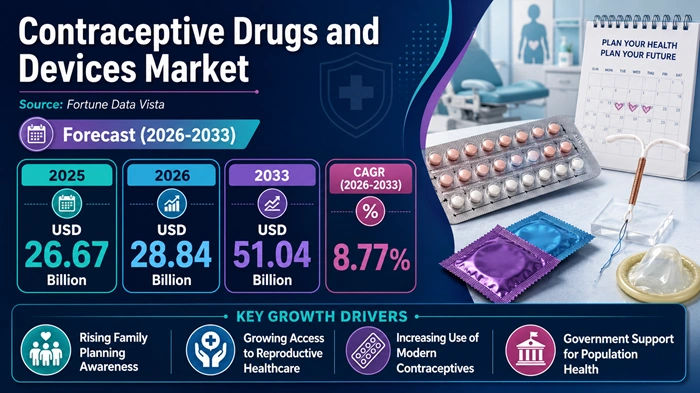
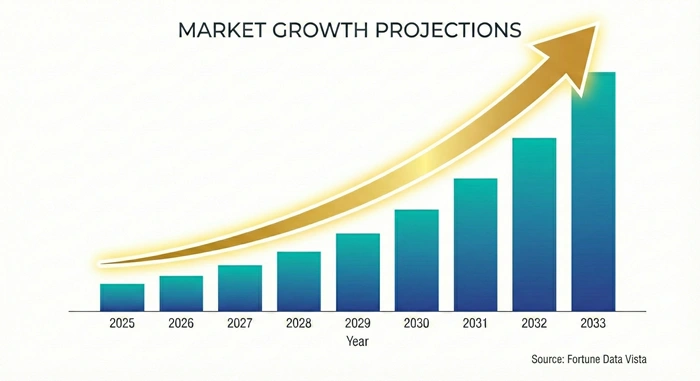
The global contraceptive drugs and devices market size is valued at USD 26.67 billion in 2025 and is predicted to increase from USD 28.84 billion in 2026 to approximately USD 51.04 billion by 2033, growing at a CAGR of 8.77% from 2026 to 2033.
This robust growth reflects the ongoing global expansion of family planning access, rising awareness of reproductive health rights, and continuous innovation across both hormonal and non-hormonal contraceptive product categories. As governments, non-profit organizations, and healthcare providers keep investing in reproductive health education, demand for reliable contraceptive drugs and devices continues expanding across both developed and developing healthcare markets.
AI Impact on the Contraceptive Drugs and Devices Industry
Artificial Intelligence Is Personalizing Contraceptive Selection Guidance, Improving Clinical Trial Efficiency, and Strengthening Telehealth Access Across the Contraceptive Drugs and Devices Landscape — Fundamentally Changing How Patients and Providers Approach Family Planning
Artificial intelligence has begun reshaping how patients and healthcare providers approach contraceptive selection, with digital health platforms now using AI-driven questionnaires to match individual patients with contraceptive methods best suited to their specific health profile, lifestyle preferences, and side-effect tolerance. This personalized guidance capability matters considerably for a category where method adherence often determines real-world effectiveness, since patients who receive contraceptive recommendations aligned with their actual daily habits and health considerations tend to stick with their chosen method more consistently. Telehealth providers increasingly rely on these AI-assisted screening tools to expand access to contraceptive counseling, particularly across rural areas where in-person reproductive health visits remain limited.
Beyond patient-facing applications, AI is also accelerating clinical research within the contraceptive drugs and devices space, with pharmaceutical companies using machine learning models to identify promising hormonal formulations and predict potential adverse effects earlier in the development pipeline. This capability helps researchers narrow down candidate compounds more efficiently, potentially shortening the lengthy timelines traditionally associated with bringing new contraceptive drugs to market. As these AI-driven personalization and research tools continue maturing, they are becoming an increasingly important factor shaping innovation across the broader contraceptive drugs and devices market.
Growth Factors
Rising Family Planning Awareness and Growing Access to Reproductive Healthcare Continue Driving Sustained Demand
The most significant growth factor supporting the contraceptive drugs and devices market is the steadily rising global awareness of family planning benefits, as governments and health organizations continue running public education campaigns aimed at reducing unintended pregnancies and improving maternal health outcomes. As women across both developed and developing regions gain greater access to reproductive health information, demand for a wider variety of contraceptive options, from oral pills to long-acting reversible devices, continues climbing steadily.
A second important growth factor is the expanding availability of contraceptive products through diverse distribution channels, including retail pharmacies, telehealth platforms, and public health programs supported by non-governmental organizations working to reach underserved populations. This expanding accessibility, combined with continuous innovation in longer-lasting and more convenient contraceptive formats, has broadened the addressable patient base considerably. This combination of rising family planning awareness and expanding healthcare access continues to strengthen demand across the contraceptive drugs and devices market.
Market Outlook
Long-Acting Reversible Contraceptive Innovation and Expanding Telehealth Integration Point Toward Sustained Growth Through 2033
Looking ahead through the forecast period, the contraceptive drugs and devices industry is expected to benefit substantially from continued innovation in long-acting reversible contraceptive technology, as manufacturers develop intrauterine devices and implants offering longer effective durations with fewer side effects compared to earlier generation products. This innovation trend is likely to continue shifting patient preference toward these longer-lasting options, since they require less frequent clinical intervention while still preserving future fertility once discontinued.
At the same time, expanding telehealth integration is expected to create substantial new demand by making contraceptive counseling and prescription access considerably more convenient for patients who previously faced barriers like clinic availability or geographic distance. Companies that can deliver both innovative device technology and streamlined digital access pathways are increasingly well positioned to capture this growth. Manufacturers combining strong clinical research capabilities with expanding distribution partnerships are likely to lead growth within the broader contraceptive drugs and devices market through 2033.
Expert Speaks
-
"We remain deeply committed to expanding access to safe, effective contraceptive options, and our continued investment in long-acting reversible technology reflects that priority." — CEO, Bayer AG
-
"As reproductive health awareness continues growing worldwide, our organization is focused on developing contraceptive products that meet the evolving needs of women across every stage of life." — CEO, Pfizer Inc
-
"Expanding equitable access to family planning remains central to our mission, and we continue partnering with healthcare providers globally to strengthen contraceptive availability." — CEO, Organon & Co
Key Report Takeaways
-
North America leads the global contraceptive drugs and devices market, holding approximately 38% market share in 2025, supported by advanced healthcare infrastructure and strong reproductive health awareness
-
Asia Pacific is the fastest-growing region, projected to expand at a CAGR near 10.2% through 2033, driven by rising government family planning initiatives across China and India
-
Retail pharmacy channels represent the dominant distribution segment, accounting for roughly 39% share, given the widespread over-the-counter availability of oral contraceptives in many countries
-
Contraceptive drugs contribute the most to overall demand, reflecting continued widespread reliance on oral pills, injectables, and patches for pregnancy prevention
-
Oral contraceptive pills remain the most widely adopted product type, valued for their affordability, accessibility, and established clinical track record
-
Long-acting reversible contraceptive devices will grow the fastest among product segments, holding close to 27% market share with a CAGR near 11% through the forecast period, driven by rising patient preference for reduced maintenance requirements
Market Scope
| Parameter | Details |
|---|---|
| Market Size by 2033 | USD 51.04 Billion | Market Size by 2026 | USD 28.84 Billion | Market Size by 2025 | USD 26.67 Billion | Market Growth Rate from 2026 to 2033 | CAGR of 8.77% | Dominating Region | North America | Fastest Growing Region | Asia Pacific | Segments Covered | Product Type, Distribution Channel, End User, Region | Regions Covered | North America, Europe, Asia Pacific, Latin America, Middle East & Africa |
Market Dynamics
Drivers Impact Analysis
Rising Family Planning Awareness and Expanding Reproductive Healthcare Access Remain the Two Strongest Forces Behind Market Momentum
| Driver | (≈) % Impact on CAGR Forecast | Geographic Relevance | Impact Timeline |
|---|---|---|---|
| Growing global awareness of family planning and reproductive health benefits | ~33% | Global, strongest in Asia Pacific, Africa | Short to long-term |
| Expanding access to contraceptive products through diverse distribution channels | ~29% | Global | Medium to long-term |
| Rising government and non-profit investment in family planning programs | ~24% | Asia Pacific, Latin America, Africa | Medium-term |
| Continuous innovation in long-acting reversible contraceptive technology | ~14% | North America, Europe | Short to medium-term |
Growing global awareness of family planning benefits continues to serve as the primary engine behind sustained growth in the contraceptive drugs and devices market, as public health campaigns and reproductive health education programs help more women understand the full range of contraceptive options available to them. This growing awareness has translated directly into rising demand across both hormonal drug formulations and physical device categories worldwide.
Expanding access to contraceptive products through diverse distribution channels represents the second major driver, as retail pharmacies, telehealth platforms, and public health programs continue widening reach into previously underserved populations. This distribution expansion, combined with rising government and non-profit investment in family planning initiatives, continues reinforcing steady demand growth across the broader contraceptive drugs and devices market.
Restraints Impact Analysis
Side Effect Concerns and Cultural Barriers Continue to Moderate Broader Adoption
| Restraint | (≈) % Impact on CAGR Forecast | Geographic Relevance | Impact Timeline |
|---|---|---|---|
| Concerns around hormonal side effects associated with certain contraceptive drugs | ~35% | Global | Short to medium-term |
| Cultural and religious barriers limiting contraceptive adoption in certain regions | ~28% | Middle East and Africa, parts of Asia | Long-term |
| High cost of long-acting reversible devices in low-income healthcare settings | ~23% | Emerging markets | Medium-term |
| Regulatory restrictions and inconsistent reimbursement policies across countries | ~14% | Global | Medium to long-term |
The most persistent restraint facing the contraceptive drugs and devices market is ongoing patient concern around hormonal side effects associated with certain oral contraceptives and injectable formulations, which continues to influence method selection and adherence patterns among many users. This concern has prompted growing interest in non-hormonal alternatives among patients seeking to avoid these potential complications.
Cultural and religious barriers limiting contraceptive adoption represent a second significant restraint, particularly across parts of the Middle East, Africa, and certain Asian communities where traditional attitudes toward family planning can slow broader acceptance despite growing government support programs. Combined with the high cost of long-acting reversible devices in lower-income healthcare settings, these restraints continue moderating how quickly broader adoption spreads across the global contraceptive drugs and devices market.
Opportunities Impact Analysis
Non-Hormonal Innovation and Expanding Emerging Market Access Represent the Clearest Paths to Growth
| Opportunity | (≈) % Impact on CAGR Forecast | Geographic Relevance | Impact Timeline |
|---|---|---|---|
| Advancing non-hormonal contraceptive alternatives with reduced side effect profiles | ~37% | Global | Short to medium-term |
| Expanding government-backed family planning programs across emerging economies | ~33% | Asia Pacific, Africa, Latin America | Medium to long-term |
| Growing telehealth-based contraceptive counseling and prescription access | ~30% | North America, Europe | Medium-term |
Advancing non-hormonal contraceptive alternatives represents one of the most substantial opportunities within the contraceptive drugs and devices market, as manufacturers developing these lower side-effect options stand to capture significant share from patients who have previously discontinued hormonal methods due to tolerability concerns. This innovation direction is expected to meaningfully reshape competitive positioning among leading pharmaceutical and device manufacturers over the coming years.
Expanding government-backed family planning programs across emerging economies presents a second substantial opportunity, as countries like India and several African nations continue investing in reproductive health infrastructure to reduce unintended pregnancy rates and improve maternal health outcomes. Growing telehealth-based contraceptive counseling further broadens the opportunity landscape, particularly as patients increasingly seek convenient, private access to prescription contraceptive services. Companies pursuing these parallel opportunities are well positioned to capture meaningful growth within the broader contraceptive drugs and devices market through the forecast period.
Segment Analysis
By Product Type: Contraceptive Drugs
Contraceptive Drugs Continue to Anchor the Product Landscape, Reflecting Widespread Reliance on Oral and Injectable Formulations
Contraceptive drugs hold the largest share within the product type segment of the contraceptive drugs and devices market, accounting for approximately 58% of total segment revenue in 2025. This dominance reflects the widespread and continued reliance on oral contraceptive pills, injectables, and patches, since these formulations remain broadly accessible, relatively affordable, and well understood by both patients and prescribing physicians across diverse healthcare systems. In markets like the United States and India, patients increasingly access combined oral contraceptive pills and progestin-only formulations through both retail pharmacy and telehealth channels. Leading suppliers such as Bayer, Pfizer, and Organon continue to dominate this segment through continuous formulation innovation and expanded product portfolios.
Growth within this segment remains particularly strong in Asia Pacific, where rapidly expanding government family planning initiatives across China and India continue driving demand for affordable, accessible contraceptive drug options among growing populations. The region's combination of large patient populations and increasing public health investment has helped contraceptive drugs maintain their leading position despite growing interest in long-acting device alternatives. As family planning awareness continues expanding globally, contraceptive drugs are expected to remain the dominant product type within the broader contraceptive drugs and devices market throughout the forecast period.
By Distribution Channel: Retail Pharmacy
Retail Pharmacy Remains the Leading Distribution Channel, Reflecting Widespread Over-the-Counter Accessibility
Retail pharmacy accounts for approximately 39% of distribution channel revenue within the contraceptive drugs and devices market, reflecting the widespread over-the-counter and prescription accessibility of oral contraceptives and other products through community pharmacy networks in numerous countries. Patients increasingly value the convenience and privacy of purchasing contraceptive products directly through retail pharmacies without requiring extensive clinical visits, making this channel a consistently reliable source of demand across diverse patient demographics. This steady, high-volume channel activity has made retail pharmacy the anchor distribution pathway for contraceptive drug manufacturers targeting broad consumer access.
Growth in this distribution channel remains especially strong in North America, where established retail pharmacy chains continue expanding their reproductive health product offerings alongside growing over-the-counter contraceptive pill availability following recent regulatory approvals. Companies like Perrigo and CooperSurgical have expanded their regional retail partnerships significantly to support this growing channel demand, often working closely with pharmacy networks to improve product visibility and patient education. As retail pharmacy accessibility continues expanding globally, this distribution channel is expected to remain a primary demand driver within the broader contraceptive drugs and devices market.
Regional Insights
North America
Advanced Healthcare Infrastructure and Strong Reproductive Health Awareness Keep North America Firmly in the Lead
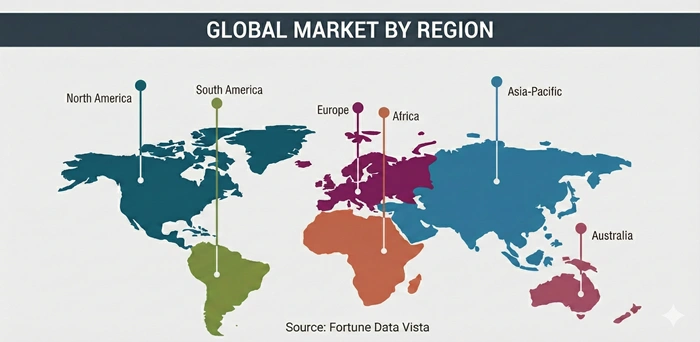
North America commands the leading position in the global contraceptive drugs and devices market, holding approximately 38% share in 2025, supported by advanced healthcare infrastructure, strong reproductive health awareness, and broad over-the-counter and prescription contraceptive availability across the region. The United States drives the overwhelming majority of regional demand, backed by a dense concentration of leading pharmaceutical companies and device manufacturers continuously expanding their contraceptive product portfolios. Companies with strong regional presence include Bayer, Pfizer, Organon, and CooperSurgical, each maintaining deep relationships with healthcare providers and retail pharmacy networks across the country.
Canada also contributes meaningfully to regional demand, supported by comprehensive public healthcare coverage and growing telehealth-based contraceptive counseling services. The region's combination of strong consumer purchasing power, deep pharmaceutical distribution networks, and continuous product innovation ensures North America's leadership position within the contraceptive drugs and devices market remains firmly intact through the remainder of the forecast period.
Asia Pacific
Expanding Government Family Planning Programs and Rising Awareness Position Asia Pacific as the Fastest-Growing Region
Asia Pacific is projected to register the fastest CAGR within the global contraceptive drugs and devices market through 2033, expanding at a rate near 10.2% as expanding government-backed family planning programs and rising reproductive health awareness create substantial new demand across the region. China and India lead much of this regional growth, supported by significant government investment in reducing unintended pregnancy rates and improving maternal health outcomes through expanded contraceptive access programs. Regional and international pharmaceutical companies alike have expanded their presence to serve this growing institutional and consumer demand, often partnering with public health agencies to reach underserved rural populations.
Japan and South Korea contribute further depth to regional growth, both bringing advanced healthcare systems that increasingly incorporate newer contraceptive device categories alongside traditional drug formulations. Growing government investment in reproductive health infrastructure across several Asia Pacific countries continues to accelerate contraceptive adoption among expanding urban and rural populations alike. This combination of rising government support, expanding healthcare access, and growing public awareness positions Asia Pacific as the clear growth leader within the broader contraceptive drugs and devices market through the forecast period.
Customization Available for This Report
Region-Specific and Country-Specific Versions of This Report Are Available to Deliver a Sharper, More Localized View of Market Dynamics
This report can be tailored on a region-by-region and country-by-country basis, providing localized market sizing, competitive mapping, and reproductive healthcare investment trend analysis that a global overview alone cannot fully capture.
Clients seeking a more focused breakdown can request a customized version covering any of the following regions and countries, complete with demand forecasting, competitor landscape review, and adoption trend analysis tied specifically to the contraceptive drugs and devices keyword focus:
North America
-
U.S. — Detailed review of over-the-counter access trends and retail pharmacy distribution patterns
-
Canada — Coverage of public healthcare coverage and telehealth counseling adoption
-
Mexico — Analysis of emerging reproductive healthcare infrastructure modernization trends
Europe
-
U.K. — Review of contraceptive access regulation and distribution channel trends
-
Germany — Coverage of healthcare investment among leading pharmaceutical manufacturers
-
France — Insights into reproductive health program modernization and adoption patterns
-
Italy — Analysis of regional contraceptive access investment trends
-
Rest of Europe — Country-level view of emerging demand across Eastern Europe and the Nordics
Asia Pacific
-
China — Coverage of expanding government family planning investment and program reach
-
India — Analysis of growing reproductive healthcare access and awareness campaigns
-
Japan — Review of established healthcare infrastructure and device adoption trends
-
South Korea — Assessment of healthcare investment and contraceptive product adoption
-
Australia — Insights into reproductive health funding and adoption trends
-
Rest of Asia Pacific — Country-level breakdown covering Thailand, Vietnam, Indonesia, and Malaysia
Latin America
-
Brazil — Coverage of expanding reproductive healthcare infrastructure investment and adoption
-
Argentina — Analysis of early-stage family planning program modernization trends
-
Rest of Latin America — Country-level sizing across Colombia, Peru, and Chile
Middle East & Africa
-
UAE — Review of reproductive healthcare investment and adoption trends
-
Saudi Arabia — Coverage of expanding family planning modernization initiatives
-
Rest of MEA — Country-level view of Sub-Saharan Africa reproductive healthcare expansion
Top Key Players
-
Bayer AG (Germany)
-
Pfizer Inc (United States)
-
Organon & Co (United States)
-
Johnson and Johnson (United States)
-
Teva Pharmaceutical Industries Ltd (Israel)
-
CooperSurgical Inc (United States)
-
Mylan N.V. Viatris (United States)
-
Church and Dwight Co Inc (United States)
-
Cipla Ltd (India)
-
Lupin Limited (India)
-
Reckitt Benckiser Group plc (United Kingdom)
-
Perrigo Company plc (Ireland)
Recent Developments
-
In 2025, Pfizer expanded its contraceptive drug portfolio with continued investment in reformulated oral contraceptive pills offering improved tolerability profiles
-
In 2025, Bayer strengthened its long-acting reversible contraceptive device lineup through expanded clinical research supporting extended duration intrauterine devices
-
In 2026, Organon deepened its investment in reproductive health access programs to support growing demand across emerging market family planning initiatives
-
In 2025, CooperSurgical advanced its intrauterine device manufacturing capacity to meet rising global demand for long-acting reversible contraceptive options
-
In 2025, Perrigo expanded distribution of its over-the-counter oral contraceptive pill following regulatory approvals across additional international markets
Market Trends
Non-Hormonal Innovation and Growing Telehealth Access Are Reshaping Contraceptive Care Standards
One of the clearest trends shaping the contraceptive drugs and devices market is the accelerating development of non-hormonal contraceptive alternatives, as researchers and manufacturers respond to patient demand for effective options that avoid the side effects associated with traditional hormonal formulations. Companies are investing heavily in clinical research, recognizing that expanding non-hormonal choices has become an increasingly important competitive differentiator as patient preferences continue evolving.
A second significant trend is the growing integration of telehealth platforms into contraceptive counseling and prescription services, as patients increasingly seek convenient, private access to reproductive healthcare without requiring in-person clinic visits. This trend toward digital access is particularly meaningful for patients in underserved or rural areas facing limited local healthcare availability, continuing to support steady expansion across the broader contraceptive drugs and devices market as digital health adoption increases.
Segments Covered in the Report
By Product Type
-
Contraceptive Drugs (Oral Contraceptive Pills, Injectables, Patches)
-
Contraceptive Devices (Intrauterine Devices, Implants, Condoms, Diaphragms)
By Distribution Channel
-
Retail Pharmacy
-
Hospital Pharmacy
-
Online Channel
-
Public Channel and NGOs
By End User
-
Female Contraceptive Users
-
Male Contraceptive Users
By Region
-
North America (U.S., Canada, Mexico)
-
Europe (U.K., Germany, France, Italy, Rest of Europe)
-
Asia Pacific (China, India, Japan, South Korea, Australia, Rest of Asia Pacific)
-
Latin America (Brazil, Argentina, Rest of Latin America)
-
Middle East & Africa (UAE, Saudi Arabia, Rest of MEA)
❝ Built for Every Level — From Startups to Industry Giants ❞
Here Is Exactly How This Report Works for You
-
For tier 1 companies, investors, and established market leaders, this report delivers detailed competitor revenue analysis, product innovation trend mapping, and geopolitical risk context that support confident decisions around product expansion, pricing strategy, and long-term positioning within the contraceptive drugs and devices space
-
For tier 2 and tier 3 companies, startups, and mid-sized suppliers, this report highlights the most commercially promising distribution channels and underserved regional opportunities, giving you a practical framework to compete against larger established players without overextending limited resources
-
For every decision maker across the value chain, this report explains exactly how family planning policy trends, healthcare access developments, and competitor product launches are shaping market direction through 2033, equipping you to plan investment and go-to-market decisions with genuine confidence
Frequently Asked Questions:
Answer: The global contraceptive drugs and devices market was valued at USD 26.67 billion in 2025 and is projected to reach USD 51.04 billion by 2033. This growth is driven largely by rising family planning awareness and expanding reproductive healthcare access.
Answer: Growth in the contraceptive drugs and devices market is being driven by growing global family planning awareness and expanding distribution through retail and telehealth channels. Rising government investment in reproductive health programs is further reinforcing this expansion.
Answer: North America currently leads the contraceptive drugs and devices market with roughly 38% share, supported by advanced healthcare infrastructure. Asia Pacific is growing the fastest, driven by expanding government family planning programs.
Answer: Contraceptive drugs generate the largest share of revenue in the contraceptive drugs and devices market, reflecting widespread reliance on oral and injectable formulations. Retail pharmacy also remains the dominant distribution channel.
Answer: Leading companies in the contraceptive drugs and devices market include Bayer, Pfizer, Organon, CooperSurgical, and Johnson and Johnson. These companies compete through continuous innovation in long-acting reversible devices and non-hormonal formulations.