
Copper Market Overview
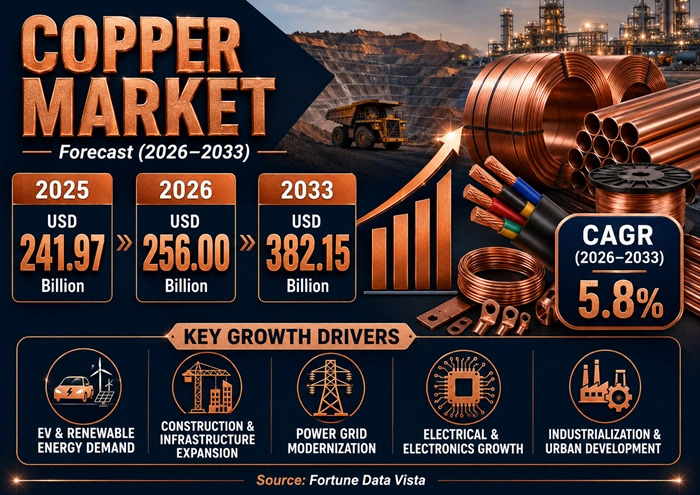
The global copper market size is valued at USD 241.97 billion in 2025 and is predicted to increase from USD 256.00 billion in 2026 to approximately USD 382.15 billion by 2033, growing at a CAGR of 5.8% from 2026 to 2033. This robust trajectory is anchored by surging demand from the clean energy transition, electric vehicle manufacturing, grid infrastructure modernization, and the accelerating buildout of AI-powered data centers worldwide — all of which are highly copper-intensive and structurally long-duration in their demand profiles.
AI Impact on the Copper Industry
Artificial Intelligence Is Transforming Copper Mining, Processing, and Demand Forecasting — Making the Industry Smarter, Safer, and More Productive at Every Stage of the Value Chain
Artificial intelligence is quietly but profoundly reshaping the copper industry from the mine face to the trading floor. In open-pit and underground mining operations, AI-powered autonomous haulage systems, drill pattern optimization tools, and real-time ore grade prediction models are delivering measurable gains in extraction efficiency and operating cost reduction. Companies like Freeport-McMoRan and Codelco are deploying machine learning algorithms that analyze seismic sensor data, equipment telemetry, and geological survey information simultaneously to optimize mine planning and extend asset lifespans. These AI tools are enabling miners to extract more copper from lower-grade ore bodies — a critical capability as global average copper ore grades continue to decline — directly improving the supply-side economics of an industry that needs to produce significantly more metal to meet the green energy transition's insatiable demand. The integration of AI into copper processing operations is also reducing water and energy consumption per tonne of refined copper produced, aligning the industry with increasingly stringent environmental performance expectations.
On the demand forecasting and price discovery side, AI-driven analytical platforms are transforming how traders, industrial consumers, and mining companies manage price risk in a highly volatile commodity market. Real-time natural language processing tools scrape macroeconomic signals, geopolitical developments, and shipping data to generate short-term copper price alerts that previously required weeks of manual analysis. For large industrial consumers — copper wire manufacturers, automotive OEMs, and construction companies — AI-powered procurement optimization systems are improving purchasing efficiency by identifying optimal hedging windows and anticipating supply tightness before it manifests in spot prices. Goldman Sachs Research's copper price models, which integrate AI-enhanced demand scenario analysis, have consistently outperformed conventional econometric approaches in predicting short-term price movements in the copper market, highlighting how deeply AI is now embedded in this critical commodity's information ecosystem.
Growth Factors
The Green Energy Transition, EV Revolution, and Global Infrastructure Investment Supercycle Are Collectively Creating an Unprecedented Multi-Decade Demand Tailwind for Copper
Copper's unique combination of electrical conductivity, thermal performance, corrosion resistance, and ductility makes it irreplaceable in virtually every technology platform underpinning the global energy transition. A single electric vehicle requires approximately 83 kilograms of copper — nearly four times the amount used in a conventional internal combustion engine vehicle. Offshore wind turbines require up to 9.67 tonnes of copper per megawatt of installed capacity. Grid-scale solar power systems, EV charging infrastructure, and high-voltage direct current (HVDC) transmission lines connecting offshore renewables to load centers are each copper-intensive applications growing at exceptional rates. As national decarbonization targets accelerate the global fleet electrification and renewable energy deployment timelines, the copper market faces a structural demand surge that most supply-side forecasts suggest will outpace new mine supply beginning around 2029. This supply-demand dynamic is the most powerful medium-to-long-term growth driver for copper prices and investment activity in the mining and refining sector.
Global infrastructure investment is generating a parallel demand boost for copper across construction, power distribution, and telecommunications applications. Government-led infrastructure programs — including the U.S. Infrastructure Investment and Jobs Act, the European Union's Green Deal industrial investment programs, China's grid modernization spending, and India's ambitious National Infrastructure Pipeline — are collectively deploying trillions of dollars into roads, bridges, power grids, housing, and digital connectivity infrastructure that all require substantial copper input. The rollout of 5G telecommunications networks globally is another high-growth demand stream, as 5G base stations require significantly more copper than previous-generation networks. Data center construction, driven by AI computing infrastructure investment from technology hyperscalers, represents one of the fastest-growing new copper demand categories — with analysts estimating that AI infrastructure investment will add 500,000 tonnes of incremental copper demand globally by 2030.
Market Outlook
The Copper Market Is Entering a Period of Tightening Structural Supply-Demand Dynamics, With Rising Prices and Intensifying Competition for High-Quality Ore Deposits Shaping the Decade Ahead
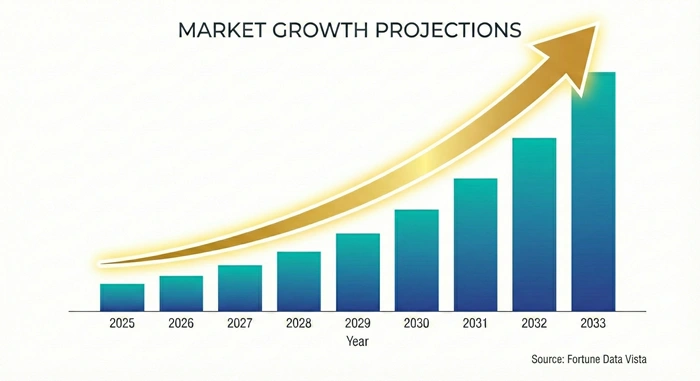
The long-term outlook for the global copper market is defined by a fundamental tension between rapidly growing structural demand and a supply side constrained by declining ore grades, long project development lead times, and increasing resource nationalism in key mining jurisdictions. Goldman Sachs Research forecasts that global copper demand will overtake supply from 2029 onwards — a tipping point that is expected to drive LME copper prices toward USD 15,000 per tonne by 2035 from current levels around USD 10,000–11,000. This impending tightness is already reshaping investment patterns in the mining sector, with major copper producers accelerating brownfield expansion projects, extending mine lives, and revisiting previously uneconomic deposit developments. The outlook strongly favors existing large-scale copper producers with low-cost, long-life mine assets — while simultaneously creating compelling investment opportunities in exploration companies with high-quality undeveloped copper resources.
The role of recycled copper in balancing the market's supply-demand equation is growing significantly. Secondary copper recovery from end-of-life electrical cables, electronics, automotive components, and industrial equipment is becoming an increasingly critical supplement to primary mined supply. The recycled copper segment is projected to grow from USD 51.9 billion in 2026 to USD 105.1 billion by 2033, growing at a rapid CAGR driven by tightening primary supply, rising copper scrap premiums, and regulatory mandates in Europe and North America promoting circular economy material flows. Investments in urban mining technology — advanced cable stripping, electronic waste dismantling, and automated copper recovery from mixed scrap streams — are improving recovery rates and reducing processing costs, making secondary copper a more commercially competitive and environmentally preferred supplement to primary production. The interaction between primary and secondary copper supply is one of the most strategically important dynamics shaping the copper market's structure through the forecast period.
Expert Speaks
-
"Copper is the metal of the energy transition — there is no practical substitute for it in electric motors, power transmission, or renewable energy generation, and the scale of demand growth we are projecting far exceeds the mining industry's current capacity expansion pipeline." — Richard Adkerson, Executive Chairman, Freeport-McMoRan Inc.
-
"Codelco is committed to significantly increasing its copper production through major mine expansion and development projects, because we understand that the global copper market will need hundreds of thousands of additional tonnes of supply annually to meet the demands of electrification and decarbonization over the next decade." — Rubén Alvarado, CEO, Codelco
-
"Glencore views copper as strategically irreplaceable in the transition economy and is prioritizing it as our highest-conviction commodity — we are actively investing in new copper supply capacity and recycling infrastructure to ensure we can capture the full value of this exceptional long-term demand outlook." — Gary Nagle, CEO, Glencore plc
Key Report Takeaways
-
Asia Pacific dominates the global copper market, holding the largest regional share in 2025, led by China — which accounts for approximately 55% of global refined copper consumption — driven by its massive infrastructure construction activity, growing EV manufacturing base, and renewable energy capacity expansion programs
-
North America is the fastest-growing major developed region, driven by Inflation Reduction Act-funded clean energy manufacturing, surging EV adoption, data center construction for AI infrastructure, and multi-billion-dollar grid modernization investments across the United States and Canada
-
Construction and infrastructure sectors are the largest copper consumers, accounting for the highest share of end-use copper demand globally, with electrical wiring, plumbing, HVAC systems, and power distribution infrastructure requiring copper across virtually every type of building and civil engineering project
-
Electrical and electronics applications contribute the most significant revenue share within the copper market, with wire rods being the dominant product form, accounting for approximately 48.7% of total copper product consumption globally as electrical wiring systems remain the most universal copper application across all industries
-
Electrolytic refining remains the most widely used copper processing method, producing the highest-purity copper cathode used in wire manufacturing, electronics, and premium industrial applications — it accounts for the majority of primary refined copper output globally and remains the benchmark processing technology
-
The EV-related copper segment is projected to grow at the fastest CAGR through 2033, capturing an increasing share of the copper market as EV production volumes scale exponentially — the EV wiring harness, motor winding, and charging infrastructure segment is forecast to represent over 18% of total copper demand by 2033, growing at a double-digit CAGR that significantly outpaces the overall market average
Market Scope
| Parameter | Details |
|---|---|
| Market Size by 2033 | USD 382.15 Billion | Market Size by 2026 | USD 256.00 Billion | Market Size by 2025 | USD 241.97 Billion | Market Growth Rate from 2026 to 2033 | CAGR of 5.8% | Dominating Region | Asia Pacific | Fastest Growing Region | North America | Segments Covered | Product Form, Mining Type, Grade, Application, End-Use Industry, Region | Regions Covered | North America, Europe, Asia Pacific, Latin America, Middle East & Africa |
Market Dynamics
Drivers Impact Analysis
Energy Transition Copper Demand, Infrastructure Investment Supercycle, and EV Production Scaling Are the Three Foundational Forces Driving the Copper Market's Sustained Growth
| Driver | ≈ % Impact on CAGR Forecast | Geographic Relevance | Impact Timeline |
|---|---|---|---|
| Renewable energy and grid infrastructure copper demand | ~32% | Global | Near to Long-term (2026–2033) |
| Electric vehicle manufacturing and charging infrastructure | ~26% | China, Europe, North America | Medium to Long-term |
| Global construction and infrastructure investment programs | ~21% | Asia Pacific, North America | Near to Medium-term |
| Data center and AI computing infrastructure buildout | ~13% | North America, Asia Pacific | Near to Medium-term |
| 5G network rollout and telecommunications expansion | ~8% | Asia Pacific, North America, Europe | Near-term (2026–2028) |
The renewable energy sector's copper intensity is the most structurally important demand driver for the copper market over the full 2026–2033 forecast period. Solar photovoltaic systems, onshore and offshore wind installations, and the grid-scale energy storage systems that accompany them require enormous quantities of copper per unit of installed capacity — far exceeding what conventional fossil fuel power plants require. As the global installed base of renewable energy capacity doubles and then triples over the forecast horizon, cumulative copper demand from this single sector alone could absorb a significant fraction of global annual mine production. Goldman Sachs Research has estimated that grid and power infrastructure will drive more than 60% of total copper demand growth to 2030 — effectively meaning that the clean energy transition is the copper market's most important and most durable growth engine. The breadth of copper's role across solar cells, turbine windings, transformer cores, underground cables, and HVDC interconnectors ensures that this demand is both distributed across geographies and largely insensitive to technology shifts.
Electric vehicle demand for copper represents the most rapidly expanding individual demand category within the global copper market, and its growth trajectory is fundamentally reshaping how mining companies, refiners, and downstream processors plan their capacity expansions. With EV production volumes forecast to reach 50–60 million units annually by 2030, the automotive sector's copper demand will approximately triple from 2025 levels — driven not just by vehicle motors and wiring harnesses, but by the massive copper content of public and private charging networks required to support a global EV fleet of hundreds of millions of vehicles. This demand is geographically concentrated in China, Europe, and North America, creating powerful regional copper demand pools that are driving government procurement programs, strategic copper stockpiling initiatives, and upstream investment in new copper mine development.
Restraints Impact Analysis
Mine Grade Deterioration, Resource Nationalism, and High Capital Intensity of New Copper Supply Development Represent the Most Significant Structural Constraints on Market Growth
| Restraint | ≈ % Impact on CAGR Forecast | Geographic Relevance | Impact Timeline |
|---|---|---|---|
| Declining ore grades and rising extraction costs | ~−2.8% | Latin America, Africa | Ongoing (2026–2033) |
| Resource nationalism and mining royalty increases | ~−2.3% | Chile, Peru, DRC, Zambia | Near to Long-term |
| Long lead times for new mine development (10–15 years) | ~−2.1% | Global | Medium to Long-term |
| Water scarcity in key mining regions (Atacama Desert) | ~−1.5% | Chile, Peru | Ongoing |
| Environmental opposition and permitting delays | ~−1.2% | North America, Europe | Near to Medium-term |
Declining ore grades represent a fundamental and worsening constraint on the copper supply side that is clearly visible in operational data from major copper-producing nations. The average grade of copper ore being mined globally has fallen from approximately 1.0% copper in the late 20th century to around 0.6% today — meaning miners must process 60–70% more rock to produce the same tonnage of refined copper, with proportionally higher energy, water, and processing costs. This grade deterioration is particularly severe in Chile, the world's largest copper producer, where major operations at Escondida and Collahuasi are mining progressively deeper, harder, and lower-grade material. The financial consequence is a steady escalation in the all-in sustaining cost per pound of copper produced, which is compressing industry margins and raising the copper price threshold at which new mine development becomes economically viable.
Political and regulatory risk in major copper-producing nations is an equally important constraint that is difficult to model and increasingly difficult to manage. Chile and Peru together account for more than 40% of global copper mine production, and both countries have experienced significant political instability, royalty renegotiations, and community opposition to mining expansion in recent years. The Democratic Republic of Congo — the world's largest cobalt producer and a growing copper producer — presents regulatory unpredictability and infrastructure challenges that raise development risks. China's dominant position in copper smelting and refining capacity adds a further geopolitical dimension, as export restrictions on copper processing by-products such as sulphuric acid (a key co-product of copper smelting) — as announced in April 2026 — can disrupt global supply chains with minimal warning.
Opportunities Impact Analysis
Emerging Market Electrification, Urban Mining Scale-Up, and Deep-Sea Polymetallic Nodule Development Represent the Most Transformative Long-Term Copper Market Opportunities
| Opportunity | ≈ % Impact on CAGR Forecast | Geographic Relevance | Impact Timeline |
|---|---|---|---|
| Recycled and secondary copper expansion (urban mining) | ~+3.4% | Europe, North America, Asia Pacific | Near to Long-term |
| Emerging market electrification and grid expansion | ~+3.8% | India, Southeast Asia, Africa | Medium to Long-term |
| Deep-sea copper nodule and alternative ore source development | ~+2.6% | Global (Pacific Ocean, Africa) | Long-term (2030–2033+) |
| Copper use in AI data center infrastructure | ~+2.9% | North America, Asia Pacific | Near to Medium-term |
| Thiosulfate leaching and bioleaching technology advances | ~+2.2% | Latin America, Africa | Medium to Long-term |
The scaling of urban mining — recovering copper from end-of-life electrical equipment, automobiles, construction waste, and consumer electronics — represents one of the most commercially compelling and geographically flexible opportunities available to copper market participants. Unlike primary mining, urban mining facilities can be sited close to population centers where scrap copper concentrations are highest, with dramatically lower land, water, and energy requirements per tonne of refined output. European regulations mandating take-back schemes for electronic waste, circular economy material recovery targets, and extended producer responsibility frameworks are creating structured scrap supply streams that are transforming recycled copper from an opportunistic business into a systematic, industrial-scale process. As primary copper prices rise with structural tightening, recycled copper's cost-competitiveness improves further — creating a positive feedback loop that accelerates investment in secondary processing capacity.
India's rapid industrialization and electrification trajectory represents one of the most significant emerging demand opportunities in the global copper market. India's per capita copper consumption remains dramatically below that of China, South Korea, and developed economies — indicating enormous room for growth as Indian manufacturing, construction, renewable energy, and EV sectors expand in step with its economic development. India's ambitious targets to achieve 500 GW of renewable energy capacity by 2030, coupled with government-led grid expansion programs and rapidly growing EV adoption, are creating a new and substantial long-term copper demand pool. Southeast Asia's growing electronics manufacturing hubs in Vietnam, Malaysia, and Thailand similarly represent expanding copper demand markets that are increasingly attracting upstream investment from international mining companies seeking diversified demand exposure beyond the Chinese market.
Segment Analysis
By Product Form — Wire Rods
Wire Rods Dominate the Copper Market's Product Landscape, Underpinned by Insatiable Demand From Electrical Wiring, EV Manufacturing, and Power Grid Infrastructure
Wire rods represent the largest and most strategically important product form segment within the copper market, accounting for approximately 48.7% of total copper product revenue share in 2025. As the foundational input for electrical wiring systems across construction, industrial, automotive, and energy applications, copper wire rods benefit from near-universal demand across every sector of the global economy. The segment's growth is being further amplified by the electric vehicle revolution — EV wiring harnesses require significantly more copper wire than conventional vehicles, and the rapid scaling of global EV production is translating directly into wire rod demand growth that outpaces the overall market's CAGR. The wire rod segment is also experiencing demand acceleration from the renewable energy sector, as every solar panel array, wind turbine, and grid-scale battery storage installation requires copper wiring for internal connections, grid interconnection, and monitoring systems. North America, Europe, and Asia Pacific — particularly China — are the primary consumption markets for copper wire rods, driven by their large construction, automotive, and power infrastructure sectors. Major wire rod producers including Aurubis AG, Codelco, and KME Group are investing in capacity expansion and quality upgrades to meet both conventional and emerging application demands.
Asia Pacific is the dominant growth region for copper wire rod consumption, where China's State Grid Corporation's multi-trillion-yuan transmission and distribution grid upgrade programs, rapid EV production scale-up by BYD and CATL's automotive manufacturing customers, and aggressive solar and wind capacity additions are collectively creating the world's largest and most concentrated demand pool for copper wire rod products. India's wire rod demand is growing at one of the fastest regional CAGRs globally, as domestic electrical infrastructure expansion, housing construction, and incipient EV adoption converge to drive demand upward from a historically low per capita base. Leading suppliers in the region include Hindalco Industries — which recently acquired Ryker Base Pvt Ltd to expand its copper value-added portfolio — and Sterlite Copper, both of whom are well-positioned to serve India's rapidly growing wire rod market. The wire rod segment's centrality to the global energy transition ensures it will remain the dominant product category in the copper market through 2033 and well beyond.
By End-Use Industry — Electrical and Electronics
The Electrical and Electronics Industry Is the Backbone of Copper Demand, and Its Rapid Technology Evolution Is Creating Entirely New High-Value Application Streams
The electrical and electronics end-use industry is the largest demand category in the copper market, contributing approximately 52.3% of global copper revenue share in 2025 and growing at a steady CAGR driven by multiple simultaneous technology transitions. Copper's unmatched electrical conductivity — second only to silver but vastly more commercially practical at scale — makes it the universal material of choice for printed circuit boards, semiconductor packages, connectors, transformers, motors, and power distribution equipment. The relentless miniaturization of consumer electronics, the proliferation of connected IoT devices, the rollout of 5G infrastructure, and the explosive growth of AI data centers are each creating incremental copper demand within the electronics sector that supplements the large baseline consumption from conventional consumer electronics manufacturing. Leading electronics companies including Samsung, Intel, Apple, and Foxconn are collectively processing millions of tonnes of copper annually into high-value electronic components — and their production volumes are growing in direct proportion to the global digital economy's expansion.
In the power equipment sub-segment — which includes transformers, switchgear, motors, and generators — copper demand is being driven by the intersection of grid modernization and industrial electrification. High-efficiency motor standards mandated by governments in North America, Europe, and China are requiring manufacturers to replace aging motor fleets with premium-efficiency models that typically use more copper per unit output to achieve their efficiency targets. Data center power infrastructure — including UPS systems, high-voltage bus bars, cooling systems, and power distribution units — is a rapidly growing copper demand category that is being specifically amplified by AI server farm construction in the United States, China, and Singapore. Companies such as Eaton Corporation, Schneider Electric, and ABB are major downstream copper consumers in the power equipment space, and their recent announcements of significant capacity expansions in transformers and switchgear reflect directly bullish signals for copper demand in the electrical equipment segment of the market through 2033.
Regional Insights
Asia Pacific — The Global Powerhouse of Copper Consumption and Processing
China's Unrivaled Manufacturing Scale, Grid Investment Programs, and EV Production Leadership Cement Asia Pacific as the Undisputed Leader in the Global Copper Market
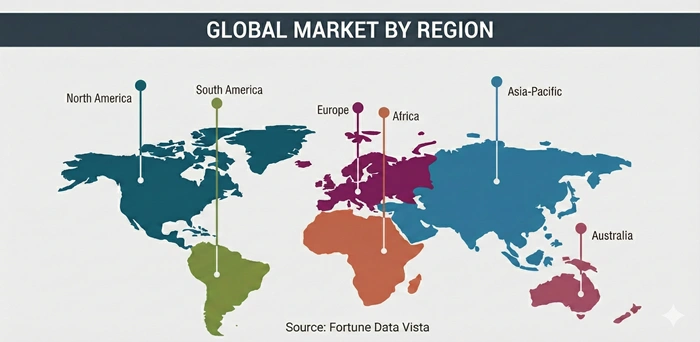
Asia Pacific is the dominant region in the global copper market, accounting for more than 57.4% of global revenue share in 2025 and growing at a regional CAGR of approximately 6.2% through 2033. China alone is responsible for approximately 55% of global refined copper consumption — a concentration that makes Chinese industrial policy, infrastructure investment, and manufacturing activity the single most important variable in global copper price discovery and supply-demand balancing. China's State Grid Corporation has committed to investing over CNY 700 billion annually in grid construction and upgrade programs through 2030, with transmission lines, transformer substations, and distribution networks collectively representing the single largest source of copper demand in the Chinese economy. Domestic EV production from BYD, NIO, and Li Auto — supported by China's dominant position in lithium battery manufacturing — is adding millions of tonnes to cumulative copper demand each year. Leading mining and refining companies with significant Asia Pacific exposure include Jiangxi Copper, Yunnan Copper, China Minmetals, and Japan's Pan Pacific Copper — each operating large-scale refining operations that supply domestic and international copper wire and copper products markets.
Japan, South Korea, India, and Australia each contribute meaningfully to the region's copper consumption story, representing increasingly important demand pools in their own right. Japan's manufacturing economy — anchored by automotive, electronics, and precision engineering — maintains consistently high per-capita copper consumption, while South Korea's semiconductor and display manufacturing industries are among the most copper-intensive technology sectors globally. India is the region's fastest-growing major copper market, with infrastructure investment, EV policy push, and renewable energy deployment collectively creating demand growth rates that significantly outpace developed market norms. Australia, while primarily a copper producer rather than consumer, is attracting significant investment in new copper mine development at Olympic Dam and other major deposits, positioning itself as a strategically important supply contributor to the Asia Pacific copper ecosystem over the 2026–2033 forecast horizon.
North America — The Fastest-Growing Developed Region Driven by Clean Energy and Digital Infrastructure Investment
IRA-Funded Clean Energy Manufacturing, Data Center Construction, and Grid Modernization Are Converging to Make North America the Copper Market's Most Dynamic Growth Region Among Developed Economies
North America holds approximately 18.6% of the global copper market share in 2025 and is on track to register a regional CAGR of approximately 6.4% through 2033 — one of the highest growth rates among established copper-consuming regions globally. The United States is the dominant country within the region, where the convergence of IRA-funded clean energy manufacturing, aggressive EV adoption targets, and an unprecedented data center construction wave is generating the fastest-growing incremental copper demand environment that North American producers and processors have experienced in decades. Major copper-consuming industries — wire and cable manufacturers, EV OEMs, transformer producers, and electrical contractors — are all reporting capacity constraints and long lead times for copper products, reflecting the intensity of demand growth relative to available supply. Leading copper producers and processors in the region include Freeport-McMoRan, Southern Copper Corporation, and Aurubis Americas, which supply refined copper and copper rod to downstream manufacturing industries across the United States and Canada.
Canada is a growing copper producer, with significant development-stage copper deposits in British Columbia and Ontario attracting increasing interest from domestic and international mining companies seeking to benefit from North America's proximity to rapidly growing copper demand centers. Mexico, through Southern Copper's (Grupo Mexico) large-scale mining operations at Buenavista del Cobre and Toquepala, contributes meaningfully to regional copper supply while its expanding manufacturing sector generates growing downstream demand. The regional copper market is additionally influenced by North America's strategic interest in securing domestic and allied-nation copper supply chains — reducing dependence on Chilean, Peruvian, and Chinese sources — creating policy-level support for new North American copper mine development that supplements the commercial demand drivers already sustaining the region's exceptional CAGR.
Top Key Players
-
Freeport-McMoRan Inc. (United States)
-
Codelco (Corporación Nacional del Cobre de Chile) (Chile)
-
Glencore plc (Switzerland)
-
BHP Group Limited (Australia)
-
Anglo American plc (United Kingdom)
-
Rio Tinto plc (United Kingdom/Australia)
-
Antofagasta plc (United Kingdom/Chile)
-
KGHM Polska Miedź S.A. (Poland)
-
Aurubis AG (Germany)
-
Southern Copper Corporation (Grupo Mexico) (Mexico)
-
Jiangxi Copper Company Limited (China)
-
Hindalco Industries Ltd. (India)
Recent Developments
-
In April 2026, Codelco secured a major financing package to fund Phase 2 development at its Rajo Inca project in Chile, extending the operating life of its Salvador mining complex and adding incremental copper production capacity to offset grade decline at its legacy operations, with the project expected to sustain 40,000 tonnes of annual copper production for 40 years.
-
In March 2026, Freeport-McMoRan announced that its Bagdad copper mine expansion in Arizona received its final federal environmental permit, clearing the path for a USD 1.4 billion capacity expansion that will increase Bagdad's annual copper output by approximately 200 million pounds, benefiting from growing domestic demand and IRA-related investment incentives.
-
In February 2026, Glencore completed the acquisition of a 30% stake in the Alumbrera copper-gold mine in Argentina from Goldcorp subsidiary Minera Alumbrera, expanding its Latin American copper asset portfolio as part of its stated strategic priority to increase copper production toward 1.5 million tonnes annually by 2030.
-
In November 2025, Hindalco Industries completed the acquisition of Ryker Base Pvt Ltd, a subsidiary of Polycab India, in a deal valued at INR 323 crore, strategically expanding its value-added copper product portfolio and strengthening its position in India's rapidly growing copper wire rod and downstream product markets.
-
In September 2025, Anglo American announced the commissioning of the first phase of its Quellaveco copper mine expansion in Peru, ramping up output toward an annual capacity of 300,000 tonnes, making Quellaveco one of the largest and lowest-cost copper mines globally and a key asset in Anglo American's strategic shift toward copper as its highest-priority growth metal.
Market Trends
The Decarbonization Supercycle and Growing Copper Supply Deficits Are Creating the Most Compelling Structural Market Dynamics Seen in the Commodity's Modern History
The defining macro trend for the copper market heading into the latter half of the 2026–2033 forecast period is the gradual tightening of global supply-demand balances driven by the clean energy transition's insatiable copper requirements. While the market is currently in a modest supply surplus — estimated at approximately 160,000 tonnes in 2026 — Goldman Sachs Research and major commodity analysts expect this surplus to erode and the market to enter structural deficit conditions from 2029 onwards. This impending tightness is already visible in copper futures market structures, rising project capital expenditure by major miners, and growing government interest in securing domestic copper supply chains through strategic stockpiling and investment in allied-nation mining assets. Copper prices, which reached a record USD 11,771 per tonne in late 2025, are forecast to average USD 10,710 in the first half of 2026 and to trend toward USD 15,000 per tonne by 2035 as the supply deficit deepens. The anticipation of this structural shift is attracting both record corporate and speculative investment into the copper market ecosystem — from upstream mining to downstream processing and recycling.
The second critical trend is the copper market's growing bifurcation between high-grade, low-cost, long-life copper assets — which are attracting premium valuations and intense M&A interest from major mining companies — and declining-grade incumbent operations that face sustained cost inflation and shrinking competitive moats. Major producers are pivoting their capital allocation strategies sharply toward copper, with BHP's recent commitment to making copper its highest-priority growth metal, Anglo American's strategic transformation to a copper-centric portfolio, and Glencore's stated ambition to grow copper production toward 1.5 million tonnes by 2030 all reflecting this industry-wide conviction that copper is the defining commodity of the energy transition era. For downstream copper consumers, this competitive landscape is driving greater vertical integration — with EV manufacturers, renewable energy developers, and utility companies increasingly exploring direct investment in copper mining assets to secure long-term supply at predictable costs.
Segments Covered in the Report
-
By Product Form
-
Wire Rods
-
Copper Tubes
-
Copper Sheets & Strips
-
Copper Bars & Profiles
-
Copper Alloys
-
Others
-
-
By Mining Type
-
Open-Pit Mining
-
Underground Mining
-
In-Situ Leach (ISL) Mining
-
-
By Grade
-
Pure Copper (Grade A)
-
Electrolytic Tough Pitch (ETP) Copper
-
Phosphor Deoxidized Copper
-
Oxygen-Free Copper (OFC)
-
Others
-
-
By Application
-
Electrical Wiring & Cable
-
Plumbing & HVAC
-
Industrial Machinery & Equipment
-
Renewable Energy Systems
-
EV and Automotive
-
Others
-
-
By End-Use Industry
-
Electrical & Electronics
-
Construction & Infrastructure
-
Automotive & Transportation (including EVs)
-
Industrial Machinery
-
Aerospace & Defense
-
Others
-
-
By Region
-
North America (U.S., Canada, Mexico)
-
Europe (Germany, UK, France, Poland, Italy)
-
Asia Pacific (China, India, Japan, South Korea, Australia)
-
Latin America (Chile, Peru, Brazil)
-
Middle East & Africa (Saudi Arabia, South Africa, Zambia, DRC)
-
❝ Built for Every Level — From Startups to Industry Giants ❞
Here Is Exactly How This Report Works for You
-
For Tier 1 mining companies, major industrial copper consumers, and institutional investors, this report delivers granular competitor revenue analysis by geography and product form, copper supply-demand balance modeling through 2033, and detailed assessments of how geopolitical risks — from Chile's mining royalty negotiations to China's sulphuric acid export restrictions — translate into specific price, margin, and supply security impacts on your business, because in a commodity market as geopolitically sensitive and structurally tightening as copper, the difference between proactive strategic positioning and reactive crisis management can represent billions of dollars of shareholder value.
-
For Tier 2 and Tier 3 copper downstream processors, mid-market wire and cable manufacturers, and regional construction material suppliers, this report identifies specific demand growth opportunities by application and geography — translating the copper market's complex macro dynamics into practical guidance on which end-use segments, regional markets, and customer relationships to prioritize to maximize revenue growth as the clean energy transition drives demand to new heights through 2033.
-
For startups in copper recycling, innovative mining technology companies, and clean energy investors, the forward-looking segment analysis, urban mining opportunity assessments, and competitive intelligence on how market leaders are repositioning their asset portfolios for the supply-deficit era contained in this report provide the analytical foundation to identify and capitalize on the next generation of high-value opportunities in the global copper market before the structural tightening of 2029 makes them universally apparent.
Frequently Asked Questions:
Answer: The global copper market is valued at USD 241.97 billion in 2025 and is projected to reach USD 382.15 billion by 2033. The market is growing at a CAGR of 5.8% from 2026 to 2033, driven by renewable energy demand, EV production, and global infrastructure investment.
Answer: The copper market's growth is primarily driven by the global clean energy transition, which requires copper-intensive renewable energy systems, EV manufacturing, and grid infrastructure modernization. Data center construction for AI computing and 5G telecommunications rollout are contributing significant incremental copper demand.
Answer: Asia Pacific dominates the global copper market with more than 57.4% of global revenue share in 2025, largely anchored by China's enormous copper consumption in construction, EVs, and power infrastructure. North America is the fastest-growing developed region, fueled by IRA-funded clean energy manufacturing, data center expansion, and grid modernization investment.
Answer: Goldman Sachs Research forecasts that the global copper market will move from its current modest surplus into a structural deficit from approximately 2029, as demand from the energy transition outpaces new mine supply development. This tightening is projected to push LME copper prices toward USD 15,000 per tonne by 2035, from current levels of USD 10,000–11,000.
Answer: Recycled copper — sourced through urban mining of end-of-life electrical cables, electronics, and automotive components — is becoming an increasingly important supplement to primary mined copper supply, particularly as ore grades decline and primary production costs rise. The recycled copper segment is growing at a rapid CAGR and is valued at USD 51.9 billion in 2026, reflecting strong commercial and regulatory tailwinds toward circular material recovery across all major copper-consuming regions.