
Cruciate Ligament Diagnosis and Treatment Market Overview
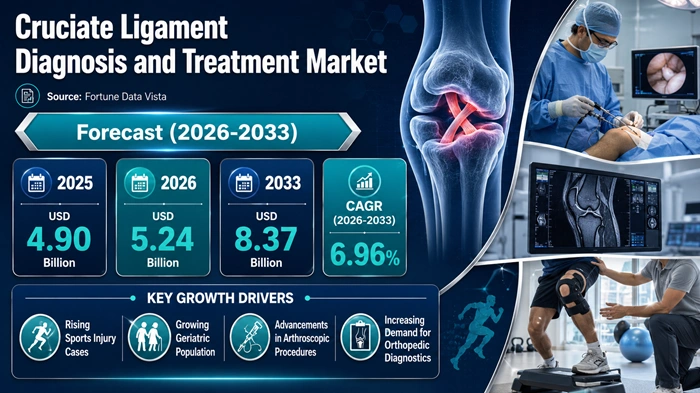
The global cruciate ligament diagnosis and treatment market size is valued at USD 4.90 billion in 2025 and is predicted to increase from USD 5.24 billion in 2026 to approximately USD 8.37 billion by 2033, growing at a CAGR of 6.96% from 2026 to 2033.
This steady growth reflects the rising global incidence of sports-related knee injuries, continuous improvements in surgical imaging and reconstruction techniques, and growing patient preference for minimally invasive treatment options. As orthopedic surgeons increasingly rely on advanced diagnostic tools and arthroscopic procedures to treat torn ligaments, hospitals and specialty sports medicine clinics worldwide continue expanding their treatment capabilities to meet growing patient demand.
AI Impact on the Cruciate Ligament Diagnosis and Treatment Industry
Artificial Intelligence Is Enhancing Injury Detection Precision, Enabling Personalized Rehabilitation Planning, and Improving Surgical Outcome Prediction Across the Cruciate Ligament Diagnosis and Treatment Landscape — Fundamentally Changing How Orthopedic Surgeons Manage Knee Injuries
Artificial intelligence is increasingly transforming how physicians diagnose and treat cruciate ligament injuries, particularly through AI-enhanced imaging analysis that can detect subtle ligament damage in MRI scans with greater consistency than manual radiologist review alone. These algorithms help identify partial tears and early-stage degeneration that might otherwise go unnoticed until symptoms worsen, allowing for earlier intervention and potentially better long-term outcomes. Sports medicine clinics adopting these AI-powered diagnostic tools are seeing improved diagnostic confidence, which matters considerably given how much treatment planning depends on accurately assessing injury severity.
Beyond diagnosis, AI is also reshaping rehabilitation planning, with predictive analytics tools now capable of analyzing patient-specific factors like age, activity level, and surgical technique to recommend personalized recovery timelines and physical therapy protocols. This individualized approach helps reduce re-injury risk, which remains a persistent concern following ligament reconstruction surgery, particularly among athletes returning to high-intensity sports. As AI-driven diagnostic and rehabilitation tools continue maturing, they are becoming an increasingly valuable capability for providers competing within the broader cruciate ligament diagnosis and treatment market.
Growth Factors
Rising Sports Injury Rates and Advancing Surgical Techniques Continue Driving Sustained Demand
The most significant growth factor supporting the cruciate ligament diagnosis and treatment market is the steadily rising incidence of sports-related knee injuries, driven by growing participation in competitive and recreational athletics across both younger and older populations worldwide. As more individuals engage in high-impact sports and fitness activities, the number of anterior and posterior cruciate ligament tears requiring medical intervention continues climbing, creating consistent demand for both diagnostic services and surgical treatment options. This trend has been particularly notable among younger athletes, where early and effective treatment matters considerably for long-term joint health and continued athletic participation.
A second important growth factor is the continuous advancement of minimally invasive and arthroscopic surgical techniques, which have significantly improved recovery times and reduced complication rates compared to traditional open surgery approaches. These technological improvements have made ligament reconstruction more accessible and appealing to a broader range of patients, including older individuals who might previously have been considered poor surgical candidates. This combination of rising injury rates and improving surgical technology continues to expand the addressable patient population across the cruciate ligament diagnosis and treatment market.
Market Outlook
Regenerative Therapy Advances and Expanding Rehabilitation Infrastructure Point Toward Sustained Growth Through 2033
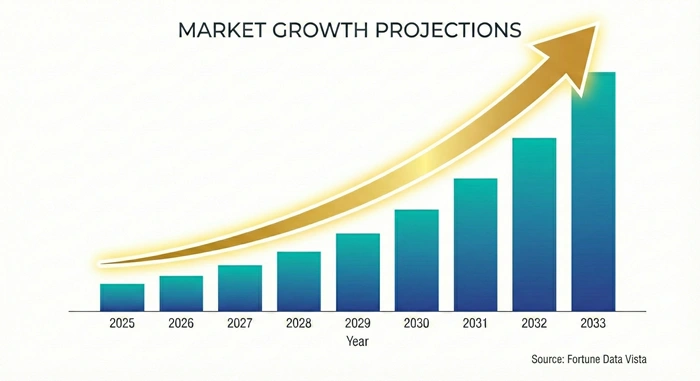
Looking ahead through the forecast period, the cruciate ligament diagnosis and treatment industry is expected to benefit substantially from continued advancement in regenerative therapy options, including bridge-enhanced ligament restoration techniques that offer alternatives to traditional graft-based reconstruction surgery. As clinical evidence around these newer regenerative approaches continues accumulating, they are likely to capture an increasingly meaningful share of treatment volume, particularly among patients seeking options that preserve native tissue rather than relying entirely on grafts.
At the same time, growing investment in dedicated rehabilitation infrastructure, including specialized physical therapy centers and sports medicine institutes, is expected to support improved long-term recovery outcomes while creating new revenue streams beyond the initial surgical procedure. Providers that can offer comprehensive care pathways spanning diagnosis, surgery, and structured rehabilitation are increasingly well positioned to capture a larger share of overall patient value. Companies balancing surgical innovation with strong rehabilitation support services are likely to lead growth within the broader cruciate ligament diagnosis and treatment market through 2033.
Expert Speaks
-
"Advances in graft-free and regenerative reconstruction techniques are opening new possibilities for patients who previously had limited surgical options." — CEO, Zimmer Biomet Holdings Inc
-
"Our continued investment in arthroscopic technology reflects what surgeons consistently tell us they need to improve precision and reduce recovery time." — CEO, Stryker Corporation
-
"As sports participation continues rising globally, we remain focused on expanding access to reliable, minimally invasive treatment options for ligament injuries." — CEO, Smith and Nephew plc
Key Report Takeaways
-
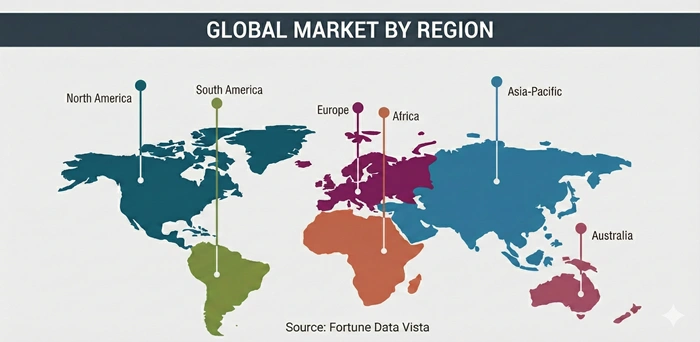
North America leads the global cruciate ligament diagnosis and treatment market, holding approximately 40% market share in 2025, supported by high healthcare spending, advanced orthopedic infrastructure, and strong sports injury awareness
-
Asia Pacific is the fastest-growing region, projected to expand at a CAGR near 9% through 2033, driven by expanding healthcare access and rising sports participation across China and India
-
Hospitals represent the dominant end-user segment, accounting for roughly 55% share, given the specialized surgical infrastructure required for comprehensive ligament care
-
Surgical treatment contributes the most to overall demand, reflecting its effectiveness in restoring knee stability for severe ligament injuries
-
MRI-based diagnosis remains the most widely adopted diagnostic approach, valued for its detailed, non-invasive visualization of soft tissue damage
-
Minimally invasive surgery will grow the fastest among surgical type segments, holding close to 40% market share with a CAGR near 7.5% through the forecast period, driven by faster recovery and reduced complication rates
Market Scope
| Parameter | Details |
|---|---|
| Market Size by 2033 | USD 8.37 Billion | Market Size by 2026 | USD 5.24 Billion | Market Size by 2025 | USD 4.90 Billion | Market Growth Rate from 2026 to 2033 | CAGR of 6.96% | Dominating Region | North America | Fastest Growing Region | Asia Pacific | Segments Covered | Diagnosis Type, Treatment Type, Surgery Type, End-Use, Region | Regions Covered | North America, Europe, Asia Pacific, Latin America, Middle East & Africa |
Market Dynamics
Drivers Impact Analysis
Rising Sports Injury Incidence and Aging Population Vulnerability Remain the Two Strongest Forces Behind Market Momentum
| Driver | (≈) % Impact on CAGR Forecast | Geographic Relevance | Impact Timeline |
|---|---|---|---|
| Rising incidence of sports-related ligament injuries | ~36% | Global, strongest in North America, Europe | Short to long-term |
| Growing aging population vulnerable to ligament degeneration | ~26% | North America, Europe, growing in Asia Pacific | Medium to long-term |
| Advancements in minimally invasive and arthroscopic surgical techniques | ~23% | Global | Short to medium-term |
| Expanding rehabilitation and physical therapy infrastructure | ~15% | Global | Medium-term |
Rising incidence of sports-related ligament injuries continues to serve as the primary engine behind sustained growth in the cruciate ligament diagnosis and treatment market, as growing participation in competitive and recreational sports across all age groups steadily expands the pool of patients requiring diagnostic evaluation and surgical intervention. This growing injury burden has translated directly into higher procedure volumes at hospitals and specialty orthopedic centers, creating consistent demand for both imaging technology and reconstruction devices.
Growing aging population vulnerability represents the second major driver, as weaker joints and reduced bone strength among older adults increase susceptibility to ligament injuries even from relatively minor trauma. This demographic trend, combined with continuous advancement in minimally invasive surgical techniques that make treatment more accessible to older patients, continues reinforcing steady demand growth across the broader cruciate ligament diagnosis and treatment market.
Restraints Impact Analysis
High Treatment Costs and Limited Access to Specialized Care Continue to Moderate Broader Adoption
| Restraint | (≈) % Impact on CAGR Forecast | Geographic Relevance | Impact Timeline |
|---|---|---|---|
| High cost of ligament reconstruction surgery and rehabilitation | ~37% | Global, notable in developing regions | Short to medium-term |
| Limited availability of skilled orthopedic surgeons in some regions | ~29% | Asia Pacific, Latin America, Middle East & Africa | Ongoing |
| Delayed diagnosis due to limited access to advanced imaging | ~21% | Emerging markets | Medium-term |
| Risk of post-surgical complications and re-injury | ~13% | Global | Long-term |
The most persistent restraint facing the cruciate ligament diagnosis and treatment market is the substantial cost associated with ligament reconstruction procedures and the extended post-surgical rehabilitation they require, which can place these treatments out of reach for patients in developing healthcare systems. This cost barrier often delays or prevents access to timely surgical intervention, potentially worsening long-term joint outcomes for affected patients.
Limited availability of skilled orthopedic surgeons represents a second significant restraint, as performing ligament reconstruction safely and effectively requires specialized training that many regions, particularly across parts of Asia Pacific and Africa, have not yet developed sufficient capacity to provide. Combined with delayed diagnosis in areas lacking advanced imaging infrastructure, these restraints continue moderating how quickly broader treatment access can expand across the global cruciate ligament diagnosis and treatment market.
Opportunities Impact Analysis
Regenerative Therapy Innovation and Expanding Emerging Market Healthcare Access Represent the Clearest Paths to Growth
| Opportunity | (≈) % Impact on CAGR Forecast | Geographic Relevance | Impact Timeline |
|---|---|---|---|
| Advancing regenerative and graft-free ligament restoration techniques | ~38% | North America, Europe | Medium to long-term |
| Expanding healthcare infrastructure and sports medicine access in emerging economies | ~33% | Asia Pacific, Latin America | Medium to long-term |
| Growing adoption of AI-based diagnostics and wearable recovery monitoring | ~29% | Global | Short to medium-term |
Advancing regenerative and graft-free ligament restoration techniques represent one of the most promising opportunities within the cruciate ligament diagnosis and treatment market, as newer approaches like bridge-enhanced restoration offer patients alternatives that preserve native tissue while potentially reducing long-term osteoarthritis risk compared to traditional graft-based reconstruction. Companies advancing these regenerative technologies stand to capture meaningful share as clinical evidence continues building.
Expanding healthcare infrastructure across emerging economies presents a second substantial opportunity, as growing investment in hospitals, diagnostic centers, and specialty clinics across China, India, and Latin America creates new access points for patients who previously had limited treatment options. Growing adoption of AI-based diagnostics and wearable recovery monitoring devices further broadens the opportunity landscape, helping providers deliver more personalized, data-driven care throughout the treatment journey. Companies pursuing these parallel opportunities are well positioned to capture meaningful growth within the broader cruciate ligament diagnosis and treatment market through the forecast period.
Segment Analysis
By Treatment Type: Surgical Treatment
Surgical Treatment Continues to Anchor the Treatment Landscape, Valued for Its Effectiveness in Restoring Long-Term Knee Stability
Surgical treatment holds the largest share within the treatment type segment of the cruciate ligament diagnosis and treatment market, accounting for approximately 70% of total segment revenue in 2025. This dominance reflects the procedure's proven ability to restore knee stability and function following severe ligament tears, particularly among athletes and physically active patients who require full recovery to resume high-intensity activity. In markets like the United States and Germany, surgical reconstruction remains the preferred approach for complete ligament ruptures, supported by decades of clinical evidence and continuously improving graft techniques. Leading device manufacturers such as Arthrex, Zimmer Biomet, and Stryker continue to dominate this segment through ongoing innovation in fixation devices and graft materials.
Growth within this segment remains particularly strong in North America, where well-established reimbursement frameworks and a dense concentration of sports medicine specialists continue supporting high surgical volumes. The region's combination of favorable insurance coverage, physician expertise, and rapid adoption of newer techniques like all-suture implants has helped surgical treatment maintain its leading position despite growing interest in non-surgical alternatives. As regenerative surgical techniques continue advancing, surgical treatment is expected to remain the dominant treatment type within the broader cruciate ligament diagnosis and treatment market throughout the forecast period.
By Diagnosis Type: MRI Scans
MRI Scans Remain the Dominant Diagnostic Approach, Reflecting Their Superior Soft Tissue Visualization Capabilities
MRI scans account for approximately 40% of diagnosis type revenue within the cruciate ligament diagnosis and treatment market, reflecting their unmatched ability to provide detailed, high-resolution imaging of soft tissue structures without radiation exposure. Physicians widely prefer MRI for accurately detecting ligament tears and guiding subsequent treatment decisions, since this imaging modality reliably distinguishes between partial and complete tears in ways that other diagnostic methods cannot match. This diagnostic reliability has made MRI the gold standard across clinical settings, from major hospital orthopedic departments to specialized sports medicine clinics evaluating athlete injuries.
Growth in this diagnostic segment remains especially strong in North America and parts of Europe, where widespread MRI equipment availability and strong insurance coverage support routine use in suspected ligament injury cases. Companies like GE HealthCare and Siemens Healthineers maintain strong positions supplying advanced imaging equipment to hospitals and diagnostic centers pursuing higher-resolution soft tissue evaluation capabilities. As imaging technology continues improving diagnostic accuracy and speed, MRI scans are expected to remain the leading diagnosis type within the broader cruciate ligament diagnosis and treatment market.
Regional Insights
North America
High Healthcare Spending and Advanced Orthopedic Infrastructure Keep North America Firmly in the Lead
North America commands the leading position in the global cruciate ligament diagnosis and treatment market, holding approximately 40% share in 2025, supported by high healthcare spending, advanced orthopedic care facilities, and a high prevalence of sports-related injuries across the region. The United States drives the overwhelming majority of regional demand, backed by strong reimbursement systems, widespread patient awareness, and a dense concentration of leading medical device companies investing continuously in surgical innovation. Companies with strong regional presence include Zimmer Biomet, Stryker, Arthrex, and DePuy Synthes, each maintaining deep relationships with major hospital networks and sports medicine centers across the country.
Canada also contributes meaningfully to regional demand, supported by growing sports participation and steadily expanding orthopedic care infrastructure. The region's combination of strong reimbursement support, advanced surgical technology adoption, and continuous research investment ensures North America's leadership position within the cruciate ligament diagnosis and treatment market remains firmly intact through the remainder of the forecast period.
Asia Pacific
Expanding Healthcare Access and Rising Sports Participation Position Asia Pacific as the Fastest-Growing Region
Asia Pacific is projected to register the fastest CAGR within the global cruciate ligament diagnosis and treatment market through 2033, expanding at a rate near 9% as expanding healthcare access and rising sports participation create substantial new demand across the region. China and India lead much of this regional growth, supported by large patient populations, rising healthcare spending, and government initiatives aimed at improving orthopedic infrastructure and treatment accessibility. Regional and international medical device companies alike have expanded their presence to serve this growing demand, often introducing more affordable treatment options suited to local market conditions.
Japan and South Korea contribute further depth to regional growth, both bringing established healthcare systems that increasingly favor advanced arthroscopic and minimally invasive techniques for ligament treatment. Growing government investment in sports medicine facilities across several Asia Pacific countries continues to accelerate access to specialized ligament care among patients who previously had limited treatment options nearby. This combination of expanding healthcare infrastructure, rising sports participation, and growing affordability focus positions Asia Pacific as the clear growth leader within the broader cruciate ligament diagnosis and treatment market through the forecast period.
Customization Available for This Report
Region-Specific and Country-Specific Versions of This Report Are Available to Deliver a Sharper, More Localized View of Market Dynamics
This report can be tailored on a region-by-region and country-by-country basis, providing localized market sizing, competitive mapping, and treatment adoption trend analysis that a global overview alone cannot fully capture.
Clients seeking a more focused breakdown can request a customized version covering any of the following regions and countries, complete with demand forecasting, competitor landscape review, and adoption trend analysis tied specifically to the cruciate ligament diagnosis and treatment keyword focus:
North America
-
U.S. — Detailed review of reimbursement trends and orthopedic surgical innovation patterns
-
Canada — Coverage of sports medicine infrastructure investment and treatment access
-
Mexico — Analysis of emerging orthopedic care infrastructure development
Europe
-
U.K. — Review of NHS treatment pathways and surgical adoption trends
-
Germany — Coverage of hospital orthopedic investment and reimbursement dynamics
-
France — Insights into ligament treatment adoption and rehabilitation trends
-
Italy — Analysis of regional sports medicine infrastructure investment
-
Rest of Europe — Country-level view of emerging demand across Eastern Europe and the Nordics
Asia Pacific
-
China — Coverage of expanding orthopedic infrastructure and rising injury diagnosis rates
-
India — Analysis of growing treatment access and sports medicine facility expansion
-
Japan — Review of established healthcare infrastructure and technology adoption trends
-
South Korea — Assessment of ligament treatment adoption and hospital investment
-
Australia — Insights into sports medicine funding and treatment adoption trends
-
Rest of Asia Pacific — Country-level breakdown covering Thailand, Vietnam, Indonesia, and Malaysia
Latin America
-
Brazil — Coverage of expanding hospital orthopedic investment and treatment adoption
-
Argentina — Analysis of early-stage sports medicine infrastructure development
-
Rest of Latin America — Country-level sizing across Colombia, Peru, and Chile
Middle East & Africa
-
UAE — Review of sports medicine infrastructure investment and treatment access trends
-
Saudi Arabia — Coverage of expanding orthopedic care capability initiatives
-
Rest of MEA — Country-level view of Sub-Saharan Africa orthopedic infrastructure expansion
Top Key Players
-
Zimmer Biomet Holdings Inc (United States)
-
Stryker Corporation (United States)
-
DePuy Synthes (United States)
-
Smith and Nephew plc (United Kingdom)
-
Arthrex Inc (United States)
-
Medtronic plc (Ireland)
-
Conmed Corporation (United States)
-
B. Braun Melsungen AG (Germany)
-
NuVasive Inc (United States)
-
Corin Group (United Kingdom)
-
Orthofix International N.V. (United States)
-
Miach Orthopaedics Inc (United States)
Recent Developments
-
In 2026, Arthrex launched an all-suture ACL implant called TightRope SB, a first-of-its-kind metal-free device that improves fixation flexibility and supports better knee stability during recovery
-
In 2025, Miach Orthopaedics gained FDA clearance for updated labeling on its BEAR implant, showing reduced risk of post-traumatic osteoarthritis compared to traditional graft-based reconstruction
-
In 2025, Zimmer Biomet acquired Monogram Technologies to advance robotic-assisted orthopedic procedures, including knee and ligament surgeries, aimed at improving surgical precision
-
In 2025, Stryker expanded its arthroscopic surgical technology portfolio to support faster, more precise ligament reconstruction procedures across hospital partner networks
-
In 2026, Smith and Nephew strengthened its minimally invasive surgical device offerings to expand access to less invasive ligament repair options for a broader patient population
Market Trends
Regenerative Reconstruction Techniques and Growing Rehabilitation Focus Are Reshaping Treatment Standards
One of the clearest trends shaping the cruciate ligament diagnosis and treatment market is the growing clinical interest in regenerative and graft-free reconstruction techniques, as newer approaches like bridge-enhanced ligament restoration offer patients alternatives that preserve native tissue while potentially reducing long-term joint degeneration risk. Device manufacturers are increasingly investing in these regenerative technologies, recognizing that this shift could meaningfully reshape competitive positioning across the surgical treatment landscape over the coming years.
A second significant trend is the increasing emphasis on structured rehabilitation programs following ligament treatment, as providers recognize that personalized physical therapy protocols play a critical role in preventing re-injury and ensuring successful long-term outcomes. This growing focus on comprehensive recovery pathways is reshaping how providers structure their service offerings, with rehabilitation increasingly viewed as an essential component rather than an afterthought within the broader cruciate ligament diagnosis and treatment market.
Segments Covered in the Report
By Diagnosis Type
-
MRI Scans
-
X-ray Imaging
-
Arthroscopy
-
Physical Examination
-
Ultrasound Imaging
By Treatment Type
-
Surgical Treatment
-
Non-Surgical Treatment
By Surgery Type
-
Minimally Invasive Surgery
-
Traditional Open Surgery
-
Arthroscopic Surgery
By End-Use
-
Hospitals
-
Specialty Clinics
-
Rehabilitation Centers
-
Sports Institutes
By Region
-
North America (U.S., Canada, Mexico)
-
Europe (U.K., Germany, France, Italy, Rest of Europe)
-
Asia Pacific (China, India, Japan, South Korea, Australia, Rest of Asia Pacific)
-
Latin America (Brazil, Argentina, Rest of Latin America)
-
Middle East & Africa (UAE, Saudi Arabia, Rest of MEA)
❝ Built for Every Level — From Startups to Industry Giants ❞
Here Is Exactly How This Report Works for You
-
For tier 1 companies, investors, and established market leaders, this report delivers detailed competitor revenue analysis, surgical innovation trend mapping, and geopolitical risk context that support confident decisions around product expansion, pricing strategy, and long-term positioning within the cruciate ligament diagnosis and treatment space
-
For tier 2 and tier 3 companies, startups, and mid-sized device manufacturers, this report highlights the most commercially promising treatment categories and underserved regional opportunities, giving you a practical framework to compete against larger established players without overextending limited resources
-
For every decision maker across the value chain, this report explains exactly how reimbursement trends, regulatory approvals, and competitor product launches are shaping market direction through 2033, equipping you to plan investment and go-to-market decisions with genuine confidence
Frequently Asked Questions:
Answer: The global cruciate ligament diagnosis and treatment market was valued at USD 4.90 billion in 2025 and is projected to reach USD 8.37 billion by 2033. This growth is driven largely by rising sports injury rates and advancing surgical reconstruction techniques.
Answer: Growth in the cruciate ligament diagnosis and treatment market is being driven by rising sports-related injury incidence and growing aging population vulnerability to ligament degeneration. Advancements in minimally invasive surgical techniques are further reinforcing this expansion.
Answer: North America currently leads the cruciate ligament diagnosis and treatment market with roughly 40% share, supported by high healthcare spending and advanced orthopedic infrastructure. Asia Pacific is growing the fastest, driven by expanding healthcare access.
Answer: Surgical treatment generates the largest share of revenue in the cruciate ligament diagnosis and treatment market, valued for its effectiveness in restoring long-term knee stability. MRI scans also remain the dominant diagnostic approach for evaluating ligament damage.
Answer: Leading companies in the cruciate ligament diagnosis and treatment market include Zimmer Biomet, Stryker, Arthrex, Smith and Nephew, and DePuy Synthes. These companies compete through continuous innovation in graft techniques, regenerative implants, and minimally invasive surgical devices.