
Data Center Interconnect Market Overview
The global data center interconnect market size is valued at USD 15.97 billion in 2025 and is predicted to increase from USD 18.14 billion in 2026 to approximately USD 44.48 billion by 2033, growing at a CAGR of 13.52% from 2026 to 2033.
This steady expansion reflects the surging volume of data traffic moving between geographically dispersed data centers as enterprises and cloud providers scale their digital infrastructure. As hyperscale cloud operators and telecom carriers continue racing to support AI workloads, video streaming, and real-time application delivery, the need for high-capacity, low-latency connectivity between facilities has become a critical infrastructure priority worldwide.
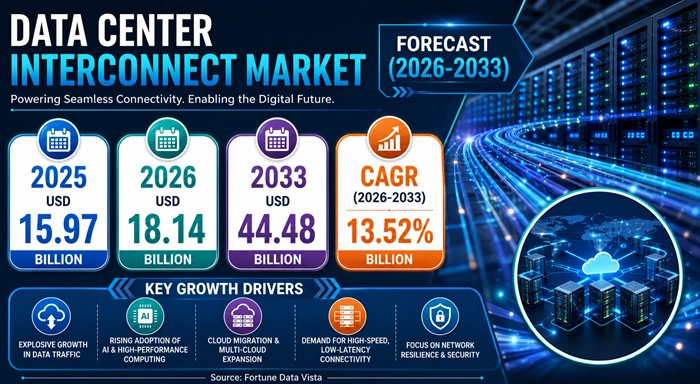
AI Impact on the Data Center Interconnect Industry
Artificial Intelligence Workload Growth Is Driving Unprecedented Bandwidth Demand, Reshaping Network Architecture Requirements, and Accelerating Coherent Optics Adoption Across the Data Center Interconnect Landscape — Fundamentally Changing How Operators Design Multi-Site Infrastructure
The explosive growth of AI training and inference workloads has become one of the most significant forces reshaping how operators approach data center interconnect infrastructure, since large language model training increasingly requires distributing compute across multiple geographically separate facilities that must communicate with extremely low latency. This shift has pushed network architects to rethink traditional interconnect designs, favoring higher-capacity coherent optical systems that can move massive volumes of data between AI training clusters without becoming a performance bottleneck. Hyperscale operators building dedicated AI infrastructure campuses are now treating interconnect capacity planning as a core architectural decision rather than an afterthought.
Beyond raw bandwidth demand, AI is also being used directly within interconnect management itself, with network operators increasingly deploying machine learning-based traffic prediction and automated fault detection tools that help optimize how data flows across interconnected facilities. These AI-driven network management platforms can proactively identify potential congestion points or hardware degradation before they cause service disruptions, which matters considerably given how costly downtime becomes when multiple data centers depend on uninterrupted connectivity. As AI continues driving both the demand for and the intelligence behind interconnect infrastructure, it is becoming a defining force shaping competitive dynamics across the broader data center interconnect market.
Growth Factors
Rising Cloud Migration and Explosive Data Traffic Growth Continue Driving Sustained Infrastructure Investment
The most significant growth factor supporting the data center interconnect market is the continued enterprise migration toward cloud and hybrid infrastructure models, which requires reliable, high-speed connectivity linking on-premises facilities, colocation sites, and public cloud regions. As organizations increasingly distribute workloads across multiple locations for redundancy, performance, and regulatory compliance reasons, the volume of data that must move securely between these sites continues climbing at a pace that legacy networking infrastructure often cannot support efficiently. This sustained cloud adoption trend has made robust interconnect capacity a fundamental requirement rather than an optional upgrade for enterprises of nearly every size.
A second important growth factor is the relentless growth in global data traffic driven by streaming video, real-time collaboration tools, and increasingly data-intensive applications that demand consistent low-latency performance regardless of user location. Content delivery networks and telecom carriers have responded by expanding their interconnect footprints substantially, recognizing that network performance directly impacts customer experience and retention. This combination of accelerating cloud migration and continuously rising data traffic volumes continues to broaden demand across the data center interconnect market.
Market Outlook
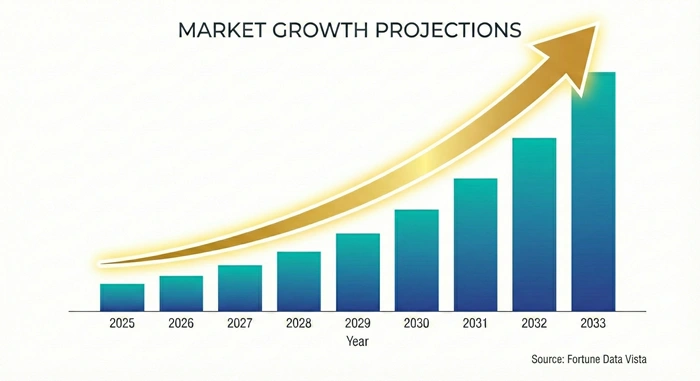
Coherent Optics Advancement and Expanding Hyperscale Campus Buildouts Point Toward Sustained Growth Through 2033
Looking ahead through the forecast period, the data center interconnect industry is expected to benefit substantially from continued advancement in coherent optical transmission technology, as vendors push transmission speeds toward 800G and beyond to keep pace with exploding bandwidth requirements from AI and cloud workloads. As these higher-capacity optical systems become more cost-effective and widely deployed, they are likely to fundamentally reshape how much data operators can move between facilities without proportionally increasing their physical infrastructure footprint.
At the same time, the rapid expansion of hyperscale data center campuses, particularly those built specifically to support AI training infrastructure, is expected to create enormous new demand for interconnect capacity linking these massive facilities to broader cloud and enterprise networks. Vendors that can deliver scalable, software-defined interconnect solutions capable of supporting rapid capacity expansion are increasingly well positioned to capture this growth. Companies balancing optical hardware innovation with intelligent network automation software are likely to lead growth within the broader data center interconnect market through 2033.
Expert Speaks
-
"The explosion in AI workloads is fundamentally changing how our customers think about network capacity between data centers, and coherent optics innovation is central to meeting that demand." — CEO, Ciena Corporation
-
"Our customers are building infrastructure at a pace we have never seen before, and reliable, scalable interconnect solutions are essential to supporting that growth." — CEO, Cisco Systems Inc
-
"As enterprises and cloud providers expand across regions, the ability to move data securely and efficiently between facilities has become a genuine competitive advantage." — CEO, Nokia Corporation
Key Report Takeaways
-
North America leads the global data center interconnect market, holding approximately 38% market share in 2025, supported by a dense concentration of hyperscale data centers and advanced telecom infrastructure
-
Asia Pacific is the fastest-growing region, projected to expand at a CAGR near 16% through 2033, driven by rapidly expanding cloud infrastructure and rising digital adoption across China and India
-
Hyperscale cloud providers represent the largest customer segment, given their massive multi-site data traffic requirements and continuous infrastructure expansion
-
Optical DCI solutions contribute the most to overall demand, reflecting their ability to deliver the high-capacity, long-distance connectivity that modern data centers require
-
Coherent optical transmission remains the most widely adopted technology type, valued for its superior capacity and spectral efficiency compared to older transmission methods
-
Packet-optical DCI platforms will grow the fastest among product segments, holding close to 45% market share with a CAGR near 15% through the forecast period, driven by rising demand for integrated, software-defined connectivity
Market Scope
| Parameter | Details |
|---|---|
| Market Size by 2033 | USD 44.48 Billion | Market Size by 2026 | USD 18.14 Billion | Market Size by 2025 | USD 15.97 Billion | Market Growth Rate from 2026 to 2033 | CAGR of 13.52% | Dominating Region | North America | Fastest Growing Region | Asia Pacific | Segments Covered | Product Type, Data Rate, Application, End User, Region | Regions Covered | North America, Europe, Asia Pacific, Latin America, Middle East & Africa |
Market Dynamics
Drivers Impact Analysis
Rising Cloud Adoption and AI-Driven Bandwidth Demand Remain the Two Strongest Forces Behind Market Momentum
| Driver | (≈) % Impact on CAGR Forecast | Geographic Relevance | Impact Timeline |
|---|---|---|---|
| Growing enterprise cloud and hybrid infrastructure adoption | ~34% | Global, strongest in North America, Europe | Short to long-term |
| Explosive growth in AI workloads requiring multi-site connectivity | ~30% | North America, Asia Pacific | Short to medium-term |
| Rising global data traffic from streaming and real-time applications | ~22% | Global | Medium to long-term |
| Expanding hyperscale data center campus construction | ~14% | Global | Medium-term |
Growing enterprise cloud and hybrid infrastructure adoption continues to serve as the primary engine behind sustained growth in the data center interconnect market, as organizations increasingly distribute workloads across multiple facilities to improve resilience, performance, and regulatory compliance. This growing distributed architecture trend has translated directly into higher demand for reliable, high-capacity connectivity linking these dispersed sites together.
Explosive growth in AI workloads represents the second major driver, as training large-scale models increasingly requires interconnecting compute clusters across multiple data centers with extremely low latency and massive bandwidth. This emerging demand source, combined with continuously rising global data traffic from streaming and collaboration applications, continues reinforcing steady demand growth across the broader data center interconnect market.
Restraints Impact Analysis
High Infrastructure Costs and Complex Network Integration Challenges Continue to Moderate Broader Adoption
| Restraint | (≈) % Impact on CAGR Forecast | Geographic Relevance | Impact Timeline |
|---|---|---|---|
| High capital costs for deploying advanced optical interconnect infrastructure | ~36% | Global, notable in emerging markets | Short to medium-term |
| Complexity of integrating interconnect solutions across multi-vendor environments | ~28% | Global | Ongoing |
| Limited fiber infrastructure availability in certain regions | ~22% | Asia Pacific, Latin America, Middle East & Africa | Medium-term |
| Regulatory and data sovereignty restrictions affecting cross-border connectivity | ~14% | Europe, Asia Pacific | Long-term |
The most persistent restraint facing the data center interconnect market is the substantial capital investment required to deploy advanced coherent optical systems and supporting infrastructure, which can strain budgets for smaller operators and enterprises seeking to expand their multi-site connectivity. This cost barrier often slows how quickly organizations can upgrade legacy interconnect infrastructure to keep pace with rising bandwidth demands.
Complexity of integrating interconnect solutions across multi-vendor environments represents a second significant restraint, as many enterprises operate infrastructure built from equipment supplied by different vendors, making seamless interoperability a persistent technical challenge. Combined with limited fiber infrastructure availability in certain developing regions, these restraints continue moderating how quickly broader adoption can spread across the global data center interconnect market.
Opportunities Impact Analysis
800G Optical Transmission Advancement and Expanding Emerging Market Cloud Infrastructure Represent the Clearest Paths to Growth
| Opportunity | (≈) % Impact on CAGR Forecast | Geographic Relevance | Impact Timeline |
|---|---|---|---|
| Advancing 800G and beyond coherent optical transmission technology | ~38% | Global | Short to medium-term |
| Expanding hyperscale and cloud infrastructure investment across emerging economies | ~34% | Asia Pacific, Latin America, Middle East & Africa | Medium to long-term |
| Growing adoption of software-defined and automated interconnect management | ~28% | North America, Europe | Short to medium-term |
Advancing 800G and beyond coherent optical transmission technology represents one of the most substantial opportunities within the data center interconnect market, as vendors developing these higher-capacity systems stand to capture significant share from operators seeking to future-proof their infrastructure against continuously rising bandwidth demand. This technology shift is expected to meaningfully reshape competitive positioning among leading optical equipment providers over the coming years.
Expanding hyperscale and cloud infrastructure investment across emerging economies presents a second substantial opportunity, as rapidly growing digital adoption across Asia Pacific and Latin America drives new data center construction that requires robust interconnect capabilities from day one. Growing adoption of software-defined and automated interconnect management platforms further broadens the opportunity landscape, helping operators reduce operational complexity while improving network reliability. Companies pursuing these parallel opportunities are well positioned to capture meaningful growth within the broader data center interconnect market through the forecast period.
Segment Analysis
By Product Type: Optical DCI Solutions
Optical DCI Solutions Continue to Anchor the Product Landscape, Valued for Their Superior Capacity and Long-Distance Performance
Optical DCI solutions hold the largest share within the product type segment of the data center interconnect market, accounting for approximately 62% of total segment revenue in 2025. This dominance reflects the technology's proven ability to move enormous volumes of data across long distances with minimal signal degradation, making it the preferred choice for connecting geographically dispersed hyperscale facilities and metro data center clusters. In markets like the United States and China, optical DCI systems remain the default choice for high-capacity multi-site connectivity, supported by continuous innovation in coherent transmission technology. Leading equipment manufacturers such as Ciena, Huawei, and Nokia continue to dominate this segment through ongoing advancement of their optical transport platforms.
Growth within this segment remains particularly strong in North America, where hyperscale cloud providers continue investing heavily in high-capacity optical infrastructure to support rapidly expanding AI training and cloud service demands. The region's dense concentration of data center campuses and strong vendor ecosystem has helped optical DCI solutions maintain their leading position despite growing interest in packet-optical integrated alternatives. As transmission speeds continue advancing toward 800G and beyond, optical DCI solutions are expected to remain the dominant product type within the broader data center interconnect market throughout the forecast period.
By Application: Real-Time Disaster Recovery and Business Continuity
Real-Time Disaster Recovery Applications Remain a Critical Growth Driver, Reflecting Enterprise Priorities Around Data Resilience
Real-time disaster recovery and business continuity applications represent a significant and steadily growing application segment within the data center interconnect market, reflecting the increasing enterprise priority placed on ensuring data remains accessible and synchronized across multiple facilities even during localized outages or disasters. Organizations across financial services, healthcare, and government sectors particularly rely on robust interconnect infrastructure to maintain continuous data replication between primary and backup sites, since even brief service interruptions can carry substantial financial and regulatory consequences. This consistent, mission-critical demand has made disaster recovery applications an important anchor for interconnect vendors targeting enterprise customers.
Growth in this application segment remains especially strong in regions with stringent regulatory requirements around data availability, particularly across North America and Europe, where compliance frameworks often mandate specific data resilience standards for regulated industries. Companies like Cisco and Juniper Networks have expanded their enterprise-focused interconnect offerings significantly to support this growing disaster recovery demand, often bundling automated failover capabilities directly into their platforms. As enterprises continue prioritizing data resilience amid rising cyber threats and regulatory scrutiny, this application segment is expected to remain an important demand driver within the broader data center interconnect market.
Regional Insights
North America
Dense Hyperscale Infrastructure and Advanced Telecom Networks Keep North America Firmly in the Lead
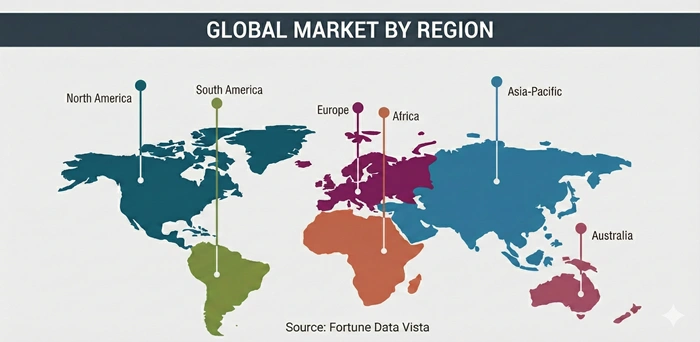
North America commands the leading position in the global data center interconnect market, holding approximately 38% share in 2025, supported by a dense concentration of hyperscale data centers, advanced telecom infrastructure, and aggressive AI infrastructure investment across the region. The United States drives the overwhelming majority of regional demand, backed by major cloud providers and telecom carriers continuously expanding their interconnect capacity to support growing AI and cloud workloads. Companies with strong regional presence include Ciena, Cisco Systems, Juniper Networks, and Nokia, each maintaining deep relationships with hyperscale cloud operators and enterprise customers across the country.
Canada also contributes meaningfully to regional demand, supported by growing data center construction activity and expanding cloud service adoption among Canadian enterprises. The region's combination of strong technology infrastructure, deep vendor ecosystem, and continuous AI-driven capacity expansion ensures North America's leadership position within the data center interconnect market remains firmly intact through the remainder of the forecast period.
Asia Pacific
Rapid Cloud Infrastructure Expansion and Rising Digital Adoption Position Asia Pacific as the Fastest-Growing Region
Asia Pacific is projected to register the fastest CAGR within the global data center interconnect market through 2033, expanding at a rate near 16% as rapid cloud infrastructure expansion and rising digital adoption create substantial new demand across the region. China and India lead much of this regional growth, supported by massive government-backed digital infrastructure investment and rapidly growing hyperscale data center construction aimed at supporting domestic cloud and AI service demand. Regional and international vendors alike have expanded their presence to serve this growing institutional demand, often establishing local manufacturing and support operations to better serve regional customers.
Japan and South Korea contribute further depth to regional growth, both bringing advanced telecom infrastructure that increasingly supports high-capacity interconnect deployment for enterprise and hyperscale customers alike. Growing government investment in digital infrastructure across several Asia Pacific countries continues to accelerate interconnect adoption among operators building next-generation data center capacity. This combination of rising cloud investment, expanding digital adoption, and growing government support positions Asia Pacific as the clear growth leader within the broader data center interconnect market through the forecast period.
Customization Available for This Report
Region-Specific and Country-Specific Versions of This Report Are Available to Deliver a Sharper, More Localized View of Market Dynamics
This report can be tailored on a region-by-region and country-by-country basis, providing localized market sizing, competitive mapping, and infrastructure investment trend analysis that a global overview alone cannot fully capture.
Clients seeking a more focused breakdown can request a customized version covering any of the following regions and countries, complete with demand forecasting, competitor landscape review, and adoption trend analysis tied specifically to the data center interconnect keyword focus:
North America
-
U.S. — Detailed review of hyperscale infrastructure investment and AI-driven capacity expansion
-
Canada — Coverage of data center construction trends and cloud service adoption patterns
-
Mexico — Analysis of emerging digital infrastructure modernization trends
Europe
-
U.K. — Review of enterprise cloud adoption and interconnect infrastructure investment
-
Germany — Coverage of data sovereignty regulations and regional interconnect deployment
-
France — Insights into telecom infrastructure modernization and adoption trends
-
Italy — Analysis of regional data center infrastructure investment
-
Rest of Europe — Country-level view of emerging demand across Eastern Europe and the Nordics
Asia Pacific
-
China — Coverage of expanding hyperscale infrastructure and government digital investment
-
India — Analysis of growing cloud infrastructure and data center construction trends
-
Japan — Review of established telecom infrastructure and technology adoption trends
-
South Korea — Assessment of interconnect adoption and hyperscale investment patterns
-
Australia — Insights into cloud infrastructure funding and adoption trends
-
Rest of Asia Pacific — Country-level breakdown covering Thailand, Vietnam, Indonesia, and Malaysia
Latin America
-
Brazil — Coverage of expanding data center infrastructure investment and adoption trends
-
Argentina — Analysis of early-stage digital infrastructure development
-
Rest of Latin America — Country-level sizing across Colombia, Peru, and Chile
Middle East & Africa
-
UAE — Review of hyperscale data center investment and interconnect adoption trends
-
Saudi Arabia — Coverage of expanding digital infrastructure modernization initiatives
-
Rest of MEA — Country-level view of Sub-Saharan Africa digital infrastructure expansion
Top Key Players
-
Ciena Corporation (United States)
-
Cisco Systems Inc (United States)
-
Juniper Networks Inc (United States)
-
Huawei Technologies Co Ltd (China)
-
Nokia Corporation (Finland)
-
Fujitsu Ltd (Japan)
-
Infinera Corporation (United States)
-
ADVA Optical Networking SE (Germany)
-
ZTE Corporation (China)
-
NEC Corporation (Japan)
-
Colt Technology Services (United Kingdom)
-
Equinix Inc (United States)
Recent Developments
-
In 2026, Huawei launched its F5G-A series featuring lossless DCI products with fgOTN dual-mode technology, expanding its optical transport portfolio across Asia Pacific markets
-
In 2025, Ciena strengthened its Waveserver interconnect platform with enhanced coherent optics capabilities to support higher-capacity long-haul and metro connectivity
-
In 2025, Cisco Systems expanded its integrated DCI networking platforms through deepened partnerships with major hyperscale cloud providers
-
In 2026, Nokia advanced its WaveFabric optical solution portfolio to better serve hyperscaler and carrier customers building next-generation interconnect infrastructure
-
In 2025, Juniper Networks enhanced its PTX series platforms with expanded automation capabilities to support software-defined interconnect deployment across enterprise networks
Market Trends
800G Transmission Advancement and AI-Driven Capacity Planning Are Reshaping Infrastructure Standards
One of the clearest trends shaping the data center interconnect market is the rapid push toward 800G and higher coherent optical transmission speeds, as operators race to keep pace with explosive bandwidth demand driven by AI training workloads and continuously rising cloud traffic. Equipment vendors are investing heavily in next-generation optical technology, recognizing that transmission capacity is becoming an increasingly critical competitive differentiator across the industry.
A second significant trend is the growing integration of AI-driven network management and automation tools directly into interconnect platforms, as operators seek to proactively identify capacity constraints and potential failures before they disrupt service. This trend is particularly meaningful for hyperscale operators managing sprawling multi-site infrastructure, since automated management tools can help reduce operational complexity while improving overall network reliability, continuing to support steady expansion across the broader data center interconnect market.
Segments Covered in the Report
By Product Type
-
Optical DCI Solutions
-
Packet-Optical DCI Platforms
-
Software and Services
By Data Rate
-
Up to 100G
-
100G to 400G
-
Above 400G
By Application
-
Real-Time Disaster Recovery and Business Continuity
-
Workload and Data Mobility
-
Content Delivery
-
Cloud Connectivity
By End User
-
Cloud Service Providers
-
Telecom and Communication Service Providers
-
Colocation Providers
-
Enterprises
By Region
-
North America (U.S., Canada, Mexico)
-
Europe (U.K., Germany, France, Italy, Rest of Europe)
-
Asia Pacific (China, India, Japan, South Korea, Australia, Rest of Asia Pacific)
-
Latin America (Brazil, Argentina, Rest of Latin America)
-
Middle East & Africa (UAE, Saudi Arabia, Rest of MEA)
❝ Built for Every Level — From Startups to Industry Giants ❞
Here Is Exactly How This Report Works for You
-
For tier 1 companies, investors, and established market leaders, this report delivers detailed competitor revenue analysis, infrastructure investment trend mapping, and geopolitical risk context that support confident decisions around product expansion, pricing strategy, and long-term positioning within the data center interconnect space
-
For tier 2 and tier 3 companies, startups, and mid-sized equipment vendors, this report highlights the most commercially promising technology categories and underserved regional opportunities, giving you a practical framework to compete against larger established players without overextending limited resources
-
For every decision maker across the value chain, this report explains exactly how AI-driven demand growth, regulatory developments, and competitor product launches are shaping market direction through 2033, equipping you to plan investment and go-to-market decisions with genuine confidence
Frequently Asked Questions:
Answer: The global data center interconnect market was valued at USD 15.97 billion in 2025 and is projected to reach USD 44.48 billion by 2033. This growth is driven largely by rising cloud adoption and explosive AI-related bandwidth demand.
Answer: Growth in the data center interconnect market is being driven by rapid enterprise cloud migration and explosive AI workload-driven bandwidth requirements. Rising global data traffic from streaming and real-time applications is further reinforcing this expansion.
Answer: North America currently leads the data center interconnect market with roughly 38% share, supported by dense hyperscale infrastructure and advanced telecom networks. Asia Pacific is growing the fastest, driven by rapid cloud infrastructure expansion.
Answer: Optical DCI solutions generate the largest share of revenue in the data center interconnect market, valued for their superior capacity and long-distance performance. Real-time disaster recovery applications also remain a critical growth driver.
Answer: Leading companies in the data center interconnect market include Ciena, Cisco Systems, Huawei, Nokia, and Juniper Networks. These companies compete through continuous innovation in coherent optics, automation, and software-defined interconnect platforms.