
Data Center Liquid Cooling Market Overview
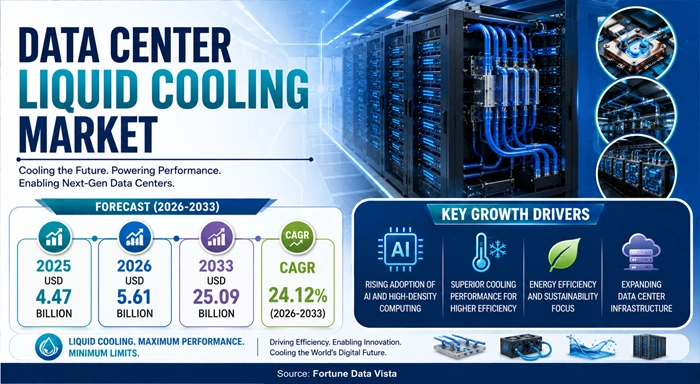
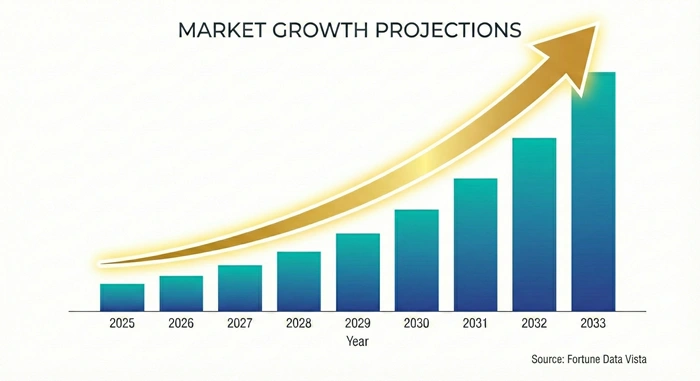
The global data center liquid cooling market size is valued at USD 4.47 billion in 2025 and is predicted to increase from USD 5.61 billion in 2026 to approximately USD 25.09 billion by 2033, growing at a CAGR of 24.12% from 2026 to 2033.
This exceptional growth trajectory reflects the computing industry's urgent shift away from traditional air-cooling systems as artificial intelligence workloads and high-performance computing clusters push rack power densities well beyond what fans and chilled air can safely manage. As hyperscale operators and enterprise data centers race to accommodate increasingly powerful GPU-based infrastructure, demand for direct-to-chip, immersion, and rear door heat exchanger cooling systems continues expanding across cloud providers, colocation facilities, and telecom operators worldwide.
AI Impact on the Data Center Liquid Cooling Industry
Artificial Intelligence Workload Density Is Redefining Thermal Management Requirements, Accelerating Direct-to-Chip Adoption, and Strengthening Predictive Maintenance Capabilities Across the Data Center Liquid Cooling Landscape — Fundamentally Changing How Facilities Manage Extreme Heat Loads
Artificial intelligence has become both the primary driver and a direct beneficiary of the data center liquid cooling market, as GPU accelerators used for training large language models now generate thermal design power levels exceeding levels that traditional air handling was ever engineered to manage. This dynamic matters considerably because a single misjudged thermal threshold can throttle GPU performance or trigger costly downtime, and operators are increasingly turning to direct-to-chip cold plate systems capable of pulling heat away from silicon far more efficiently than ambient air ever could. Companies building AI-optimized cooling control software directly into their thermal management platforms are increasingly differentiating themselves through measurably better rack density support.
Beyond raw thermal capacity, AI is also strengthening predictive maintenance capabilities within liquid cooling infrastructure itself, with sensor-driven analytics now able to flag pump degradation, coolant flow irregularities, or leak risks well before they escalate into facility-wide outages. This capability has proven valuable for hyperscale operators managing thousands of cooling loops simultaneously, since predictive monitoring reduces both unplanned downtime and the labor cost of manual inspection rounds. As AI training clusters continue scaling in size and power density, these predictive and thermal management tools are becoming an increasingly important factor shaping investment decisions across the broader data center liquid cooling market.
Growth Factors
Rising Rack Power Densities and Growing Hyperscale AI Infrastructure Investment Continue Driving Sustained Demand
The most significant growth factor supporting the data center liquid cooling market is the steadily rising power density of modern server racks, as GPU accelerators and custom AI chips push thermal output well past the practical limits of conventional air-cooling systems. With leading chipmakers projecting accelerator thermal design power to keep climbing through the remainder of the decade, this density-driven demand has become an increasingly important factor for facility operators evaluating cold plate, immersion, and hybrid cooling approaches.
A second important growth factor is the massive capital investment hyperscale cloud providers and AI infrastructure developers are pouring into new data center construction, as companies race to secure computing capacity for training and inference workloads that require liquid-first thermal architecture from the ground up. This investment-driven momentum, combined with tightening sustainability mandates pushing operators toward more energy-efficient cooling methods, has broadened the addressable market for liquid cooling considerably. This combination of rising rack density and growing hyperscale investment continues to strengthen demand across the data center liquid cooling market.
Market Outlook
Expanding Immersion Cooling Adoption and Growing Retrofit Demand Among Legacy Facilities Point Toward Sustained Growth Through 2033
Looking ahead through the forecast period, the data center liquid cooling industry is expected to benefit substantially from expanding adoption of immersion cooling technology, as operators running the most extreme AI training workloads increasingly seek fully submerged cooling architectures capable of handling thermal loads that even advanced cold plate systems struggle to manage efficiently. This immersion-focused shift is likely to reshape facility design priorities considerably as more hyperscale operators invest in next-generation liquid-first infrastructure.
At the same time, growing retrofit demand among legacy air-cooled facilities is expected to create substantial new demand, as existing data centers seek to extend their operational lifespan by integrating rear door heat exchangers and hybrid cooling solutions rather than undertaking costly full facility rebuilds. Companies that can deliver both retrofit flexibility and proven thermal performance are increasingly well positioned to capture this growth. Providers combining strong engineering expertise with scalable deployment models are likely to lead growth within the broader data center liquid cooling market through 2033.
Analyst Perspective
Structural Shift Toward Liquid-First Facility Design Is Reshaping Long-Term Vendor Positioning Across the Industry
From an analyst standpoint, the transition occurring within the data center liquid cooling market represents far more than an incremental efficiency upgrade, it reflects a structural transformation in how data centers are designed from the earliest planning stages onward. Analysts note that direct-to-chip cold plate systems currently dominate deployed capacity because they retrofit relatively easily into existing rack architecture, but two-phase immersion systems are advancing rapidly as operators pursue the higher thermal efficiency needed for next-generation accelerator chips exceeding 4,000 watts of thermal design power.
Analysts are also closely watching the revenue mix shift occurring within the industry, as current solutions-dominated revenue is expected to gradually rebalance toward services over the coming years, reflecting growing demand for installation, maintenance, and coolant management expertise as deployments scale. This shift suggests that vendors building strong service and support capability alongside hardware manufacturing will likely capture disproportionate value as the broader data center liquid cooling market matures through the forecast period.
Key Report Takeaways
-
North America leads the global data center liquid cooling market, holding approximately 38% market share in 2025, supported by the world's largest concentration of hyperscale cloud providers and AI training clusters
-
Asia Pacific is the fastest-growing region, projected to expand at a CAGR near 27.4% through 2033, driven by rapidly expanding hyperscale data center construction and rising government digital infrastructure investment across China, India, and Japan
-
Hyperscale cloud providers represent the dominant end-user segment, accounting for roughly 39% share, given their continuous need for high-density thermal management supporting massive AI training infrastructure
-
AI and high-performance computing workloads contribute the most to overall demand, reflecting the direct link between rising accelerator thermal output and liquid cooling adoption
-
Direct-to-chip cooling remains the most widely adopted cooling method, valued for its retrofit compatibility with existing rack architecture and proven thermal performance
-
Immersion cooling segments will grow the fastest among cooling technology categories, holding close to 22% market share with a CAGR near 28.6% through the forecast period, driven by rising demand from extreme-density AI training deployments
Market Scope
| Parameter | Details |
|---|---|
| Market Size by 2033 | USD 25.09 Billion | Market Size by 2026 | USD 5.61 Billion | Market Size by 2025 | USD 4.47 Billion | Market Growth Rate from 2026 to 2033 | CAGR of 24.12% | Dominating Region | North America | Fastest Growing Region | Asia Pacific | Segments Covered | Cooling Technology, Component, Data Center Type, End User, Region | Regions Covered | North America, Europe, Asia Pacific, Latin America, Middle East & Africa |
Market Dynamics
Drivers Impact Analysis
Rising Rack Power Densities and Growing Hyperscale AI Investment Remain the Two Strongest Forces Behind Market Momentum
| Driver | (≈) % Impact on CAGR Forecast | Geographic Relevance | Impact Timeline |
|---|---|---|---|
| Rising rack power densities driven by AI accelerator thermal output | ~36% | Global | Short to long-term |
| Massive hyperscale capital investment in liquid-first data center construction | ~28% | North America, Asia Pacific | Medium-term |
| Tightening sustainability and energy efficiency mandates on data center operators | ~22% | Europe, North America | Medium to long-term |
| Growing edge and telecom data center expansion requiring compact cooling solutions | ~14% | Global | Short to medium-term |
Rising rack power densities driven by AI accelerator thermal output continue to serve as the primary engine behind sustained growth in the data center liquid cooling market, as GPU-based training clusters push thermal loads well beyond what conventional air handling was ever designed to manage. This density-driven momentum has translated directly into rising capital allocation among both hyperscale cloud providers and colocation operators upgrading existing facilities.
Massive hyperscale capital investment in liquid-first data center construction represents the second major driver, as companies racing to secure AI computing capacity increasingly design new facilities around liquid cooling infrastructure from the ground up rather than retrofitting later. This investment-driven demand, combined with tightening sustainability mandates pushing operators toward more energy-efficient thermal management, continues reinforcing steady momentum across the broader data center liquid cooling market.
Restraints Impact Analysis
High Retrofit Costs and Facility Infrastructure Compatibility Challenges Continue to Moderate Broader Adoption
| Restraint | (≈) % Impact on CAGR Forecast | Geographic Relevance | Impact Timeline |
|---|---|---|---|
| High upfront costs associated with retrofitting legacy air-cooled facilities | ~35% | Global, particularly mature markets | Short to medium-term |
| Limited availability of skilled technicians for liquid cooling installation and maintenance | ~27% | Global | Medium-term |
| Coolant leak risk and facility infrastructure compatibility concerns | ~24% | Global | Medium-term |
| Regulatory uncertainty around dielectric fluid composition and disposal requirements | ~14% | Europe, North America | Short to medium-term |
The most persistent restraint facing the data center liquid cooling market is the substantial upfront cost associated with retrofitting legacy air-cooled facilities, which requires significant structural modifications to plumbing, power distribution, and floor loading that many operators find financially and logistically challenging to justify without a clear immediate business case. This cost sensitivity remains particularly pronounced among smaller colocation providers operating on tighter capital budgets.
Limited availability of skilled technicians capable of installing and maintaining liquid cooling systems represents a second significant restraint, since these systems require specialized expertise that traditional data center facility teams often lack. Combined with ongoing coolant leak risk concerns and facility compatibility challenges, these restraints continue moderating how quickly broader adoption spreads across the global data center liquid cooling market.
Opportunities Impact Analysis
Immersion Cooling Innovation and Expanding Edge Data Center Deployment Represent the Clearest Paths to Growth
| Opportunity | (≈) % Impact on CAGR Forecast | Geographic Relevance | Impact Timeline |
|---|---|---|---|
| Expanding adoption of immersion cooling for extreme-density AI training deployments | ~37% | North America, Asia Pacific | Medium to long-term |
| Growing edge and micro data center deployment requiring compact liquid cooling solutions | ~34% | Global | Medium-term |
| Rising demand for sustainable dielectric fluids replacing PFAS-based coolants | ~29% | Europe, North America | Short to medium-term |
Expanding adoption of immersion cooling for extreme-density AI training deployments represents one of the most substantial opportunities within the data center liquid cooling market, as operators running the most demanding training workloads stand to benefit significantly from fully submerged thermal architecture capable of handling heat loads beyond cold plate system limits. This immersion-driven differentiation is expected to meaningfully reshape competitive positioning among leading cooling technology providers over the coming years.
Growing edge and micro data center deployment requiring compact liquid cooling solutions presents a second substantial opportunity, as expanding distributed computing infrastructure across telecom and enterprise networks creates demand for scaled-down cooling systems supporting smaller footprint facilities. Rising demand for sustainable dielectric fluids replacing PFAS-based coolants further broadens the opportunity landscape, particularly for chemical suppliers able to deliver high-performance, environmentally compliant alternatives. Companies pursuing these parallel opportunities are well positioned to capture meaningful growth within the broader data center liquid cooling market through the forecast period.
Segment Analysis
By Cooling Technology: Direct-to-Chip Cooling
Direct-to-Chip Cooling Continues to Anchor the Technology Landscape, Reflecting Its Retrofit Compatibility With Existing Rack Infrastructure
Direct-to-chip cooling holds the largest share within the cooling technology segment of the data center liquid cooling market, accounting for approximately 44% of total segment revenue in 2025. This dominance reflects the technology's practical advantage of integrating cold plates directly onto processors and memory modules without requiring the extensive facility redesign that immersion systems often demand, making it the natural first step for operators upgrading existing infrastructure. In markets like the United States and China, hyperscale operators increasingly favor cold plate systems that can be deployed rack by rack as they expand AI training capacity incrementally. Leading suppliers such as Vertiv, Schneider Electric, and CoolIT Systems continue to dominate this segment through expanded product portfolios and continuous engineering improvements aimed at handling ever-higher thermal loads.
Growth within this segment remains particularly strong in North America, where the world's largest concentration of hyperscale cloud providers and AI training clusters continues generating sustained demand across thousands of actively expanding data center campuses. The region's combination of massive AI infrastructure capital investment and mature data center construction expertise has helped direct-to-chip cooling maintain its leading position despite growing interest in immersion alternatives. As global AI training capacity continues expanding, direct-to-chip cooling is expected to remain the dominant category within the broader data center liquid cooling market throughout the forecast period.
By Cooling Technology: Immersion Cooling
Immersion Cooling Represents the Fastest-Growing Technology Segment, Reflecting Rising Demand From Extreme-Density AI Training Deployments
Immersion cooling represents the fastest-growing technology segment within the data center liquid cooling market, holding close to 22% share in 2025 with a projected CAGR near 28.6% through the forecast period as operators running the most extreme AI training workloads increasingly require thermal architecture capable of handling heat loads beyond what cold plate systems can efficiently manage. Unlike direct-to-chip solutions that cool components individually, immersion systems submerge entire server assemblies in dielectric fluid, achieving substantially higher heat rejection capacity for the densest computing clusters. This performance advantage has generated substantial interest among hyperscale operators building dedicated AI factories where thermal efficiency directly determines how much computing capacity a facility can support.
Growth in this segment remains especially strong in Asia Pacific, where a dense concentration of rapidly expanding hyperscale data center construction and rising government digital infrastructure investment continue driving strong demand for providers capable of delivering these advanced systems reliably. Companies like Submer and LiquidStack have expanded their immersion cooling portfolios significantly to serve this growing demand, often incorporating bio-synthetic dielectric fluids to improve both performance and environmental compliance. As extreme-density AI deployments continue expanding globally, this segment is expected to remain the fastest-growing category within the broader data center liquid cooling market.
Regional Insights
North America
World's Largest Concentration of Hyperscale AI Infrastructure Keeps North America Firmly in the Lead
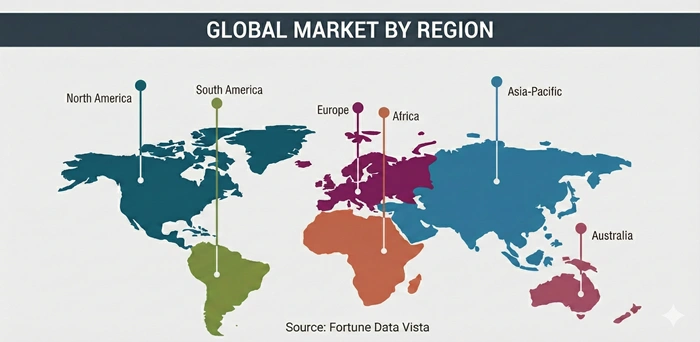
North America commands the leading position in the global data center liquid cooling market, holding approximately 38% share in 2025, supported by the world's largest concentration of hyperscale cloud providers, extensive AI training cluster deployments, and well-established data center construction expertise. The United States drives the overwhelming majority of regional demand, backed by massive capital investment from major cloud service providers racing to secure AI computing capacity across newly constructed liquid-first facilities. Companies with strong regional presence include Vertiv, Schneider Electric, and CoolIT Systems, each maintaining deep relationships with major hyperscale and colocation operators across the country.
Canada also contributes meaningfully to regional demand, supported by growing data center construction activity and expanding enterprise cloud infrastructure investment across emerging technology hubs. The region's combination of established construction infrastructure, deep capital investment commitment, and continuous engineering innovation ensures North America's leadership position within the data center liquid cooling market remains firmly intact through the remainder of the forecast period.
Asia Pacific
Rapidly Expanding Hyperscale Construction and Rising Government Digital Investment Position Asia Pacific as the Fastest-Growing Region
Asia Pacific is projected to register the fastest CAGR within the global data center liquid cooling market through 2033, expanding at a rate near 27.4% as rapidly expanding hyperscale data center construction and rising government digital infrastructure investment create substantial new demand across the region. China, India, and Japan lead much of this regional growth, supported by growing domestic cloud computing capacity and expanding government support for local AI infrastructure development requiring dependable high-density cooling solutions. Regional and international manufacturers alike have expanded their presence to serve this growing demand, often establishing local production and support facilities to reduce dependence on distant technical assistance.
South Korea and Australia contribute further depth to regional growth, both bringing established data center infrastructure and growing investment in AI and high-performance computing facilities requiring reliable thermal management capability. Growing government investment in digital infrastructure across several Asia Pacific markets continues to accelerate data center liquid cooling adoption among expanding hyperscale networks alike. This combination of rapidly expanding hyperscale construction, rising government investment, and growing AI infrastructure buildout positions Asia Pacific as the clear growth leader within the broader data center liquid cooling market through the forecast period.
Customization Available for This Report
Region-Specific and Country-Specific Versions of This Report Are Available to Deliver a Sharper, More Localized View of Market Dynamics
This report can be tailored on a region-by-region and country-by-country basis, providing localized market sizing, competitive mapping, and technology adoption trend analysis that a global overview alone cannot fully capture.
Clients seeking a more focused breakdown can request a customized version covering any of the following regions and countries, complete with demand forecasting, competitor landscape review, and adoption trend analysis tied specifically to the data center liquid cooling keyword focus:
North America
-
U.S. — Detailed review of hyperscale investment and cooling technology adoption trends
-
Canada — Coverage of emerging data center construction and adoption patterns
-
Mexico — Analysis of growing enterprise cloud infrastructure investment trends
Europe
-
U.K. — Review of sustainability regulation and cooling technology adoption trends
-
Germany — Coverage of enterprise data center investment among leading providers
-
France — Insights into liquid cooling adoption and regulatory patterns
-
Italy — Analysis of regional data center liquid cooling investment trends
-
Rest of Europe — Country-level view of emerging demand across Eastern Europe and the Nordics
Asia Pacific
-
China — Coverage of expanding hyperscale construction and technology deployment
-
India — Analysis of growing domestic cloud infrastructure and demand trends
-
Japan — Review of established data center infrastructure and adoption trends
-
South Korea — Assessment of AI infrastructure investment and adoption trends
-
Australia — Insights into data center construction and technology adoption trends
-
Rest of Asia Pacific — Country-level breakdown covering Singapore, Malaysia, and Indonesia
Latin America
-
Brazil — Coverage of expanding data center construction and cooling adoption
-
Argentina — Analysis of early-stage enterprise cloud infrastructure trends
-
Rest of Latin America — Country-level sizing across Colombia, Chile, and Peru
Middle East & Africa
-
UAE — Review of large-scale data center development and technology investment trends
-
Saudi Arabia — Coverage of expanding national digital infrastructure development initiatives
-
Rest of MEA — Country-level view of African data center infrastructure expansion
Top Key Players
-
Vertiv Holdings Co (United States)
-
Schneider Electric SE (France)
-
CoolIT Systems Inc (Canada)
-
Asetek A/S (Denmark)
-
LiquidStack Holding B.V. (Netherlands)
-
Submer Technologies S.L. (Spain)
-
Alfa Laval Corporate AB (Sweden)
-
Rittal GmbH & Co KG (Germany)
-
Chilldyne Inc (United States)
-
Green Revolution Cooling Inc (United States)
-
Asperitas B.V. (Netherlands)
-
Boyd Corporation (United States)
Recent Developments
-
In 2025, Vertiv expanded its direct-to-chip cooling portfolio through enhanced coolant distribution unit capacity to support growing hyperscale AI deployments
-
In 2025, Schneider Electric strengthened its liquid cooling infrastructure offerings through targeted acquisition of thermal management technology providers
-
In 2026, CoolIT Systems advanced its cold plate design capability to support next-generation accelerator chips exceeding higher thermal design power thresholds
-
In 2025, LiquidStack broadened its immersion cooling production capacity across North America to serve growing extreme-density AI training deployments
-
In 2025, Submer deepened its bio-synthetic dielectric fluid portfolio through continued investment in sustainable coolant research for European facilities
Market Trends
Regional Adoption Patterns Are Shaping Distinct Growth Trajectories Across the Global Data Center Liquid Cooling Market
North America Market Trends: Hyperscale operators continue racing to deploy direct-to-chip and immersion cooling across newly constructed AI training campuses, with rack densities now regularly exceeding thresholds that traditional air handling cannot support. Rising GPU thermal design power projected to exceed 4,000 watts by the end of the decade is reinforcing liquid cooling's role as a structural requirement rather than an optional upgrade for facilities supporting frontier AI workloads.
South America Market Trends: Adoption remains at an earlier stage compared to more mature markets, though growing enterprise cloud investment across Brazil and Chile is beginning to generate interest in hybrid cooling retrofits for existing facilities. Limited local technical expertise and higher import costs for specialized cooling hardware continue moderating the pace of large-scale deployment across the region.
Europe Market Trends: Operators are increasingly prioritizing sustainable dielectric fluids and energy-efficient cooling architecture to align with tightening environmental regulations and corporate sustainability commitments. Rear door heat exchangers are gaining traction as a practical bridge technology, allowing facilities to extend the operational life of legacy infrastructure while gradually transitioning toward fuller liquid-first designs.
APAC Market Trends: China, India, and Japan are driving substantial volume growth through rapid hyperscale data center construction and expanding government-backed digital infrastructure programs that continue to outpace most other regions in absolute demand. Regional manufacturers are increasingly investing in local production capacity for immersion and direct-to-chip systems to reduce dependence on imported cooling hardware amid rising domestic AI infrastructure investment.
MEA Market Trends: Accelerating adoption is tied to ambitious national digital transformation initiatives across the Gulf Cooperation Council countries, where new hyperscale and enterprise facilities are being designed with liquid cooling built in from the outset. Growing government investment in AI and cloud infrastructure across the broader region continues to support steady uptake of advanced thermal management systems as data center construction activity accelerates.
Segments Covered in the Report
By Cooling Technology
-
Direct-to-Chip Cooling
-
Immersion Cooling
-
Rear Door Heat Exchangers
-
Liquid-to-Air Cooling Systems
By Component
-
Solutions
-
Services
By Data Center Type
-
Hyperscale Data Centers
-
Enterprise Data Centers
-
Colocation Data Centers
-
Edge and Micro Data Centers
By End User
-
Cloud Service Providers
-
Telecom Operators
-
BFSI
-
Government and Healthcare
-
IT and Manufacturing
By Region
-
North America (U.S., Canada, Mexico)
-
Europe (U.K., Germany, France, Italy, Rest of Europe)
-
Asia Pacific (China, India, Japan, South Korea, Australia, Rest of Asia Pacific)
-
Latin America (Brazil, Argentina, Rest of Latin America)
-
Middle East & Africa (UAE, Saudi Arabia, Rest of MEA)
❝ Built for Every Level — From Startups to Industry Giants ❞
Here Is Exactly How This Report Works for You
-
For tier 1 companies, investors, and established market leaders, this report delivers detailed competitor revenue analysis, thermal technology trend mapping, and geopolitical risk context that support confident decisions around facility investment, pricing strategy, and long-term positioning within the data center liquid cooling space
-
For tier 2 and tier 3 companies, startups, and mid-sized providers, this report highlights the most commercially promising cooling technology categories and underserved regional opportunities, giving you a practical framework to compete against larger established players without overextending limited resources
-
For every decision maker across the value chain, this report explains exactly how rising accelerator thermal loads, sustainability regulation trends, and competitor capacity expansions are shaping market direction through 2033, equipping you to plan investment and go-to-market decisions with genuine confidence
Frequently Asked Questions:
The global data center liquid cooling market was valued at USD 4.47 billion in 2025 and is projected to reach USD 25.09 billion by 2033. This growth is driven largely by rising rack power densities and massive hyperscale AI infrastructure investment.
Growth in the data center liquid cooling market is being driven by rising GPU thermal output alongside massive hyperscale capital investment in liquid-first facility construction. Tightening sustainability mandates are further reinforcing this expansion.
North America currently leads the data center liquid cooling market with roughly 38% share, supported by the world's largest concentration of hyperscale AI infrastructure. Asia Pacific is growing the fastest, driven by expanding hyperscale construction and government digital investment.
Direct-to-chip cooling generates the largest share of revenue in the data center liquid cooling market, reflecting its retrofit compatibility with existing infrastructure. Immersion cooling remains the fastest-growing technology segment.
Leading companies in the data center liquid cooling market include Vertiv, Schneider Electric, CoolIT Systems, Asetek, and LiquidStack. These companies compete through continuous innovation in cold plate design and immersion cooling technology.