
Data Center Market Overview
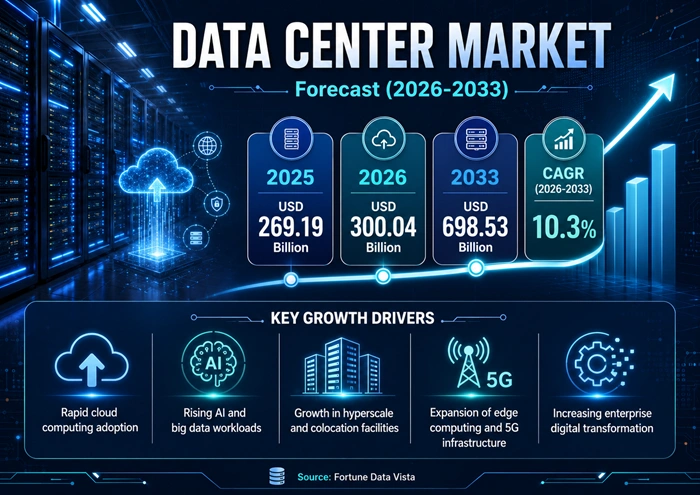
The global data center market size is valued at USD 269.19 billion in 2025 and is predicted to increase from USD 300.04 billion in 2026 to approximately USD 698.53 billion by 2033, growing at a CAGR of 10.3% from 2026 to 2033. This powerful expansion reflects the convergence of hyperscale cloud infrastructure investment, artificial intelligence workload proliferation, enterprise digital transformation, and the global buildout of edge computing networks that together are reshaping how digital infrastructure is designed, deployed, and operated across every major economy.
AI Impact on the Data Center Industry
Artificial Intelligence Has Become the Single Largest Demand Catalyst in the Data Center Market — Fundamentally Changing Infrastructure Design, Power Requirements, and Competitive Dynamics Across the Entire Industry*
Artificial intelligence is the most transformative force acting on the data center market today. The shift from conventional cloud workloads to large-scale AI training and inference has fundamentally changed what a modern data center needs to look like. GPU-dense compute clusters require power densities per rack that are five to ten times higher than traditional server configurations — pushing hyperscalers and colocation operators to redesign their cooling architecture, power distribution systems, and floor layouts from the ground up. Liquid cooling has gone from a niche consideration to a near-universal requirement for AI compute deployments, and the capital expenditure cycles of the world's largest cloud operators are increasingly dictated by their AI infrastructure ambitions rather than general cloud capacity expansion.
Beyond the infrastructure changes AI demands, it is also becoming a management tool within the data center itself. AI-powered predictive maintenance systems now monitor thousands of hardware components in real time, identifying failure precursors before they cause downtime. Machine learning algorithms manage dynamic cooling adjustments, reducing power usage effectiveness (PUE) scores and cutting operational costs significantly in facilities where these systems are deployed. AI is also being applied to capacity planning, predicting when specific racks will reach utilization thresholds and automating workload migration to maintain performance guarantees. The net effect is that AI is simultaneously the industry's largest demand driver and one of its most powerful operational efficiency tools, positioning the data center market for sustained, high-investment growth through 2033.
Growth Factors
Explosive Cloud Adoption, Rising Enterprise Digitalization, 5G Network Expansion, and the Surge in AI Infrastructure Investment Are the Converging Forces Driving Sustained Data Center Market Growth Through 2033*
Cloud computing remains the foundational demand driver for the data center market. As enterprises across every industry vertical — healthcare, banking, retail, manufacturing, education, and government — migrate workloads from on-premises infrastructure to cloud platforms, the aggregate demand for data center capacity scales proportionally. The three largest hyperscalers alone have collectively committed over USD 300 billion in combined capital expenditure for the period 2025 to 2027, with the majority directed toward AI-ready data center infrastructure. This level of planned investment is unprecedented and signals that the growth trajectory for the data center industry is not a cyclical upswing but a structural multi-year expansion driven by genuinely transformational technology shifts.
Simultaneously, the global 5G rollout is creating powerful incremental demand for edge data center capacity. As 5G networks go live across North America, Europe, and Asia-Pacific, they require geographically distributed computing nodes positioned close to end users to deliver the sub-10-millisecond latency that 5G applications — augmented reality, autonomous vehicles, smart manufacturing, and real-time financial transactions — demand. This edge computing build-out is distinct from centralized hyperscale expansion and creates demand for smaller, purpose-built data centers in secondary and tertiary cities that were previously underserved by digital infrastructure. Together, hyperscale cloud expansion and the distributed 5G edge buildout represent two complementary growth engines that are expanding the total addressable market for data center infrastructure investment at a pace the industry has never experienced before.
Market Outlook
The Data Center Market Is Entering a Decade of Structural Investment Expansion — Driven by AI Infrastructure, Sovereign Cloud Mandates, Sustainability Requirements, and the Proliferation of Data-Intensive Digital Services*
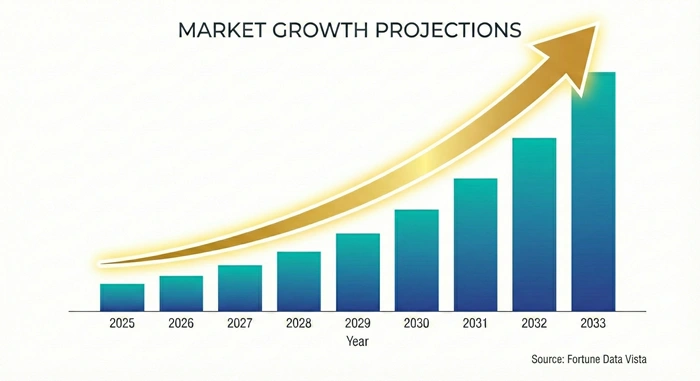
Looking ahead to 2033, the data center market is expected to reach USD 698.53 billion, reflecting a sustained CAGR of 10.3% across the forecast period. This trajectory will be shaped by several compounding forces. AI infrastructure investment will continue to grow as generative AI adoption broadens from early enterprise adopters to mid-market and consumer applications, creating demand for inference-optimized data centers that serve end users with low-latency responses. Governments across Asia-Pacific, the Middle East, and Europe are mandating sovereign cloud frameworks that require data to be stored and processed within national borders, creating entirely new national data center markets where limited infrastructure previously existed.
Sustainability will also define the competitive and regulatory landscape for the data center market through 2033. As facilities consuming multiple gigawatts of power face increasing scrutiny from regulators, environmental advocates, and large corporate tenants with net-zero commitments, the industry is investing heavily in renewable energy procurement, advanced liquid cooling, water recycling, and waste heat recovery systems. Markets like Singapore, Ireland, and Amsterdam have already imposed power consumption caps on new data center construction, pushing investment toward alternative locations and raising the bar for energy efficiency across the industry. Operators that can credibly demonstrate sustainability performance alongside technical capability will capture preferred status with enterprise tenants and government clients — making green infrastructure not just an ethical choice but a commercial imperative in the data center market of 2033.
Expert Speaks
-
"We are living through the most significant data center construction cycle in history. AI demands infrastructure at a scale and pace that requires the entire ecosystem — from power utilities to cooling vendors to fiber providers — to move faster than it ever has. Our capital investment plans through 2027 are larger than the combined investment of the previous decade, and we are still not building fast enough to match forecasted AI compute demand. The data center industry is the physical foundation on which the AI economy will be built." — CEO, Microsoft Corporation
-
"Every major enterprise customer we speak to today has AI somewhere in their top three strategic priorities, and that means they need dramatically more compute, storage, and networking capacity than their current infrastructure provides. Data centers are not just a cost center anymore — they are the strategic asset that determines how fast a company can innovate. We are investing in new data center regions, power procurement agreements, and liquid cooling partnerships specifically to stay ahead of this demand curve." — CEO, Amazon Web Services (Amazon.com, Inc.)
-
"The intersection of AI, cloud, and 5G is creating a data center demand environment that is fundamentally different from anything the industry has experienced. We are seeing customers move from multi-year planning cycles to urgent 12-month deployment timelines as they race to build AI capabilities before their competitors. Our global colocation and networking infrastructure is being expanded at an unprecedented rate to serve this demand, and we expect this investment intensity to continue well into the next decade." — CEO, Equinix, Inc.
Key Report Takeaways
-
North America leads the global data center market, holding approximately 38.5% of global revenue share in 2025, driven by the concentration of hyperscale cloud operators including AWS, Microsoft Azure, and Google Cloud, alongside the world's deepest enterprise IT spending base and a favorable regulatory environment for large-scale data infrastructure investment.
-
Asia-Pacific is the fastest-growing region, projected to register the highest CAGR through 2033, fueled by accelerating cloud adoption in China, India, Japan, and Southeast Asia, alongside substantial government investment in national digital infrastructure programs and rapidly growing AI workload demand from domestic technology companies.
-
Hyperscale data centers are the largest end-user segment, accounting for approximately 52% of revenue, as cloud platforms, social media giants, and AI companies invest in massive purpose-built facilities optimized for GPU-dense compute, high-speed networking, and aggressive energy efficiency targets.
-
The IT infrastructure component segment — servers, storage, and networking — contributes the most to overall data center market revenue, with hardware representing approximately 53.7% of total expenditure, driven by the accelerating replacement of legacy equipment with AI-optimized servers, high-bandwidth networking switches, and NVMe-based storage arrays.
-
Liquid cooling is the most rapidly adopted operational technology, with direct liquid cooling and immersion cooling systems replacing air-based cooling as the dominant thermal management approach in AI and high-performance computing facilities, driven by rack power densities that now regularly exceed 100 kW.
-
The edge data center segment is the fastest-growing future category, projected to expand at a CAGR of approximately 21.3% through 2033, capturing an increasing share of total deployments as 5G operators, autonomous system developers, and IoT platform operators require low-latency computing nodes positioned close to end-user locations rather than centralized in major metropolitan hubs.
Market Scope
| Parameter | Details |
|---|---|
| Market Size by 2033 | USD 698.53 Billion | Market Size by 2026 | USD 300.04 Billion | Market Size by 2025 | USD 269.19 Billion | Market Growth Rate from 2026 to 2033 | CAGR of 10.3% | Dominating Region | North America | Fastest Growing Region | Asia-Pacific | Segments Covered | By Component, By Data Center Type, By Tier Type, By Organization Size, By Industry Vertical, By Region | Regions Covered | North America, Asia-Pacific, Europe, Latin America, Middle East & Africa |
Market Dynamics
Drivers Impact Analysis
Hyperscale Cloud Expansion and AI Compute Infrastructure Demand Are the Two Most Powerful and Durable Demand Drivers in the Global Data Center Market*
| Driver | ≈ % Impact on CAGR Forecast | Geographic Relevance | Impact Timeline |
|---|---|---|---|
| Surging AI and machine learning workload demand | ~+36% | Global — hyperscale clusters in North America and Asia-Pacific | Ongoing, long-term |
| Rapid cloud computing adoption across enterprise segments | ~+26% | Global — particularly North America, Europe, Asia-Pacific | Ongoing, long-term |
| 5G rollout driving edge data center investment | ~+18% | Asia-Pacific, North America, Europe | Near to mid-term |
| Government digital infrastructure and sovereign cloud mandates | ~+12% | Middle East, Southeast Asia, India, Europe | Mid to long-term |
| Enterprise IoT and real-time analytics expansion | ~+8% | Global — manufacturing, logistics, healthcare verticals | Mid to long-term |
The data center market is receiving its most powerful demand signal from the generational shift toward AI-native computing. Enterprises across every industry vertical are reorienting their technology investment strategies around artificial intelligence, which requires compute, storage, and networking infrastructure that is fundamentally more intensive than traditional enterprise workloads. A single large language model training run can consume more compute capacity than an entire medium-sized enterprise's annual server workload — and organizations are running these training cycles repeatedly as they fine-tune models for specific business applications. This means that every dollar of AI adoption at the enterprise level generates a disproportionate increase in data center capacity demand, creating a demand multiplier effect that sustains investment well beyond any single technology cycle.
Cloud computing adoption continues to broaden and deepen simultaneously — more enterprises are moving more workloads to cloud platforms, while existing cloud users are expanding their footprints with additional services, geographies, and workload categories. Public cloud spending is projected to exceed USD 1 trillion by 2026, and the infrastructure that supports this spending is housed in data centers that must be built, powered, cooled, and connected at scale before that spending can be captured. This creates a structural demand pipeline for data center construction, IT hardware, power infrastructure, and operational technology that extends well beyond the 2033 forecast period, providing sustained confidence in the industry's long-term investment thesis.
Restraints Impact Analysis
Power Constraints, Rising Construction Costs, Land Scarcity in Primary Markets, and Regulatory Barriers Are Moderating the Speed and Scale of Data Center Market Expansion*
| Restraint | ≈ % Impact on CAGR Forecast | Geographic Relevance | Impact Timeline |
|---|---|---|---|
| Power grid capacity constraints in primary markets | ~-32% | North America (Virginia, California), Europe (Amsterdam, Ireland) | Near to mid-term |
| Regulatory caps on data center power consumption | ~-25% | Singapore, Ireland, Netherlands, EU broadly | Near to long-term |
| High capital investment and construction cost inflation | ~-22% | Global — acute in energy and materials cost-driven markets | Near to mid-term |
| Talent shortages in data center operations and engineering | ~-13% | Global — acute in North America and Europe | Mid to long-term |
| Water consumption concerns impacting facility approvals | ~-8% | Arid regions: Arizona, Texas, Middle East | Mid to long-term |
The most immediate constraint on the data center market is the inadequacy of power grid infrastructure to support the scale of new capacity being demanded. In northern Virginia — the world's largest data center cluster — utilities have acknowledged that new power connections cannot be guaranteed for years, and several hyperscale projects have been delayed or redirected to alternative locations as a result. This power access bottleneck is not unique to Virginia: Dublin, Singapore, and Amsterdam have all imposed formal moratoriums or strict caps on new data center power connections, redirecting investment flows to less constrained markets while highlighting the need for long-term grid investment that moves far faster than traditional utility planning cycles allow.
Construction cost inflation compounds these constraints. The cost of steel, concrete, copper cabling, and specialized cooling equipment has risen significantly since 2021, and the specialized labor required to build, commission, and operate modern data center facilities remains in acute shortage globally. These cost pressures are extending construction timelines and compressing returns for developers working with fixed-price lease agreements signed before the inflation cycle. Regulatory uncertainty around environmental approvals — particularly in European and Asian markets — adds further project risk. While strong demand fundamentals ensure the data center market will continue growing, these constraints are moderating the speed of capacity addition and elevating barriers to entry for smaller participants who lack the capital reserves, utility relationships, and regulatory expertise of established operators.
Opportunities Impact Analysis
Emerging Market Buildout, Renewable Energy Integration, Liquid Cooling Innovation, and Sovereign Cloud Requirements Are the Four Highest-Value Growth Opportunities in the Data Center Market*
| Opportunity | ≈ % Impact on CAGR Forecast | Geographic Relevance | Impact Timeline |
|---|---|---|---|
| Emerging market data center buildout | ~+38% of opportunity pool | India, Southeast Asia, Middle East, Africa | Mid to long-term |
| Sovereign cloud and data localization mandates | ~+27% of opportunity pool | GCC, India, Southeast Asia, EU member states | Near to mid-term |
| Renewable energy-powered green data center development | ~+20% of opportunity pool | Nordic countries, North America, Europe | Near to mid-term |
| Liquid cooling and advanced thermal management adoption | ~+15% of opportunity pool | Global — concentrated in AI compute deployments | Near-term |
Emerging markets represent the most structurally significant long-term growth frontier for the data center market. India is already one of the world's fastest-growing data center markets, with colocation capacity expected to triple by 2028 as domestic cloud demand, government digitalization initiatives, and multinational data localization requirements drive urgent facility development. Saudi Arabia, the UAE, Indonesia, Malaysia, and Vietnam are all seeing extraordinary levels of hyperscale and colocation investment as governments compete to attract cloud operators and establish domestic digital infrastructure that supports their broader economic diversification goals.
Sovereign cloud mandates are creating entirely new national data center markets in regions that previously relied entirely on imported digital infrastructure services. These mandates require that government data, citizen personal information, and critical sector data be processed and stored within national borders — compelling every major cloud provider to establish in-country presence or partner with certified local operators. For data center developers and colocation operators, these mandates represent guaranteed long-term demand contracts anchored by government and regulated-industry tenants who cannot legally migrate their workloads to foreign facilities. This structural demand quality is among the most commercially attractive dynamics in the global data center market today.
Segment Analysis
By Data Center Type: Hyperscale Data Centers
Hyperscale Data Centers Dominate the Global Data Center Market — Commanding the Largest Revenue Share and Attracting the Majority of New Capital Investment as Cloud and AI Demand Scales Exponentially*
Hyperscale data centers hold approximately 52% of global data center market revenue in 2025, with a CAGR of approximately 11.8% through 2033. These massive facilities — each consuming hundreds of megawatts of power and housing tens of thousands of servers — are the infrastructure backbone of the world's largest cloud platforms, AI development programs, and digital services ecosystems. Their scale enables the economics of rapid hardware refresh cycles, customized silicon deployment, and advanced cooling systems that are impractical at smaller facility sizes, giving hyperscale operators a structural efficiency advantage that reinforces their market dominance. North America leads hyperscale data center deployment, with Virginia, Oregon, Georgia, and Texas serving as the most active construction markets, anchored by AWS, Microsoft Azure, and Google Cloud's aggressive capacity expansion programs. Key technology suppliers to the hyperscale segment include Dell Technologies (USA), Hewlett Packard Enterprise (USA), and Vertiv Holdings (USA).
The hyperscale segment is growing particularly fast in Asia-Pacific, where China, Japan, South Korea, and India are all seeing major hyperscale facility investments from both domestic cloud providers and international operators establishing local cloud regions. China's BATJ tech giants — Baidu, Alibaba, Tencent, and JD.com — are expanding their domestic hyperscale footprints aggressively as AI workloads proliferate across their platforms, while Singapore, Malaysia, and Japan are attracting billions in foreign hyperscale investment as regional cloud hub destinations. The data center market's hyperscale segment is also at the forefront of sustainability innovation, with operators including Equinix (USA) and Digital Realty (USA) committing to 100% renewable energy procurement and investing in innovative thermal management technologies — including immersion cooling and rear-door heat exchangers — to manage the extreme power densities of AI compute deployments in their facilities.
By Component: IT Infrastructure
IT Infrastructure Remains the Largest Revenue Component in the Data Center Market — Servers, Storage, and Networking Together Account for the Majority of Capital Expenditure in Every Facility Type*
The IT infrastructure segment — encompassing servers, storage systems, and networking equipment — holds approximately 53.7% of total data center market revenue in 2025 and is advancing at a CAGR of approximately 11.2% through 2033. This dominance reflects the fundamental reality that the data center is, at its core, an infrastructure for computing — and every capacity expansion, hardware refresh cycle, and technology upgrade translates directly into IT equipment procurement. Server demand is being transformed by AI, with GPU-equipped compute nodes from NVIDIA and AMD commanding dramatically higher average selling prices than conventional CPU-only servers, significantly increasing per-rack IT expenditure. North America leads IT infrastructure procurement volume, driven by hyperscale refresh cycles and enterprise server replacement programs, with Cisco Systems (USA), Dell Technologies (USA), and Arista Networks (USA) holding strong positions in the networking and switching sub-segment.
Storage infrastructure is experiencing its own transformation within the data center market, with NVMe-based all-flash arrays displacing spinning disk in both performance and nearline tiers as QLC NAND cost per gigabyte continues to decline. Network infrastructure is being upgraded to 400G and 800G ethernet speeds to meet the bandwidth demands of AI training clusters that require extremely high-speed east-west traffic between GPU nodes. Asia-Pacific is the fastest-growing region for IT infrastructure procurement, with China, India, and Southeast Asian data center operators expanding their equipment investments rapidly to support both domestic AI workload growth and new cloud region deployments. Pure Storage (USA), NetApp (USA), and Huawei Technologies (China) are significant suppliers in the Asia-Pacific storage sub-segment, serving both hyperscale and enterprise data center customers across the region as demand for advanced IT infrastructure continues to surge.
Regional Insights
North America
North America Holds the Dominant Position in the Global Data Center Market — Anchored by Hyperscale Cloud Investment, the World's Largest Enterprise IT Sector, and Unmatched Technology Innovation Ecosystems*
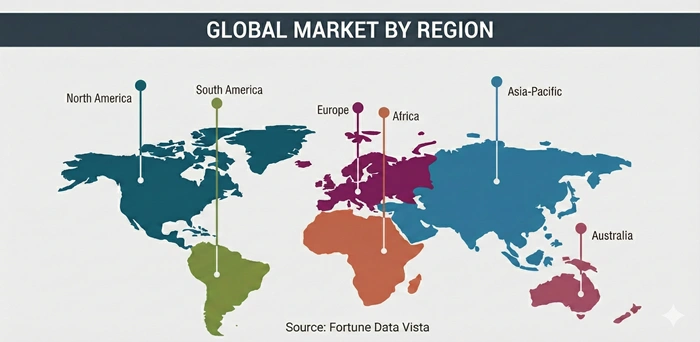
North America accounts for approximately 38.5% of global data center market revenue in 2025, with a projected CAGR of approximately 9.7% through 2033, making it the largest and most commercially mature regional market in the world. The United States is by far the dominant contributor, hosting the headquarters and primary cloud regions of AWS, Microsoft Azure, and Google Cloud — the three hyperscalers that collectively account for approximately 65% of global public cloud spending. Northern Virginia alone — the epicenter of global data center activity — hosts over 350 hyperscale and colocation facilities representing more than 3 GW of IT load capacity. Phoenix, Chicago, Dallas, and Atlanta are the next most active US markets, attracting substantial new investment as power constraints in Virginia push development to alternative locations with stronger grid access. Key players concentrated in North America include Equinix Inc. (USA), Digital Realty Trust (USA), CyrusOne (USA), and QTS Realty Trust (USA).
North America is also at the forefront of AI infrastructure investment, with the US federal government actively incentivizing domestic AI data center construction through the CHIPS and Science Act, federal procurement commitments, and bilateral technology partnership agreements with allied nations. Canada is contributing meaningfully to regional growth through major hyperscale investments in Quebec and Ontario, where abundant hydroelectric power and cooler climate conditions make for highly attractive green data center economics. The region's CAGR reflects a market that is already large but actively expanding — driven by AI compute demand, enterprise migration to cloud-native architectures, and the ongoing replacement of aging data center infrastructure with modern, energy-efficient facilities that meet the sustainability commitments of corporate tenants and hyperscale operators alike.
Asia-Pacific
Asia-Pacific Is the Fastest-Growing Region in the Global Data Center Market — Powered by Booming Cloud Adoption, Government Digital Infrastructure Programs, and Surging AI Workload Demand From Domestic Technology Enterprises*
Asia-Pacific is the fastest-growing regional market in the data center industry, projected to expand at a CAGR of approximately 13.8% through 2033, significantly outpacing the global average. China is the region's largest individual market, where domestic cloud providers including Alibaba Cloud, Tencent Cloud, and Huawei Cloud are investing aggressively in new hyperscale facilities to support AI training, e-commerce, and enterprise cloud adoption programs. India is the region's fastest-growing country market, with colocation operators including Adani Enterprises, CtrlS Datacenters, and STT GDC India investing billions in new capacity to serve both domestic enterprise demand and international cloud operator requirements for in-country data processing. Singapore, Japan, South Korea, Indonesia, and Malaysia are all active investment markets receiving substantial foreign hyperscale capital as operators establish cloud regions across the Asia-Pacific geography.
The region's growth is further accelerated by government-led digital infrastructure investment programs. China's "East Data West Computing" initiative is redirecting hyperscale investment toward inland provinces with lower land costs and renewable energy access. India's Data Center Policy is incentivizing private sector investment through infrastructure status designations and simplified regulatory approvals. Southeast Asian nations including Malaysia, Thailand, and Vietnam are actively competing to attract hyperscale operators by offering power access guarantees, streamlined construction approvals, and investor-friendly regulatory frameworks. Key regional players — including GDS Holdings (China), Keppel Data Centres (Singapore), ST Telemedia Global Data Centres (Singapore), and NTT Global Data Centers (Japan) — are expanding their portfolios rapidly to capture this extraordinary growth opportunity, reinforcing Asia-Pacific's position as the most dynamic growth frontier in the global data center market.
Top Key Players
-
Equinix, Inc. (United States)
-
Digital Realty Trust, Inc. (United States)
-
Amazon Web Services (Amazon.com, Inc.) (United States)
-
Microsoft Corporation (United States)
-
Google LLC (Alphabet Inc.) (United States)
-
IBM Corporation (United States)
-
CyrusOne LLC (United States)
-
QTS Realty Trust, LLC (United States)
-
NTT Global Data Centers (Japan)
-
Keppel Data Centres (Singapore)
-
GDS Holdings Limited (China)
-
ST Telemedia Global Data Centres (Singapore)
-
Vertiv Holdings Co. (United States)
-
Schneider Electric SE (France)
-
Adani Enterprises Limited (India)
Recent Developments
-
In January 2025, Microsoft Corporation announced a commitment to invest USD 80 billion in AI-enabled data center infrastructure globally in fiscal year 2025 alone, with more than half of that investment directed toward facilities within the United States, marking one of the largest single-year data center capital commitments in the industry's history.
-
In March 2025, Equinix, Inc. announced a joint venture with GIC (Singapore's sovereign wealth fund) to develop and operate xScale hyperscale data centers in Europe, adding approximately 600 MW of additional AI-ready compute capacity across Germany, France, the Netherlands, Sweden, and the United Kingdom over a five-year build program.
-
In February 2025, Digital Realty Trust completed the acquisition of an 80-acre land parcel in Johor, Malaysia — adjacent to Singapore's constrained market — to develop a multi-campus hyperscale data center park, with the first phase targeting over 200 MW of IT capacity to serve cloud and AI customers requiring Singapore-adjacent regional infrastructure.
-
In November 2024, Google LLC announced the expansion of its data center campus in Council Bluffs, Iowa with an additional USD 600 million investment, adding new liquid-cooled AI compute buildings designed to support Google Cloud's generative AI product portfolio and enterprise customer AI workload requirements across the North American region.
-
In April 2025, NTT Global Data Centers completed the commissioning of a new 120 MW hyperscale campus in Inzai, Japan — the company's largest single-site facility in Asia-Pacific — designed specifically for high-density AI and HPC deployments, featuring direct liquid cooling infrastructure capable of supporting rack densities exceeding 100 kW per rack.
Market Trends
Two Transformative Trends Are Redefining the Economics and Architecture of the Global Data Center Market: The Shift to Liquid Cooling as a Default Infrastructure Standard and the Emergence of AI-Native Facility Design as a New Asset Class*
Liquid cooling is no longer a premium option for specialized high-performance computing deployments — it is rapidly becoming the default infrastructure approach for any new data center building that will house AI compute workloads. The GPU servers at the core of modern AI training and inference clusters generate power densities that air cooling physically cannot manage at scale: a single H100 GPU server draws over 10 kW, and a fully populated AI rack can exceed 100 kW. Direct liquid cooling (DLC) — which circulates coolant through plates attached directly to CPU and GPU heatsinks — and immersion cooling — which submerges entire server boards in dielectric fluid — are both being standardized by major hyperscalers in their new building specifications. Vertiv Holdings and Schneider Electric are seeing record demand for liquid cooling infrastructure, and engineering firms report that virtually every new hyperscale data center design brief now includes liquid cooling as a primary rather than supplementary thermal management strategy. This shift is reshaping the supply chain for data center infrastructure products and elevating the technical bar for operators and designers across the data center market.
The second defining trend is the emergence of AI-native data centers as a distinct facility category separate from conventional cloud or enterprise data centers. AI-native facilities are purpose-designed from the ground up for high-density GPU compute: reinforced floor structures to support heavier liquid-cooled server systems, significantly upgraded power distribution to support 400 kW to 1 MW per pod configurations, ultra-high-speed 400G and 800G networking fabrics to minimize GPU-to-GPU communication latency, and integrated redundant power supply chains that minimize downtime risk for multi-week AI training runs that cannot be easily interrupted. Companies including CoreWeave, xAI (Elon Musk's AI company), and Microsoft are building or leasing dedicated AI-native campuses that differ fundamentally from conventional colocation facilities. This is creating a new sub-market within the data center industry — one defined by extreme technical specifications, premium pricing, and deep partnerships between hyperscale AI operators and specialized facility developers who understand the unique engineering demands of next-generation AI infrastructure.
Segments Covered in the Report
-
By Component
-
IT Infrastructure (Servers, Storage, Networking Equipment)
-
Power Infrastructure (UPS, Generators, PDUs, Transfer Switches)
-
Cooling Infrastructure (Air Cooling, Liquid Cooling, Immersion Cooling)
-
General Construction (Buildings, Civil Works)
-
Others (Security, Monitoring Systems)
-
-
By Data Center Type
-
Hyperscale Data Centers
-
Colocation Data Centers
-
Enterprise Data Centers
-
Edge Data Centers
-
-
By Tier Type
-
Tier I and II
-
Tier III
-
Tier IV
-
-
By Organization Size
-
Large Enterprises
-
Small and Medium Enterprises (SMEs)
-
-
By Industry Vertical
-
BFSI (Banking, Financial Services & Insurance)
-
IT and Telecommunications
-
Government and Defense
-
Healthcare and Life Sciences
-
Retail and E-Commerce
-
Media and Entertainment
-
Manufacturing
-
Others
-
-
By Region
-
North America (US, Canada, Mexico)
-
Asia-Pacific (China, Japan, India, South Korea, Singapore, Australia, ASEAN, Rest of Asia-Pacific)
-
Europe (Germany, UK, France, Netherlands, Ireland, Sweden, Rest of Europe)
-
Latin America (Brazil, Mexico, Argentina, Rest of Latin America)
-
Middle East & Africa (UAE, Saudi Arabia, South Africa, Rest of MEA)
-
"Built for Every Level — From Startups to Industry Giants"
Here Is Exactly How This Report Works for You
-
This report gives every participant in the data center ecosystem — from early-stage technology startups developing cooling or power management solutions, to tier-1 colocation operators, hyperscale cloud providers, private equity investors, and national infrastructure planners — the precise market intelligence needed to understand supply-demand imbalances across facility types and geographies, benchmark competitor revenue streams and expansion strategies, and assess how geopolitical forces including US-China technology decoupling, sovereign data localization mandates, and energy policy shifts directly impact data center site selection, investment returns, and long-term operational risk profiles.
-
For tier 2 and tier 3 infrastructure suppliers — covering cooling equipment manufacturers, power distribution vendors, structured cabling providers, and facility management technology companies — this report's detailed component-level market sizing, OEM procurement trend analysis, and regional deployment pipeline data are essential tools for identifying which facility types and geographies represent the strongest near-term customer acquisition opportunities and how to position capabilities to win preferred vendor status with leading operators and hyperscalers.
-
Investors and executive teams evaluating M&A activity, new facility investments, or technology licensing in the data center sector will gain direct strategic value from the full report's competitive positioning matrix, geopolitical risk scenario modeling, power procurement trend analysis, and long-term forecast scenarios — delivering the evidence base needed for high-confidence, capital-efficient decisions in one of the world's most active and complex infrastructure investment markets.
Frequently Asked Questions:
Answer: The global data center market is valued at USD 269.19 billion in 2025 and is expected to grow to USD 300.04 billion in 2026. By 2033, the market is projected to reach approximately USD 698.53 billion, expanding at a CAGR of 10.3% over the 2026–2033 forecast period.
Answer: The data center market is primarily driven by the explosive demand for AI infrastructure, accelerating enterprise cloud migration, and the 5G-driven buildout of edge computing capacity across global telecommunications networks. Government digital infrastructure mandates, data localization requirements, and sovereign cloud frameworks are adding additional structural demand across emerging economies.
Answer: North America dominates the data center market with approximately 38.5% of global revenue in 2025, led by hyperscale cloud operators and a deeply established enterprise IT ecosystem. Asia-Pacific is the fastest-growing region, projected at a CAGR of approximately 13.8% through 2033, driven by surging AI workloads, cloud adoption, and large-scale government digital infrastructure investment programs.
Answer: In the data center market, hyperscale facilities are massive centralized campuses purpose-built for cloud, AI training, and large-scale enterprise workloads, commanding approximately 52% of market revenue. Edge data centers are smaller, geographically distributed facilities positioned close to end users to deliver the low-latency computing that 5G networks, autonomous systems, and real-time IoT applications require — and they represent the fastest-growing segment at approximately 21.3% CAGR through 2033.
Answer: The global data center market is led by hyperscale cloud operators including Amazon Web Services, Microsoft Corporation, and Google LLC, alongside major colocation and interconnection platform providers such as Equinix, Digital Realty Trust, and NTT Global Data Centers. Infrastructure suppliers including Vertiv Holdings, Schneider Electric, and Cisco Systems are also key participants supplying critical power, cooling, and networking technologies to facilities worldwide.