
Data Science Platform Market Overview
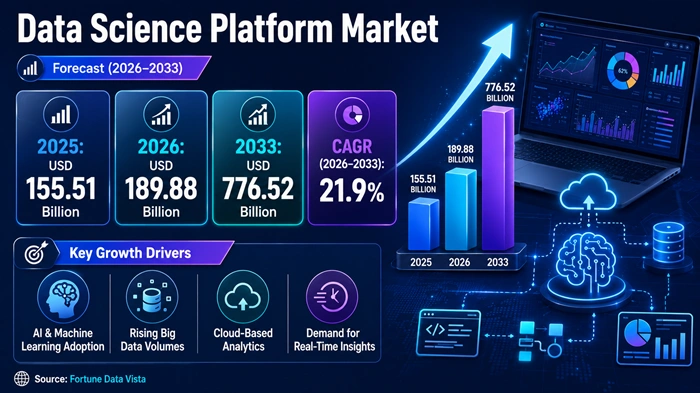
The global data science platform market size is valued at USD 155.51 billion in 2025 and is predicted to increase from USD 189.88 billion in 2026 to approximately USD 776.52 billion by 2033, growing at a CAGR of 21.9% from 2026 to 2033.
The data science platform market is experiencing exceptional growth as enterprises across every major industry accelerate their investment in data-driven decision-making, machine learning infrastructure, and advanced analytics capabilities. Organizations are increasingly recognizing that raw data holds little strategic value without the right platforms to clean, process, model, and interpret it at scale. This realization — combined with the explosive adoption of cloud computing, the proliferation of artificial intelligence tools, and the surge in demand for real-time business intelligence — is positioning data science platforms as essential enterprise infrastructure for the decade ahead.
AI Impact on the Data Science Platform Industry
Generative AI and Automated Machine Learning Are Fundamentally Transforming the Data Science Platform Market — Democratizing Advanced Analytics and Accelerating Enterprise AI Adoption at Scale
Artificial intelligence is not merely a feature within modern data science platforms — it has become their defining competitive characteristic. The integration of generative AI, large language model (LLM) interfaces, and automated machine learning (AutoML) capabilities into leading platforms is radically lowering the skill barrier required to extract insights from complex datasets. Business analysts with limited coding experience can now build, validate, and deploy predictive models using natural language prompts and no-code interfaces, significantly expanding the total population of data science platform users within large organizations.
Beyond accessibility, AI is also enhancing the technical depth of what these platforms can deliver. Features such as AI-assisted feature engineering, automated hyperparameter tuning, intelligent data pipeline orchestration, and anomaly detection are compressing the model development lifecycle from weeks to hours. Platforms from providers including Databricks, Google Cloud, and Microsoft Azure are embedding AI at every layer of the stack, enabling data science teams to spend less time on routine model management and more time on high-value problem formulation and business strategy. As AI continues to evolve, its integration into data science infrastructure will remain the most powerful force shaping competitive differentiation in this market through 2033.
Growth Factors
Surging Enterprise Data Volumes, Cloud Migration at Scale, and the Critical Need for Real-Time Analytics Are the Core Drivers Fueling Data Science Platform Market Expansion
The exponential growth of enterprise data — generated by IoT devices, customer interactions, transactional systems, social media, and connected supply chains — is creating an urgent and sustained demand for powerful data science platforms capable of ingesting, processing, and deriving value from data at previously impossible speeds and volumes. Organizations across banking, healthcare, retail, manufacturing, and logistics are deploying data science platforms not as optional enhancements but as mission-critical infrastructure that directly supports revenue generation, cost optimization, and risk management. This fundamental shift in how businesses view data analytics is driving broad-based platform adoption across all industry verticals and company sizes.
Cloud computing is the second major catalyst, providing the elastic compute and storage infrastructure that makes enterprise-scale data science workloads economically viable for organizations of all sizes. The shift from on-premises data warehouses and analytics tools toward cloud-native data science environments has dramatically expanded the addressable market, enabling small and mid-sized enterprises (SMEs) to access the same analytical capabilities that were once exclusive to large corporations with substantial IT budgets. As hybrid and multi-cloud architectures become the standard deployment model, leading platform vendors are engineering seamless cross-environment compatibility, further reducing adoption friction and accelerating overall market growth.
Market Outlook
The Data Science Platform Market Is Entering a High-Growth Phase of Enterprise Maturity — Driven by AI Integration, Cross-Industry Adoption, and the Global Race for Data Intelligence Supremacy
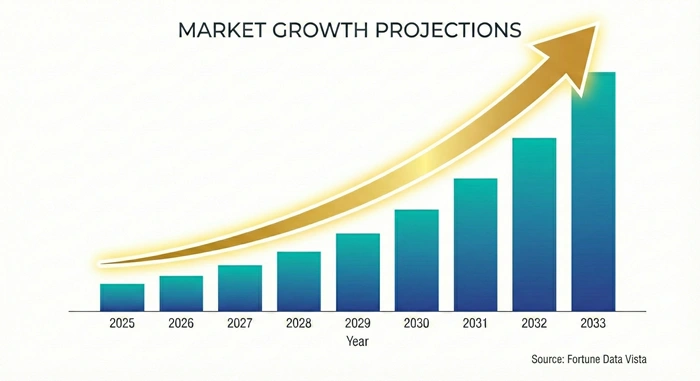
The medium-to-long-term outlook for the data science platform market is exceptionally strong, underpinned by structural demand drivers that are independent of macroeconomic cycles. Every major industry — from financial services to pharmaceuticals to manufacturing — is in the early-to-mid stages of a multi-year data intelligence transformation that requires sustained investment in advanced analytics platforms, ML operations (MLOps) infrastructure, and data governance tools. This transformation is not a discretionary IT upgrade; it is a strategic imperative driven by competitive pressure, regulatory compliance requirements, and the need to deliver personalized, data-informed customer experiences at scale.
Looking toward 2033, the data science platform market is expected to evolve significantly in its architecture, with federated learning, edge analytics, and real-time streaming intelligence becoming standard platform capabilities. The growing importance of explainable AI (XAI) — enabling organizations to understand and audit the decisions made by their machine learning models — is also expected to drive demand for more sophisticated, compliance-ready platform offerings. As the vendor landscape continues to consolidate through mergers and partnerships, and as open-source ecosystems such as Apache Spark, MLflow, and Hugging Face become more deeply integrated into commercial platforms, the industry is set to deliver increasingly powerful capabilities at progressively lower costs, supporting the market's trajectory toward USD 776.52 billion by 2033.
Expert Speaks
-
"Microsoft's investment in Azure AI and data science infrastructure reflects our conviction that every organization in the world will become a data company within this decade. Our Fabric platform is designed to unify the entire data analytics lifecycle — from ingestion to insights — and we are seeing remarkable adoption across every industry vertical we serve." — Satya Nadella, Chairman & CEO, Microsoft Corporation
-
"At Google, we believe that the democratization of data science is one of the most important technology transitions of our era. Vertex AI and BigQuery are designed to give every business — regardless of technical resources — the ability to build, deploy, and scale machine learning models that drive real and measurable business outcomes." — Sundar Pichai, CEO, Alphabet Inc. / Google LLC
-
"The demand we are seeing for IBM's watsonx platform confirms that enterprise clients are no longer asking whether they should invest in data science infrastructure — they are asking how fast they can scale it. Organizations need platforms that are secure, governed, and capable of working with their existing data architecture, and that is precisely where IBM's approach delivers differentiated value." — Arvind Krishna, Chairman & CEO, IBM Corporation
Key Report Takeaways
-
North America dominates the global data science platform market, accounting for approximately 38% of total revenue in 2025, driven by the world's highest concentration of technology companies, financial institutions, and healthcare systems with advanced analytics maturity, alongside massive government and private-sector AI investment programs.
-
Asia Pacific is the fastest growing regional market for data science platforms, with China, India, and South Korea collectively driving double-digit annual demand growth through rapid digital transformation, government-funded AI initiatives, and the explosive expansion of cloud computing infrastructure that is enabling enterprise data science at scale.
-
Large enterprises are the dominant end-user segment, contributing over 68% of total data science platform market revenue in 2025, as major corporations in BFSI, healthcare, retail, and manufacturing invest heavily in enterprise-grade MLOps, data governance, and real-time analytics capabilities to maintain competitive advantages.
-
Customer analytics is the leading application segment, accounting for the largest share of data science platform revenue as organizations prioritize understanding and predicting customer behavior, personalizing digital experiences, and improving retention through AI-powered segmentation, recommendation engines, and churn prediction models.
-
Cloud-based deployment is the most widely adopted delivery model, commanding over 65% of total market revenue in 2025 as enterprises favor cloud-native data science environments for their scalability, cost flexibility, built-in AI tooling, and ability to support distributed teams working across multiple geographies and data sources simultaneously.
-
The small and medium enterprise (SME) segment is projected to be the fastest growing future segment, with an anticipated market share exceeding 35% by 2033 and a CAGR of approximately 26% through the forecast period, driven by the rapid proliferation of no-code and low-code data science tools that make advanced analytics accessible to businesses without large in-house data science teams.
Market Scope
| Parameter | Details |
|---|---|
| Market Size by 2033 | USD 776.52 Billion | Market Size by 2026 | USD 189.88 Billion | Market Size by 2025 | USD 155.51 Billion | Market Growth Rate from 2026 to 2033 | CAGR of 21.9% | Dominating Region | North America | Fastest Growing Region | Asia Pacific | Segments Covered | Component, Deployment, Enterprise Size, Application, Industry Vertical | Regions Covered | North America, Europe, Asia Pacific, Latin America, Middle East & Africa |
Market Dynamics
Drivers Impact Analysis
Accelerating Enterprise AI Adoption, Explosion in Data Generation, and the Critical Shift to Cloud-Native Analytics Are Collectively Propelling the Data Science Platform Market Forward
| Driver | ≈ % Impact on CAGR Forecast | Geographic Relevance | Impact Timeline |
|---|---|---|---|
| Rapid enterprise AI and ML adoption | ~34% | Global — especially North America and Asia Pacific | Short to Long Term |
| Exponential growth of enterprise data volumes | ~28% | Global — all sectors | Short to Medium Term |
| Cloud migration and hybrid infrastructure adoption | ~24% | North America, Europe, Asia Pacific | Short to Long Term |
| Government AI investment and digital economy initiatives | ~14% | Asia Pacific, Europe, MEA | Medium to Long Term |
The accelerating pace of enterprise AI adoption is the single most impactful driver of growth in the data science platform market. Organizations across every sector are under intense competitive pressure to deploy machine learning models in production environments — not as research experiments but as live decision-making engines embedded in customer-facing applications, supply chain systems, fraud detection pipelines, and clinical diagnostics tools. This shift from AI experimentation to AI operationalization is driving demand for comprehensive data science platforms that cover the full lifecycle from data preparation through model training, deployment, monitoring, and governance in a unified, scalable environment.
The explosion in structured and unstructured data generated by digital operations, connected devices, and customer interactions is creating a parallel demand surge that reinforces platform adoption across all industries. Healthcare organizations are analyzing patient records, genomic data, and medical imaging at unprecedented scale. Retailers are processing billions of transactional data points daily to optimize pricing, inventory, and personalization. Financial institutions are running real-time fraud detection and credit scoring models on millions of transactions per second. All of these use cases require purpose-built data science platforms capable of handling data volume, velocity, and variety that legacy analytics tools cannot address.
Restraints Impact Analysis
Data Privacy Regulations, Shortage of Skilled Data Scientists, and High Implementation Complexity Are the Primary Barriers Slowing Wider Adoption of Data Science Platforms
| Restraint | ≈ % Impact on CAGR Forecast | Geographic Relevance | Impact Timeline |
|---|---|---|---|
| Shortage of qualified data science talent | ~35% | Global — especially SMEs and emerging markets | Short to Medium Term |
| Data privacy, security, and regulatory compliance complexity | ~33% | Europe, North America, Asia Pacific | Short to Long Term |
| High implementation cost and integration complexity | ~32% | SMEs, developing market enterprises | Medium Term |
The global shortage of qualified data scientists, ML engineers, and analytics specialists remains one of the most significant barriers to accelerated adoption of data science platforms, particularly among small and mid-sized enterprises that cannot offer the compensation packages needed to compete for top talent. Despite the emergence of AutoML and no-code tools designed to democratize data science, a meaningful skill gap persists in organizations that lack the foundational data literacy needed to select, implement, and manage sophisticated analytics platforms effectively. This talent constraint is slowing deployment timelines, increasing platform underutilization, and limiting the return on investment that many organizations achieve from their data science investments.
Data privacy regulations — including the EU's General Data Protection Regulation (GDPR), the California Consumer Privacy Act (CCPA), and emerging data localization requirements across Asia and the Middle East — are adding significant complexity to enterprise data science deployments. Organizations must ensure that their data science platforms incorporate robust data governance, lineage tracking, access controls, and audit capabilities to maintain regulatory compliance, which increases implementation complexity and cost. For multinational enterprises operating across multiple regulatory jurisdictions, meeting these requirements simultaneously across a unified data science platform can be a substantial technical and operational challenge that slows deployment timelines and increases total cost of ownership.
Opportunities Impact Analysis
The Rise of MLOps, Expansion into Emerging Markets, and the Growing Demand for Industry-Specific Data Science Solutions Represent the Most Compelling Growth Opportunities in This Market
| Opportunity | ≈ % Impact on CAGR Forecast | Geographic Relevance | Impact Timeline |
|---|---|---|---|
| MLOps and AI governance platform demand | ~38% | North America, Europe, Large Asia Pacific enterprises | Medium to Long Term |
| Industry-specific and vertical data science solutions | ~34% | Healthcare, BFSI, Manufacturing globally | Medium to Long Term |
| Penetration into SMEs via no-code/low-code platforms | ~28% | All regions — especially emerging markets | Short to Long Term |
The rapid maturation of ML operations (MLOps) as a discipline is creating a substantial product and service opportunity for data science platform vendors. As enterprises move from deploying a handful of experimental models to managing hundreds or thousands of production ML systems simultaneously, the need for robust MLOps platforms that automate model versioning, deployment, monitoring, retraining, and explainability is becoming critical. Vendors that build or acquire leading MLOps capabilities — such as Databricks's acquisition of MosaicML or AWS's SageMaker MLOps tooling — are positioning themselves to capture this high-value, recurring revenue stream that will grow significantly as enterprise AI portfolios scale.
The development of industry-specific data science solutions represents a second major opportunity, as organizations increasingly seek platforms that come pre-built with domain-relevant data models, compliance frameworks, and use-case templates specific to their sector. Healthcare providers want platforms pre-configured for HIPAA-compliant clinical analytics. Banks need platforms with built-in financial crime detection templates and regulatory reporting capabilities. Manufacturers require platforms optimized for predictive maintenance, quality control, and supply chain intelligence. Vendors that invest in deep vertical specialization and deliver sector-tailored value propositions are finding that they can command premium pricing, lower customer acquisition costs, and significantly higher net retention rates than horizontal platform vendors competing on generic capabilities alone.
Segment Analysis
By Deployment
Cloud-Based Deployment Is the Dominant and Fastest Growing Mode in the Data Science Platform Market, While On-Premises Remains Essential for Security-Sensitive Enterprise Workloads
Cloud-based deployment holds the dominant position in the data science platform market, commanding approximately 65% of total market revenue in 2025 and projected to grow at a CAGR of approximately 23.5% through 2033. Cloud platforms offer unmatched scalability, built-in AI and ML tooling, pay-as-you-go economics, and continuous feature updates that make them the default choice for the majority of new enterprise data science deployments globally. North America leads cloud data science platform adoption, driven by the massive market presence of AWS SageMaker, Google Vertex AI, and Microsoft Azure Machine Learning — three platforms that collectively define the competitive benchmark for cloud-native data science infrastructure. These providers have invested billions of dollars in purpose-built AI computing infrastructure, making their platforms the natural destination for organizations scaling their data science workloads from prototype to production.
On-premises deployment retains a meaningful share of approximately 35% in the data science platform market, serving large enterprises in highly regulated industries — including financial services, defense, government, and healthcare — where data sovereignty, security requirements, and compliance mandates make cloud-based processing either impractical or legally restricted. IBM, SAS Institute, and Cloudera are among the key vendors maintaining strong on-premises platform portfolios that cater to this persistently demanding customer segment. The Asia Pacific region, particularly China, is a significant market for on-premises data science infrastructure as government data localization policies and strategic technology independence objectives create structural demand for domestically hosted analytics platforms. As hybrid deployment models mature — allowing organizations to dynamically route workloads between on-premises and cloud environments based on data classification and performance requirements — the boundary between these two segments is becoming increasingly fluid.
By Industry Vertical
BFSI Leads Industry Adoption of Data Science Platforms While Healthcare and Manufacturing Are Emerging as High-Growth Verticals Driving Next-Wave Market Expansion
The banking, financial services, and insurance (BFSI) sector is the largest industry vertical in the data science platform market, contributing approximately 24% of total revenue in 2025 with a projected CAGR of around 22% through 2033. Financial institutions were among the earliest enterprise adopters of advanced analytics, and today they represent the most mature and highest-spending vertical, deploying data science platforms for credit risk modeling, algorithmic trading, real-time fraud detection, customer lifetime value prediction, and regulatory stress testing. North America and Europe are the leading regions for BFSI data science platform adoption, with global banks including JPMorgan Chase, Goldman Sachs, and HSBC operating some of the world's most sophisticated in-house data science organizations built on platforms from IBM, Google Cloud, and Palantir Technologies. The regulatory complexity and high financial stakes of BFSI analytics workloads make this vertical particularly demanding — and particularly well-compensated — for platform vendors with proven enterprise-grade security and compliance capabilities.
Healthcare is the fastest growing industry vertical within the data science platform market, with a projected CAGR exceeding 27% through 2033 as health systems, pharmaceutical companies, and medical device manufacturers accelerate their investment in AI-driven clinical intelligence, drug discovery, and population health management platforms. The COVID-19 pandemic fundamentally shifted the pace of digital transformation in healthcare, creating an urgent recognition that data science infrastructure is essential for pandemic preparedness, clinical trial optimization, and precision medicine delivery. Asia Pacific is the fastest growing region for healthcare data science adoption, with government-funded health digitization programs in China, Japan, and India driving large-scale deployments across hospital networks and national health information systems. Companies including Oracle Health, Veeva Systems, and Microsoft (through Azure Health Data Services) are competing aggressively for leadership in this high-growth vertical.
Regional Insights
North America
North America Dominates the Global Data Science Platform Market, Anchored by World-Class Technology Ecosystems, the Highest Enterprise AI Investment, and a Mature Analytical Talent Base
The United States Remains the World's Most Advanced and Highest-Spending Market for Data Science Infrastructure, Setting the Benchmark for Global Platform Innovation and Adoption
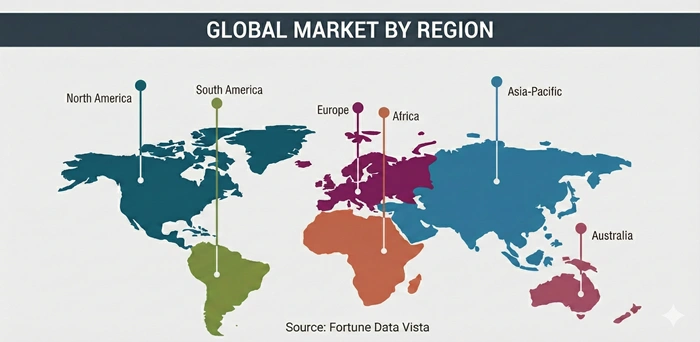
North America holds the largest regional share of the data science platform market at approximately 38% of global revenue in 2025, a position of leadership it has maintained since the earliest commercial deployments of enterprise analytics platforms in the late 2000s. The United States is the overwhelming driver of regional demand, home to the world's largest technology companies — including Microsoft, Google, Amazon Web Services, IBM, and Databricks — which are simultaneously the dominant platform vendors and the most sophisticated platform users in the global market. The region benefits from the world's deepest concentration of data science talent, the most mature AI research ecosystem, and the largest enterprise IT budget allocation for analytics and AI infrastructure of any geography. North America is projected to grow at a regional CAGR of approximately 20.5% from 2026 to 2033, reflecting a market that is maturing from initial adoption into deep, enterprise-wide platform deployment and expansion.
Canada is contributing meaningfully to North American market growth through its world-class AI research institutions — including the Vector Institute in Toronto, the Mila Institute in Montreal, and the Alberta Machine Intelligence Institute — which are generating a pipeline of enterprise-ready AI talent and research breakthroughs that are translating into commercial platform innovation. The Canadian government's Pan-Canadian Artificial Intelligence Strategy has further reinforced the country's position as a significant hub for data science platform development and adoption. Key vendors including Salesforce (Einstein Analytics), Palantir Technologies, and Alteryx are actively expanding their North American customer base through industry-specific solution bundles and partner ecosystems that accelerate enterprise platform deployment.
Asia Pacific
Asia Pacific Is the Fastest Growing Regional Market for Data Science Platforms, with China, India, and South Korea Driving Explosive Demand Through Digital Transformation and Government AI Programs
China's National AI Strategy and India's Digital India Initiative Are Creating Unprecedented Investment Momentum That Is Rapidly Positioning Asia Pacific as the World's Second-Largest Data Science Platform Market
Asia Pacific is the fastest growing regional market for data science platforms, with a projected CAGR of approximately 25.8% from 2026 to 2033, significantly outpacing North America and Europe. The region currently holds approximately 24% of global market share in 2025 — a figure that is expected to grow substantially as enterprise data science adoption deepens across China, India, Japan, South Korea, and Australia. China is the single largest market within the region, where massive government investment in AI infrastructure, a thriving domestic technology industry anchored by Alibaba Cloud, Baidu AI Cloud, and Huawei Cloud, and aggressive enterprise digitalization across banking, healthcare, and manufacturing are collectively driving data science platform demand at exceptional speed. The Chinese government's AI development roadmap — targeting global AI leadership by 2030 — has created a powerful public-private investment cycle that is accelerating data science infrastructure buildout across the entire economy.
India is emerging as the most dynamic growth story within Asia Pacific, combining a world-class software engineering talent pool, rapidly expanding cloud infrastructure, and a government-driven Digital India agenda that is pushing data science adoption across public sector departments, financial institutions, and healthcare networks simultaneously. Indian technology services companies including Tata Consultancy Services, Infosys, and Wipro are both major consumers of global data science platforms and increasingly significant resellers and integrators of these solutions for their enterprise clients worldwide. South Korea and Japan contribute high-value adoption from technologically sophisticated enterprises in automotive, electronics, and semiconductor manufacturing that are deploying data science platforms for predictive maintenance, quality optimization, and supply chain intelligence applications, making Asia Pacific one of the most strategically important growth regions for the global data science platform market through 2033.
Report Customization Available by Region and Country
Gain a Decisive Competitive Advantage with Our Fully Customized Region-Wise and Country-Wise Data Science Platform Market Reports — Tailored to Your Geography, Industry Focus, and Strategic Objectives
This report is available for complete customization across all major global regions and individual countries. A customized version provides granular, geography-specific market intelligence that goes well beyond the insights available in a standard global report — covering local regulatory environments, country-level competitive landscapes, adoption barriers, investment trends, and opportunity mapping specific to the data science platform market in the selected geography. Whether you are planning a market entry, evaluating regional expansion, or building a country-specific competitive strategy, our customization capability delivers the depth and precision your decision-making requires.
Customized data science platform market reports are available for all of the following regions and countries, each offering detailed, tailored market analysis, growth projections, segment-level insights, and competitive intelligence relevant to the specific market:
North America
-
U.S. — Largest global market deep-dive, enterprise AI spending analysis, vendor competitive mapping, sector-specific adoption trends (BFSI, healthcare, retail), and federal AI policy impact assessment
-
Canada — AI research ecosystem analysis, government AI strategy impact, enterprise platform adoption by industry vertical, and key vendor market share data
-
Mexico — Digital transformation trajectory, nearshoring-driven data analytics demand, cloud infrastructure expansion, and SME platform adoption potential
Europe
-
U.K. — Post-Brexit technology investment landscape, financial services data science leadership, regulatory environment (AI Act alignment), and key platform vendor strategies
-
Germany — Manufacturing and automotive sector data science platform demand, Industry 4.0 alignment, enterprise AI governance requirements, and competitive vendor analysis
-
France — Government digital economy investment, AI national strategy impact, enterprise cloud adoption, and sector-level data science platform demand
-
Italy — Industrial digitalization trends, SME analytics adoption potential, and regional platform vendor competitive landscape
-
Rest of Europe — Scandinavian AI leadership, Eastern European growth potential, EU AI Act compliance demand, and emerging market entry opportunities
Asia Pacific
-
China — National AI strategy impact, domestic vs. international vendor competitive dynamics, enterprise adoption by sector, and data localization policy implications
-
India — Talent ecosystem analysis, Digital India initiative impact, IT services sector platform demand, and SME market opportunity mapping
-
Japan — Manufacturing and financial services data science platform leadership, domestic vendor ecosystem, and enterprise AI adoption maturity
-
South Korea — Semiconductor and electronics sector analytics demand, government AI investment, and key conglomerate platform strategies
-
Australia — Cloud-first enterprise environment, government digital transformation programs, financial services and mining sector analytics demand
-
Rest of Asia Pacific — Southeast Asia digital economy growth, Indonesia, Vietnam, and Thailand market entry potential
Latin America
-
Brazil — Largest LATAM market analysis, financial services and agritech data science demand, cloud adoption trajectory, and key platform vendor activity
-
Argentina — Technology sector resilience, data science startup ecosystem, and enterprise platform adoption dynamics
-
Rest of Latin America — Chile, Colombia, Peru digital economy development and data science platform market entry analysis
Middle East & Africa (MEA)
-
UAE — Smart city initiative-driven analytics demand, financial hub data science investment, and key government and enterprise platform projects
-
Saudi Arabia — Vision 2030 digital transformation alignment, oil and gas sector analytics demand, and cloud infrastructure investment outlook
-
Rest of MEA — South Africa, Nigeria, and Egypt enterprise digital transformation trends and data science platform market development potential
Top Key Players
-
Microsoft Corporation (United States)
-
Alphabet Inc. (Google LLC) (United States)
-
Amazon Web Services, Inc. (AWS) (United States)
-
IBM Corporation (United States)
-
Databricks Inc. (United States)
-
SAS Institute Inc. (United States)
-
Palantir Technologies Inc. (United States)
-
Alteryx, Inc. (United States)
-
Cloudera, Inc. (United States)
-
TIBCO Software Inc. (United States)
-
Dataiku (France)
-
H2O.ai (United States)
Recent Developments
-
In 2025, Microsoft Corporation launched Microsoft Fabric as its unified data analytics and AI platform, fully integrating Azure Synapse Analytics, Power BI, and Azure Data Factory into a single end-to-end data science environment — a major architectural consolidation that significantly simplifies how enterprises build and manage their data science workflows at scale.
-
In 2024, Databricks Inc. completed the acquisition of MosaicML, a leading generative AI training platform, for approximately USD 1.3 billion, significantly enhancing Databricks's ability to offer enterprise customers a complete platform for training, fine-tuning, and deploying large language models alongside its existing data engineering and analytics capabilities.
-
In 2025, IBM Corporation expanded its watsonx platform with three new industry-specific editions tailored for healthcare, financial services, and manufacturing — each pre-loaded with domain-specific data models, compliance frameworks, and AI use-case accelerators designed to reduce enterprise deployment time from months to weeks.
-
In 2024, Google LLC announced the general availability of Vertex AI Model Garden, an expanded library of over 130 foundation models accessible through Google Cloud's unified data science platform, enabling enterprise customers to fine-tune, evaluate, and deploy a wide range of AI models within a single governed environment.
-
In 2025, Palantir Technologies Inc. secured a multi-year, USD 480 million contract expansion with the U.S. Department of Defense for its AI Platform (AIP), cementing Palantir's position as the leading data science platform provider for national security and defense analytics applications globally.
Market Trends
AutoML, Federated Learning, and the Integration of Generative AI Into Data Science Platforms Are the Three Transformative Trends Defining the Next Phase of Market Evolution
From Experimental AI Projects to Enterprise-Wide AI Factories — The Data Science Platform Market Is Evolving Toward Unified, Governed, and Continuously Self-Improving Analytics Ecosystems
The rapid mainstream adoption of automated machine learning (AutoML) and no-code data science tools is fundamentally broadening the user base of data science platforms beyond specialized data scientists and ML engineers. AutoML capabilities — which automate the most time-consuming and technically demanding aspects of model development, including feature selection, algorithm comparison, and hyperparameter optimization — are enabling business analysts, domain experts, and operational managers to build and deploy predictive models without writing a single line of code. This democratization trend is dramatically accelerating the pace at which organizations can extract value from their data, compressing analytical project timelines and enabling a much wider range of business decisions to be supported by data-driven models in real time.
Federated learning and privacy-preserving AI represent an emerging but rapidly growing trend that is reshaping how data science platforms handle sensitive data across distributed environments. Rather than centralizing sensitive patient records, financial transactions, or customer data in a single repository for model training, federated learning enables models to be trained locally on distributed data sources — sharing only model parameters, not underlying data, across participating nodes. This approach is particularly transformative for industries like healthcare and financial services, where data sharing restrictions have historically limited the quality and generalizability of machine learning models. As federated learning capabilities become standard features in leading data science platforms, they will unlock a new generation of collaborative AI use cases that were previously impossible under conventional data governance frameworks, further accelerating market growth through 2033.
Segments Covered in the Report
-
By Component
-
Software
-
Services (Professional Services, Managed Services)
-
-
By Deployment
-
Cloud-Based
-
On-Premises
-
-
By Enterprise Size
-
Large Enterprises
-
Small and Medium Enterprises (SMEs)
-
-
By Application
-
Customer Analytics
-
Business Operations
-
Marketing Analytics
-
Finance and Accounting
-
Logistics and Supply Chain
-
Others (HR Analytics, Risk Management, Research & Development)
-
-
By Industry Vertical
-
Banking, Financial Services, and Insurance (BFSI)
-
IT and Telecom
-
Healthcare and Life Sciences
-
Retail and E-Commerce
-
Manufacturing
-
Transportation and Logistics
-
Government and Public Sector
-
Others (Energy, Media & Entertainment, Education)
-
-
By Region
-
North America (U.S., Canada, Mexico)
-
Europe (U.K., Germany, France, Italy, Rest of Europe)
-
Asia Pacific (China, India, Japan, South Korea, Australia, Rest of Asia Pacific)
-
Latin America (Brazil, Argentina, Rest of Latin America)
-
Middle East & Africa (UAE, Saudi Arabia, Rest of MEA)
-
❝ Built for Every Level — From Startups to Industry Giants ❞
Here Is Exactly How This Report Works for You
-
For Tier 1 platform vendors, enterprise technology conglomerates, and institutional investors, this report delivers a comprehensive competitor revenue analysis — including product-level revenue breakdowns, customer vertical contribution mapping, and a detailed geopolitical risk assessment covering AI regulation, data sovereignty policy, and cross-border technology trade tensions — giving your M&A, corporate strategy, and investor relations teams the intelligence needed to make high-confidence strategic decisions in one of the world's fastest-growing enterprise software categories.
-
For Tier 2 and Tier 3 technology companies, regional analytics platforms, and cloud service integrators, the supply-demand dynamics section of this report maps enterprise procurement trend shifts, cloud infrastructure cost pressures, and the growing competition between hyperscaler-bundled and independent data science platforms — providing your sales, product, and business development teams with the competitive intelligence needed to identify addressable gaps and position your offerings more effectively in a rapidly consolidating market.
-
For startups, AI-native companies, and new market entrants, this report outlines the highest-growth application segments, underserved industry verticals, and geographic white-space opportunities within the data science platform market — combined with a detailed M&A and partnership activity analysis — providing the investor-ready evidence base and go-to-market intelligence needed to build a compelling narrative, secure funding, and scale your platform business ahead of intensifying competition from well-resourced incumbents.
Frequently Asked Questions:
Answer: The global data science platform market was valued at USD 155.51 billion in 2025 and is projected to reach USD 776.52 billion by 2033. It is expected to grow at a CAGR of 21.9% from 2026 to 2033.
Answer: The data science platform market is primarily driven by surging enterprise demand for AI and machine learning capabilities, the rapid adoption of cloud-based analytics infrastructure, and the exponential growth of enterprise data volumes across all major industry verticals. Government AI investment programs and the increasing democratization of data science through AutoML and no-code tools are further accelerating adoption globally.
Answer: North America dominates the global data science platform market, holding approximately 38% of total revenue in 2025. The region's leadership is supported by the world's highest concentration of technology platform vendors including Microsoft, Google, Amazon, IBM, and Databricks, combined with the largest enterprise AI investment budgets of any geography.
Answer: Cloud-based deployment is the dominant model in the data science platform market, accounting for over 65% of total revenue in 2025. Cloud platforms offer unmatched scalability, continuous AI tooling updates, and cost-flexible pricing models that make them the preferred choice for enterprises of all sizes deploying new data science workloads.
Answer: The data science platform market is led by global technology giants including Microsoft (Azure Machine Learning), Google Cloud (Vertex AI), Amazon Web Services (SageMaker), IBM (watsonx), and Databricks, alongside specialized vendors such as SAS Institute, Palantir Technologies, Alteryx, and Dataiku. These companies compete on platform completeness, AI capability depth, enterprise security, and industry-specific solutions to capture market share across all major verticals and geographies.