
Deep Learning Market Overview
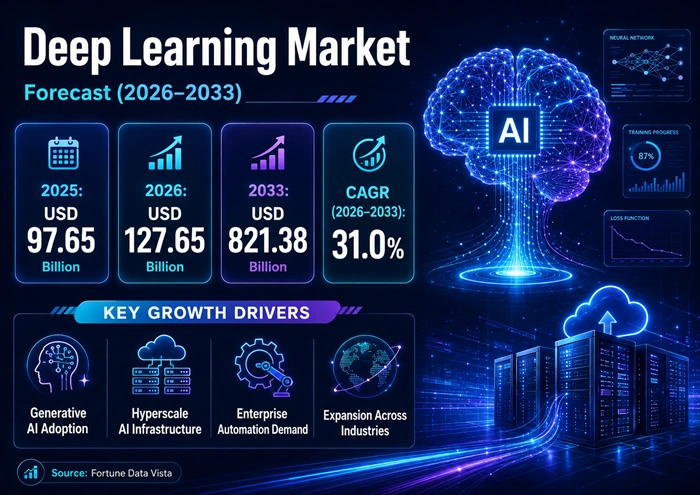
The global deep learning market size is valued at USD 97.65 billion in 2025 and is predicted to increase from USD 127.65 billion in 2026 to approximately USD 821.38 billion by 2033, growing at a CAGR of 31.0% from 2026 to 2033.
Deep learning — a specialized subset of machine learning that uses multi-layered neural networks to process vast amounts of unstructured data — has emerged as the foundational technology powering the modern AI revolution. From generative AI models and large language systems to computer vision, speech recognition, autonomous driving perception, and drug discovery platforms, deep learning is the engine underneath virtually every major AI application transforming industry today. The explosive growth of GPU-accelerated computing infrastructure, the availability of massive labeled and unlabeled training datasets, and the commercialization of powerful cloud-based AI platforms have together created the conditions for the deep learning market to sustain one of the highest sustained CAGRs of any technology segment globally through 2033.
AI Impact on the Deep Learning Industry
Generative AI, Foundation Models, and AI Supercomputing Infrastructure Are Creating a Self-Reinforcing Acceleration Cycle That Is Compounding the Deep Learning Market's Growth at a Rate Unprecedented in Enterprise Technology History
The relationship between AI advancement and the deep learning market is uniquely circular and self-amplifying. As AI models become more capable, they generate demand for more powerful deep learning infrastructure — more GPUs, more training data, more efficient deep learning frameworks, and more sophisticated model deployment platforms. This, in turn, enables researchers and engineers to develop even more capable AI systems, which drives further investment in infrastructure. The emergence of large language models (LLMs) and multimodal foundation models — including systems like OpenAI's GPT-4 series, Google's Gemini, Meta's Llama series, and Anthropic's Claude — has fundamentally changed the scale and nature of deep learning infrastructure demand. Training a single frontier model now requires thousands of high-end GPUs running for weeks or months, representing infrastructure investments in the hundreds of millions of dollars — driving the deep learning hardware market to unprecedented growth levels that are fundamentally reshaping the semiconductor and data center industries.
Beyond infrastructure, AI is transforming how deep learning systems are built and deployed. AutoML platforms powered by deep learning meta-learning techniques are enabling organizations with limited AI expertise to build and fine-tune high-performance models without data science specialists. AI-generated synthetic training data is addressing one of the deepest structural constraints on deep learning advancement — the shortage of high-quality, labeled training data in specialized domains. And AI-driven neural architecture search is identifying novel model architectures that outperform human-designed networks across a growing range of tasks. These meta-AI developments are creating an increasingly autonomous deep learning development ecosystem that dramatically lowers the barrier to entry for new market participants while simultaneously raising the performance ceiling for cutting-edge applications — both dynamics that reinforce the market's exceptional growth trajectory.
Growth Factors
Surging Enterprise AI Adoption, the Generative AI Investment Wave, and the Proliferation of GPU Computing Infrastructure Are Compounding Deep Learning Market Growth Across Every Industry Vertical and Geography
The most powerful near-term growth driver of the deep learning market is the global enterprise AI adoption wave that was catalyzed by the public launch and rapid commercialization of generative AI systems beginning in late 2022 and continuing to accelerate through 2026. Organizations across every industry — from banking and insurance to retail, manufacturing, healthcare, and government — are actively investing in deep learning-powered AI applications to automate workflows, generate content, analyze complex datasets, improve customer experiences, and gain competitive intelligence. The AI software investment cycle this has triggered is extraordinary in scale — global AI software spending is growing at rates that consistently surprise even optimistic forecasts, with enterprise customers building proprietary deep learning model training and fine-tuning capabilities rather than relying solely on API access to third-party models. This enterprise AI internalization trend is driving sustained demand for deep learning platforms, MLOps infrastructure, and cloud AI compute services that extend well beyond the early hype cycle.
The second structural growth driver is the acceleration of AI infrastructure investment by the world's major cloud providers, semiconductor companies, and technology hyperscalers. NVIDIA, AMD, Intel, and a new generation of AI chip startups including Cerebras Systems, Groq, and d-Matrix are all investing billions in the development of next-generation AI accelerator hardware optimized for deep learning training and inference workloads. Microsoft's investment in OpenAI, Google's Gemini program, Amazon's Alexa AI expansion, and Meta's FAIR research laboratory are all driving massive internal deep learning infrastructure spending that flows directly into the hardware, software, and services layers of the market. National governments — including the United States, China, the European Union, the United Kingdom, India, and Japan — are also deploying sovereign AI strategies with significant public funding for domestic deep learning computing infrastructure, creating an additional layer of structural demand that makes the market's growth trajectory unusually broad-based and resilient.
Market Outlook
The Deep Learning Market Is on a Decade-Long Exponential Growth Trajectory Driven by Generative AI Commercialization, Autonomous Systems Deployment, Healthcare AI Diagnostics, and the Global Digital Transformation of Every Major Industry
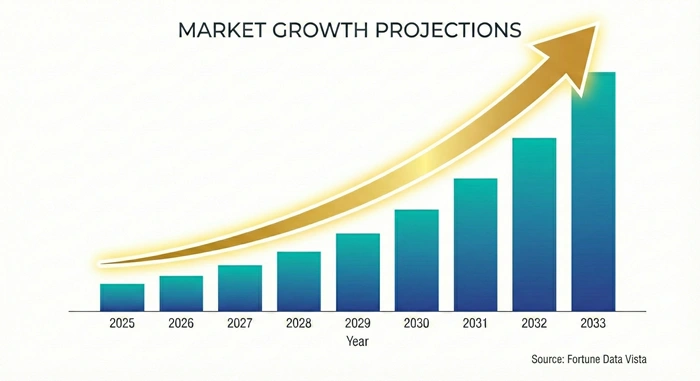
The long-term strategic outlook for the deep learning market is one of sustained, compounding growth that will fundamentally reshape the global technology economy through 2033 and beyond. The CAGR of 31.0% projected from 2026 to 2033 reflects a market in the relatively early stages of its commercial S-curve — widespread enterprise adoption of deep learning-powered AI is still nascent in most industries and geographies, and the transition from early experimentation to systematic, scaled deployment of deep learning across business-critical workflows represents a multi-year commercial wave that is still building momentum. As organizations complete their initial AI proof-of-concept phases and move to production deployment of deep learning systems at scale, the per-organization deep learning infrastructure and platform spend will increase dramatically — shifting the market from growth driven by new customer acquisition to compounding growth driven by expanding wallet share among an already converted customer base.
Healthcare represents one of the most transformative long-term growth frontiers for the deep learning market. Deep learning's ability to identify complex patterns in medical imaging, genomic sequences, electronic health records, and drug molecular structures is enabling diagnostic accuracy and drug discovery speed improvements that are qualitatively superior to what human specialists or conventional software can achieve. The FDA's approval of multiple deep learning-based medical imaging diagnostic devices, the growing use of AI in clinical trial optimization, and the deployment of deep learning in real-time patient monitoring systems are all creating new and rapidly growing market segments within healthcare AI that were not commercially viable even three years ago. As regulatory frameworks for AI-based medical devices mature and clinical evidence of deep learning's diagnostic value accumulates, healthcare will transition from an exploratory deep learning market to a large and rapidly scaling commercial segment that meaningfully contributes to overall market growth.
Expert Speaks
-
"NVIDIA's role in the deep learning ecosystem extends far beyond GPU hardware — we are building the full-stack AI computing platform, from chips to software frameworks to cloud services, that the world needs to develop and deploy AI at scale. The demand signals we are seeing from hyperscalers, sovereign AI programs, and enterprise customers confirm that we are at the very beginning of a multi-decade AI infrastructure investment cycle," — Jensen Huang, President & CEO, NVIDIA Corporation.
-
"Microsoft is deeply committed to democratizing access to deep learning and AI capabilities through Azure AI and our Copilot ecosystem. We are seeing extraordinary adoption of deep learning-powered AI tools across every industry we serve — from healthcare and financial services to manufacturing and public sector — and our partnership with OpenAI gives us unique access to the frontier model development that is driving this transformation," — Satya Nadella, Chairman & CEO, Microsoft Corporation.
-
"Alphabet's AI investments span the full depth of the deep learning stack — from custom TPU hardware and TensorFlow software infrastructure to the Gemini foundation model family and DeepMind's research breakthroughs in protein structure prediction, mathematical reasoning, and scientific discovery. We believe deep learning is the most powerful general-purpose technology humanity has ever developed, and we intend to remain at the frontier of its advancement," — Sundar Pichai, CEO, Alphabet Inc.
Key Report Takeaways
-
North America leads the global deep learning market, accounting for approximately 38–42% of total global revenue in 2025, anchored by the world's largest concentration of AI technology companies, hyperscale cloud providers, AI research institutions, and enterprise AI early adopters — with the United States home to NVIDIA, Microsoft, Google, Amazon, Meta, OpenAI, and the majority of the world's leading deep learning platform providers.
-
Asia Pacific is the fastest-growing region in the deep learning market, projected to register a CAGR of approximately 33–35% from 2026 to 2033, driven by massive government AI investment programs in China, India, Japan, and South Korea, the rapid growth of domestic AI technology champions, and the world's largest pool of AI engineering talent at competitive cost structures.
-
The hardware offering segment is the largest revenue contributor to the deep learning market, accounting for approximately 58–62% of total revenue in 2025, dominated by GPU accelerators from NVIDIA and AMD that serve as the essential computational substrate for both training and inference of large-scale deep learning models across cloud, enterprise, and edge deployment environments.
-
Image recognition and computer vision is the largest application segment, contributing approximately 22–26% of total deep learning market revenue in 2025, driven by the ubiquitous deployment of deep learning-powered visual AI in smartphone cameras, autonomous vehicles, medical imaging diagnostics, retail analytics, industrial quality inspection, and security surveillance applications globally.
-
Cloud-based deployment is the dominant and fastest-growing deployment mode, capturing approximately 68–72% of market revenue in 2025 and growing at a CAGR of approximately 33–35% from 2026 to 2033, as cloud AI platforms from Microsoft Azure, Amazon Web Services, and Google Cloud provide organizations of all sizes with on-demand access to the massive GPU compute resources required for deep learning model training and serving.
-
The healthcare and life sciences end-user segment is the fastest-growing industry vertical within the deep learning market, expected to grow at a CAGR of approximately 34–38% from 2026 to 2033 with a market share of approximately 12–15% by 2033, as deep learning achieves clinical validation across medical imaging diagnosis, drug discovery acceleration, genomic analysis, and real-time patient monitoring applications.
Market Scope
| Parameter | Details |
|---|---|
| Market Size by 2033 | USD 821.38 Billion | Market Size by 2026 | USD 127.65 Billion | Market Size by 2025 | USD 97.65 Billion | Market Growth Rate from 2026 to 2033 | CAGR of 31.0% | Dominating Region | North America | Fastest Growing Region | Asia Pacific | Segments Covered | Offering, Application, End-User Industry, Deployment Mode, Organization Size | Regions Covered | North America, Europe, Asia Pacific, Latin America, Middle East & Africa |
Market Dynamics
Drivers Impact Analysis
The Generative AI Revolution, Hyperscale Cloud AI Infrastructure Investment, and Broadening Enterprise Deep Learning Adoption Across Every Industry Are Compounding the Deep Learning Market's Growth at an Exceptional Rate
| Driver | ≈ % Impact on CAGR Forecast | Geographic Relevance | Impact Timeline |
|---|---|---|---|
| Generative AI and large language model commercialization | ~32% | Global, Dominant in North America | Ongoing through 2033 |
| Hyperscale cloud provider AI infrastructure investment | ~25% | North America, Asia Pacific, Europe | Ongoing |
| Broad enterprise AI adoption across all industry verticals | ~20% | Global | Near to Long-Term |
| Government sovereign AI programs and national AI strategies | ~13% | Asia Pacific, Europe, North America | Near to Long-Term |
| Deep learning in healthcare, drug discovery, and life sciences | ~10% | North America, Europe, Asia Pacific | Medium to Long-Term |
The generative AI revolution triggered by OpenAI's ChatGPT launch has permanently altered the commercial trajectory of the deep learning market by catalyzing a wave of enterprise AI investment that is orders of magnitude larger than the enterprise machine learning adoption wave that preceded it. Every major enterprise software category is being rebuilt around large language model and multimodal deep learning capabilities — from enterprise resource planning and customer relationship management to code generation, legal document analysis, financial modeling, and clinical decision support. This software transformation is creating enormous and sustained demand for deep learning training infrastructure, fine-tuning platforms, vector database systems, model deployment pipelines, and AI application development frameworks that collectively represent the fastest-growing enterprise technology spending category in history. NVIDIA's hyperscale customer GPU order backlogs, Microsoft Azure's AI revenue growth rates, and Google Cloud's AI-attributed revenue acceleration all provide direct market evidence of this exceptional demand environment.
The sovereign AI movement — in which national governments are committing to building domestic AI computing infrastructure rather than depending entirely on foreign cloud providers — is adding a new and significant layer of structural demand to the deep learning market. The United States CHIPS and AI Act, the European Union's AI Act combined with AI factory investments, the UAE's and Saudi Arabia's national AI programs, India's India AI Mission, Japan's sovereign AI computing strategy, and China's government-directed AI investment programs are collectively channeling hundreds of billions of dollars into domestic GPU clusters, AI supercomputing centers, and deep learning platform development. This government-backed demand is particularly valuable for the deep learning market because it is long-duration, relatively price-insensitive, and often extends into adjacent areas including domestic semiconductor development, AI talent training, and sovereign data infrastructure that collectively broaden the market's addressable commercial base.
Restraints Impact Analysis
High Computational Costs, Shortage of AI Talent, Regulatory Uncertainty Around AI Systems, and Ethical Concerns About Deep Learning Applications Are the Most Significant Forces Constraining the Market's Full Potential
| Restraint | ≈ % Impact on CAGR Forecast | Geographic Relevance | Impact Timeline |
|---|---|---|---|
| High computational cost of deep learning training and inference | ~32% | Global, Most Impactful for SMEs | Ongoing |
| Shortage of qualified AI and deep learning engineering talent | ~28% | Global | Ongoing |
| Regulatory uncertainty and AI governance compliance complexity | ~25% | Europe, North America | Near to Long-Term |
| Data privacy, security, and AI bias concerns | ~15% | Global | Ongoing |
The cost of training frontier deep learning models is one of the most significant structural restraints on the market's development. Training a single state-of-the-art foundation model can require compute investments of $50 million to over $100 million — a capital requirement accessible only to the world's largest technology companies, well-funded AI startups, and national government programs. This creates a concentration dynamic in which the majority of frontier deep learning research and development is conducted by a very small number of entities, while the broader enterprise market is limited to fine-tuning and deploying pre-trained models rather than training proprietary foundation models. While inference costs — the cost of running trained models in production — have fallen dramatically through hardware and software efficiency improvements, the training cost barrier continues to constrain competitive entry at the model development layer and concentrates market power among a handful of AI hyperscalers.
The global shortage of qualified deep learning engineers, data scientists, and AI infrastructure specialists remains a genuine constraint on how quickly organizations can develop and deploy deep learning applications at scale. Despite the enormous expansion of AI education programs, online learning platforms, and university AI curricula over the past five years, the demand for experienced AI practitioners consistently exceeds supply across all major markets — particularly for the senior engineers capable of designing and training custom deep learning architectures for domain-specific applications. This talent constraint slows enterprise AI project execution, inflates AI engineering compensation to levels that small and medium-sized enterprises struggle to sustain, and creates dependency on third-party AI service providers that adds cost and complexity to deep learning deployment programs.
Opportunities Impact Analysis
Edge AI Deep Learning Deployment, AI-Specific Semiconductor Innovation, Democratization Through No-Code AI Platforms, and Deep Learning in Scientific Discovery Are Creating Transformative New Growth Opportunities
| Opportunity | ≈ % Impact on CAGR Forecast | Geographic Relevance | Impact Timeline |
|---|---|---|---|
| Edge AI and on-device deep learning inference | ~30% | Global, Fastest in Asia Pacific | Near to Long-Term |
| Novel AI accelerator chips reducing training and inference costs | ~28% | North America, Asia Pacific | Near to Long-Term |
| No-code and low-code AI platforms democratizing deep learning | ~22% | Global | Near to Medium-Term |
| Deep learning in scientific discovery (climate, genomics, materials) | ~20% | North America, Europe, Asia Pacific | Medium to Long-Term |
Edge AI represents one of the most commercially significant near-term opportunities in the deep learning market. As the cost and power efficiency of specialized AI inference chips improves — through innovations in processor architecture from companies including NVIDIA (Jetson), Apple (Neural Engine), Qualcomm (AI Accelerator), and MediaTek — deploying deep learning models directly on edge devices rather than relying on cloud inference is becoming viable for a rapidly expanding range of applications. Industrial quality inspection systems, autonomous mobile robots, smart retail analytics, precision agriculture sensors, and wearable health monitoring devices all benefit from on-device deep learning inference that provides real-time results without cloud latency and without transmitting sensitive raw data over networks. The proliferation of edge AI applications is creating a new market tier within the deep learning ecosystem that operates largely independently of cloud infrastructure and is growing at rates that even exceed the cloud deep learning segment in some geographies.
The application of deep learning to accelerate fundamental scientific discovery is an opportunity with potentially civilization-scale long-term impact. DeepMind's AlphaFold system demonstrated conclusively that deep learning can solve protein structure prediction problems that had stumped biochemists for decades — a breakthrough with far-reaching implications for drug discovery, materials science, and synthetic biology. Similar deep learning breakthroughs are being actively pursued in climate modeling, nuclear fusion plasma control, quantum chemistry simulation, and new materials discovery for batteries and semiconductors. As the scientific community incorporates deep learning into the standard toolkit of research methodology across more disciplines, the demand for specialized deep learning models, scientific computing infrastructure, and AI-enabled research platforms will expand significantly — broadening the deep learning market's addressable base well beyond its current commercial AI application focus.
Segment Analysis
By Offering
Hardware Dominates the Deep Learning Market While Deep Learning Software Platforms and Services Emerge as the Fastest-Growing Offering Categories Driven by Enterprise AI Application Deployment
The hardware offering segment is the largest revenue contributor in the deep learning market, accounting for approximately 58–62% of total revenue in 2025 and growing at a CAGR of approximately 29.5% from 2026 to 2033. GPU accelerators from NVIDIA — whose H100 and H200 Hopper architecture chips have become the de facto standard compute substrate for frontier AI model training — dominate this segment, with NVIDIA maintaining an estimated 80–85% share of the AI accelerator market. North America dominates GPU procurement volumes through its hyperscale cloud provider base, but Asia Pacific is the fastest-growing region for AI hardware investment, driven by China's massive domestic GPU cluster buildout using domestic chips from Huawei (Ascend series) and Cambricon in response to US export controls, and by hyperscale investments from Chinese tech giants Alibaba, Tencent, and Baidu. AMD's MI300X accelerator is gaining meaningful enterprise market share as organizations seek GPU supply chain diversification, and a wave of ASIC-based AI accelerators from companies like Google (TPUs), Amazon (Trainium and Inferentia), and Microsoft (Maia) are carving out significant internal compute workloads that reduce commercial GPU demand within these hyperscalers.
The software segment — encompassing deep learning frameworks, model development platforms, MLOps tools, and AI application deployment software — is growing at the fastest rate within the offering mix, projected to register a CAGR of approximately 33–36% from 2026 to 2033. This growth is driven by the scaling of enterprise AI deployments from pilot to production, which requires sophisticated software infrastructure for model versioning, monitoring, continuous training, and governance. TensorFlow (Google), PyTorch (Meta), and the growing ecosystem of commercial deep learning platform providers including Databricks, Scale AI, and Weights & Biases are all growing revenue rapidly as enterprise demand for professional deep learning development tooling accelerates. The deep learning market's software segment is also benefiting from the AI agent and AI application development wave, as organizations build deep learning-powered autonomous systems that require robust orchestration and monitoring software infrastructure.
By Application
Image Recognition Leads Deep Learning Market Revenue While Natural Language Processing Represents the Fastest-Growing Application Category Powered by the Generative AI and Large Language Model Revolution
Image recognition and computer vision is the largest application segment in the deep learning market, contributing approximately 22–26% of total revenue in 2025 and growing at a CAGR of approximately 29.0% from 2026 to 2033. The pervasive deployment of convolutional neural networks and vision transformer models across smartphone cameras, autonomous vehicle perception systems, medical imaging diagnostic AI, retail analytics platforms, industrial defect detection systems, and security surveillance applications creates a uniquely broad and resilient demand base that spans consumer, enterprise, and government procurement. Asia Pacific leads global growth in computer vision deep learning adoption, driven by China's massive smart city surveillance infrastructure buildout, the rapid integration of visual AI into Chinese manufacturing quality control processes, and South Korea's world-leading deployment of AI-powered semiconductor wafer inspection systems by Samsung and SK Hynix. Key companies active in this segment include NVIDIA, Google (through Vision AI), Amazon (Rekognition), Microsoft (Azure Vision), Qualcomm, and a rich ecosystem of computer vision AI specialists.
Natural language processing is the fastest-growing application segment in the deep learning market, expected to register a CAGR of approximately 36–40% from 2026 to 2033, with its market share rising from approximately 18–20% in 2025 toward 22–25% by 2033. The generative AI revolution has transformed NLP from a specialized AI application into the primary interface layer between humans and AI systems — and the commercial deployment of large language model-powered chatbots, copilots, document analysis systems, code generation tools, and customer service AI agents is creating enormous demand for the transformer-based deep learning models, fine-tuning infrastructure, and AI orchestration platforms that enable enterprise NLP at scale. North America leads NLP deep learning adoption by a wide margin, anchored by the commercial success of OpenAI, Anthropic, Cohere, and the NLP products embedded across Microsoft 365, Google Workspace, and Salesforce CRM platforms.
Regional Insights
North America
North America Leads the Global Deep Learning Market as the World's Premier AI Innovation Hub, Home to the Largest Concentration of Deep Learning Technology Companies, Research Institutions, and Enterprise AI Adopters
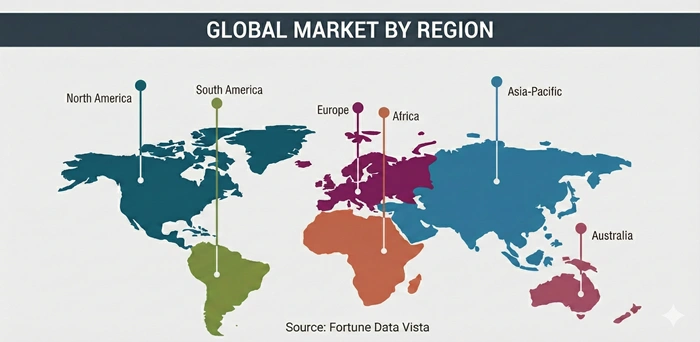
North America holds the largest share of the global deep learning market, accounting for approximately 38–42% of total global revenue in 2025 and projected to grow at a CAGR of approximately 30.5% from 2026 to 2033. The United States is the dominant national market by a substantial margin — home to NVIDIA, Microsoft, Alphabet (Google), Amazon, Meta, Apple, IBM, and OpenAI, the companies that collectively define the frontier of deep learning technology and hold the majority of AI infrastructure spending globally. The US benefits from the world's deepest pool of AI research talent, with MIT, Stanford, Carnegie Mellon, UC Berkeley, and Caltech consistently producing the engineers and researchers who advance deep learning algorithms, architectures, and applications. The US government's AI investment through DARPA, NIH, NSF, and the CHIPS and AI Act is adding sovereign public sector demand on top of the already massive commercial market.
Canada is an increasingly significant contributor to the North American deep learning market, home to pioneering deep learning researchers including Geoffrey Hinton, Yoshua Bengio, and their respective research networks at the Vector Institute (Toronto) and Mila (Montreal) — institutions that are attracting global AI talent and corporate research investment from major technology companies. Mexico's growing technology sector is beginning to adopt deep learning applications, particularly in manufacturing automation and financial services, representing an early-stage but growing contribution to the region's overall market. North America's deep learning market is expected to exceed USD 320 billion by 2033, maintaining its global leadership position as both the primary source of deep learning innovation and the largest enterprise adoption market throughout the forecast period.
Asia Pacific
Asia Pacific Is the Fastest-Growing Region in the Deep Learning Market, Powered by China's AI Superpower Ambitions, India's Rapidly Expanding AI Ecosystem, and Government-Backed Deep Learning Infrastructure Investment Across the Region
Asia Pacific is the fastest-growing regional market in the global deep learning market, projected to expand at a CAGR of approximately 33–35% from 2026 to 2033, with its share of global revenue currently at approximately 28–32% in 2025 and growing. China is by far the largest and most strategically significant deep learning market in the region — Chinese technology giants Baidu, Alibaba, Tencent, Huawei, and ByteDance are all making massive investments in proprietary deep learning research and AI application deployment across search, e-commerce, social media, cloud services, autonomous driving, and enterprise AI. China's government has designated AI as a core national strategic technology priority, with significant public funding flowing into national AI supercomputing centers, AI industrial parks, and domestic deep learning chip development programs that are partially insulating China's AI ecosystem from US semiconductor export controls. Companies like SenseTime, Megvii, and IFLYTEK are deploying deep learning at a scale in computer vision and speech recognition applications that exceeds almost anything seen outside the largest US hyperscalers.
India is emerging as one of the most important growth markets for the deep learning market in Asia Pacific, driven by the India AI Mission's public investment commitment, a world-class pool of AI engineering talent in Bengaluru, Hyderabad, and Pune, and the rapid digitalization of financial services, healthcare, and manufacturing sectors that are creating large-scale deep learning application deployment opportunities. Japan's well-funded AI research institutions and industrial automation sector, South Korea's leading semiconductor companies, and Australia's growing government AI investment are all contributing to a regional deep learning ecosystem that is diverse, well-capitalized, and growing at a pace that will meaningfully close the gap with North America in both AI innovation and enterprise adoption by 2033.
Report Customization: Region-Wise and Country-Wise Insights
This Report Is Available with Full Geographic Customization — Providing Technology Companies, Cloud Providers, AI Investors, and Enterprise Decision-Makers with Precise, Country-Level Deep Learning Market Intelligence Tailored to Their Strategic Business Objectives
This report on the deep learning market is available with complete region-wise and country-wise customization, enabling AI technology vendors, cloud infrastructure providers, enterprise software companies, venture capital investors, and corporate strategy teams to access the specific geographic market intelligence needed to make confident investment, market entry, and competitive strategy decisions. Whether the goal is to evaluate competitive dynamics in the US enterprise AI platform market, assess the opportunity in India's rapidly expanding deep learning services sector, or map the government AI infrastructure investment pipeline in the Gulf states, our research team delivers fully tailored analysis built around your target geography and business priorities.
Customized reports are available for the following regions and countries, each providing detailed market sizing, deep learning application demand analysis, competitive landscape mapping, infrastructure investment analysis, regulatory environment review, and growth opportunity assessment specific to that geography:
North America
-
U.S. — Hyperscale deep learning infrastructure spending, NVIDIA/AMD competitive GPU market dynamics, enterprise AI platform adoption across BFSI and healthcare, and OpenAI/Anthropic/Google LLM commercial ecosystem analysis
-
Canada — AI research institute ecosystem (Vector Institute, Mila), federal AI investment programs, enterprise deep learning adoption, and startup commercialization landscape
-
Mexico — Manufacturing AI automation adoption, fintech deep learning applications, and nearshore AI services market development
Europe
-
U.K. — AI Safety Institute framework impact, deep learning startup ecosystem in London, financial services AI adoption, and government AI compute investment
-
Germany — Industrial AI and deep learning in manufacturing (Industry 4.0), automotive AI (BMW, Mercedes, Volkswagen), and GDPR compliance impact on AI data practices
-
France — Government AI strategy and national deep learning compute investment, BPI France AI startup ecosystem, and enterprise AI adoption across key sectors
-
Italy — Industrial deep learning adoption, government digital transformation AI programs, and academic AI research commercialization
-
Rest of Europe — Nordic AI innovation hub analysis, Eastern European AI development talent landscape, and cross-border cloud AI market dynamics
Asia Pacific
-
China — Baidu/Alibaba/Tencent/Huawei AI platform competitive analysis, government AI compute investment, domestic GPU chip development, and deep learning regulatory environment
-
India — India AI Mission investment, engineering talent ecosystem, AI startup funding landscape, and enterprise deep learning adoption across BFSI, healthcare, and IT services
-
Japan — Industrial deep learning in automotive and robotics, government AI supercomputing investment, and academic-industry AI partnership landscape
-
South Korea — Samsung/SK Hynix AI chip development, deep learning in semiconductor manufacturing, government AI R&D investment, and tech giant AI platform analysis
-
Australia — Government AI strategy, enterprise deep learning adoption, research institution AI commercialization, and APAC AI hub development analysis
-
Rest of Asia Pacific — Southeast Asian AI startup ecosystem, Singapore as APAC AI hub, and Vietnam/Indonesia tech sector deep learning adoption
Latin America
-
Brazil — Government AI strategy, fintech deep learning adoption, agritech AI applications, and major enterprise AI investment landscape
-
Argentina — AI startup ecosystem, software development talent, and growing enterprise deep learning adoption across financial and retail sectors
-
Rest of Latin America — Regional AI investment trends, Colombia and Chile digital transformation, and Latin American deep learning market entry opportunity analysis
Middle East & Africa
-
UAE — National AI Strategy 2031, ADNOC and financial sector AI deployment, deep learning in smart city infrastructure, and Mohammed bin Zayed AI University ecosystem
-
Saudi Arabia — Vision 2030 AI investment, NEOM deep learning applications, and Saudi Aramco AI-powered energy sector deployment
-
Rest of MEA — African AI startup landscape, South African enterprise AI adoption, and Middle Eastern government AI compute infrastructure investment
Top Key Players
-
NVIDIA Corporation (United States)
-
Microsoft Corporation (United States)
-
Alphabet Inc. (Google) (United States)
-
Amazon Web Services, Inc. (United States)
-
Meta Platforms, Inc. (United States)
-
IBM Corporation (United States)
-
Intel Corporation (United States)
-
Apple Inc. (United States)
-
Baidu, Inc. (China)
-
Qualcomm Technologies, Inc. (United States)
-
Samsung Electronics Co., Ltd. (South Korea)
-
OpenAI, LP (United States)
-
Huawei Technologies Co., Ltd. (China)
-
SAP SE (Germany)
-
Databricks, Inc. (United States)
Recent Developments
-
2025 — NVIDIA Corporation launched its Blackwell Ultra GPU architecture and GB300 NVL72 rack-scale AI computing system, delivering approximately 1.5 exaflops of AI inference compute per rack — representing a generational leap in deep learning training and inference throughput that immediately attracted purchase commitments from all major hyperscale cloud providers and sovereign AI program operators globally.
-
2025 — Microsoft Corporation announced a five-year, $80 billion commitment to AI data center infrastructure investment, with the majority allocated to deep learning training clusters in the United States and internationally, alongside the expansion of its Azure AI platform with new fine-tuning, inference, and agent orchestration services powered by its continued partnership with OpenAI.
-
2024 — Alphabet Inc. (Google) released the Gemini 1.5 Pro and Gemini 2.0 foundation model families with breakthrough multi-modal reasoning capabilities and an unprecedented one-million token context window, strengthening Google DeepMind's position as a leading frontier deep learning research institution and accelerating enterprise adoption of Google Cloud AI services across healthcare, financial services, and developer tooling.
-
2024–2025 — Amazon Web Services expanded its AWS Trainium2 and Inferentia3 AI chip program, offering enterprise customers significantly lower deep learning inference and training costs compared to GPU-based alternatives for compatible model architectures, while also announcing Project Rainier — a massive custom AI compute cluster built with Trainium2 chips for Anthropic's Claude model training that represents one of the largest single AI infrastructure investments in AWS history.
-
2025 — Meta Platforms, Inc. released the Llama 4 family of open-weight foundation models with multimodal capabilities across text, image, and video understanding, continuing its strategy of open-sourcing frontier deep learning models to build developer ecosystem adoption — a strategy that has made Meta's Llama model family the most downloaded open-weight foundation model series globally and established Meta AI Research (FAIR) as a central contributor to the deep learning community.
Market Trends
The Rise of Agentic AI Systems and the Shift from Cloud-Only to Hybrid Edge-Cloud Deep Learning Deployment Are the Two Most Commercially Transformative Trends Reshaping the Deep Learning Market's Architecture and Growth Trajectory
The most consequential trend reshaping the deep learning market in 2026 and beyond is the transition from standalone AI model deployment to agentic AI systems — networks of deep learning models that can plan multi-step tasks, use external tools, access real-time data, and execute complex workflows with minimal human oversight. Agentic AI frameworks built on orchestrated deep learning components are enabling a new class of AI application — including autonomous coding agents, AI research assistants, AI-powered supply chain optimization agents, and multi-agent customer service systems — that deliver dramatically higher business value than single-purpose AI models. This agentic AI transition is driving new demand for deep learning inference infrastructure capable of handling high-frequency, low-latency model calls, new software frameworks for agent orchestration and memory management, and new evaluation and safety tooling that can assess multi-step AI system behavior in complex environments.
The second defining trend is the rapid maturation of hybrid edge-cloud deep learning deployment architectures. As deep learning model compression techniques — including quantization, pruning, knowledge distillation, and parameter-efficient fine-tuning — produce smaller, faster models capable of running effectively on consumer-grade hardware, the commercial value of running deep learning inference at the edge — in smartphones, industrial sensors, medical devices, and autonomous vehicles — is becoming large enough to attract major strategic investment. Apple's Neural Engine, Qualcomm's AI Hub, and NVIDIA's Jetson platform are all competing to become the preferred deep learning inference substrate for edge AI applications. This trend is not reducing cloud deep learning demand — it is creating an additional, complementary market layer where deep learning inference runs simultaneously at the edge and in the cloud, with the architecture optimized for each specific application's latency, privacy, and cost requirements.
Segments Covered in the Report
-
By Offering
-
Hardware
-
GPUs (Graphics Processing Units)
-
CPUs (Central Processing Units)
-
FPGAs (Field-Programmable Gate Arrays)
-
ASICs and Custom AI Accelerators (TPUs, NPUs)
-
-
Software
-
Deep Learning Frameworks (TensorFlow, PyTorch, Keras)
-
Deep Learning Platforms and MLOps Tools
-
AI Application Development Software
-
-
Services
-
Professional Services (Consulting, Implementation, Training)
-
Managed Services
-
-
-
By Application
-
Image Recognition and Computer Vision
-
Natural Language Processing (NLP) and Text Analytics
-
Signal Recognition (Speech Recognition, Gesture Recognition)
-
Data Mining and Business Intelligence
-
Fraud Detection and Cybersecurity
-
Drug Discovery and Healthcare Diagnostics
-
Autonomous Vehicles and Robotics
-
Industrial Automation and Predictive Maintenance
-
Others
-
-
By End-User Industry
-
BFSI (Banking, Financial Services, and Insurance)
-
Healthcare and Life Sciences
-
Retail and E-commerce
-
IT and Telecommunications
-
Automotive and Transportation
-
Manufacturing
-
Media and Entertainment
-
Government and Defense
-
Energy and Utilities
-
Others
-
-
By Deployment Mode
-
Cloud-Based
-
On-Premises
-
Hybrid
-
-
By Organization Size
-
Large Enterprises
-
Small and Medium-Sized Enterprises (SMEs)
-
-
By Region
-
North America (U.S., Canada, Mexico)
-
Europe (U.K., Germany, France, Italy, Rest of Europe)
-
Asia Pacific (China, India, Japan, South Korea, Australia, Rest of Asia Pacific)
-
Latin America (Brazil, Argentina, Rest of Latin America)
-
Middle East & Africa (UAE, Saudi Arabia, Rest of MEA)
-
❝ Built for Every Level — From Startups to Industry Giants ❞
Here Is Exactly How This Report Works for You
-
Tier 1 AI technology companies, cloud hyperscalers, and institutional technology investors will find this report essential for tracking the competitive revenue trajectories of the world's leading deep learning platform providers, identifying where enterprise AI wallet share is shifting across cloud providers and hardware architectures, and understanding which geographic markets and industry verticals are generating the fastest-growing demand in the deep learning market — intelligence that is directly actionable for product roadmap prioritization, partnership strategy, and M&A target identification.
-
For mid-market AI software companies, deep learning services providers, and enterprise technology resellers, this report delivers critical competitive and market intelligence on how geopolitical AI technology restrictions — including US semiconductor export controls affecting China's GPU access, the EU AI Act's compliance requirements, and national AI sovereignty programs — are reshaping competitive dynamics, creating market access opportunities, and influencing enterprise AI procurement decisions in ways that directly impact revenue growth, partner positioning, and go-to-market strategy across every major geography.
-
Deep learning startups, AI research commercialization ventures, and growth-stage AI application companies will benefit from our detailed analysis of which enterprise AI application segments are attracting the highest commercial adoption rates, which industry verticals present the most underserved deep learning market opportunities, and how the world's largest strategic acquirers in AI are evaluating technology assets — providing the market context, competitive benchmarking, and strategic positioning intelligence needed to build investor confidence, accelerate commercial traction, and capture meaningful market share in the world's fastest-growing technology industry.
Frequently Asked Questions:
Answer: The global deep learning market was valued at USD 97.65 billion in 2025 and is projected to grow from USD 127.65 billion in 2026 to approximately USD 821.38 billion by 2033, at a CAGR of 31.0%. This exceptional growth rate reflects the rapid enterprise adoption of generative AI, the scaling of deep learning infrastructure investment by hyperscale cloud providers, and the expanding application of neural network technology across healthcare, automotive, manufacturing, and financial services.
Answer: The primary drivers of the deep learning market include the commercial success of generative AI and large language models that has triggered unprecedented enterprise AI investment, the massive infrastructure spending commitments by cloud hyperscalers and national governments in AI supercomputing capacity, and the broad expansion of deep learning applications across image recognition, natural language processing, autonomous systems, and drug discovery. The continued improvement in GPU performance, the declining cost of AI inference through specialized chips, and the growing availability of foundation models for enterprise fine-tuning are further accelerating market growth.
Answer: North America dominates the deep learning market with approximately 38–42% of global revenue in 2025, anchored by the world's highest concentration of AI technology companies, hyperscale cloud providers, and enterprise AI early adopters in the United States. Asia Pacific is the fastest-growing region, projected to grow at a CAGR of 33–35% from 2026 to 2033, driven by China's massive government-backed AI investment programs, India's rapidly expanding AI ecosystem, and deep learning adoption across Asia's leading technology and manufacturing industries.
Answer: Image recognition and computer vision is the largest application segment in the deep learning market, accounting for approximately 22–26% of total revenue in 2025, driven by the ubiquitous deployment of convolutional neural network models across smartphones, autonomous vehicles, medical imaging, and industrial inspection systems. Natural language processing is the fastest-growing application segment, fueled by the generative AI revolution and the mass commercial deployment of large language model-powered applications across enterprises globally.
Answer: The deep learning market represents the specialized subset of the broader artificial intelligence market that focuses specifically on multi-layered neural network technologies — the algorithms, hardware accelerators, software frameworks, and deployment platforms that power the most advanced AI applications including generative AI, computer vision, speech recognition, and autonomous systems. While the broader AI market includes rule-based systems, expert systems, and traditional machine learning approaches, the deep learning market captures the highest-growth, most computationally intensive tier of AI that is responsible for the majority of recent AI capability breakthroughs and the largest share of enterprise AI infrastructure investment.