
Drug Discovery Informatics Market Overview
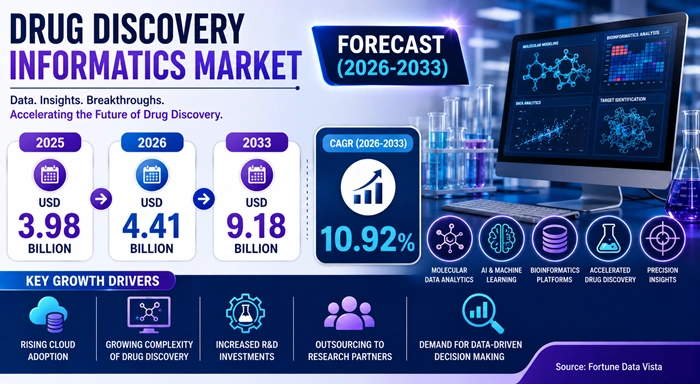
The global drug discovery informatics market size is valued at USD 3.98 billion in 2025 and is predicted to increase from USD 4.41 billion in 2026 to approximately USD 9.18 billion by 2033, growing at a CAGR of 10.92% from 2026 to 2033.
This strong growth reflects the pharmaceutical industry's accelerating shift toward data-driven drug development, where computational modeling, artificial intelligence, and integrated data management tools are replacing slower, trial-heavy laboratory processes. As drug candidates grow more complex and research budgets face mounting pressure to deliver faster returns, demand for advanced informatics platforms continues expanding across pharmaceutical companies, biotechnology firms, and contract research organizations worldwide.
AI Impact on the Drug Discovery Informatics Industry
Artificial Intelligence Is Accelerating Molecular Screening, Enhancing Predictive Toxicology Modeling, and Strengthening Target Identification Across the Drug Discovery Informatics Landscape — Fundamentally Changing How Researchers Approach Early-Stage Drug Development
Artificial intelligence has become an increasingly valuable tool for accelerating molecular screening processes, with deep learning models now capable of analyzing millions of chemical compound structures to predict binding affinity and biological activity far faster than traditional wet-lab screening methods ever allowed. This speed matters considerably in an industry where every month saved during early discovery stages translates into meaningful competitive advantage and reduced research spending, and AI-assisted screening platforms are helping research teams narrow down promising candidates before committing to expensive laboratory validation. Companies building AI-driven molecular screening directly into their informatics platforms are increasingly differentiating themselves through measurably shorter discovery timelines.
Beyond screening, AI is also improving predictive toxicology modeling, with machine learning algorithms now able to analyze historical compound safety data to flag potentially problematic molecules before they reach costly animal or human trial phases. This capability has proven valuable for pharmaceutical companies managing large drug candidate pipelines, since earlier toxicity flagging reduces both wasted research investment and ethical concerns around unnecessary testing. As these AI-driven screening and prediction tools continue maturing, they are becoming an increasingly important factor shaping research efficiency across the broader drug discovery informatics market.
Growth Factors
Rising Drug Development Complexity and Growing Pharmaceutical R&D Investment Continue Driving Sustained Demand
The most significant growth factor supporting the drug discovery informatics market is the steadily increasing complexity of drug candidates entering development pipelines, as biologics, cell therapies, and precision medicine approaches require far more sophisticated computational modeling and data integration than traditional small-molecule drugs ever did. With research teams managing growing volumes of genomic, proteomic, and clinical data simultaneously, this complexity-driven demand has become an increasingly important growth driver for informatics platform providers serving both established pharmaceutical giants and emerging biotech companies.
A second important growth factor is the continued expansion of global pharmaceutical research and development spending, as companies facing patent cliffs and competitive pressure increasingly invest in technology that can accelerate discovery timelines and improve candidate selection accuracy. This growing R&D investment, combined with rising outsourcing of discovery functions to specialized contract research organizations equipped with advanced informatics capability, has broadened the addressable market considerably. This combination of rising drug development complexity and growing R&D investment continues to strengthen demand across the drug discovery informatics market.
Market Outlook
Cloud-Based Platform Adoption and Expanding AI Integration Point Toward Sustained Growth Through 2033
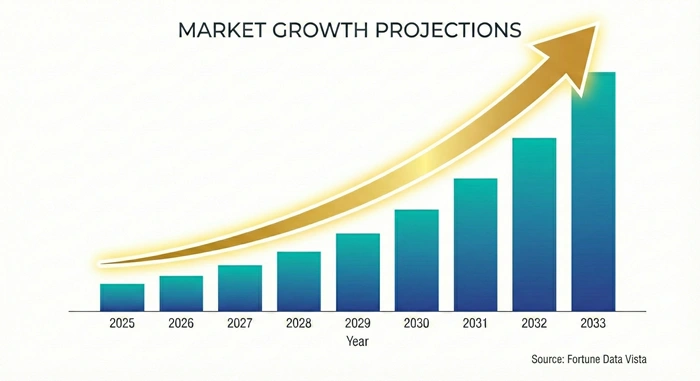
Looking ahead through the forecast period, the drug discovery informatics industry is expected to benefit substantially from continued migration toward cloud-based informatics platforms, as pharmaceutical companies increasingly favor scalable, collaborative systems that allow global research teams to access shared data and computational resources without maintaining costly on-premises infrastructure. This cloud transition is likely to reshape platform procurement considerably as more organizations prioritize flexibility and reduced IT overhead.
At the same time, deepening integration of artificial intelligence and machine learning capability directly into core informatics workflows is expected to create substantial new demand, as researchers seek platforms that combine data management with genuinely predictive analytical power rather than treating these as separate systems. Companies that can deliver both robust data infrastructure and cutting-edge computational capability are increasingly well positioned to capture this growth. Providers combining strong scientific domain expertise with modern software architecture are likely to lead growth within the broader drug discovery informatics market through 2033.
Expert Speaks
-
"Our continued investment in AI-driven informatics platforms reflects our commitment to helping researchers make faster, more confident decisions throughout the drug discovery process." — CEO, Thermo Fisher Scientific Inc
-
"As drug candidates grow more complex, our biosimulation and modeling technology remains focused on helping pharmaceutical partners reduce both cost and risk during early development." — CEO, Certara Inc
-
"We remain dedicated to advancing molecular modeling and collaborative data platforms that support faster, more informed decisions across the entire discovery pipeline." — CEO, Dassault Systèmes SE
Key Report Takeaways
-
North America leads the global drug discovery informatics market, holding approximately 41% market share in 2025, supported by extensive pharmaceutical R&D spending and dense concentration of leading biotechnology firms
-
Asia Pacific is the fastest-growing region, projected to expand at a CAGR near 13.6% through 2033, driven by expanding contract research activity and rising government investment in life sciences technology across China and India
-
Pharmaceutical companies represent the dominant end-user segment, accounting for roughly 47% share, given their extensive research budgets and continuous pipeline development requirements
-
Software and platform offerings contribute the most to overall demand, reflecting sustained investment in molecular modeling and data management tools across research organizations
-
Cloud-based deployment remains the fastest-growing modality, valued for its scalability and ability to support distributed global research teams
-
Biotechnology and precision medicine application segments will grow the fastest among end-user categories, holding close to 26% market share with a CAGR near 14.2% through the forecast period, driven by rising demand for advanced genomic and proteomic data analysis
Market Scope
| Parameter | Details |
|---|---|
| Market Size by 2033 | USD 9.18 Billion | Market Size by 2026 | USD 4.41 Billion | Market Size by 2025 | USD 3.98 Billion | Market Growth Rate from 2026 to 2033 | CAGR of 10.92% | Dominating Region | North America | Fastest Growing Region | Asia Pacific | Segments Covered | Offering, Deployment Mode, End User, Region | Regions Covered | North America, Europe, Asia Pacific, Latin America, Middle East & Africa |
Market Dynamics
Drivers Impact Analysis
Rising Drug Development Complexity and Expanding Pharmaceutical R&D Spending Remain the Two Strongest Forces Behind Market Momentum
| Driver | (≈) % Impact on CAGR Forecast | Geographic Relevance | Impact Timeline |
|---|---|---|---|
| Increasing complexity of biologics and precision medicine drug candidates | ~34% | North America, Europe | Medium to long-term |
| Rising global pharmaceutical research and development spending | ~28% | Global | Short to long-term |
| Growing outsourcing of discovery functions to contract research organizations | ~24% | Global | Medium-term |
| Expanding integration of AI and machine learning into research workflows | ~14% | North America, Asia Pacific | Short to medium-term |
Increasing complexity of biologics and precision medicine drug candidates continues to serve as the primary engine behind sustained growth in the drug discovery informatics market, as research teams managing sophisticated genomic and proteomic data require far more advanced computational tools than traditional small-molecule discovery workflows demanded. This complexity-driven momentum has translated directly into rising platform investment among pharmaceutical companies pursuing next-generation therapeutic approaches.
Rising global pharmaceutical research and development spending represents the second major driver, as companies facing patent expirations and competitive pressure increasingly invest in technology capable of accelerating discovery timelines and improving candidate selection. This investment-driven demand, combined with growing outsourcing of discovery functions to specialized contract research organizations, continues reinforcing steady momentum across the broader drug discovery informatics market.
Restraints Impact Analysis
High Implementation Costs and Data Integration Challenges Continue to Moderate Broader Adoption
| Restraint | (≈) % Impact on CAGR Forecast | Geographic Relevance | Impact Timeline |
|---|---|---|---|
| High cost of implementing and maintaining advanced informatics platforms | ~35% | Global, particularly emerging markets | Short to medium-term |
| Difficulty integrating disparate legacy data systems across research organizations | ~28% | North America, Europe | Medium to long-term |
| Shortage of skilled bioinformatics and computational biology professionals | ~23% | Global | Medium-term |
| Data privacy and security concerns surrounding sensitive research information | ~14% | Global | Short to medium-term |
The most persistent restraint facing the drug discovery informatics market is the substantial upfront and ongoing cost associated with implementing advanced informatics platforms, which can create significant barriers for smaller biotechnology companies and research institutions operating with constrained budgets despite the long-term efficiency benefits. This cost sensitivity remains particularly pronounced among emerging biotech firms competing for limited venture funding.
Difficulty integrating disparate legacy data systems represents a second significant restraint, since many established pharmaceutical companies maintain years of research data scattered across incompatible platforms that require costly migration and standardization efforts before modern informatics tools can be fully effective. Combined with an ongoing shortage of skilled bioinformatics professionals capable of managing these complex systems, these restraints continue moderating how quickly broader adoption spreads across the global drug discovery informatics market.
Opportunities Impact Analysis
Cloud Platform Expansion and Deepening AI Integration Represent the Clearest Paths to Growth
| Opportunity | (≈) % Impact on CAGR Forecast | Geographic Relevance | Impact Timeline |
|---|---|---|---|
| Expanding adoption of cloud-based, scalable informatics platforms | ~37% | Global | Short to medium-term |
| Deepening integration of AI and machine learning into core research workflows | ~34% | North America, Asia Pacific | Medium to long-term |
| Growing contract research organization demand for advanced informatics capability | ~29% | Asia Pacific | Medium-term |
Expanding adoption of cloud-based informatics platforms represents one of the most substantial opportunities within the drug discovery informatics market, as pharmaceutical companies seeking scalable, collaborative research infrastructure increasingly favor cloud deployment over costly on-premises systems that limit global team accessibility. This platform shift is expected to meaningfully reshape competitive positioning among leading informatics providers over the coming years.
Deepening integration of AI and machine learning into core research workflows presents a second substantial opportunity, as researchers increasingly demand platforms that combine robust data management with genuinely predictive analytical capability rather than treating these as separate, disconnected systems. Growing contract research organization demand for advanced informatics tools further broadens the opportunity landscape, particularly as pharmaceutical companies outsource increasing portions of their discovery pipeline. Companies pursuing these parallel opportunities are well positioned to capture meaningful growth within the broader drug discovery informatics market through the forecast period.
Segment Analysis
By Offering: Software and Platforms
Software and Platform Solutions Continue to Anchor the Offering Landscape, Reflecting Sustained Investment in Molecular Modeling Tools
Software and platform solutions hold the largest share within the offering segment of the drug discovery informatics market, accounting for approximately 52% of total segment revenue in 2025. This dominance reflects the continuous investment required in molecular modeling, biocontent management, and sequence analysis software that forms the technological backbone of modern discovery research across pharmaceutical and biotechnology organizations. In markets like the United States and Switzerland, research teams increasingly favor integrated platforms that combine multiple analytical capabilities rather than managing separate point solutions for each discovery stage. Leading suppliers such as Dassault Systèmes, Certara, and Schrödinger continue to dominate this segment through expanded product portfolios and continuous computational capability improvements.
Growth within this segment remains particularly strong in North America, where extensive pharmaceutical R&D spending and dense concentration of leading biotechnology firms continue generating sustained demand for advanced software platforms across thousands of active drug discovery programs. The region's combination of deep research funding and strong technology adoption culture has helped software and platform solutions maintain their leading position despite growing interest in outsourced services alternatives. As molecular modeling technology continues advancing, software and platforms are expected to remain the dominant category within the broader drug discovery informatics market throughout the forecast period.
By End User: Biotechnology Companies
Biotechnology Companies Represent the Fastest-Growing End User Segment, Reflecting Rising Demand for Precision Medicine Data Analysis
Biotechnology companies represent the fastest-growing end user segment within the drug discovery informatics market, holding close to 26% share in 2025 with a projected CAGR near 14.2% through the forecast period as smaller, agile biotech firms increasingly adopt sophisticated informatics tools to compete against larger pharmaceutical companies with greater research resources. Unlike traditional pharmaceutical giants that often maintain extensive in-house informatics infrastructure built over decades, biotechnology companies typically favor flexible, cloud-based platforms that require lower upfront capital investment while still delivering advanced genomic and proteomic analysis capability. This accessibility-driven adoption has generated substantial interest among venture-backed biotech startups pursuing precision medicine and cell therapy programs that demand extensive computational modeling.
Growth in this segment remains especially strong in Asia Pacific, where expanding government investment in life sciences technology and a rapidly growing biotech startup ecosystem across China and India continue driving strong demand for accessible informatics platforms. Companies like Schrödinger and Certara have expanded their biotechnology-focused product offerings significantly to serve this growing regional demand, often providing flexible pricing models tailored to smaller research budgets. As precision medicine research continues expanding globally, this end user segment is expected to remain the fastest-growing category within the broader drug discovery informatics market.
Regional Insights
North America
Extensive Pharmaceutical R&D Spending and Deep Biotechnology Concentration Keep North America Firmly in the Lead
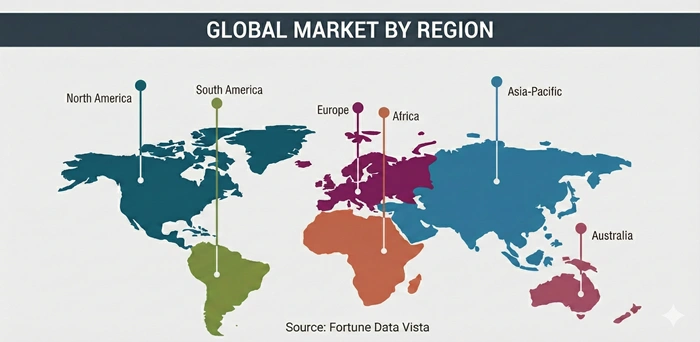
North America commands the leading position in the global drug discovery informatics market, holding approximately 41% share in 2025, supported by extensive pharmaceutical research and development spending, a dense concentration of leading biotechnology firms, and strong early adoption of advanced computational research tools. The United States drives the overwhelming majority of regional demand, backed by substantial federal research funding and hundreds of pharmaceutical and biotechnology companies actively investing in informatics infrastructure to accelerate drug candidate pipelines. Companies with strong regional presence include Certara, Thermo Fisher Scientific, Schrödinger, and Dassault Systèmes, each maintaining deep relationships with major pharmaceutical research organizations across the country.
Canada also contributes meaningfully to regional demand, supported by growing academic research partnerships and expanding biotechnology cluster activity centered around major research universities. The region's combination of established funding infrastructure, deep scientific talent pools, and continuous technology innovation ensures North America's leadership position within the drug discovery informatics market remains firmly intact through the remainder of the forecast period.
Asia Pacific
Expanding Contract Research Activity and Rising Government Life Sciences Investment Position Asia Pacific as the Fastest-Growing Region
Asia Pacific is projected to register the fastest CAGR within the global drug discovery informatics market through 2033, expanding at a rate near 13.6% as expanding contract research activity and rising government investment in life sciences technology create substantial new demand across the region. China and India lead much of this regional growth, supported by rapidly growing contract research organization capacity and increasing domestic biotechnology investment aimed at reducing dependence on Western drug development infrastructure. Regional and international informatics providers alike have expanded their presence to serve this growing demand, often establishing local support centers to better serve nearby research customers.
Japan and South Korea contribute further depth to regional growth, both bringing established pharmaceutical manufacturing infrastructure and growing government support for precision medicine research initiatives. Growing venture capital investment in biotechnology startups across several Asia Pacific markets continues to accelerate informatics platform adoption among expanding research organizations alike. This combination of rising contract research capacity, growing government investment, and expanding biotech startup activity positions Asia Pacific as the clear growth leader within the broader drug discovery informatics market through the forecast period.
Customization Available for This Report
Region-Specific and Country-Specific Versions of This Report Are Available to Deliver a Sharper, More Localized View of Market Dynamics
This report can be tailored on a region-by-region and country-by-country basis, providing localized market sizing, competitive mapping, and technology adoption trend analysis that a global overview alone cannot fully capture.
Clients seeking a more focused breakdown can request a customized version covering any of the following regions and countries, complete with demand forecasting, competitor landscape review, and adoption trend analysis tied specifically to the drug discovery informatics keyword focus:
North America
-
U.S. — Detailed review of pharmaceutical R&D investment and informatics adoption trends
-
Canada — Coverage of academic research partnerships and biotechnology cluster activity
-
Mexico — Analysis of emerging contract research organization investment trends
Europe
-
U.K. — Review of biotechnology funding and informatics platform adoption trends
-
Germany — Coverage of pharmaceutical research investment among leading companies
-
France — Insights into molecular modeling and computational research patterns
-
Italy — Analysis of regional life sciences technology investment trends
-
Rest of Europe — Country-level view of emerging demand across Eastern Europe and the Nordics
Asia Pacific
-
China — Coverage of expanding contract research capacity and technology adoption
-
India — Analysis of growing biotechnology investment and informatics demand
-
Japan — Review of established pharmaceutical infrastructure and adoption trends
-
South Korea — Assessment of precision medicine research investment and adoption
-
Australia — Insights into life sciences research technology adoption trends
-
Rest of Asia Pacific — Country-level breakdown covering Singapore, Vietnam, and Malaysia
Latin America
-
Brazil — Coverage of expanding biotechnology research access and adoption
-
Argentina — Analysis of early-stage pharmaceutical research modernization trends
-
Rest of Latin America — Country-level sizing across Colombia, Peru, and Chile
Middle East & Africa
-
UAE — Review of life sciences research investment and technology adoption trends
-
Saudi Arabia — Coverage of expanding biotechnology research modernization initiatives
-
Rest of MEA — Country-level view of African life sciences infrastructure expansion
Top Key Players
-
Certara Inc (United States)
-
Dassault Systèmes SE (France)
-
Schrödinger Inc (United States)
-
Thermo Fisher Scientific Inc (United States)
-
PerkinElmer Inc (United States)
-
Charles River Laboratories International Inc (United States)
-
Boehringer Ingelheim International GmbH (Germany)
-
Infosys Limited (India)
-
Collaborative Drug Discovery Inc (United States)
-
Eurofins DiscoverX Products LLC (United States)
-
Oracle Corporation (United States)
-
Genedata AG (Switzerland)
Recent Developments
-
In 2025, Certara expanded its biosimulation platform capabilities with enhanced predictive modeling features targeting complex biologics development programs
-
In 2025, Schrödinger strengthened its computational drug design software through continued investment in AI-driven molecular screening technology
-
In 2026, Dassault Systèmes advanced its BIOVIA platform integration capabilities to support broader collaborative research across distributed pharmaceutical teams
-
In 2025, Thermo Fisher deepened its informatics service offerings through expanded partnerships supporting genomic and proteomic data analysis workflows
-
In 2025, Infosys broadened its life sciences informatics consulting practice to support growing pharmaceutical outsourcing demand across emerging markets
Market Trends
Cloud Migration and Deepening AI Integration Are Reshaping Research Infrastructure Priorities
One of the clearest trends shaping the drug discovery informatics market is the accelerating migration toward cloud-based research platforms, as pharmaceutical and biotechnology companies increasingly favor scalable, collaborative systems over traditional on-premises infrastructure that limits accessibility for globally distributed research teams. Providers are investing heavily in cloud architecture, recognizing that platform flexibility has become an increasingly important competitive differentiator as research organizations seek to reduce IT overhead while maintaining computational power.
A second significant trend is the growing integration of artificial intelligence and machine learning capability directly into informatics platforms rather than treating predictive analytics as a separate add-on tool. This trend toward native AI integration is particularly meaningful for research teams seeking seamless workflows that combine data management with genuinely predictive screening and modeling power, continuing to support steady expansion across the broader drug discovery informatics market as AI adoption deepens throughout the research process.
Segments Covered in the Report
By Offering
-
Software and Platforms
-
Services
By Deployment Mode
-
Cloud-Based
-
On-Premises
By End User
-
Pharmaceutical Companies
-
Biotechnology Companies
-
Contract Research Organizations
-
Academic and Research Institutes
By Region
-
North America (U.S., Canada, Mexico)
-
Europe (U.K., Germany, France, Italy, Rest of Europe)
-
Asia Pacific (China, India, Japan, South Korea, Australia, Rest of Asia Pacific)
-
Latin America (Brazil, Argentina, Rest of Latin America)
-
Middle East & Africa (UAE, Saudi Arabia, Rest of MEA)
❝ Built for Every Level — From Startups to Industry Giants ❞
Here Is Exactly How This Report Works for You
-
For tier 1 companies, investors, and established market leaders, this report delivers detailed competitor revenue analysis, technology investment trend mapping, and geopolitical risk context that support confident decisions around product expansion, pricing strategy, and long-term positioning within the drug discovery informatics space
-
For tier 2 and tier 3 companies, startups, and mid-sized providers, this report highlights the most commercially promising offering categories and underserved regional opportunities, giving you a practical framework to compete against larger established players without overextending limited resources
-
For every decision maker across the value chain, this report explains exactly how R&D funding trends, data privacy regulation, and competitor product launches are shaping market direction through 2033, equipping you to plan investment and go-to-market decisions with genuine confidence
Frequently Asked Questions:
Answer: The global drug discovery informatics market was valued at USD 3.98 billion in 2025 and is projected to reach USD 9.18 billion by 2033. This growth is driven largely by rising drug development complexity and expanding pharmaceutical R&D spending.
Answer: Growth in the drug discovery informatics market is being driven by increasing complexity of biologics and precision medicine candidates alongside rising R&D spending. Growing outsourcing to contract research organizations is further reinforcing this expansion.
Answer: North America currently leads the drug discovery informatics market with roughly 41% share, supported by extensive pharmaceutical R&D spending. Asia Pacific is growing the fastest, driven by expanding contract research activity and government investment.
Answer: Software and platform solutions generate the largest share of revenue in the drug discovery informatics market, reflecting sustained investment in molecular modeling tools. Biotechnology companies remain the fastest-growing end user segment.
Answer: Leading companies in the drug discovery informatics market include Certara, Dassault Systèmes, Schrödinger, Thermo Fisher Scientific, and PerkinElmer. These companies compete through continuous innovation in AI-driven molecular screening and cloud platforms.