
Edge Artificial Intelligence Chips Market Overview
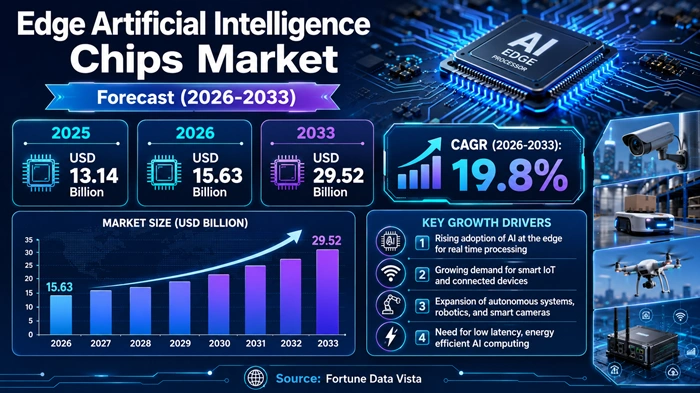
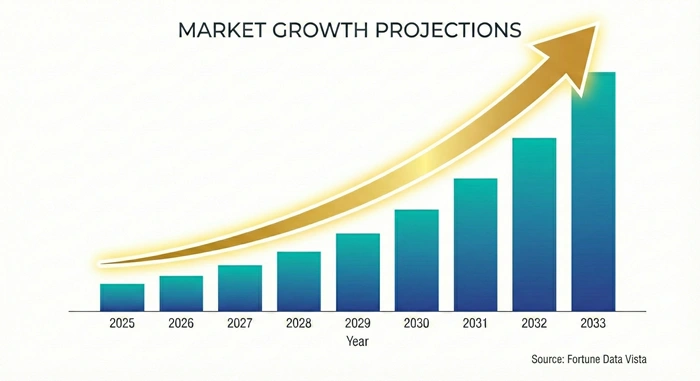
The global edge artificial intelligence chips market size is valued at USD 13.14 billion in 2025 and is predicted to increase from USD 15.63 billion in 2026 to approximately USD 29.52 billion by 2033, growing at a CAGR of 19.8% from 2026 to 2033.
This rapid expansion reflects the accelerating shift of AI computation from centralized cloud data centers to edge devices — where AI inference and increasingly AI training are being performed directly on smartphones, autonomous vehicles, industrial machines, surveillance cameras, wearables, and IoT sensors. As enterprises and consumers demand faster, more private, lower-latency AI experiences that do not depend on constant internet connectivity, the demand for purpose-built AI processing silicon optimized for power efficiency and edge deployment is growing at a pace that is generating one of the semiconductor industry's most dynamic and investment-intensive market opportunities.
AI Impact on the Edge Artificial Intelligence Chips Industry
The Rapid Proliferation of Generative AI Models, Large Language Model Deployment on Device, Transformer Architecture Optimization for Edge Silicon, and On-Device Machine Learning Frameworks Are Fundamentally Reshaping the Edge AI Chip Design Priorities and Market Demand Landscape*
Generative AI — the same category of technology that brought large language models, image generation systems, and multimodal AI assistants to widespread public awareness — is now flowing rapidly into edge silicon design priorities, fundamentally changing what chipmakers need their edge AI processors to do. Historically, edge AI chips were designed primarily for efficient inference of relatively compact convolutional neural networks used in image classification, object detection, and keyword spotting — tasks that were well-served by fixed-function neural processing units with relatively modest memory bandwidth. The emergence of compressed and quantized versions of large language models — including Meta's LLaMA family, Google's Gemma, Microsoft's Phi series, and Apple's On-Device Intelligence models — that are capable of running on smartphone and laptop silicon has dramatically raised the bar for edge AI chip compute density, memory bandwidth, and model memory capacity requirements. Qualcomm's Snapdragon 8 Elite, Apple's A18 Pro, MediaTek's Dimensity 9400, and Google's Tensor G4 are all explicitly designed around the requirement to run multiple-billion-parameter compressed language models efficiently on-device — representing a fundamental shift in edge AI chip design philosophy that is driving rapid generational performance scaling and creating a powerful competitive technology race among the world's leading mobile chip designers.
The impact of this generative AI transition on the broader edge artificial intelligence chips market extends well beyond mobile SoCs — with the transformer neural architecture's requirements for high-memory bandwidth, matrix multiplication acceleration, and flexible programmability driving a new generation of AI accelerator ASIC and FPGA designs for automotive, industrial, and smart infrastructure edge applications. Semiconductor companies including NVIDIA (Jetson series), Hailo Technologies, Kneron, Syntiant, and GreenWaves Technologies are developing edge AI accelerators explicitly designed for efficient transformer model inference at very low power envelopes — targeting the automotive, robotics, industrial vision, and smart sensor markets where cloud connectivity cannot be relied upon. The chip design ecosystem supporting edge AI deployment is also being transformed by the rapid maturation of AI compilation and model optimization toolchains — including NVIDIA TensorRT, Qualcomm's AI Model Efficiency Toolkit, and TensorFlow Lite — that automate the compression, quantization, and hardware-specific optimization of AI models for deployment on edge chips, dramatically reducing the engineering effort required to deploy sophisticated AI on constrained hardware.
Growth Factors
IoT Device Proliferation Demanding Local AI Processing, 5G Network Expansion Enabling Edge Intelligence Deployment, Autonomous Vehicle ADAS Adoption, Industrial Automation AI Integration, and Data Privacy Regulations Favoring On-Device Computation Are the Five Core Drivers of the Edge Artificial Intelligence Chips Market*
The most powerful structural demand driver in the edge artificial intelligence chips market is the explosive global proliferation of IoT-connected devices that require intelligent local data processing to deliver their core functionality — a growth wave driven by smart manufacturing, precision agriculture, smart cities, connected healthcare, and consumer electronics that is creating billions of new edge AI deployment opportunities every year. Unlike cloud-dependent AI applications, edge AI chips enable devices to process sensor data, detect anomalies, recognize patterns, and make decisions locally without sending data to remote servers — a capability that is essential in environments where network connectivity is unreliable, latency requirements are stringent, data privacy regulations prohibit cloud transmission of sensitive information, or the volume of raw sensor data is too large to economically transmit for remote processing. Industrial applications including predictive maintenance systems on factory equipment, quality inspection cameras in manufacturing lines, and autonomous mobile robots in warehouses are all powered by edge AI chips that run complex machine learning inference locally — and the global industrial automation investment wave is creating an enormous and rapidly growing demand for power-efficient, high-performance edge AI silicon in enterprise and industrial settings. The edge artificial intelligence chips market's growth in industrial applications is particularly strong in Asia Pacific and North America — where smart factory investment, logistics automation, and Industry 4.0 adoption are accelerating across automotive, electronics, and consumer goods manufacturing sectors.
Data privacy regulations — including GDPR in Europe, CCPA in California, and an expanding range of national AI regulation frameworks globally — are creating a compliance-driven demand pull for on-device AI processing that is a meaningful and growing structural driver for the edge artificial intelligence chips market. Organizations operating under these frameworks face increasing restrictions on transmitting personally identifiable information — including biometric data, location data, health data, and behavioral data — to cloud servers for AI processing, creating direct regulatory incentive to move AI computation onto local edge chips where data never leaves the device. Healthcare wearables that analyze continuous ECG, blood oxygen, and activity data; smart cameras that perform facial recognition or behavioral analysis; financial services devices that analyze transaction patterns for fraud detection — all of these applications benefit from regulatory compliance positioning that edge AI chip processing enables. NVIDIA, Qualcomm, Intel, and emerging edge AI ASIC specialists including Hailo and Kneron are all actively marketing this compliance advantage of edge AI processing to regulated industries — creating a differentiated demand driver for the edge artificial intelligence chips market that is growing as privacy regulations become more stringent and more globally widespread.
Market Outlook
North America's Technology Leadership and Dominant Private Sector AI Investment, Asia Pacific's Manufacturing Scale and Consumer Device Production, and Europe's Strong Industrial Automation and Privacy-Driven Edge AI Adoption Are Shaping the Global Edge Artificial Intelligence Chips Market Through 2033*
The long-term outlook for the edge artificial intelligence chips market is among the most positive in the entire semiconductor industry — driven by the irreversible architectural shift of AI workloads from cloud to edge, the accelerating integration of AI capabilities into every major consumer electronics product category, and the growing enterprise recognition that real-time on-device intelligence delivers operational and compliance benefits that cloud-dependent AI cannot match. North America leads the market with approximately 38.4% of global revenue in 2025, anchored by the U.S. technology ecosystem's world-leading concentration of AI chip design talent, fabless semiconductor companies, and AI software framework developers — including NVIDIA, Qualcomm, Intel, AMD, Apple, and Google — whose edge AI chip platforms power the majority of the world's AI-enabled smartphones, computers, automotive systems, and enterprise edge devices. U.S. federal government investment in AI research, the Defense Advanced Research Projects Agency's (DARPA) edge AI processor programs, and the CHIPS and Science Act's semiconductor manufacturing incentives are all strengthening the U.S. edge AI chip industry's global competitive position and expanding its addressable market by supporting both technology development and domestic manufacturing capability.
Asia Pacific is the fastest-growing regional market, projected to expand at a CAGR of approximately 21.5% from 2026 to 2033, driven by China's domestic AI chip industry development under its national semiconductor self-sufficiency strategy, the region's unmatched consumer electronics and smartphone manufacturing scale that creates an enormous demand base for mobile AI SoCs, South Korea and Taiwan's advanced semiconductor manufacturing capabilities through Samsung and TSMC that give Asian chip designers access to the most advanced process nodes available, and Japan's substantial robotics and industrial automation industry that is increasingly integrating edge AI capabilities. The global edge artificial intelligence chips market's growth trajectory is further reinforced by the automotive sector's commitment to ADAS and autonomous driving technology — which requires edge AI chips capable of processing camera, radar, and lidar sensor streams in real time — and by the consumer electronics industry's relentless integration of AI features that differentiate products and justify premium pricing in competitive markets.
Expert Speaks
-
"NVIDIA's edge AI platform — anchored by the Jetson family of computing modules — is enabling a generation of intelligent machines, autonomous robots, and smart infrastructure systems that would have been impossible just a few years ago. The edge artificial intelligence chips market is entering a new phase where the AI models being deployed on edge devices are approaching the sophistication of cloud AI systems — and our Jetson Orin platform is providing the compute density needed to run these complex models efficiently in power-constrained edge environments. NVIDIA is investing heavily in expanding the Jetson ecosystem of hardware, software, and developer tools because we believe that edge AI is one of the most important computing markets of the next decade — and that getting the platform right now will establish competitive advantages that compound as the market scales to billions of devices." — Jensen Huang, CEO, NVIDIA Corporation
-
"Qualcomm's Snapdragon platform has been at the forefront of edge AI for more than a decade — and with the Snapdragon 8 Elite generation, we are bringing on-device generative AI capabilities that would have required a data center server just three years ago to a device that fits in your pocket. The edge artificial intelligence chips market is growing because consumers and enterprise customers are discovering that on-device AI is simply a better user experience — faster, more private, always available, and increasingly more capable than cloud AI for the applications people use most. Qualcomm's investment in our Hexagon NPU architecture, our AI Model Efficiency Toolkit, and our ecosystem of AI application partnerships positions us to capture a leading share of the edge AI opportunity across mobile, automotive, industrial IoT, and PC computing." — Cristiano Amon, CEO, Qualcomm Technologies, Inc.
-
"Intel's approach to the edge AI opportunity is built on the belief that intelligence belongs at every point in the computing continuum — from data centers to edge servers to client devices — and that Intel's unique ability to provide AI silicon across all of these deployment environments gives us a competitive advantage that no pure-play edge AI company can match. The edge AI hardware market is growing strongly because enterprises are learning that processing AI workloads locally at the point of data generation delivers latency, cost, and privacy benefits that cloud-centric approaches cannot provide — and Intel's portfolio from Gaudi AI accelerators to Core Ultra NPUs to Movidius vision processing units positions us to serve this market across every deployment scenario. We are seeing particularly strong growth in industrial and smart city applications where our OpenVINO AI optimization toolkit is simplifying edge AI deployment across the heterogeneous mix of hardware that enterprise customers have deployed." — Pat Gelsinger (former CEO), Intel Corporation
Key Report Takeaways
-
North America is the dominant regional market in the edge artificial intelligence chips market with approximately 38.4% of global revenue in 2025, driven by the world-leading concentration of AI chip design companies including NVIDIA, Qualcomm, Intel, AMD, Apple, and Google that develop the majority of the global edge AI chip platforms used in smartphones, PCs, automotive systems, and enterprise edge devices, supported by robust U.S. government AI research investment, DARPA edge AI programs, and CHIPS Act semiconductor manufacturing incentives that are strengthening North America's global competitive position.
-
Asia Pacific is the fastest-growing regional market, projected to expand at a CAGR of approximately 21.5% from 2026 to 2033, driven by China's aggressive domestic AI chip development agenda under its national semiconductor self-sufficiency strategy — including companies such as Huawei HiSilicon, Cambricon Technologies, and Horizon Robotics — combined with the region's unmatched consumer electronics manufacturing scale, South Korea's Samsung Exynos platform, Taiwan's MediaTek edge AI SoCs, and Japan's expanding robotics and industrial automation AI chip demand base.
-
The inference segment dominates the edge artificial intelligence chips market by function, accounting for approximately 74.8% of global function segment revenue in 2025, as the overwhelming majority of edge AI deployments run pre-trained neural network models for real-time decision-making — including image recognition, object detection, natural language understanding, and anomaly detection — rather than performing the computationally intensive training phase, which remains largely cloud-based for the most complex models while increasingly moving to edge for model fine-tuning and personalization applications.
-
Consumer electronics is the dominant end user segment, contributing approximately 56.3% of global end user segment revenue in 2025, as billions of smartphones, smart TVs, wearables, tablets, and smart home devices now incorporate dedicated neural processing units that run AI features including photography enhancement, voice assistant recognition, facial authentication, real-time translation, health monitoring, and personalized recommendation — with Apple, Qualcomm, Samsung, and MediaTek collectively supplying the AI SoCs that power the world's largest consumer electronics AI compute installed base.
-
The Application-Specific Integrated Circuit (ASIC) segment is the fastest-growing chip type, projected to expand at a CAGR of approximately 23.8% from 2026 to 2033, as companies including Google (Tensor Processing Unit Edge), Amazon (Inferentia), Tesla (Full Self-Driving chip), and a growing number of edge AI ASIC startups develop fixed-function AI accelerators optimized for specific edge inference workloads — delivering 5–10x better power efficiency compared to general-purpose CPUs and GPUs for targeted applications in automotive, smart surveillance, and industrial AI.
-
Autonomous vehicles and ADAS is the fastest-growing application segment, projected to expand at a CAGR of approximately 25.2% from 2026 to 2033, as the mandatory integration of advanced driver assistance systems in new vehicles across the EU, U.S., China, and Japan, combined with the accelerating development of Level 3 and Level 4 autonomous driving capabilities by automotive OEMs and technology companies, is creating an enormous and rapidly expanding demand for high-performance, safety-certified edge AI chips capable of processing sensor fusion data in real time at the latency and reliability standards required for automotive safety applications.
Market Scope
| Parameter | Details |
|---|---|
| Market Size by 2033 | USD 29.52 Billion | Market Size by 2026 | USD 15.63 Billion | Market Size by 2025 | USD 13.14 Billion | Market Growth Rate from 2026 to 2033 | CAGR of 19.8% | Dominating Region | North America | Fastest Growing Region | Asia Pacific | Segments Covered | By Chip Type, By Function, By Device Type, By Processing Type, By Application, By End User | Regions Covered | North America, Europe, Asia Pacific, Latin America, Middle East & Africa |
Market Dynamics
Drivers Impact Analysis
IoT Device Proliferation, 5G Rollout Enabling Edge Intelligence, Autonomous Vehicle AI Demand, Data Privacy Regulatory Pressure Favoring On-Device Computation, and Power Efficiency Requirements Driving Dedicated AI Silicon Are the Five Core Demand Drivers*
| Driver | ≈ % Impact on CAGR Forecast | Geographic Relevance | Impact Timeline |
|---|---|---|---|
| IoT device proliferation demanding local AI processing | ~28% | Global | Short to Long Term |
| 5G network rollout enabling dense edge AI deployment | ~23% | Asia Pacific, North America, Europe | Short to Long Term |
| Autonomous vehicle ADAS and self-driving AI chip demand | ~22% | North America, Europe, Asia Pacific | Short to Long Term |
| Data privacy regulations driving on-device computation | ~17% | Europe, North America | Short to Long Term |
| Power efficiency requirements favoring dedicated AI silicon over GPUs | ~10% | Global | Short to Long Term |
The global rollout of 5G networks is one of the most powerful infrastructure enablers of the edge artificial intelligence chips market — creating the high-bandwidth, ultra-low-latency connectivity fabric that allows edge AI devices to function as distributed intelligence nodes in dense networked environments. 5G's combination of very high data throughput, sub-millisecond latency, and massive device density support enables new edge AI architectures where multiple AI chips embedded in infrastructure — smart cameras, IoT sensors, industrial controllers, and autonomous vehicles — can communicate and coordinate their intelligence in real time while processing the most computationally demanding tasks locally. The deployment of 5G edge computing infrastructure in manufacturing plants, smart cities, logistics hubs, and healthcare facilities is directly driving demand for the edge AI chips that power the intelligent devices and systems that 5G connectivity enables — creating a strong and accelerating growth tailwind for the edge artificial intelligence chips market that is expected to intensify as 5G deployment reaches its full global coverage across the forecast period.
The automotive sector's rapid adoption of advanced driver assistance systems and the longer-term development of autonomous vehicles represent one of the most commercially significant demand drivers for high-performance edge AI chips in the current decade. Modern ADAS systems including lane keeping assist, automatic emergency braking, adaptive cruise control, and traffic sign recognition require dedicated edge AI chips capable of processing multiple camera streams simultaneously in real time at the latency and functional safety standards required by automotive regulations including ISO 26262. The accelerating global regulatory mandate for ADAS features — with the EU requiring automated emergency braking and lane departure warning in all new passenger vehicles from 2024, and similar mandates in the U.S., China, and Japan — is creating a very large and highly predictable recurring demand stream for automotive-grade edge AI chips from companies including NVIDIA (Drive platform), Qualcomm (Snapdragon Ride), Mobileye (EyeQ), and NXP Semiconductors (S32 family) that are certified for safety-critical automotive AI applications and integrated into the production programs of automotive OEMs worldwide.
Restraints Impact Analysis
High Edge AI Chip Development Cost and Long Design Cycles, Advanced Node Manufacturing Constraints, Power and Thermal Management Challenges in Constrained Environments, and Fragmented Deployment Standards Are the Primary Barriers*
| Restraint | ≈ % Impact on CAGR Forecast | Geographic Relevance | Impact Timeline |
|---|---|---|---|
| High NRE cost and long design cycles for custom AI ASICs | ~35% | Global | Short to Long Term |
| Advanced process node supply constraints limiting production access | ~28% | Global | Short to Long Term |
| Power and thermal management challenges in edge-constrained devices | ~24% | Global | Short to Medium Term |
| Fragmented deployment standards complicating software optimization | ~13% | Global | Short to Medium Term |
The development cost and timeline for custom AI ASIC designs — which deliver the best performance-per-watt for specific edge AI workloads — represent a significant barrier to entry that limits the number of companies that can participate effectively in the edge artificial intelligence chips market. A full custom AI ASIC design using a 5nm or 3nm process node requires non-recurring engineering investments of USD 100–300 million and development timelines of three to five years from architecture definition to production silicon — a capital intensity that is accessible only to large technology corporations, well-funded fabless semiconductor companies, and handsomely financed startups. This high development cost means that smaller companies seeking to deploy custom AI chips for specific edge applications face economic barriers that push them toward higher-cost, lower-efficiency general-purpose processors or FPGA solutions — while larger players including Apple, Google, Qualcomm, and NVIDIA can amortize their ASIC development costs across hundreds of millions of devices, achieving cost competitiveness and performance advantages that are very difficult for smaller entrants to match.
Advanced semiconductor manufacturing capacity constraints — particularly at the leading-edge nodes (3nm and 5nm) where the most power-efficient AI chip designs are manufactured — represent a meaningful supply-side restraint on the edge artificial intelligence chips market's growth. Taiwan Semiconductor Manufacturing Company (TSMC) produces the majority of the world's leading-edge AI chips — including Apple's A-series, Qualcomm's Snapdragon, NVIDIA's Jetson, and AMD's Instinct chips — and TSMC's production capacity at 3nm and 5nm nodes, while expanding, remains constrained by the enormous capital investment required for advanced fab construction and the multi-year lead time of semiconductor equipment procurement. Geopolitical tensions between the United States and China over semiconductor technology access — including U.S. export controls on advanced chip manufacturing equipment to China and NVIDIA's restrictions on selling its most advanced AI chips to Chinese customers — are adding supply chain unpredictability and cost pressures to the edge artificial intelligence chips market that are constraining both supply availability and demand in specific geographic markets.
Opportunities Impact Analysis
Generative AI On-Device Deployment, Smart Manufacturing AI Integration, Emerging Market Consumer Electronics AI Adoption, and Next-Generation Automotive Autonomous Driving Are Creating Major Market Expansion Opportunities*
| Opportunity | ≈ % Impact on CAGR Forecast | Geographic Relevance | Impact Timeline |
|---|---|---|---|
| Generative AI and LLM deployment on edge devices driving NPU performance scaling | ~33% | North America, Asia Pacific, Europe | Short to Long Term |
| Smart manufacturing and Industry 4.0 AI integration | ~26% | Asia Pacific, Europe, North America | Short to Long Term |
| Emerging market smartphone and consumer device AI adoption | ~23% | Asia Pacific, Latin America, MEA | Short to Long Term |
| Advanced autonomous driving Level 3+ creating high-ASP AI chip demand | ~18% | North America, Europe, China | Medium to Long Term |
The deployment of generative AI and compressed large language models on edge devices represents the most transformative near-term opportunity in the edge artificial intelligence chips market — driving a step-change in NPU performance requirements that is forcing rapid generational upgrades of mobile SoCs, AI PCs, and smart device processors. Apple's on-device intelligence features built on the A18 Pro's neural engine, Qualcomm's Snapdragon 8 Elite running Meta's LLaMA model locally, and Microsoft's Copilot+ PC initiative requiring dedicated NPU performance in Windows laptops are creating an enormous wave of consumer and enterprise hardware refresh driven specifically by the need for more powerful edge AI chips capable of running generative AI models locally. The premium market value of these generative AI-capable edge devices — Apple iPhone 16 Pro, Qualcomm-powered Galaxy S25, and Copilot+ PCs — compared to prior-generation hardware represents a direct expansion of average selling price and market revenue that is one of the most important commercial drivers of the edge artificial intelligence chips market's accelerating growth through the 2026–2033 forecast period.
The global smart manufacturing and Industry 4.0 transformation — driven by labor cost pressures, supply chain resilience imperatives, quality improvement demands, and energy efficiency optimization goals — is creating an enormous new application domain for the edge artificial intelligence chips market that is growing rapidly and offers attractive long-term demand dynamics. Factory AI applications including visual quality inspection, predictive maintenance on rotating machinery, collaborative robot guidance, and real-time process optimization all require edge AI chips that can process complex sensor data locally at the production floor level — where cloud connectivity is impractical for sub-millisecond control loop requirements and where sensitive manufacturing process data cannot be transmitted outside the facility for competitive and regulatory reasons. Companies including NVIDIA (Jetson for industrial), Intel (OpenVINO on Movidius), and Hailo Technologies are actively developing edge AI chip platforms and software ecosystems specifically designed for industrial deployment — targeting the hundreds of billions of dollars of global smart manufacturing investment that is being made by automotive, electronics, pharmaceutical, food processing, and consumer goods manufacturers across Asia Pacific, North America, and Europe.
Segment Analysis
By Chip Type: System-on-Chip (SoC)
AI-Enabled SoCs Are the Backbone of the Consumer and Mobile Edge AI Compute Market, Integrating CPU, GPU, and NPU Cores on a Single Die to Deliver the Performance, Efficiency, and Cost Profile That Mass-Market Edge AI Devices Require*
System-on-Chip (SoC) is the dominant chip type in the edge artificial intelligence chips market, accounting for approximately 48.7% of global chip type segment revenue in 2025 and growing at a CAGR of approximately 18.9% from 2026 to 2033. The AI-enabled SoC's dominance reflects the smartphone market's position as the world's largest volume deployment environment for edge AI chips — where integrated SoC architectures from Qualcomm (Snapdragon), Apple (A and M series), Samsung (Exynos), and MediaTek (Dimensity) combine CPU, GPU, NPU, ISP, and modem functionality on a single chip to deliver the compute density, power efficiency, and bill-of-materials cost profile that smartphone OEMs require. Qualcomm's Snapdragon platform leads the Android smartphone AI SoC market, powering hundreds of millions of premium and mid-range Android devices annually with its Hexagon NPU architecture — while Apple's A-series chips power iOS devices and its M-series chips power Mac computers, collectively making Apple the world's highest-performance edge AI SoC producer by any measure of neural network inference benchmark. Asia Pacific dominates the SoC segment's production and a large portion of its consumption — with TSMC in Taiwan manufacturing the most advanced AI SoCs for Qualcomm, Apple, and MediaTek, and Samsung in South Korea producing its Exynos SoCs for Galaxy devices — while the world's largest volume consumer of AI SoCs is China's smartphone market, where Qualcomm and MediaTek chips power hundreds of millions of devices annually.
MediaTek's Dimensity 9400 SoC — featuring a dedicated AI processing engine with 50 TOPS (trillion operations per second) of NPU performance — represents the company's push into the premium AI SoC segment traditionally dominated by Apple and Qualcomm, targeting the growing number of Chinese and Taiwanese Android OEMs seeking premium AI SoC alternatives to Qualcomm's Snapdragon. The SoC segment's growth within the broader edge artificial intelligence chips market is accelerating because of the generative AI capability race among smartphone OEMs — with each new SoC generation needing to deliver significantly more NPU compute performance to run the latest compressed LLM and multimodal AI models locally. Google's Tensor G series SoCs — produced in partnership with Samsung and designed specifically for on-device AI features in Pixel smartphones — represent another important competitive dimension of the mobile AI SoC market, with Google's TPU-derived tensor processing architecture delivering strong performance on transformer-based AI workloads including natural language processing, speech recognition, and image analysis. The SoC segment is also expanding into automotive infotainment and ADAS applications — where Qualcomm's Snapdragon Ride and Ride Vision SoC platforms are replacing traditional multi-chip automotive electronics architectures with centralized AI SoC designs that reduce system cost, weight, and complexity while dramatically increasing AI processing capability.
By Application: Autonomous Vehicles and ADAS
Autonomous Vehicle and ADAS Applications Are the Fastest-Growing and Highest-Average-Selling-Price Segment in the Edge Artificial Intelligence Chips Market, Driven by Global Regulatory Mandates and OEM Investment in Next-Generation Vehicle Intelligence*
The autonomous vehicles and ADAS application segment is the fastest-growing in the edge artificial intelligence chips market, projected to expand at a CAGR of approximately 25.2% from 2026 to 2033, currently accounting for approximately 18.4% of global application segment revenue in 2025. Automotive AI chips are the highest-ASP (average selling price) category in the edge AI chip market — with advanced ADAS and autonomous driving AI compute platforms selling for USD 200–2000+ per vehicle depending on capability level — compared to mobile SoC prices of USD 20–100 per smartphone, creating an economics that makes automotive AI chips commercially very significant despite lower unit volumes than mobile. North America leads the automotive AI chip segment — anchored by NVIDIA's Drive platform that powers robotaxi and advanced ADAS programs at companies including Tesla (which uses its own in-house Full Self-Driving chip), Waymo, Cruise, and dozens of automotive OEMs implementing NVIDIA Drive Orin or Thor as their central ADAS computer — with North America accounting for approximately 41.6% of global automotive AI chip segment revenue in 2025. Key players including Mobileye, Qualcomm, NXP Semiconductors, Texas Instruments, and Renesas Electronics are all competing intensely for the automotive ADAS chip market — where design wins are measured in hundreds of millions of vehicle program commitments over multi-year production cycles.
Asia Pacific — particularly China, Japan, and South Korea — is the fastest-growing regional market for automotive edge AI chips, expanding at a CAGR of approximately 28.1% from 2026 to 2033, as Chinese automotive OEMs including BYD, Li Auto, Xpeng, and Nio integrate increasingly sophisticated AI-driven ADAS and driver assistance systems into their electric vehicle ranges in response to both domestic consumer demand for smart vehicle features and China's evolving ADAS regulatory requirements. China's domestic automotive AI chip sector is also developing — with companies including Horizon Robotics (whose Journey 5 chip is designed for L2+ ADAS applications), Black Sesame Technologies, and Cambricon Technologies developing automotive AI silicon specifically optimized for Chinese OEM programs — representing an important competitive dynamic within the global edge artificial intelligence chips market that reduces Chinese OEM dependence on NVIDIA, Qualcomm, and Mobileye chips as geopolitical supply chain risks increase. Japan's automotive sector — including Toyota, Honda, Denso, and Panasonic — is making substantial investments in ADAS AI chip integration across their global vehicle programs, while South Korea's Hyundai and Kia are deploying NVIDIA Drive and Mobileye EyeQ systems across their expanding global EV lineups that are competing aggressively in premium and mid-range markets worldwide.
Regional Insights
North America: The Dominant Region in the Edge Artificial Intelligence Chips Market
North America Leads the Global Edge Artificial Intelligence Chips Market Through Its World-Class AI Chip Design Ecosystem, Government-Backed Semiconductor Investment, and the Deepest Concentration of AI Application Development Driving End-Market Demand*
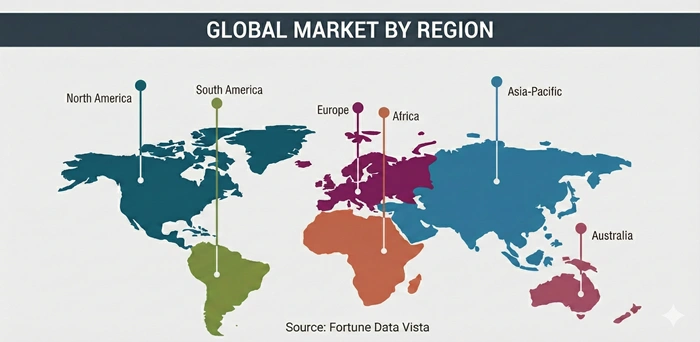
North America holds the dominant position in the global edge artificial intelligence chips market, accounting for approximately 38.4% of global revenue in 2025 and maintaining a CAGR of approximately 19.2% through 2033. The United States is the global center of edge AI chip design — home to NVIDIA (Jetson edge AI platform), Qualcomm (Snapdragon), Intel (Movidius, OpenVINO, Core Ultra NPU), AMD, Apple (A and M series), and Google (Edge TPU) — which collectively develop the chip platforms that power the majority of the world's edge AI-enabled devices across mobile, PC, automotive, and enterprise categories. The CHIPS and Science Act — which authorized USD 52 billion in U.S. semiconductor manufacturing and research investment — is strengthening North America's edge AI chip supply chain by incentivizing domestic fab construction at TSMC's Arizona facility, Intel's Ohio fabs, and Samsung's Texas plant.
U.S. defense and federal agency programs through DARPA, the Department of Defense, and IARPA represent a significant specialized demand segment within the North American edge AI chip market — funding development of ultra-low-power AI inference chips for autonomous drones, battlefield sensor systems, and intelligence analysis platforms that have very demanding size, weight, power, and cost constraints. The strong venture capital ecosystem in Silicon Valley, Austin, and Boston is supporting a growing cohort of edge AI chip startups — including Hailo Technologies' U.S. operations, Syntiant, Mythic AI, and Eta Compute — that are developing specialized low-power AI inference chips targeting IoT, wearables, and industrial sensor applications that the major semiconductor companies do not optimally serve with their mainstream platforms. North America's dominance in the edge artificial intelligence chips market is expected to be maintained through 2033, driven by continued investment in AI chip design innovation, the expansion of autonomous vehicle programs, and the growing corporate enterprise demand for on-device AI processing in cloud-independent edge computing architectures.
Asia Pacific: The Fastest-Growing Region in the Edge Artificial Intelligence Chips Market
Asia Pacific Is the World's Fastest-Growing Edge AI Chips Market, Powered by China's Domestic AI Chip Development Strategy, the Region's Unmatched Consumer Electronics Manufacturing Scale, and Rapidly Expanding Industrial Automation AI Adoption*
Asia Pacific is the fastest-growing regional market in the edge artificial intelligence chips market, projected to expand at a CAGR of approximately 21.5% from 2026 to 2033, and currently accounts for approximately 33.7% of global revenue in 2025. China is the dominant individual country market within the region — both as the world's largest consumer of edge AI chips through its smartphone, consumer electronics, surveillance infrastructure, and automotive markets, and as a rapidly developing producer of domestic edge AI chips through companies including Huawei HiSilicon (Kirin mobile SoCs), Cambricon Technologies (AI acceleration chips), Horizon Robotics (automotive AI), and Biren Technology (AI compute chips). China's national semiconductor self-sufficiency strategy is accelerating domestic edge AI chip development as U.S. export restrictions on advanced chip technology intensify — creating growing commercial opportunities for Chinese chip designers serving domestic OEM customers who previously sourced AI chips from Qualcomm, NVIDIA, and Intel.
Taiwan and South Korea are the two other major individual country markets within Asia Pacific's edge AI chip sector — with Taiwan home to MediaTek (the world's second-largest mobile SoC designer) and the headquarters of TSMC (the foundry that manufactures the most advanced edge AI chips globally for Apple, Qualcomm, NVIDIA, and AMD), and South Korea home to Samsung Electronics which both designs Exynos AI SoCs and operates advanced semiconductor fabs producing AI chips through its Samsung Foundry division. Japan's edge AI chip demand is driven by its world-class robotics industry, automotive electronics sector, and industrial automation market — with companies including Renesas Electronics, Sony Semiconductor (image sensors with embedded AI), and Panasonic developing AI chips for factory automation, automotive, and consumer applications that are integral to Asia Pacific's growing contribution to the global edge artificial intelligence chips market.
Top Key Players
-
NVIDIA Corporation (United States)
-
Qualcomm Technologies Inc. (United States)
-
Intel Corporation (United States)
-
Apple Inc. (United States)
-
Alphabet Inc. (Google) (United States)
-
Advanced Micro Devices Inc. (AMD) (United States)
-
Samsung Electronics Co. Ltd. (South Korea)
-
MediaTek Inc. (Taiwan)
-
Huawei Technologies Co. Ltd. (China)
-
Mobileye Global Inc. (Israel)
-
NXP Semiconductors N.V. (Netherlands)
-
Hailo Technologies Ltd. (Israel)
Recent Developments
-
In May 2025, NVIDIA announced a landmark agreement to supply 18000 Blackwell AI chips to Humain, a Saudi Arabian AI infrastructure company — a deal that underscores NVIDIA's global edge AI chip supply strategy and its commitment to expanding AI compute infrastructure across the Middle East, with the collaboration aimed at building a 500 MW AI data center and edge AI deployment network that will serve the Kingdom's Vision 2030 digital transformation agenda across both cloud and edge computing environments.
-
In January 2026, Intel officially launched its Core Ultra 200V series of AI PC processors equipped with Intel vPro enterprise capabilities — incorporating Intel's latest generation neural processing unit designed to deliver industry-leading AI PC performance for on-device generative AI workloads, with the launch targeting enterprise customers seeking to deploy Copilot+ AI features on corporate PCs while maintaining the manageability, security, and IT administration capabilities that enterprise IT departments require.
-
In March 2026, Qualcomm announced expanded automotive design wins for its Snapdragon Ride Elite autonomous driving platform — with multiple global automotive OEMs including leading European and Asian manufacturers confirming production program commitments that position Qualcomm's automotive AI chips for deployment in tens of millions of vehicles globally through the early 2030s, reinforcing Qualcomm's strategy to diversify its edge AI chip revenue beyond smartphones into the higher-ASP automotive intelligence segment.
-
In February 2026, Mobileye reported a significant expansion of its EyeQ6 ADAS chip design win pipeline — with automotive OEM commitments for EyeQ6 integration in new vehicle programs representing over 15 million units annually at full production volume, confirming Mobileye's continued dominant position in the automotive ADAS chip segment despite growing competition from NVIDIA, Qualcomm, and domestic Chinese ADAS chip developers targeting the Chinese automotive market.
-
In November 2025, MediaTek unveiled its Dimensity 9400 flagship mobile SoC — which includes a next-generation AI processing engine delivering 50 TOPS of neural processing performance — representing MediaTek's most aggressive competitive move into the premium AI smartphone market, targeting Android smartphone OEMs including Oppo, Vivo, Xiaomi, and Honor who are seeking a credible alternative to Qualcomm's Snapdragon 8 Elite for their flagship device programs.
Market Trends
The On-Device Generative AI Revolution and the Convergence of Edge AI With Next-Generation Automotive Intelligence Are the Two Defining Market Trends Reshaping the Competitive and Technical Landscape of the Edge Artificial Intelligence Chips Market*
The on-device generative AI revolution is the most commercially consequential near-term trend in the edge artificial intelligence chips market — transforming what edge AI chips need to do and who is buying the most capable ones. Three years ago, the most demanding edge AI use case was real-time object detection on a smartphone camera — now it is running a billions-parameter multimodal large language model locally on a smartphone, tablet, or laptop with response times indistinguishable from cloud AI. This performance demand shift is driving the fastest generational improvement in neural processing unit performance in the chip industry's history — with leading mobile SoC NPU performance roughly doubling with each annual product generation — and creating a hardware refresh cycle that is pulling tens of millions of consumers and enterprises to upgrade their AI-capable devices years ahead of their normal replacement cycle. The trend is highly beneficial to every company in the mobile SoC supply chain — from TSMC whose advanced nodes are required for competitive NPU silicon, to Qualcomm and Apple whose premium AI SoCs command higher prices, to memory suppliers whose high-bandwidth LPDDR5X DRAM is required for efficient large model inference.
The second defining trend is the convergence of edge AI chip technology with the automotive industry's ambitious transition toward fully autonomous and semi-autonomous vehicles — a convergence that is reshaping both the technical requirements and the competitive dynamics of the automotive AI chip segment within the edge artificial intelligence chips market. Automotive-grade AI chips are becoming the highest-performance, highest-complexity, and highest-value semiconductor products in the edge AI market — with NVIDIA's Drive Thor platform targeting 2000 TOPS of AI performance to support Level 3+ autonomous driving, and with automotive OEMs committing billions of dollars to multi-year supply agreements for AI chip platforms that will define the intelligence architecture of their vehicle lineups through the 2030s. The automotive AI chip market's transition from discrete ADAS chips to centralized high-performance AI compute platforms — following the architectural model pioneered by Tesla's Full Self-Driving computer and NVIDIA's Drive Orin — is creating enormous revenue concentration in high-ASP platforms that are reshaping the competitive landscape of both the automotive semiconductor market and the broader edge artificial intelligence chips market simultaneously.
Segments Covered in the Report
-
By Chip Type:
-
Central Processing Units (CPUs)
-
General Purpose CPUs
-
Mobile CPUs
-
Embedded CPUs
-
-
Graphics Processing Units (GPUs)
-
Discrete GPUs
-
Integrated GPUs
-
-
Application-Specific Integrated Circuits (ASICs)
-
Fixed Function ASICs
-
Programmable ASICs
-
-
Field Programmable Gate Arrays (FPGAs)
-
High-End FPGAs
-
Mid-Range FPGAs
-
Low-Power FPGAs
-
-
Neural Processing Units (NPUs)
-
Standalone NPUs
-
Integrated NPUs
-
-
System-on-Chip (SoC)
-
AI-Enabled SoCs
-
Multi-Core SoCs
-
-
Other Chip Types
-
-
By Function:
-
Training
-
Inference
-
-
By Device Type:
-
Consumer Devices
-
Smartphones
-
Smart Wearables
-
Smart Home Devices
-
Tablets
-
-
Enterprise Devices
-
Industrial Robots
-
Smart Surveillance Cameras
-
Edge Servers
-
Smart Medical Devices
-
Drones
-
-
Automotive Devices
-
Advanced Driver-Assistance Systems (ADAS)
-
In-Vehicle Infotainment
-
Autonomous Vehicle ECUs
-
-
-
By Processing Type:
-
On-Device Processing
-
Hybrid Edge-Cloud Processing
-
-
By Application:
-
Autonomous Vehicles & ADAS
-
Smart Surveillance & Security
-
Smart Retail
-
Industrial Automation & Robotics
-
Smart Healthcare
-
Natural Language Processing
-
Image & Video Recognition
-
Predictive Maintenance
-
Other Applications
-
-
By End User:
-
Automotive
-
Consumer Electronics
-
Healthcare
-
Retail
-
Manufacturing & Industrial
-
Telecommunications
-
Government & Defense
-
Other End Users
-
-
By Region:
-
North America (U.S., Canada, Mexico)
-
Europe (Germany, UK, France, Netherlands, Sweden, Rest of Europe)
-
Asia Pacific (China, Japan, South Korea, Taiwan, India, Australia, Rest of Asia Pacific)
-
Latin America (Brazil, Argentina, Rest of Latin America)
-
Middle East & Africa (UAE, Saudi Arabia, Rest of MEA)
-
"Built for Every Level — From Startups to Industry Giants"
Here Is Exactly How This Report Works for You
-
For Tier 1 global semiconductor corporations, Fortune 500 technology companies designing custom AI silicon, major automotive OEMs evaluating ADAS chip platform partnerships, institutional investors in semiconductor and AI hardware equities, and sovereign technology funds building strategic AI infrastructure positions, this report delivers comprehensive competitive revenue analysis by chip type, application, device category, and geography — with deep intelligence on how critical geopolitical factors including U.S.-China semiconductor export controls, TSMC advanced node access restrictions, and the Huawei HiSilicon competitive re-emergence in Chinese markets are directly reshaping supply chain strategies, design win dynamics, and market share trajectories across the global edge artificial intelligence chips market, providing the strategic intelligence needed for confident decisions on platform partnerships, M&A targeting, manufacturing investment, and geographic market entry priorities through 2033.
-
For Tier 2 and Tier 3 specialized edge AI chip designers, embedded AI software companies, edge computing platform developers, industrial automation system integrators, and smart device manufacturers, this report provides granular demand forecasts by application and end user vertical, competitive supplier landscape mapping, technology readiness assessment for emerging chip architectures including neuromorphic and in-memory computing, and supply-demand balance analysis across key node technologies — enabling precise investment and partnership decisions that capture the fastest-growing segments of the edge artificial intelligence chips market before competitors establish dominant positions in these high-growth application domains.
-
For edge AI chip startups developing differentiated architectures for IoT, wearables, and industrial sensing, early-stage investors evaluating the edge AI hardware opportunity, fabless semiconductor company founders assessing market entry vectors, and government program managers designing edge AI chip research incentives, this report delivers actionable competitive white space analysis identifying the application segments, geographic markets, and technology architecture approaches where innovative entrants can build fundable, defensible positions alongside established giants; detailed profiling of how leading private edge AI chip companies including Hailo, Syntiant, and Mythic have built their technology differentiation and customer acquisition strategies; regulatory landscape mapping for automotive safety certification and IoT device standards across key global markets; and forward-looking scenario analysis of how the generative AI on-device transition will reshape the competitive hierarchy and investment dynamics of the global edge artificial intelligence chips market through the 2033 forecast period.
Frequently Asked Questions:
Answer: The global edge artificial intelligence chips market is valued at USD 13.14 billion in 2025 and is projected to reach USD 29.52 billion by 2033, growing at a CAGR of 19.8% from 2026 to 2033. This robust growth is driven by the proliferation of AI-enabled consumer devices, rising demand for real-time on-device AI processing, automotive ADAS adoption, and data privacy regulations favoring local computation.
Answer: The edge artificial intelligence chips market is served by SoCs, CPUs, GPUs, ASICs, FPGAs, and dedicated Neural Processing Units — with AI-enabled SoCs dominating at approximately 48.7% of chip type segment revenue in 2025, as they integrate all required compute functions on a single die for mobile and consumer devices. The ASIC segment is growing fastest at approximately 23.8% CAGR, driven by demand for power-efficient fixed-function AI accelerators in automotive and industrial edge applications.
Answer: The edge artificial intelligence chips market is led by NVIDIA, Qualcomm, Intel, Apple, Google, AMD, Samsung, MediaTek, Huawei HiSilicon, Mobileye, and NXP Semiconductors — which collectively develop the majority of AI chip platforms used across mobile, automotive, industrial, and enterprise edge applications. Specialized ASIC companies including Hailo Technologies, Syntiant, and Kneron are growing rapidly in targeted edge AI chip segments.
Answer: The automotive adoption of edge artificial intelligence chips is primarily driven by global regulatory mandates requiring ADAS features including automatic emergency braking and lane keeping assist in new vehicles, combined with automotive OEM investment in Level 3 and Level 4 autonomous driving capabilities. The automotive AI chip segment is growing at approximately 25.2% CAGR from 2026 to 2033 — the fastest of any application segment — with NVIDIA, Qualcomm, and Mobileye leading the competitive landscape.
Answer: North America dominates the edge artificial intelligence chips market with approximately 38.4% of global revenue in 2025, driven by the world-leading concentration of AI chip design companies including NVIDIA, Qualcomm, Intel, Apple, AMD, and Google — which develop the platforms used in the majority of global AI-enabled devices. Asia Pacific is the fastest-growing region at approximately 21.5% CAGR, driven by China's domestic chip development strategy, the region's smartphone manufacturing scale, and rapidly expanding industrial AI adoption.