
Electrical Enclosure Market Overview
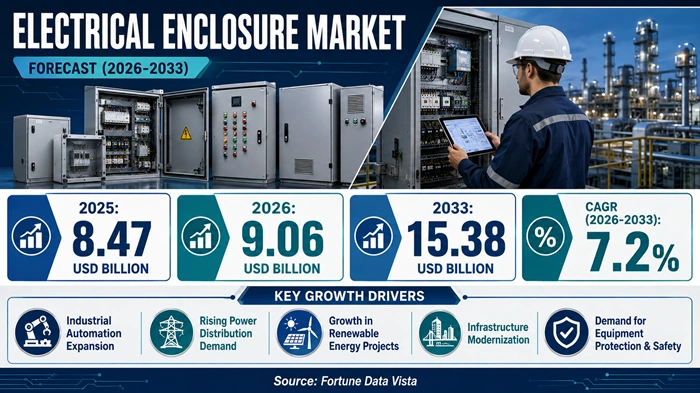
The global electrical enclosure market size is valued at USD 8.47 billion in 2025 and is predicted to increase from USD 9.06 billion in 2026 to approximately USD 15.38 billion by 2033, growing at a CAGR of 7.2% from 2026 to 2033.
The market is gaining strong momentum due to rapid industrialization, expanding power infrastructure, and the growing need to protect sensitive electrical components from environmental hazards. Industrial sectors across the globe are investing heavily in smart manufacturing, renewable energy integration, and digital grid technologies, all of which rely on durable and standards-compliant enclosure solutions. With governments enforcing stricter electrical safety regulations and industries shifting toward automation, the demand for reliable housing for electrical systems continues to rise consistently.
AI Impact on the Electrical Enclosure Industry
Artificial Intelligence Is Quietly Transforming How Electrical Enclosures Are Designed, Monitored, and Maintained Across Industrial Sectors Worldwide
Artificial intelligence is no longer just a buzzword in the technology world — it is actively reshaping how manufacturers and end-users approach electrical enclosure design and management. AI-powered systems are now being embedded into enclosure monitoring solutions that can detect real-time anomalies such as temperature spikes, moisture intrusion, and vibration-related stress. These capabilities allow facility managers to act on predictive alerts before minor issues turn into costly failures, significantly improving system uptime and overall safety performance. As the electrical enclosure market continues to evolve, AI-driven design optimization tools are also helping engineers reduce material waste, improve airflow calculations, and comply with international protection ratings more efficiently.
Beyond maintenance, AI is contributing to supply chain intelligence in the enclosures industry. Manufacturers are using machine learning algorithms to forecast demand patterns, optimize inventory levels, and reduce production lead times. Smart factories building the next generation of enclosures are integrating AI into quality control processes, using computer vision to detect micro-defects during fabrication. This shift is not only improving product quality but also reducing costs, making AI a key growth enabler for both established players and new entrants in the global electrical enclosure market.
Growth Factors
Strong Industrial Demand, Infrastructure Modernization, and the Rise of Renewable Energy Are the Core Forces Propelling the Electrical Enclosure Market Forward
The global push toward industrial automation is one of the most powerful drivers behind the sustained growth of this market. Factories implementing Industry 4.0 solutions require a dense network of protected electrical systems — from programmable logic controllers (PLCs) to variable frequency drives (VFDs) — and each of these components demands a certified enclosure to ensure operational safety. The growing deployment of smart grid infrastructure across North America, Europe, and Asia Pacific is equally important, as grid modernization mandates the use of outdoor and indoor enclosures capable of withstanding extreme weather, humidity, and electromagnetic interference. The electrical enclosure market is, therefore, directly tied to the pace of energy sector investment and industrial upgrades globally.
Simultaneously, the rapid expansion of renewable energy installations is generating a substantial wave of new demand. Solar farms, wind energy sites, and battery storage systems require specialized electrical enclosures that can handle outdoor environments and extreme temperatures. Data centers — which are being built at record pace across North America and Asia Pacific — rely on large-scale floor-mounted enclosures to organize and protect server room electrical infrastructure. Beyond these sectors, the rise of electric vehicle (EV) charging networks is creating a new niche for weatherproof, tamper-resistant enclosures. This multi-sector demand base gives the market resilience and a strong long-term growth trajectory through 2033.
Market Outlook
From Smart Enclosures to Corrosion-Resistant Materials, the Electrical Enclosure Market Is Undergoing a Fundamental Product Transformation Driven by Technology and Sustainability
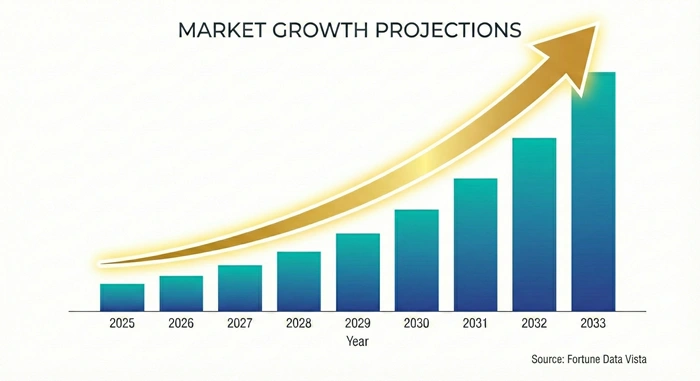
Looking ahead, the global electrical enclosure market is positioned for sustained expansion through 2033. The increasing adoption of IoT-enabled enclosures is a defining trend — these solutions not only protect electrical components but also communicate operational status through sensors and wireless interfaces, enabling remote diagnostics. Product developers are shifting toward modular enclosure systems that can be customized rapidly across industries, reducing project timelines and installation costs. The market is also witnessing a notable transition from traditional steel enclosures to advanced materials such as polycarbonate, fiberglass, and GRP (glass-reinforced polyester), especially in chemical and marine applications where corrosion resistance is a priority.
From a competitive standpoint, the market landscape is becoming more dynamic as global players ramp up R&D investments and explore new geographic markets. Emerging economies in Southeast Asia, Latin America, and the Middle East are building out power and industrial infrastructure at scale, creating significant opportunities for enclosure manufacturers. Meanwhile, developed markets in North America and Europe are generating replacement demand as aging electrical infrastructure is upgraded to meet modern safety and efficiency standards. The combination of new-build demand in emerging markets and retrofit demand in mature economies gives the electrical enclosure market a well-rounded and durable growth outlook.
Expert Speaks
-
"The digitalization of industrial infrastructure is accelerating at a pace we have not seen before, and smart enclosure solutions that can integrate with IIoT ecosystems are becoming central to our customers' operations," — Gerd Kerkhoff, Industry Leader, Siemens AG.
-
"Sustainable manufacturing and energy-efficient product design are no longer optional — they are business imperatives. We are committed to developing enclosure solutions that support our customers' decarbonization goals while meeting the strictest protection standards," — Jean-Pascal Tricoire, Former CEO, Schneider Electric.
-
"The electrical protection market is evolving beyond passive hardware. Our focus is on delivering intelligent, connected systems that help industrial customers reduce downtime, improve safety, and achieve full visibility over their electrical infrastructure," — Craig Arnold, CEO, Eaton Corporation.
Key Report Takeaways
-
Asia Pacific leads the global electrical enclosure market, driven by aggressive infrastructure investment, rapid industrialization, and grid expansion projects in China, Japan, India, and South Korea, collectively accounting for the largest regional market share of approximately 38–40% during the forecast period.
-
North America is the fastest-growing regional market, propelled by smart grid modernization, EV charging infrastructure rollouts, and booming data center construction, with the region projected to grow at a CAGR exceeding 7.5% from 2026 to 2033.
-
Large industrial and utility end-users are the most significant consumers of electrical enclosures, particularly in power generation, transmission and distribution, and oil & gas sectors, where safety compliance and asset protection are non-negotiable requirements.
-
The power generation and distribution application segment contributes the most to overall market revenue, benefiting from continuous global investment in grid infrastructure upgrades and renewable energy integration.
-
Metallic enclosures — particularly steel and aluminum variants — remain the most widely used product type, dominating with roughly 60%+ market share due to their superior mechanical strength, long service life, and broad applicability across industrial environments.
-
The non-metallic enclosure segment is expected to grow the fastest, with a projected CAGR of approximately 8.5% from 2026 to 2033, as industries in chemicals, food processing, and marine applications increasingly favor polycarbonate and fiberglass materials for their corrosion resistance and lighter weight.
Market Scope
| Parameter | Details |
|---|---|
| Market Size by 2033 | USD 15.38 Billion | Market Size by 2026 | USD 9.06 Billion | Market Size by 2025 | USD 8.47 Billion | Market Growth Rate from 2026 to 2033 | CAGR of 7.2% | Dominating Region | Asia Pacific | Fastest Growing Region | North America | Segments Covered | Material Type, Mounting Type, Form Factor, Type, Product Type, End-User | Regions Covered | North America, Europe, Asia Pacific, Latin America, Middle East & Africa |
Market Dynamics
Drivers Impact Analysis
Industrial Automation, Renewable Energy Expansion, and Mandatory Safety Regulations Are Creating a Powerful and Diversified Set of Demand Drivers for the Electrical Enclosure Market
| Driver | ≈ % Impact on CAGR Forecast | Geographic Relevance | Impact Timeline |
|---|---|---|---|
| Rising industrial automation and Industry 4.0 adoption | ~30% | Global, High in Asia Pacific & North America | Near to Long-Term (2026–2033) |
| Renewable energy infrastructure expansion | ~25% | Global, Strongest in Asia Pacific & Europe | Medium to Long-Term (2027–2033) |
| Smart grid upgrades and T&D investment | ~20% | North America, Europe, Asia Pacific | Near to Medium-Term (2026–2029) |
| Stringent electrical safety regulations | ~15% | Global, Strong in Europe & North America | Ongoing |
| Data center and EV charging infrastructure | ~10% | North America, Asia Pacific | Near to Medium-Term (2026–2030) |
The surge in industrial automation is the single most significant force shaping the trajectory of the electrical enclosure market. As manufacturers across sectors — from automotive to pharmaceuticals — integrate robotics, servo systems, and automated control panels, the number of electrical components requiring protection multiplies exponentially. Each PLC cabinet, motor control center, and drive panel needs a certified enclosure, meaning the electrical enclosure market grows in direct proportion to the breadth of automation investments. Countries like China, Germany, and the United States are at the forefront of this shift, collectively driving billions of dollars in enclosure procurement annually.
Renewable energy is the second major pillar of growth. Utility-scale solar and wind installations require large outdoor enclosures that can resist UV exposure, temperature extremes, and moisture — all while maintaining NEMA and IP protection ratings. Governments in the EU, India, China, and the US have committed to ambitious clean energy targets through 2030 and beyond, ensuring a steady pipeline of renewable projects that will continuously generate demand for industrial enclosures. Energy storage systems (ESS), which are rapidly scaling up to support grid balancing, represent a particularly promising niche for specialized battery enclosure designs.
Restraints Impact Analysis
High Customization Costs, Raw Material Price Volatility, and Regulatory Compliance Burdens Represent the Key Factors That Could Constrain the Electrical Enclosure Market's Growth Pace
| Restraint | ≈ % Impact on CAGR Forecast | Geographic Relevance | Impact Timeline |
|---|---|---|---|
| High cost of custom enclosure solutions | ~35% | Global | Near to Medium-Term |
| Fluctuating steel and aluminum raw material prices | ~30% | Global | Ongoing |
| Complex and evolving compliance standards | ~20% | Europe, North America | Ongoing |
| Competition from low-cost regional manufacturers | ~15% | Asia Pacific, Latin America | Medium-Term |
One of the most persistent challenges in the electrical enclosure market is the high cost associated with custom and specialized enclosure designs. While standard enclosures serve well for general applications, industries such as oil & gas, hazardous environments, and pharmaceuticals require explosion-proof or highly corrosion-resistant designs that demand premium materials and specialized manufacturing processes. This price barrier can deter smaller manufacturers and mid-sized companies from upgrading to better solutions, particularly in price-sensitive markets. The challenge is compounded by the lengthy certification processes that custom products must undergo before reaching the market.
Raw material price volatility is another real and persistent concern. Steel, aluminum, and specialty polymers used in enclosure manufacturing are subject to global commodity market fluctuations, geopolitical supply disruptions, and energy cost shifts. When input costs rise unpredictably, manufacturers find it difficult to maintain stable pricing, which can disrupt long-term procurement agreements with industrial buyers. For smaller enclosure producers operating on thin margins, raw material shocks can have an outsized impact on profitability, potentially leading to market consolidation as larger players absorb smaller ones.
Opportunities Impact Analysis
Emerging Market Industrialization, Smart Enclosure Innovation, and the EV Revolution Are Opening New High-Value Opportunities for Electrical Enclosure Market Participants
| Opportunity | ≈ % Impact on CAGR Forecast | Geographic Relevance | Impact Timeline |
|---|---|---|---|
| IoT-integrated smart enclosure development | ~35% | Global | Medium to Long-Term |
| Infrastructure buildout in developing economies | ~30% | Asia Pacific, MEA, Latin America | Near to Long-Term |
| EV charging station network expansion | ~20% | North America, Europe, Asia Pacific | Near to Medium-Term |
| Modular and lightweight enclosure design | ~15% | Global | Medium-Term |
The rapid growth of IoT and connectivity is creating an entirely new product category within the electrical enclosure market — intelligent enclosures embedded with environmental sensors, remote access modules, and real-time monitoring capabilities. These smart enclosures are no longer just passive hardware; they are active components in a plant's digital infrastructure. Major players are investing in R&D to develop enclosures that can report temperature, humidity, and door-open events directly to a central management system, enabling proactive maintenance strategies. This product evolution opens premium pricing opportunities and deeper partnerships with automation software vendors.
Emerging economies represent another massive opportunity layer. Countries across Southeast Asia, sub-Saharan Africa, and Latin America are building new industrial corridors, upgrading power grids, and constructing commercial real estate at significant scale. Each of these infrastructure projects demands reliable electrical protection solutions. Unlike mature markets where the focus is on replacement or upgrades, these regions represent greenfield demand — larger orders, faster growth, and longer product lifecycles. Companies that establish regional partnerships, offer localized support, and adapt their product portfolios to local environmental and regulatory conditions will be well-positioned to capture this wave of growth.
Segment Analysis
By Material Type
Metallic Enclosures Maintain Dominant Market Leadership While Non-Metallic Solutions Emerge as the Fastest-Growing Segment Across Corrosion-Sensitive Industries
The metallic enclosure segment continues to hold the dominant position in the global electrical enclosure market, commanding approximately 62% market share as of 2025. Stainless steel and aluminum remain the preferred construction materials for heavy industrial applications where mechanical robustness, fire resistance, and long-term durability are non-negotiable. The segment benefits from widespread adoption across power generation plants, oil & gas facilities, transportation infrastructure, and data centers — all of which operate under demanding environmental conditions that standard plastics simply cannot endure. Asia Pacific accounts for the largest share of metallic enclosure consumption, driven by China's massive manufacturing base and Japan's precision-driven industrial sector. Companies like Rittal GmbH, Schneider Electric, and ABB Ltd. are the dominant suppliers in this space, continuously introducing powder-coated and galvanized steel variants that extend product life in corrosive environments. The metallic segment is projected to grow at a steady CAGR of approximately 6.4% from 2026 to 2033, supported by ongoing investments in energy infrastructure worldwide.
The non-metallic enclosure segment is where the most dynamic growth is occurring in the current phase of the electrical enclosure market. Made primarily from polycarbonate, fiberglass, and GRP materials, non-metallic enclosures are gaining traction in the chemical processing, food and beverage, marine, and water treatment sectors due to their excellent corrosion resistance, lighter weight, and lower total cost of ownership. This segment is expected to grow at the highest CAGR of approximately 8.5% from 2026 to 2033, with particularly strong momentum in Europe and North America where chemical and food processing industries are actively transitioning away from steel to avoid rust and contamination risks. Manufacturers such as Fibox Oy Ab and Allied Moulded Products are leading innovators in this space, introducing new formulations that meet UL, NEMA, and IEC certification standards. The combination of performance benefits and cost efficiency is making non-metallic enclosures an increasingly attractive choice for system integrators and OEMs globally.
By Mounting Type
Wall-Mounted Enclosures Lead the Global Market While Free-Standing Enclosures Are Essential for High-Density Industrial and Commercial Electrical Panel Applications
The wall-mounted enclosure segment currently dominates the mounting type category, accounting for the highest market revenue share in the global electrical enclosure market. These enclosures are favored for their compact footprint, easy installation on vertical surfaces, and suitability for applications where floor space is limited — including commercial buildings, control rooms, HVAC systems, and telecom facilities. The demand for wall-mounted solutions is especially strong in the Asia Pacific region, where rapid urbanization and commercial construction are driving consistent procurement volumes. Key companies such as Schneider Electric, Legrand SA, and Eaton Corporation have extensive product lines catering to this segment across both standard and weatherproof variants. The wall-mounted segment holds approximately 45% of the mounting type market and is growing at a CAGR of around 6.8% from 2026 to 2033.
The free-standing or floor-mounted enclosure segment plays a critical role in large-scale industrial and utility applications. These enclosures are deployed in motor control centers (MCCs), main distribution panels, industrial switchgear assemblies, and large-scale automation cabinets where a single system must house multiple electrical components. The segment is particularly prominent in North America and Europe, where heavy industrial facilities and process plants require high-density electrical panel configurations. The free-standing segment is growing steadily as industrial capital expenditure rises globally, with ABB, Rittal, and Siemens among the key suppliers offering modular, multi-bay configurations suited to complex installations. This segment is expected to maintain strong demand through 2033, supported by the expansion of smart manufacturing facilities and energy storage installations worldwide.
Regional Insights
Asia Pacific
Asia Pacific Remains the Unchallenged Leader in the Global Electrical Enclosure Market, Fueled by Industrial Scale, Infrastructure Investment, and Government-Backed Energy Modernization
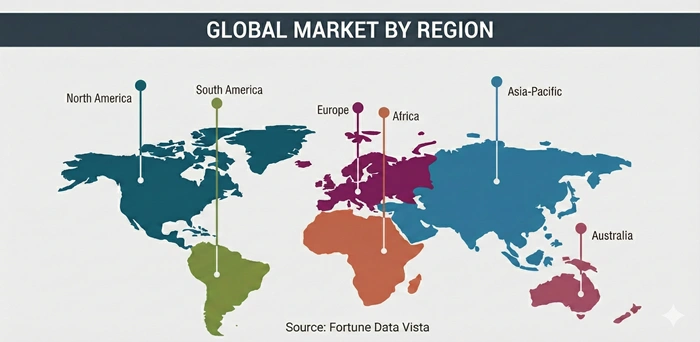
Asia Pacific holds the largest share of the global electrical enclosure market, accounting for approximately 38–40% of global revenue in 2025, and the region is expected to maintain this leadership position through 2033 with a CAGR of approximately 7.0%. The region's dominance is rooted in the sheer scale of industrial activity in China, Japan, India, and South Korea. China alone accounts for a significant portion of global enclosure manufacturing and consumption, driven by its vast electronics, heavy machinery, and power infrastructure sectors. The Chinese government's ongoing investment in ultra-high-voltage transmission networks and its push for domestic renewable energy capacity are generating sustained procurement volumes. Key players active across Asia Pacific include Rittal GmbH (Germany), ABB Ltd. (Switzerland), Siemens AG (Germany), and regional manufacturers such as BCH Electric Ltd. in India, who are scaling production to meet growing local and export demand.
Japan and South Korea contribute strongly to the region's premium segment, with manufacturers in these countries prioritizing precision engineering, corrosion resistance, and smart monitoring features in their enclosure products. India is rapidly emerging as a high-growth market within Asia Pacific, driven by the government's focus on power sector modernization, the National Infrastructure Pipeline, and rising data center construction in cities like Mumbai and Hyderabad. The Asia Pacific electrical enclosure market is also benefiting from foreign direct investment in the region's manufacturing sector, with multinational companies establishing production bases and requiring locally compliant enclosure solutions. The combination of scale, government policy support, and growing industrial sophistication positions Asia Pacific as the long-term engine of the global market.
North America
North America Is the Fastest-Growing Region in the Electrical Enclosure Market, Driven by Smart Grid Investment, Data Center Proliferation, and the EV Charging Infrastructure Boom
North America is the fastest-growing region in the global electrical enclosure market, projected to register a CAGR of approximately 7.5–8% from 2026 to 2033, driven by a convergence of infrastructure modernization, digital transformation, and energy transition investments. The United States is the dominant market within the region, fueled by the ongoing upgrade of aging electrical grid infrastructure, large-scale investment in renewable energy, and the rapid build-out of hyperscale data centers. The U.S. Inflation Reduction Act and associated federal incentives for clean energy are channeling billions of dollars into solar, wind, and battery storage projects — each requiring specialized outdoor and industrial enclosures. Leading companies with strong North American presence include nVent HOFFMAN (U.S.), Eaton Corporation (Ireland/U.S.), Hubbell Incorporated (U.S.), and Schneider Electric (France). The electrical enclosure market in North America benefits from high standards compliance requirements, creating a premium pricing environment that rewards product quality and certification. Canada is contributing meaningfully through its mining, oil sands, and utility sectors, while Mexico's growing manufacturing industry — particularly in automotive and electronics — is generating consistent demand for enclosure solutions aligned with NEMA standards. North America's market is expected to surpass USD 3.2 billion by 2033, making it the most valuable single-region growth opportunity of the forecast period.
Report Customization: Regional and Country-Level Insights
Tailored Market Intelligence Is Available for Every Region and Country Covered in This Study, Enabling Businesses to Make Precision Decisions Based on Local Market Realities
This report is available with full regional and country-level customization to help businesses, investors, and decision-makers access the specific geographic insights most relevant to their strategic objectives. Whether you are evaluating a market entry into Southeast Asia or benchmarking competitive dynamics in Western Europe, our analysts can deliver bespoke data and analysis tailored precisely to your target geography and the electrical enclosure market combination.
Customized reports are available for the following regions and countries, each offering detailed market analysis, growth trends, segment breakdowns, competitive landscapes, and unique opportunities:
North America
-
U.S. — Detailed enclosure market breakdown by NEMA ratings, end-user verticals, and competitive landscape including nVent, Eaton, and Hubbell
-
Canada — Insights into oil & gas, mining, and utility-driven enclosure demand
-
Mexico — Analysis of manufacturing-sector adoption across automotive and electronics industries
Europe
-
U.K. — Focus on renewable energy, data centers, and EV infrastructure enclosure demand
-
Germany — Industrial automation and precision engineering sector-specific analysis
-
France — Utility, transportation, and smart city-driven enclosure insights
-
Italy — Manufacturing and food processing sector demand patterns
-
Rest of Europe — Coverage of Nordic, Eastern European, and Benelux enclosure markets
Asia Pacific
-
China — In-depth analysis of manufacturing, grid infrastructure, and domestic brand landscape
-
India — Government initiative-driven demand, infrastructure pipeline, and renewable energy analysis
-
Japan — Precision industry, aging infrastructure replacement, and EV-related enclosure demand
-
South Korea — Electronics, semiconductor, and smart factory enclosure analysis
-
Australia — Mining, utilities, and energy transition sector analysis
-
Rest of Asia Pacific — Southeast Asia, Taiwan, and emerging market breakdowns
Latin America
-
Brazil — Industrial, energy, and agricultural sector enclosure demand analysis
-
Argentina — Infrastructure investment and emerging automation sector insights
-
Rest of Latin America — Regional competitive landscape and growth opportunity mapping
Middle East & Africa
-
UAE — Smart city, data center, and oil & gas enclosure market analysis
-
Saudi Arabia — Vision 2030-driven infrastructure and industrial sector breakdown
-
Rest of MEA — Covering South Africa, Egypt, and sub-Saharan growth markets
Top Key Players
-
Rittal GmbH & Co. KG (Germany)
-
Schneider Electric SE (France)
-
ABB Ltd. (Switzerland)
-
Eaton Corporation plc (Ireland)
-
Siemens AG (Germany)
-
nVent Electric plc / HOFFMAN (United States)
-
Hubbell Incorporated (United States)
-
Legrand SA (France)
-
Emerson Electric Co. (United States)
-
Pentair plc (United Kingdom)
-
Fibox Oy Ab (Finland)
-
Allied Moulded Products Inc. (United States)
-
AZZ Incorporated (United States)
-
GE Industrial Solutions (United States)
-
Socomec Group SA (France)
Recent Developments
-
2024 — Eaton Corporation expanded its Crouse-Hinds series of hazardous location enclosures, launching new explosion-proof and dust-ignition-proof products specifically designed for oil & gas and chemical processing industries in North America and the Middle East.
-
2025 — Rittal GmbH introduced its next-generation modular IT and industrial enclosure systems featuring integrated IoT monitoring capabilities, enabling real-time environmental monitoring and predictive maintenance alerts — a significant step in the company's digitalization roadmap.
-
2024 — Schneider Electric acquired a minority stake in a smart enclosure sensor technology startup, reinforcing its EcoStruxure platform strategy and expanding its intelligent infrastructure portfolio for data centers and industrial automation.
-
2025 — nVent Electric (HOFFMAN) launched a new range of stainless steel outdoor enclosures rated for IP66/IP67 protection, targeting renewable energy and EV infrastructure applications across North America and Europe, aligned with the EV charging station buildout acceleration.
-
2024–2025 — ABB Ltd. announced capacity expansions at its enclosure manufacturing facilities in Germany and China, increasing annual production by approximately 15% to meet rising global demand driven by grid modernization projects and smart factory investments.
Market Trends
From Smart Monitoring Integration to Sustainable Material Adoption, the Electrical Enclosure Market Is Being Reshaped by Technology Convergence and Environmental Responsibility
The most transformative trend reshaping the electrical enclosure market today is the integration of smart monitoring and IoT connectivity directly into enclosure hardware. Manufacturers are embedding temperature sensors, humidity detectors, tamper alarms, and wireless communication modules into standard enclosure designs, creating solutions that actively report system health rather than passively housing electrical components. This transition is being driven by the industrial sector's shift toward predictive maintenance — a strategy that reduces unplanned downtime, extends asset lifespan, and significantly lowers maintenance costs over time. As connectivity standards like MQTT and industrial Ethernet mature, the smart enclosure segment is expected to capture a growing portion of new enclosure deployments globally.
Sustainability is the second dominant trend shaping how enclosures are designed and manufactured. Buyers across Europe and North America are increasingly specifying environmentally responsible materials — such as recycled aluminum, halogen-free polymers, and powder coatings with low VOC emissions — in their procurement criteria. Regulatory pressure from the EU's Ecodesign Directive and similar global frameworks is pushing manufacturers to conduct lifecycle assessments and publish carbon footprint data for their products. Lightweight modular enclosure systems, which reduce both raw material usage and shipping costs, are gaining popularity in data center and renewable energy applications. These sustainability-driven product innovations are creating differentiation opportunities for manufacturers that invest early in green design capabilities.
Segments Covered in the Report
-
By Material Type
-
Metallic Enclosures (Steel, Stainless Steel, Aluminum)
-
Non-Metallic Enclosures (Polycarbonate, Fiberglass/GRP, ABS Plastic)
-
-
By Mounting Type
-
Wall-Mounted Enclosure
-
Floor-Mounted / Free-Standing Enclosure
-
Underground Electric Enclosure
-
-
By Form Factor
-
Small Enclosures
-
Compact Electric Enclosures
-
Full-Size Electric Enclosures
-
-
By Type
-
Junction Enclosures
-
Disconnect Enclosures
-
Operator Interface Enclosures
-
Environment and Climate Control Enclosures
-
Push Button Enclosures
-
-
By Product Type
-
Drip-Tight
-
Hazardous Environment
-
Flame / Explosion Proof
-
Dust-Tight
-
Others
-
-
By End-User
-
Power Generation
-
Transmission and Distribution
-
Oil & Gas
-
Transportation
-
Food & Beverages
-
Medical
-
Metals & Mining
-
Pulp & Paper
-
Other End-Users
-
-
By Region
-
North America (U.S., Canada, Mexico)
-
Europe (U.K., Germany, France, Italy, Rest of Europe)
-
Asia Pacific (China, India, Japan, South Korea, Australia, Rest of Asia Pacific)
-
Latin America (Brazil, Argentina, Rest of Latin America)
-
Middle East & Africa (UAE, Saudi Arabia, Rest of MEA)
-
❝ Built for Every Level — From Startups to Industry Giants ❞
Here Is Exactly How This Report Works for You
-
Decision-makers at Tier 1 and Tier 2 companies will gain a precise view of competitor revenue streams, pricing strategies, and market share movements — empowering them to benchmark their own performance, identify whitespace opportunities, and sharpen their go-to-market strategies with confidence. This report delivers the granular intelligence needed to stay ahead in an intensely competitive electrical enclosure landscape.
-
For investors, mid-level firms, and high-growth startups, this report maps the direct relationship between global supply-demand dynamics and enclosure procurement trends, offering insights into which geographies and application segments are seeing the fastest capital deployment. Geopolitical factors — including trade policy shifts, nearshoring trends, and raw material supply disruptions — are analyzed in detail, so your business is never blindsided by macro forces.
-
Startups and emerging players looking to enter or expand within the electrical enclosure market will benefit from a thorough analysis of regulatory requirements, certification pathways, unserved market niches, and the strategies used by top players to build distribution networks. The report provides the roadmap you need to compete effectively regardless of your scale.
Frequently Asked Questions:
Answer: The global electrical enclosure market was valued at USD 8.47 billion in 2025 and is projected to reach USD 15.38 billion by 2033. The market is expected to grow at a CAGR of 7.2% from 2026 to 2033.
Answer: The primary growth drivers include rising industrial automation, smart grid infrastructure investments, and expanding renewable energy installations. Stringent electrical safety regulations and the rapid proliferation of data centers and EV charging networks are also significantly boosting demand.
Answer: Asia Pacific holds the dominant share of the electrical enclosure market, accounting for approximately 38–40% of global revenue. North America is the fastest-growing region, registering the highest CAGR driven by smart grid upgrades and clean energy investments.
Answer: The metallic enclosure segment leads the electrical enclosure market with over 60% market share, owing to its superior strength, fire resistance, and durability in demanding industrial environments. However, non-metallic enclosures are growing the fastest due to their corrosion resistance and lighter weight in chemical and marine applications.
Answer: Leading companies in the electrical enclosure market include Rittal GmbH, Schneider Electric, ABB Ltd., Eaton Corporation, Siemens AG, nVent HOFFMAN, Hubbell Incorporated, and Legrand SA. These players compete through product innovation, strategic acquisitions, modular design offerings, and global distribution capabilities.