
Empty Capsules Market Overview
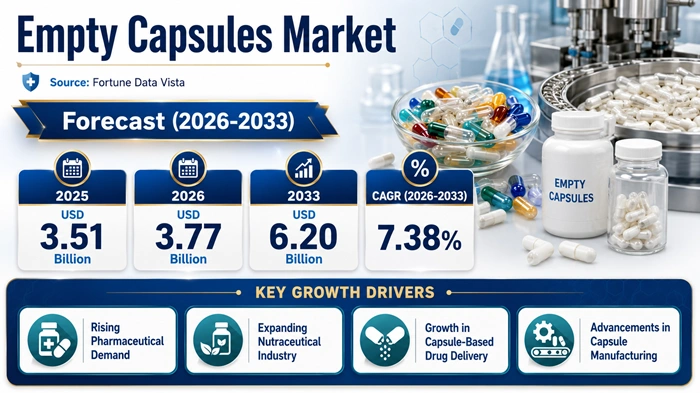
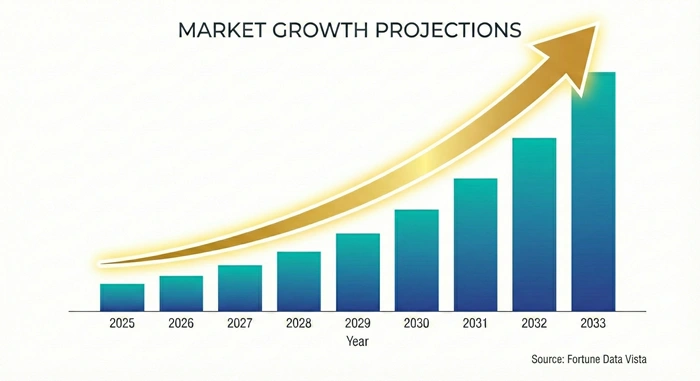
The global empty capsules market size is valued at USD 3.51 billion in 2025 and is predicted to increase from USD 3.77 billion in 2026 to approximately USD 6.20 billion by 2033, growing at a CAGR of 7.38% from 2026 to 2033.
This steady growth reflects rising global consumption of pharmaceuticals and dietary supplements, growing consumer preference for plant-based and gelatin-free capsule alternatives, and continued expansion of contract manufacturing across generic drug production. As pharmaceutical companies and nutraceutical brands increasingly rely on third-party capsule suppliers to meet growing dosage form demand, the empty capsules market continues expanding across hard gelatin, HPMC, and specialty capsule categories worldwide.
AI Impact on the Empty Capsules Industry
Artificial Intelligence Is Optimizing Capsule Formulation Consistency, Enhancing Production Line Quality Control, and Strengthening Predictive Demand Forecasting Across the Empty Capsules Landscape — Fundamentally Changing How Manufacturers Approach Quality and Supply Planning
Artificial intelligence has become an increasingly valuable tool for maintaining formulation consistency in capsule shell manufacturing, with machine vision systems now capable of scanning thousands of capsules per minute to detect microscopic defects in wall thickness, moisture content, and seal integrity that manual inspection would routinely miss. This precision matters considerably since inconsistent capsule quality can directly affect drug dissolution rates and shelf stability, and AI-assisted inspection systems are helping manufacturers catch defects before batches reach pharmaceutical customers. Companies building AI-driven quality control directly into their production lines are increasingly differentiating themselves through fewer rejected batches and stronger customer trust.
Beyond quality control, AI is also improving predictive demand forecasting for capsule manufacturers, with data analytics tools now able to analyze historical order patterns alongside broader pharmaceutical and nutraceutical industry trends to anticipate raw material and production capacity needs well in advance. This capability has proven valuable for suppliers managing gelatin and HPMC sourcing, since better demand forecasting reduces both costly overproduction and disruptive stockouts. As these AI-driven quality and forecasting tools continue maturing, they are becoming an increasingly important factor shaping operational efficiency across the broader empty capsules market.
Growth Factors
Rising Global Pharmaceutical Consumption and Growing Preference for Plant-Based Capsules Continue Driving Sustained Demand
The most significant growth factor supporting the empty capsules market is the steadily rising global consumption of pharmaceutical and nutraceutical products, as aging populations and growing chronic disease prevalence continue increasing demand for oral dosage forms across both developed and emerging healthcare markets. This consistent underlying demand for medicines and supplements has created a dependable, recurring revenue base for capsule shell manufacturers supplying drug companies worldwide.
A second important growth factor is the accelerating consumer shift toward gelatin-free and plant-based capsule alternatives, as dietary restrictions, religious considerations, and ethical concerns around animal-derived ingredients push more manufacturers toward hydroxypropyl methylcellulose and other vegetarian capsule materials. This growing preference for clean-label, allergen-free formulations, combined with expanding contract manufacturing arrangements that allow pharmaceutical companies to outsource capsule production entirely, has broadened the addressable market considerably. This combination of rising pharmaceutical consumption and growing plant-based preference continues to strengthen demand across the empty capsules market.
Market Outlook
Sustainable Material Innovation and Expanding Generic Drug Production Point Toward Sustained Growth Through 2033
Looking ahead through the forecast period, the empty capsules industry is expected to benefit substantially from continued innovation in sustainable and biodegradable capsule materials, as manufacturers respond to environmental concerns and regulatory pressure by developing alternatives that reduce reliance on animal-derived gelatin without compromising drug delivery performance. This material innovation is likely to reshape competitive positioning considerably as more pharmaceutical brands prioritize sustainability credentials in their supplier selection.
At the same time, continued expansion of generic drug manufacturing across emerging markets is expected to create substantial new demand, as cost-effective medicine production in countries like India and China relies heavily on affordable, reliable capsule shell supply chains. Companies that can deliver both consistent quality and competitive pricing at scale are increasingly well positioned to capture this growth. Manufacturers combining strong material science innovation with broad global production capacity are likely to lead growth within the broader empty capsules market through 2033.
Expert Speaks
-
"Our continued investment in plant-based capsule technology reflects our commitment to meeting growing pharmaceutical and nutraceutical demand for sustainable dosage form solutions." — CEO, Lonza Group AG
-
"As generic drug production continues expanding globally, our capsule manufacturing capacity remains focused on delivering the consistent quality our pharmaceutical partners depend on." — CEO, Roquette Frères
-
"We remain dedicated to advancing HPMC and specialty capsule formulations that support both clinical requirements and evolving consumer preferences." — CEO, ACG Worldwide
Key Report Takeaways
-
Asia Pacific leads the global empty capsules market, holding approximately 38% market share in 2025, supported by extensive generic drug manufacturing and low-cost capsule production capacity across India and China
-
North America is the fastest-growing region, projected to expand at a CAGR near 8.9% through 2033, driven by rising consumer demand for plant-based capsules and expanding nutraceutical manufacturing investment
-
Pharmaceutical companies represent the dominant end-user segment, accounting for roughly 62% share, given the consistent, high-volume dosage form requirements across drug manufacturing operations
-
Hard gelatin capsule types contribute the most to overall demand, reflecting their established cost efficiency and widespread use across generic drug production
-
HPMC-based capsule materials remain the fastest-growing raw material category, valued for their suitability for vegetarian and allergen-free formulations
-
Nutraceutical application segments will grow the fastest among end-user categories, holding close to 27% market share with a CAGR near 9.6% through the forecast period, driven by rising global dietary supplement consumption
Market Scope
| Parameter | Details |
|---|---|
| Market Size by 2033 | USD 6.20 Billion | Market Size by 2026 | USD 3.77 Billion | Market Size by 2025 | USD 3.51 Billion | Market Growth Rate from 2026 to 2033 | CAGR of 7.38% | Dominating Region | Asia Pacific | Fastest Growing Region | North America | Segments Covered | Type, Raw Material, End User, Region | Regions Covered | North America, Europe, Asia Pacific, Latin America, Middle East & Africa |
Market Dynamics
Drivers Impact Analysis
Rising Pharmaceutical Consumption and Growing Plant-Based Capsule Demand Remain the Two Strongest Forces Behind Market Momentum
| Driver | (≈) % Impact on CAGR Forecast | Geographic Relevance | Impact Timeline |
|---|---|---|---|
| Rising global pharmaceutical and nutraceutical consumption levels | ~34% | Global | Short to long-term |
| Growing consumer preference for gelatin-free and plant-based capsules | ~28% | North America, Europe | Medium to long-term |
| Expanding contract manufacturing and outsourced dosage form production | ~24% | Global | Short to medium-term |
| Increasing generic drug manufacturing activity across emerging markets | ~14% | Asia Pacific | Medium-term |
Rising global pharmaceutical and nutraceutical consumption continues to serve as the primary engine behind sustained growth in the empty capsules market, as aging populations and growing chronic disease management needs steadily increase demand for oral dosage forms across nearly every major healthcare system. This consistent underlying demand has translated directly into dependable, recurring orders for capsule shell manufacturers serving drug companies worldwide.
Growing consumer preference for gelatin-free and plant-based capsules represents the second major driver, as dietary restrictions and ethical considerations around animal-derived ingredients push more brands toward HPMC and other vegetarian capsule materials. This preference-driven demand, combined with expanding contract manufacturing arrangements, continues reinforcing steady demand growth across the broader empty capsules market.
Restraints Impact Analysis
Raw Material Price Volatility and Intense Price Competition Continue to Moderate Broader Margin Growth
| Restraint | (≈) % Impact on CAGR Forecast | Geographic Relevance | Impact Timeline |
|---|---|---|---|
| Volatility in gelatin and HPMC raw material pricing | ~35% | Global | Short to medium-term |
| Intense price competition among capsule manufacturers in commoditized segments | ~29% | Asia Pacific | Medium to long-term |
| Stringent pharmaceutical-grade quality and regulatory compliance requirements | ~22% | North America, Europe | Short to medium-term |
| Limited product differentiation in standard hard gelatin capsule categories | ~14% | Global | Medium-term |
The most persistent restraint facing the empty capsules market is the ongoing volatility in gelatin and HPMC raw material pricing, which can compress manufacturer margins considerably during periods of supply chain disruption or rising commodity costs. This pricing pressure remains particularly acute for suppliers competing in highly commoditized hard gelatin capsule segments.
Intense price competition among manufacturers represents a second significant restraint, since the relatively standardized nature of basic capsule products makes it difficult for suppliers to differentiate beyond price in many market segments. Combined with stringent pharmaceutical-grade quality and regulatory compliance requirements that raise operating costs, these restraints continue moderating how quickly broader margin expansion occurs across the global empty capsules market.
Opportunities Impact Analysis
Sustainable Material Development and Expanding Nutraceutical Demand Represent the Clearest Paths to Growth
| Opportunity | (≈) % Impact on CAGR Forecast | Geographic Relevance | Impact Timeline |
|---|---|---|---|
| Developing biodegradable and sustainable capsule shell materials | ~37% | North America, Europe | Medium to long-term |
| Expanding global dietary supplement and nutraceutical consumption | ~33% | Global | Short to medium-term |
| Growing specialty capsule development for modified-release drug delivery | ~30% | Global | Medium-term |
Developing biodegradable and sustainable capsule shell materials represents one of the most substantial opportunities within the empty capsules market, as manufacturers creating environmentally responsible alternatives stand to capture significant share from pharmaceutical and nutraceutical brands prioritizing sustainability credentials. This material innovation is expected to meaningfully reshape competitive positioning among leading capsule suppliers over the coming years.
Expanding global dietary supplement and nutraceutical consumption presents a second substantial opportunity, as health-conscious consumers worldwide increasingly incorporate vitamins, minerals, and herbal supplements into daily routines, driving sustained demand for both hard gelatin and specialty capsule formats. Growing development of specialty capsules for modified-release drug delivery further broadens the opportunity landscape, particularly for suppliers able to offer advanced formulation expertise alongside standard production. Companies pursuing these parallel opportunities are well positioned to capture meaningful growth within the broader empty capsules market through the forecast period.
Segment Analysis
By Type: Hard Gelatin Capsules
Hard Gelatin Capsules Continue to Anchor the Type Segment, Reflecting Their Established Cost Efficiency and Widespread Manufacturing Compatibility
Hard gelatin capsules hold the largest share within the type segment of the empty capsules market, accounting for approximately 58% of total segment revenue in 2025. This dominance reflects the long-established cost advantage and widespread manufacturing infrastructure compatibility of gelatin-based capsules, which remain the standard choice for generic drug production and cost-sensitive dosage form manufacturing across most global markets. In markets like India and China, pharmaceutical manufacturers increasingly favor hard gelatin capsules for their proven stability and lower production cost compared to specialty alternatives. Leading suppliers such as ACG Worldwide, Lonza, and Qualicaps continue to dominate this segment through expanded production capacity and continuous manufacturing efficiency improvements.
Growth within this segment remains particularly strong in Asia Pacific, where extensive generic drug manufacturing activity and established gelatin sourcing infrastructure continue driving broad demand for cost-effective capsule shells across thousands of pharmaceutical formulations. The region's combination of low-cost production capability and deep pharmaceutical manufacturing base has helped hard gelatin capsules maintain their leading position despite growing interest in HPMC and plant-based alternatives. As generic drug production continues expanding globally, hard gelatin capsules are expected to remain the dominant category within the broader empty capsules market throughout the forecast period.
By Raw Material: HPMC
HPMC Capsules Represent the Fastest-Growing Raw Material Category, Reflecting Rising Demand for Vegetarian and Allergen-Free Formulations
HPMC-based capsules represent the fastest-growing raw material category within the empty capsules market, holding close to 22% share in 2025 with a projected CAGR near 9.6% through the forecast period as consumer and regulatory demand for gelatin-free alternatives continues strengthening across multiple regions. Unlike traditional gelatin capsules derived from animal collagen, HPMC capsules are manufactured from plant cellulose, making them suitable for vegetarian, vegan, and religious dietary requirements that gelatin products cannot satisfy. This dietary flexibility advantage has generated substantial interest among nutraceutical brands and pharmaceutical companies targeting health-conscious and ethically-minded consumer segments increasingly prevalent across developed markets.
Growth in this segment remains especially strong in North America, where rising consumer awareness of dietary restrictions and strong regulatory support for allergen-free labeling continue expanding demand for HPMC-based dosage forms across both pharmaceutical and supplement categories. Companies like Lonza and Qualicaps have expanded their HPMC production capacity significantly to serve this growing regional demand, often emphasizing clean-label positioning in their marketing to differentiate from conventional gelatin alternatives. As consumer preference continues shifting toward plant-based dosage forms, this raw material category is expected to remain the fastest-growing segment within the broader empty capsules market.
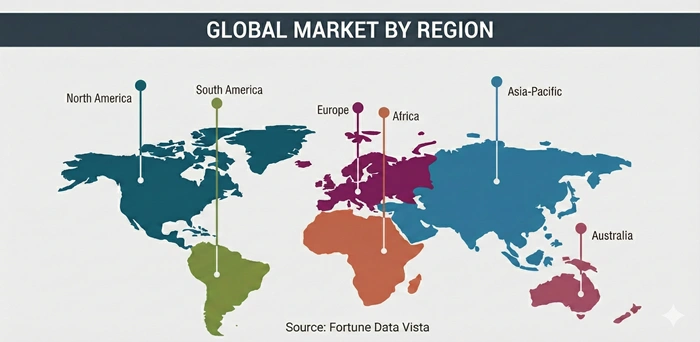
Regional Insights
Asia Pacific
Extensive Generic Drug Manufacturing and Low-Cost Production Capacity Keep Asia Pacific Firmly in the Lead
Asia Pacific commands the leading position in the global empty capsules market, holding approximately 38% share in 2025, supported by extensive generic drug manufacturing activity, low-cost production capacity, and a dense concentration of leading capsule manufacturers. India and China drive the overwhelming majority of regional demand, backed by well-established pharmaceutical manufacturing clusters producing cost-effective medicines for both domestic consumption and global export markets. Companies with strong regional presence include ACG Worldwide, Suheung, Sunil Healthcare, and Associated Capsules, each maintaining deep relationships with generic drug manufacturers across the region.
Japan and South Korea also contribute meaningfully to regional demand, supported by advanced pharmaceutical manufacturing standards and growing nutraceutical production for both domestic and export markets. The region's combination of vast manufacturing scale, established raw material sourcing infrastructure, and continuous production efficiency improvements ensures Asia Pacific's leadership position within the empty capsules market remains firmly intact through the remainder of the forecast period.
North America
Rising Plant-Based Capsule Demand and Expanding Nutraceutical Investment Position North America as the Fastest-Growing Region
North America is projected to register the fastest CAGR within the global empty capsules market through 2033, expanding at a rate near 8.9% as rising consumer demand for plant-based capsules and expanding nutraceutical manufacturing investment create substantial new demand across the region. The United States leads much of this regional growth, supported by a rapidly expanding dietary supplement industry and growing consumer preference for vegetarian and allergen-free dosage forms among health-conscious buyers. Companies with strong regional presence including Lonza, Catalent, and CapsCanada continue expanding their North American production footprint to serve this growing demand, often investing in HPMC capacity to meet clean-label formulation requirements.
Canada contributes further depth to regional growth, bringing expanding nutraceutical manufacturing investment and growing consumer wellness trends that continue driving dietary supplement consumption across the country. Rising demand for sustainable and ethically sourced capsule materials across the broader North American market continues to accelerate premium formulation adoption among expanding pharmaceutical and supplement manufacturers alike. This combination of rising plant-based preference, expanding nutraceutical investment, and growing clean-label demand positions North America as the clear growth leader within the broader empty capsules market through the forecast period.
Customization Available for This Report
Region-Specific and Country-Specific Versions of This Report Are Available to Deliver a Sharper, More Localized View of Market Dynamics
This report can be tailored on a region-by-region and country-by-country basis, providing localized market sizing, competitive mapping, and manufacturing trend analysis that a global overview alone cannot fully capture.
Clients seeking a more focused breakdown can request a customized version covering any of the following regions and countries, complete with demand forecasting, competitor landscape review, and adoption trend analysis tied specifically to the empty capsules keyword focus:
North America
-
U.S. — Detailed review of nutraceutical manufacturing and plant-based capsule adoption trends
-
Canada — Coverage of dietary supplement consumption and wellness trend patterns
-
Mexico — Analysis of emerging pharmaceutical manufacturing investment trends
Europe
-
U.K. — Review of capsule regulation and pharmaceutical-grade compliance trends
-
Germany — Coverage of HPMC production investment among leading manufacturers
-
France — Insights into hard gelatin and specialty capsule adoption patterns
-
Italy — Analysis of regional capsule manufacturing investment trends
-
Rest of Europe — Country-level view of emerging demand across Eastern Europe and the Nordics
Asia Pacific
-
China — Coverage of expanding generic drug manufacturing and capsule production
-
India — Analysis of growing low-cost capsule manufacturing and export demand
-
Japan — Review of established pharmaceutical manufacturing standards and adoption
-
South Korea — Assessment of nutraceutical capsule investment and adoption
-
Australia — Insights into dietary supplement manufacturing adoption trends
-
Rest of Asia Pacific — Country-level breakdown covering Thailand, Vietnam, Indonesia, and Malaysia
Latin America
-
Brazil — Coverage of expanding nutraceutical capsule access and adoption
-
Argentina — Analysis of early-stage pharmaceutical manufacturing modernization trends
-
Rest of Latin America — Country-level sizing across Colombia, Peru, and Chile
Middle East & Africa
-
UAE — Review of pharmaceutical manufacturing investment and capsule adoption trends
-
Saudi Arabia — Coverage of expanding healthcare manufacturing modernization initiatives
-
Rest of MEA — Country-level view of Sub-Saharan Africa pharmaceutical manufacturing expansion
Top Key Players
-
Lonza Group AG (Switzerland)
-
ACG Worldwide (India)
-
Qualicaps Co Ltd (Japan)
-
Catalent Inc (United States)
-
Suheung Co Ltd (South Korea)
-
Sunil Healthcare Limited (India)
-
CapsCanada Corporation (Canada)
-
Associated Capsules Private Limited (India)
-
Bright Pharma Caps Inc (United States)
-
Roxlor LLC (United States)
-
Medicaps Limited (India)
-
Nectar Lifesciences Limited (India)
Recent Developments
-
In 2025, Lonza expanded its plant-based capsule production capacity to meet growing demand for vegetarian and allergen-free dosage forms across North America
-
In 2025, ACG Worldwide strengthened its manufacturing footprint through continued investment in advanced HPMC capsule production facilities across India
-
In 2026, Qualicaps advanced its sustainable capsule material research targeting biodegradable alternatives for pharmaceutical and nutraceutical applications
-
In 2025, Catalent deepened its contract manufacturing partnerships to support expanding outsourced capsule production for global pharmaceutical clients
-
In 2025, Suheung broadened its specialty capsule portfolio with new modified-release formulations targeting complex drug delivery requirements
Market Trends
Plant-Based Material Innovation and Expanding Contract Manufacturing Are Reshaping Production Priorities
One of the clearest trends shaping the empty capsules market is the accelerating shift toward plant-based and gelatin-free capsule materials, as dietary restrictions, ethical concerns, and religious considerations push more pharmaceutical and nutraceutical brands toward HPMC and other vegetarian alternatives. Manufacturers are investing heavily in sustainable material research, recognizing that clean-label positioning has become an increasingly important competitive differentiator as consumer wellness trends continue strengthening across developed markets.
A second significant trend is the growing reliance on contract manufacturing arrangements, as pharmaceutical and supplement companies increasingly outsource capsule production entirely to specialized suppliers rather than maintaining in-house manufacturing capability. This trend toward outsourced dosage form production is particularly meaningful for smaller nutraceutical brands seeking to scale quickly without capital-intensive manufacturing investment, continuing to support steady expansion across the broader empty capsules market as outsourcing adoption deepens.
Segments Covered in the Report
By Type
-
Hard Gelatin Capsules
-
Soft Gelatin Capsules
-
Non-Gelatin Capsules
By Raw Material
-
Gelatin
-
HPMC
-
Pullulan
-
Other Raw Materials
By End User
-
Pharmaceutical Industry
-
Nutraceutical Industry
-
Cosmetics Industry
By Region
-
North America (U.S., Canada, Mexico)
-
Europe (U.K., Germany, France, Italy, Rest of Europe)
-
Asia Pacific (China, India, Japan, South Korea, Australia, Rest of Asia Pacific)
-
Latin America (Brazil, Argentina, Rest of Latin America)
-
Middle East & Africa (UAE, Saudi Arabia, Rest of MEA)
❝ Built for Every Level — From Startups to Industry Giants ❞
Here Is Exactly How This Report Works for You
-
For tier 1 companies, investors, and established market leaders, this report delivers detailed competitor revenue analysis, manufacturing capacity trend mapping, and geopolitical risk context that support confident decisions around product expansion, pricing strategy, and long-term positioning within the empty capsules space
-
For tier 2 and tier 3 companies, startups, and mid-sized suppliers, this report highlights the most commercially promising material categories and underserved regional opportunities, giving you a practical framework to compete against larger established players without overextending limited resources
-
For every decision maker across the value chain, this report explains exactly how raw material pricing trends, sustainability regulation, and competitor capacity expansions are shaping market direction through 2033, equipping you to plan investment and go-to-market decisions with genuine confidence
Frequently Asked Questions:
Answer: The global empty capsules market was valued at USD 3.51 billion in 2025 and is projected to reach USD 6.20 billion by 2033. This growth is driven largely by rising pharmaceutical consumption and growing demand for plant-based capsules.
Answer: Growth in the empty capsules market is being driven by rising global pharmaceutical and nutraceutical consumption alongside growing preference for gelatin-free capsules. Expanding contract manufacturing arrangements are further reinforcing this expansion.
Answer: Asia Pacific currently leads the empty capsules market with roughly 38% share, supported by extensive generic drug manufacturing. North America is growing the fastest, driven by rising plant-based capsule demand and nutraceutical investment.
Answer: Hard gelatin capsules generate the largest share of revenue in the empty capsules market, reflecting their established cost efficiency and manufacturing compatibility. HPMC-based capsules remain the fastest-growing raw material category.
Answer: Leading companies in the empty capsules market include Lonza, ACG Worldwide, Qualicaps, Catalent, and Suheung. These companies compete through continuous innovation in plant-based materials and expanded manufacturing capacity.