
Enterprise Asset Management Market Overview
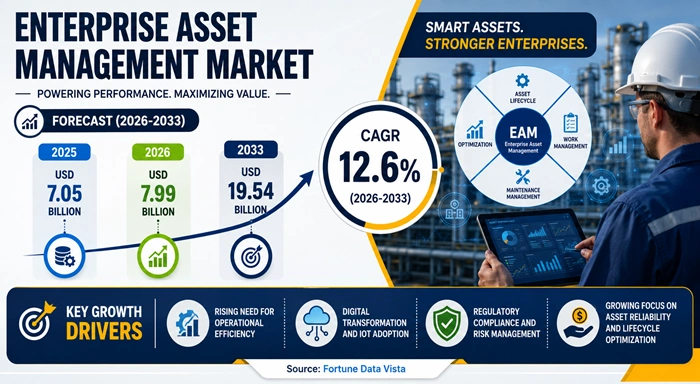
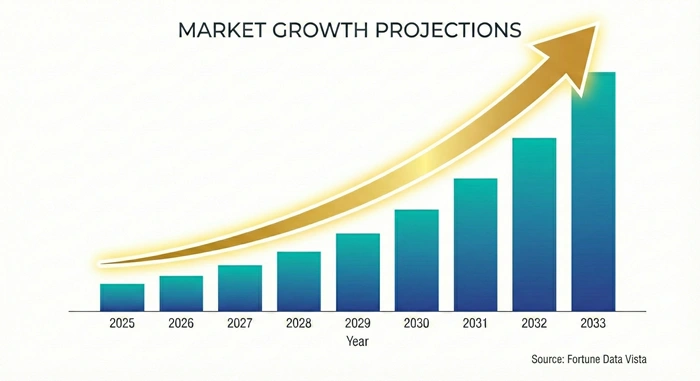
The global enterprise asset management market size is valued at USD 7.05 billion in 2025 and is predicted to increase from USD 7.99 billion in 2026 to approximately USD 19.54 billion by 2033, growing at a CAGR of 12.6% from 2026 to 2033.
Organizations across every major industry are under increasing pressure to extract maximum value from their physical and digital asset portfolios while managing maintenance costs, minimizing unplanned downtime, and meeting stringent regulatory compliance requirements. Enterprise asset management solutions address all of these needs within a single, integrated platform — enabling companies to track, maintain, and optimize their assets across their entire lifecycle. As industrial digitalization accelerates and cloud-native EAM platforms become more accessible to organizations of all sizes, the enterprise asset management market is entering a sustained high-growth phase driven by both technology adoption and operational necessity.
AI Impact on the Enterprise Asset Management Industry
Artificial Intelligence and Machine Learning Are Redefining How Organizations Manage Physical Assets — Shifting the EAM Industry from Reactive Maintenance to Predictive, Autonomous Asset Intelligence
Artificial intelligence is fundamentally reshaping the enterprise asset management landscape, transforming EAM platforms from administrative record-keeping systems into dynamic, predictive asset intelligence engines. The integration of AI and machine learning into EAM software enables organizations to move beyond time-based and breakdown-triggered maintenance toward condition-based and predictive maintenance strategies that use real-time sensor data, operational history, and environmental variables to forecast equipment failure before it occurs. This shift has measurable financial impact — organizations deploying AI-driven predictive maintenance within their EAM frameworks report significant reductions in unplanned downtime, lower maintenance costs, and extended asset operational lifecycles that directly improve return on capital investment.
AI is also enabling the automation of complex asset management workflows that previously required significant manual labor and expert judgment. Natural language processing interfaces allow maintenance technicians to search equipment histories, raise work orders, and access technical documentation using conversational queries on mobile devices in the field. Computer vision systems integrated with industrial cameras and drones are automating physical asset condition assessments that once required scheduled manual inspections, enabling organizations to monitor large, geographically distributed asset fleets with unprecedented frequency and accuracy. As AI capabilities within EAM platforms continue to mature, they are becoming a primary differentiator that determines which vendors capture the highest-value enterprise customer segments in the rapidly growing enterprise asset management market.
Growth Factors
Accelerating Industrial Digitalization, Rising Demand for Predictive Maintenance, and the Explosion of IoT-Connected Assets Are the Core Forces Driving Enterprise Asset Management Market Expansion
The accelerating pace of industrial digitalization across manufacturing, energy, utilities, transportation, and public infrastructure sectors is creating a powerful and broad-based demand driver for enterprise asset management platforms. As organizations invest in Industry 4.0 technologies — including industrial IoT sensors, digital twins, automated production systems, and connected logistics networks — the volume, complexity, and strategic importance of their managed asset portfolios is growing exponentially. This growth creates a direct requirement for sophisticated EAM platforms capable of integrating with operational technology (OT) systems, processing large-scale sensor data streams, and providing unified visibility across all asset classes and geographic locations. Organizations that lack capable EAM infrastructure are increasingly finding themselves unable to realize the full value of their digitalization investments, creating a compelling business case for platform adoption and upgrade.
The growing emphasis on predictive maintenance as a cost and reliability management strategy is the second major growth driver in the enterprise asset management market. Unplanned equipment downtime costs industrial organizations an estimated hundreds of billions of dollars annually in lost production, emergency repair costs, and supply chain disruption. Predictive maintenance programs powered by EAM platforms with integrated IoT connectivity, condition monitoring analytics, and AI-driven failure prediction capabilities offer a proven path to dramatically reducing these costs. The return on investment case for predictive maintenance is well-established and increasingly understood at the executive level, making EAM platform investment a priority in capital expenditure planning discussions across heavy industry, utilities, oil and gas, and transportation sectors globally.
Market Outlook
The Enterprise Asset Management Market Is Entering a High-Acceleration Phase Driven by Cloud Adoption, ESG Asset Reporting Requirements, and the Increasing Complexity of Modern Asset Portfolios
The medium-to-long-term outlook for the enterprise asset management market is very strong, supported by structural demand trends that are independent of short-term economic cycles. The ongoing migration of enterprise software workloads from on-premises to cloud environments is a particularly powerful tailwind, as cloud-native EAM platforms offer significant advantages in deployment speed, total cost of ownership, scalability, and remote accessibility compared to traditional server-based installations. This migration is expanding the addressable market for EAM by making sophisticated asset management capabilities economically viable for a much broader range of organizations — including mid-market companies and public sector entities that previously lacked the IT budget to implement enterprise-grade EAM solutions.
The growing importance of environmental, social, and governance (ESG) reporting frameworks is also creating a new and increasingly significant demand driver for EAM platforms. Accurate, auditable data on asset energy consumption, carbon emissions, maintenance records, and end-of-life disposal is required for compliance with ESG disclosure standards that are progressively being mandated by regulators and demanded by institutional investors. EAM platforms are uniquely positioned to serve as the system of record for ESG-relevant asset data, creating a new and compelling value proposition that is attracting investment in EAM capabilities from organizations that might not have previously prioritized asset management technology. As ESG compliance requirements intensify globally through 2033, this driver is expected to meaningfully expand the enterprise asset management market's addressable buyer base across both private industry and public sector organizations.
Expert Speaks
-
"IBM's Maximo Application Suite continues to be one of our most strategically important enterprise software offerings because it sits at the intersection of two of the most powerful technology trends reshaping industrial operations — AI and IoT. Organizations across every asset-intensive sector are investing in intelligent asset management capabilities, and we are committed to continuously expanding Maximo's predictive maintenance, digital twin, and sustainability reporting capabilities to meet this growing demand." — Arvind Krishna, Chairman & CEO, IBM Corporation
-
"SAP's enterprise asset management solutions are a critical component of our broader Industry Cloud strategy, helping asset-intensive organizations connect maintenance operations with supply chain, procurement, and financial management in a unified digital environment. The ability to manage the full asset lifecycle within the SAP ecosystem — from procurement through decommissioning — is a capability that our customers increasingly see as essential to achieving operational efficiency and regulatory compliance goals." — Christian Klein, CEO, SAP SE
-
"At Oracle, we are seeing accelerating demand from our utilities, manufacturing, and government customers for integrated EAM capabilities that combine asset lifecycle tracking, work order management, and real-time IoT data within a single cloud platform. The growing complexity of modern infrastructure asset portfolios and the increasing regulatory scrutiny of asset management practices are making investment in enterprise-grade EAM solutions a non-negotiable strategic priority for our largest customers across all industry verticals." — Safra Catz, CEO, Oracle Corporation
Key Report Takeaways
-
North America dominates the global enterprise asset management market, accounting for approximately 36% of total revenue in 2025, supported by the early and mature adoption of digital asset management technologies across U.S. manufacturing, utilities, oil and gas, and public infrastructure sectors, alongside the dominant commercial presence of global EAM leaders including IBM (Maximo), SAP, Oracle, and Infor.
-
Asia Pacific is the fastest growing regional market, with China, India, Japan, South Korea, and Australia collectively driving exceptional double-digit demand growth through rapid industrialization, large-scale government infrastructure investment programs, Industry 4.0 adoption across manufacturing sectors, and the growing penetration of cloud-based EAM solutions in mid-market enterprises that were previously underserved by legacy on-premises systems.
-
Large enterprises are the dominant end-user segment, accounting for over 65% of total enterprise asset management market revenue in 2025, as multinational corporations and large industrial organizations in manufacturing, energy, utilities, and transportation represent the highest-volume, most complex, and highest-spending buyers of comprehensive EAM platforms with advanced predictive maintenance, IoT integration, and regulatory compliance capabilities.
-
The manufacturing sector is the leading industry vertical driving EAM demand, contributing the largest share of annual platform revenue as factories, production facilities, and process plants worldwide invest in asset lifecycle management, preventive and predictive maintenance programs, and equipment reliability solutions that directly protect production output and reduce operational costs.
-
Cloud-based deployment is the most widely adopted delivery model, commanding over 60% of new EAM platform deployments in 2025 as enterprises prioritize the scalability, rapid implementation, continuous feature updates, and remote accessibility advantages of cloud-native EAM over traditional on-premises installations that require significant upfront IT infrastructure investment.
-
The SME segment is the fastest growing enterprise size category, projected to achieve a market share exceeding 38% by 2033 and grow at a CAGR of approximately 15.2% through the forecast period, driven by the rapid proliferation of affordable, subscription-priced cloud EAM solutions that are making enterprise-grade asset management capabilities accessible to mid-market organizations for the first time.
Market Scope
| Parameter | Details |
|---|---|
| Market Size by 2033 | USD 19.54 Billion | Market Size by 2026 | USD 7.99 Billion | Market Size by 2025 | USD 7.05 Billion | Market Growth Rate from 2026 to 2033 | CAGR of 12.6% | Dominating Region | North America | Fastest Growing Region | Asia Pacific | Segments Covered | Component, Deployment, Enterprise Size, Application, End User | Regions Covered | North America, Europe, Asia Pacific, Latin America, Middle East & Africa |
Market Dynamics
Drivers Impact Analysis
Rapid Industrial IoT Adoption, Growing Predictive Maintenance Investment, and Cloud Deployment Migration Are Collectively Accelerating the Enterprise Asset Management Market's Growth Trajectory
| Driver | ≈ % Impact on CAGR Forecast | Geographic Relevance | Impact Timeline |
|---|---|---|---|
| Industrial IoT and connected asset infrastructure expansion | ~32% | Global — especially North America, Europe, Asia Pacific | Short to Long Term |
| Predictive maintenance investment and operational cost reduction | ~28% | Manufacturing, Energy, Utilities globally | Short to Medium Term |
| Cloud-based EAM deployment and digital transformation | ~24% | Global — led by North America and Europe | Short to Long Term |
| ESG compliance and sustainability asset reporting requirements | ~16% | Europe, North America, Large Asia Pacific enterprises | Medium to Long Term |
The rapid expansion of industrial IoT infrastructure — with billions of new sensors, connected machines, and smart field devices being deployed annually across manufacturing plants, energy grids, transportation networks, and public utilities — is creating a structural demand multiplier for enterprise asset management platforms capable of integrating, analyzing, and acting on the data these connected assets generate. Every connected asset requires monitoring, maintenance scheduling, performance tracking, and lifecycle management — functions that sit at the core of EAM platform value propositions. As organizations scale their IoT asset deployments from pilot programs to enterprise-wide implementations, the demand for robust EAM platforms that serve as the management layer for connected asset ecosystems is growing in direct proportion, creating a sustained and expanding revenue opportunity for platform vendors across all major industries.
Regulatory compliance pressures are adding a second, increasingly urgent dimension to the EAM investment case, particularly in heavily regulated industries including utilities, oil and gas, aerospace, pharmaceuticals, and public infrastructure. Asset management record-keeping, maintenance documentation, inspection certification, and equipment history reporting are required for regulatory compliance in these sectors, and the manual processes and legacy systems that many organizations still rely on for these functions are becoming inadequate as regulatory requirements grow more demanding and the cost of non-compliance rises. Modern EAM platforms that provide automated audit trails, digital work order management, configurable inspection templates, and real-time compliance dashboards are directly solving this problem, creating a compelling, non-discretionary investment driver that supports platform adoption even in periods of tighter IT spending.
Restraints Impact Analysis
High Implementation Complexity, Data Integration Challenges, and the Total Cost of Ownership for Legacy Enterprise Systems Are the Primary Factors Constraining Faster EAM Market Adoption
| Restraint | ≈ % Impact on CAGR Forecast | Geographic Relevance | Impact Timeline |
|---|---|---|---|
| Complex implementation and lengthy deployment timelines | ~36% | All enterprise sizes — especially mid-market | Short to Medium Term |
| Data integration with legacy ERP, SCADA, and OT systems | ~34% | Manufacturing, Energy, Utilities globally | Medium Term |
| High total cost of ownership for large-scale EAM deployments | ~30% | SMEs and organizations in emerging markets | Short to Medium Term |
The complexity of implementing enterprise-grade EAM systems remains one of the most significant adoption barriers in the market, particularly for mid-sized and large organizations with established legacy systems, complex asset hierarchies, and multiple operational sites that must be migrated and integrated into a unified new platform. EAM implementations at large enterprises can take 12–24 months or longer to complete, require substantial internal IT and change management resources, and carry a meaningful risk of cost overrun or delayed go-live that dampens organizational enthusiasm for proceeding with investment. The shortage of experienced EAM implementation consultants — particularly those with deep domain expertise in specific industries — further constrains the rate at which organizations can successfully complete deployments even when the budget and organizational will are in place.
Integrating modern EAM platforms with existing operational technology (OT) infrastructure — including SCADA systems, distributed control systems (DCS), programmable logic controllers (PLCs), and legacy ERP platforms — presents significant technical complexity that is a persistent source of implementation delay and post-deployment frustration. Asset data often exists in siloed, proprietary formats across multiple disconnected systems, and achieving the unified, real-time data integration that unlocks the full predictive and analytical value of a modern EAM platform requires careful technical planning, custom integration work, and ongoing data governance management. Organizations that underestimate this integration complexity frequently experience delayed ROI from their EAM investments, which can dampen institutional enthusiasm for further platform expansion and upgrade, creating a cyclical constraint on market growth.
Opportunities Impact Analysis
Digital Twin Technology Integration, Asset-Intensive Sector Infrastructure Investment, and SME Market Expansion Via Cloud SaaS EAM Represent the Most Compelling Growth Opportunities
| Opportunity | ≈ % Impact on CAGR Forecast | Geographic Relevance | Impact Timeline |
|---|---|---|---|
| Digital twin and simulation-driven asset management | ~38% | North America, Europe, Advanced Asia Pacific | Medium to Long Term |
| Government and public infrastructure digitalization programs | ~34% | Asia Pacific, MEA, Latin America | Medium to Long Term |
| SME cloud EAM SaaS adoption and market democratization | ~28% | Global — especially emerging markets | Short to Long Term |
The integration of digital twin technology into enterprise asset management platforms is creating a transformative new capability that represents one of the most valuable emerging opportunities in the market. Digital twins — virtual replicas of physical assets that mirror real-world conditions in real time using sensor data and simulation modeling — enable organizations to test maintenance strategies, simulate failure scenarios, optimize asset performance parameters, and plan capital replacement cycles in a virtual environment before implementing changes in the physical world. EAM vendors including IBM, Hexagon, and AVEVA are investing heavily in digital twin integration capabilities, positioning their platforms as comprehensive asset intelligence environments that go well beyond traditional maintenance scheduling and work order management to deliver strategic, simulation-based asset lifecycle optimization.
The global wave of government infrastructure investment programs — including national grid modernization initiatives, water utility infrastructure upgrades, highway and rail network expansion, and smart city development projects — is creating large, highly concentrated procurement opportunities for EAM platform vendors with established public sector credentials and the ability to support large-scale, complex infrastructure asset portfolios. Governments and public utilities managing billions of dollars in infrastructure assets increasingly recognize that effective digital asset management is essential to extending infrastructure lifespans, optimizing maintenance budgets, and meeting sustainability targets. This recognition is translating into substantial EAM procurement programs in Asia Pacific, the Middle East, Europe, and Latin America, creating high-value, multi-year contract opportunities that favor established enterprise EAM vendors with proven public sector implementation experience.
Segment Analysis
By Deployment
Cloud-Based EAM Is the Dominant and Fastest Growing Deployment Model, While On-Premises Remains the Preferred Choice for Security-Sensitive and Heavily Regulated Industries
Cloud-based enterprise asset management solutions hold the dominant position in the deployment segment, accounting for approximately 62% of total market revenue in 2025 and projected to grow at a CAGR of approximately 14.1% through 2033. Cloud EAM platforms offer decisive advantages in implementation speed, subscription pricing flexibility, automatic software updates, and mobile accessibility that collectively make them the default deployment choice for most new EAM investments across all but the most security-restricted industries. North America leads cloud EAM adoption, driven by the high cloud readiness of U.S. and Canadian enterprises, the commercial strength of cloud-native EAM platforms from IBM (Maximo Application Suite on AWS/Azure), SAP (S/4HANA Cloud Asset Management), and Oracle (Fusion Cloud EAM), and a well-developed partner ecosystem that accelerates cloud deployment timelines. The cloud deployment model is particularly attractive to the growing SME segment, where subscription-based pricing eliminates large upfront capital expenditure and makes enterprise-grade EAM economically accessible for the first time.
On-premises EAM deployments retain a share of approximately 38% of total market revenue in 2025, serving large enterprises in industries including defense, nuclear energy, oil and gas, financial services, and critical national infrastructure where data sovereignty requirements, security protocols, and regulatory mandates make cloud hosting either legally restricted or organizationally unacceptable. These customers represent a highly valuable, persistently demanding buyer segment that continues to drive meaningful license revenue for EAM vendors who maintain robust on-premises product lines. Europe is the leading region for on-premises EAM persistence, where stringent data protection regulations including GDPR and sector-specific cybersecurity standards in energy and critical infrastructure sectors create structural demand for on-premises deployment. SAP, IBM, and Infor are the primary vendors maintaining strong on-premises EAM portfolios that continue to serve this demanding but revenue-rich customer segment effectively in the enterprise asset management market.
By End User
Manufacturing Is the Largest End-User Vertical While Energy and Utilities Represent the Highest-Value Growth Segment in the Enterprise Asset Management Market
Manufacturing represents the largest end-user industry vertical in the enterprise asset management market, contributing approximately 28% of total revenue in 2025 and growing at a CAGR of approximately 12.8% through 2033. Manufacturers operate large, complex, and capital-intensive asset portfolios — including production lines, CNC machines, conveyor systems, HVAC equipment, and facility infrastructure — whose performance and reliability directly determine production output, product quality, and plant profitability. The global push toward smart manufacturing and Industry 4.0 transformation is accelerating EAM adoption within this sector, as manufacturers seek to integrate their EAM systems with production execution systems, quality management platforms, and supply chain software for end-to-end operational visibility. Asia Pacific is the fastest growing region for manufacturing EAM adoption, with China, South Korea, Japan, and India recording above-average procurement growth driven by large-scale factory automation programs and government-supported smart manufacturing initiatives. Major EAM vendors competing in this vertical include IBM (Maximo), SAP, IFS, and Infor, all of which offer manufacturing-specific asset management modules with production equipment reliability and spare parts inventory management capabilities.
The energy and utilities sector accounts for approximately 22% of total enterprise asset management market revenue in 2025 and is projected to grow at a CAGR of approximately 13.5% through 2033, making it the highest-growth major end-user vertical in absolute CAGR terms. Utilities and energy companies manage some of the world's most complex and geographically distributed asset portfolios — including power generation equipment, transmission and distribution infrastructure, pipeline networks, renewable energy installations, and water treatment facilities — where asset reliability failures have immediate public safety and regulatory consequences. North America leads energy and utilities EAM adoption, with U.S. electric utilities investing heavily in grid modernization and asset intelligence programs that require sophisticated EAM platforms capable of integrating with advanced metering infrastructure (AMI), SCADA systems, and GIS mapping tools. Hexagon AB, IBM, and Oracle are among the leading EAM vendors with specialized energy and utilities product offerings that address the unique asset lifecycle management challenges of this highly regulated, asset-intensive sector.
Regional Insights
North America
North America Is the World's Dominant Enterprise Asset Management Market, Supported by Advanced Digital Infrastructure, High EAM Technology Maturity, and a Strong Presence of Global EAM Platform Leaders
The United States Drives the Overwhelming Majority of North American Revenue, Anchored by Large-Scale Deployments Across Manufacturing, Utilities, Oil and Gas, and Government Infrastructure Sectors
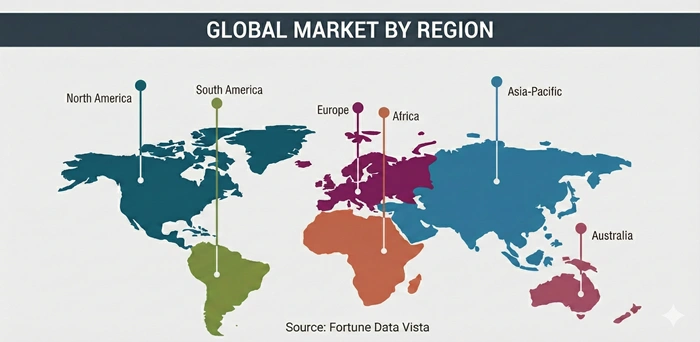
North America holds the largest regional share of the enterprise asset management market at approximately 36% of global revenue in 2025, a position of leadership built on decades of enterprise software investment across the region's asset-intensive industrial sectors. The United States is the largest single-country market globally for EAM, benefiting from a mature enterprise software culture, high IT investment levels across manufacturing and industrial companies, and the dominant commercial presence of the world's leading EAM platform providers including IBM (Maximo), SAP, Oracle, Infor (CloudSuite EAM), and Hexagon AB. North America is projected to grow at a regional CAGR of approximately 11.8% from 2026 to 2033, reflecting a market that is transitioning from initial platform adoption to deep deployment expansion, IoT integration, and AI-driven predictive maintenance capability buildout. The region's utilities sector is particularly active in EAM investment, driven by federal infrastructure spending programs and the urgency of modernizing aging electricity grid, water supply, and transportation infrastructure assets.
Canada contributes meaningful secondary demand from its oil and gas, mining, utilities, and public infrastructure sectors, where large asset portfolios requiring comprehensive lifecycle management and regulatory compliance documentation create consistent EAM platform procurement needs. The Canadian government's infrastructure investment programs are also driving EAM adoption in the public sector, as municipalities and provincial governments modernize their approaches to managing roads, bridges, water systems, and public building assets. Mexico's market is growing rapidly from a lower base, driven by expanding manufacturing sector investment from nearshoring trends and the modernization of state-owned utility and energy company asset management practices as part of broader industrial efficiency improvement programs across the country.
Asia Pacific
Asia Pacific Is the Fastest Growing Regional Market for Enterprise Asset Management, Powered by Industrial Expansion, Smart Manufacturing Adoption, and Massive Government Infrastructure Investment Programs
China's Industrial Digitalization Drive and India's Manufacturing Sector Expansion Are the Two Most Powerful Country-Level Demand Catalysts Reshaping the Asia Pacific EAM Landscape
Asia Pacific is the fastest growing regional market in the enterprise asset management industry, with a projected CAGR of approximately 15.4% from 2026 to 2033, significantly outpacing all other regions. The region currently holds approximately 24% of global market share in 2025, a figure that is expected to increase substantially as China, India, Japan, South Korea, and Australia all accelerate their industrial digitalization investments. China is the dominant force within the region, where the government's Made in China 2025 and dual-circulation economic strategy are driving unprecedented levels of investment in smart manufacturing, industrial IoT, and enterprise software adoption across state-owned enterprises and private industrial conglomerates. Major EAM vendors including SAP, IBM, and Infor are actively expanding their China operations and local partner networks to compete with domestic enterprise software providers for EAM contracts at large Chinese industrial and utility clients.
India is the most dynamic emerging growth market within Asia Pacific, combining a rapidly expanding manufacturing base, ambitious infrastructure development under the National Infrastructure Pipeline program, and a government push to modernize public asset management across railways, highways, ports, and power distribution networks. Indian conglomerates and public sector enterprises are progressively upgrading their EAM capabilities from basic computerized maintenance management systems (CMMS) to full enterprise-grade EAM platforms, creating a substantial addressable market opportunity for both international vendors and Indian software service companies that integrate and customize global EAM platforms. Japan and South Korea bring high-value demand from their technologically sophisticated manufacturing sectors, where automotive, electronics, and semiconductor companies invest in advanced predictive maintenance and asset intelligence capabilities that require the most sophisticated EAM platform features available in the enterprise asset management market.
Report Customization Available by Region and Country
Access Highly Targeted, Geography-Specific Enterprise Asset Management Market Intelligence Through Our Fully Customized Region-Wise and Country-Wise Reports — Designed to Drive Better Decisions for Every Market You Operate In
This report can be fully customized to deliver in-depth, geography-specific intelligence for any region or country covered in the global study. A customized version of this report goes beyond the global analysis to provide country-level market sizing, local competitive landscape mapping, sector-specific adoption trend analysis, regulatory environment assessment, and strategic opportunity identification specific to the enterprise asset management market dynamics in the selected geography. Whether your focus is on market entry strategy, geographic expansion planning, distribution partnership development, or investment due diligence, our customization capability ensures your market intelligence is precisely aligned with your business objectives and geographic area of focus.
Customized enterprise asset management market reports are available for all of the following regions and countries, offering detailed insights, market analysis, trends, and competitive intelligence tailored to each specific geography:
North America
-
U.S. — Largest global EAM market deep-dive, sector-level adoption analysis (manufacturing, utilities, oil and gas, government), top vendor competitive benchmarking, and federal infrastructure investment impact assessment
-
Canada — Oil sands, mining, and utilities EAM demand analysis, provincial government asset management digitalization programs, and leading vendor and integrator market strategies
-
Mexico — Nearshoring-driven manufacturing sector EAM demand, Pemex and CFE utility EAM modernization programs, and cloud EAM adoption trajectory analysis
Europe
-
U.K. — Critical infrastructure EAM regulatory requirements, utilities and rail network asset management investment, and leading vendor competitive strategies in the post-Brexit enterprise software market
-
Germany — Europe's largest industrial EAM market, automotive and manufacturing sector adoption analysis, Industry 4.0 EAM integration trends, and top SAP and IBM deployment case studies
-
France — Public utility and infrastructure sector EAM demand, government digital transformation program impact, and leading EAM vendor competitive positioning
-
Italy — Manufacturing and energy sector EAM adoption, domestic vs. international vendor preference analysis, and mid-market EAM growth opportunity mapping
-
Rest of Europe — Scandinavian energy sector EAM leadership, Eastern Europe industrial growth-driven demand, and EU infrastructure investment program impact analysis
Asia Pacific
-
China — Government-driven industrial digitalization impact, domestic vs. international EAM vendor competition, Made in China 2025 program EAM implications, and state-owned enterprise procurement dynamics
-
India — National Infrastructure Pipeline EAM opportunity, manufacturing sector expansion demand analysis, cloud EAM mid-market growth, and leading IT integrator competitive strategies
-
Japan — Automotive and electronics sector EAM maturity, domestic vendor ecosystem analysis, and predictive maintenance technology adoption trends
-
South Korea — Semiconductor and shipbuilding sector EAM demand, government smart factory initiative impact, and leading conglomerate EAM deployment strategies
-
Australia — Mining and utilities sector EAM leadership, cloud EAM adoption trajectory, and government infrastructure asset management program analysis
-
Rest of Asia Pacific — Southeast Asia manufacturing growth-driven EAM demand, Indonesia, Thailand, Vietnam market entry opportunity assessment
Latin America
-
Brazil — Oil, gas, and utilities sector EAM demand, Petrobras and Eletrobras EAM modernization programs, and mid-market manufacturing adoption analysis
-
Argentina — Industrial sector resilience and EAM adoption dynamics, economic environment impact on IT procurement, and cloud EAM growth trajectory
-
Rest of Latin America — Colombia, Chile, Peru infrastructure and mining sector EAM opportunity analysis and regional competitive landscape
Middle East & Africa (MEA)
-
UAE — Smart city and government infrastructure EAM investment, ADNOC and DEWA utility program analysis, and premium EAM vendor competitive positioning in Dubai and Abu Dhabi
-
Saudi Arabia — Vision 2030 infrastructure digitalization impact, national utility and industrial sector EAM procurement, and government enterprise software adoption programs
-
Rest of MEA — South Africa mining and utilities EAM demand, East Africa infrastructure development opportunity, and Egypt industrial modernization program analysis
Top Key Players
-
IBM Corporation (United States)
-
SAP SE (Germany)
-
Oracle Corporation (United States)
-
Hexagon AB (Sweden)
-
IFS AB (Sweden)
-
Infor, Inc. (Koch Industries) (United States)
-
ABB Ltd. (Switzerland)
-
Siemens AG (Germany)
-
Schneider Electric SE (France)
-
AVEVA Group plc (United Kingdom)
-
Aptean (United States)
-
Rockwell Automation, Inc. (United States)
Recent Developments
-
In 2025, IBM Corporation announced a major update to its Maximo Application Suite, introducing generative AI-powered work order creation and natural language asset query capabilities, enabling maintenance technicians to interact with the platform using conversational prompts on mobile devices — significantly reducing training requirements and accelerating adoption across field maintenance teams at large industrial customers.
-
In 2024, SAP SE deepened its partnership with Microsoft to integrate SAP Enterprise Asset Management within Microsoft Teams and Azure Digital Twins, creating a seamless workflow between SAP's EAM capabilities and Microsoft's collaboration and digital twin infrastructure for joint enterprise customers managing complex, geographically distributed industrial asset portfolios.
-
In 2025, Hexagon AB completed the acquisition of asset performance management software company Prometheus Group for approximately USD 500 million, significantly enhancing Hexagon's EAM and asset performance management capabilities for the energy, mining, and industrial manufacturing sectors and expanding its installed base to over 1800 enterprise customers worldwide.
-
In 2024, IFS AB launched IFS Cloud 24R1 with an expanded enterprise asset management module featuring enhanced predictive maintenance analytics, AI-driven spare parts demand forecasting, and sustainability asset reporting capabilities aligned with EU CSRD regulatory requirements — responding directly to growing customer demand for EAM platforms that support both operational efficiency and ESG compliance objectives.
-
In 2025, Infor (Koch Industries) announced the general availability of Infor EAM v12, featuring a redesigned mobile-first user interface, enhanced IoT sensor data integration pipelines, and native integration with Infor's supply chain and procurement modules — strengthening the platform's competitive positioning against SAP and IBM for large manufacturing and utilities EAM procurement decisions across North America and Europe.
Market Trends
The Convergence of EAM with Digital Twins, IoT, and Sustainability Reporting Is Creating a New Generation of Intelligent Asset Lifecycle Management Platforms That Are Redefining the Enterprise Asset Management Market
From Maintenance Software to Strategic Asset Intelligence — The Enterprise Asset Management Market Is Evolving Into the Central Command Layer for Industrial Operational Decisions Across All Asset-Intensive Sectors
The convergence of enterprise asset management platforms with digital twin technology, industrial IoT data streams, and enterprise sustainability reporting requirements is creating a new generation of what might best be described as "intelligent asset lifecycle management" systems that go far beyond traditional maintenance scheduling and work order management. Leading EAM vendors are investing heavily in digital twin integration capabilities that allow organizations to create continuously updated virtual replicas of their physical asset portfolios, enabling simulation-based maintenance planning, virtual commissioning of new equipment, and real-time performance benchmarking against engineering design parameters. This capability dramatically expands the strategic value that EAM platforms deliver to executive and operations leadership, transforming them from back-office maintenance tools into front-line decision-support systems that directly inform capital investment, production planning, and asset replacement strategies.
Sustainability-driven asset management is emerging as a rapidly growing use case that is creating new module and service revenue opportunities for EAM vendors. Organizations subject to corporate sustainability reporting standards — including the EU's Corporate Sustainability Reporting Directive (CSRD), the SEC's climate disclosure rules, and voluntary frameworks including GRI and TCFD — need accurate, auditable data on asset-level energy consumption, carbon emissions, refrigerant usage, and end-of-life material disposition that EAM platforms are uniquely positioned to provide. Vendors who invest in ESG-specific EAM reporting capabilities, carbon accounting integrations, and circular economy asset lifecycle modules are positioning themselves to capture a growing and increasingly mandatory spending category that will extend EAM market expansion well beyond traditional maintenance management buyers into sustainability, finance, and corporate governance functions within large enterprise organizations.
Segments Covered in the Report
-
By Component
-
Software (License and Subscription)
-
Services (Implementation, Consulting, Maintenance and Support, Training)
-
-
By Deployment
-
Cloud-Based (SaaS, PaaS)
-
On-Premises
-
-
By Enterprise Size
-
Large Enterprises
-
Small and Medium Enterprises (SMEs)
-
-
By Application
-
Fixed Asset Management
-
Infrastructure Asset Management
-
Field Asset Management
-
Linear Asset Management
-
Fleet Asset Management
-
Others (Digital Asset Management, IT Asset Management)
-
-
By End User
-
Manufacturing
-
Energy and Utilities
-
Healthcare
-
IT and Telecom
-
Transportation and Logistics
-
Government and Public Sector
-
Others (Mining, Oil and Gas, Construction, Aerospace and Defense)
-
-
By Region
-
North America (U.S., Canada, Mexico)
-
Europe (U.K., Germany, France, Italy, Rest of Europe)
-
Asia Pacific (China, India, Japan, South Korea, Australia, Rest of Asia Pacific)
-
Latin America (Brazil, Argentina, Rest of Latin America)
-
Middle East & Africa (UAE, Saudi Arabia, Rest of MEA)
-
❝ Built for Every Level — From Startups to Industry Giants ❞
Here Is Exactly How This Report Works for You
-
For Tier 1 enterprise software vendors, industrial conglomerates, and institutional investors, this report delivers a comprehensive competitor revenue analysis — including product-level revenue and ARR contribution breakdowns, customer industry vertical concentration data, and a detailed assessment of how geopolitical factors including data localization regulations, government technology procurement policies, and cross-border technology trade dynamics are impacting EAM vendor market positioning, M&A strategy, and international expansion decisions in the global enterprise asset management market.
-
For Tier 2 and Tier 3 EAM vendors, regional system integrators, and industrial IoT solution providers, the supply-demand dynamics section of this report maps enterprise procurement cycle patterns, platform replacement timing trends, and geographic white-space opportunities where market-leading vendors have limited penetration — providing your sales, partner, and product teams with the competitive intelligence needed to identify the most accessible high-value target segments and build a differentiated market entry and expansion strategy.
-
For startups, EAM technology innovators, PE investors, and corporate development teams, this report provides a complete competitive landscape analysis — including patent activity, strategic partnership trends, and M&A valuation benchmarks — alongside a detailed mapping of the highest-growth application and industry vertical segments, geographic expansion priorities, and technology integration opportunities within the enterprise asset management market that present the most compelling investment, acquisition, and partnership targets through 2033.
Frequently Asked Questions:
Answer: The global enterprise asset management market was valued at USD 7.05 billion in 2025 and is projected to reach USD 19.54 billion by 2033. It is expected to grow at a CAGR of 12.6% from 2026 to 2033, driven by industrial digitalization, cloud adoption, and growing demand for predictive maintenance solutions.
Answer: The enterprise asset management market is primarily driven by the rapid expansion of industrial IoT infrastructure, increasing investment in predictive maintenance programs, and the accelerating migration of enterprise software workloads to cloud platforms. Growing ESG compliance requirements and the complexity of modern industrial asset portfolios are further supporting sustained market expansion through 2033.
Answer: North America dominates the global enterprise asset management market, accounting for approximately 36% of total revenue in 2025. The region's leadership is driven by advanced digital infrastructure, high EAM technology adoption maturity across manufacturing and utilities sectors, and the dominant commercial presence of IBM, SAP, Oracle, and other global EAM platform leaders.
Answer: A Computerized Maintenance Management System (CMMS) is focused primarily on maintenance scheduling, work order management, and maintenance record-keeping — making it a narrower tool suited to smaller organizations or single-site operations. Enterprise asset management encompasses the full asset lifecycle — from procurement, commissioning, and operational performance optimization through regulatory compliance, depreciation tracking, and end-of-life disposal — making it a comprehensive strategic platform suited for large, asset-intensive enterprises managing complex, multi-site asset portfolios.
Answer: The global enterprise asset management market is led by IBM (Maximo Application Suite), SAP (S/4HANA Asset Management), Oracle (Fusion Cloud EAM), Hexagon AB, IFS AB, Infor, ABB, Siemens, and Schneider Electric, among others. These companies compete through continuous AI and IoT integration investment, industry-specific solution development, cloud platform expansion, and strategic acquisitions to strengthen their positions across manufacturing, energy, utilities, and public infrastructure end-user segments worldwide.