
Flow Meters Market Overview
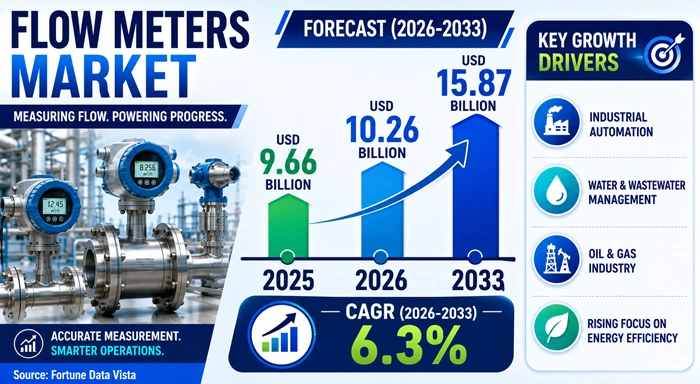
The global flow meters market size is valued at USD 9.66 billion in 2025 and is predicted to increase from USD 10.26 billion in 2026 to approximately USD 15.87 billion by 2033, growing at a CAGR of 6.3% from 2026 to 2033.
Flow meters are instruments used to measure the volumetric or mass flow rate of liquids, gases, and steam moving through pipelines and process systems. They serve as essential measurement components across a broad range of critical industrial applications — including oil and gas custody transfer, municipal water distribution, chemical process control, pharmaceutical manufacturing, food and beverage processing, power generation, and HVAC systems — where accurate flow measurement is fundamental to process efficiency, safety compliance, regulatory reporting, and energy management. The flow meters market encompasses a diverse technology landscape including electromagnetic, ultrasonic, Coriolis, differential pressure, vortex, thermal mass, and positive displacement designs — each optimized for specific fluid types, flow ranges, accuracy requirements, and installation environments. Growing industrial automation, expanding smart water management programs, accelerating IIoT adoption, and the increasing complexity of process industries are collectively driving strong and consistent commercial demand across the global flow measurement industry through 2033.
AI Impact on the Flow Meters Industry
Artificial intelligence is transforming flow meters from passive measurement instruments into intelligent, self-diagnosing, predictively capable process monitoring nodes — enabling industrial operators to extract substantially more operational value from their flow measurement infrastructure through real-time anomaly detection, predictive maintenance, and AI-powered process optimization
Artificial intelligence is redefining the commercial and operational value proposition of the flow meters market by elevating installed flowmeter hardware from simple measurement transducers into intelligent process monitoring assets. Modern smart flow meters increasingly incorporate embedded microprocessors capable of running machine learning algorithms that monitor signal patterns, detect early-stage measurement drift, identify partial pipe obstruction signatures, and flag coating or fouling conditions — all without requiring manual inspection or external data processing infrastructure. Emerson's Coriolis meters, Endress+Hauser's Proline series, and ABB's electromagnetic flowmeters are among the products already incorporating embedded diagnostic intelligence that provides continuous self-verification, reduces maintenance intervention frequency, and ensures measurement accuracy between calibration intervals. For industrial operators managing large distributed flowmeter fleets — across refineries, water utilities, and chemical plants — this embedded AI diagnostic capability reduces the total cost of ownership of flow measurement infrastructure by extending calibration intervals, preventing unexpected measurement failures, and enabling condition-based rather than calendar-based maintenance scheduling.
At the systems level, AI is creating powerful new capabilities through the integration of flowmeter data streams with plant-wide process optimization platforms and digital twin models. When AI analytics platforms process flow measurement data from multiple meters across a process system simultaneously — alongside temperature, pressure, and quality sensor inputs — they can detect subtle process efficiency degradation, identify energy waste patterns, and optimize flow distribution across complex piping networks with a system-level intelligence that individual meter diagnostics cannot achieve. Industrial companies including Emerson, Honeywell, and Siemens are actively developing AI-powered process optimization platforms that treat flow measurement data as a continuous intelligence input feeding autonomous process control recommendations — transforming flow measurement from a passive data collection function into an active driver of operational performance improvement. As IIoT connectivity, edge computing, and cloud analytics platforms continue to mature and integrate more deeply with field-installed flow measurement hardware, the strategic value of AI-enabled flow meters within industrial process optimization frameworks will grow significantly — reinforcing commercial investment in advanced flow measurement technology through 2033.
Growth Factors
The accelerating global expansion of oil and gas infrastructure, smart water management program investment, chemical and pharmaceutical industry process automation demand, the IIoT revolution enabling intelligent flow measurement networks, and growing environmental compliance requirements are generating broad-based and sustained commercial growth across the flow meters market through 2033
The oil and gas industry remains the single most commercially significant demand driver for the flow meters market — generating the largest volume of high-specification, high-value flow measurement deployments across upstream exploration, midstream pipeline transmission, and downstream refining operations. As global energy demand continues to grow and infrastructure investment in both conventional hydrocarbons and liquefied natural gas (LNG) terminals expands, the requirement for accurate, reliable flow measurement for custody transfer, allocation measurement, and process control generates consistent high-value demand for Coriolis, ultrasonic, and differential pressure flow meters that can meet the rigorous accuracy and reliability standards of fiscal metering applications. The development of U.S. shale gas reserves, Middle Eastern oil field expansion projects, and LNG export terminal construction in Australia, Qatar, and the United States are all creating large-scale flow measurement deployment opportunities that sustain the oil and gas sector's position as the primary revenue engine of the flow meters market. Growing focus on pipeline leak detection and emissions monitoring further drives demand for networked flow measurement systems capable of detecting small flow anomalies across long-distance pipeline infrastructure.
Smart water management is the second major commercial growth driver — with utilities worldwide investing heavily in intelligent water distribution network monitoring to reduce non-revenue water (NRW) losses, comply with water conservation regulations, and modernize aging measurement infrastructure. The United Nations' SDG 6 clean water targets, the EU Water Framework Directive, and U.S. EPA water loss control requirements are creating regulatory mandates that drive municipal water utility investment in electromagnetic and ultrasonic flow meters compatible with advanced metering infrastructure (AMI) networks. In developing markets — particularly across Asia Pacific, Latin America, and the Middle East — government-funded water infrastructure modernization programs are generating large-scale meter replacement and new installation opportunities for the flow meters market as utilities upgrade from mechanical to electronic and smart flow measurement systems. The global water stress challenge — with over 2 billion people living in water-scarce conditions — is intensifying the political and economic pressure on water utilities worldwide to invest in accurate, continuous flow monitoring infrastructure that enables precision water network management.
Market Outlook
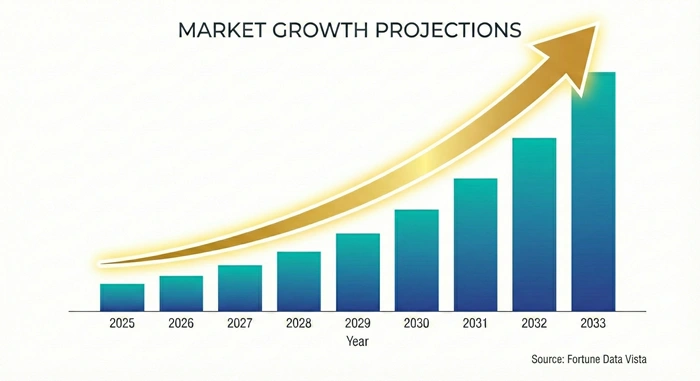
With a trajectory toward USD 15.87 billion by 2033 at a CAGR of 6.3%, the flow meters market is entering a sustained period of technology-driven commercial expansion — anchored by IIoT-enabled smart measurement infrastructure, ultrasonic and Coriolis technology adoption acceleration, environmental compliance demand, and emerging clean energy applications in hydrogen and biogas flow measurement
The medium-to-long-term outlook for the flow meters market is stable and broadly positive across all major technology, end-user, and geographic dimensions. Electromagnetic and ultrasonic flow meter technology segments are growing fastest, driven by their compatibility with IIoT connectivity, their suitability for clean water and wastewater applications, and the declining cost of advanced signal processing electronics that enables increasingly affordable high-performance clamp-on and inline ultrasonic meter deployment. The Coriolis flow meter segment — which delivers the highest mass flow measurement accuracy available and is the technology of choice for pharmaceutical, chemical, and custody transfer applications — continues to grow at above-average rates as industry operators in these high-value sectors justify the premium instrument cost with the measurement performance and process insight benefits it delivers. Differential pressure flow meters, while the most mature technology segment, will sustain their substantial installed base replacement and upgrade demand through 2033 — particularly for steam and high-temperature process applications where alternative technologies face deployment challenges.
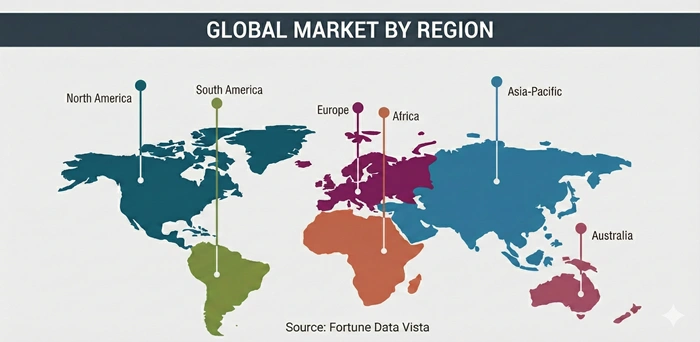
Asia Pacific will be the fastest-growing region through 2033, driven by massive industrial infrastructure expansion across China, India, Southeast Asia, and the Middle East-adjacent South Asian markets — with chemical, pharmaceutical, food processing, and municipal water utility sectors all generating strong demand for flow measurement technology at scale. North America will maintain its dominant market position, supported by the most active oil and gas production environment, the most technologically sophisticated industrial maintenance culture, and the highest per-installation flow meter capital expenditure driven by premium-specification Coriolis and ultrasonic meters in custody transfer and pharmaceutical applications. Europe will generate steady and growing revenue, driven by pharmaceutical and chemical industry process automation investment, renewable energy and hydrogen infrastructure development creating new flow measurement applications, and EU environmental compliance mandates driving monitoring infrastructure upgrades.
Expert Speaks
-
"The digital transformation of industrial flow measurement is accelerating faster than at any previous point in the industry's history. We are seeing customers across oil and gas, water utilities, and process industries invest in smart, connected flow meter platforms that go far beyond simple measurement to deliver continuous diagnostic intelligence, predictive maintenance signals, and real-time process performance data — and this capability expansion is driving both new deployment and upgrade replacement demand that we expect to sustain strong commercial growth through the remainder of this decade." — CEO perspective, leading global process automation and flow measurement instrument company
-
"Flow measurement accuracy is fundamental to operational profitability in energy-intensive industries — every percentage point of measurement uncertainty at a custody transfer station or process control loop directly translates into financial exposure. We are investing significantly in developing the next generation of Coriolis and ultrasonic flow meters with embedded AI diagnostics, advanced IIoT connectivity, and broader fluid compatibility — because our customers increasingly need flow measurement solutions that deliver not just accuracy but operational intelligence and remote monitoring capability at scale across large, distributed installations." — CEO perspective, leading precision measurement and industrial process technology company
-
"The intersection of environmental regulatory pressure and operational efficiency goals is creating unprecedented demand for advanced flow measurement solutions in water management, emissions monitoring, and energy metering applications globally. Smart flow meters that connect to utility management systems, enable remote reading, support leak detection algorithms, and generate the data quality required for environmental compliance reporting represent the growth frontier for our industry — and we are committed to leading that transition with product innovations that deliver both measurement excellence and digital connectivity." — CEO perspective, leading industrial instrumentation and measurement solutions provider
Key Report Takeaways
-
North America leads the global flow meters market, holding approximately 38% of total revenue share in 2025, driven by the world's most active oil and gas production and pipeline infrastructure, stringent EPA and industry standards mandating high-accuracy flow measurement in environmental and process applications, and the dominant commercial presence of leading flow meter vendors including Emerson, Honeywell, ABB, and Badger Meter — alongside the highest per-installation flow meter capital expenditure globally driven by premium Coriolis and ultrasonic fiscal metering applications.
-
Asia Pacific is the fastest-growing regional market, expected to register the highest CAGR through 2033, powered by massive industrial infrastructure construction across China, India, South Korea, and Southeast Asia, large-scale municipal water utility modernization programs across the region, explosive growth of chemical, pharmaceutical, and food processing industries generating strong process flow measurement demand, and government-funded smart city and smart water initiatives creating broad, sustained deployment opportunities for intelligent flow measurement systems.
-
Electromagnetic flow meters represent the largest technology segment, accounting for approximately 26.8% of global flow meters market revenue in 2025, as their superior performance for conductive liquid measurement — delivering high accuracy, zero pressure drop, and minimal maintenance requirements — makes them the dominant choice for water and wastewater utilities, chemical process applications, and food and beverage processing facilities that collectively represent the highest-volume flow meter deployment sectors globally.
-
Oil and gas is the largest end-user industry, contributing approximately 28.4% of global flow meters market revenue in 2025, generating the highest average revenue per flow meter installation through the premium Coriolis, ultrasonic, and multi-phase measurement technologies required for custody transfer accuracy, allocation measurement, and pipeline leak detection — with the shale production boom, LNG terminal construction, and Middle Eastern oil field expansion programs sustaining strong near-term demand.
-
Ultrasonic flow meters are the fastest-growing technology segment, expected to grow at a CAGR exceeding 8.1% through 2033, driven by their expanding applicability across both liquid and gas measurement, growing clamp-on deployment for non-invasive retrofit applications in existing pipelines, competitive cost positioning relative to Coriolis and electromagnetic alternatives, and strong demand from natural gas distribution utilities and municipal water systems investing in smart metering infrastructure upgrades.
-
Water and wastewater is the fastest-growing end-user segment, anticipated to grow at a CAGR exceeding 7.3% through 2033, as global water stress, UN SDG 6 targets, and municipal infrastructure modernization programs drive sustained investment in electromagnetic and ultrasonic flow meters for distribution network monitoring, non-revenue water reduction programs, and environmental compliance reporting — creating a structurally growing and government-funded demand pipeline in both developed and developing markets globally.
-
Inline flow meters are the largest product type segment, accounting for approximately 61.3% of global market revenue in 2025, as in-line installation remains the standard specification for permanent process and utility flow measurement applications requiring the highest accuracy, full-bore measurement, and long-term reliability — though non-invasive clamp-on and insertion meters are the fastest-growing sub-segments driven by retrofit and temporary measurement demand in the oil, gas, and water utility sectors.
Market Scope
| Parameter | Details |
|---|---|
| Market Size by 2033 | USD 15.87 Billion | Market Size by 2026 | USD 10.26 Billion | Market Size by 2025 | USD 9.66 Billion | Market Growth Rate from 2026 to 2033 | CAGR of 6.3% | Dominating Region | North America | Fastest Growing Region | Asia Pacific | Segments Covered | Technology, Phase, End-User Industry, Application, Product Type | Regions Covered | North America, Europe, Asia Pacific, Latin America, Middle East & Africa |
Market Dynamics
Drivers Impact Analysis
Expanding oil and gas infrastructure investment, global smart water management program momentum, IIoT-enabled intelligent flow measurement adoption, pharmaceutical and food industry process automation demand, and growing environmental compliance monitoring requirements are generating a compounding and multi-dimensional commercial growth engine sustaining the flow meters market through 2033
| Driver | ≈ % Impact on CAGR Forecast | Geographic Relevance | Impact Timeline |
|---|---|---|---|
| Oil and gas production and pipeline infrastructure expansion driving premium meter demand | ~27% | North America, Middle East, Asia Pacific | Short to Long Term |
| Smart water management and municipal utility modernization investment | ~24% | Asia Pacific, Europe, North America | Short to Long Term |
| IIoT adoption enabling intelligent, connected flow measurement networks | ~22% | North America, Europe, Asia Pacific | Short to Long Term |
| Pharmaceutical, food, and chemical industry process automation and compliance | ~18% | North America, Europe, Asia Pacific | Short to Medium Term |
| Environmental monitoring and emissions compliance mandates | ~9% | Europe, North America, Global | Short to Long Term |
The oil and gas industry's sustained capital expenditure in production, processing, and transportation infrastructure is the most commercially significant demand driver in the flow meters market — because it generates the highest average revenue per installed meter through the premium technology specifications required for fiscal metering accuracy. Custody transfer flow measurement in liquid and gas pipelines requires measurement uncertainty below 0.1–0.2%, which mandates the use of high-specification Coriolis or multi-path ultrasonic meters that represent substantially higher unit values than the meters used in process monitoring or utility applications. The global liquefied natural gas market — with LNG export capacity projected to grow by over 40% through 2030 — is creating a particularly powerful demand driver for high-specification ultrasonic fiscal meters at LNG loading terminals, regasification facilities, and pipeline interconnection metering stations globally. Growth in shale gas production infrastructure in North America, offshore oil platform construction in the North Sea and Gulf of Mexico, and Middle Eastern oil field expansion programs are all sustaining strong demand for Coriolis, differential pressure, and multi-phase flow measurement technology throughout the forecast period.
The global smart water management investment wave is the second most commercially powerful driver — creating a multi-decade replacement and upgrade cycle for the aging mechanical meter infrastructure that serves municipal water distribution networks worldwide. The World Bank estimates that global non-revenue water losses cost utilities over USD 14 billion annually — water that is either physically lost through pipe leaks or commercially lost through measurement inaccuracy — creating an enormous economic incentive for utility investment in accurate, continuously monitoring flow measurement technology. Electromagnetic flow meters connected to AMI networks enable utilities to detect distribution anomalies, identify developing pipe failures, and measure district metered area flows with the accuracy required for targeted NRW reduction programs. Government infrastructure investment programs — including the U.S. Infrastructure Investment and Jobs Act allocating over USD 55 billion to water infrastructure, the EU's water framework investment directives, and Asian Development Bank-funded water infrastructure projects across South and Southeast Asia — are creating large-scale, public-funded demand for smart flow measurement technology that reinforces the flow meters market's commercial growth prospects through 2033.
Restraints Impact Analysis
High capital costs for precision Coriolis and multi-path ultrasonic meters limiting adoption in price-sensitive markets, installation and maintenance complexity in difficult process environments, long hardware replacement cycles reducing annual market velocity, and competition from alternative measurement technologies are creating meaningful commercial headwinds moderating the flow meters market's growth trajectory
| Restraint | ≈ % Impact on CAGR Forecast | Geographic Relevance | Impact Timeline |
|---|---|---|---|
| High capital cost of precision Coriolis and multi-path ultrasonic meters limiting mid-market and emerging market adoption | ~40% | Asia Pacific, Latin America, MEA | Short to Long Term |
| Long installed equipment lifecycle reducing annual replacement and upgrade market velocity | ~35% | All markets | Short to Long Term |
| Installation complexity and process shutdown requirements for inline meter replacement | ~25% | Global | Short to Medium Term |
The high capital cost of the most technically advanced flow meter technologies — particularly Coriolis and multi-path ultrasonic meters — creates a significant restraint on adoption in price-sensitive markets and application segments where the performance premium does not justify the cost differential. A high-specification Coriolis meter for a pharmaceutical or custody transfer application can cost USD 5,000–50,000 depending on pipe size and specification, compared to USD 500–2,000 for a standard electromagnetic or differential pressure meter for general-purpose applications. In emerging market industrial deployments — where capital budgets are more constrained and operational sophistication is developing — buyers frequently specify lower-cost technology alternatives even when Coriolis or ultrasonic meters would deliver better long-term performance and total cost of ownership outcomes. This price sensitivity creates market segmentation dynamics that limit premium technology penetration in the fastest-growing emerging market geographies — moderating the overall revenue growth potential of the flow meters market in these regions.
The extended operational lifecycle of installed flow measurement hardware is a structural restraint on market velocity that fundamentally differentiates the flow meters market from faster-cycling technology segments. Industrial flow meters are designed and specified for 15–25 year operational lifetimes in demanding process environments — meaning that a large proportion of the existing global installed base of functional meters will not require replacement during the 2026–2033 forecast period. The annual replacement and upgrade market is therefore governed by lifecycle factors, performance dissatisfaction, or technology upgrade motivation rather than routine product turnover — creating a market where sales velocity is more constrained than in faster-refresh technology categories. This lifecycle restraint is partially offset by greenfield industrial construction and infrastructure expansion programs — which generate new installation demand independent of replacement cycles — but it nevertheless moderates the overall market growth rate and creates competitive pressure among vendors to differentiate on service, connectivity features, and upgrade value propositions that motivate earlier meter lifecycle replacement decisions.
Opportunities Impact Analysis
The emergence of hydrogen and biogas flow measurement as high-growth application frontiers, the massive retrofit opportunity in aging industrial meter infrastructure, the Asia Pacific industrial and utility construction boom, and the development of AI-integrated smart flow measurement platforms represent four high-value opportunity vectors that will materially expand the commercial frontier of the flow meters market through 2033
| Opportunity | ≈ % Impact on CAGR Forecast | Geographic Relevance | Impact Timeline |
|---|---|---|---|
| Hydrogen economy and clean energy infrastructure creating new precision flow measurement applications | ~33% | Europe, North America, Asia Pacific | Medium to Long Term |
| Aging infrastructure replacement cycle in industrial and municipal meter fleets | ~28% | North America, Europe | Short to Medium Term |
| Asia Pacific industrial and utility construction boom creating greenfield deployment volumes | ~27% | Asia Pacific | Short to Long Term |
| AI-integrated smart flow meter platform development expanding service and software revenue | ~12% | North America, Europe | Medium to Long Term |
The emerging hydrogen economy represents one of the most commercially significant long-term growth opportunities for the flow meters market — because hydrogen's unique physical properties (low density, high diffusivity, potential hydrogen embrittlement of materials) create demanding and specialized flow measurement requirements that cannot be met by conventional flow meter technologies without significant re-engineering. Accurate hydrogen flow measurement is essential for electrolysis production output verification, pipeline blending ratio monitoring, refueling station custody transfer, and fuel cell system management — and the rapidly expanding global hydrogen infrastructure investment (projected at over USD 300 billion through 2030) is creating a growing addressable market for hydrogen-compatible Coriolis, thermal mass, and ultrasonic flow meters with specialized materials, sealing systems, and signal processing designed for hydrogen service. Leading flow meter vendors including Endress+Hauser, Emerson, and Bronkhorst are actively developing hydrogen-optimized flow measurement products — with early commercial deployments already occurring at green hydrogen pilot plants in Europe and Japan, and with the commercial scale of hydrogen infrastructure expected to accelerate substantially through 2030 and beyond.
The aging infrastructure replacement opportunity is a nearer-term commercial catalyst — with a substantial portion of the global installed flow meter base in oil and gas pipelines, chemical plants, and water utilities approaching or exceeding their designed operational lifetime and requiring technology refresh investment. In North American oil and gas pipeline infrastructure — much of which was built in the 1970s–1990s — operators are investing in measurement technology upgrades that simultaneously replace aging meters and introduce IIoT connectivity, advanced diagnostics, and improved accuracy specifications that support modern pipeline management and regulatory compliance requirements. Similarly, municipal water utilities in Europe and North America are progressing through systematic meter replacement programs driven by infrastructure asset management plans and smart metering investment programs — creating large, planned, multi-year deployment pipelines for electromagnetic flow meter suppliers. These replacement programs are generating predictable and commercially significant order volumes for the flow meters market that reinforce the industry's stable and sustained revenue growth through 2033.
Segment Analysis
By Technology: Electromagnetic Flow Meters
Electromagnetic flow meters dominate the flow meters market through their combination of unmatched performance for conductive liquid measurement, zero pressure drop, minimal maintenance requirements, and broad compatibility with smart metering and IIoT connectivity infrastructure — making them the technology of choice for the world's largest flow measurement application categories
Electromagnetic flow meters represent the largest technology segment in the flow meters market, accounting for approximately 26.8% of global revenue in 2025 and growing at a CAGR of approximately 6.7% through 2033. Their operating principle — inducing a voltage in a conductive liquid passing through a magnetic field — delivers measurement accuracy of ±0.2–0.5% of reading with no moving parts, no pressure drop penalty, and full bore measurement capability that makes them ideal for the high-volume, continuous measurement demands of water distribution, wastewater treatment, chemical dosing, food and beverage processing, and pharmaceutical manufacturing applications. North America leads the electromagnetic flow meter segment, accounting for approximately 37% of global electromagnetic meter revenue in 2025, driven by extensive water utility deployment programs, pharmaceutical manufacturing measurement standards, and the dominant commercial presence of key vendors including Emerson's Micro Motion and Rosemount brands, ABB, and Endress+Hauser in U.S. industrial markets. Europe is the second-largest electromagnetic meter geography — with German, UK, and Scandinavian water utilities among the most technologically advanced early adopters of smart electromagnetic meters connected to AMI networks for real-time distribution monitoring and NRW management.
Asia Pacific is the fastest-growing electromagnetic flow meter geography, expanding at a regional CAGR exceeding 8.3% through 2033, as China's massive water infrastructure modernization program, India's Jal Jeevan Mission rural water supply expansion, and Southeast Asia's rapidly growing municipal water utility investment collectively drive unprecedented volume deployment of electromagnetic flow meters across the region. The water sector's specific requirement for reliable, hygienic, low-maintenance measurement in clean and waste water streams makes electromagnetic meters the default technology choice — with no viable alternative technology offering comparable performance in these applications. Key companies competing in the electromagnetic flow meter segment for the flow meters market globally include Endress+Hauser, Emerson, ABB, Yokogawa, Siemens, and Krohne — alongside strong regional competitors including Azbil Corporation in Japan and emerging Chinese manufacturers including Kaifeng Instrument and Beijing Automation Control that are competing aggressively on price in the Asia Pacific water and industrial utility markets.
By End-User Industry: Oil and Gas
Oil and gas remains the most commercially valuable and technology-demanding end-user segment in the flow meters market — generating the highest average revenue per installed instrument through the fiscal metering accuracy requirements, hazardous area certification specifications, and multi-phase measurement capabilities that define this sector's uniquely demanding and high-value flow measurement requirements
The oil and gas end-user segment holds the largest revenue share in the flow meters market, contributing approximately 28.4% of global market revenue in 2025 and growing at a CAGR of approximately 6.1% through 2033. The economic significance of accuracy in oil and gas custody transfer measurement — where even a 0.1% measurement error translates into millions of dollars of financial exposure at high-volume metering stations — creates a commercial environment where operators justify premium Coriolis and multi-path ultrasonic meter capital costs with compelling financial ROI arguments. Upstream exploration and production operations require flow measurement for well test monitoring, injection flow control, and production allocation across multi-well pad completions — driving demand for robust, field-deployable meters certified for explosion-hazardous zone installation. Midstream pipeline operations rely on high-specification custody transfer meters at compressor stations, custody transfer points, and interconnection metering stations — generating large, planned replacement and capacity expansion investment cycles. North America generates approximately 40% of global oil and gas flow meter revenue in 2025, driven by the world's largest shale production infrastructure, extensive LNG export terminal development on the U.S. Gulf Coast, and the highest per-meter capital investment globally driven by premium fiscal metering specifications.
The Middle East is the second-largest oil and gas flow meter market globally — with Saudi Aramco, Abu Dhabi National Oil Company, Kuwait Petroleum, and QatarEnergy collectively operating some of the world's largest flow measurement installations across oil field production, gas processing, LNG export, and petrochemical complex operations. Asia Pacific is the fastest-growing oil and gas flow meter region, driven by offshore oil and gas development in Southeast Asia, Chinese refinery expansion programs, and Indian refining and natural gas distribution infrastructure investment — all creating strong demand for both fiscal metering and process measurement flow meter deployment. Key companies competing for oil and gas flow meter contracts in the flow meters market include Emerson Electric, Endress+Hauser, ABB, Honeywell Process Solutions, Krohne, Yokogawa, and SICK AG — each offering application-specific product portfolios designed for the unique pressure ratings, temperature ranges, fluid compatibility requirements, and accuracy standards demanded by upstream, midstream, and downstream oil and gas measurement applications.
Regional Insights
North America
North America's world-leading oil and gas production and transmission infrastructure, the most technologically sophisticated industrial flow measurement culture globally, stringent regulatory standards driving continuous accuracy upgrades, and the home market concentration of the industry's leading flow meter vendors firmly establish it as the dominant commercial region in the global flow meters market
North America leads the flow meters market, accounting for approximately 38% of global revenue share in 2025, with a regional CAGR of approximately 6.1% projected through 2033. The United States drives the majority of regional revenue — anchored by the world's most active upstream oil and gas production environment, an extensive interstate natural gas pipeline network requiring continuous fiscal metering infrastructure, and stringent EPA and industry standards mandating high-accuracy flow measurement in environmental monitoring, pharmaceutical manufacturing, and water utility applications. The home market presence of major flow meter manufacturers — Emerson Electric (with Micro Motion, Rosemount, and Daniel brands), Honeywell Process Solutions, Badger Meter, and Cameron (a Schlumberger company) — creates a self-reinforcing ecosystem of product innovation, service infrastructure, and enterprise customer relationships that supports North America's market leadership. Canada contributes meaningful regional revenue through its oil sands production infrastructure, extensive natural gas distribution networks, and municipal water utility flow meter replacement programs in Ontario, Alberta, and British Columbia.
The North American flow meter market also benefits from the region's strong industrial asset management culture — where operators systematically track meter performance, calibration records, and lifecycle status across large installed fleets and invest in planned replacement programs that generate predictable annual procurement volumes for leading suppliers. The U.S. Infrastructure Investment and Jobs Act is creating a multi-year funded pipeline for water and wastewater infrastructure investment — including flow meter replacement and AMI-connected smart metering upgrades — that will sustain public sector demand for electromagnetic and ultrasonic flow meters through the forecast period. North America's flow meter market is increasingly bifurcating between the premium technology segment — Coriolis and multi-path ultrasonic for custody transfer and pharmaceutical applications — and the high-volume smart infrastructure segment — electromagnetic and ultrasonic for water utility AMI programs — with both segments generating above-market revenue growth rates that reinforce the region's commercial leadership.
Asia Pacific
Asia Pacific's extraordinary pace of industrial construction, the world's largest ongoing water infrastructure investment programs, explosive growth of chemical and pharmaceutical manufacturing, and government-backed smart city and smart utility initiatives are establishing the region as the most commercially dynamic and fastest-growing market in the global flow meters market
Asia Pacific is the fastest-growing region in the flow meters market, expected to grow at a regional CAGR of approximately 7.4% through 2033, driven by the world's largest and most diverse portfolio of industrial and infrastructure construction activity generating new flow measurement deployment demand at scale. China is the single largest individual country market within the region — with state-funded water infrastructure projects under the Sponge City Program, massive petrochemical complex construction, pharmaceutical industry expansion under the 14th Five-Year Plan, and food processing sector growth collectively generating enormous and diversified flow meter deployment volumes. India represents one of the most commercially significant emerging market opportunities — with the Jal Jeevan Mission committing over USD 50 billion to rural water supply infrastructure, rapid pharmaceutical and chemical industry expansion requiring process measurement upgrades, and oil and gas refining capacity additions generating strong demand for both utility and process flow meter technology. Key companies with strong Asia Pacific market presence in the flow meters market include Endress+Hauser, Emerson, ABB, Yokogawa, Siemens, Krohne, and Azbil Corporation — alongside growing domestic Chinese competitors including RIFL, Kaifeng Instrument, and Beijing Sevenstar that are gaining market share through competitive pricing and government procurement access in state-funded water and energy projects.
Japan, South Korea, and Australia contribute high-value revenue to the Asia Pacific flow meters market — with Japan's advanced industrial measurement culture and strong domestic vendors including Azbil, Oval Corporation, and Keyence generating significant Coriolis and thermal mass flow meter demand, South Korea's semiconductor, shipbuilding, and LNG infrastructure sectors creating precision measurement requirements, and Australia's extensive mining, LNG export terminal, and municipal water utility investments driving diverse flow meter deployment. Southeast Asia — including Indonesia, Malaysia, Vietnam, and Thailand — represents the fastest-growing sub-region within Asia Pacific, as rapidly expanding petrochemical, food and beverage, and pharmaceutical industries generate strong process flow measurement demand in markets where Western flow meter vendors are actively investing in distribution network expansion and local service infrastructure. As Asia Pacific's industrial infrastructure continues to expand at a rate unmatched by any other world region, the flow meters market in the Asia Pacific region will maintain its status as the most commercially dynamic and fastest-growing geography through 2033 and beyond.
Report Customization Available
Get a Fully Customized Flow Meters Market Report for Your Target Region or Country
Our flow meters market report is available with complete region-specific and country-level customization designed to address your precise strategic research and commercial intelligence requirements. Each customized version delivers in-depth market sizing, technology segment analysis, end-user industry demand profiling, regulatory compliance environment review, competitive landscape analysis of regional and global meter vendors, and growth opportunity mapping — all calibrated specifically to the commercial dynamics, industrial structure, and regulatory environment of your chosen geography and application focus area.
Customized flow meters market reports are available for the following regions and countries:
North America
-
United States – Detailed analysis of oil and gas custody transfer metering investment, EPA and DOT regulatory compliance driving flow meter upgrades, water utility AMI smart metering programs, pharmaceutical cGMP measurement standards, Emerson and Honeywell domestic competitive landscape, and Infrastructure Investment and Jobs Act water infrastructure funding impact
-
Canada – Coverage of Canadian oil sands production flow measurement needs, TransCanada and Enbridge pipeline metering infrastructure, provincial water utility upgrade programs, domestic regulatory standards for fiscal metering, and international vendor competitive presence in Canadian industrial and utility markets
-
Mexico – Analysis of Pemex flow measurement infrastructure, Mexican water utility meter upgrade programs, growing chemical and food industry flow meter demand, regulatory environment for custody transfer measurement, and international vendor market access strategies
Europe
-
United Kingdom – Ofwat regulatory drivers for water utility metering upgrades, North Sea oil and gas flow measurement demand, post-Brexit regulatory alignment implications, domestic vendor presence including ABB and Spirax-Sarco, and pharmaceutical industry precision measurement requirements
-
Germany – German chemical and pharmaceutical industry Coriolis and thermal mass flow meter demand, DIN/ISO regulatory standards for industrial measurement, water utility electromagnetic meter deployment, Endress+Hauser and Krohne domestic competitive leadership, and Industry 4.0 smart flow measurement integration
-
France – French water utility measurement upgrade investment, nuclear power plant flow measurement requirements, pharmaceutical and food industry metering demand, COFRAC accreditation framework, and domestic flow meter vendor landscape
-
Italy – Italian chemical, pharmaceutical, and food processing flow measurement demand, MISE energy efficiency regulations driving meter upgrades, water utility investment in smart metering, and international vendor commercial presence in Italian industrial markets
-
Rest of Europe – Coverage of Netherlands, Sweden, Switzerland, and Poland regarding industrial process flow measurement demand, oil and gas pipeline metering, water utility smart infrastructure investment, and EU regulatory compliance driving measurement upgrades
Asia Pacific
-
China – MIIT and MOW regulatory framework, domestic vendor competitive landscape including RIFL and Kaifeng Instrument, Sponge City Program water meter demand, petrochemical and pharmaceutical industry flow measurement investment, and international vendor localization and manufacturing strategies
-
India – Jal Jeevan Mission water infrastructure impact, BIS regulatory standards for flow meters, pharmaceutical and chemical industry precision measurement demand, oil and gas refining sector requirements, and domestic versus international vendor competitive dynamics
-
Japan – METI industrial efficiency standards, Japanese pharmaceutical and semiconductor industry precision flow measurement, domestic vendor landscape including Azbil and Oval Corporation, LNG import terminal metering requirements, and advanced IIoT integration in Japanese industrial flow measurement
-
South Korea – Korean semiconductor and LNG infrastructure flow measurement needs, K-Water utility smart metering programs, domestic industrial measurement standards, Samsung and POSCO industrial flow meter procurement, and international vendor market access strategies
-
Australia – NATA calibration standards, Australian LNG export terminal Coriolis custody transfer requirements, water utility AMI programs, mining sector flow measurement needs, and international vendor commercial presence and service infrastructure
-
Rest of Asia Pacific – Coverage of Indonesia, Malaysia, Vietnam, and Thailand regarding petrochemical and palm oil industry flow measurement, water utility upgrade programs, government industrial development programs driving meter demand, and international vendor distribution strategies
Latin America
-
Brazil – Petrobras and Transpetro pipeline flow measurement infrastructure, ANA water regulatory framework driving utility metering, pharmaceutical and food industry measurement demand, INMETRO calibration standards, and domestic versus international vendor competitive landscape
-
Argentina – Oil and gas production flow measurement needs, water utility infrastructure investment, YPF flow measurement procurement, regulatory environment for custody transfer metering, and international vendor market access and distribution
-
Rest of Latin America – Coverage of Colombia, Chile, and Peru regarding mining, oil and gas, and water utility flow meter demand, government infrastructure investment programs, and international vendor commercial presence in Andean and Central American markets
Middle East & Africa
-
UAE – ADNOC and ENOC oil and gas flow measurement infrastructure, Dubai Electricity and Water Authority smart metering programs, industrial zone chemical and pharmaceutical flow measurement demand, ESMA regulatory standards, and international vendor commercial presence in GCC markets
-
Saudi Arabia – Saudi Aramco and SABIC flow measurement procurement, Vision 2030 water infrastructure investment driving smart metering, NIDLP localization requirements for industrial equipment, and international versus domestic flow meter vendor dynamics in Saudi industrial markets
-
Rest of MEA – Coverage of South Africa, Kuwait, Oman, Qatar, and Egypt regarding oil and gas flow measurement investment, water utility smart metering programs, mining industry flow measurement needs, and international vendor market access and local agent distribution landscape
Top Key Players
-
Emerson Electric Co. (United States)
-
Endress+Hauser Group (Switzerland)
-
ABB Ltd. (Switzerland)
-
Honeywell International Inc. (United States)
-
Siemens AG (Germany)
-
Yokogawa Electric Corporation (Japan)
-
Krohne Group (Germany)
-
Badger Meter, Inc. (United States)
-
SICK AG (Germany)
-
Azbil Corporation (Japan)
-
Spirax-Sarco Engineering plc (United Kingdom)
-
Bronkhorst High-Tech B.V. (Netherlands)
-
Oval Corporation (Japan)
-
Cameron (Schlumberger) (United States)
-
Keyence Corporation (Japan)
Recent Developments
-
In March 2025, Emerson Electric Co. launched its next-generation Coriolis flow and density meter — the Micro Motion G-Series — featuring enhanced IIoT connectivity with built-in HART, Foundation Fieldbus, and WirelessHART communication protocols, an expanded fluid measurement range for high-viscosity process fluids, and an integrated AI-powered diagnostics module that continuously monitors meter health and provides early warning of process upsets or coating conditions. The product launch reinforced Emerson's leadership in the premium Coriolis flow meter segment and directly addressed growing demand for intelligent, connected fiscal metering solutions in oil and gas, chemical, and pharmaceutical applications globally.
-
In January 2025, Endress+Hauser Group completed the acquisition of Vortex Technologies GmbH — a specialized German manufacturer of high-temperature vortex flow meters for steam and hot gas measurement applications in the power generation and chemical industries. The acquisition expanded Endress+Hauser's product portfolio into high-temperature process measurement applications and reinforced its competitive position in the European power generation and industrial steam metering segment of the flow meters market, complementing its existing electromagnetic, Coriolis, and ultrasonic product lines.
-
In October 2024, Badger Meter, Inc. announced the expansion of its ORION Cellular Advanced Metering Infrastructure (AMI) system — launching a new cloud-based water utility analytics platform that integrates real-time electromagnetic flow meter data with AI-powered leak detection algorithms, demand forecasting tools, and automated regulatory reporting features. The platform launch significantly expanded Badger Meter's smart water metering value proposition for U.S. and Canadian municipal water utilities and positioned the company as a leading provider of integrated smart water flow management solutions for the water utility segment of the flow meters market.
-
In September 2024, Krohne Group received ATEX and IECEx hazardous area certification for its new OPTISWIRL 4300 vortex flow meter series — featuring an enhanced piezoelectric sensor design with improved performance in steam and wet gas applications, advanced self-diagnostics, and Bluetooth commissioning capability for safe and efficient installation in explosive atmosphere classified process environments. The certification expanded Krohne's addressable market for vortex flow measurement in oil and gas, chemical, and power generation applications where hazardous area compliance is a mandatory specification requirement.
-
In April 2025, Yokogawa Electric Corporation launched its RotaMASS 3-Series Coriolis mass flow meter with embedded AI-driven process diagnostics — the first Yokogawa Coriolis product to incorporate machine learning-based signal analysis capable of detecting two-phase flow conditions, coating buildup, and entrained gas in real time during normal process operation without requiring system shutdown. The product launch strengthened Yokogawa's competitive position in the high-specification pharmaceutical, chemical, and food and beverage process measurement applications that require continuous, validated flow measurement performance assurance in the flow meters market.
Market Trends
The convergence of IIoT connectivity transforming flow meters into intelligent, networked process monitoring nodes, the rapid commercial expansion of clamp-on non-invasive ultrasonic technology enabling affordable retrofit measurement without process interruption, and the emergence of hydrogen and clean energy as new high-growth application frontiers are defining the most commercially consequential trends reshaping the flow meters market through 2033
The most transformative technology trend reshaping the flow meters market is the integration of IIoT connectivity and embedded intelligence into field-installed flow measurement hardware — transitioning the industry's product value proposition from accurate measurement instruments to intelligent, networked process monitoring assets. Leading vendors including Endress+Hauser, Emerson, and ABB are equipping new flow meter generations with integrated HART, Foundation Fieldbus, Profibus, Modbus, and wireless communication capabilities that enable continuous, remote meter health monitoring, process data streaming to cloud analytics platforms, and remote configuration — eliminating the cost and safety risk of physical site visits for routine maintenance and configuration tasks. The Endress+Hauser Heartbeat Technology, Emerson's Pervasive Sensing architecture, and ABB's Ability Industrial Internet of Things platform each represent commercial implementations of this intelligent, connected flow meter vision — and their growing adoption among process industry operators is establishing IIoT connectivity as a standard specification requirement for new flow meter procurement rather than a premium upgrade option. This trend is simultaneously expanding vendor revenue opportunities beyond hardware sales into recurring software subscription, managed service, and predictive maintenance contract revenue streams.
The second defining market trend is the rapid commercial expansion of non-invasive clamp-on ultrasonic flow measurement — which eliminates process shutdown requirements for meter installation, avoids wetted parts reliability concerns, and enables temporary or permanent measurement in applications where inline meter installation is impractical or prohibitively expensive. Advances in signal processing algorithms, transducer coupling technology, and meter intelligence have progressively improved clamp-on ultrasonic accuracy to within ±1% in well-characterized pipe installations — making it a commercially viable alternative to inline meters for an expanding range of process and utility applications. In the water utility and district energy metering segments, clamp-on ultrasonic meters are enabling network-wide flow monitoring deployments at scale that would not be economically feasible with inline meters — because installation requires no excavation, no pipe cutting, and no process interruption. FLEXIM, Siemens, Emerson, and SICK are leading commercial vendors in the clamp-on ultrasonic segment, with growing order pipelines from water utilities, HVAC operators, and process industry customers seeking retrofit measurement solutions that deliver usable data quality without the cost and disruption of traditional inline meter installation.
Segments Covered in the Report
-
By Technology
-
Differential Pressure Flow Meters (Orifice Plate, Venturi Tube, Flow Nozzle, Pitot Tube, Annubar)
-
Positive Displacement Flow Meters (Oval Gear, Piston, Diaphragm, Rotary Vane)
-
Electromagnetic Flow Meters
-
Ultrasonic Flow Meters (Transit-Time, Doppler, Clamp-On)
-
Coriolis Flow Meters
-
Vortex Flow Meters
-
Thermal Mass Flow Meters
-
Others (Turbine, Variable Area/Rotameter)
-
-
By Phase
-
Liquid Flow Meters
-
Gas Flow Meters
-
Steam Flow Meters
-
-
By End-User Industry
-
Oil and Gas
-
Water and Wastewater
-
Chemical and Petrochemical
-
Power Generation
-
Food and Beverage
-
Pharmaceutical and Biotechnology
-
Pulp and Paper
-
Mining
-
HVAC
-
Others
-
-
By Application
-
Process Monitoring and Control
-
Custody Transfer and Fiscal Metering
-
Leak Detection
-
Energy Management
-
Environmental Monitoring and Compliance
-
Others
-
-
By Product Type
-
Inline Flow Meters
-
Insertion Flow Meters
-
Non-Invasive (Clamp-On) Flow Meters
-
-
By Region
-
North America (U.S., Canada, Mexico)
-
Europe (U.K., Germany, France, Italy, Rest of Europe)
-
Asia Pacific (China, India, Japan, South Korea, Australia, Rest of Asia Pacific)
-
Latin America (Brazil, Argentina, Rest of Latin America)
-
Middle East & Africa (UAE, Saudi Arabia, Rest of MEA)
-
❝ Built for Every Level — From Startups to Industry Giants ❞
Here Is Exactly How This Report Works for You
-
For Tier 1 industrial automation conglomerates, global EPC contractors, and institutional investors: This report delivers granular competitive revenue analysis for all 15 major flow meter vendors — including Emerson, Endress+Hauser, ABB, Honeywell, and Yokogawa — with detailed technology segment revenue breakdowns, end-user industry penetration assessments, and IIoT product portfolio benchmarking. It further provides a comprehensive analysis of how geopolitical dynamics — including U.S.-China industrial technology localization pressure affecting Western vendor market access in Chinese government procurement, EU carbon border adjustment mechanism driving energy measurement compliance investment, Russian energy market disruption reshaping European gas metering infrastructure investment — are directly impacting competitive strategies, manufacturing footprint decisions, and investment priorities across the flow meters market, enabling leadership teams to navigate complexity with data-informed confidence.
-
For Tier 2 and Tier 3 flow meter manufacturers, measurement distributors, and calibration service companies: This report identifies specific technology segments, application categories, and geographic markets where demand is growing faster than current competitive supply — revealing commercial white-space opportunities for specialized niche flow meter products, regional distribution partnerships, calibration and maintenance service expansion, and system integration service businesses that serve the IIoT-connected flow measurement market. Competitor revenue source analysis shows which technology platforms, end-user verticals, and service offerings are generating the highest growth and margin rates for market leaders — providing strategic benchmarking intelligence for product portfolio decisions and go-to-market investment prioritization in the flow meters market.
-
For Flow meter technology startups, private equity investors, and industrial technology M&A teams: This report maps the highest-CAGR commercial frontiers — hydrogen-compatible flow measurement technology, AI-integrated smart meter platforms, non-invasive clamp-on ultrasonic systems, and Asia Pacific water utility smart metering infrastructure — with detailed analysis of competitive intensity, technology differentiation windows, M&am
Frequently Asked Questions:
Answer: The global flow meters market was valued at USD 9.66 billion in 2025 and is projected to reach approximately USD 15.87 billion by 2033, growing at a CAGR of 6.3% from 2026 to 2033. This growth is driven by expanding oil and gas infrastructure investment, smart water management program adoption, IIoT integration enabling intelligent flow measurement networks, and growing environmental monitoring and compliance requirements across industrial sectors globally.
Answer: Electromagnetic flow meters hold the largest technology segment share in the flow meters market at approximately 26.8% of global revenue in 2025, due to their superior performance for conductive liquid measurement in water, wastewater, and process applications. Ultrasonic flow meters are the fastest-growing technology segment, expanding at a CAGR exceeding 8.1% through 2033, driven by non-invasive clamp-on retrofit applications, expanding natural gas distribution metering, and growing adoption in water utility AMI-connected smart metering programs.
Answer: Oil and gas is the largest end-user industry in the flow meters market, accounting for approximately 28.4% of global revenue in 2025, driven by the high-value Coriolis and multi-path ultrasonic meters required for fiscal metering accuracy in custody transfer and pipeline operations. Water and wastewater is the fastest-growing end-user segment — driven by global water infrastructure modernization programs, non-revenue water reduction investment, and smart metering upgrades mandated by government water conservation policies — and pharmaceutical, chemical, and food and beverage industries are also significant and growing contributors to total flow meter demand.
Answer: North America dominates the flow meters market with approximately 38% of global revenue share in 2025, anchored by the world's most active oil and gas production and pipeline infrastructure, stringent regulatory standards requiring high-accuracy measurement, and the home market presence of leading vendors including Emerson, Honeywell, and Badger Meter. Asia Pacific is the fastest-growing region at a projected CAGR of approximately 7.4% through 2033, powered by massive industrial construction in China and India, government-funded water infrastructure programs, and rapidly expanding chemical, pharmaceutical, and food processing industries generating strong process flow measurement demand.
Answer: IIoT integration is transforming flow meters from passive measurement instruments into intelligent, networked process monitoring nodes — with embedded communication capabilities including HART, Foundation Fieldbus, and wireless protocols enabling continuous remote health monitoring, real-time data streaming to cloud analytics platforms, and AI-powered predictive maintenance signaling from field-installed meters. Leading vendors including Emerson, Endress+Hauser, and ABB have developed IIoT-enabled smart flow meter platforms with embedded diagnostics that reduce maintenance costs, extend calibration intervals, and enable plant-wide process optimization — expanding vendor revenue opportunities beyond hardware into recurring software subscription and managed maintenance service streams that are increasingly valued across the industrial process industries.