
Generative AI in Media and Entertainment Market Overview
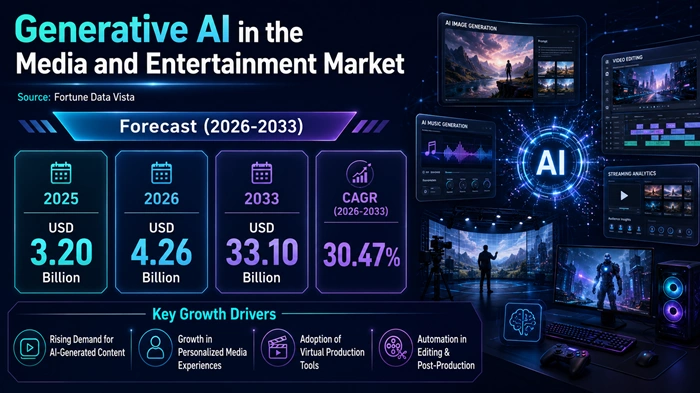
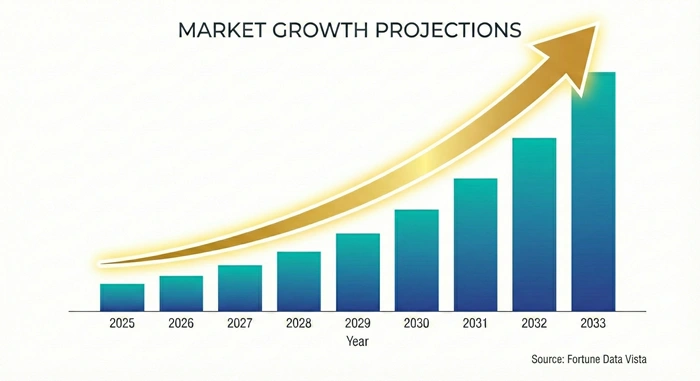
The global generative AI in media and entertainment market size is valued at USD 3.20 billion in 2025 and is predicted to increase from USD 4.26 billion in 2026 to approximately USD 33.10 billion by 2033, growing at a CAGR of 30.47% from 2026 to 2033.
This explosive growth trajectory reflects rapid adoption of AI-powered content creation tools across film, gaming, music, and advertising production workflows worldwide. As studios and streaming platforms race to reduce production costs while accelerating content output, generative AI has moved from experimental technology to a mainstream production tool embedded across nearly every stage of the creative pipeline.
AI Impact on the Generative AI in Media and Entertainment Industry
Generative Artificial Intelligence Is Transforming Content Creation Speed, Enabling Hyper-Personalized Viewer Experiences, and Redefining Visual Effects Production Across the Media and Entertainment Landscape — Fundamentally Changing How Studios Build Creative Content
Generative AI has fundamentally altered how creative teams approach content production, with studios now using text-to-video and text-to-image models to generate storyboards, concept art, and even finished visual sequences in a fraction of the time traditional methods required. This capability is proving especially valuable for smaller production houses that previously lacked the budget for extensive visual effects work, since generative tools can now produce convincing environments, backgrounds, and character animations without requiring large specialized VFX teams. Major studios are similarly embracing these tools to compress production timelines on big-budget projects, freeing creative talent to focus on storytelling rather than repetitive technical execution.
Beyond content creation itself, generative AI is reshaping how media companies personalize viewer experiences, with streaming platforms increasingly using AI-generated trailers, thumbnails, and even alternate scene edits tailored to individual viewer preferences. This level of personalization was simply impractical at scale before generative AI made rapid content variation economically feasible. As these capabilities continue advancing, they are becoming a core competitive differentiator for media companies competing within the broader generative AI in media and entertainment market, pushing traditional studios to accelerate their own AI adoption considerably.
Growth Factors
Rising Production Cost Pressure and Growing Demand for Faster Content Output Continue Driving Sustained Adoption
The most significant growth factor supporting the generative AI in media and entertainment market is the intense pressure studios and streaming platforms face to produce more content faster while managing tightening production budgets amid a highly competitive streaming landscape. Generative AI tools have demonstrated a clear ability to compress timelines for tasks like rotoscoping, background generation, and dubbing localization, making AI adoption an increasingly obvious choice for production companies seeking to maintain output volume without proportionally increasing headcount or budget.
A second important growth factor is the growing consumer expectation for personalized, immersive entertainment experiences, as audiences increasingly favor platforms that can deliver content recommendations, dynamic storylines, and localized versions tailored to their specific preferences and language needs. Media companies are investing heavily in generative AI capabilities that can automatically translate, dub, and adapt content for international markets, dramatically expanding the reach of a single production without requiring separate localized shoots. This expanding range of practical applications continues to broaden adoption across the generative AI in media and entertainment market.
Market Outlook
Virtual Production Expansion and Growing Gaming Industry Integration Point Toward Accelerating Growth Through 2033
Looking ahead through the forecast period, the generative AI in media and entertainment industry is expected to see substantial growth in virtual production applications, as filmmakers increasingly combine generative AI with real-time rendering engines to create entire virtual sets and environments that eliminate the need for costly location shoots. This shift toward AI-assisted virtual production is likely to fundamentally reshape how mid-budget films and television series are made, extending Hollywood-grade visual quality to productions that previously could not afford such capabilities.
At the same time, deepening integration of generative AI within gaming development is expected to drive substantial growth, as game studios use AI tools to generate vast open-world environments, non-player character dialogue, and procedurally generated content that would take enormously longer to build manually. Companies that successfully combine generative AI capabilities across film, television, gaming, and music production stand to capture disproportionate value as these previously separate industries increasingly converge around shared AI infrastructure. Businesses balancing rapid innovation with careful intellectual property management are best positioned to lead growth within the broader generative AI in media and entertainment market through 2033.
Expert Speaks
-
"Generative AI is fundamentally changing our creative pipeline, allowing storytellers to iterate faster and bring ambitious ideas to life that would have been cost-prohibitive just a few years ago." — CEO, Adobe Inc
-
"Our cloud AI infrastructure is becoming the backbone for how studios and streaming platforms are reimagining content production at scale." — CEO, Amazon Web Services
-
"We see enormous opportunity in helping creative professionals use AI as a collaborative tool rather than a replacement, and that philosophy is shaping everything we build." — CEO, Autodesk Inc
Key Report Takeaways
-
North America leads the global generative AI in media and entertainment market, holding approximately 40% market share in 2025, supported by a dense concentration of major studios, streaming platforms, and leading AI technology providers
-
Asia Pacific is the fastest-growing region, projected to expand at a CAGR near 35% through 2033, driven by rapidly expanding gaming industries and growing content production investment across China, Japan, and India
-
Streaming platforms and OTT providers represent the fastest-growing customer base, increasingly adopting generative AI for personalized content recommendations and localization
-
Video and animation content generation contributes the most to overall demand, reflecting the sheer scale of visual content production across film, television, and advertising
-
Text-to-video generation remains the most widely adopted technology type, valued for its ability to dramatically accelerate storyboarding and pre-visualization workflows
-
Cloud-based deployment will grow the fastest among deployment segments, holding close to 65% market share with a CAGR near 33% through the forecast period, driven by scalability and lower infrastructure investment requirements
Market Scope
| Parameter | Details |
|---|---|
| Market Size by 2033 | USD 33.10 Billion | Market Size by 2026 | USD 4.26 Billion | Market Size by 2025 | USD 3.20 Billion | Market Growth Rate from 2026 to 2033 | CAGR of 30.47% | Dominating Region | North America | Fastest Growing Region | Asia Pacific | Segments Covered | Technology, Application, Deployment Mode, End User, Region | Regions Covered | North America, Europe, Asia Pacific, Latin America, Middle East & Africa |
Market Dynamics
Drivers Impact Analysis
Rising Production Cost Pressure and Growing Demand for Personalized Content Remain the Two Strongest Forces Behind Market Momentum
| Driver | (≈) % Impact on CAGR Forecast | Geographic Relevance | Impact Timeline |
|---|---|---|---|
| Growing need to reduce production costs and accelerate content timelines | ~35% | Global, strongest in North America | Short to long-term |
| Rising consumer demand for personalized and localized content experiences | ~27% | Global | Medium to long-term |
| Expanding integration of generative AI in gaming and virtual production | ~22% | North America, Asia Pacific | Medium-term |
| Increasing availability of advanced generative AI models and cloud infrastructure | ~16% | Global | Short to medium-term |
Growing need to reduce production costs continues to serve as the primary engine behind sustained growth in the generative AI in media and entertainment market, as studios and streaming platforms face intensifying competition that demands ever-larger content libraries produced within increasingly compressed budgets. Generative AI tools have proven capable of dramatically cutting time spent on tasks like visual effects, dubbing, and content variation, making this technology an increasingly essential part of modern production workflows.
Rising consumer demand for personalized content represents the second major driver, as audiences increasingly expect entertainment experiences tailored to their individual tastes, viewing habits, and language preferences. This growing expectation, combined with expanding generative AI integration in gaming and virtual production environments, continues reinforcing steady demand growth across the broader generative AI in media and entertainment market.
Restraints Impact Analysis
Intellectual Property Concerns and Talent Workforce Disruption Continue Moderating Adoption Speed
| Restraint | (≈) % Impact on CAGR Forecast | Geographic Relevance | Impact Timeline |
|---|---|---|---|
| Intellectual property and copyright concerns around AI-generated content | ~38% | Global, strictest in North America, Europe | Ongoing |
| Workforce disruption concerns among creative professionals and unions | ~29% | North America, Europe | Short to medium-term |
| High computational costs for training and running advanced generative models | ~20% | Global | Medium-term |
| Regulatory uncertainty around AI content labeling and disclosure | ~13% | Global | Long-term |
Intellectual property and copyright concerns represent the most significant restraint facing the generative AI in media and entertainment market, since generative models are often trained on vast datasets that may include copyrighted creative works, raising legal uncertainty that has already triggered high-profile litigation across the industry. This uncertainty makes many studios cautious about fully embracing generative AI tools until clearer legal frameworks and licensing arrangements emerge.
Workforce disruption concerns present a second substantial restraint, as writers, animators, and visual effects artists have raised significant concerns about generative AI displacing creative jobs, leading to labor disputes and union negotiations that have directly shaped how studios can deploy these tools. Combined with the high computational costs required to run advanced generative models at scale, these restraints continue moderating how quickly full-scale adoption spreads across the broader generative AI in media and entertainment market.
Opportunities Impact Analysis
Virtual Production Expansion and Growing Gaming Industry Convergence Represent the Clearest Paths to Growth
| Opportunity | (≈) % Impact on CAGR Forecast | Geographic Relevance | Impact Timeline |
|---|---|---|---|
| Expanding virtual production and AI-generated environment creation | ~39% | Global | Short to medium-term |
| Growing convergence between generative AI, gaming, and interactive entertainment | ~33% | North America, Asia Pacific | Medium to long-term |
| Increasing demand for automated content localization and dubbing | ~28% | Global, strongest in Asia Pacific, Latin America | Short to medium-term |
Expanding virtual production capabilities represent one of the most substantial opportunities within the generative AI in media and entertainment market, as filmmakers increasingly combine generative AI with real-time rendering to build entire virtual environments that reduce reliance on costly physical sets and location shoots. Technology providers offering integrated virtual production ecosystems stand to capture significant value as this approach becomes standard practice across mid-budget and independent productions.
Growing convergence between generative AI and gaming presents a second substantial opportunity, as game studios increasingly use AI to generate expansive open worlds, dynamic narratives, and realistic character behavior that would be prohibitively time-consuming to build manually. Increasing demand for automated content localization further broadens the opportunity landscape, particularly across Asia Pacific and Latin America where studios seek cost-effective ways to adapt content for diverse regional audiences. Companies pursuing these parallel opportunities are well positioned to capture meaningful growth within the broader generative AI in media and entertainment market through the forecast period.
Segment Analysis
By Application: Video and Animation Content Creation
Video and Animation Content Creation Continues to Anchor the Application Landscape, Reflecting the Scale of Visual Production Demand
Video and animation content creation holds the largest share within the application segment of the generative AI in media and entertainment market, accounting for approximately 38% of total segment revenue in 2025. This dominance reflects the sheer volume of visual content that film, television, and advertising production requires, where generative AI tools can dramatically accelerate tasks ranging from background generation to full scene creation without the traditional cost of manual animation or extensive VFX teams. Studios increasingly rely on these tools to produce content at a pace that traditional production methods simply cannot match, particularly for streaming platforms competing to release new titles continuously. Leading technology providers such as Adobe, Runway AI, and Autodesk continue to dominate this segment through continuous expansion of their generative video and animation capabilities.
Growth within this segment remains particularly strong in North America, where major studios and streaming platforms continue investing heavily in generative video tools to maintain competitive content release schedules. The region's dense concentration of production companies and technology providers has helped sustain rapid adoption despite ongoing debates around intellectual property and creative labor implications. As generative video quality continues improving and production costs decline further, video and animation content creation is expected to remain the leading application segment within the broader generative AI in media and entertainment market throughout the forecast period.
By End User: Streaming Platforms and OTT Providers
Streaming Platforms Remain a Rapidly Expanding End-User Segment, Driven by Personalization and Content Velocity Demands
Streaming platforms and OTT providers represent one of the fastest-growing end-user segments within the generative AI in media and entertainment market, reflecting their unique need to continuously produce fresh content while simultaneously personalizing viewer experiences at massive scale. These platforms rely heavily on generative AI for tasks like automated trailer creation, dynamic thumbnail generation, and content localization that allows a single production to reach global audiences in multiple languages without separate localized shoots. This consistent, high-value demand has made streaming platforms an increasingly important customer base for generative AI technology vendors serving the broader entertainment industry.
Growth among streaming platform end users remains especially strong in Asia Pacific, where rapidly expanding subscriber bases across China, India, and Southeast Asia create substantial demand for localized content production at scale. Companies like Netflix and various regional streaming providers have expanded their internal AI capabilities significantly to support this growing personalization and localization need. As streaming competition intensifies globally, this end-user segment is expected to remain a key demand driver within the broader generative AI in media and entertainment market.
Regional Insights
North America
Dense Studio Concentration and Advanced AI Technology Infrastructure Keep North America Firmly in the Lead
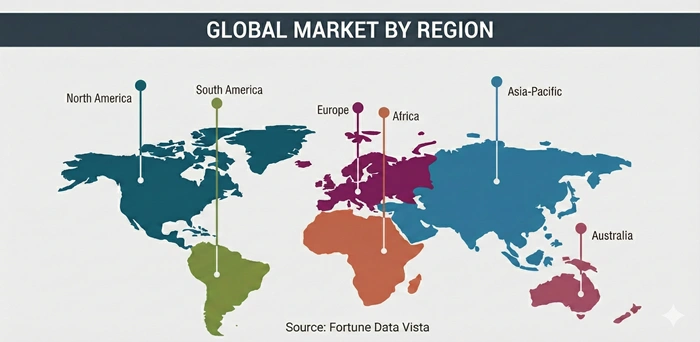
North America commands the leading position in the global generative AI in media and entertainment market, holding approximately 40% share in 2025, supported by a dense concentration of major film studios, streaming platforms, and leading generative AI technology providers headquartered across the region. The United States drives the overwhelming majority of regional demand, backed by Hollywood's continued investment in AI-assisted production tools and a highly competitive streaming landscape that rewards faster, more personalized content delivery. Companies with strong regional presence include Adobe, Autodesk, Amazon Web Services, Microsoft, and Runway AI, each maintaining deep relationships with major studios and production houses across the country.
Canada also contributes meaningfully to regional demand, supported by its growing visual effects and animation production industry that increasingly incorporates generative AI tools into established workflows. The region's combination of strong technology infrastructure, deep creative industry expertise, and continuous AI innovation investment ensures North America's leadership position within the generative AI in media and entertainment market remains firmly intact through the remainder of the forecast period.
Asia Pacific
Expanding Gaming Industry and Rising Content Production Investment Position Asia Pacific as the Fastest-Growing Region
Asia Pacific is projected to register the fastest CAGR within the global generative AI in media and entertainment market through 2033, expanding at a rate near 35% as rapidly expanding gaming industries and rising content production investment create substantial new demand across the region. China and Japan lead this growth, supported by massive domestic gaming markets and growing animation production sectors increasingly incorporating generative AI tools to accelerate content creation. Regional and international technology providers alike have expanded their presence to serve this growing institutional demand, often developing localized AI models suited to regional languages and cultural content preferences.
India and South Korea contribute further depth to regional growth, both bringing expanding entertainment production sectors that increasingly favor AI-enabled tools to compete with established global content producers. Rising government support for creative technology industries across several Asia Pacific countries continues to accelerate generative AI adoption among production companies that previously operated with more limited technology budgets. This combination of gaming industry expansion, growing production investment, and rising government support positions Asia Pacific as the clear growth leader within the broader generative AI in media and entertainment market through the forecast period.
Customization Available for This Report
Region-Specific and Country-Specific Versions of This Report Are Available to Deliver a Sharper, More Localized View of Market Dynamics
This report can be tailored on a region-by-region and country-by-country basis, providing localized market sizing, competitive mapping, and adoption trend analysis that a global overview alone cannot fully capture.
Clients seeking a more focused breakdown can request a customized version covering any of the following regions and countries, complete with demand forecasting, competitor landscape review, and adoption trend analysis tied specifically to the generative AI in media and entertainment keyword focus:
North America
-
U.S. — Detailed review of studio AI investment trends and streaming platform personalization strategies
-
Canada — Coverage of visual effects and animation industry AI adoption patterns
-
Mexico — Analysis of emerging content production technology modernization trends
Europe
-
U.K. — Review of broadcast media AI adoption and creative industry investment
-
Germany — Coverage of gaming industry generative AI integration trends
-
France — Insights into film and animation production AI adoption patterns
-
Italy — Analysis of regional content production technology investment
-
Rest of Europe — Country-level view of emerging demand across Eastern Europe and the Nordics
Asia Pacific
-
China — Coverage of expanding gaming industry and content production AI investment
-
India — Analysis of growing entertainment production sector AI adoption trends
-
Japan — Review of established animation and gaming industry technology adoption
-
South Korea — Assessment of entertainment production AI platform investment
-
Australia — Insights into media production technology modernization trends
-
Rest of Asia Pacific — Country-level breakdown covering Thailand, Vietnam, Indonesia, and Malaysia
Latin America
-
Brazil — Coverage of expanding streaming platform localization technology adoption
-
Argentina — Analysis of emerging content production AI investment trends
-
Rest of Latin America — Country-level sizing across Colombia, Peru, and Chile
Middle East & Africa
-
UAE — Review of media production technology investment and adoption trends
-
Saudi Arabia — Coverage of expanding entertainment industry AI modernization initiatives
-
Rest of MEA — Country-level view of Sub-Saharan Africa media production technology expansion
Top Key Players
-
Amazon Web Services Inc (United States)
-
Microsoft Corporation (United States)
-
Adobe Inc (United States)
-
Autodesk Inc (United States)
-
Oracle Corporation (United States)
-
Nvidia Corporation (United States)
-
Runway AI Inc (United States)
-
Alibaba Group Holding Ltd (China)
-
Google LLC (United States)
-
International Business Machines Corporation (United States)
-
Meta Platforms Inc (United States)
-
Netflix Inc (United States)
Recent Developments
-
In 2025, Adobe expanded its Firefly generative AI suite with new video generation capabilities designed to accelerate storyboarding and pre-visualization workflows for film and television production
-
In 2025, Amazon Web Services strengthened its Bedrock and Media Intelligence platforms, enabling studios to automate video editing, content personalization, and speech synthesis at greater scale
-
In 2026, Runway AI introduced enhanced text-to-video generation models targeted at independent filmmakers and mid-budget production studios seeking Hollywood-grade visual effects capabilities
-
In 2025, Autodesk deepened its generative AI integration across its animation and visual effects software suite to support faster asset creation for gaming and film studios
-
In 2026, Nvidia expanded partnerships with major studios to deploy AI-accelerated rendering infrastructure supporting real-time virtual production environments
Market Trends
Virtual Production Convergence and Deepening Gaming Integration Are Reshaping Creative Industry Standards
One of the clearest trends shaping the generative AI in media and entertainment market is the rapid convergence of generative AI with real-time rendering and virtual production techniques, as filmmakers increasingly build entire virtual sets and environments that eliminate dependence on costly physical locations. This trend is pushing technology providers to develop increasingly sophisticated tools that blend generative content creation with real-time interactive rendering engines traditionally associated with gaming development.
A second significant trend is the deepening integration of generative AI within game development pipelines, as studios use AI tools to generate expansive open-world environments, procedural content, and dynamic non-player character behavior that would otherwise require enormous manual development effort. This growing overlap between gaming and traditional media production is reshaping competitive dynamics across the broader generative AI in media and entertainment market, rewarding companies that can serve both industries with unified technology platforms.
Segments Covered in the Report
By Technology
-
Text-to-Image Generation
-
Text-to-Video Generation
-
Voice and Speech Synthesis
-
Natural Language Processing
By Application
-
Video and Animation Content Creation
-
Music and Audio Production
-
Gaming and Interactive Content
-
Advertising and Marketing Content
-
Content Localization and Dubbing
By Deployment Mode
-
Cloud-Based
-
On-Premise
By End User
-
Film and Television Studios
-
Streaming Platforms and OTT Providers
-
Gaming Companies
-
Advertising Agencies
By Region
-
North America (U.S., Canada, Mexico)
-
Europe (U.K., Germany, France, Italy, Rest of Europe)
-
Asia Pacific (China, India, Japan, South Korea, Australia, Rest of Asia Pacific)
-
Latin America (Brazil, Argentina, Rest of Latin America)
-
Middle East & Africa (UAE, Saudi Arabia, Rest of MEA)
❝ Built for Every Level — From Startups to Industry Giants ❞
Here Is Exactly How This Report Works for You
-
For tier 1 companies, investors, and established market leaders, this report delivers detailed competitor revenue analysis, AI adoption trend mapping, and geopolitical risk context that support confident decisions around technology investment, content strategy, and long-term positioning within the generative AI in media and entertainment space
-
For tier 2 and tier 3 companies, startups, and mid-sized production studios, this report highlights the most commercially promising application areas and underserved regional opportunities, giving you a practical framework to compete against larger established players without overextending limited resources
-
For every decision maker across the value chain, this report explains exactly how intellectual property developments, labor negotiations, and competitor technology launches are shaping market direction through 2033, equipping you to plan investment and go-to-market decisions with genuine confidence
Frequently Asked Questions:
Answer: The global generative AI in media and entertainment market was valued at USD 3.20 billion in 2025 and is projected to reach USD 33.10 billion by 2033. This rapid growth is driven largely by rising production cost pressure and expanding virtual production adoption.
Answer: Growth in the generative AI in media and entertainment market is being driven by growing need to reduce production costs and rising demand for personalized content experiences. Expanding integration with gaming and virtual production is further reinforcing this expansion.
Answer: North America currently leads the generative AI in media and entertainment market with roughly 40% share, supported by a dense concentration of studios and technology providers. Asia Pacific is growing the fastest, driven by expanding gaming and content production investment.
Answer: Video and animation content creation generates the largest share of revenue in the generative AI in media and entertainment market, reflecting the scale of visual production demand. Streaming platforms also represent a rapidly expanding end-user segment.
Answer: Leading companies in the generative AI in media and entertainment market include Amazon Web Services, Microsoft, Adobe, Autodesk, and Nvidia. These companies compete through continuous innovation in generative video, cloud AI infrastructure, and virtual production technology.