
Graphene Market Overview
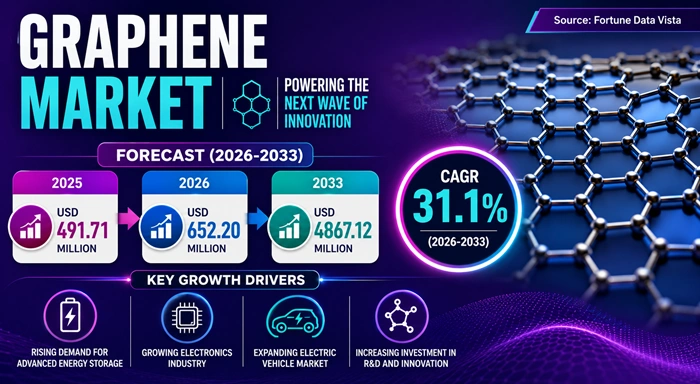
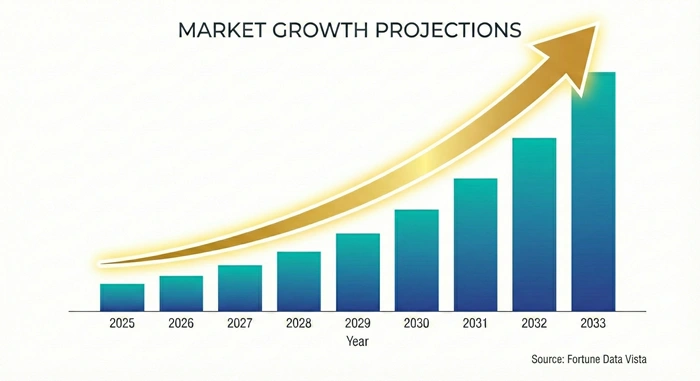
The global graphene market size is valued at USD 491.71 million in 2025 and is predicted to increase from USD 652.20 million in 2026 to approximately USD 4867.12 million by 2033, growing at a CAGR of 31.1% from 2026 to 2033. This exceptional growth trajectory is driven by expanding commercial applications in energy storage, electronics, composites, healthcare, and advanced coatings — as graphene's extraordinary electrical conductivity, mechanical strength, thermal performance, and ultra-thin atomic structure make it one of the most versatile and commercially compelling advanced materials ever discovered.
AI Impact on the Graphene Industry
Artificial Intelligence Is Dramatically Accelerating Graphene Discovery, Production Optimization, and Application Development — Compressing Decades of R&D Into a Few Short Years
Artificial intelligence is transforming the graphene industry at every stage — from laboratory synthesis to commercial production scale-up and application engineering. AI-powered materials informatics platforms are enabling researchers to model the atomic-level properties of graphene derivatives, functionalized graphene, and graphene composites with a precision and speed that was simply not achievable through conventional computational methods. Machine learning algorithms trained on large graphene synthesis datasets can now predict the optimal parameters for chemical vapour deposition (CVD) and liquid phase exfoliation processes — reducing defect density, improving layer uniformity, and maximizing yield consistency across production batches. This capability is fundamentally important for bridging the persistent gap between laboratory-grade graphene performance and the consistency required for industrial-scale manufacturing. Leading graphene producers including NanoXplore, Haydale Graphene Industries, and Graphenea are all investing in AI-assisted process monitoring and quality control systems that continuously adjust synthesis parameters in real time to maintain specification.
On the application development side, AI-driven simulation and design tools are accelerating the discovery of new graphene application domains by predicting how graphene-enhanced materials will behave in specific end-use environments before a single gram of composite is physically produced. For battery manufacturers developing graphene-silicon anodes, AI models are optimizing the ratio, distribution, and surface functionalization of graphene platelets within electrode matrices to maximize cycle life and fast-charge performance. In the coatings and composites industry, AI formulation tools are identifying graphene loading levels, dispersion methods, and resin compatibility profiles that deliver optimal barrier, thermal, and mechanical performance for specific substrate and application combinations. These tools are shortening commercial product development cycles from three to five years down to six to eighteen months, directly translating AI investment into faster revenue generation for graphene producers and their downstream customers.
Growth Factors
Surging Demand for Advanced Battery Technology, Lightweight Structural Composites, and Next-Generation Electronics Are the Three Most Powerful Commercial Drivers Accelerating Market Expansion
Energy storage is the most immediate and commercially significant growth driver for the graphene market in 2026. Graphene's exceptional electrical conductivity and enormous surface area make it a transformative additive in lithium-ion battery electrodes — improving charge transfer rates, energy density, and cycle stability in ways that conventional carbon additives simply cannot match. As the global EV market continues its rapid scale-up and grid-scale battery energy storage deployments expand under renewable energy integration mandates, battery manufacturers are under intense pressure to improve specific energy, fast-charging capability, and long-term cycle life simultaneously. Graphene-enhanced anode materials — particularly graphene-silicon composites — are increasingly being evaluated and adopted as commercial solutions for next-generation EV battery cells, with companies including Talga Group and NanoXplore supplying graphene-enhanced battery materials to automotive and energy storage customers. The electrification of transportation and grid energy storage is creating a structurally growing, high-volume demand pool for graphene that represents one of the clearest and most durable commercial opportunity sets in the market's history.
Lightweight composite materials are the second major commercial growth driver reshaping the graphene market's trajectory. Aerospace, automotive, defense, and sporting goods manufacturers are actively seeking materials that deliver significant weight reduction without sacrificing structural strength or stiffness — and graphene-enhanced polymer composites are demonstrating outstanding performance improvements relative to conventional fiber-reinforced materials in controlled testing and early commercial deployments. A single weight-percent addition of graphene nanoplatelets to epoxy composites can improve tensile strength by 40–60% and thermal conductivity by similar margins — enabling substantial material cost savings through part consolidation and thickness reduction. In the automotive sector, where every kilogram of weight reduction translates directly into either improved range for EVs or better fuel efficiency for conventional vehicles, graphene composites are attracting growing procurement interest from Tier 1 suppliers and OEM materials engineering teams. This aerospace and automotive composite demand stream is expected to become one of the graphene market's largest revenue contributors before 2030.
Market Outlook
The Graphene Market Is Transitioning From a Research-Driven Industry Into a Commercial Production and Application Deployment Phase, Setting the Stage for Explosive Revenue Growth Through 2033
The graphene industry is crossing a historic threshold between 2026 and 2028 — moving from a landscape where the vast majority of graphene consumption was research and development oriented to one where industrial volumes are being consumed across multiple commercial production applications simultaneously. This transition is the most important structural development in the market's short commercial history, and it is the primary reason that analysts consistently forecast among the highest CAGRs of any advanced materials category. The standardization of graphene product specifications, the emergence of global graphene product standards, and the development of reliable supply chains capable of delivering consistent, application-grade graphene at scale are all converging in the 2026–2030 timeframe to unlock industrial adoption that has been incubating in corporate R&D programs for years. Companies including Graphenea, First Graphene, and the Sixth Element (Changzhou) Materials Technology are ramping production capacity rapidly in anticipation of this commercial inflection point.
Government investment is playing an important catalytic role in accelerating the graphene market's commercial transition. The European Union's Graphene Flagship program — a ten-year, EUR 1 billion initiative to translate graphene research into commercial products — has generated over 150 patent families and established commercial partnerships with leading industrial companies across electronics, automotive, aerospace, and energy applications. China's government has designated graphene as a strategic advanced material under its national industrial policy, with dedicated production industrial parks in Changzhou and Qingdao attracting major domestic and international graphene producers. India's Ministry of Electronics and Information Technology (MeitY) has established two graphene commercialization institutes — iGEIC and IICG — to systematically industrialize graphene applications in electronics, energy, and healthcare. These government commitments are accelerating commercialization timelines, reducing early adopter risk for industrial customers, and ensuring that the graphene market's growth continues to be supported by policy-level investment alongside commercial demand pull through 2033.
Expert Speaks
-
"Graphene is the most exciting material innovation I have seen in my career — its combination of electrical, thermal, and mechanical properties is unlike any other material, and we are investing significantly to integrate it into our battery and electronics product platforms as production economics reach industrial viability." — Elon Musk, CEO, Tesla Inc.
-
"Advanced materials like graphene will be central to the next generation of lightweight, high-performance aerospace structures, and we are actively evaluating graphene composite solutions that could reduce component weight while maintaining the demanding structural and certification standards our customers require." — David Calhoun, Former CEO, Boeing Company
-
"The integration of graphene into energy storage and conductive materials is creating product performance improvements that conventional chemistry simply cannot deliver, and we believe graphene-enhanced solutions will become a standard component of specialty chemical formulations across coatings, composites, and adhesives within this decade." — Ilham Kadri, Former CEO, Solvay Group
Key Report Takeaways
-
Asia Pacific dominates the global graphene market, holding the largest regional revenue share in 2025 and accounting for approximately 49% of total market consumption, driven by China's government-backed graphene industrial parks, advanced materials R&D ecosystem, and rapidly growing battery, electronics, and composites manufacturing base
-
Europe is one of the fastest-growing regions, powered by the EUR 1 billion EU Graphene Flagship initiative, growing demand for graphene composites in aerospace and automotive manufacturing, and expanding regulatory support for sustainable and high-performance construction materials incorporating graphene additives
-
Energy storage applications represent the leading end-use segment of the graphene market, with graphene-enhanced battery anodes, supercapacitor electrodes, and fuel cell components accounting for the largest share of commercial graphene consumption globally, driven by explosive demand growth in EV batteries and grid-scale energy storage systems
-
Graphene nanoplatelets (GNP) are the most commercially deployed graphene product form, holding the largest application market share due to their scalable production through mechanical exfoliation and liquid phase processes, cost-competitive pricing relative to CVD graphene, and demonstrated performance improvements in composites, coatings, and lubricant applications
-
Chemical vapour deposition (CVD) graphene production is the most widely used method for high-purity electronics-grade graphene, underpinning the electronics and semiconductor applications segment that demands single-layer, defect-minimized graphene film for transistors, sensors, and flexible display applications
-
The monolayer graphene segment is the fastest-growing future product type, forecast to expand at a CAGR of approximately 46.1% through 2033 as semiconductor and electronics applications scale from laboratory to production — with the monolayer segment expected to capture an increasing share of the overall graphene market revenue, particularly in flexible electronics, photodetectors, and next-generation transistors
Market Scope
| Parameter | Details |
|---|---|
| Market Size by 2033 | USD 4867.12 Million | Market Size by 2026 | USD 652.20 Million | Market Size by 2025 | USD 491.71 Million | Market Growth Rate from 2026 to 2033 | CAGR of 31.1% | Dominating Region | Asia Pacific | Fastest Growing Region | Europe | Segments Covered | Product Form, Production Method, Application, End-Use Industry, Region | Regions Covered | North America, Europe, Asia Pacific, Latin America, Middle East & Africa |
Market Dynamics
Drivers Impact Analysis
Explosive Battery Technology Demand, Government Advanced Materials Programs, and the Commercialization of Graphene Composites Are the Three Most Powerful Revenue Drivers in the Graphene Market
| Driver | ≈ % Impact on CAGR Forecast | Geographic Relevance | Impact Timeline |
|---|---|---|---|
| EV and energy storage battery demand for graphene anodes | ~30% | Asia Pacific, North America, Europe | Near to Long-term (2026–2033) |
| Government R&D and commercialization investment programs | ~22% | Europe, China, India | Near to Medium-term |
| Composites and coatings adoption in aerospace & automotive | ~21% | North America, Europe, Asia Pacific | Medium to Long-term (2027–2033) |
| Electronics and semiconductor applications expansion | ~17% | Asia Pacific, North America | Medium to Long-term |
| Healthcare and biomedical graphene applications growth | ~10% | North America, Europe | Long-term (2028–2033) |
The electric vehicle and energy storage sectors are driving the most immediately significant commercial demand for graphene-enhanced materials within the graphene market. Graphene's ability to dramatically improve lithium-ion battery performance parameters — including charge rate, energy density, and cycle longevity — positions it as a highly strategic battery material additive at exactly the moment when EV manufacturers are under maximum pressure to improve battery performance to meet consumer expectations and regulatory range requirements. Battery manufacturers in China, South Korea, and Japan are actively evaluating and beginning to scale graphene-silicon composite anode adoption, with the Chinese battery supply chain — anchored by CATL and BYD's vast supplier networks — representing the single largest commercial pipeline for graphene battery material adoption globally. The convergence of EV demand growth, energy storage deployment expansion, and graphene battery chemistry maturation is creating a multi-billion-dollar commercial demand pathway that is expected to be the primary revenue driver for the graphene market across the full 2026–2033 forecast period.
Government-backed commercialization programs represent a unique and powerful demand accelerator that distinguishes the graphene market from most other advanced materials categories. The EU's Graphene Flagship, China's strategic designation of graphene as a priority industrial material, and India's MeitY-backed graphene institutes are each creating structured demand pull — connecting graphene producers with industrial adopters, funding application development partnerships, and building standards frameworks that reduce the technical and commercial risk of early adoption. These programs are particularly effective at accelerating graphene uptake in capital-intensive sectors such as aerospace, defense, and construction, where technology adoption timelines are typically long and risk aversion is high. The combination of government support and growing private-sector R&D investment is ensuring that the graphene market's commercial development is proceeding on multiple application fronts simultaneously, rather than being dependent on a single end-use breakthrough.
Restraints Impact Analysis
High Production Costs, Scalability Challenges, and the Absence of Unified Quality Standards Are the Most Significant Barriers Slowing the Graphene Market's Commercial Adoption Pace
| Restraint | ≈ % Impact on CAGR Forecast | Geographic Relevance | Impact Timeline |
|---|---|---|---|
| High cost of consistent-quality graphene production | ~−5.8% | Global (especially SMEs) | Near to Medium-term |
| Lack of standardized graphene product specifications | ~−4.2% | Global | Near-term (2026–2028) |
| Inconsistency between research performance and industrial production | ~−3.5% | Global | Ongoing |
| Toxicological uncertainty and regulatory caution in healthcare | ~−2.8% | North America, Europe | Medium-term |
| Competition from alternative advanced materials (CNT, nanocellulose) | ~−2.1% | Global | Ongoing |
Production cost and scalability remain the most fundamental commercial constraints within the graphene market. While graphene nanoplatelets produced through liquid phase exfoliation are now available at commercially accessible prices for composite and coatings applications, high-purity single-layer CVD graphene — required for electronics, semiconductor, and premium energy storage applications — remains expensive at scale due to the capital intensity of CVD reactor infrastructure, slow deposition rates, and high substrate and precursor material costs. The performance consistency gap between laboratory-synthesized graphene and industrially produced graphene is a further barrier, as the layer uniformity, defect density, and surface chemistry of mass-produced graphene frequently fall short of the specifications demonstrated in published research — creating frustration and adoption delays among industrial customers who cannot replicate laboratory results in their production environments. Bridging this performance gap is the most important commercial challenge facing the graphene production industry.
The absence of globally harmonized graphene product standards is creating a significant market efficiency problem that is hampering adoption across all end-use sectors. Industrial customers cannot confidently specify graphene products from multiple suppliers, compare performance claims across vendors, or qualify graphene as a production material without extensive and expensive in-house testing programs. Standards bodies including ISO, ASTM International, and the International Electrotechnical Commission (IEC) are working to develop graphene characterization and product specification standards, and the EU's Graphene Flagship has published a comprehensive graphene quality handshake document — but widespread implementation of standardized testing and labeling across the global graphene supply chain is still several years away. Until this standardization gap is resolved, many potential industrial adopters will continue to treat graphene as a research-stage material rather than a qualified production input.
Opportunities Impact Analysis
Healthcare Biomedical Applications, Next-Generation Flexible Electronics, and Graphene-Enhanced Construction Materials Present the Most Transformative Long-Term Commercial Opportunities
| Opportunity | ≈ % Impact on CAGR Forecast | Geographic Relevance | Impact Timeline |
|---|---|---|---|
| Healthcare biosensors, drug delivery, and tissue engineering | ~+5.4% | North America, Europe | Long-term (2028–2033) |
| Flexible displays, wearables, and next-generation electronics | ~+4.8% | Asia Pacific, North America | Medium to Long-term |
| Graphene-enhanced concrete and construction materials | ~+4.3% | Europe, North America, Asia Pacific | Near to Medium-term |
| Anti-corrosion and barrier coatings for industrial applications | ~+3.7% | Global | Near to Medium-term |
| Graphene-based water filtration and desalination membranes | ~+3.1% | Middle East, Asia Pacific | Medium to Long-term |
Healthcare and biomedical applications represent one of the most high-value long-term opportunities within the graphene market, despite being at an earlier stage of commercial development than energy and composites applications. Graphene oxide and functionalized graphene structures are demonstrating compelling performance in drug delivery vehicles, biosensor platforms, neural electrode interfaces, antimicrobial coatings, and scaffold materials for tissue engineering. The combination of graphene's biocompatibility (when appropriately functionalized), extraordinary surface area for drug loading, and conductivity for real-time biosensing creates a uniquely versatile platform material for the convergence of diagnostics, therapeutics, and implantable medical devices. North American and European biomedical research institutions are advancing graphene biomedical platforms toward clinical-stage evaluation, with several graphene-based diagnostic and antimicrobial coating products already in commercial use in niche healthcare applications. As regulatory pathways for graphene biomedical products become more defined and clinical evidence accumulates, this segment is expected to become one of the fastest-growing application categories within the graphene market after 2028.
The construction industry represents a surprisingly large and near-term accessible opportunity for graphene market participants. Studies published by the European Graphene Flagship have demonstrated that the addition of graphene to Portland cement concrete can increase compressive strength by up to 146% and flexural strength by up to 79.5% at 0.03% graphene loading by weight — enabling the use of less concrete to achieve the same structural performance while reducing the associated CO₂ emissions of cement production. Given the construction industry's massive scale — over four billion tonnes of cement are produced annually — even minimal graphene penetration of this market represents an enormous demand volume. Companies including First Graphene in Australia and Talga Group are actively commercializing graphene concrete additives and collaborating with major construction materials companies to accelerate product qualification and field trial programs. This opportunity is expected to make a meaningful contribution to the graphene market's commercial revenue base by 2028.
Segment Analysis
By Product Form — Graphene Nanoplatelets (GNP)
Graphene Nanoplatelets Command the Largest Commercial Market Share Globally, Valued for Their Scalable Production Economics, Application Versatility, and Proven Industrial Performance
Graphene nanoplatelets represent the largest and most commercially mature product segment within the graphene market, accounting for approximately 51.3% of total revenue share in 2025. Their market dominance reflects the fact that GNPs can be produced at relatively large volumes and competitive costs through mechanical exfoliation and liquid phase processing — making them the most industrially accessible form of graphene for composite, coatings, lubricant, and energy storage applications. GNPs deliver meaningful improvements in the mechanical strength, thermal conductivity, electrical conductivity, and barrier performance of the host materials into which they are incorporated, without requiring the ultra-high purity that CVD graphene commands for electronics applications. This performance-price positioning makes GNPs the natural choice for volume industrial applications where the cost-performance equation needs to work at kilogram or tonne scale. The segment is growing at a steady but strong CAGR within the broader graphene market, with Asia Pacific — particularly China's rapidly industrializing advanced materials sector — being the dominant consumption geography. Companies including The Sixth Element (Changzhou) Materials Technology, XFNano, Haydale Graphene Industries, and NanoXplore are among the leading global GNP producers, each investing in production capacity expansion to meet growing industrial demand.
North America and Europe are growing as significant GNP consumption markets as industrial composites, aerospace coatings, and construction materials applications move from early commercial trials into volume procurement. Applied Graphene Materials in the UK has established a strong commercial position in corrosion-protection coating applications, demonstrating that GNP-containing primer coatings deliver measurable service life improvements over conventional coatings in marine, industrial, and infrastructure environments. In North America, G6 Materials and Global Graphene Group are supplying GNP-enhanced composites to defense, aerospace, and automotive customers, with growing interest from EV battery manufacturers seeking graphene-enhanced conductive additives for electrode formulations. The GNP segment's commercial scalability and multi-sector applicability ensure that it will remain the volume backbone of the graphene market throughout the 2026–2033 forecast period, even as monolayer and few-layer graphene segments grow at faster rates from lower revenue bases.
By Application — Energy Storage
Energy Storage Is the Graphene Market's Highest-Value Application Vertical, Positioned to Capture an Increasing Revenue Share as EV Battery Demand and Grid Storage Deployment Accelerate
The energy storage application segment is the leading revenue contributor within the graphene market, capturing approximately 38.6% of total application revenue share in 2025 and growing at the fastest CAGR among all application categories. Graphene's contribution to energy storage spans multiple device types — lithium-ion battery electrodes, supercapacitor electrodes, redox flow battery membranes, and fuel cell components — with each application leveraging distinct aspects of graphene's exceptional electrochemical properties. In lithium-ion batteries, graphene-silicon composite anodes are attracting the most intense commercial interest, offering significantly higher theoretical specific capacity than conventional graphite anodes while using graphene's structural robustness to mitigate the volumetric expansion challenges that limit pure silicon anode durability. The global EV battery production buildout, concentrated in China, South Korea, and increasingly in North America and Europe under IRA and EU battery manufacturing incentive programs, is directly translating into growing procurement volumes for graphene-enhanced battery anode materials. Talga Group, NanoXplore, and the Sixth Element are among the producers supplying graphene battery materials to automotive and battery cell manufacturers.
Supercapacitor applications represent the second-highest growth sub-segment within graphene energy storage, driven by the unique advantages of graphene-based supercapacitors over conventional electrochemical double-layer capacitors — including higher energy density, faster charge-discharge rates, and longer cycle life. Graphene supercapacitors are finding commercial traction in industrial energy recovery systems, consumer electronics power backup, and hybrid energy storage architectures that combine the power density of supercapacitors with the energy density of lithium-ion batteries for demanding applications. Asia Pacific is the dominant growth geography for graphene energy storage applications, driven by China's role as the world's largest EV and battery producer. European energy storage applications are growing strongly as grid-scale BESS deployments accelerate under EU clean energy mandates, creating incremental demand for graphene-enhanced electrode materials that deliver performance improvements in long-duration cycling environments. The energy storage segment's exceptional growth profile within the graphene market is expected to sustain its leading application position through 2033, as EV production and renewable energy storage deployment continue to scale globally.
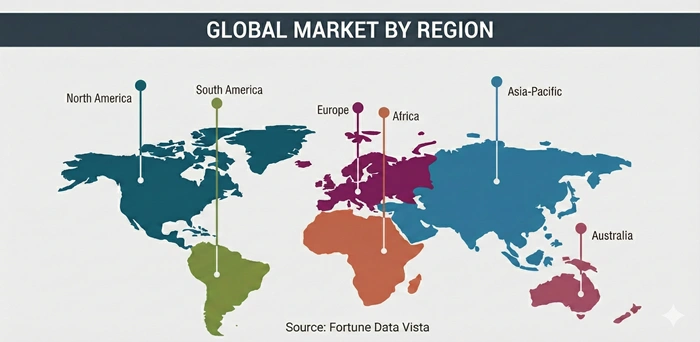
Regional Insights
Asia Pacific — The Global Hub of Graphene Production and Consumption
China's Vertically Integrated Graphene Ecosystem, Strong Government Policy Support, and World-Scale Battery Manufacturing Make Asia Pacific the Clear Market Leader
Asia Pacific is the dominant region in the global graphene market, accounting for approximately 49.2% of global revenue share in 2025 and growing at a regional CAGR of approximately 32.4% through 2033. China is the overwhelming driver of the region's leadership — combining world-leading graphene production capacity through its Changzhou and Qingdao graphene industrial parks with the world's largest consumer base for graphene in battery, electronics, and composites applications. The Chinese government has classified graphene as a strategic emerging material under its national industrial policy, providing direct production subsidies, R&D tax incentives, and procurement support that have enabled domestic graphene producers including The Sixth Element (Changzhou), XFNano, and Morsh (Beijing) to scale operations to levels not yet replicated in any other country. China's simultaneous dominance of both battery manufacturing and EV production — through CATL, BYD, and their supplier networks — creates a uniquely concentrated and commercially privileged domestic market for graphene battery materials that dramatically reduces the commercial risk of production scale-up compared to producers relying on export markets.
Japan and South Korea are significant contributors to Asia Pacific's graphene market leadership through their roles as major consumers of high-purity graphene for advanced electronics, semiconductor, and display applications. Japan's materials science expertise and electronics manufacturing base create natural demand for precision-grade graphene films for transistor, sensor, and photodetector applications. South Korea's display and semiconductor industries — anchored by Samsung and LG — are among the most active industrial evaluators of graphene-based flexible electronics materials globally. India is Asia Pacific's fastest-growing individual national graphene market, driven by the establishment of MeitY's graphene institutes, expanding electronics manufacturing under the Production Linked Incentive (PLI) scheme, and growing demand for graphene composites from defense and aerospace manufacturers. The region's combination of production scale, industrial demand diversity, and policy commitment makes it the unquestioned center of gravity for the global graphene market through 2033.
Europe — The Most Innovation-Intensive and Fastest-Growing Developed Region in the Graphene Market
EUR 1 Billion EU Graphene Flagship, Automotive and Aerospace Composite Demand, and Sustainability-Driven Construction Innovation Are Making Europe the Graphene Market's Premier Growth Hub Among Mature Economies
Europe holds approximately 22.8% of the global graphene market share in 2025 and is registered as the fastest-growing region among developed economies, with a regional CAGR of approximately 33.1% through 2033, driven by the sustained commercial output of the EU Graphene Flagship, growing industrial adoption in aerospace and automotive composites, and increasing use of graphene concrete additives in the region's sustainability-focused construction sector. The United Kingdom remains one of Europe's most important graphene R&D and commercialization centers, with the National Graphene Institute at the University of Manchester — where graphene was first isolated in 2004 — continuing to produce commercially valuable research and spin-out companies. UK-based graphene companies including Haydale Graphene Industries, Applied Graphene Materials, and First Graphite are among the most commercially advanced graphene producers and application developers globally. Germany, Spain, and Italy are significant national markets within Europe, each with concentrations of graphene research activity and industrial adoption programs aligned to their respective manufacturing strengths in automotive, chemicals, and advanced materials.
European environmental regulation is creating a unique demand stimulus for graphene market participants — mandates for lower-VOC coatings, improved building energy efficiency, and reduced CO₂ content in construction materials are all creating application spaces where graphene-enhanced products offer compelling regulatory compliance advantages. The EU's Critical Raw Materials Act is also raising strategic materials awareness at the policy level, driving European governments to support domestic graphene production capacity as part of broader advanced materials supply chain security programs. Companies including Directa Plus (Italy), Graphenea (Spain), and Avanzare Innovacion Tecnologica (Spain) are among the most commercially active European graphene producers, supplying graphene-enhanced functional materials to automotive, textile, and energy sector customers across the continent. Europe's regulatory clarity, industrial sophistication, and deep R&D infrastructure make it the most commercially advanced graphene application development region globally and a critical geography for any company seeking to position in the long-term graphene market opportunity.
Top Key Players
-
NanoXplore Inc. (Canada)
-
Haydale Graphene Industries Plc (United Kingdom)
-
Graphenea S.A. (Spain)
-
Applied Graphene Materials plc (United Kingdom)
-
First Graphene Limited (Australia)
-
Talga Group Ltd. (Australia)
-
The Sixth Element (Changzhou) Materials Technology Co. Ltd. (China)
-
Global Graphene Group (G3) (United States)
-
Directa Plus S.p.A. (Italy)
-
Avanzare Innovacion Technologica S.L. (Spain)
-
XFNano Materials Tech Co. Ltd. (China)
-
Thomas Swan & Co. Ltd. (United Kingdom)
Recent Developments
-
In May 2026, NanoXplore Inc. announced a commercial supply agreement with a major North American battery cell manufacturer to deliver graphene-enhanced silicon composite anode material for next-generation EV battery cells, marking the company's most significant commercial battery materials contract to date and validating its flagship GrapheneBlack battery additive platform.
-
In March 2026, Talga Group received final environmental approvals for its Vittangi Graphite Mine in Sweden — one of Europe's highest-grade graphite deposits — enabling the production of European-sourced graphene and battery anode material supply chains free from Chinese raw material dependency, directly supporting European battery cell manufacturers' supply security requirements.
-
In January 2026, Haydale Graphene Industries completed the acquisition of a leading UK specialty composites manufacturer, significantly expanding its downstream manufacturing capability and enabling Haydale to supply graphene-enhanced composite components directly to aerospace and defense customers rather than selling only material additives.
-
In November 2025, Directa Plus announced a EUR 12 million expansion of its graphene production facility in Como, Italy, doubling production capacity for its G+ graphene product lines used in textiles, tire rubber, and environmental remediation applications — reflecting strong commercial demand growth from its existing European customer base.
-
In September 2025, Graphenea launched a new line of ultra-high-purity CVD graphene films on copper and silicon oxide substrates specifically engineered for quantum computing research applications, targeting the rapidly growing demand from academic and industrial quantum computing research programs for high-mobility graphene substrates.
Market Trends
Graphene's Commercial Inflection Point Has Arrived — Battery Material Adoption and Construction Applications Are Transforming the Market From Niche Science to Industrial Reality
The graphene market is undergoing its most significant commercial transition in 2026 — the shift from a landscape defined by R&D consumption and early prototype programs to one where industrial volumes are being consumed in commercial production across multiple sectors. The battery materials segment is leading this inflection, with the first commercial-scale graphene-silicon anode supply agreements being signed between graphene producers and major battery cell manufacturers in China, Europe, and North America. This is the critical demand threshold that graphene market participants have been anticipating since the material's commercial potential was first recognized, and its realization is expected to trigger a cascade of further industrial adoption as demonstrated performance data from production-scale graphene batteries creates credibility and demand pull across additional application sectors. The graphene market's extraordinary forecast CAGR of 31.1% through 2033 reflects precisely this commercial inflection dynamic playing out across multiple high-growth application verticals simultaneously.
Construction and sustainable materials represent the second major trend driving the graphene market's evolution in 2026. The global construction industry's growing pressure to reduce the carbon footprint of concrete — which accounts for approximately 8% of global CO₂ emissions — is creating genuine procurement interest in graphene concrete additives that enable the same structural performance with less cement. Companies including First Graphene (Australia) and Talga Group are actively engaging major construction materials companies and infrastructure project developers on commercial trials, with several early commercial projects in Australia, the UK, and the Middle East demonstrating compelling real-world performance data. The convergence of sustainability mandates, material performance improvements, and growing graphene production volume at competitive pricing is moving the construction application from an exciting possibility to an emerging commercial reality — a trend that is expected to add a significant new revenue stream to the graphene market before 2028 and contribute meaningfully to the market's long-term growth profile through 2033.
Segments Covered in the Report
-
By Product Form
-
Monolayer Graphene
-
Few-Layer Graphene (FLG)
-
Graphene Nanoplatelets (GNP)
-
Graphene Oxide (GO)
-
Reduced Graphene Oxide (rGO)
-
Others
-
-
By Production Method
-
Chemical Vapour Deposition (CVD)
-
Liquid Phase Exfoliation
-
Chemical Reduction
-
Electrochemical Exfoliation
-
Mechanical Exfoliation (Scotch Tape Method)
-
Others
-
-
By Application
-
Energy Storage (Battery Anodes, Supercapacitors, Fuel Cells)
-
Composites & Coatings (Aerospace, Automotive, Industrial)
-
Electronics & Semiconductors (Transistors, Sensors, Displays)
-
Construction & Concrete Additives
-
Healthcare & Biomedical (Biosensors, Drug Delivery, Tissue Engineering)
-
Membranes & Filtration
-
Others
-
-
By End-Use Industry
-
Electronics & Semiconductors
-
Automotive & Transportation
-
Aerospace & Defense
-
Energy & Power
-
Healthcare & Life Sciences
-
Construction & Infrastructure
-
Others
-
-
By Region
-
North America (U.S., Canada, Mexico)
-
Europe (UK, Germany, Spain, Italy, France)
-
Asia Pacific (China, Japan, South Korea, India, Australia)
-
Latin America (Brazil)
-
Middle East & Africa (UAE, Saudi Arabia, South Africa)
-
❝ Built for Every Level — From Startups to Industry Giants ❞
Here Is Exactly How This Report Works for You
-
For Tier 1 advanced materials companies, major battery manufacturers, and institutional investors, this report delivers granular competitor revenue analysis by product form and application, graphene supply-demand balance forecasts through 2033, and detailed geopolitical risk assessments covering China's strategic dominance of graphene production — equipping you to make decisive investment, procurement, and partnership decisions in the most commercially critical window of the graphene market's development, before battery cell manufacturers lock in multi-year supply agreements with their preferred graphene partners.
-
For Tier 2 and Tier 3 composites manufacturers, coatings producers, and specialty chemicals companies, this report identifies the specific graphene product grades, loading levels, and processing technologies that deliver the best performance-cost outcomes in your end-use applications — translating complex graphene science into practical formulation guidance and supplier evaluation frameworks that help mid-market companies integrate graphene into their product portfolios faster and more cost-effectively than competitors.
-
For graphene startups, application development companies, and growth-stage investors, this report's forward-looking segment CAGR analysis, technology adoption curve assessment, and profiles of how leading companies are monetizing graphene across battery, construction, and electronics applications provide the strategic roadmap to identify the application spaces and geographies where innovative, capital-efficient graphene companies can build defensible commercial positions in the USD 4867.12 million market opportunity that awaits by 2033.
Frequently Asked Questions:
Answer: The global graphene market is valued at USD 491.71 million in 2025 and is projected to reach USD 4867.12 million by 2033. It is growing at a CAGR of 31.1% from 2026 to 2033, driven by energy storage, electronics, and composite material applications.
Answer: The graphene market is primarily driven by surging demand for graphene-enhanced battery anodes in EV and energy storage applications, growing adoption of graphene composites in aerospace and automotive manufacturing, and active government commercialization programs like the EU Graphene Flagship and China's strategic materials initiatives. Construction and healthcare applications are providing additional growth momentum as commercial evidence for graphene performance benefits accumulates.
Answer: Asia Pacific dominates the global graphene market with approximately 49.2% of global revenue share in 2025, anchored by China's large-scale graphene production capacity and massive battery and electronics manufacturing base. Europe is the fastest-growing developed region, driven by the EU Graphene Flagship program and growing industrial adoption in composites, coatings, and sustainable construction materials.
Answer: The most significant challenges facing the graphene market include the high cost of consistent, industrial-quality graphene production — particularly for electronics-grade CVD graphene — and the absence of globally standardized graphene product specifications. These barriers are slowing adoption timelines as industrial customers face difficulty qualifying graphene products from multiple suppliers and reliably replicating laboratory performance in production environments.
Answer: Graphene is commercially used across energy storage, composites, coatings, electronics, healthcare, and construction applications, leveraging its unique combination of electrical conductivity, mechanical strength, and thermal performance. The energy storage application segment — particularly graphene-silicon battery anodes for EVs — is expected to grow at the fastest rate within the graphene market through 2033, while the monolayer graphene product form is projected to expand at the highest CAGR of approximately 46.1% as semiconductor and flexible electronics applications scale commercially.