
Hybrid Vehicle Market Overview
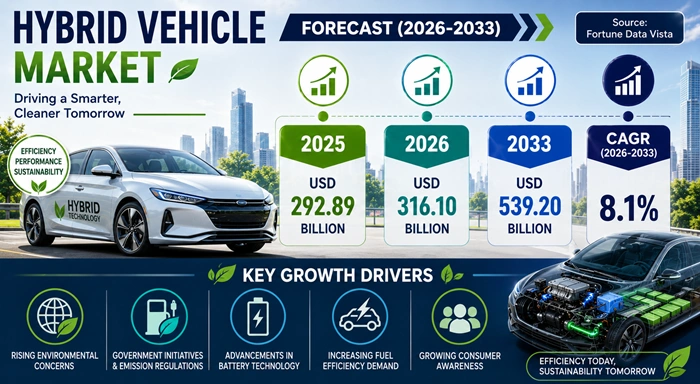
The global hybrid vehicle market size is valued at USD 292.89 billion in 2025 and is predicted to increase from USD 316.10 billion in 2026 to approximately USD 539.20 billion by 2033, growing at a CAGR of 8.1% from 2026 to 2033.
The hybrid vehicle market is gaining strong momentum as consumers and governments worldwide seek cleaner, more fuel-efficient alternatives to conventional internal combustion engine (ICE) vehicles. Rising fuel prices, tightening emission regulations, and growing awareness of environmental sustainability are collectively propelling demand for hybrid electric vehicles (HEVs) and plug-in hybrid electric vehicles (PHEVs) across both developed and emerging economies. The market benefits from decades of proven technology, widespread charging infrastructure compatibility, and lower total cost of ownership compared to fully battery-electric vehicles.
AI Impact on the Hybrid Vehicle Industry
Artificial Intelligence Is Reshaping the Way Hybrid Vehicles Are Designed, Optimized, and Driven — Creating a Smarter, More Efficient Automotive Ecosystem
Artificial intelligence is playing a transformative role in the hybrid vehicle market by enabling smarter energy management systems that dynamically balance power distribution between the electric motor and the internal combustion engine. AI-powered algorithms analyze real-time driving patterns, road conditions, and battery charge levels to optimize fuel consumption and reduce emissions. This level of precision was not possible in earlier generations of hybrid technology, and it is one of the primary reasons why automakers are investing heavily in AI integration across their hybrid lineups.
Beyond energy management, AI is influencing predictive maintenance, driver assistance, and vehicle connectivity in the hybrid segment. Machine learning models help identify potential mechanical issues before they escalate, reducing downtime and repair costs for fleet operators and individual consumers alike. As automakers integrate AI with vehicle-to-grid (V2G) technologies, the hybrid vehicle sector is becoming an increasingly vital part of the broader smart mobility and clean energy ecosystem.
Growth Factors
Strong Policy Support, Rising Fuel Costs, and Evolving Consumer Preferences Are the Core Pillars Fueling Hybrid Vehicle Market Expansion
Government initiatives such as tax credits, purchase subsidies, and stricter emission norms are among the strongest catalysts driving growth in the hybrid vehicle market. Countries across Europe, North America, and Asia Pacific have set aggressive carbon neutrality targets, making hybrid vehicles a practical transitional solution for consumers not yet ready to commit to fully electric mobility. These policy frameworks reduce the financial barrier to entry and encourage automakers to expand their hybrid portfolios.
On the consumer side, rising fuel costs and improved hybrid technology have made these vehicles more attractive than ever. Modern hybrid vehicles offer significantly better fuel economy — sometimes up to 35–40% more efficient than conventional gasoline-powered cars — without compromising driving range or requiring access to dedicated charging stations. This flexibility makes the hybrid electric vehicle a compelling option for urban commuters and long-distance drivers alike, supporting steady market growth through 2033.
Market Outlook
From Transitional Technology to Long-Term Market Powerhouse — The Hybrid Vehicle Market Is Positioned for Sustained Growth Through 2033 and Beyond
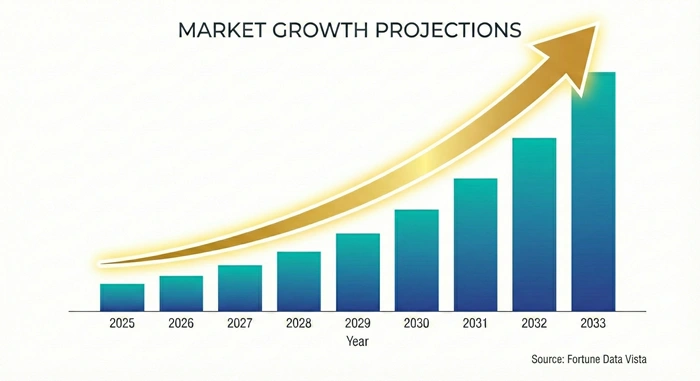
The hybrid vehicle market outlook through 2033 remains highly positive, driven by a convergence of regulatory, technological, and economic factors. As battery costs decline and energy density improves, hybrid systems are becoming more affordable to manufacture, which translates directly into more competitively priced vehicles for end consumers. Automakers are rolling out next-generation hybrid platforms that integrate advanced driver assistance systems (ADAS), over-the-air software updates, and lightweight materials to further enhance performance and efficiency.
Emerging markets in Southeast Asia, Latin America, and the Middle East are beginning to show strong uptake of hybrid electric vehicles, expanding the geographic base of the industry beyond its traditional strongholds in Japan, the United States, and Western Europe. As infrastructure challenges slow the pure EV adoption curve in these regions, hybrid vehicles serve as a more practical and immediately deployable solution. With global automakers ramping up production capacity and launching new models across all price segments, the hybrid vehicle market is well-positioned to achieve its projected valuation of USD 539.20 billion by 2033.
Expert Speaks
-
"Toyota has been the pioneer of hybrid technology for over two decades, and we remain committed to making hybrid vehicles the cornerstone of our global electrification strategy. The demand we are seeing across markets confirms that hybridization is not a stepping stone — it is a destination for millions of customers around the world." — Koji Sato, President & CEO, Toyota Motor Corporation
-
"At Ford, we see hybrid vehicles as a critical part of our electrification roadmap. Our customers want choice, efficiency, and value, and our hybrid lineup delivers all three without requiring a fundamental change in how people refuel or plan their journeys." — Jim Farley, President & CEO, Ford Motor Company
-
"Hyundai Motor Group's investment in hybrid and plug-in hybrid technology is a direct response to what our customers and regulators are asking for — cleaner vehicles that work seamlessly in the real world. We are accelerating our hybrid development programs to bring more models to market at more accessible price points." — Euisun Chung, Executive Chair, Hyundai Motor Group
Key Report Takeaways
-
Asia Pacific dominates the global hybrid vehicle market, holding the largest regional share of approximately 42% in 2025, driven by strong government mandates, a dense network of hybrid-focused automakers including Toyota, Honda, and BYD, and high consumer adoption in China, Japan, and South Korea.
-
Asia Pacific is also the fastest growing region, with China leading the charge through aggressive EV and hybrid incentive programs, rapid urbanization, and the world's largest automotive consumer base fueling double-digit regional growth rates.
-
Passenger car buyers are the dominant end-use segment, accounting for over 78% of total hybrid vehicle demand, as private consumers prioritize fuel savings, environmental responsibility, and government rebate eligibility in their purchasing decisions.
-
The full hybrid (FHEV) segment contributes the most to market revenue, owing to its superior fuel economy, no external charging requirement, and widespread availability across mainstream and premium vehicle categories from established automakers.
-
The parallel hybrid powertrain is the most popular electric powertrain configuration, commanding the largest share within the hybrid vehicle market due to its cost-effectiveness, mechanical reliability, and compatibility with a wide range of vehicle platforms.
-
Plug-in hybrid electric vehicles (PHEVs) are projected to be the fastest growing future segment, with an anticipated market share of over 35% by 2033 and a CAGR exceeding 11% during the forecast period, driven by expanding public charging infrastructure, longer all-electric range, and growing consumer preference for vehicles that offer dual-mode flexibility.
Market Scope
| Parameter | Details |
|---|---|
| Market Size by 2033 | USD 539.20 Billion | Market Size by 2026 | USD 316.10 Billion | Market Size by 2025 | USD 292.89 Billion | Market Growth Rate from 2026 to 2033 | CAGR of 8.1% | Dominating Region | Asia Pacific | Fastest Growing Region | Asia Pacific (China) | Segments Covered | Vehicle Type, Electric Powertrain, Degree of Hybridization, Component | Regions Covered | North America, Europe, Asia Pacific, Latin America, Middle East & Africa |
Market Dynamics
Drivers Impact Analysis
Rising Environmental Awareness, Robust Government Support, and Surging Fuel Prices Are Accelerating the Hybrid Vehicle Market at an Unprecedented Rate
| Driver | ≈ % Impact on CAGR Forecast | Geographic Relevance | Impact Timeline |
|---|---|---|---|
| Government incentives & emission regulations | ~35% | Global — especially EU, US, China, Japan | Short to Long Term |
| Rising fuel prices & fuel economy demand | ~28% | North America, Europe, Asia Pacific | Short to Medium Term |
| Technological advancement in battery & powertrain | ~22% | Japan, South Korea, China, Germany | Medium to Long Term |
| Growing EV transition hesitancy (range anxiety) | ~15% | North America, Emerging Markets | Short to Medium Term |
Government incentives and tightening emission regulations are the single most powerful driver of growth in the hybrid vehicle market. Policies such as the U.S. Inflation Reduction Act, EU Green Deal vehicle emission targets, and China's New Energy Vehicle (NEV) mandate are compelling both consumers and automakers to shift toward electrified platforms. These legislative frameworks not only make hybrid vehicles more affordable through subsidies and tax breaks but also create long-term demand certainty that encourages manufacturers to invest in new hybrid model development.
The escalating cost of fossil fuels is further reinforcing the value proposition of hybrid electric vehicles among price-sensitive consumers globally. With gasoline prices remaining volatile due to geopolitical instability and supply chain disruptions, hybrid vehicles — which can reduce fuel consumption by up to 40% compared to conventional cars — are increasingly seen as a practical financial investment. Automakers are capitalizing on this trend by launching a wider range of hybrid vehicles across budget, mid-range, and premium price points to capture a broader consumer base.
Restraints Impact Analysis
High Initial Vehicle Cost and Battery Replacement Concerns Remain Key Challenges Limiting Widespread Adoption of Hybrid Vehicles
| Restraint | ≈ % Impact on CAGR Forecast | Geographic Relevance | Impact Timeline |
|---|---|---|---|
| High upfront purchase cost vs. ICE vehicles | ~40% | Price-sensitive markets — India, SEA, Latin America | Short to Medium Term |
| Complex battery maintenance & replacement cost | ~30% | All regions, particularly developing markets | Medium Term |
| Growing competition from fully electric vehicles | ~30% | Europe, China, North America | Medium to Long Term |
The higher purchase price of hybrid vehicles compared to equivalent conventional gasoline-powered cars continues to be a significant restraint, particularly in price-sensitive markets across South and Southeast Asia, Latin America, and Africa. While government subsidies help reduce this gap in developed economies, many emerging markets lack robust incentive structures, leaving price-conscious buyers to opt for more affordable ICE alternatives. This pricing disparity limits the total addressable market for hybrid electric vehicles in regions where affordability is paramount.
Battery longevity and replacement costs represent another meaningful barrier. Consumers remain concerned about the long-term cost implications of battery degradation and the availability of certified service centers capable of handling hybrid-specific maintenance. Although battery warranties have improved significantly — with most automakers now offering 8-year or 100,000-mile guarantees — residual anxiety about end-of-life battery replacement expenses continues to temper adoption rates in segments where total cost of ownership is a primary purchase criterion.
Opportunities Impact Analysis
Expanding EV Infrastructure, Rising Urbanization, and Fleet Electrification Programs Present Immense Growth Opportunities for the Hybrid Vehicle Market
| Opportunity | ≈ % Impact on CAGR Forecast | Geographic Relevance | Impact Timeline |
|---|---|---|---|
| Fleet & commercial vehicle electrification | ~38% | North America, Europe, Asia Pacific | Medium to Long Term |
| Growth in emerging markets & new geographies | ~35% | India, Brazil, Middle East, Southeast Asia | Medium to Long Term |
| Expansion of PHEV segment with charging infra | ~27% | Urban centers globally | Short to Long Term |
The electrification of commercial vehicle fleets presents one of the most significant opportunities for the hybrid vehicle market over the forecast period. Logistics companies, municipal transit authorities, and ride-sharing platforms are under growing regulatory pressure to reduce fleet emissions, and hybrid technology offers a practical bridge solution that does not require complete charging infrastructure buildout. Government-sponsored fleet renewal programs in North America and Europe are expected to channel billions of dollars into hybrid commercial vehicle procurement between 2026 and 2033.
Simultaneously, the rapid urbanization and rising middle-class income growth across India, Brazil, the Middle East, and Southeast Asia are opening vast new consumer markets for hybrid vehicles. As road infrastructure improves and fuel consumption awareness grows in these regions, demand for fuel-efficient hybrid electric vehicles is expected to accelerate meaningfully. Automakers that establish early market presence in these high-growth geographies stand to gain a substantial competitive advantage as these markets mature over the next decade.
Segment Analysis
By Vehicle Type
Passenger Cars Continue to Dominate the Hybrid Vehicle Market While Commercial Vehicles Emerge as a High-Growth Opportunity Segment
The passenger car segment holds the dominant position in the hybrid vehicle market, accounting for approximately 78% of total market share in 2025, with a CAGR of around 7.8% projected through 2033. The segment's dominance is rooted in the large global consumer base seeking fuel-efficient daily transportation without the range limitations associated with fully battery-electric vehicles. Passenger hybrid vehicles are experiencing particularly strong traction in Asia Pacific, where urbanization, traffic congestion, and government rebates create an ideal adoption environment. Toyota, Honda, and Hyundai are among the leading companies driving passenger hybrid sales in the region through continuously updated model lineups, competitive pricing, and extensive dealer networks.
The commercial vehicle segment, while smaller in overall share at approximately 22%, is emerging as the fastest growing subsegment within the hybrid vehicle market, driven by fleet decarbonization mandates and rising operational cost pressures. Commercial hybrid vehicles — including hybrid delivery vans, hybrid buses, and light commercial trucks — are gaining rapid uptake in Europe and North America, where logistics operators are under strict emissions compliance requirements. Companies such as Ford Motor Company, Stellantis, and AB Volvo are actively expanding their commercial hybrid offerings, responding to municipal and corporate fleet procurement tenders that increasingly mandate lower-emission vehicle specifications. The Asia Pacific region is also witnessing growing demand for hybrid electric buses in countries like China, India, and Japan, further supporting segment expansion through the forecast period.
By Degree of Hybridization
Full Hybrid Vehicles Lead the Market Today While Plug-In Hybrids Are Rapidly Gaining Ground as the Next Dominant Configuration
Full hybrid electric vehicles (FHEVs) currently command the largest share within the hybridization segment, representing approximately 47% of market revenue in 2025 with a steady CAGR of 7.5% through 2033. FHEVs offer the compelling combination of superior fuel efficiency and no dependency on external charging infrastructure, making them the most accessible hybrid option for mainstream consumers worldwide. The Asia Pacific region, particularly Japan and China, leads FHEV adoption, with Toyota's Prius, Yaris, and Corolla hybrid models consistently ranking among the world's best-selling FHEVs. Toyota Motor Corporation's unmatched dominance in the full hybrid segment, supported by its proprietary THS II (Toyota Hybrid System) technology, continues to set the benchmark for fuel economy and reliability across global markets.
Plug-in hybrid electric vehicles (PHEVs) represent the fastest growing hybridization category, with a projected CAGR of approximately 11.3% from 2026 to 2033. PHEVs allow drivers to operate on pure electric power for short urban commutes while retaining a gasoline engine for longer journeys, addressing the range anxiety concern more comprehensively than any other hybrid configuration. Europe is the leading region for PHEV growth, with countries like Germany, the U.K., and Sweden offering generous tax incentives and a growing network of public charging points that make PHEV ownership increasingly practical. BMW, Volkswagen, and Stellantis are the key players shaping the European PHEV landscape, continuously launching new models that combine premium features with enhanced all-electric driving ranges of 50–80 kilometers.
Regional Insights
North America
North America Holds a Dominant Share in the Global Hybrid Vehicle Market, Supported by Policy Mandates, Consumer Demand, and a Strong Automaker Presence
The United States Leads North American Hybrid Adoption with Robust Federal and State-Level Incentive Programs Driving Consistent Market Expansion
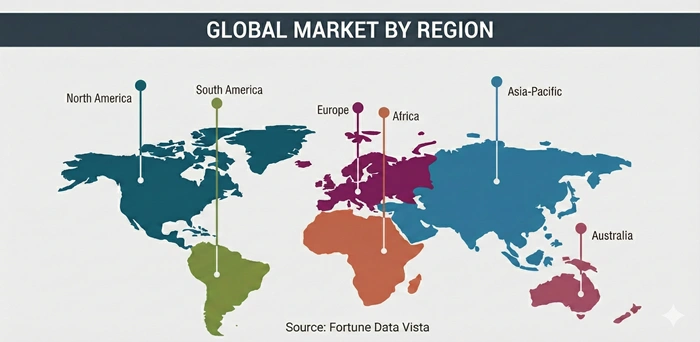
North America accounts for approximately 28% of the global hybrid vehicle market share in 2025, positioning it as one of the two largest regional markets alongside Asia Pacific. The United States is the primary engine of regional demand, bolstered by the Inflation Reduction Act's clean vehicle tax credits, California's zero-emission vehicle mandates, and a growing consumer preference for fuel-efficient alternatives as gasoline prices remain elevated. The region's strong automotive manufacturing base — home to Ford Motor Company, General Motors, and Stellantis — provides a solid foundation for continued hybrid vehicle production and innovation. North America is projected to grow at a regional CAGR of approximately 7.4% through 2033, with hybrid SUVs and pickup trucks emerging as the dominant product categories.
Canada and Mexico are contributing increasingly to North America's hybrid vehicle market growth, with both countries aligning their automotive policies more closely with the U.S. clean energy agenda. Canadian government programs offering purchase rebates for zero-emission vehicles and hybrid cars are gradually shifting consumer preferences in major urban centers such as Toronto, Vancouver, and Montreal. In Mexico, the growing manufacturing presence of global automakers and increasing consumer exposure to hybrid technology through the domestic market are creating a positive demand environment. Key players including Toyota Motor Corporation, Ford Motor Company, and General Motors continue to expand their hybrid model availability across all three North American markets, strengthening regional leadership.
Asia Pacific
Asia Pacific Dominates and Simultaneously Emerges as the World's Fastest Growing Hybrid Vehicle Market, Led by China, Japan, and South Korea
China and Japan Together Account for the Majority of Asia Pacific's Hybrid Vehicle Sales, with Government-Backed Programs Playing a Decisive Role
Asia Pacific is both the dominant and fastest growing regional market for hybrid vehicles, holding approximately 42% of global market share in 2025 and growing at an estimated regional CAGR of 10.2% from 2026 to 2033. Japan remains the global birthplace of hybrid technology and continues to be a major production and consumption hub, with Toyota, Honda, and Nissan collectively offering some of the most comprehensive hybrid vehicle lineups in the world. China, however, has emerged as the most dynamic growth market, driven by the government's ambitious NEV targets, urban air quality improvement programs, and a massive domestic manufacturing ecosystem that includes BYD, SAIC Motor, and Geely. The combination of scale, policy support, and technological investment makes Asia Pacific an unrivaled powerhouse in the global hybrid vehicle industry through the forecast period.
South Korea and India represent important secondary growth markets within Asia Pacific that are gaining increasing strategic importance. Hyundai Motor Company and Kia Corporation are aggressively expanding their hybrid lineups for both domestic consumption and global export, leveraging South Korea's advanced automotive R&D capabilities and government incentives for electrified vehicle production. India, meanwhile, is witnessing a surge of interest in hybrid vehicles as fuel efficiency concerns intensify among urban consumers and the government rolls out incentive schemes for electrified mobility. The Asia Pacific hybrid vehicle market is expected to maintain its dual role as market leader and fastest growing geography through 2033, underpinned by policy consistency, manufacturing scale, and an increasingly urbanized consumer base.
Report Customization Available by Region and Country
Unlock Deeper Market Intelligence with Our Tailored Region-Specific and Country-Specific Hybrid Vehicle Market Reports — Customized to Meet Your Exact Business Needs
This report is available for customization across all major global regions and individual countries, enabling businesses to access highly targeted insights specific to their chosen geography. Whether you are a market entrant, an established automaker, a policy analyst, or an investor, a customized version of this report delivers the precise data, competitive landscape, and opportunity mapping that generic global reports cannot provide. Region-specific and country-specific versions include detailed market sizing, regulatory environment analysis, consumer behavior patterns, competitive dynamics, and investment opportunity assessments tailored to the selected market.
The following regions and countries can be covered in customized versions of this report, with insights specific to each geography's hybrid vehicle market dynamics, trends, and opportunities:
North America
-
U.S. — Federal EV/hybrid incentive analysis, state-by-state policy mapping, top automaker sales data, and consumer adoption trends
-
Canada — Provincial government rebate program analysis, urban vs. rural hybrid adoption, and major manufacturer strategies
-
Mexico — Manufacturing ecosystem assessment, import-export dynamics, and consumer market growth outlook
Europe
-
U.K. — Post-Brexit hybrid vehicle policy environment, PHEV market dominance, and key OEM strategies
-
Germany — Premium hybrid vehicle market, leading OEM competitive landscape, and EU Green Deal impact analysis
-
France — Government EcoBonus program insights, PHEV vs. FHEV split, and urban mobility trends
-
Italy — Incentive program assessment, consumer adoption barriers, and regional OEM activity
-
Rest of Europe — Emerging hybrid markets in Scandinavia, Eastern Europe, and the Iberian Peninsula
Asia Pacific
-
China — NEV mandate compliance analysis, domestic OEM competitive mapping, and city-level demand data
-
India — Hybrid vehicle market nascent growth, government policy trajectory, and OEM investment plans
-
Japan — Technology leadership, domestic sales trends, and export-market hybrid vehicle strategy
-
South Korea — Hyundai-Kia hybrid roadmap, domestic incentives, and consumer preference insights
-
Australia — Hybrid adoption trends, government clean car discount program impact, and market outlook
-
Rest of Asia Pacific — Southeast Asia growth opportunities, Indonesia, Thailand, and Vietnam market entry analysis
Latin America
-
Brazil — Flex-fuel hybrid vehicle opportunity, government electrification programs, and OEM activity
-
Argentina — Economic impact on hybrid vehicle affordability, import dynamics, and market potential
-
Rest of Latin America — Chile, Colombia, Peru hybrid vehicle demand trends and regional market entry outlook
Middle East & Africa (MEA)
-
UAE — Luxury and premium hybrid vehicle market, government green mobility initiatives, and infrastructure readiness
-
Saudi Arabia — Vision 2030 clean mobility alignment, hybrid adoption projections, and OEM partnership landscape
-
Rest of MEA — South Africa, Nigeria, and GCC hybrid market demand analysis and investment potential
Top Key Players
-
Toyota Motor Corporation (Japan)
-
Honda Motor Co., Ltd. (Japan)
-
BYD Company Ltd. (China)
-
Ford Motor Company (United States)
-
Hyundai Motor Company (South Korea)
-
Kia Corporation (South Korea)
-
Nissan Motor Corporation (Japan)
-
BMW AG (Germany)
-
Volkswagen AG (Germany)
-
Mercedes-Benz Group AG (Germany)
-
Stellantis N.V. (Netherlands)
-
AB Volvo (Sweden)
-
General Motors Company (United States)
-
Mitsubishi Motors Corporation (Japan)
Recent Developments
-
In 2024, Toyota Motor Corporation announced a USD 8 billion investment in U.S. manufacturing, specifically targeting the expansion of hybrid and plug-in hybrid vehicle production at its Kentucky and Indiana plants to meet surging North American demand.
-
In 2025, BYD Company Ltd. unveiled its fifth-generation DM (Dual Mode) hybrid system, capable of achieving over 2,000 kilometers of combined driving range on a single tank and charge, positioning BYD as a global technology leader in the plug-in hybrid segment.
-
In 2024, Hyundai Motor Company and Kia Corporation jointly announced a USD 5 billion R&D commitment to develop next-generation hybrid and hydrogen fuel-cell vehicle platforms, reinforcing the group's long-term electrification roadmap beyond the 2030 horizon.
-
In 2025, Ford Motor Company launched its sixth-generation Ford Escape Plug-In Hybrid, featuring a significantly improved all-electric range of 62 miles and an upgraded battery management system developed in partnership with SK Innovation.
-
In 2025, Volkswagen AG announced the expansion of its GTE (Gran Turismo Electrico) PHEV lineup to include five new models across the Volkswagen, Audi, and ŠKODA brands, targeting a 30% share of total group vehicle sales from electrified powertrains by 2027.
Market Trends
Next-Generation Battery Technology, Vehicle Connectivity, and the Rise of Mild Hybrids Are the Defining Trends Reshaping the Hybrid Vehicle Market
Solid-State Battery Development and 48V Mild Hybrid Systems Are Opening New Efficiency and Cost Frontiers for the Global Hybrid Vehicle Market
The rapid development of 48-volt mild hybrid systems is one of the most impactful trends reshaping the hybrid vehicle market in the near term. Unlike full hybrids that require expensive high-voltage battery packs, 48V mild hybrid systems offer meaningful fuel economy improvements of 10–20% at a fraction of the cost, making them an attractive option for automakers targeting the mass-market vehicle segment. European and Asian automakers are leading this trend, integrating 48V systems into a growing range of compact and mid-size passenger vehicles to meet increasingly stringent EU and China emission standards without significantly increasing vehicle prices. This technology democratization is broadening the addressable market for hybrid vehicles considerably.
Connected and over-the-air (OTA) updatable hybrid vehicles represent another transformative trend that is reshaping consumer expectations and competitive dynamics. Automakers are increasingly embedding real-time connectivity features into hybrid powertrains, allowing energy management software to be remotely updated to improve efficiency, range, and performance over the vehicle's lifetime. This shift from hardware-defined to software-defined hybrid vehicles is aligning the industry with broader automotive digitalization trends, attracting tech-savvy consumers and opening new revenue streams through subscription-based feature upgrades. The convergence of hybrid propulsion technology with advanced vehicle connectivity is expected to be a key differentiator among leading automakers through 2033.
Segments Covered in the Report
-
By Vehicle Type
-
Passenger Cars
-
Commercial Vehicles (Light Commercial Vehicles, Heavy Commercial Vehicles)
-
-
By Electric Powertrain
-
Parallel Hybrid
-
Series Hybrid
-
Series-Parallel Hybrid
-
-
By Degree of Hybridization
-
Mild Hybrid Electric Vehicle (MHEV)
-
Full Hybrid Electric Vehicle (FHEV)
-
Plug-in Hybrid Electric Vehicle (PHEV)
-
-
By Component
-
Battery
-
Electric Motor
-
Powertrain
-
Electronics
-
Others (Body, Chassis, Regenerative Braking System)
-
-
By Region
-
North America (U.S., Canada, Mexico)
-
Europe (U.K., Germany, France, Italy, Rest of Europe)
-
Asia Pacific (China, India, Japan, South Korea, Australia, Rest of Asia Pacific)
-
Latin America (Brazil, Argentina, Rest of Latin America)
-
Middle East & Africa (UAE, Saudi Arabia, Rest of MEA)
-
❝ Built for Every Level — From Startups to Industry Giants ❞
Here Is Exactly How This Report Works for You
-
For Tier 1 automakers, large fleet operators, and institutional investors, this report delivers comprehensive competitor revenue analysis, including revenue sources, product-level contribution breakdowns, and geopolitical risk assessment frameworks — enabling high-confidence strategic planning in volatile market conditions. Understand exactly how leading players are positioning their hybrid vehicle portfolios and what that means for your market share.
-
For Tier 2 and Tier 3 suppliers, mid-level companies, and component manufacturers, the supply-demand dynamics section of this report provides granular visibility into raw material sourcing trends, battery supply chain disruptions, and regional demand-supply imbalances that are directly impacting hybrid vehicle production costs — giving your procurement and sales teams an actionable edge.
-
For startups and emerging market entrants, the report outlines uncontested market segments, white-space opportunity geographies, and partnership and M&A activity trends that reveal where the hybrid vehicle industry's next growth pockets will emerge — and how fast-moving companies can establish a profitable foothold ahead of intensifying competition.
Frequently Asked Questions:
Answer: The global hybrid vehicle market was valued at USD 292.89 billion in 2025 and is projected to reach USD 539.20 billion by 2033. It is expected to grow at a CAGR of 8.1% from 2026 to 2033.
Answer: The hybrid vehicle market is primarily driven by tightening government emission regulations, rising fuel prices, and growing consumer demand for fuel-efficient vehicles. Technological advancements in battery systems and expanding model availability across all price segments are further accelerating market growth.
Answer: Asia Pacific holds the dominant share of the global hybrid vehicle market, accounting for approximately 42% of total revenue in 2025. Strong government incentive programs, a dense ecosystem of hybrid-focused automakers, and massive consumer markets in China and Japan are the primary drivers of regional leadership.
Answer: Plug-in hybrid electric vehicles (PHEVs) are projected to be the fastest growing segment in the hybrid vehicle market through 2033. Their ability to operate on pure electric power for short commutes while retaining a gasoline engine for longer trips makes them highly attractive to a broad spectrum of consumers globally.
Answer: The hybrid vehicle market is led by Toyota Motor Corporation, Honda Motor Co., BYD Company Ltd., Ford Motor Company, Hyundai Motor Company, and Volkswagen AG, among others. These companies are investing heavily in next-generation hybrid technology, expanding their model lineups, and forming strategic partnerships to strengthen their competitive positions globally.