
Indoor Positioning and Indoor Navigation Market Overview
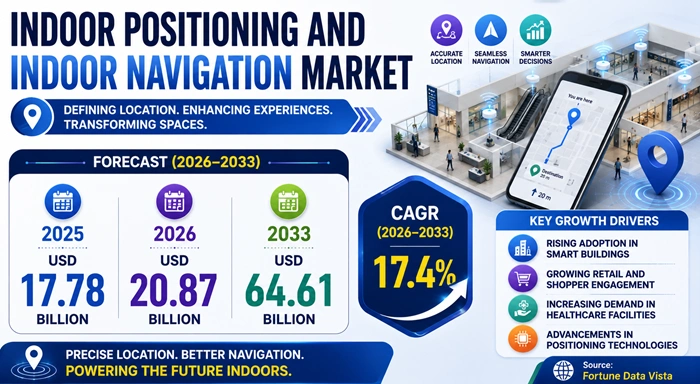
The global indoor positioning and indoor navigation market size is valued at USD 17.78 billion in 2025 and is predicted to increase from USD 20.87 billion in 2026 to approximately USD 64.61 billion by 2033, growing at a CAGR of 17.4% from 2026 to 2033.
Indoor positioning and indoor navigation (IPIN) systems provide precise real-time location tracking and route guidance inside enclosed spaces where conventional GPS signals cannot penetrate reliably — including hospitals, shopping malls, airports, warehouses, manufacturing plants, corporate campuses, and large public venues. Using technologies such as ultra-wideband (UWB), Bluetooth Low Energy (BLE) beacons, Wi-Fi fingerprinting, magnetic positioning, RFID, and sensor fusion algorithms, IPIN systems enable seamless wayfinding, asset tracking, proximity marketing, emergency response, and location-based analytics across diverse industries. The rapid proliferation of smart buildings, rising demand for real-time location services (RTLS), growing smartphone penetration, and increasing investment in connected infrastructure are collectively propelling the indoor positioning and indoor navigation market toward exceptional growth. As organizations recognize the operational efficiency, safety improvement, and customer experience benefits that precision indoor location intelligence delivers, IPIN technology is evolving from a specialized niche solution into an essential infrastructure layer for intelligent buildings and smart facilities globally.
AI Impact on the Indoor Positioning and Indoor Navigation Industry
Artificial intelligence is transforming indoor positioning and indoor navigation from passive location-tracking technology into proactive, predictive intelligence systems that can anticipate user needs, optimize facility operations, and adapt to dynamic real-world environments with accuracy and context awareness that rule-based systems cannot achieve
Artificial intelligence is fundamentally elevating the precision, reliability, and functional value of indoor positioning and indoor navigation systems. Traditional IPIN approaches using single-technology signal triangulation suffer from accuracy limitations caused by multipath signal interference, physical obstructions, and environmental variability — particularly in crowded, complex facilities like hospitals and airports where walls, metal structures, and moving crowds constantly alter the radio frequency environment. AI-powered sensor fusion algorithms that intelligently combine data from multiple positioning technologies — UWB, BLE, IMU (inertial measurement units), barometric pressure sensors, and Wi-Fi — can dynamically compensate for individual signal degradations in real time, delivering sub-meter accuracy that single-technology systems cannot match. Machine learning models trained on historical positioning data can also predict and pre-correct for systematic location errors in known facility areas, progressively improving system accuracy with accumulated operational experience without requiring manual recalibration.
At the application layer, AI is enabling a new generation of intelligent building services that transform indoor location data from raw coordinates into actionable operational and business intelligence. In healthcare, AI-powered RTLS platforms are using patient and staff location patterns to predict congestion bottlenecks, optimize clinical workflow scheduling, and automatically dispatch housekeeping and equipment maintenance resources based on occupancy and asset usage signals. In retail, AI-driven indoor location analytics are mapping customer journey patterns, dwell time distribution, and cross-category shopping flows at a granularity that enables data-informed store layout optimization and personalized promotion delivery timed to customer proximity signals. The ability of AI to translate raw indoor location data into operationally meaningful insights — and to autonomously trigger responses and workflows based on those insights — is dramatically expanding the commercial value proposition of the indoor positioning and indoor navigation market and accelerating enterprise adoption across all major verticals.
Growth Factors
The global smart building revolution, the explosive growth of IoT-connected facility infrastructure, rapidly expanding demand for real-time asset and personnel tracking across healthcare and logistics, and the proliferation of consumer indoor navigation applications across airports and large retail venues are generating a powerful and multi-dimensional commercial growth surge across the indoor positioning and indoor navigation market through 2033
The most fundamental commercial growth driver for the indoor positioning and indoor navigation market is the accelerating global adoption of smart building technology — a structural shift in how facilities are designed, operated, and experienced that places real-time location intelligence at the operational core of building management. Modern smart buildings integrate IPIN systems with building management systems (BMS), access control, energy management, occupancy monitoring, and emergency response infrastructure — creating unified intelligent facility environments where location data continuously feeds operational decisions. The smart building market is expected to exceed USD 570 billion globally by 2030, and the integration of indoor positioning infrastructure as a foundational smart building capability means that IPIN system deployments are increasingly driven by building-level smart infrastructure investment rather than standalone location technology purchasing decisions — significantly broadening the commercial adoption pathway beyond the traditional early-adopter base. Airports, hospitals, large retail complexes, and corporate campuses are at the leading edge of this smart building IPIN integration trend, with major facility operators including international airports, hospital networks, and large retail property groups making multi-year IPIN infrastructure commitments as part of broader digital facility transformation programs.
Healthcare represents the single most commercially important vertical driving near-term IPIN market growth — combining massive facility scale, safety-critical asset tracking needs, staff efficiency imperatives, and substantial capital investment capacity in a single high-demand sector. The accurate real-time tracking of medical equipment — infusion pumps, wheelchairs, portable diagnostic devices, crash carts — saves hospitals an estimated USD 40,000–80,000 per year per facility in reduced equipment replacement costs, search labor, and equipment idle time. Patient flow monitoring and staff location visibility further reduce clinical inefficiencies, improve response times, and enhance safety — creating measurable ROI that justifies IPIN infrastructure investment. As aging global populations drive increasing hospital utilization and healthcare systems face mounting pressure to improve operational efficiency, the demand for RTLS and indoor positioning technology in healthcare settings will continue to grow strongly — making this vertical one of the primary revenue engines of the indoor positioning and indoor navigation market through 2033.
Market Outlook
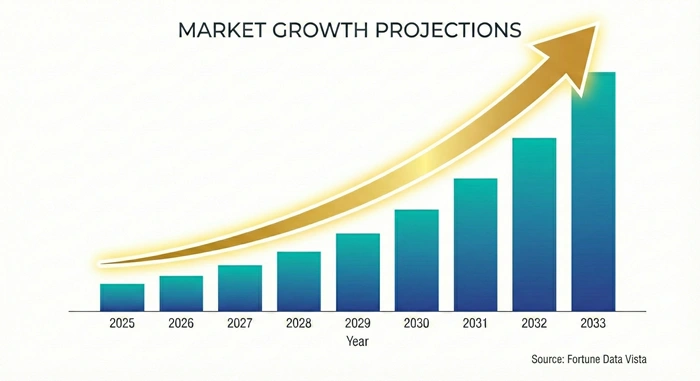
With a trajectory toward USD 64.61 billion by 2033 at a CAGR of 17.4%, the indoor positioning and indoor navigation market is entering its most commercially transformative decade — driven by converging smart building investment, 5G and UWB technology maturation, explosive IoT growth, and the irreversible shift of consumer and enterprise navigation expectations toward seamless indoor-outdoor location continuity
The medium-to-long-term market outlook for indoor positioning and indoor navigation systems is strongly positive across all major technology, application, and regional dimensions. Ultra-wideband technology — the most precision-capable IPIN technology, delivering centimeter-level accuracy — is experiencing particularly rapid commercial adoption driven by its native integration into Apple iPhone and Watch devices, growing Samsung and Android ecosystem support, and the commercial release of purpose-built UWB chipsets by NXP Semiconductors and Qorvo that are enabling affordable, mass-market UWB beacon hardware. This hardware cost decline is making UWB-based IPIN deployments commercially viable for a broader range of enterprise applications — including retail, hospitality, and corporate office environments — that previously found UWB-grade accuracy cost-prohibitive. The convergence of 5G network infrastructure with indoor positioning — through 5G positioning reference signals and private 5G network deployments in large facilities — will further expand IPIN system accuracy and scalability through the forecast period, making 5G an important commercial enabler for next-generation indoor navigation capabilities.
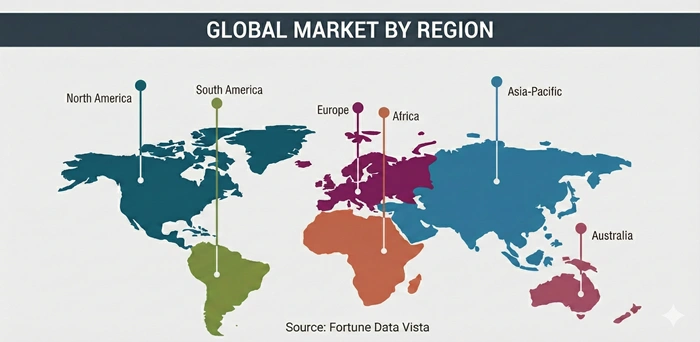
Asia Pacific will be the fastest-growing region through 2033, driven by massive smart city and smart building investment programs across China, South Korea, Japan, and India — with government-funded intelligent transportation hubs, mega-retail complexes, and smart hospital projects creating large-scale IPIN deployment opportunities. North America will maintain its dominant market position, supported by early enterprise adoption leadership, the most active technology vendor innovation ecosystem, and the highest per-site IPIN infrastructure investment driven by premium-grade smart building standards in the commercial real estate and healthcare sectors. Europe will generate steady and growing market contribution, supported by EU smart building energy efficiency mandates and growing workplace intelligence investment across corporate campuses and manufacturing facilities. The combined commercial momentum across all regions positions the indoor positioning and indoor navigation market for sustained, exceptional growth through 2033 and beyond.
Expert Speaks
-
"Indoor positioning technology is becoming as fundamental to facility operations as Wi-Fi networking was fifteen years ago — it is infrastructure that organizations simply cannot afford to operate without in a world where operational efficiency, safety compliance, and customer experience are all driven by real-time location intelligence. We are investing heavily in expanding the capabilities and reducing the deployment complexity of our indoor location systems because we believe every major facility globally will have comprehensive indoor positioning infrastructure within the next decade." — CEO perspective, leading global location technology and mapping services company
-
"The integration of UWB positioning technology directly into consumer devices — and the consequent expectation among consumers that indoor navigation should be as seamless as outdoor GPS — is creating a powerful market pull that is accelerating enterprise investment in IPIN infrastructure across airports, hospitals, shopping centers, and large public venues. We are seeing unprecedented demand for precision indoor location systems from facility operators who recognize that seamless indoor navigation is now a core component of the customer experience they must deliver to remain competitive." — CEO perspective, leading global technology hardware and semiconductor company with major investment in UWB indoor positioning
-
"Real-time location intelligence inside facilities is no longer a nice-to-have — it is an operational necessity for healthcare networks, logistics operators, and retail groups that need to optimize asset utilization, staff productivity, and customer flow at scale. Our indoor positioning platform is processing billions of location events daily across customer facilities worldwide, and the operational insights it generates are directly translating into measured cost savings and revenue improvements that make the ROI case for indoor location investment compelling and immediate." — CEO perspective, leading enterprise real-time location services and IoT platform company
Key Report Takeaways
-
North America leads the global indoor positioning and indoor navigation market, holding approximately 38% of total revenue share in 2025, driven by early enterprise adoption of RTLS in healthcare, logistics, and manufacturing, the highest concentration of IPIN technology vendors including Cisco, Zebra Technologies, Inpixon, HERE Technologies, and CenTrak, and advanced commercial real estate investment in smart building infrastructure that integrates indoor positioning as a core operational capability.
-
Asia Pacific is the fastest-growing regional market, expected to register the highest CAGR through 2033, fueled by massive government-backed smart city projects across China, South Korea, and India, rapid expansion of large-format retail, healthcare, and transportation hub infrastructure requiring indoor navigation capabilities, and growing consumer demand for seamless indoor wayfinding in airports, metro stations, and shopping complexes driven by widespread smartphone adoption.
-
Ultra-wideband (UWB) technology is the fastest-growing positioning technology segment, expected to grow at a CAGR exceeding 22% through 2033, driven by its native integration into Apple's iPhone and AirTag ecosystem, growing Android device support, NXP and Qorvo chipset cost reductions enabling affordable large-scale deployments, and its superior centimeter-level accuracy advantage over BLE and Wi-Fi alternatives for precision-critical industrial and healthcare applications.
-
Asset and personnel tracking is the largest application segment, contributing approximately 34.7% of global market revenue in 2025, as hospital networks, logistics operators, and manufacturing facilities collectively represent the highest-volume IPIN deployment base — requiring continuous real-time tracking of critical assets including medical equipment, inventory, forklifts, and personnel for both operational efficiency and safety compliance purposes.
-
Healthcare is the dominant end-user vertical, accounting for approximately 27.3% of global market revenue in 2025, as hospital networks generate the largest single-category IPIN infrastructure investment globally — deploying comprehensive RTLS systems for medical equipment tracking, patient flow monitoring, staff location visibility, infant protection, and environmental condition monitoring across large, complex multi-floor facility environments.
-
Software and services is the fastest-growing component segment, growing at a CAGR exceeding 19.2% through 2033, as organizations increasingly invest in analytics platforms, digital twin integration, AI-powered insight generation, and managed service arrangements that extract maximum operational value from their deployed indoor positioning hardware infrastructure — with software subscription revenue models generating recurring revenue streams that are increasingly valued by both vendors and investors.
-
Navigation and maps is the fastest-growing application sub-segment, anticipated to grow at a CAGR exceeding 20.5% through 2033, driven by consumer-facing indoor wayfinding demand at airports, large retail malls, university campuses, and convention centers — with Google Maps indoor navigation, Apple Maps integration, and specialized wayfinding app platforms from HERE Technologies and Mappedin expanding the consumer-accessible indoor navigation ecosystem rapidly.
Market Scope
| Parameter | Details |
|---|---|
| Market Size by 2033 | USD 64.61 Billion | Market Size by 2026 | USD 20.87 Billion | Market Size by 2025 | USD 17.78 Billion | Market Growth Rate from 2026 to 2033 | CAGR of 17.4% | Dominating Region | North America | Fastest Growing Region | Asia Pacific | Segments Covered | Component, Technology, Application, End User | Regions Covered | North America, Europe, Asia Pacific, Latin America, Middle East & Africa |
Market Dynamics
Drivers Impact Analysis
The global smart building investment wave, healthcare RTLS demand explosion, technology cost reductions enabling broader deployment, IoT infrastructure expansion, and 5G network maturation are generating a compounding set of commercial growth drivers that are reinforcing the indoor positioning and indoor navigation market's exceptional growth trajectory through 2033
| Driver | ≈ % Impact on CAGR Forecast | Geographic Relevance | Impact Timeline |
|---|---|---|---|
| Smart building adoption integrating IPIN as core facility intelligence infrastructure | ~28% | North America, Europe, Asia Pacific | Short to Long Term |
| Healthcare RTLS demand for equipment tracking and patient flow management | ~25% | North America, Europe | Short to Long Term |
| UWB technology commercialization and hardware cost reduction enabling mass-market deployment | ~22% | North America, Asia Pacific | Short to Medium Term |
| IoT expansion creating interconnected facility sensor ecosystems supporting indoor positioning | ~18% | Global | Short to Long Term |
| 5G network deployment enabling new precision indoor positioning signal infrastructure | ~7% | North America, Asia Pacific, Europe | Medium to Long Term |
The smart building adoption wave is the broadest and most durable commercial driver for the indoor positioning and indoor navigation market — because it establishes IPIN infrastructure as a foundational element of intelligent facility design rather than a standalone add-on technology. Modern smart buildings require occupancy intelligence to optimize energy consumption, space utilization, access control, and emergency response — and indoor positioning systems are the primary data collection infrastructure enabling all of these applications. Building developers and facility operators are increasingly including IPIN system specifications in new construction and renovation projects as standard intelligent building requirements — alongside power, networking, and security infrastructure — driven by green building certification standards, corporate sustainability targets, and tenant demand for workspace technology sophistication. This architectural integration of indoor positioning into smart building specifications means that IPIN deployment volumes are growing in direct proportion to smart building construction activity — creating a structural demand pipeline that is largely independent of standalone technology purchasing cycles.
Healthcare's RTLS and indoor location technology investment is the second most powerful commercial driver, and it is notable for its exceptional deployment scale — with large hospital networks installing tens of thousands of tracking tags across millions of square feet of facility space. The Joint Commission's patient safety standards, CMS meaningful use requirements, and growing clinical governance focus on preventing adverse events related to equipment unavailability, patient elopement, and delayed emergency response are creating regulatory and institutional pressure that makes RTLS investment a compliance-driven necessity rather than purely an efficiency-driven choice. The leading healthcare IPIN vendors — Zebra Technologies, CenTrak, Sonitor Technologies, and Stanley Healthcare — are benefiting from long-term, multi-year enterprise contract structures that deliver predictable, recurring revenue from ongoing platform subscriptions, system expansions, and managed service arrangements, making healthcare the most commercially stable and reliably growing vertical in the indoor positioning and indoor navigation market.
Restraints Impact Analysis
High initial deployment costs, the technical complexity of multi-technology integration, significant privacy concerns around continuous indoor location tracking, and the absence of standardized IPIN protocols are creating meaningful commercial friction that is moderating the pace of the indoor positioning and indoor navigation market's otherwise exceptional growth trajectory
| Restraint | ≈ % Impact on CAGR Forecast | Geographic Relevance | Impact Timeline |
|---|---|---|---|
| High infrastructure installation and maintenance costs for large-scale IPIN deployments | ~40% | All markets | Short to Long Term |
| Privacy and data security concerns around continuous employee and consumer location tracking | ~35% | Europe, North America | Short to Long Term |
| Lack of universal standards for IPIN interoperability across technology vendors | ~25% | Global | Medium to Long Term |
The high upfront capital cost of deploying comprehensive indoor positioning infrastructure across large facilities remains the most significant commercial restraint in the indoor positioning and indoor navigation market. A full-scale IPIN deployment across a large hospital or airport — requiring hundreds to thousands of BLE beacons, UWB anchors, or Wi-Fi access point upgrades, software licensing, site surveys, system integration, and staff training — can cost anywhere from hundreds of thousands to several million dollars depending on facility size, technology choice, and application complexity. This cost creates extended sales cycles, budget approval processes, and ROI justification requirements that slow deployment velocity — particularly in the mid-market and public sector segments where capital budgets are more constrained than in large enterprise environments. While technology cost reduction trends are gradually improving affordability — particularly for BLE beacon hardware, which has declined dramatically in price over the past five years — the total system cost for enterprise-grade IPIN deployments with software, integration, and services remains a meaningful barrier to accelerated market penetration.
Privacy concerns are an increasingly prominent restraint, particularly in consumer-facing and workplace contexts where continuous indoor location tracking raises data governance, consent, and surveillance concerns that organizations must navigate carefully. European GDPR requirements mandate explicit consent for location data collection and processing, creating compliance obligations that complicate the deployment of consumer-facing indoor navigation and proximity marketing applications in EU markets. In workplace environments, employee unions and regulatory authorities in several countries have pushed back against the use of indoor positioning to continuously monitor worker locations — particularly in distribution centers and manufacturing facilities — raising reputational and legal risks for employers that fail to establish clear data use policies and employee consent frameworks. These privacy considerations add compliance costs, limit certain application use cases, and in some cases deter organizations from deploying IPIN capabilities altogether — moderating market growth pace in segments and geographies where privacy regulation is most stringent.
Opportunities Impact Analysis
The commercial deployment of 5G-native indoor positioning, the emergence of digital twin integration creating AI-powered virtual facility intelligence platforms, and the vast untapped IPIN deployment opportunity across Asia Pacific's rapidly expanding smart city and smart facility infrastructure represent three high-value growth frontiers that will define the competitive future of the indoor positioning and indoor navigation market through 2033
| Opportunity | ≈ % Impact on CAGR Forecast | Geographic Relevance | Impact Timeline |
|---|---|---|---|
| Digital twin and AI integration creating intelligent virtual facility platforms powered by indoor location data | ~35% | North America, Europe | Medium to Long Term |
| 5G-enabled precision indoor positioning through private network deployment in large facilities | ~28% | North America, Asia Pacific | Medium to Long Term |
| Smart city and mega-infrastructure IPIN deployment across rapidly expanding Asia Pacific facilities | ~25% | Asia Pacific, MEA | Short to Medium Term |
| Consumer indoor navigation ecosystem growth via Apple Maps, Google Maps, and app-based wayfinding | ~12% | North America, Asia Pacific | Short to Medium Term |
The integration of indoor positioning data with digital twin platforms represents one of the most commercially transformative opportunities in the indoor positioning and indoor navigation market. Digital twins create real-time virtual models of physical facilities — continuously updated with sensor data, IoT readings, and occupancy signals — enabling facility operators to simulate, optimize, and automate building operations with a level of intelligence and responsiveness that physical management alone cannot achieve. When real-time indoor location data from IPIN systems is integrated into facility digital twins, the resulting platform can continuously monitor space utilization, energy consumption patterns, equipment maintenance needs, and safety conditions — automatically triggering optimized responses to real-world events. Companies including Siemens (Building X), Honeywell, and IBM are actively developing digital twin platforms with embedded IPIN data integration, and the commercial success of these integrated offerings is creating strong demand for high-quality, continuous indoor location data — driving new IPIN system deployments and expanding average revenue per deployment through software and analytics subscription revenue.
The emergence of private 5G networks in large enterprise facilities — airports, manufacturing plants, seaports, and hospital campuses — is creating a significant new indoor positioning opportunity through 5G network positioning reference signals that can deliver meter-to-sub-meter location accuracy without requiring additional dedicated positioning hardware. Several of the world's largest airports, ports, and industrial campuses are currently deploying private 5G networks for operational connectivity, and the addition of 5G positioning capabilities to these network deployments will significantly expand the addressable IPIN deployment opportunity in high-value enterprise settings. For technology vendors with 5G-integrated positioning capabilities — including Ericsson, Nokia, and Bosch — this convergence represents a major competitive opportunity to expand their indoor location market presence through their existing enterprise 5G network customer relationships. As 5G private network deployments accelerate through 2027–2030 and positioning capabilities mature, this technology convergence will generate substantial new revenue streams and competitive dynamics within the indoor positioning and indoor navigation market.
Segment Analysis
By Technology: Ultra-Wideband (UWB)
Ultra-wideband technology has emerged as the precision positioning standard of the indoor positioning and indoor navigation market — combining centimeter-level accuracy, robust multipath immunity, and native consumer device integration to establish itself as the technology of choice for the most demanding industrial, healthcare, and enterprise IPIN applications
Ultra-wideband technology is the fastest-growing technology segment in the indoor positioning and indoor navigation market, holding approximately 18.6% of global market revenue in 2025 and growing at a CAGR of approximately 22.3% through 2033. UWB operates by transmitting extremely short duration radio pulses across a wide frequency spectrum — typically 3.1 to 10.6 GHz — enabling time-of-flight distance measurement with centimeter-level precision that fundamentally outperforms the meter-scale accuracy of BLE and Wi-Fi positioning alternatives. Apple's integration of UWB chips into iPhone 11 and subsequent models, and its use in AirTags for precision finding, has dramatically raised consumer awareness and enterprise interest in UWB-based positioning capabilities — creating a pull-through demand signal that is accelerating enterprise IPIN investment in UWB infrastructure. North America leads this technology segment, accounting for approximately 41% of global UWB positioning market revenue in 2025, driven by early enterprise adoption in healthcare (patient and asset tracking), retail (shopfloor employee and inventory management), and industrial facilities (machine safety zone monitoring). Key companies driving UWB technology in the indoor positioning and indoor navigation market include Zebra Technologies, Inpixon, Sewio Networks, Pozyx, Wipelot, and chipset providers NXP Semiconductors and Qorvo.
Europe is the second-largest UWB market geography, with strong industrial adoption in German, Dutch, and Swiss manufacturing and logistics facilities — where UWB's precision accuracy is particularly valued for safety-critical applications including automated guided vehicle (AGV) collision avoidance and confined space worker safety monitoring. Asia Pacific is the fastest-growing UWB geography, driven by South Korea and China's large-scale smart facility construction programs, Japanese industrial automation investment, and the rapidly growing regional commercial real estate sector deploying UWB-based smart building positioning infrastructure. The declining cost of UWB beacon and anchor hardware — driven by NXP's UWB chipset commercialization and competitive chipset development from Qorvo and Samsung — is progressively making UWB deployments cost-competitive with BLE-based systems for mid-market applications, expanding the addressable deployment opportunity beyond premium enterprise-only use cases. As UWB native support expands across Android and Samsung devices alongside existing Apple integration, the consumer-device ecosystem that enables consumer-facing indoor navigation using UWB infrastructure will grow rapidly — creating an additional commercial demand layer that will sustain the technology segment's strong CAGR through 2033.
By End User: Healthcare
Healthcare's combination of massive facility scale, safety-critical asset tracking imperatives, patient flow management needs, regulatory compliance pressure, and substantial capital investment capacity makes it the single most commercially significant end-user vertical driving the growth and scale of the indoor positioning and indoor navigation market
The healthcare end-user segment holds the largest share in the indoor positioning and indoor navigation market, contributing approximately 27.3% of global market revenue in 2025 and growing at a CAGR of approximately 18.6% through 2033. Hospitals and healthcare networks deploy IPIN systems for a broad range of mission-critical applications — including medical equipment tracking, patient wandering prevention, staff duress alerting, infant protection, surgical asset management, and environmental condition monitoring — each delivering measurable clinical and operational value that drives compelling ROI. The financial case for IPIN investment in healthcare is well-documented: studies consistently demonstrate that hospital RTLS deployments recover their full capital investment within 18–24 months through equipment utilization improvements, search labor reduction, rental cost elimination, and clinical workflow efficiency gains. North America is the largest healthcare IPIN geography, accounting for approximately 44% of global healthcare segment revenue in 2025, driven by the scale and technological sophistication of the U.S. hospital market, active RTLS adoption by major hospital networks including HCA Healthcare, Mayo Clinic, and Cleveland Clinic, and strong CenTrak, Zebra Technologies, and Sonitor Technologies commercial presence in U.S. healthcare accounts.
Europe is the second-largest healthcare IPIN geography, with NHS hospital networks in the UK, German hospital groups, and Scandinavian healthcare systems among the most active deployers of RTLS and indoor location technology for patient safety and asset management. Asia Pacific is the fastest-growing healthcare IPIN region — growing at a regional CAGR exceeding 21% through 2033 — driven by massive hospital construction programs in China, India, and Southeast Asia, where newly built healthcare facilities are incorporating RTLS infrastructure as a standard smart hospital feature from commissioning. Key companies competing for healthcare IPIN deployments include Zebra Technologies, CenTrak (a Halma company), Sonitor Technologies, Stanley Healthcare (a Securitas Healthcare company), Inpixon, and Midmark RTLS — each offering specialized healthcare-configured indoor positioning platforms with clinical workflow integration, clinical staff app interfaces, and regulatory compliance features tailored to the unique operational requirements of hospital and healthcare facility environments.
Regional Insights
North America
North America's early enterprise adoption leadership, the world's highest per-site IPIN infrastructure investment in healthcare and commercial real estate, and the dominant market presence of the most technically advanced indoor positioning and indoor navigation platform vendors firmly establish it as the global commercial leader in this market
North America leads the indoor positioning and indoor navigation market, accounting for approximately 38% of global revenue share in 2025, with a regional CAGR of approximately 16.8% projected through 2033. The United States drives the vast majority of regional revenue, anchored by the world's highest per-capita investment in hospital RTLS infrastructure, advanced smart building adoption in commercial real estate, and the home market concentration of the leading IPIN technology vendors — including Cisco Systems, Zebra Technologies, Inpixon, CenTrak, HERE Technologies, HID Global, and AiRISTA Flow. The commercial real estate sector is a particularly strong demand driver in North America, where large corporate campuses, convention centers, and major international airports including Hartsfield-Jackson, O'Hare, and Denver International have made multi-million-dollar indoor navigation and wayfinding system investments as part of comprehensive digital facility transformation programs. The deep enterprise technology culture and mature SaaS procurement ecosystem in the United States also favor the software and managed services segments of the market — with North American customers generating the highest average revenue per IPIN deployment globally through premium analytics platform subscriptions and comprehensive managed service contracts.
Canada contributes meaningful regional revenue, particularly from healthcare IPIN deployments through major hospital networks in Ontario, British Columbia, and Alberta, as well as growing corporate campus indoor navigation adoption in Toronto and Vancouver technology district office complexes. The North American market is also the primary commercial launch pad for the most advanced next-generation IPIN capabilities — including AI-powered indoor analytics platforms, digital twin integration services, and 5G-enabled positioning systems — with major enterprise customers in the region serving as early adopters that validate new technology capabilities before broader global deployment rollout. North America's market leadership is expected to be sustained through 2033, driven by ongoing healthcare RTLS expansion, active smart building investment in commercial real estate, and continuous technology innovation from the region's dominant IPIN vendor ecosystem.
Asia Pacific
Asia Pacific's extraordinary scale of smart city construction, government-mandated intelligent transportation and public venue infrastructure investment, rapid expansion of large-format retail and healthcare facilities, and the world's largest smartphone user base are combining to establish the region as the most dynamic and fastest-growing commercial frontier in the global indoor positioning and indoor navigation market
Asia Pacific is the fastest-growing region in the indoor positioning and indoor navigation market, expected to grow at a regional CAGR of approximately 19.6% through 2033, driven by a unique combination of government-scale smart infrastructure investment and private sector facility expansion that is creating IPIN deployment opportunities at a scale and pace unmatched by any other world region. China is the single largest country market within Asia Pacific, with government-funded smart city programs deploying indoor positioning infrastructure across new airport terminals, metro stations, large hospital complexes, and convention centers at a scale and investment level that is transforming the global IPIN deployment volume picture. South Korea's digital infrastructure investment program, Japan's Olympics and post-Olympics smart venue legacy infrastructure, and India's rapidly expanding private hospital sector and mega-mall construction pipeline are collectively generating a massive and diverse pipeline of IPIN deployment opportunities across the region. Key companies active in the Asia Pacific IPIN market include global players including Cisco, HERE Technologies, and Zebra Technologies operating through regional subsidiaries, alongside strong regional players including Blueiot (Beijing), NavInfo (China), and IndoorAtlas (now with strong Asia Pacific commercial presence).
India represents one of the most significant longer-term growth opportunities in the Asia Pacific indoor positioning and indoor navigation market — with rapid smartphone adoption now exceeding 750 million users, large-scale private hospital construction under the National Health Mission, expanding international-standard airport terminal development, and a fast-growing retail mall sector that is creating broad, diverse IPIN deployment demand. Government smart city programs under the Smart Cities Mission are specifically incorporating indoor navigation and wayfinding specifications for new public transportation hubs and civic buildings — creating government-funded demand that is establishing the deployment precedents and ecosystem infrastructure for broader commercial market expansion. As India's technology infrastructure investment accelerates through the forecast period, it is expected to become one of the most commercially significant individual country markets in the global indoor positioning and indoor navigation market — driven by the combination of population scale, infrastructure investment ambition, and rapidly growing enterprise technology adoption culture.
Report Customization Available
Get a Fully Customized Indoor Positioning and Indoor Navigation Market Report for Your Target Region or Country
Our indoor positioning and indoor navigation market report is available with complete region-specific and country-level customization to precisely address your strategic research and business intelligence needs. Each customized report delivers in-depth market sizing, technology segment analysis, application-specific demand assessment, vertical industry penetration rates, regulatory and privacy compliance environment review, competitive landscape profiling, and growth opportunity mapping — all calibrated to the specific commercial dynamics of your chosen geography and application focus area.
Customized indoor positioning and indoor navigation market reports are available for the following regions and countries:
North America
-
United States – Detailed analysis of enterprise RTLS adoption in healthcare, commercial real estate smart building integration, airport and retail wayfinding deployments, leading vendor market positions including Cisco, Zebra Technologies, Inpixon, and CenTrak, and consumer indoor navigation ecosystem development through Apple Maps and Google Maps indoor capabilities
-
Canada – Coverage of Canadian healthcare IPIN investment trends, corporate campus indoor navigation adoption, smart building technology procurement, domestic regulatory environment for location data management, and cross-border market access for U.S.-based IPIN vendors
-
Mexico – Analysis of growing smart facility investment in retail, manufacturing, and transportation infrastructure, international vendor market access, SME adoption trends for indoor positioning solutions, and regulatory environment for location data collection and use
Europe
-
United Kingdom – NHS hospital RTLS investment, commercial real estate indoor navigation demand, ICO data privacy framework for location tracking, leading vendor positions including Ubisense and Mappedin UK operations, and smart building standard integration in London commercial property
-
Germany – Industrial RTLS adoption in automotive and manufacturing, GDPR compliance requirements for employee and consumer location tracking, Siemens and Bosch indoor positioning ecosystem, smart factory safety application demand, and Industrie 4.0 integration
-
France – CNIL data protection framework, French retail and airport indoor navigation adoption, healthcare RTLS investment, and growing smart building integration in Parisian commercial real estate
-
Italy – Italian manufacturing and logistics RTLS demand, smart venue indoor navigation for tourism and retail, data privacy regulatory landscape, and healthcare facility IPIN adoption trends
-
Rest of Europe – Coverage of Netherlands, Sweden, Spain, and Switzerland regarding industrial IPIN adoption, smart office navigation, European GDPR compliance, and regional vendor competitive landscape
Asia Pacific
-
China – Smart city government-funded IPIN infrastructure, domestic vendor landscape including Blueiot and NavInfo, mobile app-based indoor navigation ecosystem, smart hospital RTLS investment, and major retail complex wayfinding deployment programs
-
India – Smart Cities Mission IPIN integration, private hospital RTLS investment, international airport indoor navigation expansion, smartphone-driven consumer wayfinding demand, and government and private sector IPIN procurement trends
-
Japan – Ministry of Land smart building standards, enterprise facility IPIN adoption in retail and corporate sectors, domestic vendor landscape, industrial safety RTLS requirements, and consumer indoor navigation ecosystem through major transit operators
-
South Korea – K-Smart City program IPIN integration, Samsung and LG smart facility investment, hospital RTLS adoption, government smart infrastructure standards, and leading domestic IPIN technology developers
-
Australia – Healthcare and mining sector RTLS demand, smart building commercial real estate adoption, airport indoor navigation deployment, data privacy framework for location services, and leading international vendor commercial presence
-
Rest of Asia Pacific – Coverage of Singapore, Malaysia, Thailand, and Vietnam with focus on smart city and smart building investment programs, mobile-first indoor navigation consumer adoption, retail mall wayfinding deployment, and healthcare IPIN infrastructure development
Latin America
-
Brazil – Healthcare RTLS investment in private hospital networks, growing retail and airport indoor navigation demand, LGPD location data compliance, government smart city initiatives, and international IPIN vendor market entry strategies
-
Argentina – Enterprise facility RTLS adoption trends, healthcare and logistics sector demand, privacy regulatory environment, and international vendor platform availability and localization
-
Rest of Latin America – Coverage of Colombia, Chile, and Peru regarding smart infrastructure investment, growing enterprise IPIN adoption, government transportation hub wayfinding programs, and regional distribution landscape for indoor positioning technology
Middle East & Africa
-
UAE – Dubai smart city IPIN infrastructure investment, premium retail and hospitality venue indoor navigation, GITEX and Expo site digital experience platforms, and international vendor market penetration in Abu Dhabi and Dubai smart building projects
-
Saudi Arabia – Vision 2030 smart city and Neom project IPIN infrastructure potential, Hajj and Umrah crowd management applications, healthcare RTLS investment, and international vendor partnership opportunities with Saudi infrastructure developers
-
Rest of MEA – Coverage of South Africa, Turkey, and Israel regarding growing smart facility investment, healthcare and industrial RTLS adoption, mobile-first indoor navigation demand, and emerging smart city program IPIN specifications
Top Key Players
-
Zebra Technologies Corporation (United States)
-
Cisco Systems, Inc. (United States)
-
HERE Technologies (Netherlands)
-
Microsoft Corporation (United States)
-
Apple Inc. (United States)
-
Inpixon (United States)
-
CenTrak, Inc. (Halma plc) (United States / United Kingdom)
-
HID Global Corporation (United States)
-
Sonitor Technologies AS (Norway)
-
Ubisense Group plc (United Kingdom)
-
IndoorAtlas Ltd. (Finland)
-
Blueiot (Beijing) Technology Co., Ltd. (China)
-
Sewio Networks s.r.o. (Czech Republic)
-
AiRISTA Flow, Inc. (United States)
-
Pointr Labs (United Kingdom)
Recent Developments
-
In January 2025, Zebra Technologies Corporation announced a significant expansion of its Savanna data intelligence platform — integrating new AI-powered indoor location analytics capabilities for healthcare and retail customers, enabling real-time predictive insights from RTLS location data streams including equipment utilization forecasting, patient flow bottleneck prediction, and automated staff workflow optimization. The enhancement reinforced Zebra's leadership position in enterprise indoor positioning and indoor navigation systems and demonstrated the company's commitment to transitioning its RTLS platform from passive tracking to active operational intelligence delivery.
-
In March 2025, Inpixon completed the strategic reorganization of its indoor intelligence business — refocusing its enterprise indoor positioning platform on high-growth verticals including manufacturing, healthcare, and corporate real estate, and launching a new AI-powered digital twin integration module that enables real-time visualization of indoor location data within 3D facility models. The product launch addressed growing enterprise demand for integrated indoor positioning and digital twin operational platforms that go beyond basic tracking to deliver actionable facility intelligence.
-
In October 2024, HERE Technologies launched its new HERE Indoor SDK 3.0 — a comprehensive developer toolkit enabling application developers to build indoor positioning and navigation features into consumer and enterprise mobile apps using HERE's global indoor map database, which spans over 50,000 mapped indoor venues globally including airports, shopping malls, universities, and transit hubs. The release significantly expanded HERE's developer ecosystem and positioned the company as a leading platform provider for consumer-facing indoor navigation application development, competing directly with Google Maps and Apple Maps indoor capabilities.
-
In September 2024, CenTrak (a Halma plc company) announced the launch of its Gen2IR+ enterprise RTLS platform — featuring improved infrared and BLE hybrid location technology delivering enhanced sub-room accuracy for healthcare patient and staff tracking, with native integration with Epic Systems, Oracle Cerner, and Meditech electronic health record platforms for automated clinical workflow triggering from real-time location events. The product launch strengthened CenTrak's competitive position in the U.S. and European healthcare IPIN market and expanded its addressable deployment opportunity in mid-sized regional hospital networks.
-
In April 2025, Sewio Networks secured a major multi-site industrial deployment contract for its UWB-based RTLS platform with a leading European automotive manufacturer — deploying precision indoor positioning infrastructure across six production facilities for machine safety zone enforcement, AGV collision avoidance, and production floor asset tracking. The contract represented one of the largest UWB industrial IPIN deployments announced in Europe to date and validated the commercial scalability of UWB technology for large, complex multi-site manufacturing indoor positioning applications.
Market Trends
The convergence of UWB technology mass-market adoption through consumer device integration, the rise of AI-powered digital twin platforms consuming real-time indoor location intelligence, and the explosive growth of consumer-facing indoor navigation applications across airports and mega-retail venues are reshaping the competitive architecture and growth trajectory of the indoor positioning and indoor navigation market through 2033
The most transformative technology trend reshaping the indoor positioning and indoor navigation market is the rapid mass-market adoption of ultra-wideband positioning — accelerated by Apple's decision to embed UWB chips across its iPhone, Apple Watch, and HomePod product lines and use them for precision finding features including AirTag tracking and car key functions. This consumer device embedding of UWB technology is creating an installed base of hundreds of millions of UWB-capable endpoint devices globally — dramatically reducing the cost and complexity of deploying consumer-facing indoor navigation experiences in venues that are already populated with UWB-capable smartphones. For enterprise operators at airports, retail malls, hospitals, and corporate campuses, this installed base shift means that UWB-based indoor navigation services can reach a large proportion of their visitor population without requiring any dedicated hardware on the user side — fundamentally changing the business case for venue-scale indoor wayfinding investment. As Android device manufacturers including Samsung, Xiaomi, and Google progressively integrate UWB into flagship handsets, the consumer UWB endpoint base will expand to cover the majority of global smartphone users within the forecast period — making UWB the dominant technology standard for consumer-facing indoor navigation applications.
The second major trend is the growing integration of indoor location intelligence with building automation, digital twin platforms, and workplace experience applications — transforming indoor positioning from a standalone tracking system into a foundational data layer for intelligent building management. Enterprise real estate operators, hospital facility managers, and airport operators are increasingly deploying indoor positioning infrastructure not for a single application but as a shared intelligence infrastructure that simultaneously supports wayfinding, space utilization optimization, energy management, security response, and maintenance workflow automation. This multi-application value model dramatically improves the ROI of IPIN infrastructure investment and creates long-term platform vendor relationships characterized by expanding data integration, growing annual software subscription value, and deep technical interdependency. Technology companies including Siemens, Honeywell, IBM, and Johnson Controls are actively developing digital-twin-integrated indoor location platforms that operationalize this multi-application value model — and their commercial success is creating new competitive dynamics in the market that favor vendors capable of delivering integrated, AI-powered indoor intelligence platforms over those offering standalone positioning technology products.
Segments Covered in the Report
-
By Component
-
Hardware
-
BLE Beacons
-
Wi-Fi Access Points
-
UWB Anchors and Tags
-
RFID Tags and Readers
-
Sensors and Modules
-
-
Software
-
Indoor Positioning Platforms
-
Indoor Navigation and Mapping Tools
-
Location Analytics Software
-
Digital Twin Integration Modules
-
-
Services
-
Professional Services (Consulting, Implementation, Integration)
-
Managed Services
-
-
-
By Technology
-
Ultra-Wideband (UWB)
-
Bluetooth Low Energy (BLE)
-
Wi-Fi Positioning
-
RFID
-
Magnetic Positioning
-
Ultrasound
-
Others (Infrared, Visible Light Communication)
-
-
By Application
-
Asset and Personnel Tracking
-
Navigation and Maps / Indoor Wayfinding
-
Location-Based Analytics
-
Proximity Marketing
-
Emergency Response and Safety
-
Others
-
-
By End User
-
Healthcare (Hospitals, Clinics, Senior Care)
-
Retail and Shopping Centers
-
Manufacturing and Industrial
-
Transportation and Logistics (Airports, Warehouses, Ports)
-
Hospitality and Tourism
-
Corporate Offices
-
Public Venues (Stadiums, Museums, Convention Centers)
-
Others
-
-
By Region
-
North America (U.S., Canada, Mexico)
-
Europe (U.K., Germany, France, Italy, Rest of Europe)
-
Asia Pacific (China, India, Japan, South Korea, Australia, Rest of Asia Pacific)
-
Latin America (Brazil, Argentina, Rest of Latin America)
-
Middle East & Africa (UAE, Saudi Arabia, Rest of MEA)
-
❝ Built for Every Level — From Startups to Industry Giants ❞
Here Is Exactly How This Report Works for You
-
For Tier 1 technology conglomerates, large enterprise facility operators, and institutional investors: This report delivers granular competitive revenue analysis and market positioning assessments for all 15 key players — including Zebra Technologies, Cisco, HERE Technologies, Inpixon, and CenTrak — with detailed product portfolio benchmarking, enterprise contract structure analysis, and geographic market penetration breakdowns. It also provides a comprehensive analysis of how geopolitical and regulatory dynamics — including China's smart city infrastructure localization mandates affecting foreign IPIN vendor market access, EU AI Act implications for automated indoor location decision-making, and global supply chain disruptions impacting UWB semiconductor availability — are reshaping competitive strategies and investment priorities in the indoor positioning and indoor navigation market, giving leadership teams the data confidence to make high-stakes commercial and investment decisions with clarity.
-
For Tier 2 and Tier 3 IPIN hardware vendors, systems integrators, and vertical application software developers: This report identifies specific application segments, end-user verticals, and geographic markets where demand is outpacing current supply capacity — revealing high-value white-space opportunities for specialized vertical IPIN solutions, hardware component supply partnerships, integration service businesses, and analytics platform development. Competitor revenue source analysis highlights which technology standards, deployment models, and customer engagement approaches are generating the highest margins for market leaders — providing a strategic benchmark for product differentiation, go-to-market planning, and partnership development in the highly competitive global IPIN ecosystem.
-
For IPIN technology startups, venture capital investors, and corporate development teams: This report maps the highest-CAGR commercial frontiers — including AI-powered indoor analytics platforms, digital twin integration services, 5G-native positioning systems, and consumer-facing UWB wayfinding applications — with detailed analysis of competitive intensity, technology maturity, M&A transaction benchmarks, and investor activity. It provides the strategic intelligence foundation to identify and confidently pursue the most defensible and commercially attractive positions in the next generation of indoor positioning and indoor navigation market leadership through 2033 and beyond.
Frequently Asked Questions:
Answer: The global indoor positioning and indoor navigation market was valued at USD 17.78 billion in 2025 and is projected to reach approximately USD 64.61 billion by 2033. The market is expected to grow at a CAGR of 17.4% from 2026 to 2033, driven by smart building adoption, healthcare RTLS expansion, UWB technology commercialization, and growing consumer demand for indoor wayfinding applications across airports, hospitals, and large retail venues.
Answer: The most widely used technologies in indoor positioning and indoor navigation systems include Bluetooth Low Energy (BLE) beacons — which dominate due to low hardware costs and widespread smartphone compatibility — alongside Wi-Fi fingerprinting, ultra-wideband (UWB), RFID, and magnetic positioning. UWB is the fastest-growing technology, offering centimeter-level accuracy and native integration in Apple and Samsung devices, making it the preferred choice for precision-critical industrial, healthcare, and enterprise navigation applications.
Answer: Healthcare is the largest end-user industry in the indoor positioning and indoor navigation market, accounting for approximately 27.3% of global revenue in 2025, driven by hospital demand for RTLS-based medical equipment tracking, patient flow management, and staff safety systems. Retail, transportation and logistics, manufacturing, and corporate real estate are other major end-user verticals — each deploying indoor positioning for asset tracking, wayfinding, proximity marketing, and operational efficiency improvement at significant commercial scale.
Answer: North America leads the indoor positioning and indoor navigation market with approximately 38% of global revenue share in 2025, anchored by advanced enterprise technology adoption, the highest per-site IPIN investment in healthcare and commercial real estate, and dominant market positions by key vendors including Zebra Technologies, Cisco, Inpixon, and CenTrak. Asia Pacific is the fastest-growing region at a projected CAGR of approximately 19.6% through 2033, driven by massive government-funded smart city and smart facility investment across China, India, South Korea, and Japan.
Answer: The primary challenges in the indoor positioning and indoor navigation market are high upfront infrastructure deployment costs — particularly for large-scale enterprise deployments requiring extensive beacon or anchor hardware, software integration, and ongoing maintenance — and data privacy concerns around continuous indoor location tracking of employees and consumers. The lack of universal interoperability standards across different IPIN technology vendors also creates integration complexity that can extend deployment timelines and increase total system cost, particularly in heterogeneous enterprise environments where multiple location technologies must coexist.