
Lithium Iron Phosphate Battery Market Overview
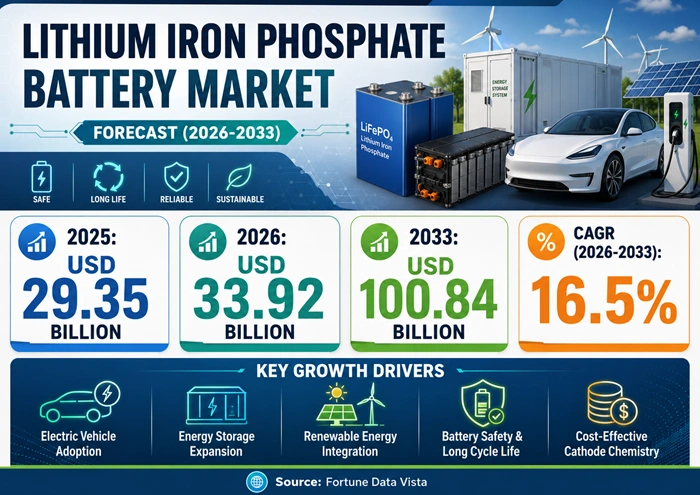
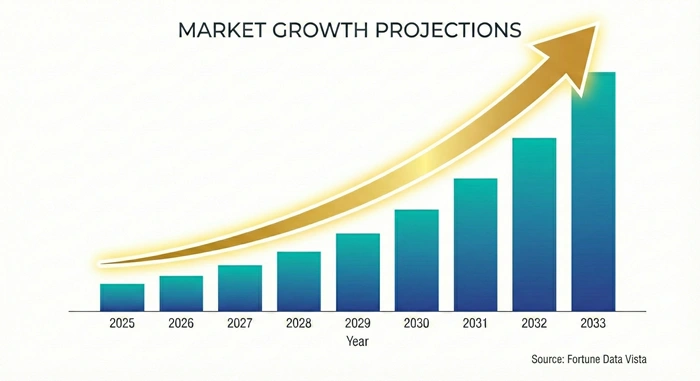
The global lithium iron phosphate battery market size is valued at USD 29.35 billion in 2025 and is predicted to increase from USD 33.92 billion in 2026 to approximately USD 100.84 billion by 2033, growing at a CAGR of 16.5% from 2026 to 2033.
The market is witnessing one of the most dynamic growth trajectories in the global energy storage landscape. LFP batteries — known for their lithium iron phosphate chemistry — are gaining a decisive edge over competing technologies due to their exceptional thermal stability, long cycle life, lower cost, and freedom from cobalt, a mineral associated with ethical supply chain concerns. Electric vehicles, grid-scale energy storage systems, and industrial power backup applications are all converging on LFP as the chemistry of choice, cementing its position as the backbone of the global clean energy transition.
AI Impact on the Lithium Iron Phosphate Battery Industry
Artificial Intelligence Is Accelerating LFP Battery Innovation, from Smart Manufacturing to Real-Time Battery Management and Lifecycle Prediction
Artificial intelligence is transforming how LFP batteries are developed, manufactured, and managed throughout their lifecycle. In the design phase, AI-driven simulation tools are helping engineers optimize electrode formulations, electrolyte compositions, and cell geometries far faster than traditional trial-and-error methods. This reduces time-to-market for next-generation LFP cells and lowers R&D costs significantly for both established manufacturers and emerging players. Machine learning models are also being used to predict battery degradation patterns, enabling manufacturers to offer more accurate cycle life guarantees — a key competitive differentiator in the EV and energy storage markets.
On the operational side, AI-powered Battery Management Systems (BMS) are now central to maximizing the performance of deployed LFP packs. These systems use real-time data analytics and predictive algorithms to balance cell charging, prevent thermal runaway events, and extend the usable life of battery installations in grid storage applications. For utilities and fleet operators managing thousands of LFP battery units, AI-enabled BMS platforms reduce maintenance costs and unplanned downtime significantly. The integration of AI into battery analytics platforms is also enabling circular economy initiatives, helping recyclers identify which cells can be repurposed for second-life applications before they enter the recycling stream.
Growth Factors
Surging EV Adoption, Renewable Energy Storage Demand, and Declining LFP Cell Costs Are Collectively Driving the Strongest Growth Phase the Market Has Ever Seen
The most powerful driver of the lithium iron phosphate battery market is the global acceleration in electric vehicle adoption. LFP chemistry has rapidly displaced NMC (nickel manganese cobalt) batteries in mainstream EV segments due to its superior thermal safety profile, longer cycle life, and significantly lower cost per kilowatt-hour. In China — the world's largest EV market — LFP cells accounted for over 81% of all EV battery capacity installed in 2025, reflecting a fundamental market shift toward iron-based chemistries. Automakers from Tesla and Volkswagen to BYD and SAIC are actively expanding their LFP vehicle lineups, ensuring steady, multi-year procurement commitments that support the market's bullish growth trajectory. Government incentive programs across the US, EU, India, and China are further accelerating EV uptake, indirectly creating a strong and predictable demand floor for LFP batteries.
The second major growth pillar is the rapid expansion of stationary energy storage. As solar and wind capacity scales up globally, grid operators require increasingly large battery systems to manage intermittency and store surplus energy during peak generation periods. LFP batteries are the preferred technology for utility-scale Battery Energy Storage Systems (BESS) due to their long calendar life — typically 10 to 15 years — and lower fire risk compared to other lithium-ion chemistries. The falling cost of LFP cells, which has declined by over 50% in the past five years, is making large-scale grid storage economically viable in markets that were previously underserved. Telecom infrastructure operators and commercial & industrial users are also adopting LFP for backup power solutions, adding another layer of diversified demand that strengthens the market's resilience through the forecast period.
Market Outlook
The LFP Battery Market Is on a Transformational Path as Gigafactory Expansions, Geopolitical Realignments, and Second-Life Battery Programs Redefine Its Competitive Landscape
The long-term outlook for the lithium iron phosphate battery market is exceptionally strong, supported by a combination of favorable technology trends, policy tailwinds, and structural demand growth. The global gigafactory buildout is accelerating, with companies like CATL, BYD, LG Energy Solution, and SVOLT expanding production capacity across multiple continents. The diversification of LFP cell manufacturing beyond China — into the United States, Europe, India, and Southeast Asia — is reducing geopolitical supply concentration risk and making the technology more accessible to local EV and energy storage manufacturers in those regions. This geographic diversification will be a key factor in sustaining high double-digit market growth through 2033.
Technologically, the market is entering an exciting phase of performance enhancement. CATL's second-generation Shenxing LFP battery — capable of delivering 520 km of range from a five-minute charge — and BYD's Blade battery platform are redefining what consumers and fleet operators expect from iron-based chemistries. These innovations are closing the energy density gap between LFP and NMC batteries, making LFP viable for premium and long-range EV applications that were previously served exclusively by NMC. Additionally, the emergence of second-life battery programs — where retired EV LFP packs are repurposed for stationary grid storage — is creating a new market segment that extends the economic value of each cell and reduces the total cost of ownership across both automotive and energy storage applications.
Expert Speaks
-
"BYD's Blade LFP battery technology represents a generational leap in energy density and safety. We believe LFP will remain the dominant chemistry for the mainstream EV market globally for the foreseeable future, and our ongoing investments in Blade battery production reflect our long-term confidence in this direction," — Wang Chuanfu, CEO, BYD Co. Ltd.
-
"The energy transition cannot succeed without massively scalable, safe, and cost-effective battery storage. CATL's LFP-based Shenxing platform is our answer to that challenge — delivering ultrafast charging without compromising on safety or lifespan, and we expect to see this technology deployed across more than 60 vehicle models globally in the near term," — Robin Zeng, Founder & CEO, Contemporary Amperex Technology Co. (CATL).
-
"Tesla's decision to use LFP chemistry across our standard-range vehicles and Powerwall stationary storage products was driven by one clear conclusion: for the majority of use cases, LFP offers a better total value equation than any other lithium chemistry available today," — Elon Musk, CEO, Tesla, Inc.
Key Report Takeaways
-
Asia Pacific dominates the global lithium iron phosphate battery market, holding approximately 58–62% of global revenue in 2025, underpinned by China's massive EV manufacturing base, government clean energy mandates, and the presence of the world's largest LFP cell producers including CATL and BYD, making it the unrivaled production and consumption hub for LFP technology.
-
Europe is the fastest-growing regional market, expected to register a CAGR of approximately 18–20% from 2026 to 2033, driven by the EU's aggressive EV adoption targets, grid-scale battery storage investments, and the accelerated buildout of domestic gigafactories to reduce reliance on Chinese cell imports.
-
EV and automotive end-users represent the largest and most dominant demand source for LFP batteries, accounting for over 55% of global market revenue in 2025, as mainstream automakers across China, Europe, and the US increasingly standardize on LFP chemistry for cost and safety advantages.
-
The stationary energy storage application segment contributes the second-highest revenue share and is growing at the fastest pace among all applications, driven by utility-scale BESS deployments globally and the rapid scaling of behind-the-meter commercial energy storage.
-
Prismatic LFP cells are the most popular form factor in the market, favored by automakers and energy storage integrators for their high volumetric efficiency, structural integrity, and ease of module integration — accounting for the majority of EV battery procurement globally.
-
The industrial and telecom backup power segment is expected to be the fastest-growing non-automotive application, projected to grow at a CAGR of approximately 17–19% from 2026 to 2033, with a current market share of around 12–14%, as telecom operators globally transition from lead-acid to LFP for tower backup systems due to lower total cost of ownership and significantly longer service life.
Market Scope
| Parameter | Details |
|---|---|
| Market Size by 2033 | USD 100.84 Billion | Market Size by 2026 | USD 33.92 Billion | Market Size by 2025 | USD 29.35 Billion | Market Growth Rate from 2026 to 2033 | CAGR of 16.5% | Dominating Region | Asia Pacific | Fastest Growing Region | Europe | Segments Covered | Battery Type, Capacity, Application, End-User | Regions Covered | North America, Europe, Asia Pacific, Latin America, Middle East & Africa |
Market Dynamics
Drivers Impact Analysis
EV Electrification, Renewable Energy Mandates, and Falling LFP Cell Costs Are Converging to Create the Strongest Demand Wave in the History of the Lithium Iron Phosphate Battery Market
| Driver | ≈ % Impact on CAGR Forecast | Geographic Relevance | Impact Timeline |
|---|---|---|---|
| Rapid EV adoption and automaker LFP standardization | ~35% | Global, Dominant in China & Europe | Near to Long-Term (2026–2033) |
| Grid-scale stationary energy storage growth | ~25% | Global, Strong in US, EU, Australia | Medium to Long-Term (2027–2033) |
| Declining LFP cell manufacturing costs | ~20% | Global | Ongoing |
| Government EV subsidies and clean energy policies | ~12% | China, US, EU, India | Near to Medium-Term (2026–2029) |
| Telecom and industrial backup power transition | ~8% | Asia Pacific, MEA, Latin America | Near to Medium-Term (2026–2030) |
The EV revolution is the central force driving the lithium iron phosphate battery market to unprecedented scale. As original equipment manufacturers (OEMs) shift their platform strategies toward LFP chemistry for mainstream vehicle lineups, the contracted demand volumes being placed with CATL, BYD, CALB, and other cell producers have reached multi-year, multi-gigawatt-hour scales. This locked-in demand is not only fueling capacity expansion but also encouraging further R&D investment in energy density improvement and fast-charging capability — creating a virtuous cycle of performance gains and cost reductions. The market is benefiting directly from the fact that global EV sales are growing at double-digit rates annually, with many forecasts projecting over 50% of new vehicle sales globally to be electric by 2030.
Beyond automotive, the shift in electricity grids toward renewable-heavy configurations is creating insatiable demand for grid-scale battery storage. Every gigawatt of solar and wind capacity added to a grid requires a corresponding investment in storage to manage output variability — and LFP batteries are emerging as the default choice for this role. Countries like the US, Australia, Germany, and India are deploying multi-hundred-megawatt BESS projects that rely entirely on LFP cells. The economic case for LFP in grid storage is compelling: its long cycle life of 4,000+ cycles, low fire risk, and declining cost per kWh make it more competitive than any alternative technology for most storage duration requirements.
Restraints Impact Analysis
Raw Material Supply Concentration, Manufacturing Overcapacity in China, and Technological Competition from Solid-State Batteries Are the Primary Constraints on the LFP Market's Growth Path
| Restraint | ≈ % Impact on CAGR Forecast | Geographic Relevance | Impact Timeline |
|---|---|---|---|
| Lithium supply concentration and price volatility | ~35% | Global | Ongoing |
| Chinese manufacturing overcapacity and margin pressure | ~30% | Asia Pacific | Near to Medium-Term |
| Competition from solid-state and NMC batteries | ~20% | Global, High in Premium EV Segment | Medium to Long-Term |
| Geopolitical trade barriers and import tariffs | ~15% | US, EU vs. China | Near-Term (2026–2028) |
Lithium raw material pricing volatility represents one of the most significant structural challenges for the lithium iron phosphate battery market. While LFP is free from cobalt and nickel, it is still entirely dependent on lithium carbonate and lithium hydroxide as primary inputs, and these commodities have exhibited extreme price swings over the past few years. The concentration of lithium processing capacity in China — which handles over 70% of global lithium chemical refining — creates a single-point-of-failure risk for non-Chinese manufacturers attempting to establish independent supply chains. Any disruption in lithium supply, whether from geopolitical tensions, regulatory shifts, or natural events affecting mining regions in Chile, Australia, or Argentina, can rapidly translate into cell cost increases that slow downstream market adoption.
Manufacturing overcapacity within China's LFP battery sector is another structural concern. In 2025, China's installed LFP battery production capacity significantly exceeds actual demand, creating intense price competition among domestic producers. While this benefits buyers in the near term through lower cell prices, it is compressing margins across the industry and threatens the financial viability of smaller manufacturers who cannot achieve the scale economics of CATL or BYD. Overcapacity also creates trade friction, as European and American policymakers impose tariffs and import restrictions on Chinese-made battery cells to protect domestic industries still in early development stages. These trade barriers are creating market fragmentation that adds cost and complexity to global supply chains.
Opportunities Impact Analysis
Geographic Diversification of LFP Manufacturing, Second-Life Battery Programs, and the Energy Transition in Developing Markets Are Opening Transformational Opportunities for the LFP Battery Market
| Opportunity | ≈ % Impact on CAGR Forecast | Geographic Relevance | Impact Timeline |
|---|---|---|---|
| Gigafactory buildout outside China | ~35% | US, EU, India, Southeast Asia | Medium to Long-Term |
| Second-life battery repurposing programs | ~25% | Global, Strong in EU & US | Medium-Term (2027–2033) |
| LFP adoption in marine and aviation electrification | ~20% | North America, Europe, Asia Pacific | Medium to Long-Term |
| Developing market infrastructure electrification | ~20% | MEA, Latin America, South/SE Asia | Near to Long-Term |
The most transformational opportunity for the LFP battery market over the next decade is the geographic diversification of cell manufacturing away from China. In the United States, the Inflation Reduction Act is incentivizing the construction of domestic gigafactories by companies like Gotion High-Tech (through its Illinois facility), KORE Power, and partnerships involving LG Energy Solution. In Europe, Northvolt, ACC (Automotive Cells Company), and FREYR Battery are all developing or producing LFP-capable manufacturing plants. In India, the Production Linked Incentive (PLI) scheme for Advanced Chemistry Cell batteries is attracting investment from both domestic players like Amara Raja and global players seeking low-cost manufacturing alternatives. This distributed manufacturing model will improve supply chain resilience and reduce the geopolitical risk premium currently embedded in global LFP battery procurement.
Second-life battery programs represent a high-value opportunity that is beginning to scale meaningfully. When an EV LFP battery reaches end-of-vehicle-life — typically after 8 to 10 years with 70–80% remaining capacity — it is still highly suitable for stationary grid storage applications where energy density requirements are less demanding. Companies such as Nissan (in partnership with Eaton), Volkswagen Group, and several Chinese EV makers are developing organized second-life programs that aggregate retired packs into grid storage installations. This approach significantly lowers the effective cost of grid storage by leveraging already-amortized battery assets, while also reducing lithium demand and battery waste — creating a compelling environmental and economic case that is gaining traction with utilities and sustainability-focused corporations globally.
Segment Analysis
By Application
EV and Automotive Applications Lead the LFP Battery Market While Stationary Energy Storage Surges as the Fastest-Growing Segment Across Global Power Grids
The automotive and electric vehicle application segment holds the commanding position in the global lithium iron phosphate battery market, accounting for approximately 55–58% of global revenue in 2025 and growing at a CAGR of roughly 16.2% from 2026 to 2033. This dominance reflects the structural shift occurring across the global automotive industry, where mainstream automakers in China, Europe, and increasingly the United States are standardizing LFP chemistry for standard-range and mid-segment EV platforms. China remains the epicenter of LFP automotive demand, where over 81% of EV battery installations in 2025 used LFP cells, driven by the commercial success of BYD's Blade battery platform and CATL's extensive OEM supply agreements. Key players driving this segment include Contemporary Amperex Technology Co., Ltd. (China), BYD Co. Ltd. (China), China Aviation Lithium Battery Co. (CALB, China), and Gotion High-Tech (China), all of which have secured multi-year supply agreements with leading automakers. Europe and North America are increasingly significant destinations for LFP automotive batteries, as Tesla, Volkswagen, and Ford integrate LFP into their volume EV models to meet cost and safety standards.
The stationary energy storage application is the fastest-growing segment in the lithium iron phosphate battery market, projected to grow at a CAGR of approximately 18.5% from 2026 to 2033, as utilities and grid operators globally scale up battery storage investments to support the intermittency of renewable energy. This segment is expanding rapidly in North America, Europe, and Asia Pacific, where governments have mandated ambitious renewable energy integration targets that require large-scale storage solutions. The United States, Australia, and Germany are among the most active markets for utility-scale LFP-based BESS deployments, with project sizes measured in hundreds of megawatts. Companies such as Tesla Energy (United States), Fluence Energy (United States/Germany), BYD Energy Storage (China), and CATL (China) are the dominant players in this space, supplying both battery modules and integrated storage system solutions. Behind-the-meter applications — including commercial building storage, industrial energy management, and microgrids — are also contributing meaningfully to segment growth as corporate sustainability mandates drive energy storage adoption beyond the utility sector.
By Battery Type
Prismatic LFP Cells Dominate Global Production While Cylindrical Format Emerges as a Key Growth Segment Driven by New Form Factor Innovation
Prismatic LFP cells represent the dominant battery type in the global market, holding approximately 60–65% market share in 2025 and growing at a CAGR of around 15.8% through 2033. Their dominance is rooted in the structural and volumetric efficiency advantages they offer for EV battery pack integration — prismatic cells can be arranged in tight, space-optimized configurations that maximize energy density at the pack level, a critical factor for vehicle range and battery weight. BYD's iconic Blade battery is a prismatic cell configuration that has set industry benchmarks for structural integration and thermal safety, influencing product roadmaps at multiple competing manufacturers. Asia Pacific — particularly China — is by far the largest market for prismatic LFP cells, with the region accounting for the majority of global production and consumption driven by its dominant EV manufacturing base. Manufacturers including CATL, BYD, CALB, EVE Energy, and Gotion High-Tech are the principal producers of prismatic LFP cells globally, with combined production capacity measured in terawatt-hours annually.
The cylindrical LFP battery type is gaining growing attention as a high-growth format within the broader lithium iron phosphate battery market, particularly following Tesla's adoption of the 4680 cylindrical format. While Tesla's 4680 cells initially used NMC chemistry, the EV industry is actively exploring cylindrical LFP formulations that combine the structural simplicity of cylindrical packaging with the cost and safety advantages of iron phosphate chemistry. Several Chinese and Korean manufacturers are developing cylindrical LFP offerings for portable energy, industrial tools, and electric two-wheeler applications. The pouch format, while holding a smaller share of the LFP market compared to prismatic and cylindrical, is preferred in certain consumer electronics and specialty industrial applications where thin profile and flexible form factors are required. North America and Europe are emerging as the key regions for next-generation battery format R&D, with automotive and energy storage customers in these markets influencing cell format specifications through their procurement processes.
Regional Insights
Asia Pacific
Asia Pacific Commands an Unassailable Lead in the LFP Battery Market, Backed by the World's Largest EV Ecosystem, Dominant Cell Producers, and Aggressive Government Clean Energy Policy
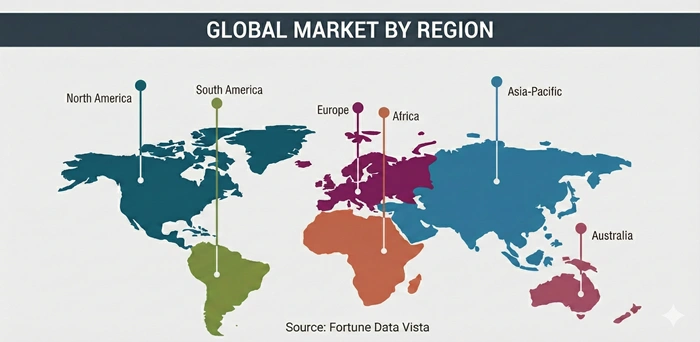
Asia Pacific holds approximately 58–62% of global lithium iron phosphate battery market revenue in 2025 and is projected to maintain its leadership throughout the forecast period with a regional CAGR of approximately 15.8% from 2026 to 2033. China is the defining force within the region and globally — it accounts for over 75% of the world's LFP cell production capacity and hosts the two largest battery manufacturers on the planet: Contemporary Amperex Technology Co., Ltd. (CATL) and BYD Co. Ltd. China's dominance is sustained by a comprehensive ecosystem of lithium raw material processing, cathode material manufacturing, cell production, pack assembly, and end-vehicle integration that gives Chinese producers an unmatched cost structure. In 2025, China's EV battery market grew by 40% year-on-year, with LFP cells accounting for over 81% of all battery capacity installed in Chinese electric vehicles, confirming the chemistry's total dominance in the world's largest EV market.
Japan and South Korea contribute meaningfully to Asia Pacific's LFP landscape, with companies like LG Energy Solution (South Korea) and Panasonic (Japan) investing in LFP cell production capabilities to complement their established NMC product lines. India is an emerging high-growth market within the region, with the government's PLI scheme attracting significant investment in domestic battery cell manufacturing, and EV sales growing rapidly across two-wheeler, three-wheeler, and passenger vehicle segments. The Asia Pacific region's combination of scale, cost leadership, policy support, and deep vertical integration makes it the anchor of the global LFP battery market and the primary reference point for technology and pricing trends that influence markets worldwide.
Europe
Europe Is the World's Fastest-Growing Region for the LFP Battery Market, Propelled by Gigafactory Investments, EV Transition Mandates, and Grid-Scale Storage Deployments
Europe is the fastest-growing region in the global lithium iron phosphate battery market, with a projected CAGR of approximately 18–20% from 2026 to 2033, driven by the EU's binding targets to phase out internal combustion engine vehicle sales by 2035 and ambitious renewable energy expansion plans. Europe currently accounts for approximately 15–18% of global market revenue in 2025, a share that is set to grow substantially as domestic gigafactory capacity comes online and LFP-based grid storage investments accelerate. Germany, the UK, France, and the Nordic countries are the most active markets, with utility companies, automakers, and grid operators all increasing their LFP battery procurement at scale. Key players with significant European operations include Northvolt AB (Sweden), Stellantis/ACC (France/Germany), Volkswagen Group (Germany) through its PowerCo battery subsidiary, and CATL, which is constructing a major European gigafactory in Hungary.
The European energy storage segment is growing particularly fast, driven by national grid balancing requirements as solar and wind capacity expands rapidly across Germany, Spain, the UK, and the Netherlands. European utilities are deploying utility-scale LFP-based BESS systems as part of their grid stability strategies, and corporate behind-the-meter storage is accelerating as electricity price volatility incentivizes industrial users to invest in on-site energy management solutions. Regulatory pressure from the EU Battery Regulation — which mandates carbon footprint declarations and recyclability thresholds for batteries placed on the European market — is also pushing manufacturers toward LFP chemistry, which has a favorable environmental profile compared to cobalt-containing alternatives. The combination of EV policy, grid storage investment, and regulatory tailwinds positions Europe as the highest-growth major region for the LFP market through 2033.
Report Customization: Region-Wise and Country-Wise Insights
This Report Is Fully Customizable for Every Region and Country — Delivering the Market-Specific Intelligence Your Business Needs to Make Confident, Geography-Targeted Decisions
This report on the lithium iron phosphate battery market is available with complete region-wise and country-wise customization, enabling businesses, investors, policymakers, and supply chain professionals to access granular, geographically tailored data that goes beyond the global-level analysis. Whether your priority is evaluating EV battery supply chains in a specific country, benchmarking energy storage project opportunities in a particular region, or understanding how local regulatory frameworks affect LFP adoption rates, our team can deliver a fully customized version of this report built around your specific geographic focus.
Customized reports are available for the following regions and countries, each providing detailed market analysis, growth forecasts, competitive landscape assessments, policy and regulatory insights, trend analysis, and business opportunities specific to that geography and the lithium iron phosphate battery market:
North America
-
U.S. — Comprehensive analysis of domestic LFP gigafactory investments, EV adoption incentives under the IRA, utility-scale BESS deployments, and competitive dynamics among Gotion, KORE Power, and Tesla Energy
-
Canada — Insights into mining-sector electrification, grid storage projects, and federal clean energy investment programs affecting LFP demand
-
Mexico — Analysis of automotive sector LFP battery demand linked to nearshoring of EV manufacturing from China and the US
Europe
-
U.K. — Grid balancing and BESS project analysis, EV transition roadmap, and Northvolt/AESC gigafactory developments
-
Germany — Volkswagen PowerCo, BASF cathode materials, and automotive OEM LFP procurement strategy deep-dive
-
France — ACC gigafactory progress, Renault Group LFP roadmap, and utility storage investments
-
Italy — Industrial and commercial energy storage adoption and EV market trajectory
-
Rest of Europe — Nordic, Eastern European, and Benelux LFP market dynamics
Asia Pacific
-
China — Dominant producer analysis, CATL and BYD competitive positioning, government policy review, and export market strategy
-
India — PLI scheme implementation, EV two-wheeler and three-wheeler LFP adoption, and domestic manufacturing ramp-up
-
Japan — Panasonic, TDK, and domestic OEM LFP strategy, along with grid storage demand trends
-
South Korea — LG Energy Solution and Samsung SDI LFP investment strategies and export opportunities
-
Australia — Grid-scale BESS deployment pipeline, lithium mining linkages, and residential storage market
-
Rest of Asia Pacific — Southeast Asian EV manufacturing hubs, Taiwan energy storage, and ASEAN market growth
Latin America
-
Brazil — Emerging EV market, renewable energy integration projects, and LFP import trends
-
Argentina — Lithium triangle resource linkages and downstream LFP manufacturing opportunities
-
Rest of Latin America — Regional clean energy transition and grid modernization demand
Middle East & Africa
-
UAE — Smart city battery storage projects, data center backup power, and EV infrastructure buildout
-
Saudi Arabia — Vision 2030 clean energy investments and LFP battery adoption in utility storage
-
Rest of MEA — Sub-Saharan energy access projects, South Africa mining electrification, and telecom backup power LFP adoption
Top Key Players
-
Contemporary Amperex Technology Co., Ltd. (CATL) (China)
-
BYD Co. Ltd. (China)
-
China Aviation Lithium Battery Co., Ltd. (CALB) (China)
-
Gotion High-Tech Co., Ltd. (China)
-
EVE Energy Co., Ltd. (China)
-
LG Energy Solution Ltd. (South Korea)
-
A123 Systems LLC (United States)
-
Northvolt AB (Sweden)
-
Panasonic Holdings Corporation (Japan)
-
Tesla, Inc. (Tesla Energy) (United States)
-
Guoxuan High-Tech Co., Ltd. (Gotion) (China)
-
SVOLT Energy Technology Co., Ltd. (China)
-
Amara Raja Energy & Mobility Ltd. (India)
-
Clarios International Inc. (United States)
-
Saft Groupe SA (TotalEnergies) (France)
Recent Developments
-
2025 — CATL launched the second generation of its Shenxing LFP battery platform, achieving 520 km of range from a five-minute charge and enabling a charging rate of up to 1,300 kW, marking a breakthrough in ultrafast-charging LFP technology for premium EV applications.
-
2025 — BYD announced the commercial launch of its Super e-Platform featuring the latest generation of Blade LFP battery technology, supporting a Megawatt Flash Charger capable of 1,000 kW charging output, with initial deployment targeting the Han L sedan and Tang L SUV models.
-
2024–2025 — Gotion High-Tech progressed construction of its Manteno, Illinois gigafactory in the United States, designed to produce LFP battery cells domestically to qualify for Inflation Reduction Act incentives — marking a significant step in LFP manufacturing diversification outside China.
-
2024 — LG Energy Solution announced expanded investment in LFP battery R&D and production capabilities, committing to integrate prismatic LFP cells into its energy storage system product portfolio to capture growing global BESS market demand, complementing its existing NMC EV cell business.
-
2024–2025 — CALB (China Aviation Lithium Battery) secured multiple strategic supply agreements with European and North American automakers and energy storage integrators, expanding its international customer base and positioning itself as a primary alternative source to CATL and BYD for LFP cell procurement.
Market Trends
From Ultrafast Charging LFP Innovation to the Emergence of LFP-Based Sodium-Ion Hybrids, the Battery Chemistry Landscape Is Evolving Rapidly to Meet the Demands of a Decarbonizing World
The most consequential trend in the lithium iron phosphate battery market today is the dramatic improvement in fast-charging performance that is closing the gap between LFP and premium NMC batteries. CATL's second-generation Shenxing battery and BYD's Blade platform upgrades have demonstrated that LFP cells can support 4C to 10C charging rates while maintaining thermal stability and cycle life — a combination that was considered technically challenging just two or three years ago. This trend is having direct implications for EV consumer adoption rates, as range anxiety and charging speed were the two most cited barriers to switching from internal combustion vehicles. As LFP fast-charging performance reaches commercial deployment at scale, it is expected to further accelerate the displacement of NMC chemistry in the mainstream EV segment globally.
The second major trend is the geographic and application diversification of LFP battery deployment. While China and automotive applications have historically defined the market, the next growth phase is increasingly driven by utility-scale energy storage in the US and Europe, telecom power in Africa and Southeast Asia, and marine electrification in Scandinavia and Japan. Simultaneously, LFP manufacturers are investing in digital platforms that offer lifecycle monitoring, performance analytics, and second-life battery certification services — transforming the business model from a pure product sale to a service-oriented relationship with end-users. This shift toward energy storage as a managed service, supported by LFP's long cycle life, is opening new revenue streams for battery manufacturers and creating stronger, longer-term relationships with utility and industrial customers.
Segments Covered in the Report
-
By Battery Type
-
Cylindrical LFP Cells
-
Prismatic LFP Cells
-
Pouch LFP Cells
-
-
By Capacity
-
Up to 16,250 mAh
-
16,251–50,000 mAh
-
50,001–100,000 mAh
-
Above 100,000 mAh
-
-
By Application
-
Automotive / Electric Vehicles
-
Stationary Energy Storage Systems (BESS/ESS)
-
Portable Electronics
-
Industrial Power Backup
-
Marine Electrification
-
-
By End-User
-
Electric Vehicle OEMs
-
Utilities and Grid Operators
-
Consumer Electronics Manufacturers
-
Commercial and Industrial Users
-
Telecom Infrastructure Operators
-
-
By Region
-
North America (U.S., Canada, Mexico)
-
Europe (U.K., Germany, France, Italy, Rest of Europe)
-
Asia Pacific (China, India, Japan, South Korea, Australia, Rest of Asia Pacific)
-
Latin America (Brazil, Argentina, Rest of Latin America)
-
Middle East & Africa (UAE, Saudi Arabia, Rest of MEA)
-
❝ Built for Every Level — From Startups to Industry Giants ❞
Here Is Exactly How This Report Works for You
-
Tier 1 OEMs, utility companies, and high-level investors will gain a precise understanding of competitor revenue streams, LFP cell sourcing strategies, and market share dynamics across all major geographies — enabling them to benchmark performance, identify underserved market pockets, and sharpen procurement and investment decisions with data-backed confidence in the rapidly evolving lithium iron phosphate battery market.
-
For Tier 2 and Tier 3 suppliers, mid-level companies, and startups, this report maps the direct relationship between global supply-demand imbalances in lithium raw materials and LFP cell pricing trends, while providing a detailed analysis of how geopolitical trade barriers, import tariffs, and regional localization mandates are reshaping competitive dynamics — so your business is always positioned ahead of macro disruptions.
-
Decision-makers at all levels — from investors evaluating gigafactory opportunities to procurement managers negotiating supply contracts — will benefit from competitor revenue source analysis, regional opportunity sizing, and forward-looking scenario modeling that this report delivers in its full purchased version, offering the strategic clarity needed to grow market share, manage risk, and capitalize on the energy transition at speed.
Frequently Asked Questions:
Answer: The global lithium iron phosphate battery market was valued at USD 29.35 billion in 2025 and is projected to reach USD 100.84 billion by 2033. The market is expected to grow at a CAGR of 16.5% from 2026 to 2033, driven by EV adoption and grid-scale energy storage expansion.
Answer: The key growth drivers include the rapid global expansion of electric vehicles, rising utility-scale battery energy storage deployments, and the declining cost of LFP cells. Government policies promoting clean energy and the superior safety and cycle life of LFP chemistry over competing battery technologies are also significant accelerants.
Answer: Asia Pacific — led by China — dominates the lithium iron phosphate battery market with approximately 58–62% of global revenue. Europe is the fastest-growing region, projected to grow at a CAGR of 18–20% from 2026 to 2033, driven by EV mandates and domestic gigafactory investments.
Answer: LFP batteries offer superior thermal stability, longer cycle life exceeding 4,000 cycles, lower cost per kWh, and freedom from cobalt and nickel, making them increasingly preferred for mainstream EVs and grid storage. While NMC batteries offer higher energy density suitable for premium long-range EVs, the lithium iron phosphate battery market is growing faster due to total cost of ownership advantages.
Answer: The leading companies include CATL and BYD in China, which together command the majority of global LFP production capacity, alongside CALB, Gotion High-Tech, EVE Energy, and LG Energy Solution. The lithium iron phosphate battery market also features emerging players like Northvolt, A123 Systems, and Tesla Energy actively expanding their LFP product portfolios.