
Marine Onboard Communication and Control Systems Market Overview
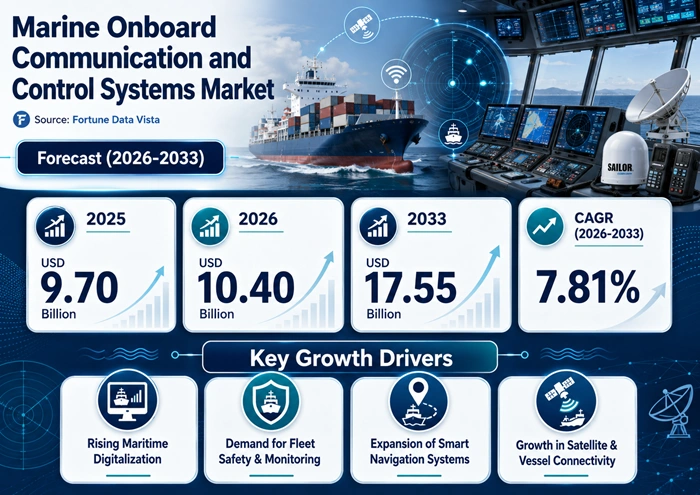
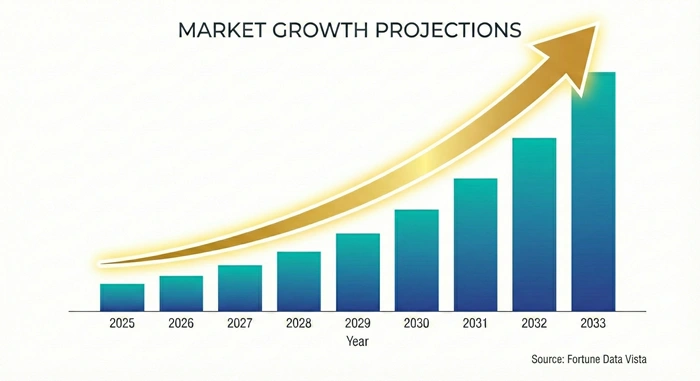
The global marine onboard communication and control systems market size is valued at USD 9.70 billion in 2025 and is predicted to increase from USD 10.40 billion in 2026 to approximately USD 17.55 billion by 2033, growing at a CAGR of 7.81% from 2026 to 2033.
These systems — encompassing satellite communication terminals, integrated bridge platforms, marine radio systems, propulsion control infrastructure, and vessel monitoring networks — form the operational backbone of modern maritime vessels across both commercial shipping and naval applications. Rising global seaborne trade volumes, accelerating vessel digitalization programs, stringent international maritime safety regulations, and growing demand for real-time fleet monitoring and remote diagnostics are all driving consistent above-average growth in this market through the forecast period.
AI Impact on the Marine Onboard Communication and Control Systems Industry
AI-Driven Predictive Maintenance, Autonomous Navigation Support, and Intelligent Fleet Management Are Transforming the Marine Onboard Communication and Control Systems Market from Rule-Based Automation into an Adaptive, Decision-Ready Maritime Intelligence Platform
Artificial intelligence is reshaping the marine onboard communication and control systems market by enabling vessels to move beyond scheduled maintenance and pre-programmed operational routines toward genuinely predictive and adaptive maritime operations. AI-powered condition monitoring platforms — integrated with onboard sensors across propulsion systems, power generation units, and communication hardware — can detect performance anomalies and predict component failures days before they occur, allowing ship operators to plan corrective maintenance at port calls rather than responding to equipment failures at sea. For commercial shipping companies managing large fleets across global trade routes, AI-enabled predictive maintenance is generating measurable reductions in unplanned downtime, voyage delays, and emergency repair costs that together represent significant annual savings per vessel.
Beyond maintenance, AI is enabling autonomous navigation assistance and intelligent route optimization capabilities that are being integrated into next-generation integrated bridge systems. Machine learning models trained on meteorological data, ocean current patterns, vessel traffic information, and fuel consumption telemetry can recommend dynamically optimized voyage routes that simultaneously reduce fuel consumption, avoid weather-related delays, and minimize emission intensity per tonne-mile of cargo carried. Major system providers including Kongsberg Maritime, Wärtsilä, and Thales Group are embedding AI decision support tools into their integrated bridge and vessel management platforms — establishing competitive differentiation through intelligence-enhanced maritime control capabilities that address the dual commercial imperatives of operational efficiency and IMO emissions compliance facing ship operators globally.
Growth Factors
The Rapid Expansion of Global Seaborne Trade Driving Fleet Modernization Investment and IMO Digital Safety Regulations Mandating Advanced Communication System Upgrades Are the Two Strongest Growth Catalysts in the Market
The continuous expansion of global seaborne trade — which carries approximately 90% of world commerce — is the foundational demand driver sustaining growth in the marine onboard communication and control systems market. Every new commercial vessel order, every fleet expansion by a major shipping line, and every government naval procurement program generates direct demand for integrated communication systems, control platforms, and vessel monitoring infrastructure. The global commercial shipping fleet is growing steadily, with containership, LNG carrier, and bulk carrier orderbooks at major shipyards in South Korea, China, and Japan remaining strong — creating a consistent pipeline of new vessel deliveries that require complete onboard communication and control system installations.
IMO regulatory requirements — including the IMO Maritime Cyber Risk Management guidelines, SOLAS communication equipment standards, and the IMO 2020 and 2030 emissions reduction targets that require fuel monitoring and optimization systems — are creating non-discretionary upgrade demand from the existing vessel fleet. Ships operating in international trade are required to maintain specific communication system standards for distress alerting, vessel traffic service interactions, and voyage data recording — mandating regular equipment upgrades as older systems reach end-of-life or fail to meet current standards. The growing complexity of maritime regulatory compliance — spanning cybersecurity, emissions monitoring, port state control inspections, and flag state requirements — is also driving demand for integrated digital platform management systems that can consolidate compliance reporting, automate regulatory documentation, and provide ship operators with a unified operational data management capability.
Market Outlook
The Marine Onboard Communication and Control Systems Market Outlook Through 2033 Is Shaped by Autonomous and Semi-Autonomous Vessel Development, Maritime Cybersecurity Investment Escalation, and Emerging Economy Fleet Expansion Programs
The development of autonomous and semi-autonomous vessel technology is the most commercially transformative long-term trend shaping the marine onboard communication and control systems market outlook. Autonomous navigation requires dramatically more sophisticated onboard communication infrastructure — including high-bandwidth satellite links for remote monitoring and intervention, redundant sensor network architectures, real-time AI decision support platforms, and secure shore-to-ship data transmission systems — compared to conventional crewed vessels. Leading maritime technology companies are actively developing and sea-trialing autonomous vessel systems, with commercial deployment of unmanned coastal vessels and remotely supervised ocean-going ships expected to accelerate significantly through the latter years of the forecast period.
Maritime cybersecurity has emerged as a critical and rapidly growing spending category within the broader vessel communication and control system market. High-profile incidents of maritime cyberattacks targeting shipping company operational technology networks, port management systems, and vessel control infrastructure have created urgent organizational awareness of cyber vulnerability across the maritime industry. IMO Resolution MSC-FAL.1/Circ.3 requires shipping companies to integrate cyber risk management into their safety management systems — a regulatory requirement that is driving structured cybersecurity investment programs at major shipping lines, naval organizations, and offshore operators who must harden their onboard communication and control system architectures against increasingly sophisticated threat actors targeting maritime assets.
Expert Speaks
-
"The maritime industry is undergoing its most significant technological transformation in decades. The integration of AI-powered analytics, high-throughput satellite connectivity, and intelligent vessel automation platforms is redefining what is operationally possible at sea. We are investing heavily in integrated maritime intelligence solutions that give ship operators, fleet managers, and naval commanders the real-time situational awareness and predictive operational capability they need to compete effectively in an increasingly complex maritime environment." — CEO, Thales Group
-
"Digitalization is the defining strategic priority for the shipping industry over the next decade — and the quality of onboard communication and control infrastructure is the single most important determinant of how effectively a vessel can leverage the full value of digital operations. Our focus on developing connected, cyber-secure, and AI-enhanced maritime systems reflects our conviction that the companies that solve the connectivity and intelligence challenges of modern shipping will define the next generation of maritime technology leadership." — CEO, Kongsberg Gruppen
-
"The convergence of autonomous navigation technology, high-speed maritime satellite communication, and integrated vessel management systems is creating a commercial opportunity in the marine communication and control market that we believe is among the most compelling in the global defense and maritime technology sector. We are committed to delivering the next generation of integrated bridge and mission systems that will define how commercial and naval vessels operate in an increasingly connected and contested maritime domain." — CEO, L3Harris Technologies
Key Report Takeaways
-
North America leads the global marine onboard communication and control systems market with approximately 32–33% revenue share in 2025, underpinned by the United States Navy's substantial and continuous investment in advanced shipboard communication and control system modernization, strong presence of leading defense and maritime technology contractors including L3Harris Technologies, Northrop Grumman, and Raytheon Technologies, and active commercial fleet digitalization investment driven by major U.S.-based shipping and offshore energy operators
-
Asia Pacific is the fastest-growing regional market, projected to expand at approximately 9.12% CAGR through 2033, powered by the world's largest commercial shipbuilding industry in China and South Korea generating consistent new-build communication system procurement, rapid naval modernization programs across China, India, Japan, Australia, and South Korea, expanding offshore maritime operations in Southeast Asia and Australia, and growing fleet management and remote monitoring system adoption among major Asian shipping lines
-
Integrated platform management systems (IPMS) lead the system type segment with approximately 39–40% revenue share in 2025, reflecting their role as the central control hub for all critical onboard functions — while propulsion control systems are the fastest-growing system type at approximately 9.20% CAGR, driven by hybrid and electric vessel adoption, LNG-fueled vessel growth, and the commercial and regulatory imperative for advanced fuel consumption optimization
-
Commercial vessels dominate the platform segment with approximately 55–56% revenue share in 2025, driven by the large installed fleet base and consistent new-build equipment demand — while naval ships represent the highest-value per-vessel system contract category and offshore support vessels are the fastest-growing platform at approximately 8.47% CAGR driven by expanding offshore energy exploration and production activity
-
Bridge systems lead the application segment with approximately 37–38% revenue share in 2025, encompassing the integrated navigation, communication, and voyage management functions that form the operational nerve center of every commercial and naval vessel — while mission-critical safety and distress systems are growing fastest at approximately 8.89% CAGR driven by mandatory SOLAS compliance upgrades and expanding IMO distress communication technology requirements
-
OEMs dominate the end-user segment with approximately 61–62% revenue share in 2025 through their role as primary system integrators on new vessel construction projects — while the aftermarket segment is growing at approximately 8.23% CAGR as the large installed global fleet base requires continuous communication system upgrades, cybersecurity retrofits, and platform modernization to maintain regulatory compliance and operational capability
Market Scope
| Parameter | Details |
|---|---|
| Market Size by 2033 | USD 17.55 Billion | Market Size by 2026 | USD 10.40 Billion | Market Size by 2025 | USD 9.70 Billion | Market Growth Rate from 2026 to 2033 | CAGR of 7.81% | Dominating Region | North America | Fastest Growing Region | Asia Pacific | Segments Covered | System Type, Platform, Application, End User, Region | Regions Covered | North America, Europe, Asia Pacific, Latin America, Middle East & Africa |
Market Dynamics
Drivers Impact Analysis
IMO Regulatory Compliance Mandates Driving System Upgrades Across the Global Fleet and Autonomous Vessel Technology Development Creating Advanced Communication Infrastructure Demand Are the Primary Growth Drivers in the Marine Onboard Communication and Control Systems Market
| Driver | ≈ % Impact on CAGR Forecast | Geographic Relevance | Impact Timeline |
|---|---|---|---|
| Global seaborne trade expansion driving new vessel construction system demand | ~30% | Global, strongest in Asia Pacific and Europe | Long-term |
| IMO safety and cyber regulations mandating communication system upgrades | ~26% | Global, highest compliance enforcement in Europe and North America | Medium to long-term |
| Autonomous and semi-autonomous vessel technology development | ~22% | Europe, North America, Asia Pacific | Long-term |
| Naval fleet modernization programs across major maritime nations | ~14% | North America, Europe, Asia Pacific | Short to long-term |
| Offshore energy sector vessel communication investment | ~8% | North America, Middle East, Asia Pacific | Medium to long-term |
The seaborne trade expansion driver operates on the fundamental commercial logic that every vessel in the global fleet represents a communication and control system installation — and with global fleet size growing alongside world trade volumes, the aggregate installed base for system maintenance, upgrade, and replacement continuously expands. New vessel deliveries at major shipyards in China, South Korea, and Japan each require complete outfitting with integrated bridge systems, satellite communication terminals, propulsion control platforms, and vessel monitoring networks — generating predictable new-build system revenue for major maritime technology suppliers. The LNG carrier and containership orderbook growth in particular is creating demand for the most sophisticated and highest-value integrated system configurations, where leading providers including Kongsberg Maritime, Wärtsilä, and Furuno Electric compete for large new-build contracts with integrated system bundles covering navigation, communication, and vessel performance management.
IMO cyber risk management requirements and SOLAS communication equipment modernization standards are creating a structured, non-discretionary upgrade cycle across the existing global merchant fleet. Ships that were delivered in the early 2000s or before are now carrying communication and control system hardware that is approaching or past its intended service life — and many of these legacy systems lack the cybersecurity architecture, satellite communication bandwidth, and digital integration capabilities required by current and emerging regulatory standards. This creates a large and commercially significant aftermarket demand pool that is independent of new vessel construction cycles — providing equipment suppliers and system integrators with a stable revenue base from retrofit, upgrade, and replacement contracts that are being driven by IMO compliance timelines rather than shipowner discretion.
Restraints Impact Analysis
High System Integration Complexity for Legacy Vessel Retrofits and Maritime Cybersecurity Vulnerability Concerns Delaying Large-Scale Digital Adoption Are the Primary Barriers in the Marine Onboard Communication and Control Systems Market
| Restraint | ≈ % Impact on CAGR Forecast | Geographic Relevance | Impact Timeline |
|---|---|---|---|
| High integration complexity and cost for legacy vessel system upgrades | ~36% | Global, highest impact in aging fleets of developing nations | Medium to long-term |
| Maritime cybersecurity risks and OT network vulnerability concerns | ~28% | Global | Short to medium-term |
| Skilled maritime technology workforce shortage | ~22% | Global, strongest in emerging markets | Long-term |
| Supply chain disruptions for specialized maritime electronics components | ~14% | Global | Short to medium-term |
The integration complexity and cost of retrofitting advanced communication and control systems onto legacy vessels — many of which were built with proprietary, non-standardized onboard architecture that resists straightforward digital system integration — is the most commercially significant adoption barrier in the marine onboard communication and control systems market for the large installed base of older vessels. Unlike new-build vessels where system integrators can design a coherent, standardized digital architecture from the keel up, retrofit projects require careful engineering assessment of existing system interfaces, cable routing constraints, electrical power capacity limitations, and operational continuity requirements that often extend project timelines and increase costs significantly beyond initial estimates. Smaller shipping companies and older fleet operators in developing maritime markets — where vessels may remain in service for 25–30 years — face the greatest financial challenges in justifying the capital investment required for comprehensive communication system modernization.
Maritime cybersecurity concerns are creating a genuine hesitancy among some ship operators to accelerate the adoption of highly networked, satellite-connected onboard system architectures that expand the vessel's external communication footprint and theoretical cyber attack surface. The maritime industry's operational technology (OT) environment — where propulsion control, navigation, and cargo management systems are increasingly interconnected on shared networks — creates the risk that a successful cyber intrusion into one system could cascade across multiple vessel functions. While this risk can be managed through robust network segmentation, intrusion detection systems, and crew cybersecurity training programs, the awareness of cyber vulnerability is prompting some operators to adopt a more cautious approach to digital system integration than the market's growth potential might otherwise justify.
Opportunities Impact Analysis
High-Throughput Maritime Satellite Connectivity Expansion Enabling Always-On Fleet Management and the Development of Autonomous Vessel Communication Infrastructure Creating New System Architecture Demand Are the Two Highest-Value Opportunities
| Opportunity | ≈ % Impact on CAGR Forecast | Geographic Relevance | Impact Timeline |
|---|---|---|---|
| LEO satellite high-throughput maritime connectivity driving vessel digitalization | ~42% | Global, strongest in major shipping lanes | Short to medium-term |
| Autonomous vessel communication infrastructure development | ~36% | Europe, North America, Japan, South Korea | Long-term |
| Naval vessel modernization in emerging maritime powers | ~22% | Asia Pacific, Middle East, Latin America | Medium to long-term |
The rapid expansion of low-earth orbit (LEO) satellite constellation services — led by Starlink Maritime, OneWeb, and Telesat Lightspeed — is fundamentally transforming the commercial potential of maritime vessel connectivity. Traditional geostationary satellite services provided limited bandwidth at high cost, constraining the volume of operational data that vessels could practically transmit and receive during voyages. LEO-based maritime services are delivering multi-megabit-per-second connectivity at dramatically lower cost per gigabyte — enabling continuous, high-volume data exchange between vessels and shore operations that was previously impractical. This connectivity transformation creates the commercial foundation for cloud-based fleet management, real-time remote diagnostics, AI-enhanced voyage optimization, and fully digital crew welfare services — all of which drive demand for upgraded onboard communication system hardware and software capable of leveraging the available bandwidth.
The development of commercial autonomous vessel programs is creating entirely new communication system architecture requirements that represent one of the highest-value long-term opportunities in the marine onboard communication and control systems market. Autonomous vessels require fully redundant, high-bandwidth, low-latency communication links between the vessel and remote operations centers — where human supervisors monitor multiple vessel operations simultaneously and can intervene in vessel control when required. The redundancy, security, and reliability standards required for autonomous vessel communication infrastructure are substantially higher than those of conventional crewed ships — creating premium system specifications and per-vessel hardware budgets that are materially larger than standard commercial vessel installations. Organizations including Rolls-Royce Marine (now Kongsberg), Yara Birkeland project developers, and various naval autonomous vessel programs are actively developing these architectures — representing the emerging frontier of the market's highest-value system opportunities.
Segment Analysis
By System Type
Integrated Platform Management Systems Lead with Over 39% Revenue Share While Propulsion Control Systems Are the Fastest-Growing Type at 9.20% CAGR as Hybrid and Alternative Fuel Vessel Adoption Accelerates in the Marine Onboard Communication and Control Systems Market
Integrated platform management systems hold the dominant position in the marine onboard communication and control systems market by system type, accounting for approximately 39–40% of total system type revenue in 2025. IPMS platforms serve as the centralized command and monitoring hub for all critical vessel functions — integrating propulsion management, power generation, auxiliary systems, damage control, and machinery performance monitoring into a single operator interface that gives bridge officers and engineering staff real-time visibility across the entire vessel operating environment. North America is the largest regional IPMS market, where the U.S. Navy's multi-billion-dollar surface combatant and submarine modernization programs generate the world's highest per-vessel IPMS investment — with system providers including L3Harris Technologies, Northrop Grumman, and Raytheon Technologies commanding major naval contracts for advanced integrated control platforms.
Propulsion control systems are growing at the fastest CAGR of approximately 9.20% within the system type segment through 2033, driven by the global maritime industry's accelerating transition to LNG-fueled vessels, hybrid electric propulsion systems, and fuel cell-powered ships that require more sophisticated engine management and fuel optimization capabilities than conventional diesel-powered vessels. Asia Pacific is the fastest-growing region for propulsion control system demand, where major South Korean and Chinese shipyards building the world's largest LNG carrier and containership new-build programs are installing advanced propulsion control systems from providers including Kongsberg Maritime, Wärtsilä, and Rolls-Royce Marine to meet charterer fuel efficiency requirements and IMO Carbon Intensity Indicator (CII) compliance obligations. The regulatory pressure from IMO's progressive emissions reduction framework is making advanced propulsion control and fuel monitoring systems a non-discretionary investment for vessel operators seeking to maintain favorable CII ratings and access charter market opportunities.
By Platform
Commercial Vessels Lead with Over 55% Platform Revenue Share While Offshore Support Vessels Are the Fastest-Growing Platform at 8.47% CAGR as Energy Sector Offshore Activity Expansion Drives Specialized Communication Demand
Commercial vessels hold the commanding platform position in the marine onboard communication and control systems market at approximately 55–56% of total platform revenue in 2025. The massive scale of the global commercial merchant fleet — encompassing containerships, bulk carriers, tankers, LNG carriers, and ro-ro vessels — provides the largest installed base of communication and control system installations, with continuous new-build procurement and fleet-wide retrofit and upgrade requirements generating consistent revenue for system providers. Europe is the largest commercial vessel communication system market by value, where major shipping lines including Maersk, MSC, CMA CGM, and Hapag-Lloyd are running active vessel digitalization programs that involve significant investment in satellite connectivity upgrades, integrated fleet management platforms, and cybersecurity system enhancements across large vessel fleets.
Offshore support vessels are growing at the fastest CAGR of approximately 8.47% within the platform segment through 2033, driven by expanding offshore oil and gas exploration, subsea cable installation, offshore wind farm installation and maintenance, and oceanographic research activities that are creating growing demand for specialized high-reliability communication and control systems tailored to the unique operational demands of OSVs. Asia Pacific and the Middle East are the fastest-growing regions for offshore support vessel communication system investment — where national oil company exploration programs, expanding offshore renewable energy development, and growing maritime security patrol activities are driving OSV fleet growth that creates corresponding system procurement demand. Companies including Furuno Electric, JRC (Japan Radio Co.), and Kongsberg Maritime are among those actively competing for OSV communication system contracts in these high-growth regional markets.
Regional Insights
North America
North America Commands Approximately 32–33% of Global Marine Onboard Communication and Control Systems Revenue, Anchored by the U.S. Navy's Naval Modernization Investment and Strong Commercial Fleet Digitalization Adoption
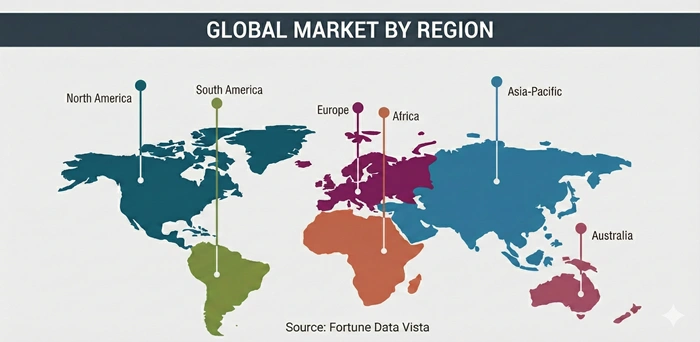
North America holds approximately 32–33% of global marine onboard communication and control systems market revenue in 2025, growing at a regional CAGR of approximately 7.14% through the forecast period. The United States represents the dominant contributor, where the U.S. Navy's sustained multi-year shipbuilding and modernization program — funding new destroyer, submarine, amphibious assault ship, and logistics vessel construction — generates the world's highest concentration of high-value naval communication and control system contracts awarded to major defense contractors. L3Harris Technologies, Northrop Grumman, Raytheon Technologies, and Cubic Defense Systems collectively hold the largest shares of U.S. naval communication system revenue through long-term platform support contracts.
The U.S. commercial maritime sector is also a significant driver of North American revenue, with Gulf of Mexico offshore operators, Great Lakes commercial shipping companies, and Alaska-route operators investing in satellite connectivity upgrades, integrated bridge system modernization, and fleet management platform implementations. Canada's Coast Guard fleet modernization program and expanding Arctic offshore exploration activities are contributing additional system procurement demand in the region. The North American market for maritime cybersecurity systems — driven by U.S. Coast Guard maritime cybersecurity guidance, Port Security Grant Program investments, and Department of Defense maritime cyber resilience requirements — is growing particularly rapidly as vessel operators and port facility managers invest in OT network security solutions.
Asia Pacific
Asia Pacific Is the Fastest-Growing Region in the Marine Onboard Communication and Control Systems Market at 9.12% CAGR, Driven by World-Leading Shipbuilding Output, Naval Modernization Programs, and Expanding Maritime Domain Awareness Investment
Asia Pacific is projected to grow at the highest regional CAGR of approximately 9.12% through 2033 within the marine onboard communication and control systems market, driven by a convergence of commercial shipbuilding volume, aggressive naval expansion, and expanding offshore maritime operations. South Korea is the world's leading builder of LNG carriers and ultra-large containerships — with Hyundai Heavy Industries, Samsung Heavy Industries, and Daewoo Shipbuilding & Marine Engineering (DSME) collectively delivering among the highest vessel tonnage globally — generating substantial new-build communication and control system procurement from these shipyards' technology partner networks. China's massive commercial shipbuilding output and People's Liberation Army Navy (PLAN) modernization program — one of the most ambitious naval expansion initiatives in history — are together creating the largest single national market growth opportunity within the Asia Pacific region.
India, Japan, and Australia represent the region's second tier of high-growth markets, each driven by distinct demand catalysts. India's Maritime India Vision 2030 shipbuilding investment program, growing Coast Guard fleet modernization, and expanding offshore oil and gas activities are creating sustained demand for domestic and imported maritime communication system technology. Japan's Self-Defense Force maritime modernization and Japan Maritime Self-Defense Force communications upgrade programs are driving high-value naval system procurement. Australia's AUKUS submarine acquisition program — representing one of the largest single naval procurement commitments in the country's history — is creating transformational long-term demand for advanced submarine communication and control systems that will benefit both domestic and allied partner defense technology companies serving the Australian naval market.
Customization Available for This Report
This report offers comprehensive region-wise and country-wise customization, delivering tailored market intelligence on marine onboard communication and control system demand dynamics, naval procurement frameworks, maritime regulatory environments, competitive landscape analysis, and fleet digitalization investment trends specifically aligned to your selected geography and market focus.
Customized versions of this report are available for each region and country listed below, offering detailed insights for maritime technology companies, defense contractors, naval procurement agencies, commercial shipping operators, and institutional investors:
North America
-
U.S. — U.S. Navy procurement framework, USCG regulatory standards, commercial fleet digitalization trends, maritime cybersecurity investment, and competitive vendor landscape
-
Canada — Transport Canada regulatory standards, Canadian Coast Guard fleet modernization, Arctic maritime communication requirements, and competitive market analysis
-
Mexico — SCT maritime regulatory standards, offshore energy sector vessel communication investment, and market entry opportunity assessment
Europe
-
U.K. — Royal Navy procurement programs, MCA regulatory standards, post-Brexit maritime regulation framework, AUKUS technology partnership implications, and competitive market landscape
-
Germany — Bundeswehr naval modernization, BSH regulatory standards, major shipping line digitalization investment analysis, and competitive vendor dynamics
-
France — Marine Nationale procurement programs, ANFR regulatory framework, French maritime industry digitalization trends, and competitive landscape analysis
-
Italy — Marina Militare procurement programs, RINA certification standards, commercial shipping fleet investment, and market opportunity assessment
-
Rest of Europe — Nordic maritime communication excellence, Eastern European naval modernization, and emerging vessel communication market analysis
Asia Pacific
-
China — PLAN naval procurement framework, MIIT regulatory standards, domestic shipbuilding communication system content, and competitive market dynamics
-
India — IN modernization programs, DG Shipping regulatory standards, Maritime India Vision 2030 investment analysis, and market opportunity assessment
-
Japan — JMSDF procurement programs, JMIA regulatory standards, advanced maritime technology adoption, and competitive market landscape
-
South Korea — ROK Navy procurement, KR classification standards, shipbuilding sector communication system content, and competitive vendor analysis
-
Australia — Royal Australian Navy programs, AMSA regulatory standards, AUKUS impact on defense maritime technology investment, and competitive market assessment
-
Rest of Asia Pacific — Southeast Asian naval investment, offshore maritime sector growth, and emerging vessel communication market analysis
Latin America
-
Brazil — Brazilian Navy procurement, ANTAQ regulatory framework, offshore energy sector communication investment, and market opportunity assessment
-
Argentina — ANA regulatory standards, Argentine naval vessel communication investment, and market development analysis
-
Rest of Latin America — Colombian, Chilean, and Peruvian naval and coast guard communication program analysis and opportunity assessment
Middle East & Africa
-
UAE — UAE Navy and Coast Guard procurement, FANR regulatory framework, offshore energy operator vessel communication investment, and competitive market landscape
-
Saudi Arabia — Royal Saudi Naval Forces procurement, KAUST maritime research programs, Vision 2030 maritime sector investment, and market opportunity analysis
-
Rest of MEA — Gulf naval vessel communication investment, Sub-Saharan Africa maritime infrastructure development, and emerging market opportunity analysis
Top Key Players
-
Thales Group (France)
-
Kongsberg Gruppen ASA (Norway)
-
L3Harris Technologies Inc. (United States)
-
Northrop Grumman Corporation (United States)
-
Raytheon Technologies Corporation (United States)
-
Wärtsilä Corporation (Finland)
-
Furuno Electric Co. Ltd. (Japan)
-
JRC — Japan Radio Co. Ltd. (Japan)
-
Inmarsat plc — Viasat (United Kingdom / United States)
-
Cobham plc (United Kingdom)
-
Rheinmetall AG — Rohde & Schwarz (Germany)
-
Garmin Ltd. (Switzerland / United States)
-
Anritsu Corporation (Japan)
-
Iridium Communications Inc. (United States)
-
Saab AB (Sweden)
Recent Developments
-
In March 2026, Kongsberg Maritime announced the successful completion of sea trials for its next-generation K-Bridge Autonomous Navigation System — an AI-powered integrated bridge platform capable of operating commercial vessels in semi-autonomous mode with shore-based supervision — following an extensive trial program conducted aboard a Norwegian coastal ferry operating on the Stavanger-Bergen route, representing a landmark milestone in commercial autonomous vessel technology development
-
In January 2026, Thales Group was awarded a major contract by the French Navy to supply advanced integrated combat management and communication systems for the next generation of French frigate vessels — a long-term program valued at several hundred million euros that will span multiple years of system design, integration, installation, and support delivery across France's new naval surface combatant program
-
In October 2025, L3Harris Technologies completed the acquisition of a specialist maritime cybersecurity systems company — significantly strengthening its maritime OT network security portfolio and positioning the company to address the rapidly growing demand for integrated cybersecurity solutions across both U.S. Navy vessel programs and commercial shipping sector clients facing increasing pressure from maritime regulatory cyber risk management requirements
-
In August 2025, Wärtsilä Corporation launched its enhanced Voyage cloud platform — an integrated real-time vessel performance, route optimization, and fleet management solution combining satellite connectivity, AI analytics, and port coordination tools in a single interface — with the platform already deployed on over 3,000 vessels globally and expanding rapidly as shipping lines accelerate digital fleet management investment to meet IMO Carbon Intensity Indicator compliance requirements
-
In June 2025, Inmarsat — now part of Viasat — announced the commercial launch of its Fleet Xpress LEO hybrid service combining its geostationary L-band reliability with high-throughput LEO satellite connectivity, providing commercial vessel operators with always-on broadband maritime communication at costs significantly below previous VSAT service pricing, with major shipping lines including Hapag-Lloyd and Evergreen Marine confirming fleet-wide deployment commitments
Market Trends
Two Defining Trends Are Reshaping the Marine Onboard Communication and Control Systems Market: The Mass Adoption of LEO Satellite High-Throughput Connectivity Transforming Vessel Data Exchange Capability and the Accelerating Convergence of OT and IT Systems Creating New Integrated Maritime Intelligence Architectures
The mass commercial adoption of LEO satellite high-throughput maritime connectivity is the single most impactful near-term trend reshaping operational possibilities in the marine onboard communication and control systems market. Services from Starlink Maritime, OneWeb, and Viasat's enhanced Fleet Xpress are delivering multi-megabit broadband connectivity to vessels anywhere on the global ocean — enabling continuous real-time data transmission volumes that were commercially impractical with traditional geostationary VSAT services. This connectivity transformation is unlocking cloud-based fleet management applications, over-the-air software updates for onboard control systems, AI-powered voyage optimization using real-time operational data, and rich crew welfare connectivity that together are driving substantial shipowner investment in upgraded onboard communication hardware and software platforms capable of leveraging the available bandwidth.
The convergence of operational technology (OT) and information technology (IT) systems aboard vessels is creating an architectural shift that is fundamentally changing how onboard communication and control systems are designed, integrated, and maintained. Traditionally, vessel OT systems — including propulsion control, navigation, and machinery management — were isolated from IT networks to ensure operational reliability and security. The competitive pressure to leverage AI analytics, cloud data platforms, and shore-side digital twin services is driving progressive integration of OT and IT architectures that creates both new commercial opportunities and new cybersecurity challenges requiring specialized maritime OT security solutions. System integrators and vessel operators must navigate this convergence carefully — ensuring that the connectivity benefits of integrated architectures are captured without introducing vulnerability pathways that could compromise critical vessel control systems to external cyber threats.
Segments Covered in the Report
By System Type
-
Satellite Communication Terminals
-
VSAT Systems and LEO Satellite Communication Terminals
-
Maritime Broadband and L-Band Communication Systems
-
-
Marine Radio Systems
-
VHF/MF/HF Radio Communication Systems
-
Digital Selective Calling (DSC) and AIS Systems
-
-
Integrated Platform Management Systems (IPMS)
-
Centralized Vessel Monitoring and Control Platforms
-
Power Management and Damage Control Systems
-
-
Propulsion Control Systems
-
Engine Management and Fuel Optimization Systems
-
Hybrid and Electric Propulsion Control Platforms
-
-
Integrated Bridge Systems (IBS)
-
Navigation, ECDIS, and Autopilot Integration
-
Vessel Traffic Management and Conning Display Systems
-
-
Others
-
Voyage Data Recorders (VDR), PA/GA Systems, and Intercom Networks
-
By Platform
-
Commercial Vessels
-
Containerships, Tankers, Bulk Carriers, and LNG Carriers
-
-
Naval Ships
-
Surface Combatants, Submarines, and Patrol Vessels
-
-
Offshore Support Vessels (OSVs)
-
Platform Supply Vessels, Anchor Handling Vessels, and AHTS
-
-
Yachts and Recreational Vessels
-
Superyachts and High-End Recreational Marine Vessels
-
By Application
-
Bridge Systems
-
Navigation, Communication, and Voyage Management
-
-
Mission Systems
-
Naval Combat Management, Surveillance, and Reconnaissance
-
-
Safety and Distress Systems
-
GMDSS Compliance, Distress Alerting, and Emergency Communication
-
-
Crew Welfare Systems
-
Internet, Entertainment, and Crew Communication Services
-
-
Others
-
Cargo Management and Passenger Communication Systems
-
By End User
-
OEMs
-
Shipbuilders and New-Build Vessel System Integrators
-
-
Aftermarket
-
Retrofit, Upgrade, and Maintenance Service Providers
-
By Region
-
North America (U.S., Canada, Mexico)
-
Europe (U.K., Germany, France, Italy, Rest of Europe)
-
Asia Pacific (China, India, Japan, South Korea, Australia, Rest of Asia Pacific)
-
Latin America (Brazil, Argentina, Rest of Latin America)
-
Middle East and Africa (UAE, Saudi Arabia, Rest of MEA)
❝ Built for Every Level — From Startups to Industry Giants ❞
Here Is Exactly How This Report Works for You
-
For tier 1 global defense contractors, major maritime technology companies, naval procurement agencies, and institutional investors targeting the maritime defense and commercial shipping technology sector, this report delivers granular competitor revenue and program analysis for Thales Group, Kongsberg, L3Harris, Wärtsilä, and emerging system integrators — alongside comprehensive geopolitical, regulatory, and technology intelligence covering how IMO cybersecurity mandates, U.S. Navy modernization budgets, Asian naval expansion programs, LEO satellite connectivity disruption, and autonomous vessel regulatory development are collectively reshaping competitive positioning, contract award patterns, and market share distribution within the marine onboard communication and control systems market through 2033
-
For tier 2 and tier 3 maritime electronics manufacturers, specialized system integrators, vessel communication service providers, and mid-size technology companies targeting the commercial shipping or naval markets, this report maps the highest-growth system categories including propulsion control, maritime cybersecurity, LEO satellite terminals, and autonomous vessel communication infrastructure — with detailed segment revenue projections, regional demand analysis, and competitive landscape intelligence that enables precise identification of commercial opportunity gaps and strategic partnership targets aligned to the market's fastest-growing demand vectors
-
For all decision-makers across the marine communication and control system value chain — from naval architects and vessel system procurement managers to private equity investors targeting maritime technology and defense electronics — this report translates complex geopolitical signals, fleet modernization program timelines, autonomous vessel regulatory development roadmaps, and maritime cybersecurity investment escalation trends into actionable strategic intelligence supporting superior product development, geographic market entry, pricing strategy, and technology partnership decisions through 2033
Frequently Asked Questions:
Answer: The global marine onboard communication and control systems market was valued at USD 9.70 billion in 2025 and is projected to reach approximately USD 17.55 billion by 2033, growing at a CAGR of 7.81% from 2026 to 2033. This growth is driven by expanding global seaborne trade, IMO digital safety and cybersecurity mandates, accelerating fleet digitalization programs, and growing naval vessel modernization investment across major maritime nations.
Answer: The primary components of marine onboard communication and control systems include satellite communication terminals, VHF/MF/HF marine radio systems, integrated platform management systems, propulsion control platforms, integrated bridge systems, and voyage data recorders — each serving distinct operational, safety, and regulatory compliance functions across commercial and naval vessel operations. Modern vessels increasingly integrate these components into unified digital architectures supported by high-speed satellite connectivity, enabling continuous data exchange between vessels and shore-based fleet management operations.
Answer: North America leads the global marine onboard communication and control systems market with approximately 32–33% revenue share in 2025, anchored by the U.S. Navy's substantial shipbuilding and modernization investment and the commanding commercial positions of L3Harris Technologies, Northrop Grumman, and Raytheon Technologies. Asia Pacific is the fastest-growing regional market at approximately 9.12% CAGR through 2033, powered by world-leading commercial shipbuilding output in South Korea and China, aggressive naval expansion programs, and expanding offshore maritime operations across the region.
Answer: The development of autonomous and semi-autonomous vessels is creating significantly enhanced communication and control system requirements — including fully redundant high-bandwidth satellite links, secure shore-to-ship data transmission, real-time AI decision support platforms, and advanced remote monitoring architectures — that represent some of the highest-value per-vessel system specifications in the marine onboard communication and control systems market. Leading technology providers including Kongsberg Maritime and Wärtsilä are actively developing and commercially deploying autonomous navigation systems, creating a long-term demand catalyst for premium-specification communication and control infrastructure as autonomous vessel deployment progressively expands through the forecast period.
Answer: Cybersecurity has become a critical and fast-growing investment category within the marine onboard communication and control systems market, driven by IMO Resolution MSC-FAL.1/Circ.3 requirements for cyber risk management integration into vessel safety management systems and a growing number of documented maritime cyberattacks targeting vessel operational technology networks. Ship operators, naval organizations, and port facility managers are investing in OT network segmentation, intrusion detection systems, and crew cybersecurity training to harden their onboard communication and control architectures — creating substantial incremental demand for specialized maritime cybersecurity solutions that are increasingly bundled with or integrated into broader vessel communication system packages.