
Maritime Surveillance Market Overview
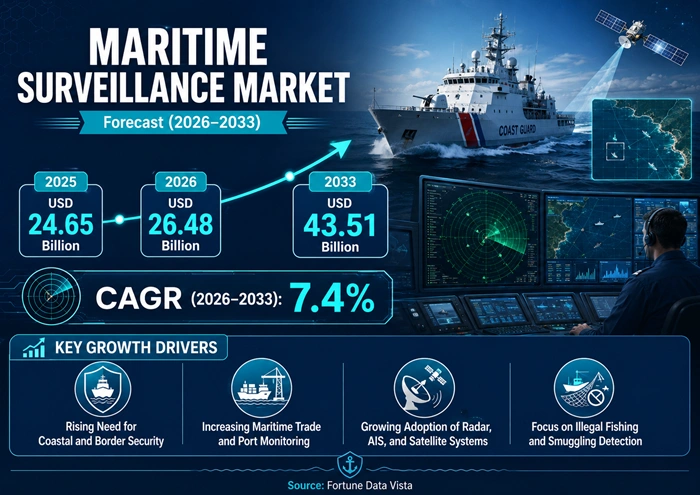
The global maritime surveillance market size is valued at USD 24.65 billion in 2025 and is predicted to increase from USD 26.48 billion in 2026 to approximately USD 43.51 billion by 2033, growing at a CAGR of 7.4% from 2026 to 2033.
Maritime surveillance encompasses the full range of technologies and systems used by governments, defense forces, coast guards, and commercial operators to monitor, track, and manage activities across the world's oceans, coastal waters, ports, and inland waterways. Rising geopolitical tensions in contested maritime zones, the escalating threat of piracy and illegal fishing, the growing volume of global maritime trade requiring continuous monitoring, and significant government investment in defense and border security modernization are collectively driving a sustained and accelerating expansion of the global ocean surveillance and coastal monitoring industry into the current decade.
AI Impact on the Maritime Surveillance Industry
Artificial Intelligence Is Fundamentally Transforming Maritime Surveillance by Enabling Autonomous Threat Detection, Real-Time Vessel Behavior Analysis, and Predictive Maritime Domain Awareness That Far Exceed the Scope and Speed of Traditional Human-Operated Monitoring Systems
Artificial intelligence is arriving in the maritime surveillance sector with extraordinary practical impact, enabling surveillance capabilities that were simply not achievable with legacy manual or rule-based monitoring systems. Modern AI-powered maritime surveillance platforms can simultaneously process data feeds from satellite imagery, AIS transponders, coastal radar networks, drone patrols, and sonar arrays — fusing these multi-sensor data streams in real time to build a comprehensive, continuously updated operational picture of vessel activities across enormous maritime zones. AI behavior analysis algorithms can identify vessels exhibiting suspicious patterns — such as AIS signal spoofing, unusual speed changes, loitering in restricted zones, or rendezvous maneuvers associated with illegal transfers — with a speed and detection accuracy that no human operator monitoring conventional sensor feeds can match. This capability is directly improving the ability of coast guards, navies, and port authorities to detect and intercept illegal activities before they escalate.
The application of AI extends powerfully into the autonomous unmanned systems domain, where AI navigation and mission management software is enabling a new generation of autonomous maritime patrol drones — both aerial and surface vessels — that can conduct extended surveillance missions with minimal human oversight. These systems reduce the personnel cost and risk associated with manned surveillance patrols while dramatically extending the coverage area and endurance of maritime surveillance operations. Navies and coast guards globally are investing heavily in AI-driven autonomous surveillance systems as a force multiplication tool, and defense technology companies including Thales Group, Leonardo S.p.A., and Elbit Systems are all making substantial R&D investments in autonomous maritime surveillance platforms that leverage AI for mission planning, target identification, and real-time decision support.
Growth Factors
The Escalation of Geopolitical Maritime Tensions, the Growing Threat of Illegal Fishing and Transnational Maritime Crime, and Massive Government Defense Spending Programs Focused on Maritime Domain Awareness Are the Primary Forces Driving Sustained Growth Across the Maritime Surveillance Market
Geopolitical tension is the most immediate and powerful driver of growth in the maritime surveillance market. Contested maritime boundaries in the South China Sea, the Baltic Sea, the Persian Gulf, and the Eastern Mediterranean are compelling regional powers and their allies to make substantial and urgent investments in surveillance systems capable of providing continuous, comprehensive, and reliable monitoring of vast maritime areas. The ability to detect and track adversary naval vessels, submarines, commercial ships with dual-use characteristics, and unmanned underwater vehicles across extended oceanic ranges has become a strategic national security priority for virtually every major maritime nation. This security imperative is not cyclical — it is a structural driver that will sustain defense procurement demand for advanced maritime surveillance systems regardless of short-term budget pressures or political cycles.
Illegal fishing is a second powerful demand driver that is often overlooked relative to defense applications but which generates enormous and consistent demand for maritime surveillance technology across a much broader set of government customers — including coastal states, fisheries enforcement agencies, and international maritime organizations with limited defense budgets but significant maritime patrol mandates. The United Nations Food and Agriculture Organization estimates that illegal, unreported, and unregulated fishing costs the global fishing industry between USD 10 billion and USD 23 billion annually and threatens the ecological sustainability of critical fish stocks. Combating this requires the kind of persistent, wide-area maritime surveillance that satellite-based AIS monitoring, aerial patrol drones, and integrated coastal radar networks uniquely enable — creating a significant and growing commercial market for affordable maritime surveillance solutions that serve coastal nations across Southeast Asia, West Africa, and Latin America.
Market Outlook
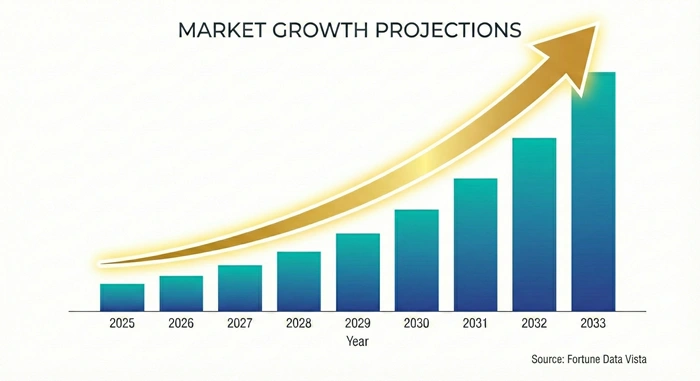
The Maritime Surveillance Market Is Positioned for Sustained High-Single-Digit Growth Through 2033, Driven by NATO Defense Modernization, Asia Pacific Naval Expansion, the Commercialization of Maritime Drone Technology, and the Growing Integration of Space-Based Surveillance Capabilities
The long-term outlook for the maritime surveillance market is consistently positive, driven by the durability of the geopolitical and security conditions that underpin demand growth and by a technology innovation cycle that is continuously expanding the capability and cost-effectiveness of maritime monitoring systems. NATO's commitment to increasing defense spending to 2% of GDP — with many member states now exceeding or targeting significantly higher thresholds — is generating a sustained wave of maritime surveillance procurement that is benefiting technology suppliers across radar, sonar, satellite surveillance, and unmanned systems categories. The United States, United Kingdom, Norway, and Australia are among the most active investors in next-generation maritime domain awareness capabilities, and their procurement programs are creating multi-billion-dollar contract opportunities for major defense prime contractors and specialist maritime surveillance technology companies.
The commercial maritime sector adds a growing secondary demand layer that is becoming increasingly significant. As global maritime trade volumes continue to expand and port authorities, shipping companies, and maritime insurance underwriters face growing pressure to demonstrate enhanced vessel tracking, safety monitoring, and environmental compliance capabilities, investment in commercial maritime surveillance technology is accelerating independently of defense procurement cycles. Vessel Traffic Services (VTS) systems, port security monitoring platforms, and ship-board surveillance equipment upgrades are all generating commercial revenue that complements and diversifies the defense-dominated demand base of the maritime surveillance market — creating a more resilient and broadly based growth profile for the industry through the full forecast period.
Expert Speaks
-
"Raytheon Technologies' intelligence and maritime surveillance portfolio continues to experience strong demand driven by the geopolitical realities that our government and allied customers face every day. Investment in persistent maritime domain awareness — combining satellite, radar, and unmanned systems into integrated operational networks — is one of the highest-priority capability areas for defense ministries globally, and our technology is at the center of that investment." — Gregory Hayes, CEO, RTX Corporation (Raytheon Technologies)
-
"Thales Group sees the maritime surveillance and security market as one of our most strategically important growth areas. The convergence of AI-driven data analytics, autonomous patrol systems, and multi-sensor fusion is transforming what is operationally achievable in maritime domain awareness — and we are investing heavily in all of these technology pillars to maintain our position at the forefront of what is possible." — Patrice Caine, CEO, Thales Group
-
"L3Harris Technologies' maritime surveillance business is expanding rapidly because both our defense and civilian coast guard customers are demanding more capability, more coverage, and more automation from their surveillance investments. Our integrated sensor systems and command-and-control platforms are delivering exactly the situational awareness advantages that modern maritime security operations require, and the demand pipeline has never been stronger." — Christopher Kubasik, CEO, L3Harris Technologies Inc.
Key Report Takeaways
-
North America dominates the global maritime surveillance market, accounting for approximately 38% of total global revenue in 2026, underpinned by the United States' unmatched naval defense procurement budget, the extensive maritime surveillance infrastructure investments of the U.S. Coast Guard and Navy, and the strong presence of world-leading defense technology companies including Raytheon Technologies, L3Harris, and Northrop Grumman that serve both domestic and allied government customers.
-
Asia Pacific is the fastest-growing regional market, expanding at a CAGR of approximately 9.1% from 2026 to 2033, driven by rapidly increasing naval defense budgets across China, India, Japan, South Korea, and Australia — all of which are investing significantly in maritime surveillance and coastal monitoring capabilities in response to the intensifying geopolitical competition in the South China Sea and wider Indo-Pacific maritime domain.
-
Military and defense is the dominant end-use segment, contributing approximately 55% of total market revenue in 2026, reflecting the strategic priority that national governments globally place on maintaining comprehensive maritime domain awareness across their exclusive economic zones, territorial waters, and strategic maritime chokepoints as a core component of national security and defense strategy.
-
Surveillance and tracking is the leading application segment, accounting for approximately 48% of total application-based revenue in 2026, driven by the universal requirement for real-time vessel tracking, suspicious activity detection, and comprehensive maritime situational awareness that underpins every aspect of naval, coast guard, and commercial maritime safety operations globally.
-
Radar systems are the dominant component segment, holding approximately 35% of total component-based market revenue in 2026, as radar remains the foundational sensor technology for maritime surveillance — providing all-weather, day-and-night detection and tracking capability for surface vessels across the full range of coastal, offshore, and open-ocean surveillance applications.
-
Satellite surveillance systems are the fastest-growing technology segment, projected to capture approximately 22% of total component revenue by 2033 at a CAGR of approximately 12% from 2026 to 2033, driven by the rapid commercialization of small satellite constellations providing global AIS monitoring, synthetic aperture radar imaging, and optical satellite surveillance that enable persistent and truly global maritime domain awareness at decreasing cost per coverage area.
Market Scope
| Parameter | Details |
|---|---|
| Market Size by 2033 | USD 43.51 Billion | Market Size by 2026 | USD 26.48 Billion | Market Size by 2025 | USD 24.65 Billion | Market Growth Rate from 2026 to 2033 | CAGR of 7.4% | Dominating Region | North America | Fastest Growing Region | Asia Pacific | Segments Covered | Component, Application, Type, End Use | Regions Covered | North America, Europe, Asia Pacific, Latin America, Middle East and Africa |
Market Dynamics
Drivers Impact Analysis
Rising Geopolitical Maritime Tensions, Escalating Defense Spending on Naval Surveillance Modernization, and the Growing Demand for Maritime Domain Awareness From Both Military and Civilian Authorities Are the Three Most Consequential Forces Driving the Maritime Surveillance Market Forward
| Driver | ≈ % Impact on CAGR Forecast | Geographic Relevance | Impact Timeline |
|---|---|---|---|
| Escalating geopolitical tensions in maritime zones | ~32% | Asia Pacific, Europe, Middle East | Short to Long-Term |
| Government defense spending on maritime surveillance modernization | ~26% | North America, Europe, Asia Pacific | Short to Long-Term |
| Rising piracy, illegal fishing, and maritime crime | ~18% | Southeast Asia, West Africa, Latin America | Medium to Long-Term |
| Growth of global maritime trade and port security requirements | ~12% | Global — highest in Asia Pacific, Europe | Medium-Term |
| Technological advancement in UAVs and autonomous maritime systems | ~7% | North America, Europe, Asia Pacific | Short to Medium-Term |
| Expansion of EEZ monitoring and environmental compliance | ~5% | Global | Long-Term |
The geopolitical driver is the most structurally entrenched and commercially significant force shaping the maritime surveillance market. The South China Sea remains one of the world's most intensively monitored maritime zones, with China, the United States, Japan, Australia, India, and ASEAN nations all investing in overlapping maritime surveillance systems — satellite, radar, drone, and naval patrol — that create enormous and sustained demand for surveillance technology across every major defense procurement category. Beyond the Indo-Pacific, the conflict in Ukraine has triggered unprecedented European defense spending growth, with NATO member states across the Baltic and Arctic regions investing in submarine detection, coastal radar, and maritime patrol drone capabilities that are adding significant new revenue to the global maritime surveillance market.
The illegal fishing and transnational maritime crime driver is particularly important commercially because it generates demand from a much wider customer base than pure defense procurement — including small island developing states, regional fisheries management organizations, international development banks, and maritime law enforcement agencies that require cost-effective and operationally practical surveillance solutions rather than the high-performance military-grade systems that dominate top-end defense contracts. This segment creates a growing commercial opportunity for maritime surveillance technology providers who can offer scalable, affordable, and easy-to-operate monitoring solutions that address the specific operational constraints of coast guard and fisheries patrol agencies in developing maritime nations.
Restraints Impact Analysis
The High Capital Cost of Advanced Maritime Surveillance Systems, Export Control Regulations on Defense Technology, and the Operational Complexity of Integrating Heterogeneous Multi-Sensor Networks Continue to Constrain Market Growth and Limit Accessibility for Smaller Maritime Nations
| Restraint | ≈ % Impact on CAGR Forecast | Geographic Relevance | Impact Timeline |
|---|---|---|---|
| High procurement and life cycle costs of advanced systems | ~-32% | Developing economies, smaller maritime nations | Short to Long-Term |
| Export control regulations and technology transfer restrictions | ~-26% | Global — U.S., European defense technology exports | Medium to Long-Term |
| Complexity of multi-sensor system integration and interoperability | ~-20% | Global | Medium-Term |
| Cybersecurity vulnerabilities in networked surveillance infrastructure | ~-12% | Global | Short to Long-Term |
| Long procurement cycles for government defense contracts | ~-10% | North America, Europe | Short to Medium-Term |
The high cost of advanced maritime surveillance systems — encompassing both the initial capital procurement cost and the significant ongoing maintenance, upgrade, and operating expenditure required to sustain operational capability — creates a meaningful accessibility barrier that limits market penetration among smaller maritime nations and developing-country coast guard and fisheries patrol agencies. A comprehensive coastal surveillance network incorporating high-performance radar, AIS monitoring, command-and-control software, and satellite connectivity may require an initial investment of hundreds of millions of dollars and ongoing annual operating costs that many governments cannot sustain without external financial support. This cost barrier means that the full commercial potential of the maritime surveillance market in Africa, Southeast Asia, and Latin America is only partially realized today, constrained by budget limitations that require tailored, modular, and cost-optimized solution offerings.
Export control regulations on advanced defense-related maritime surveillance technology — governed in the United States by the International Traffic in Arms Regulations (ITAR) and Export Administration Regulations (EAR), and in Europe by equivalent national export control frameworks — create compliance complexity and timeline delays that can slow technology transfer, complicate partnership arrangements, and limit the addressable export markets available to U.S. and European maritime surveillance technology manufacturers. These regulations, while serving legitimate national security objectives, create commercial friction that benefits competitors in less regulated supplier markets — particularly Chinese defense technology companies that face fewer formal export control constraints — and add significant compliance cost and management complexity to the export operations of Western defense suppliers.
Opportunities Impact Analysis
The Rapid Commercialization of Maritime Surveillance Drones, the Expansion of Small Satellite Constellations for Global Ocean Monitoring, and the Growing Demand for Integrated Maritime Domain Awareness Solutions in Asia Pacific and the Middle East Are Creating Powerful New Growth Pathways in the Maritime Surveillance Market
| Opportunity | ≈ % Impact on CAGR Forecast | Geographic Relevance | Impact Timeline |
|---|---|---|---|
| Commercial small satellite constellation for maritime AIS monitoring | ~28% | Global | Short to Long-Term |
| Autonomous maritime patrol drone system deployment | ~24% | North America, Europe, Asia Pacific | Short to Medium-Term |
| AI-driven maritime domain awareness platform development | ~20% | Global | Short to Long-Term |
| Maritime surveillance modernization in Middle East and Africa | ~16% | Middle East, Sub-Saharan Africa | Medium to Long-Term |
| Integrated port security and smart port surveillance systems | ~12% | Asia Pacific, Europe | Medium-Term |
The commercialization of small satellite constellations providing persistent global AIS tracking and synthetic aperture radar (SAR) imaging represents one of the most transformative opportunities in the maritime surveillance market. Companies including Spire Global, exactEarth, and Planet Labs are deploying low-earth orbit satellite constellations that provide truly global vessel tracking coverage — including in remote oceanic areas where coastal radar coverage is absent and where dark vessels attempting to evade detection are most likely to operate. As these commercial satellite surveillance services become increasingly capable, affordable, and integrated with AI-driven anomaly detection platforms, they are creating new revenue opportunities for both satellite operators and the maritime analytics companies that transform raw satellite data into actionable maritime intelligence for coast guard, fisheries, and naval customers globally.
The Middle East presents a particularly compelling near-term growth opportunity driven by the defense modernization programs of Gulf Cooperation Council states — notably Saudi Arabia and the UAE — that are investing heavily in maritime surveillance, coastal defense, and naval patrol capabilities as part of their broad strategic defense independence and modernization initiatives. These programs are generating significant contract opportunities for advanced radar, command-and-control, and unmanned patrol systems, and the Gulf states' significant defense procurement budgets and strong preference for proven Western technology platforms make them among the most commercially attractive customer markets for maritime surveillance technology providers in the current geopolitical environment.
Segment Analysis
By Component: Radar Systems
Radar Systems Lead the Maritime Surveillance Market as the Foundational Sensor Technology, Delivering All-Weather Detection and Tracking Capability Across Every Maritime Surveillance Application From Coastal Border Monitoring to Open-Ocean Naval Domain Awareness
Radar systems hold the leading component position within the maritime surveillance market, accounting for approximately 35% of total component-based revenue in 2026. Maritime radar — encompassing surface search radar, air search radar, coastal surveillance radar, and vessel traffic service radar systems — provides the foundational detection and tracking capability upon which all multi-sensor maritime domain awareness networks are built. No currently available alternative sensor technology matches maritime radar's combination of all-weather operational reliability, long-range detection performance, and established interoperability with existing command-and-control systems that makes it the default sensor layer in every coastal and naval surveillance architecture globally. The radar systems segment within the maritime surveillance market is projected to grow at a CAGR of approximately 7.8% from 2026 to 2033, driven by modernization programs replacing aging Cold War-era coastal radar networks across Europe, Asia Pacific, and the Middle East with advanced active phased array systems offering dramatically improved target discrimination, clutter rejection, and long-range detection capabilities. In North America, the dominant suppliers of maritime radar systems include Raytheon Technologies (USA), Northrop Grumman (USA), and L3Harris Technologies (USA) — all of which supply advanced maritime surveillance radar platforms to the U.S. Navy, Coast Guard, and allied defense customers through major multi-year procurement programs.
Europe is the second-largest and one of the most technologically advanced markets for maritime radar systems, with leading suppliers including Thales Group (France), Leonardo S.p.A. (Italy), and Kongsberg Gruppen (Norway) providing integrated radar surveillance systems to European navies, coast guards, and port authorities. In Asia Pacific, the maritime radar market is growing at rates above the global average, driven by the rapid naval expansion programs of India, Japan, South Korea, and Australia — all of which are investing in next-generation radar systems as part of their broader maritime domain awareness modernization. The Indian Navy and Coast Guard have been particularly active in radar procurement, with both domestic suppliers such as Bharat Electronics Limited (India) and international partners providing advanced surveillance radar systems for coastal monitoring, offshore island protection, and naval patrol vessel equipment programs.
By Application: Coastal Surveillance
Coastal Surveillance Is the Leading Application Segment in the Maritime Surveillance Market, Encompassing the Broadest Range of Government Customer Types and Generating the Most Consistent and Geographically Distributed Demand for Integrated Monitoring Solutions Globally
Coastal surveillance represents the largest application segment within the maritime surveillance market, accounting for approximately 38% of total application-based revenue in 2026. This encompasses the full range of monitoring systems deployed by coast guards, navies, port authorities, and fisheries agencies to maintain awareness of vessel activity within territorial waters, exclusive economic zones, and sensitive coastal environments — including anti-smuggling surveillance, illegal fishing detection, border security monitoring, pollution response, and maritime search and rescue coordination. The breadth and diversity of the coastal surveillance customer base — spanning highly funded NATO navies, developing-nation coast guards, port authorities of every scale, and international fisheries monitoring organizations — makes it the most commercially accessible and widely distributed application segment in the maritime surveillance market. The coastal surveillance segment is projected to grow at a CAGR of approximately 8.2% from 2026 to 2033, sustained by government investment across all geographic regions and by the growing integration of unmanned systems, satellite monitoring, and AI analytics into coastal surveillance architectures that are simultaneously improving operational capability and expanding the range of coastal surveillance customers who can afford meaningful coverage. Key players serving the global coastal surveillance market include Indra Sistemas SA (Spain), SAAB AB (Sweden), Kongsberg Gruppen (Norway), and SRT Marine Systems Plc (UK) — all of which have built significant commercial track records in delivering integrated coastal surveillance systems to government customers across Europe, Asia Pacific, the Middle East, and Latin America.
Asia Pacific is both the largest and the fastest-growing regional market for coastal surveillance, driven by the extensive and complex maritime borders of nations including Indonesia, the Philippines, Vietnam, India, and Australia — all of which face significant challenges in maintaining comprehensive coverage of their vast maritime territories with limited patrol assets. Elbit Systems (Israel) and TERMA A/S (Denmark) are also significant suppliers to Asia Pacific coastal surveillance programs, offering integrated surveillance sensor systems, command-and-control platforms, and coastal radar networks that are tailored to the specific operational environments and budget constraints of Indo-Pacific maritime security customers. The growth of affordable multi-sensor coastal surveillance packages — integrating radar, AIS monitoring, thermal cameras, and cloud-based command platforms into cost-optimized systems accessible to smaller maritime nations — is progressively expanding the addressable coastal surveillance customer base across Southeast Asia, the Pacific Island nations, and West Africa.
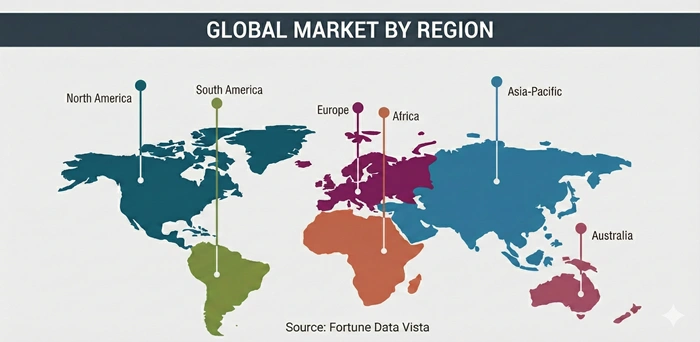
Regional Insights
North America: The Dominating Region
North America Leads the Global Maritime Surveillance Market Through the Dominant Scale of U.S. Defense Procurement, the Advanced Technological Capabilities of Its Defense Industry Base, and Its Critical Role as the Technology Supplier for Allied Maritime Domain Awareness Programs Globally
North America holds the largest share of the global maritime surveillance market, accounting for approximately 38% of total global revenue in 2026, with a regional CAGR of approximately 6.8% from 2026 to 2033. The United States is the dominant force within the region — and globally — owing to the unmatched scale of the U.S. Navy's and Coast Guard's surveillance technology procurement, the country's role as the world's leading supplier of advanced naval and maritime security technology to allied governments, and the extensive private-sector defense industrial base that develops and manufactures the most sophisticated maritime surveillance systems commercially available. Key companies anchoring North America's position include Raytheon Technologies (USA), Northrop Grumman (USA), L3Harris Technologies (USA), and Boeing (USA) — all of which serve both domestic and export maritime surveillance program requirements across surveillance radar, signals intelligence, satellite monitoring, and maritime patrol aircraft systems.
Canada contributes meaningfully to the regional market through its own naval and coast guard procurement programs, with the Royal Canadian Navy's ongoing surface combatant modernization program including significant maritime surveillance and electronic warfare capability investments. North America is also the home of the fastest-growing commercial maritime surveillance technology sector — including satellite AIS monitoring companies, AI-powered maritime analytics platforms, and autonomous surface vessel developers — that are creating new commercial revenue streams independent of traditional defense procurement. The region's combination of dominant defense procurement, strong commercial technology innovation, and its role as the primary technology supplier to NATO and Indo-Pacific allied maritime defense programs solidifies North America's position as the largest and most influential market in the global maritime surveillance ecosystem.
Asia Pacific: The Fastest Growing Region
Asia Pacific Is the Fastest Growing Regional Market for Maritime Surveillance, Powered by Rapidly Expanding Naval Defense Budgets, the Escalating Geopolitical Competition in the South China Sea, and the Urgent Modernization of Maritime Domain Awareness Capabilities Across the Indo-Pacific Region
Asia Pacific is the fastest-growing regional segment within the maritime surveillance market, projected to expand at a CAGR of approximately 9.1% from 2026 to 2033 — the highest of any region globally. China is the dominant national market by procurement volume within the region, investing enormously in its naval expansion and maritime surveillance capabilities across the South China Sea and beyond — though much of this procurement is directed toward domestic Chinese defense suppliers including China Electronics Technology Group Corporation (China) and CSSC (China). Japan, India, and Australia are the largest non-Chinese national markets, all of which are making substantial and accelerating investments in maritime surveillance as part of their individual and collectively coordinated Indo-Pacific defense postures. Japan's Ministry of Defense is procuring advanced radar systems, maritime patrol aircraft, and submarine-detection capabilities as part of its unprecedented defense spending expansion, creating significant contract opportunities for both domestic and allied maritime surveillance technology suppliers.
India is a particularly important growth market for international maritime surveillance technology companies, driven by the Indian Navy's maritime domain awareness expansion program, the Indian Coast Guard's coastal surveillance network modernization, and the government's defense procurement policy of increasing domestic content — which is creating joint venture and technology transfer opportunities for international defense companies seeking to establish India-based maritime surveillance manufacturing partnerships. Bharat Electronics Limited (India) and Hindustan Aeronautics Limited (India) are the primary domestic beneficiaries of India's defense indigenization program in the maritime surveillance sector, while international companies including Thales Group (France), SAAB AB (Sweden), and L3Harris Technologies (USA) are partnering with Indian entities to compete for major maritime surveillance procurement programs under the Make in India framework.
Report Customization by Region and Country
This Maritime Surveillance Market Report Offers Full Region-Wise and Country-Wise Customization — Delivering Precise, Geography-Specific Market Sizing, Procurement Intelligence, Competitive Landscapes, and Strategic Growth Opportunities Tailored to Every Region and Country Across the Globe
This Maritime Surveillance Market report is available with full customization by region and country, enabling organizations to access precise, geography-specific insights tailored to their strategic focus. The report can be configured to deliver exactly the regional depth and market intelligence your business requires — covering market sizing, CAGR forecasts, segment breakdowns, regulatory and procurement environment analysis, key player profiles, recent contract awards, and actionable strategic opportunities specific to each selected geography.
North America
-
U.S. — In-depth coverage of defense procurement programs, Coast Guard investments, and commercial maritime technology adoption
-
Canada — Royal Canadian Navy modernization programs, NATO alliance commitments, and domestic surveillance procurement trends
-
Mexico — Coast guard capabilities, border maritime security investments, and regional growth opportunities
Europe
-
U.K. — Royal Navy procurement, post-Brexit defense strategy, and maritime domain awareness modernization
-
Germany — Baltic Sea surveillance investments, NATO obligations, and defense spending expansion
-
France — French Navy programs, domestic defense industry capabilities, and Mediterranean maritime security priorities
-
Italy — Mediterranean coastal surveillance, naval procurement trends, and key domestic supplier landscape
-
Rest of Europe — Coverage of Scandinavian, Eastern European, and other NATO member maritime surveillance investments and procurement activity
Asia Pacific
-
China — Naval expansion programs, South China Sea surveillance infrastructure, and domestic defense technology ecosystem
-
India — Indian Navy and Coast Guard modernization, Make in India defense policy, and Indo-Pacific strategic partnerships
-
Japan — Historic defense spending expansion, maritime patrol aircraft procurement, and submarine detection capability investments
-
South Korea — Naval surveillance modernization, Yellow Sea monitoring requirements, and domestic defense industry capabilities
-
Australia — AUKUS alliance investments, Indo-Pacific maritime domain awareness, and EEZ surveillance expansion programs
-
Rest of Asia Pacific — Southeast Asian coastal surveillance growth, ASEAN maritime security investments, and Pacific Island nation monitoring demand
Latin America
-
Brazil — Atlantic ocean monitoring, Amazon river surveillance, and naval modernization priorities
-
Argentina — South Atlantic maritime security, EEZ patrol requirements, and defense procurement landscape
-
Rest of Latin America — Caribbean and Pacific coastal surveillance demand, regional fisheries monitoring programs, and emerging maritime security investment trends
Middle East and Africa (MEA)
-
UAE — Gulf maritime security, port surveillance infrastructure, and premium defense technology procurement priorities
-
Saudi Arabia — Vision 2030 naval modernization, Red Sea and Persian Gulf surveillance investments, and defense independence programs
-
Rest of MEA — Sub-Saharan Africa coastal monitoring, illegal fishing surveillance demand, and emerging maritime security procurement across the broader Middle East and Africa region
Each customized Maritime Surveillance Market report delivers targeted intelligence — including country-specific defense budget allocation trends, key procurement programs, competitive landscapes, geopolitical risk assessments, and market entry strategies — providing decision-makers with everything they need to assess market entry, prioritize investment, and build lasting competitive advantages in their chosen maritime surveillance markets across every region and country worldwide.
Top Key Players
-
Raytheon Technologies (RTX Corporation) (United States)
-
Thales Group (France)
-
L3Harris Technologies Inc. (United States)
-
Northrop Grumman Corporation (United States)
-
Kongsberg Gruppen ASA (Norway)
-
SAAB AB (Sweden)
-
Leonardo S.p.A. (Italy)
-
Elbit Systems Ltd. (Israel)
-
Indra Sistemas SA (Spain)
-
Bharat Electronics Limited (India)
-
TERMA A/S (Denmark)
-
SRT Marine Systems Plc (United Kingdom)
Recent Developments
-
In 2025, Thales Group was awarded a major contract by the French Navy to supply advanced integrated maritime surveillance systems — including the Bluemaster sonar, NS50 surface search radar, and an IFF identification suite — for installation aboard the French Navy's new offshore patrol vessels, representing a significant milestone in the company's next-generation naval surveillance technology program.
-
In 2025, Kongsberg Gruppen announced a strategic partnership with a leading Norwegian space technology company to integrate satellite-based AIS monitoring data directly into its Maritime Situational Awareness Platform — creating a seamlessly fused coastal radar and satellite surveillance capability for coast guard and naval customers that extends persistent tracking coverage well beyond the range of shore-based radar networks.
-
In 2026, L3Harris Technologies was awarded a multi-year contract by the U.S. Coast Guard to upgrade its coastal surveillance radar network across the Gulf of Mexico region, incorporating advanced active phased array radar technology with AI-based vessel classification and automatic threat alert generation capabilities that will significantly enhance the Coast Guard's ability to detect and intercept illegal maritime activity across one of its highest-priority patrol zones.
-
In 2025, Elbit Systems completed delivery of its Seagull autonomous surface vessel system to a NATO member navy for operational evaluation — a landmark achievement for the commercial unmanned maritime surveillance sector, as the Seagull is the first autonomous surface vessel to complete a verified mine countermeasure and anti-submarine warfare surveillance mission profile under real operational conditions.
-
In 2026, Leonardo S.p.A. signed a government-to-government agreement to supply Malaysia with a comprehensive integrated coastal surveillance system, incorporating over-the-horizon radar, patrol vessel command systems, and a national maritime operations center platform — marking a significant expansion of Leonardo's maritime surveillance footprint in Southeast Asia's growing defense market.
Market Trends
The Convergence of Autonomous Maritime Patrol Systems With AI-Driven Surveillance Analytics, and the Rapid Adoption of Commercial Satellite Monitoring to Achieve Truly Global Maritime Domain Awareness, Are the Two Most Consequential Trends Reshaping the Maritime Surveillance Market Through 2033
Autonomous maritime surveillance systems — both unmanned aerial vehicles and unmanned surface vessels — are transitioning from experimental programs to mainstream operational procurement, representing one of the most consequential technology trends in the maritime surveillance market today. The ability to deploy autonomous patrol drones for extended surveillance missions without the crew limitations, operating cost, and risk profile of manned patrol vessels and aircraft is creating a fundamental shift in how navies and coast guards approach large-area maritime monitoring. As AI mission management software matures, autonomous range and endurance extends, and regulators develop frameworks for autonomous maritime operation in shared sea spaces, the deployment scale of unmanned maritime surveillance systems is expected to accelerate significantly — creating major commercial opportunities for autonomous system developers and the sensor, communications, and AI platform companies that equip them.
The integration of commercial space-based surveillance capabilities into maritime domain awareness architectures is simultaneously revolutionizing what is achievable in terms of global coverage. Small satellite constellations providing continuous AIS monitoring, high-revisit optical imaging, and SAR-based dark vessel detection are enabling maritime authorities to maintain meaningful situational awareness over oceanic areas that were previously beyond practical monitoring range. As these commercial satellite services become more capable, more affordable, and more easily integrated with ground-based surveillance networks through open API standards, they are progressively democratizing meaningful maritime domain awareness — making comprehensive ocean monitoring accessible to maritime agencies across the developing world who previously lacked the resources to maintain effective surveillance of their extensive maritime territories.
Segments Covered in the Report
By Component:
-
Radar Systems
-
Sonar Systems
-
Automatic Identification Systems (AIS)
-
Unmanned Aerial Vehicles (UAVs)
-
Satellite Surveillance Systems
-
Others
By Application:
-
Coastal Surveillance
-
Port Security
-
Search and Rescue
-
Environmental Monitoring
-
Maritime Traffic Management
-
Others
By Type:
-
Surveillance and Tracking
-
Detection and Monitoring
-
Others
By End Use:
-
Military and Defense
-
Coast Guard
-
Commercial
By Region:
-
North America (U.S., Canada, Mexico)
-
Europe (U.K., Germany, France, Italy, Rest of Europe)
-
Asia Pacific (China, India, Japan, South Korea, Australia, Rest of Asia Pacific)
-
Latin America (Brazil, Argentina, Rest of Latin America)
-
Middle East and Africa (UAE, Saudi Arabia, Rest of MEA)
❝ Built for Every Level — From Startups to Industry Giants ❞
Here Is Exactly How This Report Works for You
-
Whether you are a defense technology company evaluating maritime surveillance contract opportunities across NATO and Indo-Pacific markets, a maritime security startup developing AI-driven coastal monitoring solutions, or an institutional investor assessing the long-term commercial trajectory of the maritime surveillance market, this report delivers granular revenue forecasts by component, application, type, and region — combined with detailed competitor revenue analysis and government procurement program mapping that enable confident market entry and growth strategy decisions.
-
This report comprehensively maps the supply-demand dynamics of the maritime domain awareness industry — including defense budget allocation trends by country, export control regulatory landscapes, geopolitical risk factors driving procurement urgency, and how shifting maritime security priorities across the Indo-Pacific, Baltic, and Persian Gulf regions are creating divergent demand patterns that require geographically differentiated go-to-market strategies for technology suppliers and systems integrators.
-
The full version provides detailed competitor revenue breakdowns, program-level defense contract intelligence, technology development roadmap analysis, autonomous maritime system adoption forecasting, and a forward-looking assessment of satellite surveillance, AI analytics, and smart port security opportunities — equipping decision-makers at prime contractors, technology suppliers, investors, and government procurement agencies with the strategic intelligence they need to capture growth, navigate geopolitical complexity, and build lasting market advantages in one of the world's most strategically critical and commercially expanding defense technology sectors.
Frequently Asked Questions:
Answer: The maritime surveillance market is valued at USD 24.65 billion in 2025 and is projected to reach USD 43.51 billion by 2033. It is expected to grow at a CAGR of 7.4% from 2026 to 2033, driven by escalating geopolitical tensions, rising defense spending on maritime domain awareness, and growing demand for autonomous and satellite-based maritime monitoring systems.
Answer: North America holds the dominant position in the maritime surveillance market, accounting for approximately 38% of total global revenue in 2026, anchored by the United States' unmatched naval defense procurement budget and the world-leading defense industrial base that develops and exports the most advanced maritime surveillance technologies globally. The region is also home to a rapidly growing commercial maritime surveillance sector encompassing satellite AIS monitoring, AI-driven maritime analytics, and autonomous patrol system development.
Answer: Key technologies driving the maritime surveillance market include AI-powered multi-sensor fusion for real-time vessel behavior analysis, autonomous unmanned aerial and surface patrol systems, small satellite constellations providing global AIS and SAR monitoring, and advanced active phased array radar systems that offer dramatically improved detection performance over legacy coastal surveillance radar. The integration of these technologies into unified maritime domain awareness platforms is creating significantly more capable and cost-effective surveillance solutions for both military and civil maritime authorities.
Answer: Coastal surveillance is the leading application segment in the maritime surveillance market, accounting for approximately 38% of total application revenue in 2026, covering the monitoring requirements of coast guards, navies, port authorities, and fisheries agencies across every geographic region. Port security, search and rescue coordination, maritime traffic management, and environmental monitoring are additional growing application areas that collectively broaden the commercial demand base beyond traditional defense surveillance procurement.
Answer: Autonomous unmanned maritime surveillance systems — including long-endurance patrol drones and autonomous surface vessels — are fundamentally expanding the operational capability of navies and coast guards by enabling persistent, large-area maritime monitoring missions at a fraction of the cost and risk associated with manned patrol operations. As AI mission software matures and operational deployment experience grows, autonomous maritime surveillance systems are transitioning from experimental programs to mainstream procurement items within the maritime surveillance market's fastest-growing technology categories.