
Marketing Automation Software Market Overview
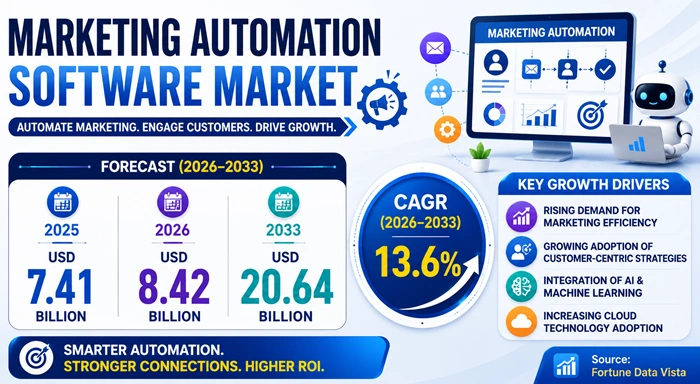
The global marketing automation software market size is valued at USD 7.41 billion in 2025 and is predicted to increase from USD 8.42 billion in 2026 to approximately USD 20.64 billion by 2033, growing at a CAGR of 13.6% from 2026 to 2033.
Marketing automation software enables businesses to plan, execute, manage, and measure marketing campaigns across multiple channels — including email, social media, web, SMS, and paid search — with minimal manual effort. By automating repetitive tasks such as lead nurturing workflows, audience segmentation, triggered email sequences, and performance reporting, these platforms allow marketing teams to focus on strategy and creativity while the software handles execution at scale. From large enterprises managing complex, multi-channel customer journeys to SMEs seeking affordable, easy-to-configure campaign tools, demand for intelligent marketing automation spans virtually every industry and business size. The convergence of artificial intelligence, real-time data analytics, customer data platforms (CDPs), and CRM integration is transforming these tools from simple task schedulers into sophisticated autonomous marketing orchestration engines — making the marketing automation software market one of the fastest-growing segments within the broader enterprise software and SaaS industry.
AI Impact on the Marketing Automation Software Industry
Generative AI, predictive analytics, and autonomous marketing agents are fundamentally redefining what marketing automation software can do — shifting the market from rule-based task execution toward intelligent, self-optimizing customer engagement systems that can plan, act, and learn without constant human direction
Artificial intelligence is no longer a supplementary feature in marketing automation platforms — it has become the defining competitive differentiator. Generative AI capabilities embedded within leading platforms such as Salesforce Marketing Cloud, Adobe Marketo Engage, and HubSpot are enabling marketers to automatically create personalized email subject lines, landing page copy, social media content, and customer journey messaging at a scale and speed that human copywriting teams simply cannot match. Predictive lead scoring models trained on historical CRM and behavioral data can now identify which prospects are most likely to convert with a precision that consistently outperforms rules-based qualification approaches — allowing sales teams to focus their limited capacity on the highest-value leads while the platform continues nurturing the rest through optimized automated sequences. These AI-driven productivity gains are compressing the ROI justification cycle for marketing automation investment — accelerating platform adoption across both enterprise and SME market segments globally.
The emergence of agentic AI — autonomous AI systems capable of reasoning, planning, and independently executing complex multi-step marketing workflows — represents the most transformative near-term development reshaping the marketing automation software market. Unlike conventional automation that executes predefined rule-based workflows, agentic AI systems can analyze campaign performance data, identify underperforming audience segments, generate alternative messaging hypotheses, execute A/B tests, analyze results, and autonomously implement winning variants — all without requiring human instruction at each step. Platforms including HubSpot's Breeze AI agents, Salesforce's Einstein Copilot, and Adobe's AI Assistant are already delivering early versions of this capability to enterprise customers. As the reliability and commercial availability of agentic marketing AI mature through the 2026–2033 forecast period, the productivity leverage and competitive advantage delivered by AI-native platforms will drive a structural shift in market leadership — favoring vendors that have invested most deeply in AI-first product architecture.
Growth Factors
Accelerating enterprise digital transformation, the irreversible shift of marketing budgets toward data-driven multi-channel digital campaigns, the SME adoption boom powered by affordable cloud-based SaaS platforms, and the AI-driven performance revolution are collectively generating powerful and sustained commercial growth across the marketing automation software market through 2033
The most fundamental commercial growth driver for the marketing automation software market is the broad and accelerating digital transformation of business marketing operations across all industries and company sizes. As digital advertising, e-commerce, and direct-to-consumer brand engagement become the primary channels for customer acquisition and retention, the volume and complexity of marketing campaigns that organizations must execute has grown far beyond what manual processes can manage efficiently. Marketing automation software is the operational backbone that makes multi-channel, personalized, data-driven marketing at scale commercially practical — enabling organizations to manage thousands of individual customer journeys simultaneously, track touchpoints across web, email, social, and paid channels, and measure campaign attribution with granular accuracy. The e-commerce revenue surge — with global online retail sales exceeding USD 6 trillion in 2024 — is particularly powerful as a demand driver, since e-commerce businesses depend on automated email flows, cart abandonment campaigns, post-purchase sequences, and loyalty program communications that require marketing automation software to execute at the required speed and scale.
The SME adoption wave represents the second major growth engine, driven by the rapid proliferation of affordable, user-friendly cloud-based marketing automation platforms that have brought sophisticated automation capabilities within reach of businesses that previously could not afford enterprise-grade tools. Platforms including Mailchimp (Intuit), ActiveCampaign, HubSpot, Klaviyo, and Brevo have created subscription-based SaaS offerings with intuitive drag-and-drop interfaces, pre-built automation templates, and transparent per-contact pricing models that eliminate the high upfront implementation costs and IT complexity that historically made marketing automation a large-enterprise-only technology. The global SME sector — comprising over 400 million businesses worldwide — represents an enormous and substantially underpenetrated market for marketing automation platforms, and as awareness of the productivity and revenue impact of these tools spreads through the global SME community, the pace of adoption will continue to drive strong revenue growth in the SaaS segments of the marketing automation software market through 2033.
Market Outlook
With a trajectory toward USD 20.64 billion by 2033 and a CAGR of 13.6% firmly outpacing broader enterprise software growth, the marketing automation software market is entering its most commercially dynamic and competitively intense period — driven by AI-native platform innovation, SME market penetration, and global digital marketing investment expansion
The medium-to-long-term market outlook for marketing automation software is exceptionally strong and broadly supported across multiple commercial dimensions. North America will maintain its dominant market position, with the United States accounting for the majority of global revenue through its deep enterprise software culture, the highest per-capita SaaS adoption rates, and the home market concentration of the world's leading platform vendors — Salesforce, Adobe, Oracle, HubSpot, and Microsoft. Asia Pacific will be the fastest-growing region, driven by China's rapidly digitizing consumer economy, India's explosive SME and startup ecosystem, and Southeast Asia's fast-growing e-commerce and mobile-first marketing landscape. Europe will generate steady and growing revenue, supported by increasing digital marketing investment, GDPR-aligned platform features that support compliance-first marketing operations, and growing enterprise demand for multi-channel customer journey automation across major economies.
The competitive landscape of the marketing automation software market is undergoing significant restructuring as AI capabilities become the primary competitive battleground. Established platform leaders are investing billions in AI product development and strategic acquisitions to maintain technical leadership — with Salesforce, Adobe, and HubSpot each announcing major generative AI and agentic AI feature releases in 2024 and 2025. Meanwhile, a new generation of AI-native marketing automation startups — built from the ground up around large language model capabilities, real-time data integration, and autonomous campaign execution — is challenging the established order and attracting substantial venture capital investment. This competitive dynamic is accelerating the pace of product innovation across the entire market, benefiting customers through expanding capabilities, and driving the market toward the USD 20.64 billion scale anticipated by 2033.
Expert Speaks
-
"Marketing automation is no longer just about efficiency — it is about intelligence. The AI capabilities we have embedded in Salesforce Marketing Cloud and our Einstein platform are enabling marketers to create truly personalized customer experiences at scale that were simply not possible before. We believe that the companies that invest in AI-driven marketing automation today will establish lasting competitive advantages in customer acquisition and retention that their competitors will struggle to close." — CEO perspective, leading global CRM and marketing automation platform company
-
"The integration of generative AI into marketing automation platforms is one of the most commercially significant technology transitions we have seen in the enterprise software market in years. We are already seeing measurable improvements in campaign performance, lead conversion rates, and marketing team productivity from our AI-powered automation capabilities, and we are continuing to invest aggressively in expanding these features because our customers are making it very clear that AI-driven automation is now a critical criterion in their platform selection decisions." — CEO perspective, global enterprise marketing software and creative platform company
-
"The SME market for marketing automation is growing faster than any other segment we track, and the combination of affordable cloud pricing, intuitive interfaces, and AI-powered campaign optimization has genuinely democratized sophisticated marketing automation capabilities. We are focused on continuing to lower the barrier to entry for small and medium businesses globally because we believe there are hundreds of millions of businesses that could benefit from automation tools that they are not yet using." — CEO perspective, leading SaaS marketing automation and CRM platform serving SMEs globally
Key Report Takeaways
-
North America dominates the global marketing automation software market, holding approximately 40% of total revenue share in 2025, anchored by the highest concentration of large enterprise software buyers, the home market presence of leading platform vendors including Salesforce, Adobe, Oracle, HubSpot, and Microsoft, and the most mature digital marketing ecosystem globally — characterized by deep CRM integration, advanced attribution capabilities, and high marketing technology stack sophistication.
-
Asia Pacific is the fastest-growing regional market, expected to register the highest CAGR through 2033, fueled by rapid digital transformation across China, India, and Southeast Asia, explosive SME sector growth driving SaaS platform adoption, fast-growing e-commerce ecosystems creating strong demand for automated multi-channel marketing, and increasing enterprise investment in personalization and customer engagement technology at scale.
-
Cloud-based deployment is the dominant and fastest-growing model, accounting for approximately 72.8% of global market revenue in 2025, as cloud platforms offer unmatched scalability, continuous feature updates, no upfront infrastructure investment, and seamless integration with CRM, analytics, and e-commerce systems — making them the overwhelming preference for both enterprise and SME buyers globally.
-
Campaign management is the largest application segment, contributing approximately 29.6% of global market revenue in 2025, as orchestrating coordinated, personalized multi-channel marketing campaigns across email, social media, paid advertising, and web content remains the primary use case for which most businesses invest in marketing automation platforms — with AI-driven campaign optimization capabilities further expanding the commercial value of this segment.
-
Large enterprises represent the largest end-user segment by revenue, accounting for approximately 61.4% of global market revenue in 2025, given their higher platform budgets, more complex multi-channel marketing requirements, larger addressable databases, and greater need for deep CRM integration and advanced analytics — though the SME segment is growing at a faster pace driven by widespread cloud platform adoption.
-
The BFSI end-user vertical is the largest industry contributor, accounting for approximately 22.3% of market share in 2025, as banks, insurance companies, and financial services firms are among the most intensive users of marketing automation for lead nurturing, customer onboarding, cross-sell and upsell campaigns, retention communications, and personalized financial product recommendation workflows.
-
Lead management is the fastest-growing application sub-segment, anticipated to grow at a CAGR exceeding 14.8% through 2033, as AI-powered lead scoring, predictive intent modeling, and automated multi-touch nurturing sequences become the highest-priority automation use case for B2B marketing and sales organizations seeking to maximize revenue from their existing pipeline generation investment.
Market Scope
Market Dynamics
Drivers Impact Analysis
The global digital marketing investment surge, AI-powered automation capabilities delivering measurable ROI improvements, accelerating SME SaaS platform adoption, and the e-commerce boom creating massive demand for automated customer engagement workflows are generating a compounding and multi-layered commercial growth engine for the marketing automation software market through 2033
| Driver | ≈ % Impact on CAGR Forecast | Geographic Relevance | Impact Timeline |
|---|---|---|---|
| Digital transformation driving multi-channel marketing automation demand across all industries | ~30% | Global | Short to Long Term |
| AI and generative AI capabilities delivering measurable campaign performance improvements | ~27% | North America, Europe | Short to Long Term |
| SME cloud platform adoption driven by affordable SaaS pricing and easy implementation | ~22% | Asia Pacific, Latin America, North America | Short to Long Term |
| E-commerce growth creating demand for automated customer journey and retention workflows | ~15% | Asia Pacific, North America | Short to Medium Term |
| CRM integration and customer data platform convergence expanding automation platform value | ~6% | North America, Europe | Medium to Long Term |
The digital transformation of marketing operations is the broadest and most durable growth driver in the marketing automation software market — encompassing not just the technology replacement of manual marketing processes, but a fundamental rethinking of how businesses engage customers throughout the entire lifecycle from awareness to advocacy. As marketing budgets continue to shift from traditional advertising toward measurable digital channels — with global digital ad spending expected to exceed USD 700 billion by 2028 — the operational infrastructure required to execute, measure, and optimize these investments at scale is increasingly supplied by marketing automation platforms. The platform capabilities most directly driving new adoption include multi-channel campaign orchestration, real-time behavioral trigger automation, dynamic content personalization, and closed-loop attribution reporting — all of which deliver measurable efficiency gains and revenue impact that create compelling and rapid ROI justification for investment. The measurability of marketing automation ROI — which is substantially more direct and verifiable than most enterprise software investments — makes it one of the most resilient categories in technology spending even during periods of macroeconomic uncertainty.
The AI-driven capability revolution is simultaneously creating a powerful secondary demand surge by dramatically expanding the performance ceiling of what marketing automation platforms can deliver. Platforms incorporating AI-powered predictive analytics, generative content creation, autonomous campaign optimization, and intelligent lead scoring are demonstrating conversion rate improvements, email open rate gains, and customer lifetime value increases that significantly outperform manually managed campaigns — creating a strong financial case for both new adoption and upgrade investment from existing platform users. For the marketing automation software market, this AI capability differentiation is creating a product upgrade cycle dynamic: businesses that adopted automation platforms for basic workflow efficiency are now investing in AI-enhanced tiers to capture the performance and competitive advantages that predictive and generative AI capabilities provide. This upgrade cycle adds a substantial incremental revenue dimension to organic new-platform-adoption growth, reinforcing the market's strong CAGR trajectory through 2033.
Restraints Impact Analysis
Data privacy regulatory complexity, integration challenges with existing enterprise technology stacks, and the difficulty of demonstrating clear marketing automation ROI in the short term are creating meaningful adoption friction that is moderating growth pace — particularly among smaller businesses and in emerging markets with less mature digital marketing ecosystems
| Restraint | ≈ % Impact on CAGR Forecast | Geographic Relevance | Impact Timeline |
|---|---|---|---|
| Data privacy regulations — GDPR, CCPA, and global equivalents — adding compliance complexity | ~38% | Europe, North America | Short to Long Term |
| Integration complexity with existing CRM, ERP, and martech stack systems | ~35% | Global | Short to Long Term |
| Skills gap in marketing automation strategy and platform administration | ~27% | Asia Pacific, Latin America, MEA | Short to Medium Term |
Data privacy regulation is one of the most significant restraints shaping the marketing automation software market — particularly in Europe, where GDPR compliance requirements create substantial obligations around customer data collection, storage, processing consent, and cross-border data transfer that add cost and complexity to marketing automation platform implementation and ongoing management. The proliferation of GDPR-equivalent privacy laws globally — including CCPA in California, LGPD in Brazil, PDPA in Singapore, and emerging frameworks across Asia and Africa — is creating a patchwork of jurisdictional compliance requirements that multi-market businesses must navigate carefully when deploying marketing automation platforms. For vendors, building and continuously updating compliance features — including consent management, data residency options, and automated data deletion capabilities — requires significant ongoing development investment. For buyers, compliance complexity increases implementation timelines, raises total cost of ownership, and sometimes results in delayed or scaled-back automation deployments that moderate market growth pace.
Integration complexity remains a persistent operational barrier, particularly for mid-market and enterprise businesses with established legacy CRM, ERP, and point-solution martech environments. Marketing automation platforms deliver maximum value when seamlessly connected to CRM data, e-commerce transaction records, web analytics, and customer support history — but achieving these integrations in complex, heterogeneous technology environments frequently requires significant technical resource investment, custom development work, and ongoing maintenance as connected systems are updated. Many businesses that would benefit from marketing automation delay deployment or limit their use to basic email automation functionality because the full integration required to realize platform value is beyond their internal technical capacity. The growth of native integration ecosystems, API standardization, and iPaaS (Integration Platform as a Service) solutions is progressively reducing this barrier — but it remains a meaningful restraint on accelerated market growth, particularly among mid-market companies managing complex legacy technology architectures.
Opportunities Impact Analysis
The convergence of customer data platform integration, agentic AI marketing automation, SME adoption in high-growth emerging markets, and the B2B revenue marketing transformation represent four high-value opportunity vectors that will materially expand the total addressable market and competitive frontier of the marketing automation software market through 2033
| Opportunity | ≈ % Impact on CAGR Forecast | Geographic Relevance | Impact Timeline |
|---|---|---|---|
| Agentic AI marketing automation enabling autonomous campaign planning and execution | ~36% | North America, Europe | Medium to Long Term |
| Customer data platform (CDP) integration creating unified customer intelligence for automation | ~28% | North America, Europe, Asia Pacific | Short to Medium Term |
| SME market expansion in Asia Pacific, Latin America, and MEA through affordable mobile-first platforms | ~24% | Asia Pacific, Latin America, MEA | Short to Medium Term |
| B2B revenue marketing convergence — integrating sales and marketing automation on unified platforms | ~12% | North America, Europe | Medium to Long Term |
The most commercially transformative opportunity in the marketing automation software market over the forecast period is the emergence of agentic AI — autonomous AI systems that can independently plan, execute, optimize, and report on marketing campaigns with minimal human direction. While current AI-enhanced automation still requires marketers to define workflows, audiences, and success metrics, agentic marketing AI platforms being developed by Salesforce, HubSpot, Adobe, and a cohort of AI-native startups will progressively shift toward fully autonomous campaign management — where AI agents continuously monitor pipeline health, identify engagement opportunities, create and test personalized content variants, and adjust campaign parameters in real time based on performance feedback. This capability shift will dramatically expand the value proposition of marketing automation platforms — making them not just efficiency tools but autonomous revenue generation systems — which will justify substantially higher platform subscription values and accelerate enterprise adoption decisions.
The integration of customer data platforms with marketing automation represents a second major opportunity that is transforming the depth and accuracy of customer intelligence available for campaign personalization. CDPs aggregate customer identity, behavioral, transactional, and preference data from all digital and offline touchpoints into unified customer profiles — and when this real-time customer intelligence is natively integrated with marketing automation execution, the result is hyper-personalized campaign delivery that can adapt to individual customer context at every interaction. Leading platform vendors including Salesforce (Data Cloud), Adobe (Real-Time CDP), and Oracle (Unity CDP) are actively building CDP capabilities directly into their marketing automation platforms — and the commercial success of these integrated offerings is creating strong upgrade incentives for enterprise customers currently operating siloed CDP and automation platforms. As unified CDP-automation platforms become the enterprise standard, they will drive both new platform adoption and significant average revenue per account expansion across the marketing automation software market.
Segment Analysis
By Deployment: Cloud-Based
Cloud-based deployment has achieved decisive market dominance in the marketing automation software market — delivering scalability, continuous innovation, and low total cost of ownership advantages that on-premises alternatives fundamentally cannot match in a world of always-on, AI-powered, multi-channel digital marketing
The cloud-based deployment segment is the dominant category in the marketing automation software market, holding approximately 72.8% of global market revenue in 2025 and growing at a CAGR of approximately 14.2% through 2033. Cloud platforms eliminate the upfront capital investment, IT infrastructure requirements, and maintenance overhead associated with on-premises deployments — enabling businesses to launch marketing automation programs within days, scale capacity elastically as database size and campaign volumes grow, and benefit from continuous feature updates without disruptive upgrade cycles. The subscription-based SaaS pricing model characteristic of cloud marketing automation platforms — typically structured on a per-contact or per-user basis — aligns vendor revenue directly with customer success and reduces financial risk for buyers compared to large upfront software license purchases. North America leads this segment by geography, accounting for approximately 39% of global cloud marketing automation revenue in 2025, driven by enterprise SaaS adoption maturity, strong AWS and Azure cloud infrastructure ecosystems, and the home market concentration of the world's leading cloud marketing automation vendors including Salesforce, HubSpot, Adobe, and Mailchimp.
Europe is the second-largest geographic market for cloud-based marketing automation, with strong enterprise demand from retail, BFSI, and media sectors and growing SME adoption across Germany, France, the UK, and the Netherlands. The availability of GDPR-compliant European data hosting options from major platform vendors has significantly accelerated cloud adoption by European businesses that previously maintained on-premises deployments for data sovereignty reasons. Asia Pacific is the fastest-growing region within the cloud deployment segment — growing at a regional CAGR exceeding 16% through 2033 — driven by the rapid growth of SaaS culture across China, India, and Southeast Asia, where mobile-first businesses are building their entire marketing technology stacks on cloud platforms from inception rather than migrating from legacy on-premises systems. Key companies dominating the cloud marketing automation landscape include Salesforce, HubSpot, Adobe (Marketo Engage), Oracle Marketing Cloud, ActiveCampaign, Klaviyo, and Brevo — each offering cloud-native platforms with varying depth of feature sophistication, price point, and target market focus.
By Application: Campaign Management
Campaign management's position as the largest application category in the marketing automation software market reflects the universal and irreplaceable need for coordinated, personalized, multi-channel marketing campaign execution that marketing automation platforms are uniquely designed to deliver
Campaign management is the largest application segment in the marketing automation software market, contributing approximately 29.6% of global market revenue in 2025 and growing at a CAGR of approximately 13.8% through 2033. This segment encompasses the full lifecycle of marketing campaign planning, audience segmentation, content creation and personalization, multi-channel execution (email, social, paid, SMS, web push), A/B testing, performance monitoring, and attribution reporting — all orchestrated through a unified automation platform. The business value delivered by campaign management automation is both immediate and measurable: marketers can execute campaigns that reach precisely targeted audience segments with personalized messaging across multiple channels simultaneously — achieving levels of relevance and timing precision that manual campaign management cannot approach. North America is the largest revenue contributor to this segment, accounting for approximately 40% of global campaign management application revenue in 2025, given enterprise marketing teams' sophistication, large addressable database sizes, and active investment in advanced campaign orchestration capabilities by major brands across retail, BFSI, healthcare, and technology sectors. Key platform vendors leading the campaign management segment include Salesforce Marketing Cloud, Adobe Marketo Engage, Oracle Eloqua, and HubSpot Marketing Hub.
Europe is a significant contributor to campaign management application revenue, with GDPR-aligned consent-based campaign orchestration features driving strong demand for sophisticated campaign management platforms that can simultaneously respect privacy requirements and deliver personalized customer communications. Asia Pacific is the fastest-growing region within the campaign management segment, driven by rapid e-commerce growth across China, India, and Southeast Asia — where brands are executing massive multi-channel campaigns across WeChat, Line, Lazada, and other regional digital platforms that require sophisticated campaign management automation to deliver at scale. The campaign management segment will continue to grow steadily through 2033, sustained by enterprises' need to efficiently execute growing volumes of increasingly personalized campaigns across expanding channel portfolios — with AI-driven campaign optimization capabilities further enhancing the commercial value of this foundational application category within the marketing automation software market.
Regional Insights
North America
North America's unmatched combination of enterprise software market maturity, the highest per-capita SaaS adoption rates globally, and the home-market concentration of the world's leading marketing automation platform vendors firmly establishes it as the dominant revenue leader in the marketing automation software market
North America leads the marketing automation software market, accounting for approximately 40% of global revenue share in 2025, with a regional CAGR of approximately 13.2% projected through 2033. The United States is the largest single country market, driven by deep enterprise marketing technology culture, the highest per-capita digital marketing investment globally, and the home headquarters advantage of the world's most commercially successful marketing automation platform companies — including Salesforce (Marketing Cloud), Adobe (Marketo Engage), HubSpot, Oracle (Eloqua), Microsoft (Dynamics 365 Marketing), Mailchimp (Intuit), Klaviyo, and ActiveCampaign. The B2B technology, financial services, retail, and healthcare sectors are the highest-revenue enterprise verticals in the North American market, with large companies typically investing in multi-platform automation stacks that integrate CRM, email automation, paid advertising management, and analytics reporting through connected platform ecosystems. North America's marketing technology industry is also the most active globally for vendor M&A activity — with major acquisitions including Salesforce's purchase of Slack and Tableau, Adobe's acquisitions of Marketo and Workfront, and HubSpot's ongoing product expansion creating platform consolidation dynamics that are reshaping competitive positioning within the regional market.
Canada contributes meaningful revenue to the North American marketing automation software market, with a strong domestic SaaS adoption culture, active enterprise digital marketing investment across financial services, retail, and media sectors, and a growing startup ecosystem generating domestic-market marketing automation demand. The North American market is also the primary testing ground for the most advanced AI-powered automation capabilities — including generative AI content creation, agentic marketing AI, and real-time CDP integration — with enterprise customers in the region serving as early adopters that provide the commercial validation and product feedback that shapes global platform development roadmaps. The region's dominance is expected to be sustained through 2033, even as Asia Pacific grows at a faster pace, because North America's combination of enterprise budget scale, platform sophistication, and ongoing technology innovation investment creates a compounding advantage that newer regional markets will take multiple years to replicate at equivalent revenue intensity.
Asia Pacific
Asia Pacific's explosive digital economy growth, the world's largest and fastest-expanding SME sector, mobile-first consumer engagement culture, and rapidly increasing enterprise investment in AI-powered marketing platforms are establishing it as the most commercially dynamic and fastest-growing region in the global marketing automation software market
Asia Pacific is the fastest-growing region in the marketing automation software market, expected to grow at a regional CAGR of approximately 15.9% through 2033, driven by a powerful combination of rapid digital economy expansion, large and growing e-commerce markets, increasing enterprise marketing sophistication, and the world's highest concentration of mobile-first consumers and businesses. China is the largest individual country market within the region, with its vast e-commerce ecosystem — anchored by Alibaba, JD.com, and Pinduoduo — generating enormous demand for automated customer lifecycle marketing, loyalty program automation, and personalized promotion delivery at scale. India is the most rapidly growing country market, driven by its explosion of internet users now exceeding 800 million, a massive and fast-growing SME sector actively adopting cloud-based marketing automation platforms, and a rapidly expanding domestic digital marketing and adtech services industry. Key companies driving growth across Asia Pacific include global platform leaders including Salesforce, HubSpot, and Adobe operating through regional subsidiaries, alongside strong regional players and local SaaS vendors serving SME market segments with market-specific features and local language support.
Japan, South Korea, and Australia represent mature Asia Pacific markets with strong enterprise marketing automation adoption across retail, financial services, and technology sectors — with Japan's sophisticated digital marketing culture and South Korea's highly connected consumer base both generating significant platform investment from local and multinational brands. Southeast Asian markets including Singapore, Indonesia, Thailand, and Vietnam are at earlier adoption stages but are experiencing the fastest SME market growth rates within the region, driven by rapidly expanding e-commerce penetration, growing mobile internet access, and a young, digitally native business population that is building marketing technology stacks on cloud-native automation platforms. Government-backed digital economy programs across multiple ASEAN nations — including Singapore's SME Go Digital initiative and India's Digital India program — are providing funding support and awareness programs that are accelerating small business adoption of marketing automation tools, further reinforcing Asia Pacific's position as the most commercially attractive growth frontier in the global marketing automation software market through 2033.
Report Customization Available
Get a Fully Customized Marketing Automation Software Market Report for Your Target Region or Country
Our marketing automation software market report is available with complete region-specific and country-level customization to precisely align with your strategic research and competitive intelligence requirements. Each customized version delivers in-depth market sizing, deployment model analysis, vertical-specific demand assessment, platform competitive landscape profiling, regulatory and data privacy environment review, pricing and subscription model benchmarking, and growth opportunity mapping — all calibrated to the specific market dynamics of your chosen geography and industry focus.
Customized marketing automation software market reports are available for the following regions and countries:
North America
-
United States – Deep-dive analysis of enterprise SaaS platform adoption, AI-driven marketing automation investment trends, leading vendor market positions including Salesforce, Adobe, HubSpot, and Oracle, vertical-specific demand breakdown across BFSI, retail, and technology, and SME platform adoption growth dynamics
-
Canada – Coverage of Canadian SaaS adoption landscape, enterprise marketing automation investment by sector, data residency and privacy compliance requirements, domestic platform vendors, and cross-border digital marketing automation demand
-
Mexico – Analysis of growing digital economy and SME market demand for marketing automation, cloud platform adoption trends, leading international platform availability and localization, and regulatory environment for marketing data management
Europe
-
United Kingdom – GDPR-compliant platform landscape, enterprise marketing automation adoption by sector, post-Brexit data transfer implications, leading vendor positions including Salesforce UK and Adobe UK operations, and UK SaaS market investment trends
-
Germany – GDPR enforcement environment, enterprise marketing automation maturity in BFSI, retail, and manufacturing sectors, domestic data hosting requirements, and leading company positions including SAP and HubSpot Germany
-
France – CNIL data privacy compliance, enterprise platform adoption in retail and luxury brand marketing, major agency and platform ecosystem, and French SME cloud marketing automation growth
-
Italy – Italian data protection authority landscape, growing retail and SME platform adoption, international platform availability with Italian localization, and digital marketing investment trends
-
Rest of Europe – Coverage of Spain, Netherlands, Belgium, Sweden, and other European markets with focus on GDPR impact, cloud automation adoption rates, SME market development, and regional platform competitive dynamics
Asia Pacific
-
China – Analysis of domestic marketing automation platform landscape including Tencent Marketing Cloud and Alibaba Marketing, cross-border digital marketing regulations, WeChat and Weibo channel integration capabilities, e-commerce automation demand, and enterprise platform adoption trends
-
India – Coverage of SME SaaS adoption surge, Freshworks and Zoho domestic platform leadership, government Digital India program impact, growing e-commerce automation demand, and enterprise marketing investment expansion across BFSI and retail sectors
-
Japan – PIPA data privacy compliance, enterprise marketing automation adoption in financial services and retail, domestic platform landscape, LINE channel integration, and AI marketing investment trends
-
South Korea – PIPA regulatory environment, Kakao and Naver channel integration requirements, enterprise marketing automation maturity, gaming and e-commerce sector demand, and leading international and domestic platform positions
-
Australia – Privacy Act compliance, enterprise and SME cloud platform adoption, major digital marketing investment by retail and financial services sectors, and leading platform vendor market positions
-
Rest of Asia Pacific – Coverage of Singapore, Indonesia, Thailand, Vietnam, and Malaysia with focus on mobile-first marketing automation, e-commerce growth driving demand, government digital economy support programs, and SME platform adoption expansion
Latin America
-
Brazil – LGPD privacy compliance, rapidly growing e-commerce and digital marketing automation demand, domestic and international platform competition, SME adoption trends, and government digital transformation support for small business marketing technology investment
-
Argentina – Marketing automation platform adoption among SMEs and mid-market companies, data privacy regulatory landscape, growing digital advertising investment, and international platform accessibility and pricing dynamics
-
Rest of Latin America – Coverage of Colombia, Chile, Mexico, and Peru regarding growing cloud SaaS adoption, digital marketing investment expansion, SME platform demand, and competitive landscape for international and regional marketing automation vendors
Middle East & Africa
-
UAE – Dubai and Abu Dhabi enterprise digital marketing maturity, DIFC and ADGM regulatory environment for data management, premium international platform adoption across retail, BFSI, and hospitality sectors, and growing SME automation investment
-
Saudi Arabia – Vision 2030 digital transformation impact on enterprise marketing investment, growing e-commerce and retail automation demand, international platform market access, and SME digital marketing adoption
-
Rest of MEA – Coverage of South Africa, Egypt, Turkey, and Nigeria with focus on growing internet penetration driving digital marketing demand, SME SaaS adoption trends, mobile-first marketing automation, and international platform entry strategies
Top Key Players
-
Salesforce, Inc. (United States)
-
Adobe Inc. (United States)
-
HubSpot, Inc. (United States)
-
Oracle Corporation (United States)
-
Microsoft Corporation (United States)
-
SAP SE (Germany)
-
Intuit Inc. (Mailchimp) (United States)
-
ActiveCampaign LLC (United States)
-
Klaviyo, Inc. (United States)
-
Zoho Corporation Pvt. Ltd. (India)
-
Brevo SAS (formerly Sendinblue) (France)
-
Acoustic, L.P. (United States)
-
Act-On Software, Inc. (United States)
-
GetResponse Sp. z o.o. (Poland)
-
Freshworks Inc. (United States)
Recent Developments
-
In September 2024, Salesforce, Inc. launched Agentforce — a suite of autonomous AI agents embedded across its Marketing Cloud, Sales Cloud, and Service Cloud platforms — marking one of the most significant product announcements in the company's history and positioning Salesforce as the first major enterprise software vendor to commercially deploy agentic AI capabilities at scale in the marketing automation software market. Agentforce marketing agents can autonomously qualify leads, generate personalized outreach sequences, respond to customer inquiries, and optimize campaign parameters without human direction — representing a fundamental shift in the commercial value proposition of the Salesforce marketing automation platform.
-
In October 2024, HubSpot, Inc. announced Breeze — its comprehensive AI layer embedded across the HubSpot CRM platform — including Breeze Copilot for AI-assisted content and workflow creation, Breeze Agents for autonomous task execution in marketing and sales, and Breeze Intelligence for AI-enhanced customer data enrichment. The launch strengthened HubSpot's competitive positioning in the SME and mid-market marketing automation segments against larger enterprise platform vendors and demonstrated the company's commitment to AI-first product innovation as the primary growth driver for the HubSpot platform ecosystem.
-
In March 2025, Adobe Inc. announced the general availability of its Unified Marketing Intelligence capabilities within Adobe Marketo Engage and Adobe Experience Cloud — integrating generative AI-powered content creation, real-time campaign performance analytics, and AI-driven audience segmentation across a single marketing automation and customer experience management workflow. The release significantly expanded Marketo Engage's AI capabilities and reinforced Adobe's competitive position in the enterprise marketing automation software market against Salesforce Marketing Cloud and Oracle Eloqua.
-
In January 2025, Klaviyo, Inc. expanded its platform beyond email and SMS automation to launch a comprehensive B2C CRM product — adding customer profile management, predictive analytics, and customer lifetime value scoring to its core email and SMS automation capabilities. The product expansion positioned Klaviyo as a full-stack marketing automation and customer management platform for e-commerce brands, significantly expanding its total addressable market and intensifying competitive pressure on both established enterprise marketing automation vendors and point-solution email marketing providers.
-
In November 2024, HubSpot, Inc. completed its acquisition of Frame AI, an enterprise AI platform specializing in conversational intelligence and customer feedback analysis, adding AI-powered signal detection from customer conversations and support interactions to HubSpot's marketing automation intelligence capabilities. The acquisition enhanced HubSpot's ability to automatically identify customer sentiment, churn risk signals, and upsell opportunities from unstructured customer communication data — enabling more intelligent automated marketing and sales engagement triggered by real-time customer behavior signals.
Market Trends
The irreversible shift toward AI-native, agentic marketing automation platforms and the convergence of marketing automation with customer data platforms and revenue operations are the two most commercially transformative trends reshaping the competitive architecture and growth trajectory of the marketing automation software market through 2033
The most defining trend reshaping the marketing automation software market is the transition from deterministic, rule-based workflow automation toward AI-native, agentic platforms capable of reasoning, planning, and autonomously executing marketing strategies in response to real-time customer signals and business conditions. Every major platform vendor — Salesforce, Adobe, HubSpot, Oracle, and Microsoft — is investing billions in embedding generative and agentic AI capabilities directly into their marketing automation product cores. This is not simply a feature addition — it represents a fundamental architecture shift that will progressively make the boundary between human marketing decision-making and automated execution increasingly fluid. For customers, this means platforms that can not only execute defined workflows but actively suggest and implement campaign optimization strategies — making marketing automation less of a productivity tool and more of an autonomous revenue generation partner. This transition is creating significant differentiation between AI-native and legacy rule-based platforms, driving customer investment in platform upgrades and creating a structural technology leadership advantage for the most AI-advanced vendors.
The second major trend is the convergence of marketing automation with revenue operations (RevOps) — the strategic alignment of marketing, sales, and customer success operations on shared data, shared goals, and shared automated workflows. Organizations that successfully align marketing automation with CRM-driven sales workflows and customer success automation achieve significantly higher revenue efficiency than those operating siloed department-specific tools. Leading platform vendors are responding to this convergence by building unified platforms that span the entire revenue lifecycle — with Salesforce's integration of Marketing Cloud, Sales Cloud, and Service Cloud, HubSpot's growth from marketing automation into full CRM and sales hub, and Adobe's Experience Cloud connecting marketing execution with commerce and customer service data all representing expressions of this convergence trend. As unified revenue operations platforms replace siloed marketing automation tools, average customer lifetime value per platform vendor account will increase substantially — driving market revenue expansion even in the absence of new customer acquisition growth.
Segments Covered in the Report
-
By Deployment
-
Cloud-Based
-
On-Premises
-
-
By Component
-
Software
-
Services
-
Professional Services
-
Managed Services
-
-
-
By Enterprise Size
-
Large Enterprises
-
Small and Medium Enterprises (SMEs)
-
-
By Channel
-
Email Marketing
-
Social Media Marketing
-
Search Marketing (SEO/SEM)
-
Content Marketing
-
Others (SMS, Web Push, Direct Mail)
-
-
By Application
-
Campaign Management
-
Lead Management
-
Analytics and Reporting
-
Sales Enablement
-
Social Media Management
-
Others
-
-
By End User
-
BFSI (Banking, Financial Services & Insurance)
-
Retail and E-Commerce
-
Healthcare
-
IT and Telecom
-
Media and Entertainment
-
Education
-
Others
-
-
By Region
-
North America (U.S., Canada, Mexico)
-
Europe (U.K., Germany, France, Italy, Rest of Europe)
-
Asia Pacific (China, India, Japan, South Korea, Australia, Rest of Asia Pacific)
-
Latin America (Brazil, Argentina, Rest of Latin America)
-
Middle East & Africa (UAE, Saudi Arabia, Rest of MEA)
-
❝ Built for Every Level — From Startups to Industry Giants ❞
Here Is Exactly How This Report Works for You
-
For Tier 1 enterprise software companies, major SaaS platform vendors, and institutional investors: This report delivers granular competitor revenue and product architecture analysis — breaking down platform-level ARR estimates, customer segment distribution, AI capability maturity assessments, and geographic market strategies for all 15 major players including Salesforce, Adobe, HubSpot, Oracle, and Microsoft. It also provides a comprehensive assessment of how geopolitical and regulatory dynamics — including U.S.-China data sovereignty conflicts affecting cross-border marketing automation deployment, EU AI Act compliance requirements for automated marketing decision-making, and emerging market data privacy law proliferation — are directly reshaping go-to-market strategies and product compliance investment in the marketing automation software market, giving executive decision-makers the intelligence needed to navigate an increasingly complex global commercial environment.
-
For Tier 2 specialty SaaS companies, digital marketing agencies, and systems integrators: This report identifies specific market gaps across vertical industries, company size segments, and geographic markets where established platform vendors are underserving customer needs — revealing commercial white-space opportunities for specialized vertical marketing automation solutions, integration and implementation services, AI consulting, and channel partner programs. Competitor revenue source analysis shows which pricing models, platform tiers, and customer segments are generating the highest-margin growth for market leaders — providing a strategic benchmark for product positioning, partnership development, and market entry planning.
-
For marketing technology startups, venture capital investors, and early-stage AI platform developers: This report maps the highest-CAGR commercial frontiers in the marketing automation software market — including agentic AI marketing agents, CDP-native automation platforms, composable marketing architecture tools, and mobile-first emerging market SME platforms — with detailed analysis of competitive intensity, customer acquisition economics, M&A transaction benchmarks, and strategic investor activity. It provides the market intelligence framework to identify, validate, and pursue the most attractive and differentiated commercial positions within the rapidly evolving marketing automation ecosystem through 2033 and beyond.
Frequently Asked Questions:
Answer: The global marketing automation software market was valued at USD 7.41 billion in 2025 and is projected to reach approximately USD 20.64 billion by 2033. The market is expected to grow at a CAGR of 13.6% from 2026 to 2033, driven by accelerating digital transformation, AI-powered platform innovation, SME cloud adoption, and growing enterprise investment in multi-channel campaign automation and lead management.
Answer: Cloud-based deployment is the dominant model in the marketing automation software market, accounting for approximately 72.8% of global revenue in 2025, driven by scalability advantages, continuous feature updates, no upfront infrastructure investment, and seamless CRM and analytics integrations. Cloud marketing automation platforms also benefit from lower total cost of ownership compared to on-premises alternatives, making them the overwhelming preference for both enterprise and SME buyers globally.
Answer: North America leads the marketing automation software market with approximately 40% of global revenue share in 2025, anchored by enterprise SaaS maturity, high per-capita digital marketing investment, and the home market presence of leading vendors including Salesforce, Adobe, HubSpot, and Oracle. Asia Pacific is the fastest-growing region at a projected CAGR of approximately 15.9% through 2033, driven by rapid digital economy expansion, explosive SME SaaS adoption, and fast-growing e-commerce markets across China, India, and Southeast Asia.
Answer: AI is transforming the marketing automation software market by shifting platforms from rule-based workflow execution toward intelligent, self-optimizing systems capable of predictive lead scoring, generative content creation, and autonomous campaign optimization. The emergence of agentic AI — with systems like Salesforce Agentforce and HubSpot Breeze Agents capable of independently executing complex marketing tasks — is creating a new category of autonomous marketing operations that is redefining the commercial value ceiling of marketing automation platforms and accelerating enterprise adoption decisions.
Answer: The most significant challenges in marketing automation software implementation are data privacy regulatory compliance — particularly navigating GDPR, CCPA, and other jurisdiction-specific requirements that govern how customer data can be collected, stored, and used in automated marketing programs — and integration complexity with existing CRM, ERP, and martech stack systems that requires significant technical resource investment to achieve seamlessly. The skills gap in marketing automation strategy and platform administration is a third major challenge, particularly in emerging markets, where insufficient internal expertise in building and optimizing automation workflows often limits organizations from realizing the full ROI potential of their platform investment.