
Medical Waste Management Market Overview
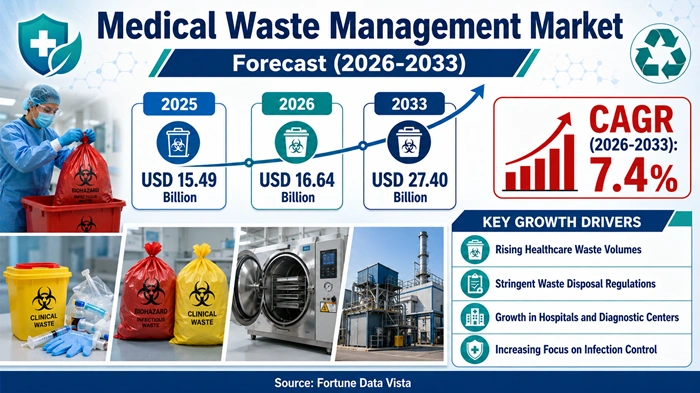
The global medical waste management market size is valued at USD 15.49 billion in 2025 and is predicted to increase from USD 16.64 billion in 2026 to approximately USD 27.40 billion by 2033, growing at a CAGR of 7.4% from 2026 to 2033.
The medical waste management industry — which encompasses the collection, transportation, treatment, and disposal of waste generated by healthcare facilities including hospitals, clinics, diagnostic laboratories, and pharmaceutical companies — has become one of the most critically important environmental and public health service sectors globally. Rising healthcare service volumes driven by aging populations and chronic disease prevalence, tightening regulatory frameworks for hazardous biomedical waste disposal, growing awareness of healthcare-associated infection risks from improper waste handling, and the expanding healthcare infrastructure of emerging economies are collectively sustaining a robust and accelerating growth trajectory for healthcare waste management services through the full forecast period.
AI Impact on the Medical Waste Management Industry
Artificial Intelligence, IoT-Connected Waste Monitoring Systems, and Predictive Route Optimization Technologies Are Transforming Medical Waste Management Operations by Reducing Collection Costs, Improving Regulatory Compliance Documentation, and Enabling Real-Time Tracking of Hazardous Waste Streams From Generation to Final Disposal
Artificial intelligence and data analytics are beginning to deliver meaningful operational improvements across the medical waste management industry — most practically in the areas of waste collection route optimization, predictive container fill-level monitoring, and regulatory compliance documentation management. AI-powered route optimization systems — which analyze real-time container fill sensor data, traffic patterns, and collection vehicle locations simultaneously — are enabling medical waste service companies to reduce unnecessary collection trips, optimize vehicle dispatch schedules, and lower per-container collection costs without compromising the pickup frequency compliance that healthcare facility contracts and regulatory frameworks require. These operational efficiency gains are becoming increasingly important competitive differentiators as labor and fuel costs rise across the logistics sector, driving leading medical waste management operators to accelerate their investment in AI-enhanced fleet and route management platforms.
IoT-enabled smart waste containers — equipped with fill-level sensors, temperature monitors, and tamper-detection systems — are transforming the compliance documentation and chain-of-custody tracking capabilities of medical waste management service providers. Real-time sensor data from smart containers enables healthcare facilities to track the exact volume, weight, and movement of every hazardous waste stream from the point of generation through treatment and disposal — generating the automated compliance documentation that EPA, DOT, and international regulatory reporting frameworks require without the manual data entry burden that paper-based tracking systems impose. Companies including Stericycle, Clean Harbors, and Veolia are investing in connected waste management technology platforms that integrate IoT container monitoring with digital manifesting, regulatory reporting, and customer portal systems — creating service quality and compliance transparency advantages that are increasingly influencing healthcare facility contracting decisions.
Growth Factors
The Expanding Global Volume of Healthcare-Generated Waste, the Tightening International Regulatory Frameworks for Biomedical Waste Disposal, and the Rapid Growth of Healthcare Infrastructure in Emerging Economies Are the Primary Forces Driving the Sustained Growth of the Medical Waste Management Market
The expanding global volume of healthcare-generated waste is the most fundamental and reliable demand driver in the medical waste management market, growing proportionally with the volume of healthcare services delivered globally. As the world's population ages and chronic disease prevalence rises — driving more frequent hospital admissions, more surgical procedures, more outpatient diagnostic testing, and more pharmaceutical treatments — the volume of infectious waste, sharps waste, pathological waste, and pharmaceutical waste generated by healthcare systems grows commensurately. The World Health Organization estimates that developed countries generate approximately 0.5 kilograms of hazardous waste per hospital bed per day — and with global hospital bed counts and outpatient visit volumes rising steadily as healthcare infrastructure expands in both developing and developed markets, the aggregate volume of medical waste requiring professional management services is on a consistent upward trajectory that supports durable demand growth for the industry through the entire forecast period.
The tightening of regulatory frameworks for biomedical and hazardous healthcare waste disposal represents a second powerful demand driver that operates through a compliance obligation mechanism — creating mandatory demand for professional medical waste management services among healthcare facilities that might otherwise seek lower-cost but non-compliant disposal alternatives. In the United States, the Resource Conservation and Recovery Act, the Medical Waste Tracking Act, and state-level regulations impose strict requirements for the segregation, containerization, labeling, manifesting, and treatment of regulated medical waste — with significant financial penalties for non-compliance that make professional waste management service contracts a non-negotiable operational requirement for licensed healthcare facilities. Similar regulatory tightening is occurring across the European Union — through the European Waste Framework Directive and specific member state healthcare waste regulations — and progressively across Asia Pacific and Latin American emerging market governments that are upgrading their biomedical waste management regulatory frameworks to international standards.
Market Outlook
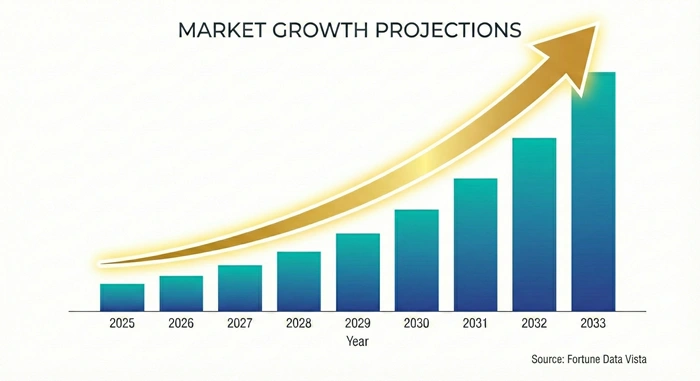
The Medical Waste Management Market Is Projected to Deliver Consistent Above-Market Revenue Growth Through 2033, Supported by the Inescapable Regulatory Compliance Mandate for Professional Waste Disposal Services, the Expanding Healthcare Infrastructure of Emerging Economies, and the Growing Adoption of Sustainable and Advanced Waste Treatment Technologies
The long-term market outlook for the medical waste management industry is underpinned by the uniquely non-discretionary nature of demand — healthcare facilities cannot choose whether to manage their hazardous waste; they can only choose which professional service provider manages it. This mandatory, regulation-driven demand structure gives the medical waste management market a revenue stability profile that is highly resilient to economic cycles, making it one of the most consistent and dependable growth markets in the broader environmental services industry. As healthcare facilities globally become larger, more specialized, and more technically advanced — generating proportionally more complex and higher-volume hazardous waste streams — the revenue per-customer of medical waste management service contracts is expected to grow alongside service complexity, sustaining above-average revenue growth even in mature markets where customer count growth is modest.
In Asia Pacific, Latin America, and the Middle East and Africa — where healthcare infrastructure is expanding rapidly to serve growing and increasingly urban populations — the medical waste management market is in an earlier and faster-paced growth phase. Governments across these regions are investing in both public hospital network expansion and the regulatory frameworks, treatment facility infrastructure, and enforcement mechanisms needed to ensure that the growing volumes of healthcare waste generated by expanding healthcare systems are managed safely and in compliance with international environmental and public health standards. For established medical waste management operators with geographic expansion strategies, these emerging market growth dynamics represent the most commercially exciting long-term growth opportunities in the global industry — offering the combination of high market growth rates and the early-mover advantage that comes with establishing long-term healthcare facility service relationships in markets before competition intensifies.
Expert Speaks
-
"Stericycle is committed to being the trusted partner for healthcare facilities across North America and internationally in managing their regulated medical waste safely, compliantly, and sustainably. We see the medical waste management market continuing to grow as healthcare volumes expand, regulatory requirements intensify, and healthcare facilities increasingly prioritize working with compliance-proven service partners that protect both their patients and their regulatory standing. Our investments in connected waste management technology, treatment capacity, and compliance service platforms are designed to serve this growing and increasingly sophisticated demand." — Cindy Miller, CEO, Stericycle Inc.
-
"Clean Harbors is seeing strong and consistent demand growth across our medical and hazardous waste management business, driven by the essential and non-discretionary nature of the services we provide to healthcare facilities, pharmaceutical companies, and life sciences organizations that depend on us for reliable, compliant waste disposal. The medical waste management industry is evolving toward more integrated service models that combine waste collection, treatment, compliance documentation, and sustainability reporting — and Clean Harbors is investing to lead this evolution through both technology innovation and strategic capacity expansion." — Alan McKim, CEO, Clean Harbors Inc.
-
"Veolia's healthcare waste management division is experiencing consistent revenue growth that reflects both the expanding volume of medical waste generated by growing global healthcare systems and the tightening regulatory environment that is raising compliance expectations for healthcare waste disposal across every market we serve. We are investing in advanced treatment technologies — including low-emission autoclaving, chemical treatment, and waste-to-energy solutions — that deliver both superior environmental performance and competitive economics for our healthcare facility clients." — Estelle Brachlianoff, CEO, Veolia
Key Report Takeaways
-
North America dominates the global medical waste management market, accounting for approximately 40% of total global revenue in 2026, driven by the United States' large and highly regulated healthcare sector, the world's most stringent medical waste disposal regulatory framework, and the established presence of leading global medical waste service operators including Stericycle, Clean Harbors, and US Ecology that serve the vast majority of U.S. hospital and healthcare facility waste management needs through comprehensive collection, treatment, and disposal service networks.
-
Asia Pacific is the fastest-growing regional market, expanding at a CAGR of approximately 9.5% from 2026 to 2033, powered by the rapid expansion of healthcare infrastructure across China, India, and Southeast Asia, growing government investment in biomedical waste regulatory enforcement, and the progressive establishment of professional medical waste treatment facility networks across emerging Asian healthcare markets that are transitioning from informal to compliant waste disposal practices.
-
Hospitals are the dominant waste source segment, contributing approximately 48% of total source-based revenue in 2026, as hospital-generated medical waste represents the highest volume per facility, the most diverse waste stream types — including infectious waste, sharps, pathological waste, and pharmaceutical waste — and the most stringent compliance and documentation requirements that generate the highest per-facility revenue for medical waste management service providers.
-
Incineration is the dominant treatment technology segment, accounting for approximately 38% of total treatment technology revenue in 2026, as thermal incineration remains the most widely accepted and regulatory-approved method for the complete sterilization and volume reduction of infectious and hazardous medical waste — particularly for pathological waste, pharmaceutical waste, and chemotherapy waste streams that require high-temperature thermal destruction that alternative treatment methods cannot achieve.
-
Collection and transportation services represent the largest service segment, holding approximately 45% of total service-type revenue in 2026, reflecting the essential and recurring logistical service requirement for regularly scheduled medical waste pickup from healthcare facilities — which generates predictable, contracted revenue streams for medical waste service operators regardless of downstream treatment and disposal method selection.
-
Autoclaving is the fastest-growing treatment technology segment, projected to expand at a CAGR of approximately 9.8% from 2026 to 2033 and reaching approximately 28% of total treatment technology revenue by 2033, driven by its lower environmental footprint relative to incineration, lower capital and operating costs, regulatory approval for infectious and sharps waste across major markets, and the growing sustainability reporting requirements of healthcare systems that are actively seeking lower-emission alternatives to incineration for treatable waste streams.
Market Scope
| Parameter | Details |
|---|---|
| Market Size by 2033 | USD 27.40 Billion | Market Size by 2026 | USD 16.64 Billion | Market Size by 2025 | USD 15.49 Billion | Market Growth Rate from 2026 to 2033 | CAGR of 7.4% | Dominating Region | North America | Fastest Growing Region | Asia Pacific | Segments Covered | Waste Type, Service, Treatment Technology, Source | Regions Covered | North America, Europe, Asia Pacific, Latin America, Middle East and Africa |
Market Dynamics
Drivers Impact Analysis
The Non-Discretionary Regulatory Compliance Mandate for Professional Medical Waste Disposal, the Rising Global Volume of Healthcare-Generated Waste, and the Rapid Expansion of Healthcare Infrastructure Across Emerging Economies Are the Three Most Consequential Growth Drivers in the Medical Waste Management Market
| Driver | ≈ % Impact on CAGR Forecast | Geographic Relevance | Impact Timeline |
|---|---|---|---|
| Stringent and expanding regulatory frameworks for biomedical waste disposal | ~30% | Global | Short to Long-Term |
| Rising healthcare service volumes increasing waste generation | ~26% | Global | Short to Long-Term |
| Emerging market healthcare infrastructure expansion | ~20% | Asia Pacific, Latin America, MEA | Medium to Long-Term |
| Growing awareness of healthcare-associated infection risks from improper waste handling | ~12% | Emerging markets | Medium-Term |
| Expansion of pharmaceutical and biotech manufacturing waste volumes | ~8% | North America, Europe, Asia Pacific | Short to Medium-Term |
| COVID-19 legacy investment in healthcare waste infrastructure and PPE waste management | ~4% | Global | Short-Term |
The regulatory compliance driver is the most structurally powerful force in the medical waste management market, operating through an obligation mechanism that makes demand for professional waste disposal services effectively inelastic to economic conditions. Healthcare facilities in all developed markets and an increasing number of emerging markets operate under legal frameworks that mandate the use of licensed medical waste service providers, require documented chain-of-custody tracking from generation through disposal, and impose significant financial penalties and operating license risks for non-compliance. This regulatory demand structure means that medical waste management service revenue is not a discretionary expense that healthcare administrators can reduce during budget pressures — it is a compliance cost that must be paid regardless of healthcare facility financial performance, creating the revenue stability and predictability that make the medical waste management industry attractive to both service operators and investors over long forecast horizons.
The healthcare infrastructure expansion driver creates the volume growth dimension of market revenue growth, as every new hospital bed, outpatient clinic, diagnostic laboratory, and pharmaceutical manufacturing facility that comes online globally generates additional ongoing medical waste requiring professional management. The most commercially significant expansion is occurring in Asia Pacific — where China's national hospital network expansion, India's Ayushman Bharat healthcare access program, and Southeast Asian government healthcare spending growth are all driving rapid increases in the volume of regulated medical waste generated annually. These emerging market healthcare infrastructure investments do not merely generate one-time waste management demand — they create permanent, recurring waste management service requirements that grow with the ongoing operations of the facilities they fund, making healthcare infrastructure investment in emerging markets one of the most reliable leading indicators of future medical waste management market revenue growth.
Restraints Impact Analysis
The High Capital Investment Requirements for Compliant Medical Waste Treatment Facilities, the Complex Cross-Jurisdictional Regulatory Compliance Landscape, and the Growing Public and Regulatory Opposition to Incineration-Based Medical Waste Treatment Are the Primary Constraints on Faster Growth in the Medical Waste Management Market
| Restraint | ≈ % Impact on CAGR Forecast | Geographic Relevance | Impact Timeline |
|---|---|---|---|
| High capital investment requirements for treatment facility construction | ~-28% | Emerging markets, new entrants | Medium to Long-Term |
| Complex and inconsistent cross-jurisdictional regulatory compliance | ~-24% | Global | Short to Long-Term |
| Public and regulatory opposition to incineration-based waste treatment | ~-20% | Europe, North America | Medium-Term |
| Informal and non-compliant waste disposal competition in emerging markets | ~-16% | Asia Pacific, Latin America, MEA | Long-Term |
| Workforce safety risks and rising insurance costs for hazardous waste handling | ~-12% | Global | Short to Medium-Term |
The high capital intensity of compliant medical waste treatment infrastructure — which requires permitted incineration facilities, validated autoclave systems, chemical treatment plants, and associated air pollution control and wastewater treatment equipment — creates a significant barrier to market entry for new operators and limits the pace of treatment capacity expansion needed to serve rapidly growing emerging market demand. Building and permitting a new medical waste incineration or autoclaving facility requires capital investment of tens of millions of dollars alongside multi-year regulatory permitting processes that can be derailed by community opposition or bureaucratic delays. This capital barrier tends to concentrate market share in established, well-capitalized operators — creating oligopolistic market structures in many national markets that limit price competition but also slow the pace of capacity expansion needed to match growing healthcare waste volumes.
The competitive pressure from informal waste disposal practices in emerging markets represents a particularly challenging restraint on professional medical waste management market growth in Asia Pacific, Latin America, and Africa — where underfunded healthcare facilities may resort to improper waste disposal practices including open burning, landfilling, or commingling of hazardous and municipal waste to avoid the cost of licensed medical waste management services. While regulatory enforcement is progressively tightening across these markets, the capacity of environmental regulatory authorities to identify, penalize, and reform informal disposal practices remains limited in many emerging market contexts — creating a competitive disadvantage for compliant professional service providers relative to non-compliant alternatives that do not bear the full cost of proper waste treatment.
Opportunities Impact Analysis
The Growing Adoption of Sustainable and Low-Emission Medical Waste Treatment Technologies, the Commercial Expansion of Pharmaceutical and Biotech Waste Management Services, and the Digital Transformation of Waste Compliance Management Platforms Are Creating Significant Revenue Growth Opportunities in the Medical Waste Management Market
| Opportunity | ≈ % Impact on CAGR Forecast | Geographic Relevance | Impact Timeline |
|---|---|---|---|
| Sustainable and low-emission waste treatment technology adoption | ~28% | North America, Europe, Asia Pacific | Short to Long-Term |
| Pharmaceutical and biotech manufacturing waste management service growth | ~24% | North America, Europe | Short to Medium-Term |
| Digital waste compliance platform and IoT smart container adoption | ~20% | North America, Europe, Asia Pacific | Short to Medium-Term |
| Emerging market formalization of medical waste regulatory frameworks | ~18% | Asia Pacific, Latin America, MEA | Long-Term |
| Pharmaceutical waste recycling and waste-to-energy program development | ~10% | North America, Europe | Medium-Term |
The growing healthcare sector commitment to environmental sustainability — driven by hospital system carbon reduction targets, healthcare supply chain sustainability reporting requirements, and the healthcare industry's recognition of its significant environmental footprint — is creating a major commercial opportunity for medical waste management operators that offer demonstrably lower-emission treatment alternatives to conventional incineration. Autoclaving, microwave treatment, and advanced chemical treatment systems that render infectious waste safe for municipal waste disposal while avoiding the air emissions associated with incineration are experiencing growing procurement preference from hospital sustainability teams and health system executive leadership that are under board-level pressure to reduce their environmental impact. Medical waste management companies that can credibly offer verified lower-emission waste treatment certifications and sustainability reporting documentation are commanding premium pricing and preferential contract renewals from health system clients with active sustainability programs.
The pharmaceutical and biotech manufacturing sector represents a high-growth, high-value customer segment for the medical waste management market, as the global expansion of pharmaceutical manufacturing capacity — including the ongoing buildout of biologics, cell therapy, and gene therapy manufacturing facilities — generates growing volumes of chemical waste, cytotoxic pharmaceutical waste, and biological manufacturing waste that require specialized treatment capabilities beyond the scope of conventional medical waste service offerings. Leading medical waste operators including Clean Harbors and Veolia are building specialized pharmaceutical waste service capabilities — including cold-chain pharmaceutical waste collection, controlled substance destruction, and cytotoxic waste treatment — to capture this premium, technically demanding customer segment whose waste volumes and service requirements are growing faster than conventional healthcare facility waste programs.
Segment Analysis
By Treatment Technology: Incineration
Incineration Remains the Dominant Treatment Technology in the Medical Waste Management Market, Valued for Its Ability to Completely Destroy All Categories of Hazardous Healthcare Waste and Achieve Maximum Volume Reduction That Alternative Treatment Technologies Cannot Match
Incineration holds the largest share of the treatment technology segment in the medical waste management market, accounting for approximately 38% of total treatment technology revenue in 2026. High-temperature thermal incineration remains the only treatment method capable of completely destroying all categories of hazardous medical waste — including pathological waste, chemotherapy pharmaceutical waste, cytotoxic materials, and infectious waste streams that cannot be safely rendered non-hazardous through steam sterilization or chemical treatment alone. The incineration segment within the medical waste management market is projected to grow at a CAGR of approximately 6.2% from 2026 to 2033, supported by the growing volume of pharmaceutical and oncology-related healthcare waste that mandates incineration treatment and by the continued dependence of emerging market waste management programs on incineration as the most established and regulatory-recognized treatment method available. North America is the largest regional market for incineration-based medical waste treatment, with Stericycle (USA), Clean Harbors (USA), and US Ecology Holdings (USA) operating the most extensive permitted incineration facility networks that collectively service the majority of U.S. hospital, pharmaceutical, and laboratory hazardous waste requiring thermal destruction.
Europe is a significant but increasingly regulation-pressured incineration market, as the European Union's Industrial Emissions Directive imposes progressively stringent air emission limits on medical waste incinerators that are raising compliance investment requirements for existing facilities and creating regulatory headwinds for new incineration capacity development. Despite these regulatory pressures, European medical waste incineration remains a large and commercially important market — with operators including Veolia (France), Suez (France), and Remondis (Germany) operating permitted incineration facilities across multiple EU member states that serve the region's substantial pharmaceutical, hospital, and laboratory hazardous waste management needs. The incineration segment will face progressive market share erosion toward lower-emission treatment alternatives over the longer term, but its combination of technical necessity for certain waste categories and established regulatory approval maintains its dominant position through the forecast period.
By Source: Hospitals
Hospitals Are the Dominant Waste Source in the Medical Waste Management Market, Generating the Largest Volume, the Most Diverse Waste Stream Types, and the Most Compliance-Intensive Service Requirements That Drive the Highest Per-Facility Revenue for Medical Waste Service Operators
Hospitals account for approximately 48% of total source-based revenue in the medical waste management market in 2026, making them the dominant customer segment by a substantial margin. The combination of high waste volume per facility, diverse waste stream types requiring multiple treatment methods, 24/7 waste generation requiring reliable collection scheduling, strict regulatory compliance obligations, and the reputational sensitivity of healthcare facilities to compliance failures makes hospitals the most commercially valuable and service-intensive customer category in the medical waste management ecosystem. The hospital source segment is projected to grow at a CAGR of approximately 7.0% from 2026 to 2033, driven by the global expansion of hospital bed capacity, the growing use of single-use medical devices and disposable personal protective equipment that increases waste generation per patient encounter, and the progressive increase in complex surgical and oncological procedures that generate higher volumes of specialized hazardous waste. North America is the dominant regional market for hospital-source medical waste management services, with Stericycle (USA) and Clean Harbors (USA) collectively serving the majority of U.S. hospital medical waste management programs through national collection networks and compliant treatment facilities.
Asia Pacific is the fastest-growing regional market for hospital-source waste management services, driven by the extraordinary pace of hospital network expansion across China, India, and Southeast Asia that is generating rapidly growing medical waste volumes requiring professional management. India's government-funded hospital expansion programs — including the Pradhan Mantri Swasthya Suraksha Yojana and the Ayushman Bharat Health and Wellness Centers initiative — are creating hundreds of new hospital and primary care facilities annually across the country, each generating ongoing medical waste management service requirements. Domestic Indian medical waste operators including Ramky Enviro Engineers (India) and Apollo Hospitals Group waste management services — alongside international operators including Veolia operating through Indian joint ventures — are competing to serve this rapidly expanding hospital waste management demand. The hospital source segment's revenue importance to the medical waste management market is reinforced by the long-term, contracted nature of hospital waste management service agreements, which provide medical waste operators with predictable, recurring revenue streams that anchor their financial performance across economic cycles.
Regional Insights
North America: The Dominating Region
North America Leads the Global Medical Waste Management Market Through the United States' World-Leading Healthcare Sector Scale, the Most Stringent Medical Waste Regulatory Compliance Framework Globally, and the Established Presence of the Industry's Most Experienced and Largest Service Operators
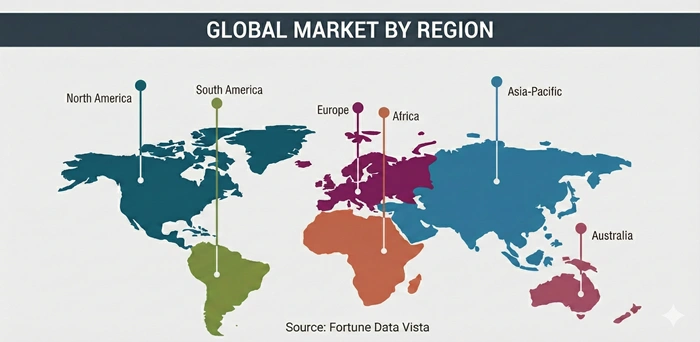
North America holds the largest regional share of the global medical waste management market, accounting for approximately 40% of total global revenue in 2026, with a regional CAGR of approximately 6.5% from 2026 to 2033. The United States is the dominant national market, driven by its world-leading healthcare sector — the largest by expenditure globally — that generates the highest absolute volume of regulated medical waste in any single country, combined with a comprehensive and rigorously enforced regulatory framework under the EPA, DOT, and state-level environmental agencies that mandates professional waste management services for every category of healthcare-generated hazardous waste. Leading operators in the North American medical waste management market include Stericycle Inc. (USA), Clean Harbors Inc. (USA), US Ecology Holdings (USA), and Sharps Compliance Corp. (USA) — all of which have built extensive permitted treatment facility networks, nationwide collection logistics, and digital compliance management platforms that serve hospitals, clinics, laboratories, and pharmaceutical manufacturers across the U.S.
Canada contributes a mature and well-regulated medical waste management market that complements the broader North American competitive landscape, with provincial environmental regulations governing biomedical waste disposal across all healthcare settings and professional service operators including Stericycle Canada and Clean Harbors Canada serving the country's hospital, clinical, and research laboratory waste management requirements. Mexico is an emerging growth market within the North American region — with the government's expanding public healthcare network and progressively tightening medical waste regulations creating growing demand for professional waste management services that domestic operators and multinational companies operating through Mexican subsidiaries are racing to serve.
Asia Pacific: The Fastest Growing Region
Asia Pacific Is the Fastest Growing Regional Market in the Medical Waste Management Industry, Led by China's Massive Healthcare Infrastructure Investment and India's Rapidly Expanding Hospital Network That Are Generating Growing Volumes of Regulated Medical Waste Requiring Professional Management
Asia Pacific is the fastest-growing regional segment in the medical waste management market, projected to expand at a CAGR of approximately 9.5% from 2026 to 2033 — the highest regional growth rate globally. China is the dominant national growth market, where the government's massive ongoing investment in public hospital infrastructure — targeting expanded hospital bed capacity and healthcare access across both urban and rural populations — is generating rapidly growing medical waste volumes that are placing increasing pressure on China's medical waste treatment infrastructure to expand commensurately. The Chinese medical waste management market is served by a combination of domestic operators including Beijing Capital Co. Ltd. (China) and Everbright Environment Group (China), alongside multinational operators including Veolia and Suez operating through Chinese joint ventures — all of which are competing to serve the extraordinary pace of healthcare infrastructure growth that is making China one of the fastest-growing medical waste management revenue opportunities globally.
India represents the most exciting emerging market growth story in the Asia Pacific medical waste management market, with a large and rapidly expanding hospital sector, growing regulatory enforcement of the Bio-Medical Waste Management Rules 2016, and a domestic professional waste management industry led by Ramky Enviro Engineers (India) and Attero Recycling (India) that is rapidly expanding its treatment capacity and geographic coverage to serve the country's diverse and geographically dispersed healthcare waste generation base. The Asia Pacific medical waste management market also benefits from growing government investment in biomedical waste regulatory infrastructure across Southeast Asian markets — including Vietnam, Indonesia, Thailand, and the Philippines — where expanding hospital networks and tightening waste disposal regulations are creating new professional service market opportunities that domestic and international waste management operators are beginning to address through facility investment and service expansion programs.
Report Customization by Region and Country
This Medical Waste Management Market Report Offers Full Region-Wise and Country-Wise Customization — Providing Geography-Specific Market Sizing, Regulatory Landscape Analysis, Treatment Infrastructure Assessment, Competitive Intelligence, and Strategic Growth Opportunities Tailored Precisely to Every Region and Country You Need to Analyze
This Medical Waste Management Market report is available with full customization by region and country, enabling organizations to access precise, geography-specific market insights aligned with their strategic priorities. The report can be configured to deliver the exact regional depth and intelligence your business requires — covering market sizing, CAGR forecasts, segment breakdowns, regulatory environment, treatment infrastructure landscape, key player profiles, and actionable strategic opportunities specific to each geography.
North America
-
U.S. — EPA and state-level regulatory compliance landscape, treatment facility network analysis, major service operator competitive profiles including Stericycle and Clean Harbors, and market sizing and forecast through 2033
-
Canada — Provincial biomedical waste regulatory framework, domestic service operator landscape, hospital waste generation volume trends, and regional market sizing and CAGR
-
Mexico — Government healthcare expansion programs, medical waste regulatory development, domestic market opportunity analysis, and competitive landscape for service operators
Europe
-
U.K. — Environment Agency regulatory requirements, NHS medical waste volumes, domestic service operator landscape, and market sizing and growth forecast
-
Germany — Industrial Emissions Directive compliance impact, Remondis and Veolia competitive positioning, pharmaceutical waste management market, and regional analysis
-
France — Veolia and Suez domestic market positions, healthcare waste regulatory framework, hospital waste management trends, and market sizing through 2033
-
Italy — Healthcare system waste generation, regulatory compliance landscape, regional market analysis, and domestic operator profiles
-
Rest of Europe — Nordic sustainable waste treatment innovation, Eastern European healthcare waste management market development, and region-wide regulatory compliance trends
Asia Pacific
-
China — Beijing Capital and Everbright competitive landscape, government hospital expansion waste impact, regulatory enforcement trends, and market sizing and CAGR forecast
-
India — Bio-Medical Waste Management Rules compliance landscape, Ramky Enviro Engineers competitive position, hospital expansion waste volume analysis, and market forecast
-
Japan — Healthcare waste regulatory framework, domestic treatment infrastructure, advanced waste technology adoption, and market sizing through 2033
-
South Korea — Healthcare waste regulation, domestic operator landscape, hospital waste management trends, and regional market analysis
-
Australia — State-level biomedical waste regulations, domestic service provider landscape, and medical waste management market sizing and forecast
-
Rest of Asia Pacific — Southeast Asian healthcare waste management regulatory development, emerging market treatment infrastructure investment, and market opportunities across Vietnam, Indonesia, Thailand, and the Philippines
Latin America
-
Brazil — ANVISA and CONAMA biomedical waste regulations, domestic operator landscape, hospital waste management market sizing, and CAGR forecast through 2033
-
Argentina — Medical waste regulatory framework, healthcare waste generation volumes, and regional market development outlook
-
Rest of Latin America — Regional healthcare infrastructure growth, biomedical waste regulatory tightening, and medical waste management market opportunities across Colombia, Chile, and other markets
Middle East and Africa (MEA)
-
UAE — Healthcare hub waste management infrastructure, Vision 2030-aligned healthcare investment, and medical waste management market sizing and competitive landscape
-
Saudi Arabia — National Transformation Program healthcare investment waste impact, treatment facility development, and market sizing and growth forecast through 2033
-
Rest of MEA — Sub-Saharan African healthcare waste management infrastructure development, informal disposal formalization opportunity, and long-term medical waste management market growth potential
Each customized Medical Waste Management Market report provides country-specific regulatory compliance analysis, treatment infrastructure landscape, competitive mapping of local and international operators, and market entry and investment strategy guidance — giving decision-makers the precision intelligence they need to build competitive advantages and maximize returns in their target geographies.
Top Key Players
-
Stericycle Inc. (United States)
-
Clean Harbors Inc. (United States)
-
Veolia Environnement SA (France)
-
Suez SA (France)
-
Waste Management Inc. (United States)
-
US Ecology Holdings Inc. (United States)
-
Sharps Compliance Corp. (United States)
-
Remondis SE and Co. KG (Germany)
-
Ramky Enviro Engineers Ltd. (India)
-
Beijing Capital Co. Ltd. (China)
-
Everbright Environment Group Ltd. (China)
-
BWS Enviro Services Pvt. Ltd. (India)
Recent Developments
-
In 2025, Stericycle Inc. completed its strategic acquisition by Waste Management Inc. in a transaction valued at approximately USD 7.2 billion — representing the largest consolidation deal in the history of the North American medical waste management industry and creating a combined entity with unmatched geographic coverage, treatment facility capacity, and compliance service capabilities across the United States and Canada that significantly strengthens Waste Management's position as the dominant provider of regulated healthcare waste services in North America.
-
In 2025, Clean Harbors Inc. expanded its pharmaceutical and controlled substance waste destruction capabilities through the commissioning of a new permitted high-temperature incineration unit at its Deer Park, Texas facility — specifically designed to handle the growing volumes of cytotoxic pharmaceutical waste, controlled substances, and DEA-regulated drug destruction programs generated by pharmaceutical manufacturers, hospital pharmacies, and retail pharmacy chains across the southeastern United States.
-
In 2026, Veolia announced a major expansion of its medical waste treatment operations in India through a joint venture agreement with a leading Indian hospital group — establishing dedicated on-site medical waste treatment facilities at major hospital campuses across five Indian states and creating a scalable service model for integrated hospital campus waste management that Veolia plans to replicate across Southeast Asian and Middle Eastern markets as part of its emerging market medical waste management growth strategy.
-
In 2025, Remondis SE launched a new digital waste management compliance platform for European healthcare facilities — providing real-time container fill monitoring, automated waste manifest generation, regulatory reporting dashboards, and digital chain-of-custody documentation that significantly reduces the administrative burden of medical waste compliance management for hospital and clinical laboratory customers across Germany, Austria, and the Netherlands.
-
In 2026, Beijing Capital Co. Ltd. announced a RMB 2.3 billion investment in new medical waste treatment facility construction across six Chinese provincial cities — significantly expanding the company's autoclave and incineration treatment capacity to serve the rapidly growing healthcare waste volumes generated by China's ongoing public hospital network expansion programs — positioning Beijing Capital as the most geographically comprehensive domestic medical waste management service provider in the Chinese market.
Market Trends
The Accelerating Transition From Incineration to Sustainable Low-Emission Treatment Technologies and the Digital Transformation of Waste Compliance Management Are the Two Most Commercially Significant Trends Reshaping the Medical Waste Management Market Through 2033
The sustainability transition in medical waste treatment — driven by healthcare system carbon reduction commitments, tightening incineration emission standards, and the growing commercial availability of validated alternative treatment technologies — is progressively shifting the treatment technology mix in the medical waste management market away from conventional incineration toward autoclaving, microwave treatment, and advanced chemical treatment methods for infectious and sharps waste streams. Healthcare systems across North America and Europe are increasingly including waste management sustainability performance — measured by treatment emissions, landfill diversion rates, and carbon footprint per ton of waste treated — in their CDMO and waste service partner evaluation criteria, creating competitive advantage for medical waste operators that invest in lower-emission treatment capabilities. Companies including Stericycle and Clean Harbors are responding by expanding their autoclave and microwave treatment capacity at the expense of incineration investment for treatable waste categories — preserving incineration capacity for the specific waste types that legally require it while shifting treatable volumes to more sustainable methods.
The digital transformation of medical waste compliance management — through IoT-connected smart containers, mobile waste tracking applications, cloud-based manifesting platforms, and AI-powered compliance reporting tools — is creating a service quality differentiation dimension in the medical waste management market that is progressively becoming as important as treatment technology and geographic coverage in healthcare facility procurement decisions. Hospital and healthcare network procurement teams are increasingly demanding real-time visibility into the status of their waste streams — from collection scheduling and container fill levels through treatment completion and disposal documentation — that paper-based tracking systems cannot provide. Medical waste operators that have invested in comprehensive digital compliance platforms are converting this capability into competitive differentiation that supports premium pricing, longer contract terms, and stronger customer retention — reinforcing the trend toward market consolidation among digitally advanced, full-service medical waste management operators.
Segments Covered in the Report
By Waste Type:
-
Infectious Waste
-
Pathological Waste
-
Sharps Waste
-
Pharmaceutical Waste
-
Chemical Waste
-
Radioactive Waste
-
Others
By Service:
-
Collection
-
Transportation
-
Treatment
-
Disposal
-
Recycling
By Treatment Technology:
-
Incineration
-
Autoclaving
-
Chemical Treatment
-
Microwave Treatment
-
Others
By Source:
-
Hospitals
-
Clinics
-
Ambulatory Surgical Centers
-
Diagnostic Laboratories
-
Pharmaceutical Companies
-
Others
By Region:
-
North America (U.S., Canada, Mexico)
-
Europe (U.K., Germany, France, Italy, Rest of Europe)
-
Asia Pacific (China, India, Japan, South Korea, Australia, Rest of Asia Pacific)
-
Latin America (Brazil, Argentina, Rest of Latin America)
-
Middle East and Africa (UAE, Saudi Arabia, Rest of MEA)
❝ Built for Every Level — From Startups to Industry Giants ❞
Here Is Exactly How This Report Works for You
-
Whether you are a global medical waste management service operator evaluating geographic expansion strategy, treatment technology investment priorities, and competitive positioning; a hospital system or healthcare network procurement leader benchmarking medical waste service provider capabilities, compliance track records, and sustainability performance; or an institutional investor assessing the long-term revenue stability, growth trajectory, and consolidation dynamics of the medical waste management industry, this report delivers granular revenue forecasts by waste type, service, treatment technology, source, and region — combined with detailed competitor revenue analysis, regulatory landscape intelligence, and treatment infrastructure capacity assessment that enables confident strategic and capital allocation decisions.
-
This report comprehensively maps the supply-demand dynamics of the global medical waste management ecosystem — including healthcare waste generation volume trends by region and facility type, treatment capacity utilization and expansion pipeline analysis, regulatory compliance framework evolution by major market, and how geopolitical factors including healthcare infrastructure nationalism, international waste shipment regulations, and emerging market regulatory enforcement investment are reshaping global medical waste service delivery patterns in ways that create both material compliance risks and significant market entry and expansion opportunities.
-
The full version provides detailed competitor revenue breakdowns by service type and geography, treatment facility network capacity benchmarking, healthcare sector waste generation forecasting by facility type, sustainability and emission performance comparison across treatment technologies, and a forward-looking assessment of digital compliance platform differentiation, pharmaceutical waste management growth, and emerging market formalization opportunities — delivering the strategic intelligence needed to capture the full commercial opportunity of one of the world's most essential and consistently growing environmental services market segments.
Frequently Asked Questions:
Answer: The medical waste management market is valued at USD 15.49 billion in 2025 and is projected to reach USD 27.40 billion by 2033. It is expected to grow at a CAGR of 7.4% from 2026 to 2033, driven by rising healthcare waste volumes, tightening regulatory compliance requirements, and the rapid expansion of healthcare infrastructure across emerging market economies.
Answer: North America leads the medical waste management market, accounting for approximately 40% of total global revenue in 2026, anchored by the United States' large and highly regulated healthcare sector and the established presence of dominant service operators including Stericycle, Clean Harbors, and Waste Management Inc. The region's combination of high healthcare waste generation volumes, stringent EPA and state-level regulatory enforcement, and mature professional waste service infrastructure sustains its leadership position through the 2033 forecast period.
Answer: The medical waste management market covers multiple regulated waste categories including infectious waste, sharps waste, pathological waste, pharmaceutical waste, chemical waste, and radioactive waste — each requiring specific treatment and disposal methods determined by their hazard classification. Infectious and sharps waste are the highest-volume categories requiring professional collection and treatment, while pharmaceutical and chemical waste generate premium-priced specialized service demand due to their complexity and the specialized incineration or chemical treatment methods their disposal requires.
Answer: The major treatment technologies in the medical waste management market include high-temperature incineration — which is the most widely used method for pathological, pharmaceutical, and chemotherapy waste — steam autoclaving, microwave treatment, and chemical treatment for infectious and sharps waste. Autoclaving is the fastest-growing treatment technology segment, projected to expand at approximately 9.8% CAGR from 2026 to 2033, as healthcare systems prioritize lower-emission alternatives to incineration for treatable waste streams in response to sustainability commitments and evolving regulatory emission standards.
Answer: The medical waste management market is responding to sustainability demands through the progressive expansion of autoclave, microwave, and chemical treatment capacity at the expense of conventional incineration for waste categories where alternative treatment is regulatory-compliant — reducing the greenhouse gas and air pollutant emissions per ton of waste treated by leading service operators. Digital waste compliance platforms that provide transparent carbon footprint reporting, treatment emission documentation, and landfill diversion metrics are also becoming standard service offerings for medical waste operators serving hospital clients with active sustainability reporting programs and carbon reduction commitments.