
Non-Clinical Information Systems Market Overview
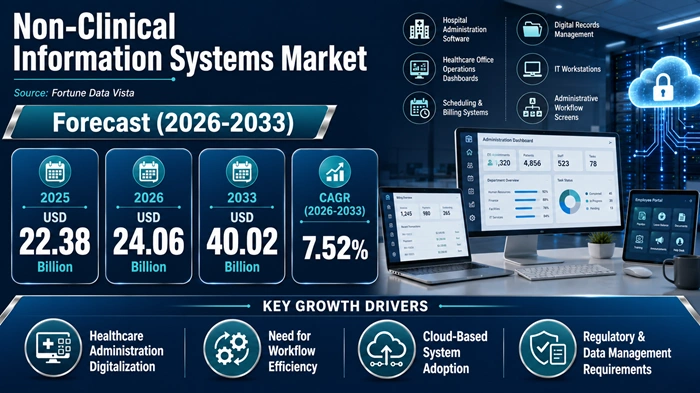
The global non-clinical information systems market size is valued at USD 22.38 billion in 2025 and is predicted to increase from USD 24.06 billion in 2026 to approximately USD 40.02 billion by 2033, growing at a CAGR of 7.52% from 2026 to 2033.
This steady growth reflects the accelerating push by hospitals and healthcare networks to modernize the administrative backbone that supports scheduling, billing, resource planning, and compliance, alongside the clinical software that manages direct patient care. Rising healthcare IT spending, growing demand for cloud-based hospital administration platforms, and increasing regulatory pressure around efficient data handling are together fueling adoption of these non-clinical healthcare software solutions across both developed and emerging healthcare systems.
AI Impact on the Non-Clinical Information Systems Industry
Artificial Intelligence Is Reshaping Administrative Automation, Predictive Resource Planning, and Back-Office Efficiency Across Hospital Operations — Fundamentally Changing How Healthcare Organizations Manage Non-Clinical Workflows
Artificial intelligence has become a genuine turning point for how healthcare organizations handle the mountains of administrative work that sit behind every patient encounter. Instead of relying on staff to manually process claims, verify insurance eligibility, or schedule follow-up appointments, many hospitals are now deploying AI-driven robotic process automation tools that handle these repetitive tasks with far greater speed and fewer errors. This shift is proving particularly valuable in billing and claims departments, where AI models can flag inconsistencies or likely denials before a claim is even submitted, saving administrative teams significant time and reducing revenue leakage across the system.
Beyond automation, AI is also improving how hospitals forecast staffing needs, bed availability, and supply inventory by analyzing historical patterns alongside real-time admission data. This predictive capability allows administrators to make more informed operational decisions rather than reacting to shortages after they occur, which is especially valuable during seasonal surges or unexpected demand spikes. As AI tools become more deeply embedded within non-clinical software platforms, the distinction between basic administrative software and genuinely intelligent operational systems is becoming less clear, pushing vendors across the non-clinical information systems market to continuously add smarter, more predictive features to stay competitive.
Growth Factors
Rising Healthcare IT Investment and Administrative Complexity Are Driving Consistent Demand for Smarter Non-Clinical Platforms — Reshaping How Hospitals Approach Operational Technology Spending
The most consistent growth factor behind rising demand in the non-clinical information systems market is the sheer scale of investment healthcare organizations are directing toward IT infrastructure modernization. As hospitals face growing patient volumes and increasingly complex regulatory reporting requirements, many are recognizing that outdated administrative software creates real operational bottlenecks that directly affect revenue and patient satisfaction. This recognition has translated into steady budget allocation for upgrading scheduling systems, billing platforms, and resource management tools, particularly among mid-sized and large hospital networks that can no longer manage growing administrative loads with legacy systems.
A second major growth factor is the increasing complexity of healthcare administration itself, driven by evolving insurance requirements, multi-facility hospital networks, and growing expectations around patient experience management. Hospitals operating across multiple locations increasingly need centralized non-clinical platforms that can standardize billing, staffing, and compliance processes across every site rather than managing each facility separately. This need for centralized, scalable administrative software is pushing many healthcare systems toward comprehensive non-clinical information systems that can grow alongside their expanding operations, rather than piecemeal solutions that eventually require costly replacement.
Market Outlook
Cloud Migration and Deeper Clinical Integration Are Expected to Define the Next Phase of Growth — Positioning Non-Clinical Platforms as Central to Broader Digital Health Strategies
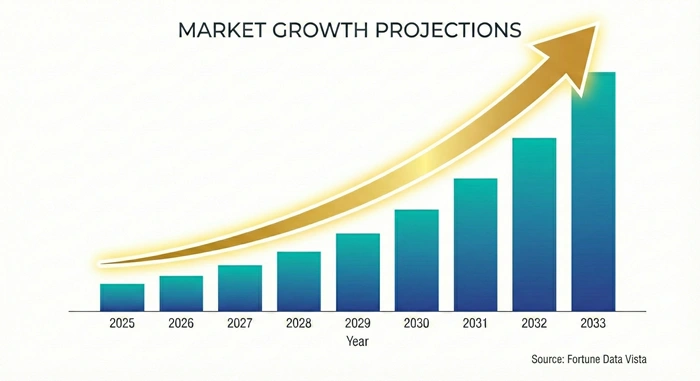
Looking toward 2033, the non-clinical information systems industry is expected to benefit significantly from the continued migration away from on-premise infrastructure toward cloud-based platforms that offer lower upfront costs and easier scalability across multi-site hospital networks. Smaller and mid-sized healthcare providers, in particular, are increasingly viewing cloud-based non-clinical systems as a way to access enterprise-grade administrative capability without the capital expense of maintaining in-house servers and IT staff. This shift is expected to broaden the addressable customer base considerably over the forecast period, extending well beyond the large hospital systems that have traditionally driven the bulk of market revenue.
At the same time, growing emphasis on interoperability between non-clinical and clinical systems is reshaping how hospitals evaluate software purchases, since fragmented systems that cannot share data efficiently create friction across the entire patient journey. Vendors that can offer seamless integration between administrative platforms and electronic health record systems are increasingly favored by hospital procurement teams looking to reduce duplicate data entry and improve overall workflow coordination. Companies that invest in flexible, interoperable, cloud-ready non-clinical information systems are well positioned to capture a growing share of this expanding market as healthcare organizations continue their broader digital transformation journeys.
Expert Speaks
-
"Hospitals today expect their administrative technology to be just as intelligent and reliable as their clinical systems, and that shift is driving how we prioritize product development." — CEO, Oracle Corporation, commenting on rising demand for smarter hospital administration platforms
-
"Interoperability between clinical and non-clinical platforms is no longer optional. Health systems are demanding it, and we are building our roadmap entirely around that expectation." — CEO, GE Healthcare, addressing the growing need for connected hospital IT ecosystems
-
"The move to cloud-based administrative infrastructure is opening the door for smaller hospitals to access technology that was previously out of reach financially." — CEO, McKesson Corporation, reflecting on how cloud adoption is broadening access across the healthcare sector
Key Report Takeaways
-
North America leads the global non-clinical information systems market, holding approximately 40% market share in 2025, supported by widespread digital healthcare adoption, favorable regulatory frameworks, and strong healthcare IT spending
-
Asia Pacific is the fastest-growing region, expected to expand at a CAGR near 10% through 2033, driven by rapid hospital infrastructure expansion and growing government support for healthcare digitization
-
Large hospital networks represent the dominant customer base, relying heavily on non-clinical information systems to standardize administrative operations across multiple facilities
-
Hospitals contribute the most to overall application demand, accounting for the majority share due to their complex billing, scheduling, and compliance requirements
-
Cloud-based deployment remains the most widely adopted delivery model, prized for its scalability and lower upfront infrastructure costs compared to traditional on-premise systems
-
Ambulatory surgical centers will grow the fastest among end-use segments, holding a meaningful share with a CAGR near 8% through the forecast period, driven by rising outpatient procedure volumes and growing demand for efficient administrative support
Market Scope
| Parameter | Details |
|---|---|
| Market Size by 2033 | USD 40.02 Billion | Market Size by 2026 | USD 24.06 Billion | Market Size by 2025 | USD 22.38 Billion | Market Growth Rate from 2026 to 2033 | CAGR of 7.52% | Dominating Region | North America | Fastest Growing Region | Asia Pacific | Segments Covered | System Type, Deployment Model, End Use, Region | Regions Covered | North America, Europe, Asia Pacific, Latin America, Middle East & Africa |
Market Dynamics
Drivers Impact Analysis
Growing Healthcare IT Spending and Rising Administrative Complexity Stand Out as the Two Dominant Forces Accelerating Market Momentum
| Driver | (≈) % Impact on CAGR Forecast | Geographic Relevance | Impact Timeline |
|---|---|---|---|
| Rising healthcare IT infrastructure investment | ~35% | North America, Europe, growing in Asia Pacific | Short to long-term |
| Increasing administrative complexity across multi-site hospital networks | ~27% | Global | Medium to long-term |
| Growing demand for cloud-based hospital administration platforms | ~22% | Global | Short to medium-term |
| Expanding outpatient and ambulatory care volumes | ~16% | North America, Europe | Medium-term |
Rising healthcare IT infrastructure investment continues to serve as the primary engine behind growth in the non-clinical information systems market, as hospitals increasingly recognize that outdated administrative software creates measurable inefficiencies that directly affect both revenue and patient experience. This trend is particularly strong in North America and Europe, where regulatory reporting requirements and payer complexity have made robust administrative technology a genuine operational necessity rather than a discretionary upgrade.
The second major driver is the growing administrative complexity that comes with operating multi-site hospital networks, since coordinating billing, scheduling, and compliance consistently across dozens or even hundreds of facilities requires centralized, scalable software rather than fragmented, location-specific tools. This matters commercially because it pushes hospital networks toward larger, more comprehensive non-clinical information systems purchases rather than smaller point solutions, generating higher-value contracts for vendors capable of delivering enterprise-wide platforms. Growing outpatient and ambulatory care volumes are further reinforcing this trend, as these facilities increasingly require the same level of administrative sophistication once reserved for large inpatient hospitals.
Restraints Impact Analysis
High Implementation Costs and Data Security Concerns Continue to Slow Broader Adoption Among Smaller Healthcare Providers
| Restraint | (≈) % Impact on CAGR Forecast | Geographic Relevance | Impact Timeline |
|---|---|---|---|
| High upfront implementation and integration costs | ~37% | Global, notable in smaller healthcare facilities | Short to medium-term |
| Data privacy and security concerns around cloud migration | ~28% | North America, Europe | Ongoing |
| Lack of standardized healthcare IT protocols across regions | ~21% | Asia Pacific, Latin America, Middle East & Africa | Medium to long-term |
| Limited budget allocation among smaller hospitals | ~14% | Emerging markets | Ongoing |
The most persistent restraint facing the non-clinical information systems market is the high upfront cost associated with implementing and integrating new administrative software, particularly for smaller hospitals and clinics operating with tight budgets. Beyond the initial software licensing cost, organizations must also account for staff training, data migration, and the operational disruption that typically accompanies any large-scale system transition, which can discourage smaller providers from upgrading even when they recognize the long-term efficiency benefits.
Data privacy and security concerns tied to cloud migration represent a second significant restraint, since non-clinical systems often handle sensitive patient billing and insurance information that must comply with strict regulatory standards. Many hospitals with strict internal data governance policies continue favoring on-premise deployment specifically because of these concerns, even though on-premise systems typically carry higher long-term maintenance costs. Combined with the lack of standardized healthcare IT protocols in several emerging markets, these restraints continue moderating how quickly the broader non-clinical information systems market can achieve universal adoption across all facility sizes and regions.
Opportunities Impact Analysis
Cloud Expansion and Deeper AI Integration Represent the Most Commercially Significant Paths to Sustained Growth
| Opportunity | (≈) % Impact on CAGR Forecast | Geographic Relevance | Impact Timeline |
|---|---|---|---|
| Expansion of affordable cloud-based platforms for smaller providers | ~39% | Global, led by Asia Pacific, Latin America | Medium to long-term |
| Deeper integration of AI-driven analytics and automation tools | ~35% | North America, Europe | Short to medium-term |
| Growing government investment in national digital health infrastructure | ~26% | Asia Pacific, Middle East & Africa | Long-term |
The expansion of affordable, cloud-based non-clinical platforms designed specifically for smaller hospitals and clinics represents one of the most significant commercial opportunities within this market. As cloud infrastructure costs continue declining and vendors develop simplified deployment models, previously underserved smaller healthcare providers are becoming a genuinely viable customer segment, opening substantial new revenue potential beyond the large hospital networks that have traditionally dominated purchasing activity.
Deeper integration of AI-driven analytics and automation tools within non-clinical platforms presents a second major opportunity, since hospitals are increasingly willing to pay a premium for software that goes beyond basic record-keeping to deliver genuine predictive insight around staffing, billing, and resource allocation. Government investment in national digital health infrastructure across several Asia Pacific and Middle Eastern countries is further expanding the addressable market, as public healthcare modernization programs increasingly mandate or incentivize adoption of standardized administrative technology. Companies that align their product development with these government-backed digitization efforts are well positioned to capture meaningful growth within the broader non-clinical information systems market.
Segment Analysis
By System Type: Hospital Information Systems
Hospital Information Systems Continue to Anchor the Market, Driven by Their Central Role in Coordinating Administrative Operations Across Large Facilities
Hospital information systems represent one of the largest and most consistently growing system type categories within the non-clinical information systems market, expected to expand at a CAGR near 6% through the forecast period. These platforms coordinate everything from patient scheduling and bed management to billing and regulatory reporting, making them foundational to how large hospitals manage day-to-day administrative operations. In markets like the United States and Germany, hospitals have increasingly standardized around comprehensive hospital information system platforms because they reduce the operational risk of managing multiple disconnected administrative tools. Leading vendors such as Cerner, Epic Systems, and Oracle continue to dominate this segment through deep enterprise relationships and continuous platform expansion designed to keep pace with evolving hospital administrative needs.
Growth in this segment remains particularly strong across regions where hospital networks are consolidating into larger, multi-facility systems that require centralized administrative coordination rather than site-specific software. This consolidation trend is prominent in North America, where hospital mergers have created sprawling networks that depend on unified hospital information systems to maintain consistent billing and compliance standards across dozens of locations. As hospitals continue expanding their outpatient and ambulatory service lines, hospital information systems are increasingly being extended to cover these newer care settings as well, reinforcing their central role within the broader non-clinical information systems market.
By End Use: Hospitals
Hospitals Remain the Dominant End-Use Segment, Reflecting the Sheer Administrative Scale Required to Manage Large-Volume Patient Care Operations
Hospitals account for approximately 60% of end-use segment revenue within the non-clinical information systems market in 2025, reflecting the sheer administrative complexity involved in running large-scale patient care operations around the clock. Between managing thousands of billing transactions, coordinating staff schedules across multiple departments, and maintaining compliance documentation for regulatory audits, hospitals simply require more comprehensive administrative software than smaller outpatient facilities. This scale advantage has made hospitals the primary revenue driver for most major non-clinical information systems vendors, and that dominance is expected to continue throughout the forecast period even as other end-use segments grow faster in percentage terms.
Ambulatory surgical centers represent the fastest-growing end-use segment, supported by rising outpatient procedure volumes and growing recognition that these facilities need administrative sophistication comparable to hospitals despite their smaller footprint. North America has seen particularly strong growth in this segment as outpatient care continues shifting away from traditional inpatient hospital settings, driven by both cost pressures and improving surgical technology that allows more procedures to be performed safely outside hospital walls. Companies like Athenahealth and NextGen Healthcare have expanded their product offerings specifically to serve this growing ambulatory market, recognizing that these facilities represent a meaningful growth opportunity within the broader non-clinical information systems market even as hospitals remain the largest overall revenue contributor.
Regional Insights
North America
Strong Healthcare IT Spending and Mature Digital Infrastructure Keep North America Firmly in the Lead
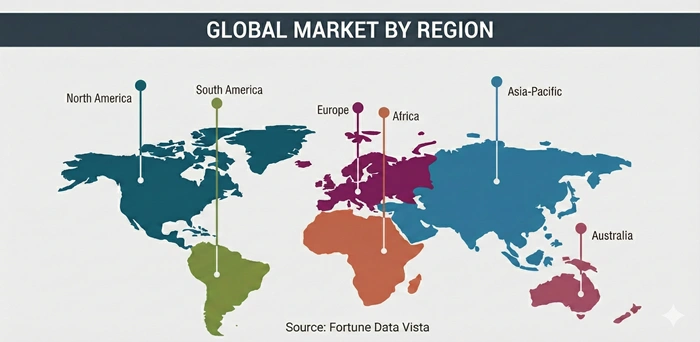
North America commands the leading position in the global non-clinical information systems market, holding approximately 40% share in 2025, supported by widespread digital healthcare adoption, favorable regulatory frameworks, and consistently strong healthcare IT spending across the region. The United States drives the overwhelming majority of regional demand, backed by a dense concentration of major health technology vendors and a hospital sector that has aggressively pursued digital transformation over the past decade. Companies with strong regional presence include Cerner, Epic Systems, Oracle, and McKesson, each maintaining deep enterprise relationships with major hospital networks across the country.
Canada also contributes meaningfully to regional demand, supported by growing public healthcare investment in digital administrative infrastructure and a steady push toward interoperability between provincial healthcare systems. The region's combination of mature IT infrastructure, strong vendor presence, and consistent regulatory support for digital health adoption ensures North America's leadership position within the non-clinical information systems market remains firmly intact through the remainder of the forecast period.
Asia Pacific
Rapid Hospital Infrastructure Expansion and Government Digitization Programs Make Asia Pacific the Fastest-Growing Region
Asia Pacific is projected to register the fastest CAGR within the global non-clinical information systems market through 2033, expanding at a rate near 10% as rapid hospital infrastructure development and expanding government digital health initiatives create substantial new demand across the region. China and India lead this growth, supported by massive investment in new hospital construction alongside government programs actively promoting digital administrative systems as part of broader healthcare modernization efforts. Regional and international vendors alike have expanded their presence to capture this growing institutional demand, often tailoring products to accommodate more budget-conscious healthcare providers.
Japan and South Korea contribute further depth to regional growth, both bringing established healthcare IT ecosystems that are increasingly focused on integrating administrative platforms with advanced clinical decision-support tools. Government-backed digital health infrastructure programs across several Asia Pacific countries continue to accelerate adoption among small and mid-sized healthcare providers that previously lacked the resources to invest in comprehensive administrative technology. This combination of infrastructure expansion, government support, and improving technology affordability positions Asia Pacific as the clear growth leader within the broader non-clinical information systems market through the forecast period.
Customization Available for This Report
Region-Specific and Country-Specific Versions of This Report Are Available to Give Clients a Sharper, More Localized View of Market Dynamics
This report can be tailored on a region-by-region and country-by-country basis, providing localized market sizing, competitive mapping, and regulatory context that a global overview alone cannot capture.
Clients seeking a more focused analysis can request a customized version covering any of the following regions and countries, complete with demand forecasting, vendor landscape review, and adoption trend analysis tied specifically to the non-clinical information systems keyword focus:
North America
-
U.S. — Detailed breakdown of hospital network consolidation and enterprise platform adoption trends
-
Canada — Coverage of provincial healthcare digitization and interoperability initiatives
-
Mexico — Analysis of expanding private healthcare IT investment
Europe
-
U.K. — Review of NHS digital infrastructure programs and administrative system adoption
-
Germany — Coverage of hospital IT modernization and regulatory compliance requirements
-
France — Insights into healthcare administrative software adoption trends
-
Italy — Analysis of regional hospital digitization patterns and vendor competition
-
Rest of Europe — Country-level view of emerging demand across Eastern Europe and the Nordics
Asia Pacific
-
China — Coverage of large-scale hospital construction and government digitization programs
-
India — Analysis of growing private hospital IT investment and affordable platform demand
-
Japan — Review of established healthcare IT ecosystem and interoperability initiatives
-
South Korea — Assessment of digital health infrastructure investment and vendor landscape
-
Australia — Insights into healthcare administrative system adoption and regulatory trends
-
Rest of Asia Pacific — Country-level breakdown covering Thailand, Vietnam, Indonesia, and Malaysia
Latin America
-
Brazil — Coverage of expanding private and public hospital IT investment
-
Argentina — Analysis of early-stage healthcare digitization trends
-
Rest of Latin America — Country-level sizing across Colombia, Peru, and Chile
Middle East & Africa
-
UAE — Review of healthcare infrastructure investment and digital administration adoption
-
Saudi Arabia — Coverage of national digital health initiatives and vendor competition
-
Rest of MEA — Country-level view of Sub-Saharan Africa healthcare IT access expansion
Top Key Players
-
Cerner Corporation (United States)
-
Epic Systems Corporation (United States)
-
Allscripts Healthcare Solutions Inc (United States)
-
McKesson Corporation (United States)
-
Oracle Corporation (United States)
-
GE Healthcare (United States)
-
Siemens Healthineers AG (Germany)
-
Athenahealth Inc (United States)
-
NextGen Healthcare Inc (United States)
-
Greenway Health LLC (United States)
-
eClinicalWorks LLC (United States)
-
Infor Inc (United States)
Recent Developments
-
In 2025, Oracle expanded its healthcare administrative platform with enhanced billing automation features designed to reduce claim denial rates across large hospital networks
-
In 2026, Amazon Web Services introduced an AI-driven healthcare workflow platform supporting patient authentication, scheduling, and medical coding automation
-
In 2025, UiPath deepened its healthcare automation partnerships by integrating robotic process automation directly with a widely used electronic medical records platform
-
In 2026, Athenahealth expanded its ambulatory-focused administrative software suite to better serve growing outpatient surgical center demand
-
In 2025, GE Healthcare strengthened its interoperability offerings, enabling deeper integration between its administrative platforms and third-party clinical systems
Market Trends
Cloud Adoption and Deeper Automation Are Redefining Expectations for Administrative Healthcare Technology
One of the clearest trends shaping the non-clinical information systems market is the accelerating shift toward cloud-based deployment, as hospitals increasingly favor the scalability and lower upfront costs that cloud platforms offer compared to traditional on-premise infrastructure. This shift is particularly pronounced among smaller and mid-sized healthcare providers that previously found enterprise-grade administrative software financially out of reach, and vendors are responding by developing more accessible, subscription-based pricing models tailored to this expanding customer base.
A second significant trend is the growing adoption of automation and AI-driven analytics within these platforms, as hospitals look beyond basic record-keeping toward tools that can genuinely predict staffing needs, flag billing issues before they escalate, and support more informed operational decision-making. This deeper reliance on intelligent automation is pushing vendors to continuously enhance their product capabilities, and interoperability between non-clinical and clinical systems is becoming an increasingly important purchasing criterion as hospitals seek to eliminate data silos across their broader technology ecosystem within the non-clinical information systems market.
Segments Covered in the Report
By System Type
-
Hospital Information Systems
-
Laboratory Information Systems
-
Pharmacy Information Systems
-
Radiology Information Systems
-
Enterprise Resource Planning Systems
By Deployment Model
-
Cloud-Based
-
On-Premise
-
Hybrid
By End Use
-
Hospitals
-
Ambulatory Surgical Centers
-
Diagnostic and Imaging Centers
-
Long-Term Care Facilities
By Region
-
North America (U.S., Canada, Mexico)
-
Europe (U.K., Germany, France, Italy, Rest of Europe)
-
Asia Pacific (China, India, Japan, South Korea, Australia, Rest of Asia Pacific)
-
Latin America (Brazil, Argentina, Rest of Latin America)
-
Middle East & Africa (UAE, Saudi Arabia, Rest of MEA)
❝ Built for Every Level — From Startups to Industry Giants ❞
Here Is Exactly How This Report Works for You
-
For tier 1 enterprises, investors, and established market leaders, this report delivers detailed competitor revenue analysis, vendor market positioning, and geopolitical risk context that support confident decisions around acquisitions, platform expansion, and long-term strategic direction within the non-clinical information systems space
-
For tier 2 and tier 3 companies, startups, and mid-sized healthcare technology providers, this report highlights the most commercially promising deployment models and underserved regional opportunities, giving you a practical framework to compete against established players without spreading resources too thin
-
For every decision maker across the value chain, this report explains exactly how healthcare IT spending patterns, evolving data security regulations, and competitor product launches are shaping market direction through 2033, equipping you to plan investment and go-to-market decisions with genuine confidence
Frequently Asked Questions:
Answer: The global non-clinical information systems market was valued at USD 22.38 billion in 2025 and is projected to reach USD 40.02 billion by 2033. This growth is driven by rising healthcare IT investment and growing administrative complexity across hospital networks.
Answer: Growth in the non-clinical information systems market is being driven by rising healthcare IT spending and the need for centralized administrative platforms across multi-site hospital networks. Expanding cloud adoption is also making these systems more accessible to smaller healthcare providers.
Answer: North America currently leads the non-clinical information systems market with roughly 40% share, supported by mature healthcare IT infrastructure and strong vendor presence. Asia Pacific is growing the fastest, driven by rapid hospital infrastructure expansion and government digitization programs.
Answer: Hospital information systems represent one of the largest categories within the non-clinical information systems market, given their central role in coordinating billing, scheduling, and compliance. Hospitals as an end-use segment also account for the majority of overall market revenue.
Answer: Leading companies in the non-clinical information systems market include Cerner, Epic Systems, Oracle, McKesson, and GE Healthcare. These companies compete through deep enterprise relationships, continuous platform innovation, and growing investment in AI-driven administrative automation.