
Online Food Delivery Market Overview
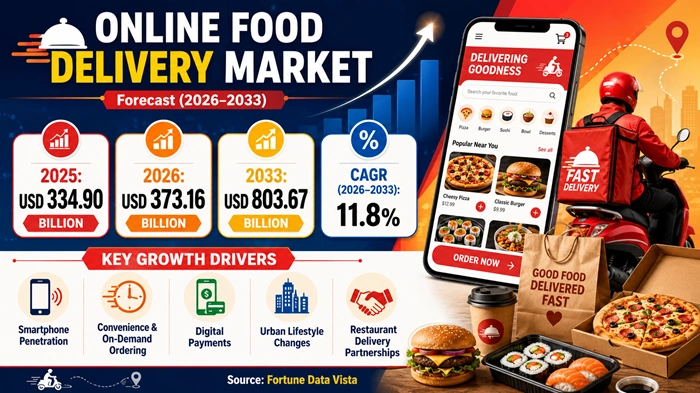
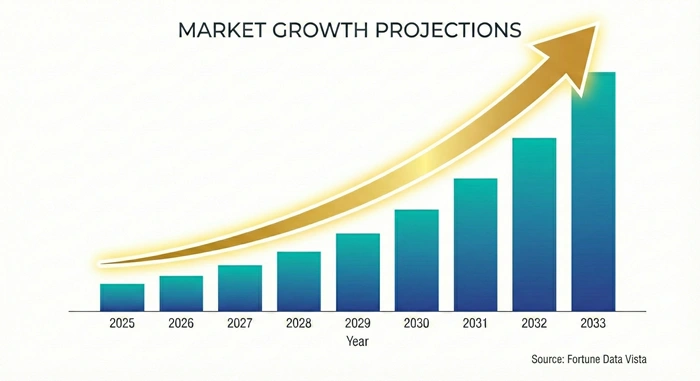
The global online food delivery market size is valued at USD 334.90 billion in 2025 and is predicted to increase from USD 373.16 billion in 2026 to approximately USD 803.67 billion by 2033, growing at a CAGR of 11.8% from 2026 to 2033.
Convenience has become the defining currency of modern consumer behavior, and nowhere is this more evident than in the explosive growth of food delivery services globally. What began as a niche service for urban residents has transformed into one of the world's fastest-growing consumer industries — connecting hundreds of millions of users daily with thousands of restaurant and grocery options through a handful of taps on a smartphone. The online food delivery market is now deeply embedded in the daily routines of consumers across every income level and geography, driven by smartphone penetration, expanding internet access, the proliferation of delivery apps, and a post-pandemic shift in consumer expectations toward on-demand, doorstep-delivered convenience that shows no signs of reversing.
AI Impact on the Online Food Delivery Industry
Artificial Intelligence Is Reshaping the Entire Online Food Delivery Value Chain — from Intelligent Demand Forecasting and Dynamic Pricing to Autonomous Delivery Vehicles and Hyper-Personalized Customer Recommendations That Drive Order Frequency and Average Order Value
Artificial intelligence has become the core operational infrastructure of the world's leading food delivery platforms, enabling the algorithmic precision and real-time optimization across routing, pricing, demand forecasting, and customer experience that makes economically viable delivery at scale possible. Machine learning-powered demand forecasting systems allow platforms including DoorDash, Uber Eats, and Meituan to predict order volumes by location, time of day, weather conditions, and local events with remarkable accuracy — enabling proactive driver positioning that reduces delivery time, improves driver earnings per hour, and lowers the cost-per-delivery that is fundamental to platform profitability. AI-driven route optimization algorithms process live traffic data, delivery cluster information, and multi-order batching opportunities in milliseconds, identifying delivery sequences that minimize total delivery time across simultaneous orders in ways that human dispatchers could never replicate at the volume and complexity of modern food delivery operations.
The customer-facing application of AI in the online food delivery market is equally transformative. Recommendation engines powered by collaborative filtering and deep learning analyze individual order history, browsing behavior, time-of-day patterns, and peer behavior to surface restaurant and menu suggestions that are dramatically more likely to result in an order than generic browse experiences — increasing session-to-order conversion rates, average order values, and repeat order frequency across platforms. AI-powered dynamic pricing systems adjust delivery fees, service charges, and promotional discount depth in real time based on demand intensity, driver supply availability, competitive positioning, and individual customer price sensitivity profiles — allowing platforms to optimize yield across the full order funnel simultaneously. The integration of AI across every layer of the online food delivery ecosystem has created a technology moat for established platforms that smaller competitors and new entrants find increasingly difficult to bridge.
Growth Factors
Smartphone and Internet Penetration Across Emerging Markets, Evolving Consumer Lifestyles Favoring Convenience, and the Expansion of Food Delivery Beyond Restaurants Into Grocery and Quick Commerce Are the Primary Structural Growth Drivers of the Online Food Delivery Market
The single most powerful structural driver of the online food delivery market's global expansion is the progressive democratization of smartphone ownership and affordable mobile data access across emerging markets in Asia Pacific, Latin America, and Africa — regions where hundreds of millions of new consumers are entering the digital economy for the first time and discovering food delivery apps as their first experience with e-commerce. In India, the combination of Reliance Jio's affordable mobile data and rapidly rising urban middle-class incomes has created one of the world's fastest-growing food delivery markets, with Swiggy and Zomato both achieving multi-hundred-million order volumes annually and progressively expanding into smaller Tier-2 and Tier-3 cities where urban convenience culture is spreading rapidly. In Southeast Asia, Grab, Gojek, and foodpanda are executing similar strategies — leveraging the region's explosive smartphone adoption and expanding urban professional class to build dominant multi-service super-app platforms where food delivery is the most frequent daily touchpoint and the gateway to additional services including payments, grocery delivery, and ride-hailing.
The expansion of delivery platforms beyond restaurant meals into grocery, household essentials, alcohol, pharmacy, and convenience store delivery is creating a second, powerful wave of addressable market expansion for the online food delivery market. The emergence of "quick commerce" — 10-to-30-minute delivery of grocery and convenience items through dedicated dark store networks — has been the most commercially dynamic segment development of the past three years. Companies including Getir, Gopuff, Swiggy Instamart, and Zepto are building dark store networks in major cities globally, competing for a share of the vast grocery and convenience retail market by offering delivery speeds that traditional e-commerce grocery services cannot match. The total addressable market for quick commerce and grocery delivery is several times larger than the restaurant meal delivery market, meaning that the food delivery platforms successfully executing this expansion are dramatically increasing their revenue ceiling and competitive relevance beyond the meal occasion that originally defined their customer relationships.
Market Outlook
The Online Food Delivery Market Is Approaching Its Most Transformative Phase — Where Platform Consolidation, Autonomous Delivery, and the Integration of Food Delivery Into Broader Super-App Ecosystems Will Define the Winners of the Next Commercial Decade
The medium-to-long-term outlook for the online food delivery market is characterized by both exceptional opportunity and intensifying competitive pressure. The total addressable market continues to expand rapidly as new geographies adopt delivery apps, new occasions are served (breakfast, late-night, office delivery), and new product categories (grocery, alcohol, pharmacy, pet food) are integrated into delivery platforms — but the cost economics of delivery remain challenged by high rider acquisition and retention costs, food platform commission tensions with restaurant partners, and consumer price sensitivity that limits delivery fee increases. The platforms that navigate this tension most successfully — typically those with the largest networks, best AI infrastructure, and most diversified service portfolios — are building durable competitive moats while less efficient operators are exiting or consolidating.
By 2033, the online food delivery market will look substantially different from today, with autonomous delivery — drone delivery to suburban residential areas, sidewalk robots in urban centers, and robotic kitchen-to-door systems in high-density apartment buildings — beginning to achieve commercial scale in leading markets including the United States, China, Japan, and the U.K. The reduction in last-mile delivery cost enabled by autonomous delivery has the potential to transform the unit economics of food delivery from marginally profitable to highly profitable at scale — a development that would dramatically increase investment flows into the sector and accelerate market growth across all geographies. Integration with voice assistants, smart home devices, in-car ordering systems, and AR/VR virtual restaurant experiences will progressively embed food delivery into every layer of consumers' digital daily lives — making it as habitual and friction-free as any other digital subscription service.
Expert Speaks
-
"DoorDash is operating in a market that continues to grow well beyond what most observers expected five years ago, and the reason is simple — we are systematically solving the convenience needs that consumers have every day, not just the dinner meal occasion. Our expansion into grocery, convenience, alcohol, and prescription delivery; our international growth in Australia, Japan, and Germany; and our investment in the DoorDash Platform for merchant technology are all positioning us to grow our total addressable market far beyond restaurant delivery — which itself is still in an early stage of penetration relative to total food spending." — Tony Xu, Co-Founder & CEO, DoorDash Inc.
-
"Uber Eats has become one of Uber's most strategically important businesses, and the cross-platform synergies between our mobility and delivery networks — shared driver supply, shared technology infrastructure, shared customer relationships — create operating advantages that standalone food delivery companies simply cannot replicate. Our investment in AI-powered marketplace efficiency, the expansion of Uber One membership benefits across both rides and delivery, and our growing grocery and convenience delivery offering are all compounding on each other to drive continued strong growth in the online food delivery market." — Dara Khosrowshahi, CEO, Uber Technologies, Inc.
-
"Meituan's food delivery business serves over 700 million annual active consumers in China, and the platform's scale creates a data and operational efficiency advantage that becomes more powerful with every incremental order. Our investment in autonomous delivery vehicles, AI kitchen management systems, and the integration of food delivery into Meituan's broader local services super-app — spanning hotel booking, in-store dining, and entertainment — is creating a local commerce ecosystem where food delivery is the daily engagement anchor that deepens customer relationships across every service category." — Wang Xing, CEO, Meituan
Key Report Takeaways
-
Asia Pacific dominates the global online food delivery market, holding the largest regional revenue share of approximately 46% in 2025, underpinned by China's world-leading food delivery ecosystem anchored by Meituan and Ele.me, India's explosively growing delivery market driven by Swiggy and Zomato, and the combined demand of hundreds of millions of urban digital consumers across Japan, South Korea, Southeast Asia, and Australia who make online food ordering a regular daily habit supported by mature delivery infrastructure.
-
North America is the highest revenue per-user region in the online food delivery market, with the United States sustaining strong growth driven by DoorDash's market leadership, Uber Eats' cross-platform advantages, the rapid expansion of grocery and convenience delivery, and consistently high average order values among American consumers who represent the world's most commercially valuable per-capita food delivery audience in terms of frequency, basket size, and willingness to pay delivery and service fees.
-
The mobile application platform segment is the dominant channel for online food ordering globally, accounting for over 75% of total online food delivery market revenue in 2025, reflecting the shift of food ordering from desktop browsers and phone calls to the always-available, personalized, and frictionless ordering experience that mobile apps — particularly those with saved payment methods, loyalty programs, and AI-driven recommendation engines — provide for consumers who order food online multiple times per week.
-
The full-stack/integrated delivery model is the most commercially advanced business model, combining restaurant partner aggregation with proprietary owned-and-operated delivery fleets that give full-stack operators (DoorDash, Uber Eats, Meituan) complete control over delivery quality, speed, and cost — providing a superior customer experience and stronger restaurant relationships than pure aggregator models that depend entirely on restaurant-operated delivery.
-
Quick commerce and grocery delivery is the fastest growing order type, projected to achieve a market share exceeding 30% by 2033 and grow at a CAGR of approximately 19.2%, as consumer demand for ultra-fast delivery of grocery essentials, convenience items, and household products creates an entirely new consumption behavior category that food delivery platforms are uniquely positioned to serve through their existing delivery infrastructure, rider networks, and consumer trust.
-
Individual and household consumers represent the dominant end-user segment, contributing approximately 82% of total revenue in 2025 as food delivery services are most heavily used by urban consumers aged 18–45 whose time constraints, digital fluency, and willingness to pay convenience premiums make them the core customer demographic — a segment that is expanding into older age groups and smaller city markets as food delivery becomes more mainstream and platform user experiences simplify.
Market Scope
| Parameter | Details |
|---|---|
| Market Size by 2033 | USD 803.67 Billion | Market Size by 2026 | USD 373.16 Billion | Market Size by 2025 | USD 334.90 Billion | Market Growth Rate from 2026 to 2033 | CAGR of 11.8% | Dominating Region | Asia Pacific | Fastest Growing Region | Latin America | Segments Covered | Platform Type, Business Model, Payment Method, Cuisine Type, Order Type, End User | Regions Covered | North America, Europe, Asia Pacific, Latin America, Middle East & Africa |
Market Dynamics
Drivers Impact Analysis
Urbanization, Time-Poor Lifestyles, Widespread Smartphone Adoption, and the Post-Pandemic Normalization of On-Demand Food Delivery Are Creating an Exceptionally Strong and Broad-Based Consumer Demand Foundation for the Online Food Delivery Market
| Driver | ≈ % Impact on CAGR Forecast | Geographic Relevance | Impact Timeline |
|---|---|---|---|
| Smartphone penetration and mobile internet adoption in emerging markets | ~32% | Asia Pacific, Latin America, MEA | Short to Long Term |
| Post-pandemic behavioral shift toward convenience and on-demand delivery | ~28% | Global — especially North America, Europe | Short to Long Term |
| Expansion into grocery, quick commerce, and non-restaurant delivery categories | ~24% | Global — especially Asia Pacific, North America, Europe | Short to Medium Term |
| AI-driven platform efficiency improvements reducing delivery cost | ~16% | North America, Europe, advanced Asia Pacific | Medium to Long Term |
The COVID-19 pandemic was a watershed event for the online food delivery market — not merely a temporary demand surge, but a permanent behavioral shift that introduced tens of millions of new users to food delivery apps, embedded ordering behavior into daily routines, and established consumer expectations for on-demand delivery speed and convenience that restaurants and retailers cannot ignore. Post-pandemic data across North America, Europe, and Asia consistently shows that a substantial portion of the user cohorts acquired during pandemic lockdowns have remained active users, validating the thesis that food delivery is a habit-forming behavior that becomes self-sustaining once consumers integrate it into their regular meal planning. This structural demand expansion — layered on top of the pre-existing urbanization and smartphone penetration trends — has created a consumer base for food delivery platforms that is both larger and more loyal than at any point in the industry's history.
The rapid expansion of food delivery platforms into grocery, convenience, and quick commerce verticals is materially expanding the total addressable market available to each platform, creating multiple daily touchpoints for consumer engagement rather than the single dinner occasion that originally defined the category. Platforms that have successfully expanded into grocery and quick commerce — including DoorDash (DashMart), Uber Eats (grocery partnerships with Albertsons, Costco), Swiggy (Instamart), and Meituan (Meituan Select) — are demonstrating significantly higher order frequency per customer and higher customer lifetime values than meal-only delivery platforms. This diversification strategy is also improving the unit economics of delivery operations by enabling multi-item basket deliveries that generate higher revenue per driver trip, reducing the per-delivery cost structure that has historically challenged food delivery platform profitability.
Restraints Impact Analysis
High Delivery Cost Structures and Profitability Challenges, Intense Platform Commission Tensions with Restaurant Partners, and Regulatory Scrutiny of Gig Worker Classification Are the Primary Constraints on Faster Online Food Delivery Market Expansion
| Restraint | ≈ % Impact on CAGR Forecast | Geographic Relevance | Impact Timeline |
|---|---|---|---|
| High last-mile delivery costs limiting platform profitability and price competitiveness | ~38% | Global — especially high labor cost markets | Short to Medium Term |
| Restaurant partner commission tensions and disintermediation risk | ~34% | North America, Europe | Short to Medium Term |
| Gig worker regulatory reclassification and labor cost inflation | ~28% | Europe, California and select U.S. states, UK | Short to Medium Term |
The last-mile delivery cost structure remains the fundamental economic challenge of the online food delivery market — delivery riders in urban markets across North America and Europe represent a high-cost labor input that is difficult to reduce without either accepting longer delivery times (which reduces consumer satisfaction) or investing in expensive autonomous delivery technology (which requires large upfront capital and faces its own regulatory pathway). Consumer price sensitivity limits delivery platform latitude to increase delivery fees to cover rising labor costs, while competitive dynamics make it difficult for any individual platform to increase fees unilaterally without losing order share to competitors. This cost structure challenge has made it difficult for many food delivery platforms to achieve sustained profitability at scale — despite their enormous revenue volumes — and continues to constrain the industry's ability to invest in new market expansion and service development.
Restaurant commission tensions are a growing structural risk for the online food delivery market in North America and Europe, where many restaurant operators argue that platform commission rates of 15%–30% per order are unsustainable and are actively investing in building direct ordering channels — through branded apps, loyalty programs, and commission-free direct ordering platforms — that reduce their dependence on third-party delivery apps. Cities including New York, San Francisco, and Seattle have already enacted permanent commission caps on food delivery platforms, limiting fees to 15%–20% of order value — a regulatory precedent that is spreading to other municipalities and reducing platform revenue per order in some of the most commercially valuable urban markets. Platforms must navigate this tension carefully, balancing the need to maintain restaurant relationships while generating sufficient commission revenue to fund delivery operations.
Opportunities Impact Analysis
Autonomous and Drone Delivery Technology, Corporate and B2B Food Delivery Services, and the Subscription Membership Model Are the Most Commercially Transformative Growth Opportunities in the Online Food Delivery Market
| Opportunity | ≈ % Impact on CAGR Forecast | Geographic Relevance | Impact Timeline |
|---|---|---|---|
| Autonomous delivery technology (drones, robots, self-driving vehicles) cost reduction | ~38% | North America, Europe, advanced Asia Pacific | Medium to Long Term |
| Corporate/B2B food delivery and office catering platform development | ~32% | North America, Europe, Japan, South Korea | Short to Medium Term |
| Subscription membership model expansion improving order frequency and loyalty | ~30% | North America, Europe, Asia Pacific | Short to Long Term |
Autonomous delivery technology represents the most structurally transformative commercial opportunity for the online food delivery market over the forecast horizon, with the potential to reduce last-mile delivery labor cost by 60–80% compared to human riders — fundamentally improving platform unit economics and enabling delivery fee reductions that could dramatically expand the addressable market by making delivery economically viable at lower order values and in lower-density geographic areas currently underserved by food delivery. Wing (Alphabet), Amazon Prime Air, Zipline, and Manna Drone Delivery are all advancing commercial drone delivery operations, while Nuro, Starship Technologies, and Kiwibot have deployed autonomous sidewalk delivery robots in university campuses and residential neighborhoods across the United States, Europe, and Japan. Regulatory approvals for beyond-visual-line-of-sight drone delivery in the United States, U.K., and Japan are progressing, and commercial-scale drone delivery to suburban residential areas is expected to become operationally viable in multiple markets within the 2033 forecast horizon.
The subscription membership model — pioneered by DoorDash DashPass and Uber One — represents a proven opportunity for the online food delivery market to convert high-frequency users into loyal, recurring-revenue customers whose order frequency and platform exclusivity increase significantly after subscription enrollment. Subscription members across DoorDash, Uber Eats, and Instacart platforms place 2–4 times more orders per month than non-subscribers, generate significantly higher lifetime revenue, and show dramatically lower churn rates — making membership programs among the highest-return customer investment categories available to food delivery platforms. Expanding subscription program benefits — including cross-category value from grocery, convenience, and ride-hailing — increases the perceived value of membership and creates a broader loyalty ecosystem that makes subscriber acquisition and retention commercially compelling at even aggressive promotional pricing.
Segment Analysis
By Business Model
The Full-Stack Integrated Delivery Model Dominates the Online Food Delivery Market in Revenue While the Quick Commerce Platform Model Delivers the Fastest Revenue Growth
The full-stack or logistics-integrated delivery model — where platforms manage both restaurant aggregation and owned-and-operated delivery fleets — is the dominant business model in the online food delivery market, accounting for approximately 58% of total revenue in 2025 and growing at a CAGR of approximately 11.4% through 2033. This model's dominance reflects its superior consumer experience credentials: by controlling the full delivery chain, platforms including DoorDash, Uber Eats, and Meituan can offer guaranteed delivery time estimates, real-time GPS tracking, standardized driver training, and accountable customer service that pure-aggregator models — which depend on restaurant-employed drivers with inconsistent quality and tracking — cannot reliably match. North America and Asia Pacific lead full-stack model adoption, driven by the dominant market positions of DoorDash and Uber Eats in the U.S. and Meituan's extraordinary scale across Chinese cities, where over 700 million consumers rely on Meituan's integrated delivery platform for daily meal ordering. Key companies in this segment include DoorDash, Uber Eats, Deliveroo, Meituan, and Swiggy, all of which have invested heavily in proprietary logistics technology, driver management platforms, and AI-driven dispatch systems that continuously improve delivery efficiency at scale within the broader online food delivery market.
The aggregator or order-focused business model — where platforms list restaurants and direct orders to them for self-managed delivery without owning delivery infrastructure — accounts for approximately 26% of total revenue in 2025 and is growing at a CAGR of approximately 10.1% through 2033, remaining commercially relevant in markets where restaurant-operated delivery maintains strong consumer acceptance and platform commission resistance limits full-stack model economics. Europe is the strongest aggregator-model market, driven by the presence of Just Eat Takeaway (which operates a hybrid model with significant aggregator characteristics in multiple European markets) and the historically strong tradition of restaurant-managed delivery in countries including Germany, Netherlands, and U.K. markets where the model has deep consumer familiarity. The aggregator model is also dominant in markets with lower delivery labor cost environments where the economics of restaurant self-delivery are more competitive with platform-managed delivery, including several Southeast Asian and Middle Eastern markets where food delivery platforms are growing rapidly.
By Order Type
Meal Delivery Remains the Foundation of the Online Food Delivery Market While Grocery and Quick Commerce Delivery Is the Fastest Growing and Most Strategically Important Emerging Segment
Restaurant meal delivery is the original and still dominant order type in the online food delivery market, representing approximately 62% of total revenue in 2025 and growing at a CAGR of approximately 9.8% through 2033. The segment's enduring dominance reflects the depth and breadth of the restaurant meal delivery occasion — breakfast, lunch, dinner, and late-night ordering across a vast spectrum of cuisine types, price points, and consumer needs ranging from weeknight convenience to celebration occasions — that creates multiple daily order opportunities per active user. Asia Pacific leads restaurant meal delivery by total order volume and revenue, with China and India individually representing multi-hundred-million annual order volumes anchored by Meituan, Ele.me, Swiggy, and Zomato — companies that have built the world's most sophisticated restaurant delivery networks through a combination of massive restaurant partner networks, advanced logistics technology, and deep consumer engagement cultivated through loyalty programs, subscription services, and consistent delivery quality. In North America, DoorDash commands approximately 67% of U.S. restaurant meal delivery market share, with Uber Eats a distant second at approximately 23%, creating a concentrated competitive landscape where platform scale advantages compound progressively over time.
Grocery and quick commerce delivery represents approximately 22% of total online food delivery market revenue in 2025 and is growing at the fastest CAGR of approximately 19.2% through 2033, driven by fundamental consumer demand for ultra-convenient access to grocery essentials, household products, and convenience items that traditional grocery e-commerce's 1–2 hour delivery windows do not satisfy. The quick commerce model — promising delivery in 10–30 minutes through strategically located dark store micro-warehouses in urban neighborhoods — has been commercialized by Getir (Turkey/U.K./U.S.), Gopuff (U.S.), Swiggy Instamart (India), Zepto (India), and foodpanda pandamart (Southeast Asia), all of which are investing heavily in dark store networks and last-mile delivery infrastructure to capture share of the enormous grocery and convenience retail market. Europe has been the most commercially competitive quick commerce market, with multiple operators simultaneously deploying dark store networks in major cities, leading to market consolidation that is progressively clarifying the sustainable competitive structures of this high-growth emerging segment in the online food delivery market.
Regional Insights
Asia Pacific
Asia Pacific Commands the Largest Share of the Global Online Food Delivery Market — Anchored by China's World-Scale Delivery Ecosystem and India's Explosively Growing Food Technology Sector
Meituan's 700 Million Consumer Reach in China and the Rapid Expansion of Swiggy and Zomato Across India's Tier-2 Cities Make Asia Pacific the Defining Commercial Engine of the Global Online Food Delivery Market
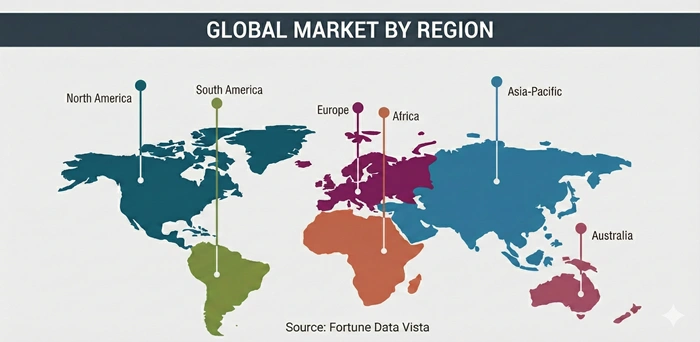
Asia Pacific holds approximately 46% of global online food delivery market revenue in 2025, a dominant position anchored by the extraordinary scale of China's food delivery ecosystem and the world's fastest-growing individual national market in India. China alone accounts for over one-third of global food delivery order volume, with Meituan's 700+ million annual active consumers and Ele.me's (Alibaba) extensive merchant network collectively processing billions of food delivery orders annually across China's tier-1, tier-2, and tier-3 cities. The region is projected to grow at a CAGR of approximately 12.3% from 2026 to 2033, driven by India's explosive Tier-2 city expansion (Swiggy and Zomato), Southeast Asia's rising middle class mobile adoption (Grab, Gojek, foodpanda), and the progressive market development of food delivery in Vietnam, Thailand, Philippines, and Indonesia — markets where food delivery penetration remains in early growth phases with vast room for expansion. Key regional players including Meituan, Ele.me, Swiggy, Zomato, Grab Food, and foodpanda collectively represent the world's most diverse and commercially sophisticated food delivery operator landscape, operating across the full range of market maturity from hyper-competitive urban China to frontier mobile delivery markets in South and Southeast Asia.
India is the most commercially compelling growth story within Asia Pacific's online food delivery market, combining a vast and rapidly urbanizing population with a cultural love of diverse cuisines, a rapidly expanding digital payment infrastructure, and aggressive restaurant ecosystem investment by Swiggy and Zomato that is dramatically expanding the supply side of the delivery market in cities and towns beyond the existing metro delivery footprint. Both Swiggy and Zomato are simultaneously expanding their restaurant delivery offerings and investing in grocery quick commerce (Swiggy Instamart and Blinkit — Zomato's acquisition) to capture India's vast grocery and convenience retail market opportunity — a diversification strategy that is transforming them from food delivery apps into comprehensive local commerce platforms. Japan and South Korea contribute significant per-capita revenue to the regional online food delivery total, with consumers in both markets demonstrating high food delivery order frequency, strong willingness to pay for premium cuisine and speed options, and sustained digital engagement with delivery platforms including Uber Eats Japan, Demaecan (Dokodemo), and Baemin (South Korea).
Latin America
Latin America Is the Fastest Growing Regional Market in the Global Online Food Delivery Industry — Driven by Explosive Smartphone Adoption, Rising Urban Middle-Class Incomes, and Super-App Platform Expansion Across Brazil, Mexico, and Colombia
iFood's Market Leadership in Brazil and Rappi's Pan-Regional Super-App Strategy Are Making Latin America One of the Most Commercially Exciting Emerging Regions in the Online Food Delivery Market
Latin America is the fastest growing regional market in the online food delivery market, with a projected CAGR of approximately 16.7% from 2026 to 2033, reflecting the region's combination of rapidly expanding urban middle-class populations, surging smartphone and mobile data adoption, and the progressive development of reliable digital payment infrastructure that makes cashless food ordering increasingly accessible to a growing share of the population. The region currently accounts for approximately 8% of global market revenue in 2025, a share that is growing rapidly as Brazil — Latin America's largest market — continues to demonstrate that food delivery adoption in emerging market urban centers can reach penetration levels approaching those of developed markets within a comparatively short time frame when the right platform investment and consumer education is in place. iFood dominates the Brazilian food delivery market with approximately 80% market share, making it one of the most dominant individual platform positions in any major national delivery market globally — a position built through consistent investment in restaurant partner quality, delivery reliability, and promotional loyalty programs that have deeply embedded the iFood habit across urban Brazilian consumer demographics. Key regional operators including Rappi (Colombia, Mexico, Brazil, Argentina), Uber Eats (Brazil, Mexico, Colombia), and PedidosYa (multiple South American markets) are competing across the full range of Latin American delivery markets with strategies combining restaurant meal delivery, grocery quick commerce, and financial services that reflect the super-app competitive model pioneered by Southeast Asian platforms.
Mexico is the most strategically important Latin American market outside Brazil for the online food delivery market's medium-term growth trajectory, with a large urban population, high smartphone penetration among younger demographics, and strong restaurant culture that creates both the consumer demand and supply-side infrastructure needed for food delivery scale. Uber Eats holds strong market positioning in Mexico given its broader Uber presence in the country's major cities, while Rappi and local competitors are investing aggressively in restaurant and grocery delivery expansion to capture market share in a rapidly growing digital food ordering audience. Argentina's food delivery market is growing through economic challenges, demonstrating the endurance of food delivery demand as a consumer priority even in inflationary environments — a finding that reinforces the structural resilience of the regional food delivery market and supports confident growth projections across the 2026–2033 forecast period.
Report Customization Available by Region and Country
Access Geography-Specific Online Food Delivery Market Intelligence Through Our Fully Customized Region-Wise and Country-Wise Report Options — Designed to Serve the Unique Platform Competitive Dynamics, Regulatory Environments, and Consumer Behavior Profiles of Every Major Global Market
This report is fully customizable by region and country, enabling food delivery platform operators, restaurant groups, investors, grocery retailers, cloud kitchen operators, logistics technology companies, and government agencies to access intelligence specifically tailored to the online food delivery market landscape of their target geographies. A customized report provides country-level market sizing, platform competitive share analysis, consumer behavior and ordering frequency data, regulatory environment assessment, restaurant partner ecosystem analysis, and strategic growth opportunity identification specific to each market.
Customized online food delivery market reports are available for all the regions and countries listed below, offering detailed market intelligence, competitive landscape analysis, consumer trend insights, platform revenue benchmarking, and growth opportunity mapping tailored to the specific online food delivery dynamics of each selected geography:
North America
-
U.S. — DoorDash, Uber Eats, and Instacart competitive share analysis, commission regulatory environment tracking, autonomous delivery commercialization timeline, subscription membership program benchmarking, and quick commerce market development
-
Canada — SkipTheDishes and Uber Eats competitive landscape, regional delivery market development across Toronto, Vancouver, and Montreal, grocery delivery integration, and regulatory environment for gig workers
-
Mexico — Uber Eats market leadership analysis, Rappi competitive positioning, mobile payment adoption impact, restaurant partner ecosystem development, and Tier-2 city market expansion opportunities
Europe
-
U.K. — Deliveroo and Uber Eats competitive dynamics, quick commerce market development (Getir, Gopuff), gig worker AB5-equivalent regulatory risk, and dark store planning permission challenges in major cities
-
Germany — Lieferando (Just Eat Takeaway) market dominance, Gorillas and quick commerce landscape, restaurant commission environment, and Delivery Hero competitive strategy analysis
-
France — Deliveroo and Uber Eats competitive dynamics, French quick commerce market development, restaurant platform commission regulation, and Paris super-dense urban delivery economics
-
Italy — Just Eat and Glovo competitive share analysis, Italian restaurant culture impact on delivery adoption, quick commerce market entry dynamics, and gig worker regulatory developments
-
Rest of Europe — Eastern Europe delivery market development, Nordic quick commerce competition, Benelux food delivery platform dynamics, and emerging market expansion opportunities
Asia Pacific
-
China — Meituan vs. Ele.me duopoly dynamics, autonomous delivery deployment, Meituan Select community group buying competitive analysis, and Chinese food delivery regulatory environment
-
India — Swiggy vs. Zomato competitive battle, Blinkit quick commerce trajectory, Tier-2/Tier-3 city expansion analysis, digital payment infrastructure impact, and cloud kitchen ecosystem development
-
Japan — Uber Eats Japan competitive positioning, Demaecan market development, consumer behavior for food delivery, and autonomous delivery regulatory pathway
-
South Korea — Baemin and Coupang Eats competitive dynamics, quick commerce development, Korean food delivery platform commission environment, and dark store network investment
-
Australia — Uber Eats and DoorDash competitive landscape, menu log positioning, delivery fee sensitivity analysis, suburban delivery market expansion, and grocery delivery growth
-
Rest of Asia Pacific — Southeast Asia super-app food delivery (Grab, Gojek), Vietnam and Thailand market development, Philippines delivery market growth, and Indonesia food delivery investment opportunity
Latin America
-
Brazil — iFood market dominance analysis, Rappi competitive positioning, grocery quick commerce development (iFood Mercado), digital payment infrastructure growth, and Tier-2 city expansion
-
Argentina — PedidosYa and Rappi competitive dynamics, economic environment impact on food delivery spending, and platform cost optimization strategies in high-inflation markets
-
Rest of Latin America — Colombia Rappi home market analysis, Chile food delivery development, Peru platform expansion, and pan-regional competitive consolidation trends
Middle East & Africa (MEA)
-
UAE — Deliveroo Middle East competitive positioning, Talabat (Delivery Hero) dominance, high-income consumer food delivery spending, and autonomous delivery pilot programs in Dubai
-
Saudi Arabia — Jahez market leadership, HungerStation competitive dynamics, Vision 2030 digital economy development impact on food delivery, and quick commerce investment opportunities
-
Rest of MEA — South Africa food delivery development, Egypt Elmenus and Talabat competitive dynamics, Nigeria food delivery market emergence, and Sub-Saharan Africa mobile money integration for food ordering
Top Key Players
-
DoorDash Inc. (United States)
-
Uber Eats (Uber Technologies, Inc.) (United States)
-
Meituan (China)
-
Delivery Hero SE (Germany)
-
Just Eat Takeaway.com N.V. (Netherlands)
-
Swiggy (India)
-
Zomato Ltd. (India)
-
Grab Holdings (GrabFood) (Singapore)
-
iFood (Brazil)
-
Rappi Inc. (Colombia)
-
Foodpanda (Delivery Hero) (Germany / Pan-Asia)
-
Deliveroo plc (United Kingdom)
Recent Developments
-
In 2025, DoorDash expanded its international operations with the acquisition of Deliveroo in a landmark deal valued at approximately USD 3.9 billion, combining DoorDash's North American operational scale and technology platform with Deliveroo's strong U.K. and Western European market presence — creating a combined entity with one of the largest and most geographically diversified food delivery networks outside of Asia, and significantly accelerating DoorDash's strategic ambition to become a global food delivery platform to rival Uber Eats in every major world market.
-
In 2025, Uber Eats deepened its grocery delivery partnerships, announcing expanded agreements with Costco, Albertsons, and Total Wine & More to offer same-hour delivery through the Uber Eats app — while simultaneously launching Uber One Membership in 25 additional international markets and crossing 30 million Uber One members globally, demonstrating the subscription model's power to increase order frequency and lock in high-value consumers across both the mobility and food delivery segments of its integrated platform.
-
In 2024, Meituan launched large-scale commercial deployment of its autonomous delivery vehicles — including low-altitude drone delivery and electric autonomous ground delivery robots — in Shenzhen and Shanghai, completing over 1 million autonomous deliveries in 2024 and establishing Meituan as the world leader in commercial-scale autonomous food delivery — a technological milestone that is progressively reducing Meituan's delivery cost per order and strengthening its competitive moat against Ele.me in China's duopoly food delivery market.
-
In 2025, Delivery Hero completed the full integration of Gorillas' quick commerce operations into its foodpanda and Talabat platforms across Europe and the Middle East, consolidating its dark store network to reduce operating losses while simultaneously relaunching the quick commerce service under unified brand identities — a strategic pivot toward profitability-focused quick commerce operations that reflected broader industry-wide rationalization of the over-invested quick commerce competitive landscape.
-
In 2024, Swiggy successfully completed its initial public offering on the Indian stock exchanges, raising approximately USD 1.35 billion in one of India's largest technology IPOs of the year — providing fresh capital to accelerate Swiggy Instamart dark store network expansion across Indian cities, invest in AI-driven delivery optimization, and expand restaurant partner acquisition into smaller Indian cities — cementing Swiggy's position as one of India's most strategically important technology companies competing in the online food delivery market.
Market Trends
The Super-App Evolution of Food Delivery Platforms and the Commercial Scaling of Autonomous Last-Mile Delivery Technology Are the Two Most Transformative Macro Trends Reshaping the Online Food Delivery Market Through 2033
From DoorDash's Deliveroo Acquisition to Meituan's Drone Delivery Fleet and Swiggy's IPO, the Online Food Delivery Market Is Entering a Phase of Strategic Consolidation and Technology-Led Operational Reinvention
The most significant business model trend in the online food delivery market is the progressive evolution of leading platforms from single-service food ordering apps into comprehensive local commerce and services super-apps that capture a dramatically larger share of consumers' daily digital wallet. Platforms including Grab, Gojek, Meituan, Rappi, and increasingly DoorDash are integrating grocery delivery, convenience store delivery, pharmacy delivery, financial services, ride-hailing, and in-store dining discovery into unified consumer applications where food delivery is the highest-frequency daily touchpoint and the gateway to deeper and more lucrative multi-service customer relationships. This super-app evolution increases average revenue per user, reduces customer acquisition cost by leveraging cross-service user growth, and creates competitive barriers that are significantly higher than those achievable through food delivery alone — making it one of the most commercially rational strategic directions available to food delivery platforms seeking long-term market leadership.
The commercialization of autonomous last-mile delivery technology — combining drone delivery for suburban residential areas, ground-based autonomous robots for urban dense areas, and AI-powered dark store fulfillment automation — is emerging as the most important operational transformation trend in the online food delivery market over the next seven years. The commercial deployment of drone delivery by Wing (Alphabet) in Australia and the United States, autonomous sidewalk robots by Starship Technologies across 100+ U.S. campuses and European cities, and Meituan's large-scale drone delivery network in China are collectively proving that autonomous delivery can achieve the reliability, safety, and consumer experience standards necessary for commercial operation at scale. As regulatory frameworks for autonomous delivery mature and hardware costs decline through volume production, the economic case for transitioning a meaningful share of last-mile food deliveries to autonomous systems within the 2033 forecast horizon becomes increasingly compelling — and the platforms that invest early in autonomous delivery capabilities will gain cost structure advantages that compound progressively over the full forecast period.
Segments Covered in the Report
-
By Platform Type
-
Mobile Applications (iOS and Android)
-
Websites and Desktop Platforms
-
-
By Business Model
-
Order-Focused / Aggregator Model (Restaurant Self-Delivery)
-
Logistics-Focused / Integrated Delivery Model (Platform-Managed Delivery Fleet)
-
Full-Stack / Vertically Integrated Model (Platform-Owned Kitchen and Delivery)
-
-
By Payment Method
-
Online Payment (Credit/Debit Cards, Digital Wallets, UPI, BNPL)
-
Cash on Delivery
-
-
By Cuisine Type
-
Fast Food and Quick Service Restaurant (QSR)
-
Full-Service and Casual Dining Restaurants
-
Cafes and Bakeries
-
Healthy, Organic, and Diet-Specific Cuisine
-
Others (Ethnic Cuisine, Desserts, Late-Night Specialty)
-
-
By Order Type
-
Restaurant Meal Delivery
-
Grocery and Fresh Produce Delivery
-
Quick Commerce and Convenience Store Delivery (10–30 Min)
-
Alcohol Delivery
-
Pharmacy and Others
-
-
By End User
-
Individual and Household Consumers
-
Corporate and Office Delivery (B2B Catering)
-
Others (Events, Institutional Catering)
-
-
By Region
-
North America (U.S., Canada, Mexico)
-
Europe (U.K., Germany, France, Italy, Rest of Europe)
-
Asia Pacific (China, India, Japan, South Korea, Australia, Rest of Asia Pacific)
-
Latin America (Brazil, Argentina, Rest of Latin America)
-
Middle East & Africa (UAE, Saudi Arabia, Rest of MEA)
-
❝ Built for Every Level — From Startups to Industry Giants ❞
Here Is Exactly How This Report Works for You
-
For Tier 1 food delivery platform operators, global restaurant chains, institutional investors, and private equity firms managing food technology portfolios, this report delivers a granular competitive revenue analysis — including platform-by-platform market share breakdown by region and order type, commission structure benchmarking, delivery cost per order comparison, subscriber monetization metrics, and a detailed assessment of how geopolitical factors including gig worker regulation in Europe, commission caps in U.S. cities, cross-border data localization requirements, and government subsidized domestic platform support in China and India are reshaping competitive positioning and capital allocation decisions across the global online food delivery market through 2033.
-
For Tier 2 and Tier 3 restaurant operators, cloud kitchen entrepreneurs, food delivery technology startups, and regional delivery platform operators, the supply-demand dynamics section maps platform-specific restaurant partnership economics, commission rate trends by geography, dark store investment thresholds for profitable quick commerce, and the emerging technology integration opportunities — including AI menu optimization, real-time inventory management, and loyalty program API integrations — that represent the highest-return growth investments available to mid-market food industry companies seeking to grow their online food delivery revenue without platform dependency.
-
For startups developing autonomous delivery technology, ghost kitchen management platforms, or food delivery analytics solutions, as well as venture capital and corporate venture investors evaluating food technology investment opportunities, this report provides a detailed technology adoption timeline, competitive patent landscape analysis, platform partnership pathway mapping, and identification of the geographic markets and application segments where the online food delivery market's exceptional growth trajectory is creating the most accessible and highest-return commercial entry points through 2033.
Frequently Asked Questions:
Answer: The global online food delivery market was valued at USD 334.90 billion in 2025 and is projected to reach approximately USD 803.67 billion by 2033. The market is expected to grow at a CAGR of 11.8% from 2026 to 2033, driven by smartphone adoption in emerging markets, expansion into grocery and quick commerce delivery, and the progressive commercialization of autonomous delivery technology.
Answer: Asia Pacific dominates the global online food delivery market, holding approximately 46% of total revenue in 2025, anchored by China's Meituan and Ele.me and India's rapidly growing Swiggy and Zomato platforms. Latin America is the fastest growing regional market, expanding at a CAGR of approximately 16.7% from 2026 to 2033, led by iFood in Brazil and Rappi across multiple South American markets.
Answer: The most significant challenge in the online food delivery market is the high cost of last-mile delivery, which makes it difficult for platforms to achieve consistent profitability despite large revenue volumes, particularly in high labor cost markets in North America and Europe. Restaurant commission tensions, gig worker regulatory reclassification risks in Europe, and intense platform competition that limits fee increases are additional structural constraints affecting platform economics across the industry.
Answer: Quick commerce — the delivery of grocery and convenience items in 10–30 minutes through urban dark store networks — is the fastest growing order type segment in the online food delivery market, projected to reach a market share exceeding 30% by 2033 and grow at a CAGR of approximately 19.2%. Leading food delivery platforms including DoorDash, Uber Eats, Swiggy, and Meituan are investing heavily in dark store infrastructure and quick commerce capabilities to capture this enormous opportunity, which represents a total addressable market several times larger than the restaurant meal delivery segment.
Answer: The global online food delivery market is led by DoorDash (dominant in North America), Meituan (dominant in China), Uber Eats (strong across North America, Europe, and Asia Pacific), Delivery Hero / Talabat (leading in Europe and Middle East), Swiggy and Zomato (leading in India), and iFood (dominant in Brazil). These platforms collectively account for the vast majority of global food delivery order volume and revenue, with competitive dynamics varying significantly across regions based on market maturity, regulatory environment, and consumer behavior patterns.