
Online Gaming Market Overview
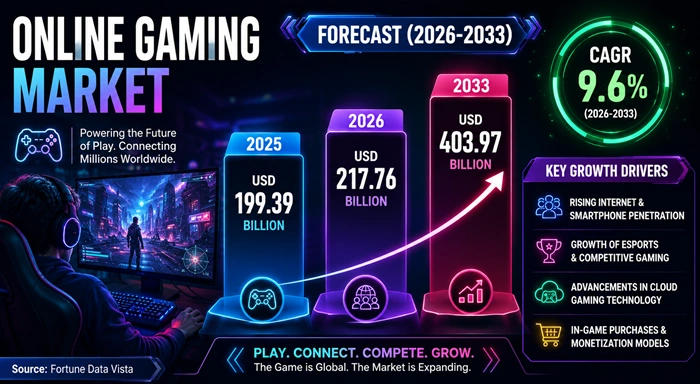
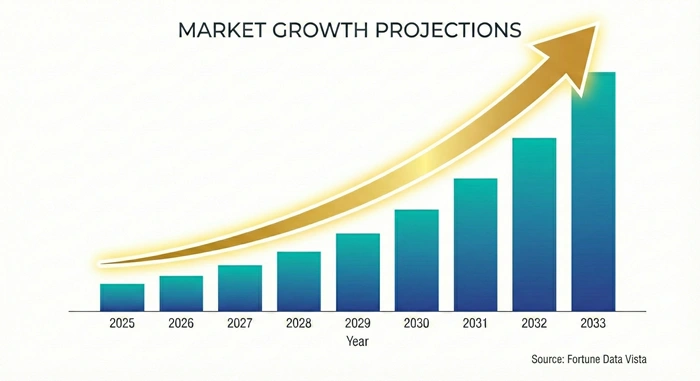
The global online gaming market size is valued at USD 199.39 billion in 2025 and is predicted to increase from USD 217.76 billion in 2026 to approximately USD 403.97 billion by 2033, growing at a CAGR of 9.6% from 2026 to 2033.
Digital entertainment has undergone a generational transformation, and at the heart of that transformation is online gaming — an industry that has grown from a niche hobby into one of the world's largest and most culturally influential entertainment sectors. The convergence of 5G connectivity, cloud computing, smartphones, and social media has expanded the global player base to billions of users spanning every age group, income level, and geography. As game developers, technology companies, and media conglomerates accelerate their investment in interactive entertainment, the online gaming industry is poised for sustained double-digit expansion that will nearly double its value through 2033.
AI Impact on the Online Gaming Industry
Artificial Intelligence Is Reshaping Online Gaming from Content Creation and Player Personalization to Anti-Cheat Systems and Procedural World Building — Creating More Immersive, Dynamic, and Commercially Powerful Gaming Experiences
Artificial intelligence is fundamentally changing what is possible in online gaming, enabling developers to create richer, more responsive, and more personalized gaming experiences than ever before. AI-driven procedural content generation allows game engines to create virtually unlimited levels, environments, storylines, and character behaviors dynamically — reducing development costs while dramatically expanding the content available to players. Recommendation engines powered by machine learning analyze individual player behavior to surface the content, modes, and in-game offers most likely to resonate with each user, improving both engagement duration and monetization conversion rates. Companies including Tencent, Activision Blizzard, and Electronic Arts are deploying AI across their gaming platforms to optimize game balance, personalize progression systems, and deliver targeted in-game advertising that feels relevant rather than intrusive.
On the player experience side, AI-powered non-player character (NPC) behavior systems are creating opponents and allies that feel genuinely intelligent rather than scripted — responding dynamically to player tactics, adapting difficulty in real time, and generating conversational interactions that make open-world gaming environments feel alive. AI is also playing a critical role in combating cheating in competitive online gaming, with real-time behavioral analysis systems detecting aim-assist hacks, wall hacks, and botting programs with far greater precision and speed than traditional signature-based detection methods. For esports and competitive gaming platforms, AI-driven analytics tools are helping teams analyze opponents, optimize strategies, and evaluate player performance at the level of granularity previously available only to elite sports organizations. These capabilities are collectively raising the quality bar of the entire online gaming market and creating sustainable competitive advantages for the platforms and developers who invest most aggressively in AI infrastructure.
Growth Factors
Smartphone and 5G Penetration Across Emerging Markets, the Explosive Rise of Esports and Streaming Culture, and the Growing Mainstream Acceptance of Cloud Gaming Are the Primary Forces Driving Online Gaming Market Expansion
The global proliferation of affordable smartphones and expanding mobile broadband coverage is the most powerful structural driver of online gaming growth worldwide. Mobile gaming now represents the largest platform segment by both user count and revenue, because smartphones eliminate every barrier that traditionally limited gaming — no dedicated hardware purchase, no physical game store, no fixed location requirement. In emerging markets across Southeast Asia, India, Latin America, and Africa, mobile online gaming is frequently the first and only gaming platform experience for hundreds of millions of new players, creating enormous new audience pools for games including Free Fire, PUBG Mobile, Call of Duty Mobile, and Candy Crush that are designed specifically for mobile-first consumption. The rollout of 5G networks globally is extending mobile gaming's advantages further by dramatically reducing latency in real-time multiplayer games and enabling cloud gaming streaming on mobile devices at quality levels previously achievable only on fiber-connected PCs or gaming consoles.
The rise of esports as a professional sport and mainstream entertainment spectacle is adding a cultural momentum driver to the online gaming market that extends well beyond the competitive players themselves. Global esports viewership has grown to hundreds of millions of viewers annually across platforms including Twitch, YouTube Gaming, and dedicated esports streaming services — and the majority of esports spectators are also active online gamers whose engagement with esports content deepens their attachment to specific game franchises and platforms. This virtuous cycle between esports, game streaming content creation, and active gaming participation is creating a content ecosystem that functions as both entertainment product and the world's most effective game marketing channel simultaneously. Publishers including Riot Games (Valorant, League of Legends), Activision Blizzard (Call of Duty, Overwatch League), and Epic Games (Fortnite) have built business models that leverage this esports-streaming-gaming flywheel to sustain player engagement and monetization across multi-year game lifecycles.
Market Outlook
The Online Gaming Market Is Entering a New Phase of Convergence — Where Gaming, Social Media, Virtual Worlds, and Digital Commerce Blend Into an Integrated Interactive Entertainment Ecosystem That Will Define the Next Generation of Digital Human Interaction
The medium-to-long-term outlook for the online gaming market is strongly positive and structurally differentiated from traditional entertainment sectors, because gaming increasingly functions as a social platform, a cultural identity, and a digital economy — not merely a leisure activity. The concept of the "metaverse" — persistent, interconnected virtual worlds where players socialize, create, compete, and conduct commerce — may be in its early commercial stages today, but the behavioral foundations for its adoption already exist in the daily habits of hundreds of millions of gamers worldwide who spend significant portions of their leisure time in shared virtual spaces. Platforms including Roblox, Fortnite, and Minecraft are already generating billions of dollars in digital goods transactions annually and functioning as genuine virtual social hubs, providing a clear commercial proof of concept for the immersive, economy-embedded gaming platforms that will dominate the online gaming market's growth through 2033 and beyond.
Cloud gaming is the technology trend most likely to structurally expand the addressable market for premium online gaming over the next seven years, by eliminating the hardware barrier that currently prevents consumers without gaming PCs or current-generation consoles from accessing the highest-quality gaming experiences. Services including Xbox Cloud Gaming (Microsoft), PlayStation Now (Sony), and NVIDIA GeForce Now are already commercially deployed, and as 5G and fiber broadband coverage expands globally, the technical quality threshold that cloud gaming can reliably deliver will progressively improve to the point where streaming games becomes indistinguishable from locally processed gameplay for the vast majority of users. When that threshold is broadly reached — likely within the forecast horizon — it will effectively convert every smartphone, smart TV, and browser-capable device into a capable gaming platform, potentially adding hundreds of millions of new premium gaming audience members to the global online gaming market.
Expert Speaks
-
"At Microsoft, gaming is one of our most strategically important and fastest-growing businesses, and Game Pass combined with our cloud gaming infrastructure is fundamentally changing how people access and experience games. The shift from game ownership to game subscription — across console, PC, and mobile via the cloud — is a structural transformation that we believe will define the next decade of the gaming industry, and our investments in both first-party content and cloud infrastructure are designed to lead that transformation." — Satya Nadella, CEO, Microsoft Corporation
-
"Sony's PlayStation ecosystem remains at the forefront of interactive entertainment, and our investment in PlayStation Studios, live service gaming experiences, and PlayStation Network social features reflects our conviction that the future of gaming is community-driven, always-connected, and increasingly cinematic in its storytelling ambition. The commercial and cultural momentum we are seeing across our gaming portfolio confirms that premium interactive entertainment is one of the most resilient and high-growth segments of the global digital economy." — Kenichiro Yoshida, Chairman, President & CEO, Sony Group Corporation
-
"Tencent's gaming business spans mobile, PC, and console platforms across both domestic Chinese and international markets, and our investments in game studios globally — from Riot Games to Supercell to Epic Games — reflect our conviction that the online gaming market's best growth decade is still ahead. The combination of growing middle-class disposable income in emerging markets, the expansion of esports culture globally, and the progressive adoption of AI-enhanced gaming experiences is creating a multi-dimensional growth environment that we are extremely well-positioned to benefit from." — Pony Ma (Ma Huateng), CEO, Tencent Holdings
Key Report Takeaways
-
Asia Pacific dominates the global online gaming market, holding the largest regional revenue share of approximately 50% in 2025, driven by China's world-leading mobile gaming ecosystem (Tencent, NetEase), Japan's console and mobile gaming culture, South Korea's esports powerhouse status, and the enormous and rapidly growing gaming populations in India and Southeast Asia whose adoption of mobile-first gaming is creating the single largest incremental demand growth region for online gaming globally.
-
North America is the fastest growing developed market region, with the United States driving above-average revenue growth through the rapid adoption of cloud gaming subscription services, sustained esports viewership and participation growth, and the progressive monetization of mobile gaming among demographic groups — including adults over 35 — who are increasingly active online gaming participants driving incremental in-app purchase and subscription revenue across major mobile and console gaming platforms.
-
Mobile gaming is the largest and most strategically significant platform segment in the online gaming market, commanding approximately 55% of total market revenue in 2025 as smartphones have democratized access to online gaming across every demographic and geographic market — with mobile gaming's combination of free-to-play accessibility, social connectivity, and always-available entertainment making it the primary point of entry for the majority of the world's active online gaming audience.
-
In-app purchases and microtransactions are the dominant revenue model, representing approximately 42% of total market revenue in 2025 as the free-to-play business model — in which games are free to download and play but generate revenue through optional cosmetic items, battle passes, loot boxes, and in-game currency purchases — has become the dominant commercial architecture across mobile, PC, and increasingly console online gaming platforms globally.
-
Battle Royale games are the fastest growing gaming type segment, projected to reach a market share exceeding 18% by 2033 and grow at a CAGR of approximately 13.7%, driven by the genre's exceptional streaming and spectator entertainment value, its accessible entry mechanics that appeal to both casual and hardcore players, and the sustained global popularity of franchises including Fortnite, PUBG, Apex Legends, and Free Fire that continue to attract massive active player communities.
-
The esports and professional gaming segment is set to be the most commercially dynamic growth area, expected to achieve significant market share expansion by 2033 as brand sponsorship investment, media rights deals, team franchising valuations, and player salary growth all accelerate — creating an ecosystem around competitive online gaming that increasingly mirrors the commercial architecture of traditional professional sports leagues.
Market Scope
| Parameter | Details |
|---|---|
| Market Size by 2033 | USD 403.97 Billion | Market Size by 2026 | USD 217.76 Billion | Market Size by 2025 | USD 199.39 Billion | Market Growth Rate from 2026 to 2033 | CAGR of 9.6% | Dominating Region | Asia Pacific | Fastest Growing Region | North America | Segments Covered | Gaming Type, Platform, Gamer Type, Revenue Model, End User | Regions Covered | North America, Europe, Asia Pacific, Latin America, Middle East & Africa |
Market Dynamics
Drivers Impact Analysis
Smartphone Ubiquity, Expanding Broadband and 5G Coverage, and the Cultural Mainstreaming of Gaming Across Demographics Are Collectively Creating the Most Favorable Demand Environment in the History of the Online Gaming Market
| Driver | ≈ % Impact on CAGR Forecast | Geographic Relevance | Impact Timeline |
|---|---|---|---|
| Smartphone penetration and mobile gaming adoption in emerging markets | ~36% | Asia Pacific, Latin America, MEA, India | Short to Long Term |
| 5G network rollout improving mobile gaming latency and quality | ~26% | Global — especially urban markets in Asia, North America, Europe | Short to Medium Term |
| Esports growth and gaming streaming culture driving engagement | ~22% | North America, Europe, Asia Pacific | Short to Long Term |
| Cloud gaming subscription service adoption eliminating hardware barriers | ~16% | North America, Europe, advanced Asia Pacific | Medium to Long Term |
The combination of falling smartphone prices and expanding mobile data infrastructure is creating entirely new gaming populations in markets where console and PC gaming have historically been inaccessible due to cost barriers. In India alone, the active mobile gaming population has grown to over 500 million players — a figure larger than the entire combined gaming population of North America and Europe — representing an enormous commercial opportunity for game developers who can design compelling experiences optimized for the specific hardware, connectivity, and payment infrastructure characteristics of emerging market mobile players. This structural demographic expansion of the global gaming audience is one of the most powerful and durable demand drivers in the online gaming market, creating a growing base of active gamers whose in-game spending propensity increases steadily as disposable incomes rise and digital payment infrastructure matures.
The esports and gaming content creator ecosystem is generating an entirely new monetization and audience development channel for game publishers that functions as a perpetual marketing engine. Top gaming streamers on Twitch and YouTube Gaming attract tens of millions of followers and generate hundreds of millions of hours of video consumption annually for their featured game titles — driving player acquisition, retention, and in-game spending through the authentic, peer-to-peer influence mechanism that is the most effective form of marketing in gaming. Publishers are increasingly designing games with streaming and spectator entertainment value as a first-class design objective — building in spectator modes, replay systems, and highlight generation tools that make their games more compelling to watch as well as play — creating a virtuous cycle between active gaming, spectator entertainment, and commercial revenue that strengthens the long-term value of major gaming franchises.
Restraints Impact Analysis
Gaming Addiction Concerns and Regulatory Intervention, Data Privacy and Security Risks, and Increasing Market Saturation in Core Demographics Are the Primary Constraints on Faster Online Gaming Market Expansion
| Restraint | ≈ % Impact on CAGR Forecast | Geographic Relevance | Impact Timeline |
|---|---|---|---|
| Government regulation of gaming addiction, loot boxes, and youth gaming time limits | ~38% | China, South Korea, Europe, India | Short to Medium Term |
| Data privacy regulations and cybersecurity risks for gaming platforms | ~32% | Global — especially Europe, North America | Short to Medium Term |
| Market saturation and rising user acquisition costs in mature gaming markets | ~30% | North America, Europe, advanced Asia Pacific | Medium to Long Term |
Government regulation of gaming addiction and youth gaming time limits — particularly in China, where gaming time restrictions for players under 18 have been strictly enforced since 2021 — represents a direct constraint on player base growth and monetization in the world's largest gaming market. China's gaming regulatory environment requires domestic game publishers to obtain approvals for all game titles before commercial release, a process that creates significant revenue delay risk and development uncertainty for both domestic and international developers seeking to operate in the Chinese market. European and other Asian regulators are also increasingly scrutinizing the loot box mechanics and in-app purchase systems that drive a disproportionate share of online gaming monetization, with loot box regulation already enacted in Belgium and the Netherlands and under active consideration in multiple other jurisdictions — creating revenue model risk for publishers heavily dependent on randomized reward monetization.
The online gaming industry's aggregation of vast amounts of personal, behavioral, and financial data about its players creates significant cybersecurity exposure and regulatory compliance obligations under data protection frameworks including GDPR in Europe and COPPA in the United States. Major gaming platform breaches — including the Sony PlayStation Network hack of 2011 and subsequent data theft incidents at Zynga, Electronic Arts, and Activision — have demonstrated the industry's vulnerability to cyberattacks that can expose millions of players' personal and payment data. As gaming platforms become increasingly integrated with real-money transactions for in-game purchases, esports wagering, and NFT-based digital asset trading, the financial security and fraud prevention requirements placed on gaming operators are intensifying — increasing compliance costs and creating potential liability exposure that limits profit margins and accelerates platform consolidation toward the largest, most resource-rich operators who can afford robust cybersecurity infrastructure.
Opportunities Impact Analysis
Cloud Gaming and Subscription Models, the Metaverse and Virtual World Commerce, and the Monetization of the Creator Economy Within Gaming Are the Most Transformative Commercial Opportunities in the Online Gaming Market
| Opportunity | ≈ % Impact on CAGR Forecast | Geographic Relevance | Impact Timeline |
|---|---|---|---|
| Cloud gaming subscription service growth and hardware barrier elimination | ~38% | North America, Europe, emerging Asia Pacific | Medium to Long Term |
| Metaverse and virtual world in-game economy development | ~34% | Global — especially North America, Asia Pacific | Long Term |
| Gaming creator economy monetization and UGC platform development | ~28% | Global — especially North America, Europe, Asia Pacific | Short to Long Term |
Cloud gaming represents the most structurally transformative commercial opportunity for the online gaming market over the forecast horizon, because it has the potential to expand the total addressable market for premium gaming experiences to every device with a screen and an internet connection — eliminating the $300–$700 hardware investment that currently gates access to console and high-end PC gaming. Microsoft's Xbox Cloud Gaming, Sony's PlayStation streaming services, and NVIDIA's GeForce Now are investing heavily in data center infrastructure, game licensing, and network optimization to build commercially viable cloud gaming experiences that can be reliably delivered over 5G and broadband connections. As these services mature and their catalogs expand, they create compelling subscription revenue models that generate predictable recurring income for platform operators — improving financial visibility and investor confidence compared to the volatile, hit-driven economics of traditional premium game sales.
The in-game creator economy — where players design, build, and sell virtual items, worlds, and experiences within platforms including Roblox, Fortnite, Minecraft, and increasingly metaverse-oriented platforms — represents a genuinely novel commercial model that is already generating billions of dollars in real economic activity and creating entirely new categories of digital entrepreneur. Roblox's developer exchange program pays creators hundreds of millions of dollars annually for the experiences they build within the platform. Fortnite's creator economy enables map designers and content creators to share in the revenue generated by their maps. These user-generated content ecosystems simultaneously reduce the development cost of maintaining platform engagement, increase the diversity and quality of available experiences for players, and create deep community investment in the platform's success — making them one of the most powerful and sustainable engagement and monetization models in the entire online gaming market.
Segment Analysis
By Platform
Mobile Devices Dominate the Online Gaming Market by Player Count and Revenue While Cloud Gaming Platforms Are Delivering the Fastest Revenue Growth as Subscription Models Gain Commercial Traction
Mobile gaming is the undisputed dominant platform in the online gaming market, capturing approximately 55% of total revenue in 2025 and growing at a CAGR of approximately 10.2% through 2033. The segment's dominance is built on the combination of near-universal smartphone penetration, the free-to-play accessibility of the most popular mobile games, and the deeply social, short-session gameplay formats that align naturally with mobile consumption patterns across both developing and developed markets. Asia Pacific leads mobile gaming by an enormous margin, accounting for the majority of both global mobile gaming revenue and active player count, with China (through Tencent and NetEase), South Korea, Japan, and India being the highest-volume mobile gaming markets by distinct metrics. Key companies competing for mobile gaming leadership include Tencent (PUBG Mobile, Honor of Kings), NetEase (Knives Out, Identity V), Supercell (Clash of Clans, Brawl Stars), Activision (Call of Duty Mobile), and Garena (Free Fire) — all of which have built multi-hundred-million active user communities on mobile platforms and generate the majority of their revenue through in-app purchases and battle pass subscriptions.
Consoles represent approximately 20% of total online gaming market revenue in 2025 and are growing at a CAGR of approximately 9.8% through 2033, driven by the strong installed base of PlayStation 5 and Xbox Series X/S combined with the platform-exclusive gaming content strategies of Sony and Microsoft that maintain console gaming's appeal as the premium home gaming experience. North America and Europe lead console online gaming adoption, where living room gaming culture and the premium entertainment value of AAA console titles sustain strong engagement and per-player monetization metrics. The integration of online multiplayer services — including PlayStation Network and Xbox Live — has made internet connectivity a standard feature of the console gaming experience, and the progressive expansion of console cloud gaming capabilities is extending the platform's reach beyond the living room to mobile devices and smart TVs, broadening the accessible audience for console-quality gaming experiences within the overall online gaming market.
By Revenue Model
In-App Purchases and Microtransactions Dominate Online Gaming Monetization While Gaming Subscription Services Are the Fastest Growing Revenue Model
In-app purchases and microtransactions are the dominant revenue model in the online gaming market, contributing approximately 42% of total revenue in 2025 and growing at a CAGR of approximately 10.8% through 2033 as the free-to-play business architecture — in which games are free to access but generate revenue through optional cosmetic items, character skins, weapon unlocks, and season passes — has become the universal commercial standard across mobile, PC, and increasingly console gaming platforms. The model's dominance reflects its commercial superiority over traditional premium game sales: free-to-play games can acquire vastly larger user bases than paid titles, and even a small percentage of paying players in a large user base can generate revenue far exceeding what a smaller audience of paying buyers would produce at a fixed purchase price. Asia Pacific leads in-app purchase revenue generation globally, with Chinese and Southeast Asian mobile gaming markets demonstrating particularly high conversion rates from free player to paying player and high lifetime monetization per paying user. Key companies leading in-app purchase-driven revenue generation include Tencent, NetEase, Activision Blizzard (via King and mobile titles), Electronic Arts (FIFA Mobile, The Sims Mobile), and Supercell.
Gaming subscription services — including Microsoft's Xbox Game Pass, Sony's PlayStation Plus, Apple Arcade, and Google Play Pass — represent approximately 14% of total online gaming market revenue in 2025 but are the fastest growing revenue model, with a CAGR of approximately 15.3% through 2033 as consumers progressively adopt subscription gaming as a complement or alternative to individual game purchases. North America and Europe lead subscription gaming adoption, where the subscription economy is well-established across music (Spotify), video (Netflix), and software (Microsoft 365) — making consumers psychologically primed for subscription-based game access models. Microsoft's Xbox Game Pass Ultimate, which provides access to a library of over 400 games across console, PC, and cloud for a monthly fee, has been the most commercially successful subscription gaming service globally and has demonstrated the model's ability to drive both hardware sales and engagement duration metrics significantly above those of non-subscriber gamers.
Regional Insights
Asia Pacific
Asia Pacific Dominates the Global Online Gaming Market with Unmatched Player Scale, Revenue Volume, and the World's Most Commercially Mature Mobile Gaming Ecosystem — Making It the Central Gravity of the Global Gaming Industry
China's Tencent-Led Mobile and PC Gaming Ecosystem, South Korea's Esports Culture, and India's Explosive Mobile Gaming Growth Make Asia Pacific the Single Most Consequential Region in the Online Gaming Market
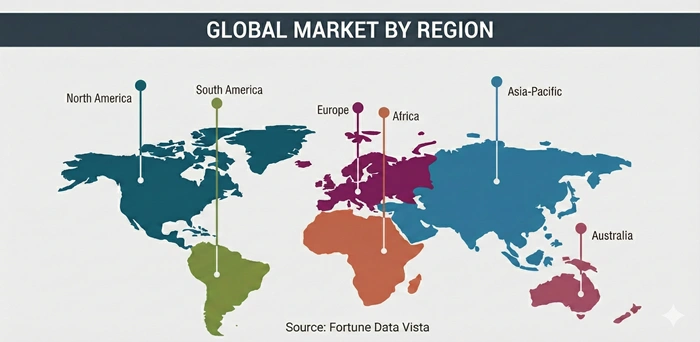
Asia Pacific holds approximately 50% of global online gaming market revenue in 2025, a dominant position reflecting the region's combination of enormous population scale, high gaming cultural engagement, and mature mobile gaming commercial ecosystems in China, Japan, South Korea, and increasingly India and Southeast Asia. China is the world's largest individual online gaming market, generating more gaming revenue than any other country, with Tencent and NetEase collectively controlling the majority of domestic gaming distribution and monetization through platforms including WeGame, QQ Games, and mobile-first titles that have achieved player bases measured in hundreds of millions of active users. The region is projected to grow at a CAGR of approximately 9.8% from 2026 to 2033, sustained by India's explosive gaming audience growth, Southeast Asia's expanding middle class mobile gaming adoption, and South Korea and Japan's sustained investment in premium gaming content and esports infrastructure. Key regional players including Tencent, NetEase, Nexon, Bandai Namco, and NCSoft dominate the competitive landscape alongside global platforms that invest heavily in Asia Pacific market localization and partnership strategies.
South Korea stands out within Asia Pacific as the world's most advanced esports ecosystem, with professional gaming leagues, dedicated esports venues, and esports education programs deeply embedded in the country's cultural fabric — generating an outsized global influence on competitive gaming culture that extends far beyond South Korea's domestic market size. Japan's gaming industry combines world-class console game development (Nintendo, Sony Interactive Entertainment, Capcom, Square Enix) with a large and growing mobile gaming market, contributing a distinctive creative heritage and loyal global consumer base. India's online gaming market is growing faster than any other major country in the region, driven by the JIO mobile data revolution that brought affordable internet to hundreds of millions of Indians, creating one of the world's most rapidly growing mobile gaming audiences with an estimated 500+ million active mobile players — a market that global gaming companies from Activision to Garena to Krafton are investing aggressively to capture.
North America
North America Is the Highest Revenue Per User Region in the Global Online Gaming Market and the World's Leading Market for Esports, Streaming, and Premium Cloud Gaming Subscription Services
The United States Is the World's Single Largest Premium Gaming Spending Market, with Unmatched Average Revenue Per User Metrics Driven by Strong Console Gaming Culture and High Digital Entertainment Spending Propensity
North America holds approximately 23% of global online gaming market revenue in 2025 — the second largest regional share — and is distinguished from other regions by its exceptionally high average revenue per gaming user, driven by strong consumer disposable income, high propensity to spend on in-game purchases and gaming subscriptions, and a deeply embedded gaming culture that spans multiple generations. The United States is the world's most valuable per-capita gaming market, generating disproportionate revenue relative to its player count through high adoption rates for premium game purchases, in-game spending, and gaming subscription services including Xbox Game Pass and PlayStation Plus. North America is projected to grow at a CAGR of approximately 10.4% from 2026 to 2033, above the global average, as cloud gaming adoption expands the addressable market and mobile gaming achieves greater monetization among older demographic groups whose income levels support higher in-game spending. Dominant regional players including Microsoft (Xbox), Activision Blizzard, Electronic Arts, Epic Games, and Riot Games generate the majority of their revenue from North American consumers while leveraging their globally distributed player bases for esports and streaming audience development.
Canada contributes a meaningful share of North American gaming revenue and is home to a significant game development industry — with major studios in Montreal, Toronto, and Vancouver creating games for global publishers including Ubisoft, EA, and Warner Bros. Games — generating both consumer demand and supply-side economic contribution to the regional gaming ecosystem. The United States' esports industry is the world's most commercially developed, with established league structures for titles including League of Legends (LCS), Call of Duty League, Overwatch League, and Valorant Champions Tour generating significant brand sponsorship, media rights, and event ticket revenues. Mexico's online gaming market is growing rapidly, driven by expanding smartphone adoption among a young population and increasing access to mobile data plans that make mobile online gaming the entry-level entertainment choice for tens of millions of Mexican consumers who represent a significant and underdeveloped revenue opportunity for mobile game publishers targeting the Latin American market.
Report Customization Available by Region and Country
Unlock Deep-Dive, Geography-Specific Online Gaming Market Intelligence Through Our Fully Customized Region-Wise and Country-Wise Report Options — Designed to Support Your Specific Market Entry, Investment, and Business Development Objectives
This report is available for complete customization across all major global regions and individual countries, providing game developers, gaming platform operators, esports organizations, streaming technology companies, digital media investors, and government policy analysts with geography-specific market intelligence tailored precisely to the online gaming landscape of their target markets. A customized report delivers country-level player base sizing, platform adoption and revenue model analysis, regulatory environment assessment, competitive landscape mapping, and strategic growth opportunity identification specific to the online gaming market dynamics of the selected geography.
Customized online gaming market reports are available for all of the following regions and countries, offering detailed market analysis, competitive intelligence, platform trends, monetization insights, and growth opportunities tailored to each specific geography:
North America
-
U.S. — World's highest ARPU gaming market analysis, Xbox and PlayStation ecosystem competitive dynamics, esports league commercial infrastructure, cloud gaming subscription adoption, and key player revenue benchmarking for Microsoft, Activision Blizzard, EA, Epic Games, and Riot Games
-
Canada — Game development studio ecosystem analysis, consumer gaming spending trends, French-Canadian market localization dynamics, and Ubisoft and EA Canada competitive profiles
-
Mexico — Mobile gaming adoption growth, free-to-play monetization penetration, platform preference analysis, and Latin American market expansion entry strategy implications
Europe
-
U.K. — Europe's largest individual gaming market, console gaming leadership, esports investment ecosystem, game development industry analysis, and regulatory developments including loot box regulation and GDPR compliance
-
Germany — Consumer gaming spending analysis, PC gaming cultural leadership, esports viewership demographics, and regulatory environment impact on gaming platform operations
-
France — Ubisoft home market analysis, console and mobile gaming balance, esports industry development, and French-language gaming content market
-
Italy — Mobile gaming growth, console gaming penetration, youth gaming demographics, and platform monetization trends
-
Rest of Europe — Eastern Europe gaming audience growth, Nordic esports leadership, Benelux loot box regulation impact, and pan-European cloud gaming service adoption
Asia Pacific
-
China — World's largest gaming market, Tencent and NetEase competitive dominance, government regulation impact analysis, domestic gaming approval process dynamics, and mobile vs. PC gaming balance
-
India — 500 million+ mobile gamer population analysis, free-to-play monetization development, esports growth trajectory, and foreign gaming company market entry strategy
-
Japan — Console gaming culture, mobile gaming monetization patterns, Nintendo and Sony competitive positioning, and gacha game mechanics regulatory developments
-
South Korea — World's most advanced esports ecosystem, PC café gaming culture, mobile gaming growth, and Nexon, Netmarble, and Krafton competitive analysis
-
Australia — Gaming regulation environment, console and mobile gaming balance, esports industry development, and cloud gaming adoption trajectory
-
Rest of Asia Pacific — Southeast Asia mobile gaming boom, Vietnam and Thailand gaming market growth, and regional free-to-play monetization dynamics
Latin America
-
Brazil — Latin America's largest gaming market, mobile gaming dominance, esports audience growth, digital payment infrastructure development, and free-to-play game performance analysis
-
Argentina — Economic environment impact on gaming spending, mobile gaming affordability dynamics, and gaming market growth opportunity assessment
-
Rest of Latin America — Colombia, Chile, Peru mobile gaming adoption, regional esports development, and platform localization opportunity analysis
Middle East & Africa (MEA)
-
UAE — Premium gaming adoption, esports investment and infrastructure, gaming tournament ecosystem, and cloud gaming service penetration
-
Saudi Arabia — Savvy Games Group investment program impact, esports World Cup ecosystem, gaming platform adoption, and government support for gaming industry development
-
Rest of MEA — South Africa gaming market leadership, Egypt mobile gaming growth, Sub-Saharan Africa emerging gaming audience development, and regional investment opportunity mapping
Top Key Players
-
Tencent Holdings Ltd. (China)
-
Sony Group Corporation (PlayStation) (Japan)
-
Microsoft Corporation (Xbox) (United States)
-
Activision Blizzard, Inc. (United States)
-
Electronic Arts Inc. (United States)
-
Epic Games, Inc. (United States)
-
NetEase, Inc. (China)
-
Nintendo Co., Ltd. (Japan)
-
Riot Games, Inc. (United States)
-
Nexon Co., Ltd. (South Korea / Japan)
-
Take-Two Interactive Software, Inc. (United States)
-
Bandai Namco Entertainment Inc. (Japan)
Recent Developments
-
In 2025, Microsoft Corporation expanded its Xbox Game Pass Ultimate subscriber base past 34 million subscribers globally, announcing the addition of Activision Blizzard's entire back catalog — including Call of Duty, Diablo, and World of Warcraft — to the Game Pass library following regulatory approvals of the Activision acquisition, creating the most comprehensive gaming subscription catalog in the industry and significantly strengthening Microsoft's competitive position against Sony and Apple in the gaming subscription service market.
-
In 2025, Sony Group Corporation launched PlayStation Studios' new live service gaming initiative, releasing Concord and committing to a multi-year pipeline of team-based online multiplayer titles designed to compete directly with Bungie's Destiny franchise and third-party live service games — while simultaneously expanding PlayStation Plus subscriber benefits to include cloud gaming access across PlayStation 5, PC, and mobile devices in all major markets.
-
In 2024, Tencent Holdings completed its acquisition of a majority stake in Stunlock Studios, the developer of V Rising, marking the latest in Tencent's long-running strategy of acquiring minority and majority stakes in leading independent game studios globally — a portfolio that now spans over 100 game companies across North America, Europe, and Asia Pacific — while simultaneously launching its WeGame international platform expansion to serve gaming audiences in Southeast Asia and Latin America with locally optimized game distribution and payment services.
-
In 2025, Electronic Arts announced the launch of EA Sports FC 25 with a new Ultimate Team live service architecture incorporating expanded cosmetic customization, cross-platform progression, and a revamped AI-driven match simulation engine — achieving over 11 million players in its launch month and demonstrating the sustained commercial vitality of EA's sports gaming franchise portfolio despite intensifying competition from Konami's eFootball and emerging football simulation titles.
-
In 2024, Epic Games launched the Fortnite Creator Economy 2.0 program, expanding revenue sharing for map developers and experience creators to include direct revenue sharing from player time spent in creator-made islands — resulting in a 300% increase in professional content creator participation on the Fortnite platform and generating over USD 300 million in creator payouts within the first year, establishing Fortnite as the most commercially rewarding user-generated content gaming platform in the world.
Market Trends
The Convergence of Gaming, Social Media, and Virtual Commerce Is Fundamentally Redefining What Online Gaming Is — Transforming It from Entertainment Software into a Persistent Digital Social Infrastructure
From Casual Mobile Play to Competitive Esports, Cloud Streaming to Metaverse Commerce, the Online Gaming Market Is Expanding Its Definition and Its Addressable Opportunity at an Unprecedented Rate Through 2033
The most consequential trend in the online gaming market today is the progressive dissolution of boundaries between gaming, social networking, and digital commerce. Games like Fortnite host live virtual concerts attended by tens of millions of players simultaneously. Roblox generates billions of dollars in virtual item sales annually. Discord has grown from a gamer chat platform into a mainstream social network with hundreds of millions of registered users. These developments reflect a broader behavioral trend — particularly among younger generations — toward spending significant social and leisure time within gaming environments that function as digital public spaces, not merely as individual entertainment products. This shift is creating enormous commercial opportunities for gaming platforms that can successfully capture social engagement alongside gameplay, and it is blurring the competitive boundaries between gaming companies, social media platforms, and digital retail businesses.
The creator economy within gaming is simultaneously one of the market's most powerful organic growth drivers and one of its most significant business model innovations. When individual players can build, design, and sell virtual experiences and items within gaming platforms — and earn real income doing so — it creates an extraordinarily motivated community of content contributors who continuously expand the volume and variety of available content, deepen community investment in the platform, and generate organic word-of-mouth promotion that no advertising budget can replicate. The commercial success of Roblox's developer ecosystem, Fortnite Creative, and Minecraft Marketplace demonstrates that gaming platforms which successfully cultivate creator communities can achieve content diversity, player retention, and monetization metrics that platform-only content strategies cannot match — making creator economy development a central strategic priority for the major platforms competing for dominance in the online gaming market through 2033.
Segments Covered in the Report
-
By Gaming Type
-
First-Person Shooter (FPS)
-
Massively Multiplayer Online Role-Playing Games (MMORPGs)
-
Battle Royale
-
Real-Time Strategy (RTS)
-
Online Casino and Gambling
-
MOBA (Multiplayer Online Battle Arena)
-
Others (PvE, Sports Simulation, Casual Puzzle)
-
-
By Platform
-
Mobile Devices (Smartphones and Tablets)
-
PC and Desktops
-
Consoles (PlayStation, Xbox, Nintendo Switch)
-
AR/VR Headsets and Cloud Gaming Platforms
-
-
By Gamer Type
-
Casual Gamers
-
Hardcore Gamers
-
Professional / Esports Players
-
Social Gamers
-
Multiplayer Enthusiasts
-
-
By Revenue Model
-
In-App Purchases and Microtransactions
-
Subscription-Based Services (Game Pass, PlayStation Plus, Apple Arcade)
-
Advertising (In-Game and Rewarded Ads)
-
Premium / Paid Game Sales
-
Others (NFT and Virtual Asset Sales, Esports Wagering)
-
-
By Demographics
-
Children (Under 13)
-
Teens (13–17)
-
Young Adults (18–24)
-
Adults (25–34)
-
Middle-Aged Adults (35–54)
-
Seniors (55+)
-
-
By End User
-
Individual / Consumer Gamers
-
Esports Organizations and Teams
-
Game Developers and Publishers
-
Others (Educational Institutions, Streaming Platforms)
-
-
By Region
-
North America (U.S., Canada, Mexico)
-
Europe (U.K., Germany, France, Italy, Rest of Europe)
-
Asia Pacific (China, India, Japan, South Korea, Australia, Rest of Asia Pacific)
-
Latin America (Brazil, Argentina, Rest of Latin America)
-
Middle East & Africa (UAE, Saudi Arabia, Rest of MEA)
-
❝ Built for Every Level — From Startups to Industry Giants ❞
Here Is Exactly How This Report Works for You
-
For Tier 1 gaming publishers, platform operators, esports organizations, and institutional investors managing large gaming sector portfolios, this report delivers a granular competitor revenue analysis — including segment-by-segment revenue contribution breakdowns, in-app purchase conversion rate benchmarking, subscription service attach rate data, and a detailed assessment of how geopolitical dynamics including China gaming regulation, U.S.-China technology competition, and cross-border data localization requirements are reshaping market access strategies and capital allocation decisions across the global online gaming market through 2033.
-
For Tier 2 and Tier 3 game developers, independent studios, mobile game publishers, and regional esports operators, the supply-demand dynamics section maps platform audience growth trajectories, monetization model performance by geography and demographic, and the emerging commercial windows — including cloud gaming partnership opportunities, esports team sponsorship economics, and user-generated content platform participation terms — that represent the most accessible and highest-return growth avenues for mid-market gaming companies seeking to scale their revenue and audience reach in the rapidly evolving online gaming market.
-
For gaming technology startups developing AI game engines, cloud gaming infrastructure, esports analytics platforms, or metaverse virtual commerce solutions, as well as PE and VC investors evaluating gaming sector investment opportunities, this report provides a detailed technology adoption timeline, competitive patent landscape analysis, and mapping of the regulatory, platform partnership, and consumer adoption dynamics that will determine which gaming technology innovations achieve the scale and commercial success necessary to generate the most significant financial returns across the forecast period to 2033.
Frequently Asked Questions:
Answer: The global online gaming market was valued at USD 199.39 billion in 2025 and is projected to reach approximately USD 403.97 billion by 2033. It is expected to grow at a CAGR of 9.6% from 2026 to 2033, driven by mobile gaming expansion, esports growth, and cloud gaming adoption.
Answer: Mobile devices are the dominant platform in the online gaming market, accounting for approximately 55% of total revenue in 2025, driven by near-universal smartphone penetration and the massive popularity of free-to-play mobile titles in Asia Pacific and emerging markets. Consoles represent the second largest platform segment, led by PlayStation and Xbox ecosystems in North America and Europe.
Answer: Cloud gaming is eliminating the hardware barrier that previously limited access to premium gaming experiences, allowing players to stream high-quality games on smartphones, smart TVs, and low-end PCs through services including Xbox Cloud Gaming and PlayStation streaming without needing expensive dedicated gaming hardware. This expansion of device accessibility is expected to significantly grow the addressable market for premium online gaming and accelerate subscription service adoption across the online gaming market through 2033.
Answer: Esports is one of the most powerful engagement and commercial growth drivers in the online gaming market, generating hundreds of millions of viewers annually whose consumption of competitive gaming content deepens their attachment to specific game franchises and drives increased in-game spending and platform engagement. Esports also attracts significant brand sponsorship investment, media rights revenue, and franchise valuation that collectively make competitive gaming one of the fastest-growing revenue streams within the broader online gaming market.
Answer: Asia Pacific dominates in total revenue share at approximately 50%, while North America demonstrates the fastest growth rate among established markets at a projected CAGR of approximately 10.4% from 2026 to 2033. India specifically represents the fastest growing individual country market in the online gaming industry, with over 500 million mobile gamers creating an enormous commercial opportunity that global gaming companies are investing aggressively to address.