
Optoelectronics Market Overview
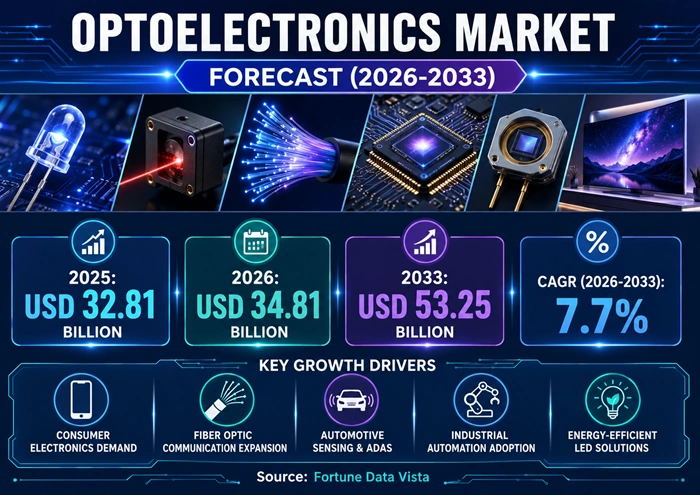
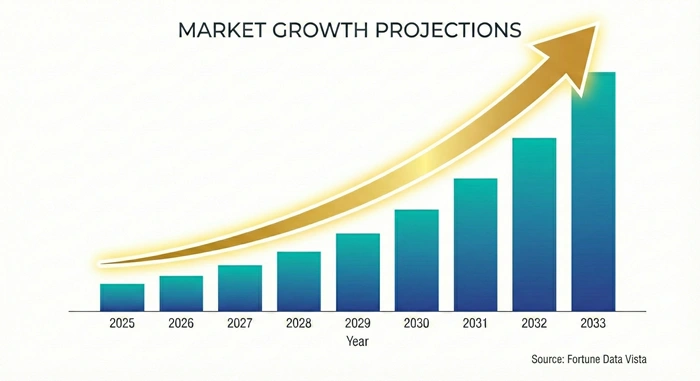
The global optoelectronics market size is valued at USD 32.81 billion in 2025 and is predicted to increase from USD 34.81 billion in 2026 to approximately USD 53.25 billion by 2033, growing at a CAGR of 7.7% from 2026 to 2033.
Optoelectronics encompasses a broad family of semiconductor devices that detect, emit, or control light — from the LEDs powering energy-efficient lighting and displays to the laser diodes transmitting data across fiber-optic networks, the image sensors capturing everything from smartphone photos to autonomous vehicle perception, and the photodetectors enabling precision industrial automation. As digital transformation accelerates across every major industry — consumer electronics, telecommunications, automotive, healthcare, and energy — the demand for high-performance light-based electronic components is expanding rapidly. The intersection of photonics innovation and semiconductor engineering is making the optoelectronics market one of the most technically dynamic and commercially expansive segments in the global electronics industry.
AI Impact on the Optoelectronics Industry
Artificial Intelligence Is Accelerating Optoelectronics Innovation by Optimizing Device Design, Expanding Autonomous Sensing Capabilities, and Enabling New Intelligent Applications Across Every Major End Market
Artificial intelligence is having a profound and multidimensional impact on the optoelectronics industry. On the design and manufacturing side, AI-driven simulation tools are enabling semiconductor engineers to model the optical and electronic behavior of novel device architectures — including next-generation vertical cavity surface emitting lasers (VCSELs), micro-LED arrays, and single-photon avalanche diodes — at a fraction of the time and cost of traditional physical prototyping. This AI-assisted design acceleration is shortening time-to-market for advanced optoelectronic components and enabling the rapid customization of device specifications for specific application requirements in automotive LiDAR, biomedical imaging, and quantum communication. Companies including Broadcom, II-VI Incorporated (now Coherent Corp.), and ams-OSRAM are all deploying AI-powered design and quality control workflows that are meaningfully reducing defect rates and improving yield in high-volume optoelectronic device manufacturing.
On the application side, AI is the enabler that transforms optoelectronic sensors from simple data collectors into intelligent perception systems. In the autonomous vehicle sector, AI algorithms process the raw point cloud data generated by LiDAR photodetectors into real-time, actionable 3D environmental maps that enable safe navigation. In healthcare, AI-powered analysis of optical coherence tomography (OCT) and photoacoustic imaging data is enabling earlier and more accurate detection of ocular diseases, cardiovascular conditions, and cancer. In industrial automation, AI vision systems combining high-resolution image sensors with deep learning inference engines are performing quality inspection tasks at speeds and accuracy levels that no human inspector can match. The tight integration of AI and optoelectronics is not only expanding the market's addressable applications but is creating a new premium tier of intelligent photonic devices that command significantly higher value than conventional passive optoelectronic components.
Growth Factors
The Global Surge in Fiber-Optic Communication Demand, the Automotive LiDAR Revolution, and the Energy Efficiency Transition to LED Lighting Are the Three Most Powerful Growth Engines Driving the Optoelectronics Market
The most powerful near-term growth driver of the optoelectronics market is the explosive global expansion of fiber-optic communication infrastructure. The proliferation of 5G networks, hyperscale data centers, undersea cable systems, and high-speed metropolitan area networks is generating enormous and rapidly growing demand for the laser diodes, photodetectors, optical transceivers, and wavelength division multiplexing components that form the physical layer of optical communication systems. Hyperscalers — including Microsoft Azure, Amazon Web Services, Google Cloud, and Meta — are investing hundreds of billions of dollars in data center expansion globally, with optical interconnect components representing a significant share of that investment. Every new data center rack deploys dozens to hundreds of optical transceiver modules, and as data transmission speeds increase from 400G to 800G and beyond, the per-transceiver optoelectronic component value increases in parallel — creating a highly favorable unit economics trend for the broader optoelectronics market.
The automotive industry's transition to electrification, advanced driver assistance systems (ADAS), and full autonomy is the second structural growth driver of equal importance. LiDAR systems — which rely on precisely controlled pulsed laser diodes and highly sensitive avalanche photodiode arrays to generate 3D maps of the vehicle's surroundings — are moving from premium optional features in high-end vehicles to standard safety equipment in mass-market models. Beyond LiDAR, automotive cameras, infrared occupant monitoring systems, gesture recognition sensors, and head-up display projection systems all represent rapidly growing optoelectronic content per vehicle. As global vehicle production integrates more optical sensing and display technology, the optoelectronics market benefits from an expanding and recurring revenue stream that is largely independent of consumer electronics demand cycles.
Market Outlook
The Optoelectronics Market Is Entering a Period of Accelerated Long-Term Growth Driven by the Convergence of 5G Connectivity, Autonomous Mobility, Healthcare Photonics, and Next-Generation Display Technology
The strategic outlook for the optoelectronics market through 2033 is characterized by both broad-based volume growth and a meaningful upward shift in average product value as commodity components give way to higher-performance, application-specific optical devices. The rollout of global 5G infrastructure — with its fiber-deep backhaul requirements and massive antenna deployments that incorporate both optical and millimeter-wave components — is creating a decade-long demand cycle for optical communication components that is still in its early-to-mid stages in most developing-market geographies. As 6G research transitions into early commercial deployment toward the end of the forecast period, the technical requirements for even faster, lower-latency optical transmission components will create a new upgrade cycle that further sustains market growth. The combination of 5G fiber deployment and hyperscale data center expansion ensures that the communication application segment will remain the single largest revenue contributor to the optoelectronics market through 2033.
Healthcare represents one of the most exciting long-term growth frontiers for the optoelectronics market. Optical coherence tomography, photoacoustic imaging, pulse oximetry, continuous glucose monitoring, laser surgical systems, and photobiomodulation therapy all rely on advanced optoelectronic components — and as aging global populations drive increasing demand for non-invasive, high-precision diagnostic and therapeutic technologies, healthcare is becoming a significant and higher-margin revenue stream for optoelectronic device manufacturers. The wearable health technology segment — where miniaturized optical heart rate sensors, blood oxygen monitors, and emerging continuous glucose measurement systems are driving volumes — is growing particularly rapidly and creating new high-volume demand for compact, low-power optoelectronic modules that were not commercially significant categories even five years ago. These diversified and expanding end-market demand streams make the outlook for the optoelectronics market across all regions robust and resilient through the full forecast period.
Expert Speaks
-
"At Broadcom, we see the optoelectronics segment as absolutely central to the next decade of data infrastructure growth. Every major hyperscale customer is deploying optical connectivity at scales we have never seen before — from pluggable transceivers to co-packaged optics directly integrated with ASICs — and our ability to deliver industry-leading laser and photodetector technologies at the required performance and volume is a critical competitive advantage," — Hock Tan, President & CEO, Broadcom Inc.
-
"Sony's image sensor business continues to benefit from the relentless growth in optical sensing applications across smartphones, automotive, and industrial automation. We are investing heavily in the next generation of stacked CMOS image sensors and event-based vision sensors that will enable the next leap in automotive perception and AI vision capabilities — applications that are driving our long-term growth strategy in optoelectronics and photonics," — Kenichiro Yoshida, Chairman, President & CEO, Sony Group Corporation.
-
"Samsung Electronics is committed to leading the advancement of optoelectronic semiconductor technology across displays, image sensors, and optical communication components. The transition to micro-LED display technology, the growth of advanced CMOS sensors in both consumer and industrial applications, and the expansion of optical interconnect in our data center customer base are all strategic priorities that we believe will deliver strong and sustained growth across our semiconductor and display businesses," — Jong-Hee Han, Vice Chairman & CEO, Samsung Electronics Co., Ltd.
Key Report Takeaways
-
Asia Pacific leads the global optoelectronics market, accounting for approximately 42–46% of total global revenue in 2025, driven by the concentration of consumer electronics and semiconductor manufacturing in China, South Korea, Japan, and Taiwan, government-backed investments in domestic photonics technology, and the massive scale of regional demand for LED components, image sensors, optical communication devices, and display technologies.
-
North America is the fastest-growing developed market for the optoelectronics market among mature economies, propelled by hyperscale data center optical interconnect investment, the rapid commercialization of automotive LiDAR technology by companies including Luminar, Cepton, and Aeye, and growing government investment in photonic semiconductor manufacturing through the CHIPS and Science Act.
-
Communication and data transmission is the largest application segment, contributing approximately 30–34% of total optoelectronics market revenue in 2025, driven by global 5G rollout, hyperscale data center expansion, and the transition to higher-speed optical transceiver platforms that increase per-port optoelectronic component content and value.
-
LEDs represent the largest device segment in the optoelectronics market, capturing approximately 28–32% of total revenue, led by the worldwide transition from incandescent and fluorescent lighting to energy-efficient LED solutions across residential, commercial, industrial, and horticultural applications, as well as the dominant role of LED backlighting and mini-LED technology in display panels.
-
Image sensors are the fastest-growing device category, projected to register a CAGR of approximately 10–12% from 2026 to 2033, currently holding approximately 18–22% market share, as demand for high-resolution CMOS sensors expands simultaneously across smartphone cameras, automotive vision systems, industrial machine vision, medical imaging devices, and security surveillance cameras.
-
The automotive industry vertical is the fastest-growing end-market, expected to grow at a CAGR of approximately 11–14% from 2026 to 2033 within the optoelectronics market, with market share expected to reach 15–18% by 2033, driven by the rapid integration of optical sensing, LiDAR, camera systems, and in-cabin optical monitoring into both electric and conventional vehicles globally.
Market Scope
| Parameter | Details |
|---|---|
| Market Size by 2033 | USD 53.25 Billion | Market Size by 2026 | USD 34.81 Billion | Market Size by 2025 | USD 32.81 Billion | Market Growth Rate from 2026 to 2033 | CAGR of 7.7% | Dominating Region | Asia Pacific | Fastest Growing Region | North America | Segments Covered | Device, Device Material, Application, Industry Vertical | Regions Covered | North America, Europe, Asia Pacific, Latin America, Middle East & Africa |
Market Dynamics
Drivers Impact Analysis
Exploding Demand for Optical Communication Components in 5G and Data Center Infrastructure, the Automotive Optical Sensing Revolution, and Global LED Energy Efficiency Adoption Are Driving Exceptional Growth in the Optoelectronics Market
| Driver | ≈ % Impact on CAGR Forecast | Geographic Relevance | Impact Timeline |
|---|---|---|---|
| 5G infrastructure and hyperscale data center optical interconnect demand | ~30% | Global, Dominant in North America and Asia Pacific | Ongoing through 2033 |
| Automotive LiDAR, ADAS camera, and optical sensing adoption | ~25% | North America, Europe, Asia Pacific | Near to Long-Term |
| Global LED energy efficiency transition | ~20% | Global | Ongoing |
| Growth of AI-enabled image sensors across consumer and industrial sectors | ~15% | Asia Pacific, North America | Near to Long-Term |
| Healthcare photonics and wearable optical sensor expansion | ~10% | North America, Europe, Asia Pacific | Medium to Long-Term |
The optical communication segment's role as the primary growth engine of the optoelectronics market cannot be overstated. Every byte of internet traffic, every cloud computing transaction, and every 5G data packet ultimately travels over fiber-optic networks whose efficiency and capacity depend entirely on the performance of laser diodes, photodetectors, and optical amplifier components. The current global wave of data center construction — driven by hyperscale cloud providers and the AI infrastructure boom that requires massive GPU cluster interconnectivity — is creating unprecedented demand for high-speed optical transceiver modules, silicon photonics components, and wavelength division multiplexing systems. Broadcom, II-VI (Coherent), Lumentum, and Finisar alumni companies are all reporting record order backlogs for optical communication components as customers race to build out the optical fabric that AI computing at scale demands.
The automotive sector's transformation represents an equally compelling structural driver for the optoelectronics market. Modern premium vehicles already incorporate up to eight or more cameras, multiple LiDAR sensors, infrared occupant monitoring systems, and optical head-up display units — representing a dramatic increase in optical component content per vehicle compared to even five years ago. As regulatory mandates for ADAS features including automatic emergency braking, lane-keeping assistance, and blind spot monitoring expand globally — covering all new vehicles sold in the European Union, the United States, and increasingly China and other markets — the optoelectronic content per vehicle will continue rising. This automotive demand is notable because it is driven by regulation and safety standards rather than purely discretionary consumer spending, making it more resilient to economic cycles than consumer electronics demand.
Restraints Impact Analysis
Supply Chain Fragility for Compound Semiconductor Materials, High Capital Investment Requirements, Technical Complexity of Advanced Devices, and Competitive Commoditization of LED Products Are Constraining the Optoelectronics Market's Full Growth Potential
| Restraint | ≈ % Impact on CAGR Forecast | Geographic Relevance | Impact Timeline |
|---|---|---|---|
| Raw material supply constraints for compound semiconductors (GaAs, InP, GaN) | ~35% | Global, Strongest in North America and Europe | Ongoing |
| High capital expenditure for advanced optoelectronic manufacturing | ~28% | Global | Ongoing |
| Technical complexity and integration challenges for emerging devices | ~22% | Global | Near to Medium-Term |
| Price commoditization of standard LED products | ~15% | Global, Strongest in Asia Pacific | Ongoing |
The compound semiconductor materials that are essential for high-performance optoelectronic devices — gallium arsenide, indium phosphide, gallium nitride, and silicon carbide — are not produced in anywhere near the same global volumes as silicon, and their supply chains are significantly more concentrated and fragile. Gallium and indium, in particular, are critical minerals with highly concentrated production in China — a geopolitical vulnerability that has become more commercially significant as US-China trade tensions have elevated the risk of export restrictions on these materials. Any disruption to the supply of these specialty semiconductors directly constrains the production capacity of laser diodes, VCSELs, high-efficiency LEDs, and solar cells — creating a meaningful supply-side ceiling on how quickly the optoelectronics market can scale to meet rapidly growing demand from communication, automotive, and defense customers.
The capital intensity of building and operating advanced optoelectronic semiconductor fabrication facilities is a significant structural barrier that limits the number of credible manufacturers capable of producing leading-edge devices. Building a new compound semiconductor wafer fabrication plant requires investments of hundreds of millions to over a billion dollars, and the specialized epitaxial growth equipment, clean room requirements, and process control expertise needed to achieve competitive yields are accessible only to well-capitalized, established manufacturers or national laboratories with government support. This high capital barrier keeps the competitive landscape for advanced optoelectronic components relatively concentrated — protecting established players' margins but also creating supply concentration risks and limiting the speed of capacity expansion in response to demand surges.
Opportunities Impact Analysis
Silicon Photonics Integration, Micro-LED Display Revolution, Quantum Communication Photonics, and Emerging Market Digital Infrastructure Investment Are Opening Major New Growth Pathways for the Optoelectronics Market
| Opportunity | ≈ % Impact on CAGR Forecast | Geographic Relevance | Impact Timeline |
|---|---|---|---|
| Silicon photonics for co-packaged optics and data center integration | ~35% | North America, Europe, Asia Pacific | Medium to Long-Term |
| Micro-LED display technology for consumer electronics | ~25% | Asia Pacific, North America | Medium to Long-Term |
| Quantum photonics and quantum communication infrastructure | ~20% | North America, Europe | Long-Term |
| Emerging market digital and 5G infrastructure buildout | ~20% | Asia Pacific, Latin America, MEA | Near to Long-Term |
Silicon photonics — the integration of optical waveguides, modulators, and photodetectors directly onto silicon CMOS wafers — represents one of the most commercially transformative opportunities in the optoelectronics market. By enabling the co-fabrication of optical and electronic components on standard silicon platforms, silicon photonics dramatically reduces the cost and power consumption of optical interconnect systems compared to conventional compound semiconductor approaches. Intel, IBM, GlobalFoundries, and a new generation of silicon photonics startups are advancing platforms that will enable direct integration of optical connectivity into processor packages — eliminating the electrical I/O bottleneck that currently limits AI accelerator cluster performance. As co-packaged optics transitions from research prototype to commercial deployment across the major hyperscaler and AI infrastructure customer base, the optoelectronics market will see a significant new revenue stream that combines high volume with premium technical value.
Micro-LED display technology represents a potentially enormous opportunity to displace OLED in the premium consumer electronics display market. Micro-LED displays offer the power efficiency and outdoor visibility of LED combined with the per-pixel contrast of OLED — without the burn-in risks and lifetime degradation that limit OLED in high-brightness applications. Apple, Samsung, LG, and a range of display panel manufacturers are investing heavily in micro-LED manufacturing process development, and as the technology scales from large-format commercial displays to consumer smartwatch and smartphone panels, it will generate substantial new demand for high-efficiency micro-LED chips and driver electronics. The optoelectronics market stands to benefit significantly from this display technology transition, which represents one of the largest potential new volume markets for LED device manufacturers in the coming decade.
Segment Analysis
By Device
LEDs Dominate the Optoelectronics Market While Image Sensors Emerge as the Fastest-Growing Device Category Fueled by Automotive Vision Systems, AI Cameras, and Wearable Health Monitoring
The LED device segment is the largest in the optoelectronics market, accounting for approximately 28–32% of total revenue in 2025 and growing at a CAGR of approximately 6.5% from 2026 to 2033. LEDs are ubiquitous across lighting, displays, signage, automotive lighting, horticulture, and UV sterilization applications — a diversification of use cases that provides stable and resilient revenue even as any individual application market may slow. Asia Pacific dominates global LED production and consumption, with China, South Korea, and Taiwan accounting for the vast majority of global LED chip and package manufacturing. Companies such as Nichia Corporation (Japan), ams-OSRAM (Germany/Austria), Cree (US), Lumileds (US), and Samsung LED (South Korea) lead the global LED segment — competing on luminous efficacy, thermal management, wavelength precision, and the increasingly important mini-LED and micro-LED product categories that command premium pricing and growing adoption in high-end display backlighting applications.
Laser diodes and VCSELs represent the second most valuable device sub-segment within the optoelectronics market, driven by the dual tailwinds of data center optical transceivers and consumer device sensing applications. VCSEL arrays — which enabled Face ID in Apple's iPhone — are now deployed at scale in smartphone 3D sensing, gesture recognition, and proximity detection, while edge-emitting laser diodes power the high-speed optical transceivers that carry the internet's fiber-optic backbone. The optoelectronics market in the laser diode category is growing rapidly as automotive LiDAR transitions from research prototype to mass production — with companies including Lumentum, II-VI (Coherent), and nLIGHT all expanding laser diode production capacity specifically for automotive LiDAR OEM supply contracts.
By Application
Communication and Data Transmission Leads Application Revenue in the Optoelectronics Market While the Automotive Application Segment Posts the Fastest Growth Rate Driven by LiDAR and ADAS Optical Sensing Mandates
The communication and data transmission application is the largest revenue-generating segment in the optoelectronics market, accounting for approximately 30–34% of total revenue in 2025 and growing at a CAGR of approximately 8.2% from 2026 to 2033. This segment encompasses optical transceivers for data centers, telecom line cards, access network optical network units, and coherent transmission systems for long-haul networks — all of which are experiencing demand growth driven by 5G deployment, AI infrastructure investment, and the global expansion of broadband internet access. North America is the dominant region for the communication application segment, where hyperscale data center concentration and the world's most advanced telecom networks generate the highest per-capita optical component demand globally. Key companies supplying this segment include Lumentum Holdings (US), Coherent Corp. (US), Broadcom Inc. (US), Neophotonics, and Accelink Technologies (China).
The automotive application is the fastest-growing segment in the optoelectronics market, expected to register a CAGR of approximately 11–14% from 2026 to 2033, with its market share growing from approximately 10–12% in 2025 toward 15–18% by 2033. Europe is the leading region for automotive optoelectronics adoption, driven by the European Union's regulatory mandates for ADAS safety features across all new vehicles, the dominant presence of tier-one automotive suppliers including Bosch, Continental, Valeo, and ZF — all of whom are deeply invested in LiDAR, camera, and optical radar technology development. Asia Pacific is the fastest-growing geography within this automotive application segment, as China's electric vehicle industry rapidly integrates advanced optical sensing and intelligent driving systems into mass-market vehicle platforms at a scale that is generating enormous volume demand for automotive-grade LED, laser, camera, and LiDAR components.
Regional Insights
Asia Pacific
Asia Pacific Dominates the Global Optoelectronics Market with the World's Largest Consumer Electronics Manufacturing Base, Deep Semiconductor Expertise, and Rapidly Growing Automotive and Communication Applications
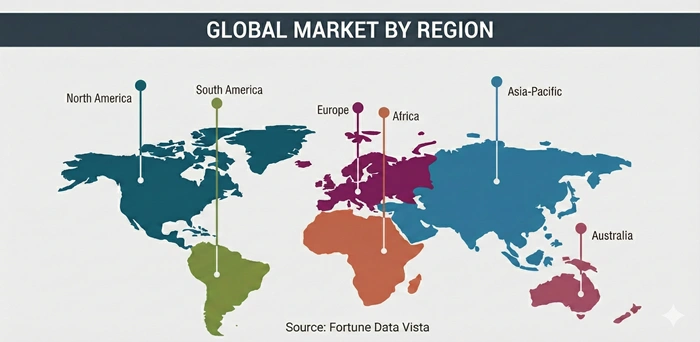
Asia Pacific leads the global optoelectronics market with approximately 42–46% of total global revenue in 2025, projected to sustain growth at a CAGR of approximately 8.2% from 2026 to 2033. China is the largest single national market, home to the world's highest volume LED chip and package production, a massive and rapidly growing consumer electronics sector, the largest electric vehicle market globally, and a government-backed photonics and semiconductor industry development program that is investing heavily in domestic compound semiconductor capability. South Korea is a critical hub for display optoelectronics through Samsung Electronics and LG Electronics — the world's leading producers of OLED display panels that incorporate millions of organic light-emitting devices per unit. Japan is home to Nichia Corporation, the world's most important LED phosphor and blue LED pioneer, as well as Sony's world-leading image sensor business and Hamamatsu Photonics, a global leader in photodetectors, photomultiplier tubes, and scientific light sensors.
Taiwan and South Korea's semiconductor foundries — including TSMC and Samsung Foundry — are critical enablers of the silicon photonics revolution, as leading-edge photonic integrated circuits increasingly require advanced CMOS fabrication nodes. India is emerging as an important growth market within Asia Pacific, where government-backed semiconductor manufacturing investment through the India Semiconductor Mission, rising smartphone manufacturing, and rapidly expanding broadband infrastructure are creating growing demand for optoelectronic components across consumer electronics, communication, and industrial applications. The Asia Pacific optoelectronics market is expected to surpass USD 24 billion by 2033, reinforcing its position as the global production and consumption center for optoelectronic devices.
North America
North America Is the Fastest-Growing Developed-Market Region in the Optoelectronics Market, Powered by AI Infrastructure Investment, Automotive LiDAR Commercialization, and Government-Backed Photonic Semiconductor Reshoring
North America holds approximately 22–25% of global optoelectronics market revenue in 2025 and is projected to grow at a CAGR of approximately 8.5–9% from 2026 to 2033 — among the fastest of any major developed-market region — driven by unique structural tailwinds that are not present in Europe or Japan. The United States is the global epicenter of the AI infrastructure buildout that is driving unprecedented demand for optical communication components through hyperscale data center expansion by Microsoft, Amazon, Google, and Meta. The CHIPS and Science Act — which authorized over $52 billion in semiconductor manufacturing and R&D investment — includes specific allocations for compound semiconductor and photonic device manufacturing that are beginning to attract new domestic production capacity investment from companies including Coherent Corp., Lumentum, and Wolfspeed. The commercial scaling of automotive LiDAR by US-based companies including Luminar Technologies, Cepton (acquired by Nikon), and Aeye is establishing North America as the global leader in next-generation automotive optoelectronic sensing.
Canada contributes meaningfully to the North American optoelectronics market through its photonics research ecosystem — with institutions including the University of Toronto, the National Research Council, and CMC Microsystems supporting commercialization of advanced photonic integrated circuit technologies. Mexico's growing electronics manufacturing sector is also generating increasing demand for optoelectronic components in consumer electronics assembly and automotive wiring harness and lighting systems. North America's optoelectronics market is expected to reach approximately USD 13 billion by 2033, with the communication and automotive application segments driving the majority of incremental growth throughout the forecast period.
Report Customization: Region-Wise and Country-Wise Insights
This Report Is Available with Full Geographic Customization — Providing Semiconductor Manufacturers, Electronics OEMs, Investors, and Technology Developers with Precise, Country-Level Optoelectronics Market Intelligence Tailored to Their Specific Business Objectives
This report on the optoelectronics market is available with complete region-wise and country-wise customization, enabling compound semiconductor manufacturers, photonic device companies, consumer electronics OEMs, automotive suppliers, and technology investors to access precisely targeted market intelligence for their geographies of interest. Whether the objective is to evaluate the competitive landscape for optical transceiver components in the North American hyperscale data center market, assess automotive LiDAR supply chain opportunities in Germany, or map the growth trajectory of LED and image sensor demand in India and Southeast Asia, our research team delivers fully tailored analysis built around your target market and strategic priorities.
Customized reports are available for the following regions and countries, each offering in-depth market sizing, device demand analysis by application, competitive landscape mapping, supply chain intelligence, regulatory environment review, and growth opportunity identification specific to that geography and the optoelectronics market:
North America
-
U.S. — Hyperscale data center optical interconnect demand, automotive LiDAR commercialization, CHIPS Act photonics manufacturing investment, and Broadcom/Lumentum/Coherent competitive analysis
-
Canada — Photonics research commercialization ecosystem, compound semiconductor startup landscape, and growing electronics manufacturing optical component demand
-
Mexico — Automotive electronics manufacturing growth, consumer electronics assembly optoelectronic demand, and cross-border supply chain analysis
Europe
-
U.K. — Post-Brexit photonics industry dynamics, compound semiconductor cluster in Wales, automotive ADAS optoelectronics demand, and Arm-powered optical computing development
-
Germany — Automotive LiDAR and ADAS supplier ecosystem, ams-OSRAM competitive analysis, industrial machine vision optical component demand, and Fraunhofer photonics research impact
-
France — Aerospace and defense optoelectronics procurement, telecom optical infrastructure investment, and European photonics industry association participation
-
Italy — Industrial automation optical sensing demand, photonic startup ecosystem, and EU photonics cluster participation
-
Rest of Europe — Nordic photonics innovation landscape, Eastern European electronics manufacturing growth, and Benelux semiconductor distribution dynamics
Asia Pacific
-
China — Domestic LED and laser diode manufacturer competitive analysis, electric vehicle optical sensing demand, government photonics investment program, and 5G optical communication rollout
-
India — India Semiconductor Mission photonics investment, smartphone manufacturing optoelectronic demand, rising broadband infrastructure build, and medical imaging optical device market
-
Japan — Nichia LED competitive positioning, Sony image sensor technology leadership, Hamamatsu Photonics scientific sensor market, and automotive optoelectronics supply analysis
-
South Korea — Samsung and LG display optoelectronics leadership, OLED and micro-LED technology development, and optical communication component manufacturing analysis
-
Australia — Defense optoelectronics procurement, research photonics sector, and solar PV optoelectronic component demand
-
Rest of Asia Pacific — Taiwan silicon photonics foundry analysis, Southeast Asian electronics manufacturing demand, and Vietnam and Thailand component distribution growth
Latin America
-
Brazil — Telecom optical infrastructure investment, consumer electronics assembly demand, and growing LED lighting adoption
-
Argentina — Technology manufacturing ecosystem, digital infrastructure investment, and optoelectronic component import dynamics
-
Rest of Latin America — Regional 5G rollout optical component demand, Colombia and Chile broadband investment, and solar energy optoelectronic adoption
Middle East & Africa
-
UAE — Smart city optical infrastructure projects, data center optical interconnect investment, and defense optoelectronics procurement
-
Saudi Arabia — Vision 2030 digital infrastructure investment, smart lighting LED adoption, and growing telecom optical network expansion
-
Rest of MEA — Sub-Saharan Africa telecom infrastructure optoelectronic demand, solar energy photovoltaic cell growth, and South African defense optical sensor market
Top Key Players
-
Broadcom Inc. (United States)
-
Sony Group Corporation (Japan)
-
Samsung Electronics Co., Ltd. (South Korea)
-
Nichia Corporation (Japan)
-
ams-OSRAM AG (Austria/Germany)
-
Coherent Corp. (formerly II-VI Incorporated) (United States)
-
Lumentum Holdings Inc. (United States)
-
Hamamatsu Photonics K.K. (Japan)
-
Vishay Intertechnology, Inc. (United States)
-
SK Hynix Inc. (South Korea)
-
Panasonic Holdings Corporation (Japan)
-
Everlight Electronics Co., Ltd. (Taiwan)
-
ON Semiconductor (onsemi) (United States)
-
STMicroelectronics N.V. (Switzerland/France)
-
Lumileds Holding B.V. (Netherlands)
Recent Developments
-
2025 — Broadcom Inc. announced a significant expansion of its silicon photonics and optical transceiver product portfolio targeting co-packaged optics applications for next-generation AI accelerator systems, with multiple hyperscale data center operators confirming qualification of Broadcom's 800G and 1.6T optical interconnect solutions for deployment in AI training cluster infrastructure — marking a pivotal milestone in the transition from pluggable to integrated optical connectivity.
-
2024 — Coherent Corp. completed the strategic divestiture of its industrial laser business unit to sharpen its focus on high-growth optical communication and compound semiconductor segments, allowing the company to concentrate capital allocation and engineering resources on expanding its indium phosphide wafer production capacity and next-generation optical transceiver platforms for data center and telecom applications.
-
2025 — Sony Group Corporation unveiled its next-generation stacked CMOS image sensor architecture featuring an AI inference processor embedded directly within the sensor chip, enabling real-time edge AI processing of visual data without transmitting raw image data to an external application processor — a development with significant implications for autonomous vehicle perception, security surveillance, and industrial machine vision applications.
-
2024 — ams-OSRAM AG completed a significant restructuring of its global manufacturing footprint, consolidating compound semiconductor wafer production at its strategically important Regensburg, Germany facility while announcing a joint development agreement with a major Asian LED display manufacturer for the co-development of next-generation micro-LED wafer technology targeting the premium consumer electronics display market.
-
2024–2025 — Lumentum Holdings expanded its automotive LiDAR laser source production capacity through a dedicated capital investment program at its San Jose and Ottawa manufacturing facilities, securing multi-year supply agreements with two Tier-1 automotive LiDAR module suppliers who are developing mass-market LiDAR systems for leading electric vehicle platforms scheduled for production launch between 2026 and 2028.
Market Trends
The Convergence of Silicon Photonics with AI Infrastructure and the Commercial Scaling of Automotive LiDAR Are the Two Most Transformative Trends Reshaping the Competitive Dynamics and Growth Architecture of the Optoelectronics Market
The defining structural trend of the optoelectronics market in this decade is the emergence of silicon photonics as the dominant platform for high-volume, cost-competitive optical communication components. As data center optical interconnect requirements scale from 400G to 800G and beyond, the performance limitations and cost structures of traditional discrete compound semiconductor optical components are becoming increasingly difficult to sustain. Silicon photonics integrates optical waveguides, modulators, and germanium photodetectors onto standard CMOS wafers — enabling the co-fabrication of optical and electronic functions at the volume and cost scaling advantages of silicon semiconductor manufacturing. Intel Foundry, GlobalFoundries, and TSMC are all offering silicon photonics process nodes, and a growing ecosystem of optical communication chipset companies including Ayar Labs, Rockley Photonics, and Ranovus are building integrated silicon photonic products that will fundamentally change the cost and performance structure of the optoelectronics market's largest application segment.
The second defining trend is the accelerating commercial deployment of solid-state LiDAR in automotive applications, which is creating a genuinely new high-volume demand category for precision laser and photodetector components that did not exist at meaningful scale five years ago. As automotive OEMs including General Motors, Ford, Volkswagen, Toyota, and a range of Chinese electric vehicle manufacturers commit to standard LiDAR fitment in production vehicles, the optoelectronics market for automotive-grade laser diodes, avalanche photodiode arrays, and LiDAR receiver ICs is transitioning from early adopter sample volumes to high-volume production supply. The extreme reliability, temperature tolerance, and lifetime requirements of automotive-grade optical components are driving significant engineering investment and creating a quality and certification barrier that is allowing established compound semiconductor manufacturers to maintain strong margins in this rapidly growing segment.
Segments Covered in the Report
-
By Device
-
LEDs (High-Power LEDs, Mid-Power LEDs, Low-Power LEDs, UV LEDs, Mini-LEDs, Micro-LEDs)
-
Laser Diodes (Edge-Emitting Lasers, VCSELs, Distributed Feedback Lasers)
-
Photodetectors and Sensors (Photodiodes, Phototransistors, Avalanche Photodiodes, Single-Photon Detectors)
-
Optocouplers and Optical Isolators
-
Infrared Components (IR LEDs, IR Detectors, IR Sensors)
-
Photovoltaic Cells and Solar Cells
-
Image Sensors (CMOS Image Sensors, CCD Sensors)
-
Display Devices (OLED Displays, LED Displays, Micro-LED Displays)
-
Others
-
-
By Device Material
-
Gallium Arsenide (GaAs)
-
Gallium Nitride (GaN)
-
Gallium Phosphide (GaP)
-
Indium Phosphide (InP)
-
Silicon Carbide (SiC)
-
Silicon-Germanium (SiGe)
-
Others
-
-
By Application
-
Communication and Data Transmission
-
Consumer Electronics
-
Automotive and Transportation
-
Aerospace and Defense
-
Healthcare and Medical Devices
-
Industrial Automation and Machine Vision
-
Security and Surveillance
-
Energy and Lighting
-
Others
-
-
By Industry Vertical
-
Consumer Electronics
-
Automotive
-
IT and Telecommunication
-
Aerospace and Defense
-
Healthcare
-
Industrial
-
Energy and Utilities
-
Others
-
-
By Region
-
North America (U.S., Canada, Mexico)
-
Europe (U.K., Germany, France, Italy, Rest of Europe)
-
Asia Pacific (China, India, Japan, South Korea, Australia, Rest of Asia Pacific)
-
Latin America (Brazil, Argentina, Rest of Latin America)
-
Middle East & Africa (UAE, Saudi Arabia, Rest of MEA)
-
❝ Built for Every Level — From Startups to Industry Giants ❞
Here Is Exactly How This Report Works for You
-
Tier 1 optoelectronic semiconductor manufacturers, global electronics OEMs, and institutional technology investors will find this report indispensable for tracking competitor revenue trajectories, understanding where optical device market share is shifting across application segments and geographies, and identifying which product innovation cycles — silicon photonics, micro-LED, automotive LiDAR — represent the most commercially significant investment opportunities in the optoelectronics market over the next seven years.
-
For mid-market photonic device distributors, specialty compound semiconductor producers, and growth-stage optoelectronics companies, this report delivers critical intelligence on how geopolitical supply chain pressures — including China's export restrictions on gallium and germanium, the CHIPS Act's impact on domestic compound semiconductor capacity, and evolving US-China technology trade restrictions — are reshaping supplier relationships, pricing dynamics, and market access strategies across the optoelectronics value chain.
-
Startups developing next-generation photonic devices, AI-integrated optical sensors, or novel display technologies will benefit from our detailed analysis of the technology adoption curves for silicon photonics, micro-LED, and quantum photonics, the strategic acquisition appetite of major industry players actively seeking photonics technology assets, and the regulatory and standards landscape shaping optoelectronic device certification for automotive and healthcare applications — giving emerging companies the market intelligence needed to time product launches, attract strategic partners, and secure growth capital in one of technology's most rapidly evolving sectors.
Frequently Asked Questions:
Answer: The global optoelectronics market was valued at USD 32.81 billion in 2025 and is expected to grow from USD 34.81 billion in 2026 to approximately USD 53.25 billion by 2033, at a CAGR of 7.7%. This growth is driven by expanding demand for optical communication components, automotive sensing devices, energy-efficient LED solutions, and advanced image sensors across multiple industry verticals.
Answer: The primary growth drivers of the optoelectronics market include the global rollout of 5G infrastructure and hyperscale data center expansion generating massive demand for optical transceivers and laser components, and the automotive industry's adoption of LiDAR, ADAS camera systems, and optical sensing technology as standard vehicle features. The global transition to LED lighting, the growth of AI-integrated image sensors in consumer and industrial applications, and the expansion of photonic devices in healthcare diagnostics are also significant and accelerating demand drivers.
Answer: Asia Pacific dominates the optoelectronics market with approximately 42–46% of global revenue in 2025, supported by the world's largest concentration of LED, image sensor, and optical communication device manufacturing in China, South Korea, Japan, and Taiwan. North America is among the fastest-growing developed market regions, projected to grow at approximately 8.5–9% CAGR from 2026 to 2033, powered by hyperscale AI infrastructure investment, automotive LiDAR commercialization, and government-backed photonic semiconductor manufacturing reshoring.
Answer: The communication and data transmission application is the largest revenue contributor to the optoelectronics market, accounting for approximately 30–34% of total revenue in 2025, driven by global 5G deployment and the extraordinary scale of hyperscale data center optical interconnect investment. The automotive application segment is growing fastest within the market, expected to reach a CAGR of 11–14% from 2026 to 2033 as LiDAR, ADAS cameras, and in-cabin optical sensing become standard features across global vehicle production.
Answer: Silicon photonics is one of the most transformative technology trends in the optoelectronics market, enabling the integration of optical waveguides, modulators, and photodetectors onto standard silicon CMOS wafers — significantly reducing the cost and power consumption of optical interconnect systems for data centers and AI computing infrastructure. As co-packaged optics transitions to commercial deployment in hyperscale data centers and AI accelerator systems, silicon photonics will create a significant new high-volume product category that strengthens the optoelectronics market's long-term growth trajectory.