
Pallets Market Overview
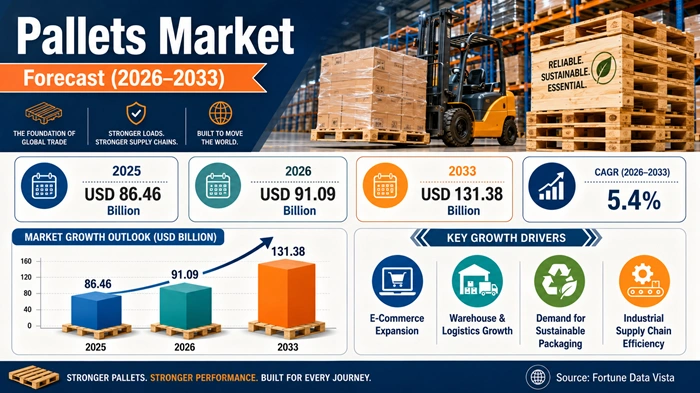
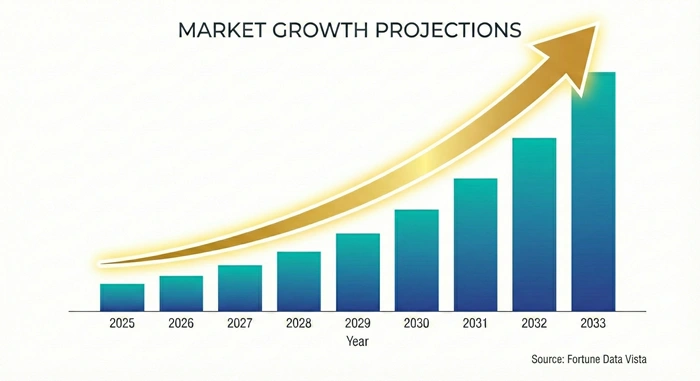
The global pallets market size is valued at USD 86.46 billion in 2025 and is predicted to increase from USD 91.09 billion in 2026 to approximately USD 131.38 billion by 2033, growing at a CAGR of 5.4% from 2026 to 2033.
Pallets are an indispensable component of global supply chains, providing the foundational unit load platform that enables safe, efficient, and standardized movement of goods across warehouses, distribution centers, production facilities, and transportation networks. The pallets market continues to grow steadily as global trade volumes expand, e-commerce logistics infrastructure scales rapidly, and industrial sectors from food and beverage to pharmaceuticals invest in more robust and sustainable material handling solutions. Growing interest in smart pallets, reusable pooling systems, and sustainable material alternatives is adding a technological and environmental dimension to what has historically been a commoditized market, creating new competitive dynamics and value-added product segments through 2033.
AI Impact on the Pallets Industry
Artificial Intelligence, IoT-Enabled Smart Pallets, and Warehouse Automation Are Converging to Transform the Pallets Industry from a Static Material Handling Category into an Intelligent, Data-Driven Supply Chain Asset Class
Artificial intelligence and the Internet of Things are beginning to reshape the pallets market in meaningful ways, particularly through the development and commercial rollout of smart pallets — conventional pallet structures embedded with RFID tags, GPS tracking modules, IoT sensors, and condition monitoring devices that generate real-time data about pallet location, load status, temperature exposure, and shock events during transit. AI-powered logistics platforms can analyze this data stream to optimize pallet routing, predict maintenance needs, prevent loss, and provide end-to-end supply chain visibility that dramatically improves operational efficiency for large-scale distributors and retailers. For industries such as pharmaceuticals and fresh food, where cold chain integrity and product traceability are critical regulatory requirements, smart pallets monitored by AI platforms are becoming a compliance enabler as much as an efficiency tool.
Beyond smart pallet technology, AI is also influencing pallet demand indirectly through its transformative impact on warehouse automation. The rapid deployment of autonomous mobile robots (AMRs), robotic palletizers, and automated storage and retrieval systems (AS/RS) in modern fulfillment centers is creating new technical requirements for pallets — including greater dimensional consistency, higher load-bearing specifications, and improved RFID readability — that are driving demand for premium plastic and composite wood pallets over traditional hand-nailed wooden alternatives. AI-driven warehouse management systems that dynamically allocate pallet positions and optimize load sequencing are further increasing the operational precision requirements placed on pallets as components within automated logistics ecosystems, creating both product specification upgrade opportunities and new market demand drivers for the global pallets market going forward.
Growth Factors
Global E-Commerce Expansion, Rising Supply Chain Automation Investment, and the Growing Shift Toward Sustainable and Reusable Pallet Solutions Are the Primary Growth Drivers of the Pallets Market
The explosive and sustained growth of global e-commerce is one of the most powerful structural drivers of demand in the pallets market. The dramatic expansion of online retail — accelerated permanently by the consumer behavior shifts of the pandemic years — has created an enormous increase in the volume of goods moving through distribution centers, last-mile fulfillment facilities, and cross-docking operations worldwide. Every shipment unit that moves through these networks requires pallet-based handling at one or more points in its journey, directly translating e-commerce growth into sustained incremental pallet procurement demand. The rapid buildout of modern fulfillment center infrastructure by Amazon, Walmart, Alibaba, and regional e-commerce logistics companies across Asia, Latin America, and Eastern Europe is generating particularly large concentrated pallet procurement events as each new facility opens and requires its initial pallet inventory.
Growing investment in supply chain sustainability is adding a second and increasingly important demand driver to the pallets market. Brands and retailers are under mounting pressure from consumers, investors, and regulators to reduce the environmental footprint of their supply chain operations, and pallet material and lifecycle choices are a visible and manageable dimension of that sustainability agenda. The shift from single-use wooden pallets to reusable plastic pallets, pooled rental systems, and composite or recycled material pallets is creating a structural market evolution that increases the lifetime value of each pallet unit and supports the commercial models of pallet pooling and rental businesses. Companies including CHEP (Brambles), PECO Pallet, and iGPS are benefiting from growing corporate sustainability commitments that make pallet pooling programs — with their documented circular economy credentials — an increasingly preferred procurement model for large consumer goods and grocery supply chains.
Market Outlook
The Pallets Market Is Set for Steady Long-Term Volume and Value Growth Through 2033 — Anchored by Global Trade Expansion, Industrial Automation, and the Progressive Adoption of Smart and Sustainable Pallet Technologies
The medium-to-long-term outlook for the pallets market is consistently positive, supported by the fundamental and non-cyclical role that pallets play in physical goods supply chains. Unlike many industrial categories where digital substitution or demand destruction is a meaningful long-term risk, the pallets market benefits from the fact that physical goods will always require physical handling, and the pallet remains the most economically efficient and widely standardized unit load platform available at any scale. Global trade volume growth, projected industrial output expansion in emerging markets, and the continued formalization of supply chains in developing economies — where pallet adoption is still well below developed market penetration levels — all contribute to a sustained demand growth environment through the forecast horizon.
Looking toward 2033, the most significant structural change in the pallets market will be the progressive shift in value mix toward higher-value, technology-enhanced, and sustainable pallet formats. The traditional wooden pallet — which still dominates global volume — will face competition from plastic, composite, and recycled material alternatives as environmental regulations, automation compatibility requirements, and corporate sustainability policies create headwinds for single-use timber-based products. The pallets market will simultaneously evolve through the growing monetization of pallet data within smart supply chains, with pallet pooling operators and technology companies developing new service and subscription revenue models built on pallet tracking, condition monitoring, and supply chain visibility services that complement physical pallet rental income.
Expert Speaks
-
"Brambles' CHEP pallet pooling network continues to grow consistently because the value proposition of our circular supply chain model has never been more relevant. Organizations across grocery, consumer goods, and automotive supply chains are increasingly choosing pallet pooling over ownership because it reduces cost, waste, and complexity simultaneously — and our investment in RFID tracking and digital supply chain visibility is making our pallets progressively smarter and more valuable to our customers." — Graham Chipchase, CEO, Brambles Limited
-
"At Walmart, our supply chain efficiency depends critically on the quality and consistency of the pallets flowing through our distribution network. We have invested significantly in transitioning to reusable pallet programs across our supplier base, and we see smart pallet technology as the next frontier in supply chain visibility — one that will enable us to track inventory location and condition with unprecedented precision from supplier dock to store floor." — Doug McMillon, President & CEO, Walmart Inc.
-
"Amazon's fulfillment network handles billions of units annually, and the efficiency of our robotic warehouses depends on pallet standardization and quality at a level that wooden pallets often cannot consistently deliver. We are actively expanding our use of high-specification plastic and composite pallets in our automated fulfillment centers because their dimensional consistency and RFID compatibility are essential to maximizing the performance of our automation investments." — Andy Jassy, President & CEO, Amazon.com, Inc.
Key Report Takeaways
-
North America dominates the global pallets market, holding the largest regional revenue share of approximately 33% in 2025, driven by one of the world's most advanced and highest-volume logistics and warehousing infrastructure networks, high e-commerce penetration, and the strong commercial presence of pallet pooling leaders including CHEP (Brambles) and PECO Pallet that serve the continent's major grocery, consumer goods, and retail supply chains.
-
Asia Pacific is the fastest growing regional market for pallets, with China, India, Japan, South Korea, and Southeast Asian manufacturing hubs driving above-average demand growth through rapid industrialization, the explosive growth of domestic e-commerce logistics networks, large-scale cold chain infrastructure investment in food and pharmaceutical sectors, and the progressive adoption of standardized pallet systems in supply chains that have historically used non-palletized handling methods.
-
Food and beverage is the largest application segment in the pallets market, representing over 30% of total revenue in 2025 as grocery retailers, food processors, beverage manufacturers, and cold chain logistics operators are among the world's highest-volume pallet users, requiring billions of pallet trips annually to move products through temperature-controlled distribution networks from production facilities to store shelves.
-
Wood pallets remain the dominant material type, accounting for approximately 62% of total market volume in 2025 due to their low unit cost, ease of repair, widespread availability, and suitability for a vast range of load types and handling environments — making them the default choice for the majority of pallet applications globally despite growing competition from plastic and composite alternatives.
-
Pallet pooling and rental systems represent the most rapidly growing ownership model, driven by corporate sustainability commitments, cost management pressures, and the operational simplicity of outsourcing pallet inventory management to professional pooling operators — making CHEP, PECO, iGPS, and Loscam the fastest-growing revenue segment within the pallets industry.
-
Plastic pallets are the fastest growing material segment, projected to achieve a market share exceeding 18% by 2033 and grow at a CAGR of approximately 7.8% through the forecast period, driven by their superior durability, hygiene compliance advantages in food and pharmaceutical applications, automation compatibility, and growing consumer goods brand commitments to phasing out single-use wooden pallet procurement.
Market Scope
| Parameter | Details |
|---|---|
| Market Size by 2033 | USD 131.38 Billion | Market Size by 2026 | USD 91.09 Billion | Market Size by 2025 | USD 86.46 Billion | Market Growth Rate from 2026 to 2033 | CAGR of 5.4% | Dominating Region | North America | Fastest Growing Region | Asia Pacific | Segments Covered | Material Type, Ownership Type, Application, End User | Regions Covered | North America, Europe, Asia Pacific, Latin America, Middle East & Africa |
Market Dynamics
Drivers Impact Analysis
Global Trade Expansion, E-Commerce Logistics Boom, and Supply Chain Modernization Are the Three Foundational Forces Propelling Consistent Growth Across the Pallets Market
| Driver | ≈ % Impact on CAGR Forecast | Geographic Relevance | Impact Timeline |
|---|---|---|---|
| E-commerce and online retail logistics network expansion | ~34% | Global — especially North America, Asia Pacific, Europe | Short to Long Term |
| Industrial automation and warehouse robotics adoption | ~26% | North America, Europe, Advanced Asia Pacific | Medium to Long Term |
| Supply chain sustainability and reusable pallet adoption | ~24% | North America, Europe | Short to Long Term |
| Emerging market supply chain formalization and pallet adoption | ~16% | Asia Pacific, Latin America, MEA | Medium to Long Term |
The explosive growth of global e-commerce has created a structural step-change in pallet demand that is fundamentally different from the gradual volume growth driven by traditional brick-and-mortar retail expansion. Modern e-commerce fulfillment centers operate at dramatically higher goods velocity, SKU complexity, and throughput volume than conventional distribution warehouses, requiring proportionally larger pallet inventories, faster pallet turn cycles, and more frequent pallet procurement. As Tier 1 e-commerce operators including Amazon, JD.com, Flipkart, and Mercado Libre continue expanding their fulfillment footprints into second and third-tier cities across Asia, Latin America, and Africa, their cumulative pallet procurement needs are generating a sustained increment of pallets market demand growth that is unlikely to decelerate meaningfully before 2033.
The rapid adoption of warehouse automation — including robotic palletizers, autonomous mobile robots, and automated storage systems — is simultaneously driving a quality upgrade cycle within the pallets market, as automated systems require pallet standards that traditional hand-nailed wooden pallets often cannot consistently meet. Dimensional variation, nail protrusion, deck board gaps, and moisture-related warping in wooden pallets cause jamming and damage in automated handling systems, creating operational and financial incentives for logistics operators to transition to precision-manufactured plastic, composite, or high-specification engineered wood pallets that deliver the consistency automated systems require. This quality upgrade trend is increasing average selling prices within the pallets market and driving revenue growth that exceeds volume growth — a favorable structural dynamic for pallet manufacturers who invest in premium product capabilities.
Restraints Impact Analysis
Raw Material Price Volatility, Environmental Regulations on Timber Sourcing, and the High Capital Cost of Transitioning to Plastic or Pooled Pallet Systems Are Constraining Faster Market Growth
| Restraint | ≈ % Impact on CAGR Forecast | Geographic Relevance | Impact Timeline |
|---|---|---|---|
| Timber price volatility and lumber supply disruptions | ~38% | North America, Europe, Latin America | Short to Medium Term |
| Environmental regulations restricting timber pallet materials | ~32% | Europe, North America, Asia Pacific | Medium to Long Term |
| High upfront cost of plastic pallet transition for SMEs | ~30% | All regions — especially emerging markets | Short to Medium Term |
Timber price volatility is the single most impactful cost-side restraint in the pallets market, given that wood remains the dominant material for over 60% of global pallet production. Lumber prices are highly sensitive to housing construction activity, forest management policies, mill capacity constraints, and cross-border timber trade agreements — all of which can fluctuate significantly and unpredictably, compressing margins for wooden pallet manufacturers and creating price instability that disrupts long-term supply contracts. The lumber price surge of 2020–2021 exposed the vulnerability of supply chains dependent on wooden pallets, prompting many large buyers to diversify toward plastic and pooled pallet programs, but the majority of the market continues to rely on wooden pallets whose economics remain directly tied to timber market conditions.
Increasingly stringent environmental regulations around timber sourcing — including requirements for Forest Stewardship Council (FSC) certified wood in supply chains serving European and North American markets — are adding compliance complexity and procurement cost to wooden pallet manufacturing. Regulations governing heat treatment requirements for international pallet movements (ISPM 15 standards) add further cost and logistical complexity to wooden pallet supply chains, while growing corporate commitments to deforestation-free supply chains are making it progressively harder for wooden pallet manufacturers to ignore the sustainability implications of their primary raw material. Together, these regulatory and reputational pressures are accelerating the long-term structural shift away from virgin timber wooden pallets toward recycled, reused, and alternative-material pallet formats.
Opportunities Impact Analysis
Smart Pallet Technology Commercialization, Cold Chain Infrastructure Expansion, and Pallet Pooling Growth in Emerging Markets Represent the Highest-Value Commercial Opportunities in the Pallets Industry
| Opportunity | ≈ % Impact on CAGR Forecast | Geographic Relevance | Impact Timeline |
|---|---|---|---|
| Smart and IoT-enabled pallet technology commercialization | ~38% | North America, Europe, Advanced Asia Pacific | Medium to Long Term |
| Cold chain and pharmaceutical logistics pallet demand growth | ~34% | Global — especially Asia Pacific and MEA | Short to Long Term |
| Pallet pooling program expansion in emerging market economies | ~28% | Asia Pacific, Latin America, MEA | Medium to Long Term |
The commercial rollout of IoT-enabled smart pallets — equipped with GPS, RFID, and condition sensors that feed real-time data into cloud-based supply chain visibility platforms — represents a high-value technology premium opportunity that is beginning to materialize in the pallets market. Organizations that integrate smart pallet data into their warehouse management and transportation management systems gain meaningful operational advantages including real-time inventory visibility, automated loss prevention alerts, temperature excursion detection for cold chain loads, and proof of delivery verification. The willingness of large consumer goods companies, pharmaceutical distributors, and grocery retailers to pay premium prices for smart pallet solutions is creating a new, high-margin revenue stream for pallet manufacturers and pooling operators who invest in embedded sensor technology and data service infrastructure.
Cold chain logistics expansion — driven by the growth of fresh and frozen food e-commerce, the global build-out of pharmaceutical distribution infrastructure, and rising consumer demand for high-quality perishable goods in emerging markets — is creating concentrated, high-specification demand for plastic pallets, antimicrobial pallet variants, and hygiene-certified reusable pallet systems that wooden pallets cannot serve effectively. This segment is growing faster than the broader pallets market and commands significantly higher per-unit revenue, making it a strategically important growth vector for pallet manufacturers seeking to improve their product mix and margin profile. The rapid expansion of COVID-19 vaccine distribution infrastructure globally also demonstrated the strategic importance of pharmaceutical cold chain pallets, and the ongoing growth of biopharmaceutical production and distribution is sustaining this demand impulse well beyond the pandemic period.
Segment Analysis
By Material Type
Wood Pallets Lead the Global Pallets Market in Volume While Plastic Pallets Are the Fastest Growing Material Segment, Driven by Automation Compatibility, Hygiene Standards, and Sustainability Commitments
Wood pallets hold the dominant position in the pallets market, accounting for approximately 62% of total market volume in 2025 and projected to grow at a CAGR of approximately 4.8% through 2033. Their continued dominance reflects the combination of low unit cost, broad repairability, widespread industry familiarity, and the absence of a cost-competitive alternative at equivalent scale in many logistics markets. North America is the world's largest wood pallet producing and consuming region, with the United States alone manufacturing an estimated 500 million wooden pallets annually for use across grocery, consumer goods, manufacturing, and agricultural supply chains. PalletOne, Millwood Inc., and Kamps Pallets are among the largest wooden pallet producers in North America, competing on price, geographic proximity to customer distribution centers, quality consistency, and pallet management and repair service capabilities. In Europe, wooden pallet demand is dominated by the EUR-pallet standard used throughout the continent's logistics network, with major producers including Falkenhahn, LOSCAM, and regional cooperatives maintaining extensive pallet manufacturing and exchange networks.
Plastic pallets represent approximately 14% of total market volume in 2025 but are growing at the fastest material-category CAGR of approximately 7.8% through 2033, driven by their superior durability, hygienic surface properties, dimensional consistency, and suitability for automated warehouse environments. The food and beverage and pharmaceutical sectors are the primary drivers of plastic pallet demand, as regulatory requirements for sanitary supply chain practices make the non-porous, easily washable surface of plastic pallets a compliance necessity rather than a preference in many applications. Asia Pacific is the fastest growing region for plastic pallet adoption, where food safety regulation upgrades in China, India, and Southeast Asia are creating institutional demand for hygienic plastic pallet alternatives to traditional wooden formats. ORBIS Corporation, Schoeller Allibert, Rehrig Pacific, and Cabka are among the leading plastic pallet manufacturers competing globally, with product portfolios ranging from lightweight export pallets to heavy-duty rackable platforms designed for the most demanding automated warehouse environments in the pallets industry.
By Application
Food and Beverage Is the Dominant Application Segment While Pharmaceutical and E-Commerce Applications Are Driving the Fastest Revenue Growth in the Pallets Market
Food and beverage is the largest application segment in the pallets market, contributing approximately 30% of total revenue in 2025 and growing at a CAGR of approximately 5.6% through 2033. The segment's dominance reflects the enormous volume of food and beverage goods flowing through global supply chains daily — from farm and processing facility through cold storage, distribution center, and final retail delivery — all of which requires consistent pallet-based handling at every transfer point. Europe and North America lead food and beverage pallet demand, with well-established grocery retail supply chains that operate on highly standardized pallet formats and require strict compliance with food safety hygiene standards that increasingly favor washable, reusable plastic pallet or CHEP-certified pooled pallet solutions. CHEP (Brambles) is the dominant supplier for food and beverage pallet pooling in both regions, with a network of shared service centers that collect, inspect, repair, and redistribute pallets across thousands of supply chain participants under a pay-per-use model that delivers both cost and sustainability advantages compared to single-use wooden pallet procurement.
The pharmaceutical and e-commerce applications are the two fastest growing sub-segments within the pallets market, each driven by distinct but powerful demand catalysts. Pharmaceutical logistics pallets — which must meet GMP hygiene standards, support temperature-controlled chain documentation, and increasingly incorporate RFID tracking for serialization compliance — command premium pricing and are growing at a CAGR well above the overall market average as biopharmaceutical production and global vaccine distribution infrastructure continue to expand. E-commerce pallet demand is driven by the relentless growth of online retail fulfillment operations, where large-format sortable and polybag facilities require specific pallet dimensions, weight ratings, and RFID readability that are creating product specification demand shifts within the overall pallets industry. North America and Asia Pacific are the leading regions for both pharmaceutical and e-commerce pallet demand growth, with companies including iGPS, PECO Pallet, and Brambles actively developing application-specific pallet solutions to capture these high-growth, high-value customer segments.
Regional Insights
North America
North America Leads the Global Pallets Market with the World's Most Advanced Logistics Infrastructure, Highest Pallet Utilization Density, and the Dominant Commercial Presence of Global Pallet Pooling Leaders
The United States Is the Single Largest Pallet Market in the World, Driven by E-Commerce Growth, Grocery Supply Chain Scale, and the Progressive Adoption of Sustainable Reusable Pallet Programs
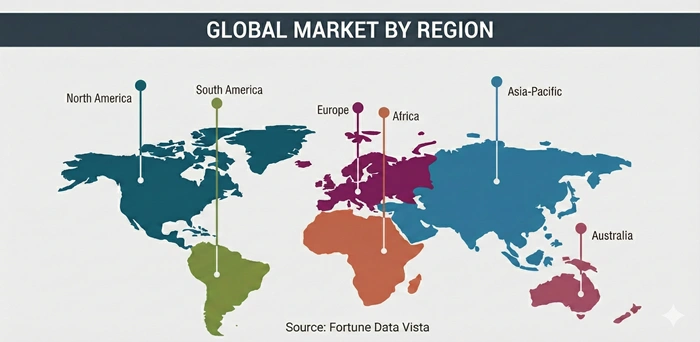
North America holds the largest regional share of the global pallets market at approximately 33% of total revenue in 2025, anchored by the United States' world-leading combination of logistics infrastructure scale, e-commerce intensity, and mature pallet pooling adoption. The U.S. market is distinguished by the dominance of CHEP's blue pallet pooling network — the world's largest — which serves the majority of major consumer goods companies and grocery retailers operating in North America, generating enormous repeat utilization revenue while simultaneously advancing the sustainability credentials of the pallet supply chain. North America is projected to grow at a regional CAGR of approximately 5.0% from 2026 to 2033, reflecting a market that continues to grow in volume and value as e-commerce fulfillment network expansion generates new pallet demand and automation-driven quality upgrades shift the product mix toward higher-value plastic and premium composite pallet formats. Key players including Brambles (CHEP), PECO Pallet, PalletOne, iGPS, and Rehrig Pacific are the dominant commercial forces in the region.
Canada contributes meaningful secondary demand from its automotive, food processing, and consumer goods distribution sectors, with the country's well-developed logistics network operating largely on the same pallet standards as the U.S. market and participating extensively in the CHEP pallet pooling network that spans both countries. Mexico's pallets market is growing more rapidly than the North American average, driven by the substantial nearshoring manufacturing investment flowing into the country from U.S. and Asian companies seeking lower-cost production locations proximate to the U.S. consumer market — a dynamic that is increasing the volume of pallet-based goods movement through Mexican industrial corridors and creating new procurement demand for pallet manufacturers and pooling operators with Mexican distribution capabilities.
Asia Pacific
Asia Pacific Is the Fastest Growing Regional Market for Pallets, Powered by China's Manufacturing Scale, India's Industrial Expansion, and the Rapid Formalization of Supply Chains Across Southeast Asia
The Shift from Informal to Standardized Pallet-Based Supply Chain Practices Across Asia Pacific's Emerging Economies Is Generating the Most Significant Volume Growth Increment in the Global Pallets Market Today
Asia Pacific is the fastest growing regional market in the global pallets industry, with a projected CAGR of approximately 7.2% from 2026 to 2033, significantly outpacing North America and Europe. The region currently accounts for approximately 28% of global pallets market revenue in 2025, a share that is expected to grow as pallet adoption deepens across both established industrial markets and rapidly developing economies where supply chain formalization is creating structural pallet demand where little or none previously existed. China is the largest individual market within the region, with massive volumes of manufactured goods requiring pallet-based handling across its extensive domestic logistics network and export supply chains. Loscam, CHEP Asia Pacific, and numerous domestic Chinese pallet manufacturers including Suzhou Pioneer Material Handling Equipment & Technology are competing intensely for share in China's rapidly expanding pallet market, where e-commerce growth from JD.com and Alibaba's logistics arms is creating outsized fulfillment center pallet procurement volumes.
India represents the most exciting long-term growth opportunity in the Asia Pacific pallets market, combining a rapidly industrializing economy, a government-driven GST-enabled supply chain formalization process that is increasing pallet adoption in domestic distribution, and massive infrastructure investment in warehousing, cold chain, and logistics parks under programs including PM GatiShakti and the National Logistics Policy. The India pallets market remains significantly underpenetrated relative to its economic size, with pallet utilization density well below that of China, Japan, or Australia, suggesting a long runway for structural market growth as organized retail, e-commerce, and modern logistics formats progressively displace informal handling practices. Japan and South Korea contribute high-value demand from their advanced manufacturing and retail sectors, with both markets characterized by strong preference for high-quality, hygienic plastic and composite pallets in automotive, electronics, and food supply chain applications.
Report Customization Available by Region and Country
Maximize Your Market Intelligence Investment with Our Fully Customized Region-Wise and Country-Wise Pallets Market Reports — Tailored to Your Geographic Focus, Industry Vertical, and Strategic Decision-Making Needs
This report is available for complete customization across all major global regions and individual countries, delivering focused, geography-specific market intelligence for the pallets market that goes beyond the global overview. A customized report includes country-level demand sizing, material type preference analysis, application-specific volume data, regulatory environment assessment, competitive landscape mapping, and strategic opportunity identification tailored precisely to the selected geography. Whether you are planning a market entry, evaluating regional manufacturing investment, building a distribution network, or conducting investor due diligence, our customization service ensures that your intelligence is directly actionable for the specific markets that matter most to your business.
Customized pallets market reports are available for all of the following regions and countries, with detailed market analysis, competitive intelligence, growth opportunities, and sector-specific demand insights tailored to each geography:
North America
-
U.S. — World's largest pallet market analysis, e-commerce and grocery supply chain demand data, CHEP and PECO pooling network coverage, wooden vs. plastic market share evolution, and top manufacturer competitive benchmarking
-
Canada — Automotive and food sector pallet demand, cross-border supply chain integration with U.S. pallet networks, and sustainable pallet adoption trends
-
Mexico — Nearshoring manufacturing boom pallet demand analysis, import vs. domestic production dynamics, and pallet pooling program penetration trajectory
Europe
-
U.K. — EUR-pallet standard compliance, grocery retail supply chain pallet demand, post-Brexit logistics impact, and plastic pallet adoption in food and pharmaceutical sectors
-
Germany — Europe's largest industrial pallet market, automotive sector pallet logistics demand, EPAL pallet network analysis, and sustainability regulation impact on wooden pallet procurement
-
France — Grocery and consumer goods pallet pooling demand, leading retail supply chain pallet specifications, and composite pallet adoption trends
-
Italy — Industrial and agricultural sector pallet demand, wood pallet manufacturing ecosystem, and import/export pallet volume dynamics
-
Rest of Europe — Eastern Europe industrial growth pallet demand, Scandinavian sustainability-driven plastic pallet adoption, and EU deforestation regulation impact on wood pallet supply
Asia Pacific
-
China — World's second-largest pallet market, e-commerce logistics pallet demand, domestic vs. imported pallet preference, and government cold chain investment pallet implications
-
India — National Logistics Policy impact on pallet adoption, cold chain infrastructure pallet demand, GST supply chain formalization effect, and modern warehousing sector growth analysis
-
Japan — Automotive and electronics sector pallet specifications, domestic pallet manufacturer competitive landscape, and reusable plastic pallet adoption trends
-
South Korea — Manufacturing sector pallet demand, semiconductor and electronics logistics requirements, and pallet pooling program development
-
Australia — Grocery and mining sector pallet demand, CHEP pooling network dominance, and sustainable pallet transition trends
-
Rest of Asia Pacific — Southeast Asia manufacturing growth pallet demand, Vietnam, Thailand, Indonesia market entry opportunity assessment
Latin America
-
Brazil — Largest Latin American pallet market, agribusiness and consumer goods pallet demand, wood pallet production ecosystem, and pallet pooling program development
-
Argentina — Agricultural export supply chain pallet demand, economic environment impact on procurement, and market development trajectory
-
Rest of Latin America — Colombia, Chile, Peru warehouse infrastructure growth and pallet market opportunity analysis
Middle East & Africa (MEA)
-
UAE — Dubai logistics hub pallet demand, cold chain and pharmaceutical supply chain growth, and premium pallet product preferences
-
Saudi Arabia — Vision 2030 logistics infrastructure investment, food and retail sector pallet demand, and modern warehouse park pallet procurement trends
-
Rest of MEA — South Africa retail and manufacturing pallet demand, East Africa logistics development, and Egypt industrial zone pallet market analysis
Top Key Players
-
Brambles Limited (CHEP) (Australia)
-
PECO Pallet, Inc. (United States)
-
PalletOne, Inc. (United States)
-
ORBIS Corporation (United States)
-
Schoeller Allibert Group (Netherlands)
-
Rehrig Pacific Company (United States)
-
iGPS Logistics LLC (United States)
-
Cabka Group GmbH (Germany)
-
Loscam International (Australia)
-
Falkenhahn AG (Germany)
-
Millwood, Inc. (United States)
-
Kamps Pallets, Inc. (United States)
Recent Developments
-
In 2025, Brambles Limited (CHEP) announced the global rollout of its next-generation RFID-enabled smart pallet platform, featuring embedded RFID tags on 100 million pallets across its North American and European networks, enabling real-time supply chain visibility for CHEP customers and marking a transformational step in the company's strategy to monetize pallet data as a supply chain intelligence service.
-
In 2024, ORBIS Corporation launched its new EcoTough pallet line — a range of heavy-duty plastic pallets manufactured using 100% post-consumer recycled resin — targeting consumer goods companies and retailers with ambitious sustainability goals that require documented recycled content in their supply chain packaging and material handling equipment.
-
In 2025, Cabka Group GmbH completed a strategic acquisition of a leading Polish pallet manufacturer, significantly expanding Cabka's Eastern European production capacity and distribution footprint and positioning the company to serve growing pallet demand from the region's expanding manufacturing and logistics sectors driven by EU nearshoring investment trends.
-
In 2024, Schoeller Allibert Group received certification for its new pharmaceutical-grade reusable plastic pallet range under EU GMP compliance standards, enabling the company to supply validated, hygienic pallet solutions directly to European pharmaceutical manufacturers and vaccine cold chain operators who require documented quality system compliance from all supply chain equipment providers.
-
In 2025, PECO Pallet, Inc. announced a major expansion of its pallet pooling network into three new U.S. regional markets — the Pacific Northwest, Mountain West, and Gulf Coast — adding service centers in Portland, Denver, and Houston that extend PECO's geographic coverage to better serve the e-commerce fulfillment and grocery distribution sectors in these rapidly growing logistics markets.
Market Trends
Smart Pallet Adoption, Sustainable Material Innovation, and the Expansion of Circular Economy Pallet Pooling Models Are the Three Most Consequential Trends Redefining the Global Pallets Market
As Supply Chains Digitalize and Sustainability Obligations Intensify, the Pallets Market Is Evolving from a Commodity Products Category into a Technology-Enhanced, Circular Economy Platform with Significant Long-Term Value Creation Potential
The adoption of smart pallet technology — incorporating RFID tags, GPS tracking, IoT sensors, and condition monitoring capabilities — is accelerating from pilot projects toward commercial-scale deployment across major consumer goods and pharmaceutical supply chains. The business case for smart pallets has been strengthened by falling sensor costs, the improved economics of RFID infrastructure as tag prices decline, and the growing availability of cloud-based supply chain visibility platforms that can integrate and analyze pallet location data alongside other logistics data streams. Brambles, iGPS, and a growing number of technology startups are competing to establish smart pallet solutions as a standard expectation in premium supply chain operations, and as more logistics operators quantify the loss prevention, inventory accuracy, and transit time optimization benefits of smart pallets, mainstream adoption is expected to accelerate meaningfully through 2033.
Sustainable material innovation is simultaneously reshaping the product landscape of the pallets market from the bottom up. Manufacturers are introducing pallet products made from recycled plastic, agricultural waste composite materials, bamboo, and reclaimed wood that deliver comparable functional performance to virgin material products with dramatically reduced environmental footprints. These products are finding an eager and growing customer base among brands and retailers committed to science-based sustainability targets that require documented reductions in supply chain packaging material impact. The circular economy is becoming the commercial organizing principle for the pallets industry's most dynamic growth companies — with CHEP's pallet pooling model, ORBIS's recycled resin plastic pallets, and Cabka's agricultural composite pallet range all demonstrating that environmental leadership and commercial profitability in the pallets industry are increasingly complementary rather than conflicting strategic objectives.
Segments Covered in the Report
-
By Material Type
-
Wood Pallets (New and Recycled)
-
Plastic Pallets (HDPE, PP, Recycled Resin)
-
Metal Pallets (Steel and Aluminum)
-
Paper and Corrugated Pallets
-
Composite Wood Pallets (Engineered Wood, Bamboo, Agricultural Fiber)
-
-
By Ownership Type
-
Captive (Company-Owned) Pallets
-
Rental Pallets
-
Pooled Pallets (Pallet Pooling Programs)
-
-
By Application
-
Food and Beverage
-
Pharmaceuticals and Healthcare
-
Retail and E-Commerce
-
Automotive
-
Chemicals
-
Agriculture and Fresh Produce
-
Electronics and Consumer Appliances
-
Transportation and Warehousing
-
Others (Textiles, Industrial Goods)
-
-
By End User
-
Manufacturing
-
Logistics and Warehousing
-
Retail and Distribution
-
Agriculture
-
Others (Government, Healthcare, Construction)
-
-
By Region
-
North America (U.S., Canada, Mexico)
-
Europe (U.K., Germany, France, Italy, Rest of Europe)
-
Asia Pacific (China, India, Japan, South Korea, Australia, Rest of Asia Pacific)
-
Latin America (Brazil, Argentina, Rest of Latin America)
-
Middle East & Africa (UAE, Saudi Arabia, Rest of MEA)
-
❝ Built for Every Level — From Startups to Industry Giants ❞
Here Is Exactly How This Report Works for You
-
For Tier 1 pallet pooling operators, global logistics companies, and institutional investors, this report delivers a comprehensive competitor revenue analysis — including pooling network utilization rates, product mix revenue contribution data, and a detailed assessment of how geopolitical factors including lumber tariffs, cross-border pallet movement regulations, and ESG investor pressure are shaping capital allocation, M&A activity, and strategic expansion decisions across the global pallets market through 2033.
-
For Tier 2 and Tier 3 pallet manufacturers, regional distributors, and material innovation companies, the supply-demand dynamics section maps material price trends, application-specific demand shifts, and geographic market development opportunities where wooden pallet incumbents are most vulnerable to displacement by plastic, composite, and smart pallet alternatives — giving your product development, sales, and business development teams the intelligence needed to position your offerings ahead of the market's structural evolution.
-
For startups developing smart pallet technologies, sustainable material innovators, and PE investors, this report provides a detailed analysis of the technology adoption curve for IoT-enabled pallet solutions, the competitive dynamics between pooling operators and product manufacturers in next-generation pallet formats, and the geographic markets where regulatory, sustainability, and automation investment trends are creating the most attractive commercial entry points for differentiated pallet products and services within the global pallets market through 2033.
Frequently Asked Questions:
Answer: The global pallets market was valued at USD 86.46 billion in 2025 and is projected to reach USD 131.38 billion by 2033. It is expected to grow at a CAGR of 5.4% from 2026 to 2033, driven by expanding e-commerce logistics, supply chain automation, and the growing shift toward sustainable and reusable pallet solutions.
Answer: Wood pallets dominate the global pallets market, accounting for approximately 62% of total volume in 2025 due to their low unit cost, repairability, and widespread industry adoption across food, manufacturing, and agricultural supply chains. However, plastic pallets are the fastest growing material segment, driven by automation compatibility requirements, hygiene standards in food and pharmaceutical applications, and corporate sustainability commitments.
Answer: Pallet pooling is a model where a network operator — such as CHEP or PECO Pallet — owns and manages a shared fleet of standardized pallets that are rented to supply chain participants on a per-trip or pay-per-use basis. This model is growing rapidly within the pallets market because it reduces procurement costs, eliminates pallet loss management complexity, and delivers documented circular economy sustainability credentials that are increasingly important to consumer goods companies managing ESG commitments.
Answer: Asia Pacific is the fastest growing regional market for pallets, with a projected CAGR of approximately 7.2% from 2026 to 2033, driven by China's manufacturing and e-commerce expansion, India's infrastructure investment, and the progressive formalization of supply chains across Southeast Asian manufacturing economies. The region's growing cold chain and pharmaceutical logistics infrastructure is also creating significant demand for hygienic plastic pallets above the overall market growth rate.
Answer: Sustainability is one of the most important structural forces reshaping the pallets market, as brands, retailers, and logistics companies commit to reducing supply chain packaging waste, deforestation impact, and carbon emissions from goods transport. These commitments are driving adoption of reusable pallet programs, recycled-content plastic pallets, and composite material pallet formats at the expense of single-use virgin-wood wooden pallets — creating a favorable commercial environment for sustainable product innovation and circular economy business models across the global pallets industry.