
Passenger Cars Market Overview
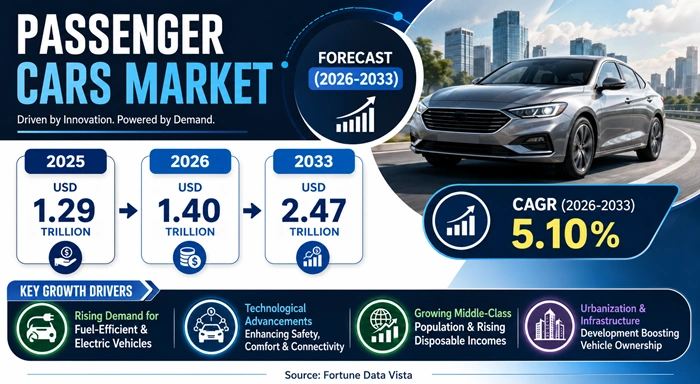
The global passenger cars market size is valued at USD 1.29 trillion in 2025 and is predicted to increase from USD 1.40 trillion in 2026 to approximately USD 2.47 trillion by 2033, growing at a CAGR of 5.10% from 2026 to 2033. This significant growth is propelled by rising global vehicle ownership, rapid electrification of the automotive industry, growing middle-class populations in emerging economies, and escalating consumer preference for advanced, technology-integrated vehicles. The passenger cars industry is undergoing its most profound transformation in a century — driven simultaneously by sustainability mandates, connectivity, and the accelerating global transition to zero-emission mobility.
AI Impact on the Passenger Cars Industry
Artificial Intelligence Is Fundamentally Redefining the Passenger Car — From How It Is Designed and Built to How It Drives, Learns, and Communicates with Its Owner*
Artificial intelligence is changing the passenger cars industry at a structural level, touching everything from design optimization and factory automation to the intelligence embedded inside the vehicles themselves. Automakers are deploying AI-powered generative design tools that evaluate thousands of structural configurations simultaneously to identify optimal combinations of weight, strength, aerodynamics, and manufacturing cost — a process that would take human engineers years to replicate manually. On the production floor, AI-driven robotic assembly, quality inspection, and predictive maintenance systems are reducing downtime, lowering defect rates, and enabling more flexible manufacturing lines capable of building multiple models simultaneously. Leading manufacturers including Toyota, Volkswagen, and Hyundai are investing billions in AI-integrated smart factory initiatives that are expected to significantly reduce time-to-market for new models.
Inside the vehicle itself, AI is the engine behind the rapidly advancing wave of connected and autonomous features that consumers are increasingly demanding. Advanced driver assistance systems (ADAS) powered by machine learning models now process sensor fusion data from cameras, radar, lidar, and ultrasonic devices in real time — enabling lane centering, adaptive cruise control, automatic emergency braking, and parking assistance across a growing range of passenger car segments. Generative AI is also being integrated into in-car virtual assistants, enabling natural language vehicle control, predictive navigation, and personalized cabin environment management. Tesla's Full Self-Driving (FSD) platform, Mercedes-Benz Drive Pilot Level 3 system, and Waymo's commercial robotaxi deployments are collectively demonstrating how AI is progressing from driver assistance to genuine conditional vehicle autonomy — a capability that is expected to become commercially mainstream in the passenger cars market within the next decade.
Growth Factors
Rising Urbanization, Income Growth in Emerging Markets, and the Global EV Revolution Are the Three Primary Engines Powering the Passenger Cars Market Forward Through 2033*
The most fundamental long-term driver of the passenger cars market is the expanding global middle class, particularly in rapidly urbanizing developing economies. As per capita income rises across Asia Pacific, Latin America, and Africa, consumers gain the financial means to purchase their first private vehicle — a transition that has historically been one of the most powerful and reliable growth engines in automotive history. In India, passenger vehicle sales grew by over 8% year-on-year in early 2023, and the country's expanding road network, rising income levels, and government "Make in India" manufacturing incentives are creating a multi-decade demand runway for passenger cars. China, despite its market maturity, continues to generate enormous volume through EV transitions and first-time rural buyers.
The global shift toward electric vehicles is emerging as an equally powerful — and transformative — growth engine. Government mandates, consumer awareness, and rapidly falling battery costs are all driving EV adoption at scale. Canada has committed to requiring 20% of all new passenger car sales to be zero-emission by 2026 and 100% by 2035. The EU's stringent CO₂ emission regulations are compelling major European automakers including Volkswagen, BMW, and Mercedes-Benz to rapidly expand their electric model lineups. In China — currently the world's largest EV market — EV penetration of new passenger car sales exceeded 40% in 2024. The convergence of government policy, falling battery costs, expanding charging infrastructure, and growing consumer confidence is turning the global EV transition from a niche phenomenon into a mainstream market reality that is structurally reshaping the passenger cars industry.
Market Outlook
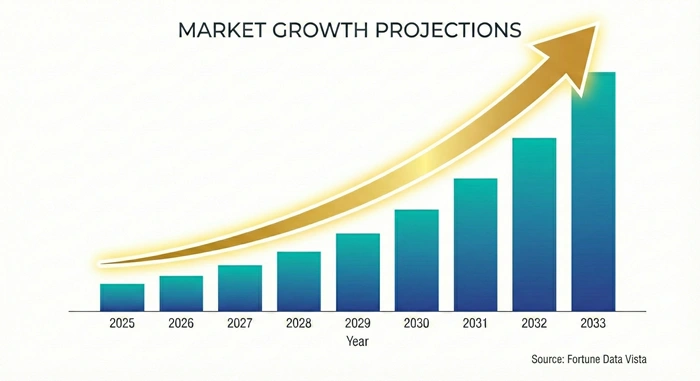
The Passenger Cars Market Is on Course for a Decade-Long Growth Cycle Driven by Electrification, Software-Defined Vehicle Architectures, and Emerging Market Volume Growth*
The long-term outlook for the passenger cars market is one of sustained, structurally supported growth, anchored by the twin pillars of electrification and digital transformation. Software-defined vehicle (SDV) architecture — in which the car's core functions are managed through centralized computing platforms and updated via over-the-air (OTA) software downloads — is becoming the dominant design philosophy at leading automakers including Tesla, Volkswagen, and Hyundai. This shift not only reduces manufacturing complexity by centralizing electronic control but also enables continuous post-sale improvement, creating recurring revenue streams from software subscriptions, in-car services, and feature unlocks that fundamentally change the passenger car business model from a one-time transaction to an ongoing relationship.
The market's geographic center of gravity is also shifting. Asia Pacific — already the world's largest regional market in unit volume — is expected to maintain or extend its lead through 2033, driven by China's EV transition, India's volume growth, and Southeast Asia's rapidly expanding urban middle class. Meanwhile, structural disruptions including semiconductor supply chain improvements post-2023, falling EV battery costs, and government infrastructure investments in both developing and developed markets are removing longstanding adoption barriers. The overall trajectory of the passenger cars market points toward an environment of healthy volume growth, significant mix improvement toward higher-value EVs and SUVs, and a wave of product and technology innovation that will make 2026–2033 one of the most dynamically competitive periods in automotive history.
Expert Speaks
-
"We are accelerating our electrification roadmap because consumer demand for EVs is outpacing our earlier projections — our goal of making Toyota carbon neutral by 2050 is not just an environmental commitment, it is a commercial necessity that will define our competitive position for the next generation." — CEO, Toyota Motor Corporation
-
"Volkswagen's transformation is about more than building electric cars — it is about becoming a fully software-defined mobility company, and the investments we are making in operating systems, in-car AI, and battery technology today will determine our market position through the 2030s." — CEO, Volkswagen Group
-
"At GM, we believe we are in the early innings of what will be a sustained multi-decade shift in how people buy, experience, and relate to their passenger vehicles — and our EV and autonomous vehicle platforms give us the foundation to lead that shift commercially." — CEO, General Motors
Key Report Takeaways
-
Asia Pacific dominates the global passenger cars market in unit volume, accounting for approximately 62.1% of total global passenger car production in 2025, driven by China's enormous domestic market and manufacturing scale, Japan's established automotive export economy, and India's rapidly growing domestic demand base
-
North America leads in revenue terms with the largest regional revenue share, supported by strong consumer purchasing power, high average transaction prices for premium and electric vehicles, and the rapid expansion of EV models from both legacy automakers and Tesla
-
Asia Pacific is also the fastest-growing region by CAGR through 2033, with India leading in growth rate and China driving overall volume, supported by government electrification policies, domestic EV champions like BYD, and strong consumer appetite for technology-integrated vehicles
-
The electric fuel type segment is the fastest-growing and is projected to dominate the passenger cars market from 2026 to 2033, driven by tightening global emission regulations, rapidly falling battery costs, expanding EV charging networks, and the launch of affordable EV models in sub-USD 30000 price bands by major global OEMs
-
The compact-SUV vehicle type segment holds the dominant share of approximately 45% of new vehicle sales globally, driven by consumer preference for higher ground clearance, spacious interiors, and the growing availability of electric and hybrid compact-SUV models at competitive price points
-
OEM dealer networks remain the leading sales channel globally, but online and direct-to-consumer platforms are the fastest-growing distribution model, with Tesla's direct sales model inspiring legacy OEMs to explore hybrid direct/dealer approaches that reduce retail costs and improve customer experience
-
The sedan segment is experiencing structural decline in mature markets like the U.S. and Europe as consumers shift toward SUVs and crossovers, but sedans are maintaining resilience in China and India — where they represent aspirational premium choices for first-time buyers upgrading from smaller hatchbacks
Market Scope
| Parameter | Details |
|---|---|
| Market Size by 2033 | USD 2.47 Trillion | Market Size by 2026 | USD 1.40 Trillion | Market Size by 2025 | USD 1.29 Trillion | Market Growth Rate from 2026 to 2033 | CAGR of 5.10% | Dominating Region | North America (Revenue); Asia Pacific (Volume) | Fastest Growing Region | Asia Pacific | Segments Covered | Fuel Type, Vehicle Type, Propulsion, Sales Channel, Region | Regions Covered | North America, Europe, Asia Pacific, Latin America, Middle East & Africa |
Market Dynamics
Drivers Impact Analysis
Global EV Adoption, Rising Disposable Income in Emerging Economies, and Supportive Government Policies Are the Three Pillars Underpinning Consistent Growth in the Passenger Cars Market*
| Driver | ≈ % Impact on CAGR Forecast | Geographic Relevance | Impact Timeline |
|---|---|---|---|
| Rapid EV adoption driven by mandates and falling battery costs | ~38% | Global, especially China, EU, North America | Near to long-term |
| Rising per capita income and middle-class growth in emerging markets | ~30% | India, Southeast Asia, Latin America | Near to mid-term |
| Government subsidies, EV incentives, and clean vehicle mandates | ~20% | Global | Near to long-term |
| Expansion of road infrastructure in developing countries | ~12% | India, Africa, Southeast Asia | Mid to long-term |
The electric vehicle transition is the most powerful near-term driver shaping the passenger cars market. Global EV sales surpassed 16.7 million units in 2024, and this figure is expected to grow significantly as new affordable EV models enter the sub-USD 25000 price segment across all major markets. China accounts for over 60% of global EV production, and its domestic champions including BYD, SAIC, and Geely are aggressively expanding into European and emerging market export lanes. The parallel investment in public charging infrastructure — with over 4.8 million public charging points installed globally as of 2024 — is addressing range anxiety and making EV ownership increasingly viable for mainstream consumers beyond early adopters.
Government policy is acting as a powerful accelerant to these market forces. The EU's legally binding target to end the sale of new petrol and diesel passenger cars by 2035 is forcing European automakers to invest tens of billions in electric platforms and battery manufacturing. U.S. federal EV tax credits of up to USD 7500 under the Inflation Reduction Act are stimulating consumer demand and incentivizing domestic EV production. India's FAME II scheme and PLI programs are catalyzing local EV manufacturing investment, while China's NEV mandate continues to push OEMs toward electric model launches at every price point. This coordinated global policy push — combined with natural consumer preference trends toward cleaner, smarter vehicles — creates a structural and durable demand foundation for the passenger cars market through 2033.
Restraints Impact Analysis
High EV Purchase Prices, Infrastructure Gaps in Emerging Markets, and Semiconductor Supply Chain Vulnerabilities Remain the Most Significant Structural Barriers in the Passenger Cars Market*
| Restraint | ≈ % Impact on CAGR Forecast | Geographic Relevance | Impact Timeline |
|---|---|---|---|
| High upfront cost of electric passenger cars | ~40% | Developing markets, price-sensitive segments | Near to mid-term |
| Inadequate EV charging infrastructure in emerging markets | ~32% | India, Southeast Asia, Africa, Latin America | Near to long-term |
| Semiconductor supply chain concentration and disruption risk | ~28% | Global | Near to mid-term |
Despite the strength of the EV transition, the high upfront purchase price of battery electric passenger cars remains a significant barrier to mass-market adoption, particularly in price-sensitive markets. The average EV transaction price in the U.S. was approximately USD 53000 in 2024 — nearly 30% higher than the average internal combustion engine vehicle — making EV ownership inaccessible to a substantial portion of potential buyers without subsidies or financing incentives. In emerging markets like India and most of Africa, where per capita income remains comparatively low, EV adoption faces an even steeper affordability barrier that is likely to persist well into the 2030s without significant cost reductions or strong government intervention.
Semiconductor supply chain risks also remain a relevant restraint in the passenger cars market. The COVID-19 pandemic exposed the automotive industry's deep dependence on a small number of chip manufacturers concentrated in Taiwan and South Korea. While the industry has made significant progress in diversifying supply through long-term contracts and new fab investments since 2021, the concentration of advanced node fabrication remains a structural vulnerability. Any geopolitical disruption, natural disaster, or demand shock in the semiconductor sector can cascade quickly into production shutdowns at major passenger car assembly plants — as demonstrated by the significant volume shortfalls recorded by most OEMs in 2021 and 2022. Ongoing investment in domestic semiconductor manufacturing in the U.S., EU, and Japan is gradually reducing but not yet eliminating this risk.
Opportunities Impact Analysis
Affordable EV Expansion, the Software-Defined Vehicle Ecosystem, and Emerging Market Volume Growth Represent the Three Most Transformative Opportunities in the Passenger Cars Market*
| Opportunity | ≈ % Impact on CAGR Forecast | Geographic Relevance | Impact Timeline |
|---|---|---|---|
| Sub-USD 25000 affordable EV models for mass market | ~40% | China, India, EU, Latin America | Near to mid-term |
| Software-defined vehicles and OTA subscription revenue | ~35% | North America, EU, China | Mid to long-term |
| Volume growth from first-time buyers in emerging markets | ~25% | India, Southeast Asia, Africa | Mid to long-term |
The development and launch of genuinely affordable electric passenger cars in the sub-USD 25000 price range represents the single most commercially significant near-term opportunity in the global passenger cars market. BYD's Seagull — priced at approximately USD 10000 in China — and Volkswagen's planned entry-level EV platform aimed at European mass-market consumers demonstrate that affordable EV manufacturing is technically and commercially feasible. If leading OEMs can replicate this pricing in global markets through battery cost reduction, manufacturing scale, and platform sharing strategies, the EV adoption curve could accelerate sharply beyond current consensus forecasts.
The software-defined vehicle (SDV) model represents a transformative long-term opportunity to reshape automotive revenue streams. As vehicles become increasingly software-driven, OEMs have the opportunity to generate recurring revenue from OTA software updates, premium feature subscriptions, in-car entertainment platforms, and data monetization services. Tesla has demonstrated the commercial viability of this model — its FSD subscription, premium connectivity services, and over-the-air performance upgrades collectively generate hundreds of dollars per vehicle per year. Legacy OEMs including Volkswagen, BMW, GM, and Ford are all investing heavily in centralized vehicle computing platforms that will enable them to pursue similar software revenue strategies — fundamentally changing the economics of the passenger cars market over the forecast period.
Segment Analysis
By Fuel Type
Electric Vehicles Are Rapidly Becoming the Dominant Fuel Type in the Passenger Cars Market, While Hybrid Technology Bridges the Transition Across Multiple Global Regions*
The electric fuel type segment has emerged as the fastest-growing and — increasingly — the dominant category within the passenger cars market, reflecting the combined force of government mandates, consumer preference shifts, and rapidly maturing battery technology. In 2024, EV penetration of new passenger car registrations exceeded 40% in China, 20% in several European countries, and was growing at a double-digit pace in the U.S. and India. The electric segment is projected to achieve a CAGR significantly above the overall market average through 2033, with battery pack costs now below USD 100/kWh for leading manufacturers — a threshold widely considered the parity point with ICE vehicle economics. Asia Pacific is the world's leading region for electric passenger car adoption, anchored by China's enormous EV manufacturing capacity and domestic consumption, while companies such as BYD, Tesla, SAIC, and Hyundai are the primary competitive forces driving volume and model diversity. The development of solid-state batteries — expected to enter limited commercial production by 2027–2028 — promises to further improve EV range, charging speed, and safety, potentially accelerating adoption beyond current trajectory.
The hybrid fuel type segment occupies a critical strategic position in the passenger cars market, serving as the practical transition pathway for consumers, markets, and regions where full EV adoption is constrained by charging infrastructure gaps or affordability barriers. Hybrid vehicles — both mild hybrids and plug-in hybrid electric vehicles (PHEVs) — offer meaningful fuel economy and emissions improvements over conventional ICE vehicles without requiring access to public charging infrastructure. Japan's Toyota remains the world's dominant hybrid vehicle manufacturer, having sold over 20 million hybrid units globally by 2024, and its new hybrid models including the Prius PHEV and Yaris Hybrid continue to command strong demand across Europe, Asia, and Latin America. Europe is the leading regional market for PHEV adoption, where government incentives and corporate fleet electrification mandates are driving strong volumes. The hybrid segment is expected to maintain solid growth through the early 2030s before gradually declining in market share as full battery electric vehicles become cost-competitive at all price points in the passenger cars market.
By Vehicle Type
Compact-SUVs Command the Dominant Market Share in the Passenger Cars Market, While Electric SUVs Represent the Most Exciting Product Category for Future Growth*
The compact-SUV vehicle type segment holds the dominant position in the passenger cars market with approximately 45% of global new vehicle sales in 2024, reflecting a profound and sustained structural shift in consumer preferences away from sedans and hatchbacks toward higher-riding, more versatile, and more spacious crossover formats. The compact-SUV's combination of car-like ride quality, SUV-like ground clearance, generous interior space, and strong all-weather capability has made it the universal choice across both developed and emerging markets. North America is the leading regional market for compact-SUV sales in value terms, where models including the Toyota RAV4, Honda CR-V, Ford Escape, Hyundai Tucson, and Chevrolet Equinox command enormous volumes and high transaction prices. The growing availability of hybrid and battery electric compact-SUV variants — from the Hyundai Kona Electric to the Tesla Model Y — is extending the segment's appeal into the rapidly growing EV buyer cohort and sustaining its structural dominance.
The SUV segment — encompassing both mid-size and full-size sport utility vehicles — represents one of the passenger cars market's highest average revenue per unit categories, and its growth trajectory through 2033 is supported by strong demand in premium, luxury, and electric sub-segments. Global SUV sales grew by over 10% between 2020 and 2021 alone, accounting for more than 45% of all new vehicle sales globally, and this momentum has continued. Premium electric SUVs including the Tesla Model X, BMW iX, Mercedes EQS SUV, and Audi e-tron GT are capturing a growing share of the high-value end of the market, while Chinese OEMs including BYD and Li Auto are disrupting the mid-range SUV segment with competitive electric platforms at lower price points. Asia Pacific is the fastest-growing regional market for SUVs within the passenger cars market, driven primarily by China and India, where rising incomes, expanding road infrastructure, and a cultural preference for large, status-signaling vehicles are sustaining above-average volume growth.
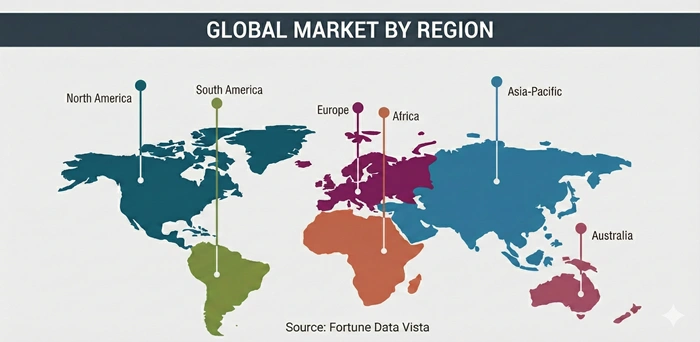
Regional Insights
Asia Pacific — The Volume Leader in the Global Passenger Cars Market
Asia Pacific's Combination of Manufacturing Scale, EV Transition Leadership, and Enormous Consumer Population Makes It the World's Most Important Passenger Cars Market*
Asia Pacific dominates the global passenger cars market in production volume terms, accounting for approximately 62.1% of total global passenger car output in 2025, with China, Japan, South Korea, and India collectively forming the world's most powerful automotive manufacturing cluster. China alone is the world's largest single national passenger car market by volume and the global epicenter of the electric vehicle transition, with EV penetration of new car sales exceeding 40% in 2024 and growing rapidly. The region is also the fastest-growing market by CAGR through 2033, driven by India's extraordinary volume growth — India surpassed Japan to become the world's third-largest passenger car market in 2023 — and by Southeast Asia's expanding consumer base. Key players dominating Asia Pacific include Toyota Motor Corporation (Japan), Hyundai Motor Group (South Korea), BYD Co. Ltd. (China), SAIC Motor (China), Maruti Suzuki India Limited (India), and Tata Motors (India).
China's transition to new energy vehicles is the defining story in the Asia Pacific passenger cars market. Domestic EV champions including BYD, Li Auto, NIO, and Xpeng are aggressively competing with global OEMs, and Chinese automakers are increasingly exporting competitively priced EV models to Europe, Southeast Asia, and Latin America. India's passenger car market is on a multi-decade growth trajectory, supported by rising incomes, road infrastructure expansion, government EV incentives under the FAME II scheme, and a manufacturing base that is being expanded by both domestic and global OEMs under the PLI scheme. Japan remains a critical market for premium hybrid vehicles, where Toyota and Honda continue to generate significant export volume, while South Korea's Hyundai and Kia are emerging as global EV leaders with ambitious electrification roadmaps and competitive product launches across all vehicle type segments.
North America — The Revenue-Dominant Region in the Global Passenger Cars Market
North America's High Average Transaction Values, Strong EV Infrastructure Investment, and Consumer Preference for Premium Vehicles Position It as the Most Commercially Valuable Passenger Cars Market*
North America holds the leading position in the global passenger cars market in revenue terms, supported by the United States' exceptionally high average vehicle transaction prices — which averaged approximately USD 48000 in 2025 — its strong consumer purchasing power, and its rapid adoption of premium, electric, and technology-advanced passenger cars. The U.S. federal EV tax credit of up to USD 7500 under the Inflation Reduction Act, combined with state-level mandates in California and 17 other states requiring increasing proportions of zero-emission vehicle sales, is driving accelerating EV adoption across the market. North America is projected to maintain a healthy CAGR through 2033, supported by ongoing product launches from leading OEMs and a robust network of dealerships and charging infrastructure. Key players driving North America's market leadership include Tesla Inc., General Motors, Ford Motor Company, Toyota Motor North America, Hyundai Motor America, and Stellantis.
Canada and Mexico are meaningful contributors to North America's overall passenger cars market strength. Canada's growing population — expanding at almost double the pace of other G7 nations through immigration — is creating new household formations and automotive demand, while Mexico's established automotive manufacturing hub status makes it a critical production base for vehicles distributed across North America. The U.S. market's strength in premium and luxury passenger cars is being reinforced by a new wave of American-designed and manufactured EVs from Tesla, GM's Ultium platform, and Ford's Mustang Mach-E and F-150 Lightning — vehicles that are simultaneously commanding premium prices and challenging imported models for market share. The long-term structural health of the North American passenger cars market is strongly positive, underpinned by favorable demographics, consumer spending power, policy support, and the ongoing technological transformation of the vehicle lineup.
Top Key Players
-
Toyota Motor Corporation (Japan)
-
Volkswagen AG (Germany)
-
Hyundai Motor Group (South Korea)
-
General Motors Company (United States)
-
Ford Motor Company (United States)
-
Stellantis N.V. (Netherlands)
-
Tesla Inc. (United States)
-
BYD Co. Ltd. (China)
-
Honda Motor Co., Ltd. (Japan)
-
Mercedes-Benz Group AG (Germany)
-
BMW Group (Germany)
-
Renault S.A. (France)
-
Nissan Motor Co., Ltd. (Japan)
-
Tata Motors Limited (India)
-
Maruti Suzuki India Limited (India)
-
SAIC Motor Corporation Limited (China)
-
Kia Corporation (South Korea)
Recent Developments
-
In October 2024, Hyundai Motor Group announced a USD 21 billion investment commitment in the United States through 2030, covering EV manufacturing, battery production, and steel supply chain development — one of the largest single automotive investment pledges in the U.S. in recent years, supporting both domestic production growth and geopolitical resilience in the passenger car supply chain.
-
In September 2024, Volkswagen AG launched its new Volkswagen Cariad software subsidiary's next-generation vehicle OS platform, designed to underpin a new range of software-defined passenger cars from 2026 onward — a critical investment in ensuring Volkswagen's long-term competitiveness in the digital and autonomous driving era.
-
In early 2025, Tesla Inc. announced positive updates on the development of its next-generation lower-cost passenger car platform targeting a starting price of approximately USD 25000, a milestone that analysts widely expect to significantly accelerate EV mass-market adoption and reinforce Tesla's volume leadership in the global passenger cars market.
-
In January 2025, Hyundai confirmed the commercial launch of the Creta EV in India, one of the most significant electric passenger car launches in the Indian market — directly competing with Mahindra XUV 400, Tata Curvv EV, and MG ZS EV, and marking Hyundai's commitment to capturing a leading share of India's rapidly growing EV passenger car segment.
-
In March 2024, Stellantis announced a EUR 5.6 billion investment commitment in Latin America — the largest single automotive industry investment in the region — reflecting growing strategic importance of Brazil, Argentina, and Mexico as passenger car production and consumption markets within the global automotive value chain.
Market Trends
The Passenger Cars Market Is Being Reshaped by the Convergence of Electrification, Connectivity, and Software-Defined Vehicle Technology — Creating Both New Leaders and Existential Challenges for Traditional Automakers*
The dominant trend reshaping the passenger cars market is the simultaneous transition to electric powertrains and software-defined vehicle architectures. These two shifts are deeply interconnected — EVs are inherently more software-dependent than ICE vehicles because their propulsion, energy management, thermal control, and user interface systems are all primarily electronic. This makes the EV transition not just a powertrain change but a fundamental reorganization of how passenger cars are designed, manufactured, and monetized. OEMs that can master this transition — building vehicles on centralized computing architectures, delivering frequent OTA updates, and generating post-sale software revenues — will be structurally advantaged over those still locked into traditional mechanical complexity paradigms.
A second defining trend is the rise of compact-SUVs and crossovers as the universally dominant vehicle type across essentially all major global markets. The structural shift away from sedans — which were once the volume backbone of the passenger cars market — toward higher-riding, more versatile SUV formats is now permanent and deeply embedded in consumer preference. This trend is driving significant implications for manufacturing strategy, platform design, and supply chain configuration, as automakers pivot investments toward SUV-optimized platforms and electrify their most popular crossover models first. The growing overlap between SUV popularity and EV adoption — most notably embodied by the Tesla Model Y, now the world's best-selling passenger car — suggests that the next decade of the passenger cars market will be defined by electric SUVs commanding both volume and revenue leadership globally.
Segments Covered in the Report
-
By Fuel Type
-
Petrol
-
Diesel
-
Hybrid Electric Vehicle (HEV)
-
Plug-in Hybrid Electric Vehicle (PHEV)
-
Battery Electric Vehicle (BEV)
-
Hydrogen Fuel Cell Electric Vehicle (FCEV)
-
-
By Vehicle Type
-
Hatchback
-
Sedan
-
Compact-SUV
-
SUV (Mid-Size & Full-Size)
-
Sports Car
-
Minivan
-
-
By Propulsion
-
Internal Combustion Engine (ICE)
-
Battery Electric Vehicle
-
Plug-in Hybrid Electric Vehicle
-
Hybrid Electric Vehicle
-
Fuel Cell Electric Vehicle
-
-
By Sales Channel
-
OEM Dealer Networks
-
Fleet & Leasing Companies
-
Online & Direct-to-Consumer Platforms
-
-
By Region
-
North America
-
U.S.
-
Canada
-
Mexico
-
-
Europe
-
Germany
-
France
-
UK
-
Italy
-
Spain
-
Netherlands
-
Rest of Europe
-
-
Asia Pacific
-
China
-
India
-
Japan
-
South Korea
-
Australia
-
Rest of Asia Pacific
-
-
Latin America
-
Brazil
-
Argentina
-
Mexico
-
Rest of Latin America
-
-
Middle East & Africa
-
UAE
-
Saudi Arabia
-
South Africa
-
Rest of Middle East & Africa
-
-
"Built for Every Level — From Startups to Industry Giants"
Here Is Exactly How This Report Works for You
-
Whether you are an EV startup entering the passenger cars market, a Tier 2 auto parts supplier evaluating platform-shift risks, or a Tier 1 global OEM benchmarking competitors' electrification roadmaps — this report delivers granular segment-level revenue forecasts, regional CAGR breakdowns, and company-level market share analysis that support faster, more confident investment and product strategy decisions; the complete purchased version includes full competitor revenue analysis, product portfolio benchmarking, and OEM-level EV transition progress tracking.
-
Supply and demand dynamics across the global passenger car value chain — from battery raw material sourcing and semiconductor procurement through assembly, dealer distribution, and consumer financing — are analyzed in depth, giving commercial, procurement, and supply chain executives the intelligence needed to anticipate bottlenecks, optimize sourcing strategies, and respond proactively to geopolitical disruptions affecting production volumes and margins.
-
For investors, automaker executives, and strategy leaders navigating the intersection of EV policy shifts, tariff and trade risks, geopolitical dynamics in key manufacturing hubs including China and Taiwan, and rapid technology disruption from new entrants — this report provides the actionable competitive intelligence and scenario analysis needed to make high-stakes decisions about capital allocation, market entry, partnership strategy, and product portfolio prioritization in the passenger cars market with clarity and conviction.
Frequently Asked Questions:
Answer: The global passenger cars market is valued at USD 1.29 trillion in 2025 and is projected to grow from USD 1.40 trillion in 2026 to approximately USD 2.47 trillion by 2033, at a CAGR of 5.10%. This growth is supported by rising EV adoption, increasing vehicle ownership in emerging markets, and strong demand for connected and autonomous passenger vehicles.
Answer: Asia Pacific leads the passenger cars market in production volume with approximately 62.1% of global output, while North America leads in revenue terms due to high average transaction prices and strong consumer spending. Asia Pacific is also the fastest-growing region through 2033, driven by India's volume growth and China's EV transition.
Answer: The growth of electric vehicles in the passenger cars market is driven by government mandates, rapidly falling battery costs, expanding public charging infrastructure, and growing consumer awareness of EV total cost of ownership advantages. Incentive programs such as the U.S. Inflation Reduction Act EV tax credit and EU emission standards are further accelerating the shift toward zero-emission passenger cars.
Answer: Compact-SUVs hold the dominant vehicle type position in the passenger cars market with approximately 45% of global new vehicle sales, driven by consumer preference for versatility, space, and ground clearance across all global markets. The rapid electrification of compact-SUVs is further strengthening this segment's lead as EV buyer demand aligns with the SUV format.
Answer: The leading companies in the passenger cars market include Toyota Motor Corporation, Volkswagen AG, Hyundai Motor Group, General Motors, Tesla Inc., BYD Co. Ltd., Ford Motor Company, and Stellantis, among others. These companies are competing intensely on EV platform development, software integration, battery technology, and global market expansion strategies.